Showing posts with label roll yield. Show all posts

Monday, April 4, 2022

VIX ETPs – What Can Go Wrong?

For many years, I’ve had a tagline at the bottom of my email: “In volatility there is opportunity!”  The tagline is a reminder that when things look darkest in the financial markets, this is often an area of maximum opportunity.

On the other hand, the VIX ETPs have quite a few quirks and as a result of these quirks and their high volatility, there are considerable risks for both longs and shorts.  How much risk?  Quite a lot.  Consider that on a split-adjusted basis, the +2x long TVIX launched at 2.66 billion (not a typo!) and trades anywhere from less than a dollar (the TVIX.IV indicative value) to 2.45 TVIXF (on the pink sheets), depending upon how you wish to measure the magnitude of the bloodbath.  On the other side of the coin, the -1x short XIV fell 93% on one day back in the February 2018 volatility spike now known as Volmageddon that resulted in an acceleration event (triggered when the price of XIV fell by more than 80% on a single day) and the closing of XIV.

From the 30,000-foot perspective, the big risk in being short volatility is that a big one-day VIX spike can theoretically destroy the value of your entire position.  On the other hand, the big risk in being long volatility is that you die a death by a thousand cuts and suffer the same 85% per year compound annual decline experienced by a product like TVIX.

There are many individual risk factors that are responsible for the total risk of an individual VIX ETP.  I have spelled out a number of these in the past, spending considerable time on contango and negative roll yield.  Way back in May 2009, I summarized some of my thinking in the likes of VXX Calculations, VIX Futures and Time Decay and elaborated on some of those themes in October 2009 in Why VXX Is Not a Good Short-Term or Long-Term Play.  I also addressed the subject of how reverse splits are the only thing keeping some of these products from falling to zero in Will TVIX Go to Zero? in February 2012.  In that post, I highlighted this gem from the TVIX prospectus:

“The long term expected value of your ETNs is zero. If you hold your ETNs as a long-term investment, it is likely that you will lose all or a substantial portion of your investment.”

One of my better summaries of the factors putting downward pressure on the price of TVIX came in Four Key Drivers of the Price of TVIX in 2012.  Here is the meat of that post:

1.  Volatility – this seems obvious, but in the short-term, the movements of the front month and second month VIX futures explain almost all of the change in the price of TVIX. For day traders, TVIX becomes essentially a substitute for trading the VIX futures and with the exception of leverage, the other factors below are inconsequential.

2.  Leverage – another obvious factor, the 2x leverage in TVIX means that on average it moves about as quickly up and down in percentage terms as the VIX does and twice as quickly as a basket of front month and second month VIX futures. In the short-term, leverage means mostly that the moves in the underlying are exaggerated; in the long-term, leverage enhances volatility compounding and has a negative impact on price.

3.  Contango – thanks to the emergence of VIX ETPs as the cornerstone of volatility as an asset class, issues related to the VIX futures term structure in general and contango and negative roll yield in particular have become among the most frequently discussed issues in this space. Simply stated, the front month and second months of VIX futures are in contango more than 75% of the time, with the result being a monthly drag on TVIX’s price that exceeds the current annual yield on the 30-Year U.S. Treasury bond.

4.  Volatility compounding – the more volatility a leveraged security exhibits, the more that volatility will have a negative impact on performance over an extended period. The issue is the same as someone who owns a dress shop and marks the dress down 50% and then up 50% or reverses the chronology and marks the dress up 50% and then down 50%. Either way, the value of that dress declines by 25%. The same is true for leveraged ETPs and the degree of the price decay is a direct function of volatility.

While the number of VIX ETNs is dwindling, ETNs have their own set of issues, as these are debt securities – essentially a promise to pay the value of the underlying index – rather than a portfolio of VIX futures, as is the case with VIX ETFs.  We have seen issues related to VIX ETNs come to the fore with TVIX in 2012 when Credit Suisse suspended new creation units in TVIX only to resume new creation units a little more than a month later – roiling the supply and demand dynamics as well as the TVIX market price in both directions.  Last month something similar happened with Barclays and VXX when Barclays suspended new creation units in this product.  There are issues related to ETNs that are unique to these types of securities and include credit risk, counterparty risk, price risk relative to indicative value, etc.  The SEC summarizes some of these ETN-specific risks in this investor bulletin.

If you want to better understand some of the risk factors involved in these products, I highly recommend you review the prospectuses of some of the following ETNs and ETFs:

I am often asked if these products were designed to go to zero.  No, they were not designed to go to zero.  The original intent was that these products would be short-term hedging or speculative instruments for institutions.  They do, however, have structural flaws that begin to appear as soon as these products are held for more than one day.  Over time, these structural flaws compound and will dominate the price action.

For all the reasons state above, I urge anyone considering trading VIX ETPs to review all relevant prospectuses and make a concerted effort to educate yourself on the products, their price histories and the reasons behind those price movements.  For those who insist on trading these products, it is always safest to consider defined risk trades so that the maximum loss is known in advance.  This may be a long position, a long or short position with an options hedge, or an options position such as a vertical spread that is a defined risk trade.

In the graphic below, I show the lifetime history of TVIX/TVIXF in black and TVIX.IV in red (it was the same as TVIX until it was delisted in July 2020).  Note that the Y-axis is on a log scale so that the data captures the relatively constant percentage declines, rather than the precipitous drop in price.  For fun, try to pick out any major spike in volatility on this chart other than the pandemic.

[source(s):  Yahoo, VIX and More]

Further Reading:
VXX Upside vs. Downside Risk with No New Creation Units
Barclays Suspends Creation Units for VXX
Four Key Drivers of the Price of TVIX
Will TVIX Go to Zero?
TVIX Creation Units Return; What It Means for Investors
Credit Suisse Suspends Creation Units in TVIX: What it Means
Why VXX Is Not a Good Short-Term or Long-Term Play
VXX Calculations, VIX Futures and Time Decay
Using Options to Control Risk in Leveraged ETFs

For those who may be interested, you can always follow me on Twitter at @VIXandMore

Disclosure(s): net short VXX and UVXY, long SVIX at time of writing

Tuesday, March 22, 2022

VXX Upside vs. Downside Risk with No New Creation Units

One week ago, Barclays announced the suspension of issuance of new creation units as well as sales from inventory for two of its ETNs: the iPath Series B S&P 500 VIX Short-Term Futures ETN (VXX); and the iPath Pure Beta Crude Oil ETN (OIL). 

The purpose of this post is to explain the risks for both long and short holders of VXX and to get a sense of how this story is likely to play out.

First of all, the announcement came before regular trading hours on March 14th and during the entire session, VXX traded at a premium of up to 3.28 points relative to its intraday indicative value (IV), as captured in a graphic in Barclays Suspends Creation Units for VXX.  By the end of the day, VXX was trading at a 1.73 point premium to indicative value -- which is what VXX would be trading at if new creation units were still enabled.

It wasn’t until March 15th that the fireworks begin.  That morning, VXX opened up another 2.08 points at 30.89, up 6.7% from the previous day’s close.  Right from the open there was some intense buying pressure that resulted in a short squeeze, with VXX briefly spiking as high as 41.65, up 44.6% from the previous day’s close.  That short squeeze was retraced over the course of the day and by the end of the session, VXX was down 0.11 on the day.  The action during the last five days has been relatively uneventful, though the volume in VXX has dropped approximately 90% from a pre-suspension average of about 50 million shares per day to less than 5 million today.  As of today’s close, VXX was at 25.44, some 3.93 points (15.4%) over indicative value.

The chart below captures the journey of VXX relative to indicative value (VXX.IV) in the seven days going back to the original announcement of the suspension of new creation units.  Note that for the last week, the VXX premium relative to VXX.IV has been in a range between 1.50 and 5.00, with that early short squeeze premium of 15.11 now firmly in the rear-view mirror.  At various times it appeared that traders had settled on 3.50 or 4.00 as an appropriate amount of premium for VXX in the absence of new creation units that could be used to arbitrage the price of VXX back down to VXX.IV.

The big questions are what to expect going forward and what are the risks to both long and short holders of VXX.  At the risk of stating the obvious, nobody outside of Barclays knows what will happen going forward, but Barclays described their move as a temporary suspension of creation units.  With VXX having assets of $729 million and a fee of 0.89% per year, Barclays has an incentive to find a solution for the creation units problem – and whatever is behind it – so that they can collect their $6.5 million annual fee from this product.  Credit Suisse was able to resolve a similar problem with the suspension TVIX new creation units in a month and a day back in 2012.  Barclays and VXX have been at this game longer than anyone else, with an initial launch of VXX back on January 30, 2009.  They have had 13 years to prepare for the present situation, which is likely a least partly related to hedging risks and costs associated with how Vladimir Putin proceeds with the invasion of Ukraine.  I expect they will find a solution to the new creation units problem in relatively short order, but I have no insight into whether this will be a matter of days or weeks.

Going forward, both longs and shorts have to expect that Barclays will bring VXX creation units back and when they do, the VXX premium relative to VXX.IV is likely to disappear almost instantly.  Truth be told, when Credit Suisse brought back creation units in TVIX back in 2012, it took two days for most of the indicative value premium to be wiped out, but those days were excruciating losses of 29.3% and 29.8% that left investors reeling and confused.  This time around the premium at risk of another new creation units air pocket is “only” 15.4% -- but there is very little to prevent this number from growing much larger.

This brings us to the other side of the equation.  How much higher can a short squeeze take VXX?  While 90% of the daily volume in VXX has evaporated in the past seven days, the current 5 million shares per day will likely have to shrink considerably more before a short squeeze has much in the way of potential staying power.  The DGAZ story from 2020 is a stark reminder that not only is it theoretically possible to see a spike of 12,000%, but such a spike has recently happened.  The problem for longs is that in waiting for a potential short squeeze, each day brings them one day closer to the seemingly inevitable announcement of a restoration of creation units and a 15.4% contraction in the price of VXX.  In addition to that potential 15.4% haircut, long holders should also keep in mind that VXX has lost an average of 56% per year going back to 2009 due to structural weaknesses such as contango, negative roll yield and daily compounding decay (which I have summarized in posts such as Four Key Drivers of the Price of TVIX), so time is not on the side of VXX longs.

In summary, the risk for shorts is the potential for a successful short squeeze along the lines of the DGAZ fiasco.  As volume in VXX decreases, which is likely to be the case until Barclays resolves the new creation units issue, the risk of a short squeeze rises.  On the other hand, the risk for longs is the resumption of new creation units almost immediately wiping out the premium over indicative value.  Both longs and shorts are likely to see their risks go up over time.  For VXX short, the assumption is that volume will continue to go down over time, increasing the risk of a short squeeze.  For VXX longs, the risk is that a solution to the creation units problem is just around the corner and could be announced at any time.  An announcement is unlikely to come out during the trading day, but overnight risk should be treated as considerably higher than intraday risk.

This situation is exactly the type of “jump risk” (or gap risk) that makes options an attractive way to structure a trade – either on the long or short side.  That said, note that implied volatility in VXX options is presently at an elevated level of 102, making outright purchases of VXX puts and calls expensive in the current environment.

I should note that VXX long holders may also be subject to acceleration risk, which means that this product is subject to early redemption or an “accelerated” maturity date, at which point the ETN would be redeemed at indicative value (VXX.IV) not at the current market price.  For more information on the risks associated with ETNs, FINRA has a good summary of the issues.

Last but not least, I should mention that the OIL ETN that had its creation units halted at the same time as VXX has seen very little in the way of premium over indicative value, with the biggest exception being a smaller squeeze/spike on the second day that coincided with the big spike in VXX.  Right now, the premium in OIL is a mere 0.03.  This does not mean that the Reddit wallstreetbets crowd will not suddenly pile into the OIL trade in an effort to squeeze the shorts in a lower volume name, but so far at least, the WSB crowd does not see OIL in the same way they saw the VXX or Opportunity of a Lifetime trade.

So, whether you are long or short VXX, understand the risks associated with your position and the time and volume factors also at work.  For those who insist on trading this name, consider structuring positions as defined-risk options trades.

In the graphic below, I show the premium of VXX to VXX.IV over the course of the last seven days, using 30-minute bars.


[source(s):  Yahoo, TD Ameritrade, VIX and More]

Further Reading:
Barclays Suspends Creation Units for VXX
Attempt at TVIX Short Squeeze Fizzling Out
The Resurrection of TVIX
TVIX Premium to Indicative Value Creeping Back Up
TVIX Creation Units Return; What It Means for Investors
Is TVIX Now Just a More Docile UVXY?
Recent TVIX Volume and VIX Futures Volume
The Story of VIX ETPs Relative to their Intraday Indicative Values
The Ups and Downs of the New Premium in TVIX
Credit Suisse Suspends Creation Units in TVIX: What it Means
Four Key Drivers of the Price of TVIX
Will TVIX Go to Zero?
TVIX Topples VXX as Highest Volume VIX ETP
Who Is Trading TVIX?
Volatility Becomes Unhinged on Friday
TVIX Finally Getting Its Due As Day Trading Rocket Fuel
TVIX Trades One Million Shares for First Time
All About UVXY

While it has not been updated in a while, new readers may also enjoy older posts that have been tagged with the Hall of Fame label.

For those who may be interested, you can always follow me on Twitter at @VIXandMore

Disclosure(s): net short VXX at time of writing

Tuesday, May 2, 2017

Euro Zone VSTOXX ETNs Land on U.S. Beaches!

Think the market is too complacent about this weekend’s election in France?  Worried that the euro area is going to crumble under the weight of Italy’s struggles?  Convinced that Greece, Portugal or Spain are just one more kicked can away from a disaster?

As of tomorrow, investors in the U.S. will have another way to translate these ideas into actionable trades with tomorrow’s launch of two new exchange-traded notes (ETNs) – EVIX (long euro zone volatility) and EXIV (inverse euro zone volatility) – from VelocityShares and UBS that put a European face on existing U.S. VIX-based products such as VIIX and perennial favorite XIV.

Based on the VSTOXX, the VIX-like volatility index for the EURO STOXX 50 Index of 50 blue-chip stocks from 11 euro zone countries, EVIX and EXIV should be familiar to those who are knowledgeable about VXX and VIIX on the long volatility side as well as XIV and SVXY on the short volatility side.  EVIX and EXIV are based on VSTOXX futures and have a target maturity of 30 days – a maturity that is maintained by rolling a portion of the portfolio each day and therefore subjecting both products to the vagaries of contango and backwardation.  In the event these are terms you are not familiar with, I strongly recommend that you click on the links above and educate yourself.  Believe it or not, this is the ninth year I have been talking about the VIX futures term structure, negative roll yield, contango and backwardation.  (Those who have been paying attention since the early days of VXX and VXZ have no doubt profited mightily from this knowledge.)

The beauty of EVIX and EXIV is that these products create so much flexibility for investors who maintain a global, cross-asset class view of volatility.  In the run-up to the first round of the French election, for example, VSTOXX spiked dramatically and pushed the VSTOXX:VIX ratio below 1.00, creating some interesting arbitrage opportunities and/or pairs trades in the process.  Now investors can trade euro zone volatility against U.S. volatility, use targeted hedges for risk that is specific to the euro zone or speculate more easily about the direction of volatility in the euro zone.

I encourage everyone to study the EVIX and EXIV prospectus closely.

This is a huge development in the volatility space and if options on EVIX and EXIV follow later this week, as expected, the volatility trading landscape will be much richer and more diverse. 

Now if we can only get liquid volatility products for gold volatility (GVZ) and crude oil volatility (OVX), I won’t even have to set out a stocking next to the chimney this Christmas.

While I’m at it, why are there no options on XIV?  This is such a popular high-beta product that it deserves options so traders can express a broader range of opinions on volatility.  Readers, it never hurts to nudge the CBOE on these issues.  An outpouring of popular sentiment can make a difference.

As the risk of charging off into full rant mode, I feel compelled to say that I hope volatility investors know a good thing when they see it.  It is a shame that VXST futures did not attract enough attention to hang around and that VMAX and VMIN are not trading with higher volumes.  One of the best volatility products ever created, ZIV, nearly died of neglect before investors finally paid it some attention.

As I see it, EVIX and EXIV as well as VMAX and VMIN are test cases for the future of the breadth of volatility products.  If you would like a diverse tapestry of volatility products in the future, it would not hurt to “buy local” volatility ETPs rather than sticking to the handful of already successful products.  If you don’t vote with your feet, you had better be happy playing in a small and rather limited sandbox.  I am fond of saying, “In volatility, there is opportunity!” – but that opportunity is a function of the richness of the various volatility product platforms.

Last but not least, I know Eurozone and eurozone are the preferred spellings, but I am sticking to the two-word “euro zone” with as much stubbornness as I can muster.  What can I say, I am short convention…

Further Reading:

For those who may be interested, you can always follow me on Twitter at @VIXandMore

Disclosure(s): net short VXX and VMAX; net long XIV and ZIV at time of writing.  The CBOE is an advertiser on VIX and More.

Tuesday, May 17, 2016

Updated VIX ETP Landscape, Including VMAX and VMIN

Now that the recently launched REX VolMAXX Long VIX Weekly Futures Strategy ETF (VMAX) and REX VolMAXX Inverse VIX Weekly Futures Strategy ETF (VMIN) VIX exchange-traded products have started to achieve critical mass, I thought it would be a good time to update my VIX ETP landscape chart.

In the graphic below, I have plotted all of the VIX ETPs with respect to their target maturity (X-axis) and leverage (Y-axis). 


[source(s):  VIX and More]

The most interesting change in this chart is the addition of VMAX and VMIN, which are on track to trade over 100,000 as a pair today for the first time since their launch two weeks ago.  In deciding where to plot these two issues, I note that the 10-day historical volatility of VMAX and VMIN is approximately 30% higher than their more popular competitors, VXX and XIV.  As VMAX and VMIN are actively managed and do not have a fixed target maturity, I am electing to assume that based on the early history, the target maturity is in the 2-3 week range.  Additionally, while there is no leverage being used in the traditional sense, as is the case with UVXY, TVIX and TVIZ, so far the use of VIX weekly futures in addition to the standard monthly VIX futures means that VMAX and VMIN have a higher beta than VXX and XIV.  For this reason, I have also plotted VMAX and VMIN as having slightly higher "leverage" than the group of VIX ETPs that have a target maturity of thirty days, such as VXX, XIV, etc.

Frankly, I am a little surprised that VMAX and VMIN have not attracted more interest in the trading community, as these products have features that should be very attractive to short-term traders.  For now, the bid ask-spreads are typically in the 0.05 – 0.10 range, but as these tighten up, I expect volume and trading interest will ramp up quickly.

One necrology housekeeping note of interest:  Citibank has decided to redeem early its C-Tracks Exchange-Traded Notes Based on the Citi Volatility Index Total Return (CVOL).  The last day of trading for CVOL will be May 23, 2016, with cash payments to be made to investors on May 24, 2016.  The diagonal “X” through the ticker symbol in the chart indicates that this is the last time CVOL will appear on this graphic.

Finally, when one is trading VIX ETPs, it is always essential to consider the degree of contango (or backwardation) in the VIX futures, which can translate into substantial negative roll yield.  For the record, the current month is on track to have the third largest average negative roll yield for the month in the thirteen-year history of the VIX futures.  For those who may be interested, the top two months in terms of extreme negative roll yield were March 2012 and July 2004.

Related posts:


Disclosure(s): net short VXX, VMAX, UVXY, TVIX and TVIZ; net long XIV, VMIN and ZIV at time of writing

[source(s):  VIX and More]

Saturday, March 12, 2016

Playing Volatile Oil Prices (Guest Columnist at Barron’s)

Today I penned my eighteenth guest column for Barron’s, filling in for Steve Sears and the venerable The Striking Price options column.  Looking back, I was surprised to see that this is the eighth year I have been contributing to Barron’s and while I have generally tilted in the direction of volatility topics during this period, I always like to keep my thoughts topical, but with an unusual twist or two.

In Playing Volatile Oil Prices:  The ins and outs of the backspread trade, I tackled the recent huge moves in crude oil prices, touched upon some of the fundamental and technical influences on the price of crude and used the current environment of chaos following a huge short squeeze as a backdrop to talk about the opportunities associated with a call backspread.

As Barron’s prefers to structure trade ideas around ETPs or single stocks, I elected to use the popular U.S. Oil Fund (USO) ETP as my underlying, though I also like the idea of call backspreads in oil and gas exploration and production (XOP) or Russia (RSX), though the Russia ETP has limited liquidity.  As an aside, readers of this blog will surely know that the prices of futures-based ETPs such as USO and VXX, among others, are strongly influenced by the roll yield associated with the shape of the futures curve.  For this reason, USO acts most like West Texas Intermediate crude oil in the short-term, but over longer periods the price of USO is more strongly affected by the term structure of crude oil futures, similar to the issues associated with VXX and the VIX.

While the Barron’s column discusses the rationale for the trade and some of the details surrounding it, I thought I would post a profit and loss graphic for the USO April 1x2 10.5/11.5 call backspread here as a companion to the Barron’s material.


[source(s):  LivevolPro / CBOE, VIX and More]

I am sure this particular call backspread trade idea is not for everyone, yet I think it is important for everyone to internalize backspreads, their P&L chart and some of the tweaks that can be made.  For instance, one can dramatically change probabilities and payoffs by modifying strikes (including making use of in-the-money strikes, for instance) and expirations, whereas the credit or debit for entering the trade is something that can be strongly influenced by adjusting the ratios to the likes of 2x3, 4x5, etc.

Also of note, readers who are new to backspreads may wish to brush up on bear call spreads (and bull put spreads) before tackling backspreads, as I like to think of backspreads as short vertical spreads that are supplemented by the purchase an extra out-of-the-money option in the time-honored tradition of swinging for the fences with some of the profits from a spread trade.

As I concluded in the column, “In the options world, there are very few trades where you can make money should the underlying shares move sharply in either direction. Backspreads are intriguing in that they have limited risk, unlimited reward (in one direction), and can make money if the underlying moves either up or down.”

Related posts:

A full list of my (18) Barron’s contributions:


Disclosure(s): long XOP and short VXX at time of writing; Livevol and CBOE are advertisers on VIX and More

Friday, January 31, 2014

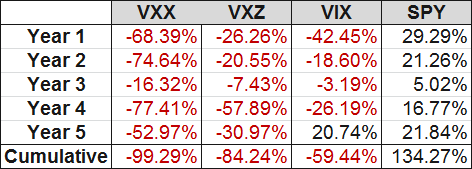
VXX and VXZ Now Five Years Old!

In the midst of all the emerging markets turmoil, I wanted to take a moment to acknowledge the fifth birthday of the two pioneering VIX ETPs : VXX and VXZ. Launched five weeks before stocks hit their 2008-09 financial crisis bottom, both VXX and VXZ have struggled against a tide of falling volatility over the course of the past five years and have also been battered by persistent contango in the VIX futures, which has created additional head winds in the form of negative roll yield.

The table below captures the grim history of these two products, looking at product lifecycle years from January 30th to January 30th:

[source(s): CBOE, Yahoo, VIX and More]

Note that even though each of the five years have been losing years for both products, there have been periods in which these products have been extremely strong performers. One of these periods was from July to October 2011 when VXX nearly tripled (maximum gain of 198%) and VXZ rallied some 66%. I mention this because both have performed well in January, with VXX up 13.0% as I type this and VXZ with gains of 2.2% for the year.

While I am not going out on a limb and predicting a renaissance for these two VIX ETPs, they are two of the most important and liquid VIX ETPs on the market and can be attractive hedges or speculative trades when the markets go through a period of selling and/or there are concerns about a potential crisis.

I have been writing about these even before they were launched and will continue to offer my thoughts on them going forward.

Related posts:

Disclosure(s): short VIX and VXX at time of writing

[source(s): CBOE, Yahoo, VIX and More]

Wednesday, October 23, 2013

Performance of VIX ETPs During the Recent Debt Ceiling Crisis

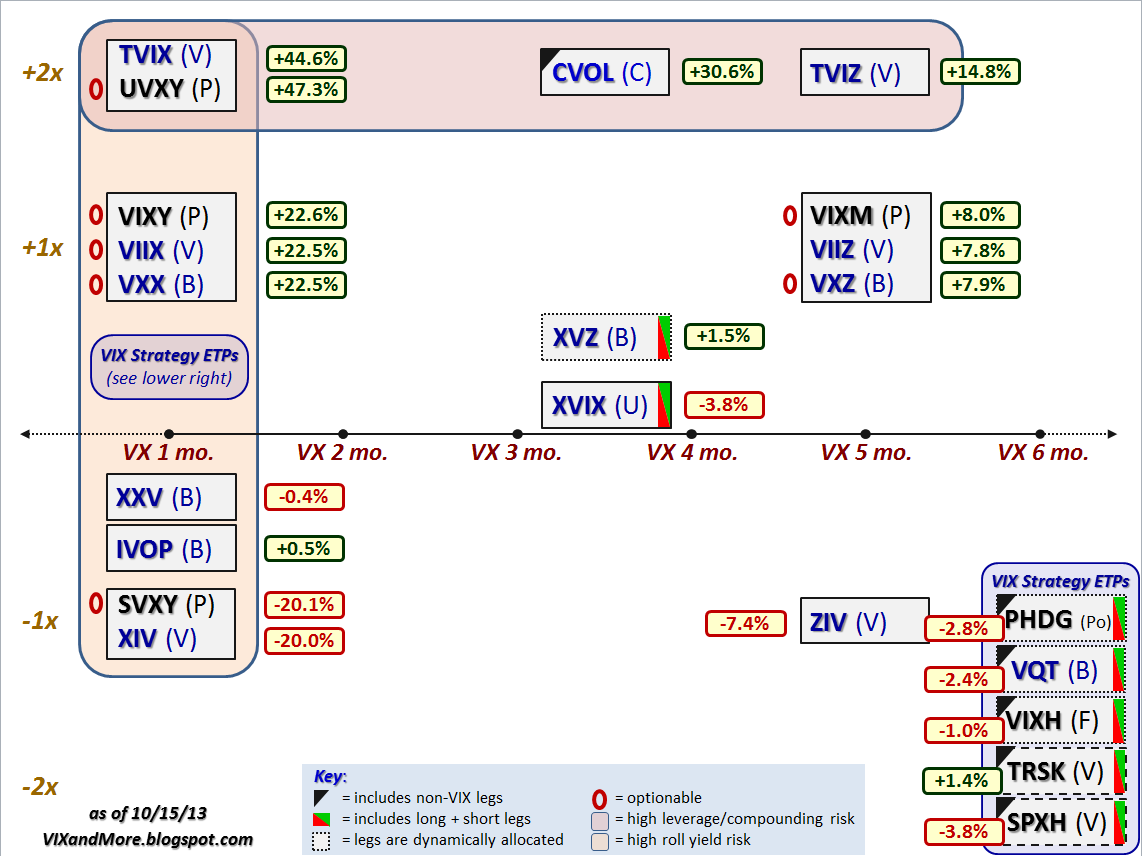
Since the first big wave of VIX ETPs hit in 2010, I have periodically plotted all these products on a grid that used the y-axis for leverage and the x-axis for target maturity. While the initial intent was to highlight roll yield risk and leverage/compounding risk, over time I was unable to resist the urge to indicate which ETPs were optionable, which had both long and short legs, which had legs that were dynamically allocated, which had non-VIX components, etc. In other words, I fell victim to my unceasing need to try to tell an entire story on one slide, no doubt due in part to having seen too many 80-page presentations put together by consulting teams…

That being said, today’s iteration of my graphical depiction (“field guide”) of the VIX ETP universe is somewhat of a compromise. This compromise is due in part to the proliferation of VIX ETPs that combine long and short legs and have those legs dynamically allocated. The first of these to launch (back on August 31, 2010) was the Barclays ETN+ S&P VEQTOR ETN (VQT), which was followed by the First Trust CBOE S&P 500 Tail Hedge Fund ETF (VIXH) on August 29, 2012 and later by the PowerShares S&P 500Downside Hedged Portfolio (PHDG) on December 6, 2012. The field became considerably more crowded this year when VelocityShares launched the Tail Risk Hedged Large Cap ETF (TRSK) and the Volatility Hedged Large Cap ETF (SPXH) on June 24, 2013.

Rather than cramming these five similar products into the same narrow space, I have separated them from the grid and given them their own “VIX Strategy ETPs” box. With VIXH and PHDG now having a reasonable body of historical data to analyze, I have had a fair amount to say about these products already and will have more to say about them in the near future. TRSK and SPXH present an entirely different approach to hedging with volatility products and I will devote a separate post to these in short order.

In the meantime, the graphic below shows the performance of all the VIX and volatility ETPs from September 20 (when the VIX closed at 13.12) to October 8 (when the VIX closed at 20.34), when the VIX spiked 55% increase in just 12 trading days. As the graphic shows, for the most part the higher the leverage and the shorter the duration, the better the VIX ETP performed during the crisis. The performance of the VIX strategy ETPs was a mixed bag, with only TRSK posting a gain during this period. Another perennial hedging favorite, XVZ, also posted a gain.

[source(s): CBOE, Yahoo, VIX and More]

The trick with these hedges is one of timing.  As has been noted here on many instances in the past, the top performers in a crisis are typically those which are ravaged by price decay due to roll yield and/or compounding when the VIX does not spike. Compare the winners and losers in the graphic below with the winners and losers tallied in VIX ETP Performance in 2012 to gets a sense of how expensive it can be to carry speculative long volatility positions as well as more dynamic hedging positions over the course of an extended period. The bottom line is that it is almost impossible to create a VIX ETP that will perform well when the VIX spikes and when there is below average volatility or expectations of future volatility.

This is not to say that it is impossible to time long and short volatility positions in order to be positioned to take advantage of increases and decreases in volatility, only that most buy-and-hold scenarios have a negative long-term expectation and timing the volatility market is probably more difficult than timing the equities market.

The bottom line is that if you think Democrats and Republicans might have some difficulty navigating the January 15 deadline for funding the government or the February 7 deadline for raising the debt ceiling once again, then look no farther than the graphic above for some ideas about how to trade these events.

Related posts:

Disclosure(s): none

Wednesday, January 30, 2013

VXX and VXZ Celebrate Fourth Birthday

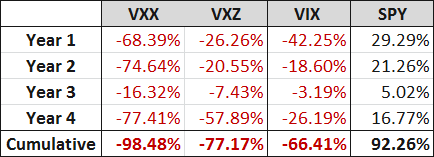
What better way to celebrate your birthday than by ripping off a huge gain. That’s what VXX must have been thinking today as it gained 6.2%, while it’s often overlooked sibling, VXZ, gained 2.2%.

Of course, the last four years have not been kind to these VIX exchange-traded products in the aggregate, but for selected periods, they have been remarkable performers. Just ask anyone who was short VXX when it spiked 198% during a period from July to October of 2011.

In spite of that impressive short-term performance, both VXX and VXZ have lost ground in each of the four years since their launch. To be fair, though, so did the VIX, if one measures each ‘performance year’ from January 30th.

The table below shows the performance of VXX, VXZ, the VIX and SPY during each of those January 30th performance years. When one considers that in each of those yearly measurement periods the SPY advanced and the VIX declined, it is a little bit easier to swallow the performance of the two pioneering VIX ETPs.

[source(s): Yahoo, thinkorswim/TD Ameritrade, VIX and More]

In spite of some of the concerns expressed about the performance of VXX and VXZ in this space as early as the first half of 2009, VXX is still the #1 VIX ETP in terms of assets at $1.043 billion, while VXZ is in the #8 slot at $57 million.

To reiterate what I have maintained since their launch, VXX and VXZ are products that are suitable for short-term long volatility positions or for longer-term holding periods under certain market conditions. For those who are interested in more information, the links below should provide some excellent jumping off points.

All investors are encouraged to carefully study the prospectus of VXX and VXZ and more generally of all VIX and volatility-based exchange-traded products.  I also strongly encourage potential investors in this space to spend some time learning the intricacies of VIX futures, contango, roll yield and other related subjects.

Related posts:

Disclosure(s): short VXX at time of writing

Friday, January 4, 2013

VIX ETP Performance in 2012

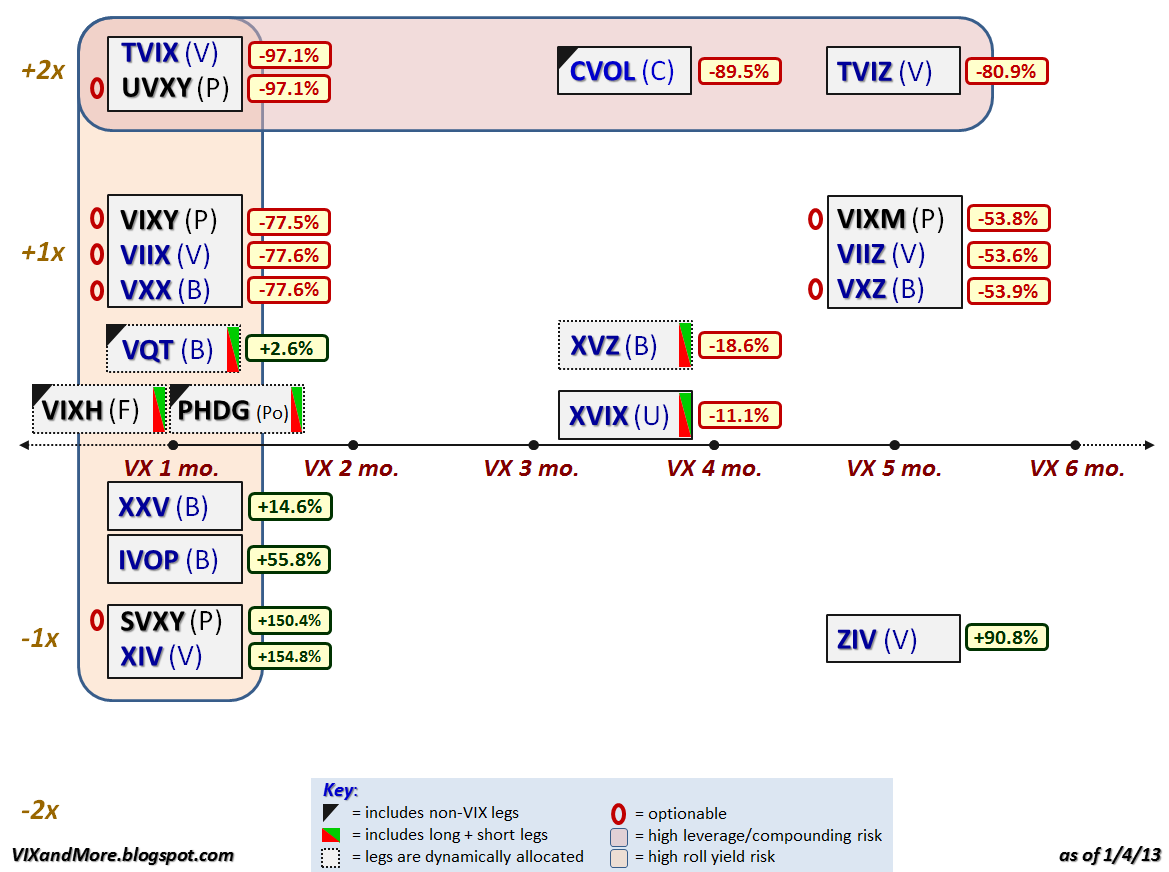
For anyone who pays attention to the VIX exchange-traded products space, 2012 was the year of the inverse (short) VIX futures ETP. The graphic below recaps the performance of the VIX ETPs that were trading as of the end of 2012 and it is easy to see that if you were long the inverse products (XIV, SVXY, ZIV, etc.) and were able to hold on to these positions during volatility storms such as the Greek elections, yield spikes on the sovereign debt of Italy and Spain, the fiscal cliff, etc. (all of which required nerves of steel and a creative risk management approach), then 2012 was a very good year for you. If not, then let the performance ups and downs be a reminder that most of the VIX ETPs are not well-suited for mainstream investors.

Instead of going into too much detail about the performance and reiterating much of what I have already said in the past, I encourage readers to investigate the links below, which include some predictions about future price moves and risk-reward ratios that have been borne out by the events of 2012.

If your new to this product space, perhaps the first place you should begin your research is with posts tagged with labels such as contango, roll yield and term structure – subjects that I have been writing about since the first VIX ETPs were launched, three years ago this month.

[Note that there are no performance numbers for VIXH or PHDG, as these products were launched during the year and have not yet accumulated full-year performance data.]

Related posts:

Disclosure(s): long XIV, SVXY and ZIV at time of writing

Sunday, December 30, 2012

Portfolio Insurance for (Almost) Free

A lot of strange things happened in the financial markets late on Friday afternoon and a good deal of the craziness was in the VIX futures market, with impacts felt in the likes of VXX, which jumped 11.6% in less than an hour (the last 40 minutes of the regular session and the first 14 minutes of after-hours trading.)

The corresponding spike in the VIX futures prices pushed the front two months of the VIX futures term structure into backwardation (a downward sloping term structure curve in which front month futures contract is priced higher than the second month futures contract) for only the second day since November 2011, with the lone exception dating from May 18, 2012, when the front two month contracts were in backwardation by a mere 0.05 points.

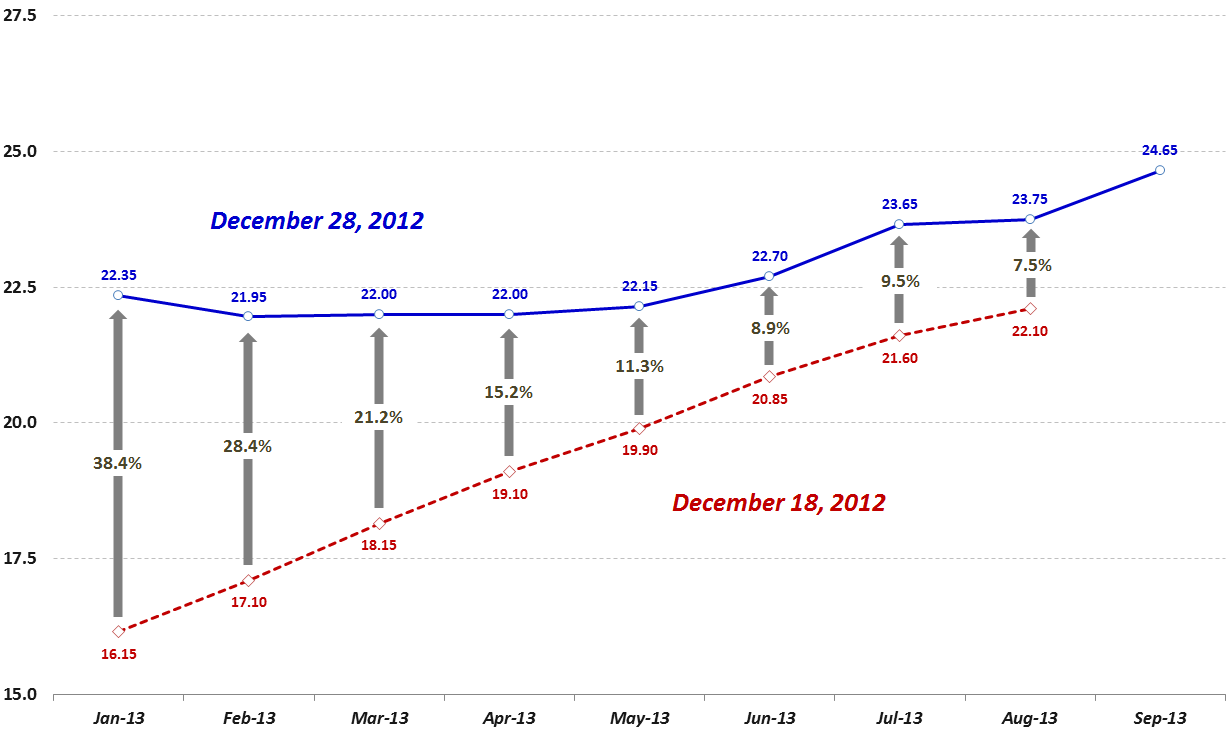
The chart below shows how the VIX futures term structure changed over a ten-day period from December 18 to December 28. While all eight VIX futures contracts that were trading on both dates showed in increase, the magnitude of these increases were skewed dramatically toward the front months, where the January VIX futures contract jumped 38.4%, the February contract gained 28.4%, the March contract rose 21.2%, etc. Also of note, whereas the December 18th term structure was upward sloping in an almost perfect linear fashion, by December 28th the term structure had twisted so that the January contract is now trading at a higher level than the contracts for the February, March, April and May expirations. In fact, the market is now pricing in expectations that a VIX of about 22 will persist for the next five months.

[source(s): CBOE Futures Exchange (CFE)]

With the backwardation in the front two months of the VIX futures contracts, this also means that investors who are looking to hedge long equity exposure against an increase in volatility can now take advantage of what is essentially free portfolio insurance. Of course I am using the “free” label loosely, but given that the short-term VIX futures (first and second month contracts) are in contango (front months less expensive than more distant months) more than 80% of the time and subject to the price decay associated with negative roll yield while in contango, I feel it is important to underscore that the short-term VIX futures roll yield is now positive, meaning that if the VIX January and February contracts do not change in price, the positive roll yield should provide a small lift to VXX, UVXY, TVIX and the other short-term VIX ETPs with a long volatility bias.

Now before anyone gets too excited about the possibility of free portfolio insurance, it is important to understand that the reason the VIX futures are in backwardation is that market participants anticipate that the VIX will decline going forward, making a long volatility hedge of limited value. So while long positions in VXX, UVXY, TVIX and their ilk are benefiting from positive roll yield at the moment, most investors consider that a decline in the VIX and VIX futures is likely to more than compensate for any gains due to roll yield, meaning that these hedges will probably be net losers when one accounts for the changes in the VIX futures and the roll yield.

[Since some of the subjects above have not come up for discussion in a fairly long time, today’s set of links is more comprehensive than usual. As always, these are not arranged in order of significance, but are grouped roughly by subject matter, with some of the more recent posts on the subject toward the top.]

Related posts:

Disclosure(s): short VXX and UVXY at time of writing

Thursday, August 16, 2012

A VIX Risk Reversal

With the VIX at about 14.50 as I type this and a large group of investors convinced that stocks are overbought and/or not properly discounting global macro risk, many are wondering just how to translate their beliefs into an effective trading strategy.

For those who think a long volatility trade is the answer, there is the issue of the significant contango headwinds, where a negative roll yield will pummel net asset values on VIX options and VIX exchange-traded products as a part of the daily rebalancing process, while VIX futures are subjected to a similar decay that reminds me a little bit of a dying helium balloon. Long story short: there is a huge daily penalty being assessed just for holding these long positions.

There are ways to minimize the effect of negative roll yield and typically one of the best of these is to work with positions that focus on the more distant months of the VIX futures term structure. This is generally why VXZ outperforms VXX over an extended period. Unfortunately for aficionados of VXZ, the negative roll yield between the fourth and seventh month VIX futures (VXZ buys the seventh month and sells the front month each day) hit a new record on Monday and continues at near record levels.

So what is a long volatility trader to do?

One trade that I somehow have never managed to highlight in my 5 ½ of writing about the VIX is a VIX risk reversal. A risk reversal is essentially a synthetic long position in which a trader uses options to create a position that is similar to owning the underlying, but typically ties up less capital in the process. In the case of a risk reversal, this means selling out-of-the-money puts and buying out-of-the-money calls. In many instances, the sale of the put options will finance 100% of the cost of the calls.

While the VIX is currently trading at 14.50, keep in mind that the best proxy for the price of the underlying for VIX options is the VIX futures for the corresponding month. So, with the September VIX futures at 18.95 at the moment, one could sell the September 18.00 puts for 1.50 and buy the September 24 calls for 1.05, pocketing the 0.45 differential. A more conservative trader might look to sell the VIX September 16 puts for 0.55 and use the proceeds to pick up a September 30 call for 0.55 or to defray some of the costs of the purchase of a more expensive call, such as the September 24 (priced at 1.05) mentioned above.

There are ways to turn this idea into a more aggressive trade as well. One approach is to morph a risk reversal into a leveraged trade in which more calls units are purchased than put units are sold. An example of this approach might involve selling the September 19 puts (which are currently at-the-money) for 2.15 and using the proceeds to purchase two contracts of the September 24 calls for 1.05 each.

A risk reversal also goes by other names, notably a long combination (or long combo) and, despite the name, is a high-risk trade that is vulnerable to the ravages of time decay. This trade is not for everyone, but can be a good way to generate significant long exposure with a minimal outlay of funds and sometimes no outlay of funds at all.

Related posts:

Disclosure(s): long VIX at time of writing

Friday, June 15, 2012

Performance of Volatility-Hedged ETPs

An emerging area of interest in the markets in general and in this space in particular is the subject of how to blend volatility exposure – both long and short – into a portfolio.

Based upon feedback I have received, three recent articles that have touched upon this subject from different angles have all resonated with readers:

Clearly the role of volatility in a portfolio is a subject that warrants further analysis and discussion.

It is worth noting that issuers of exchange-traded products have taken several approaches to addressing volatility. The most obvious was the launch of VIX-based ETPs, such as the popular VXX (iPath S&P 500 VIX Short-Term Futures ETN,) which is a long basket of short-term VIX futures.

Subsequent products have tackled the subject of volatility in a variety of different ways, including:

  1. Utilize low beta stocks to minimize portfolio volatility (SPLV)
  2. Employ a market timing mechanism that dynamically allocates between stocks and bonds according to measures of market volatility (VSPY)
  3. Employ a market timing mechanism that dynamically allocates between stocks and VIX futures according to measures of market volatility (VQT)
  4. Employ a market timing mechanism that dynamically allocates between long and short volatility positions (XVZ)

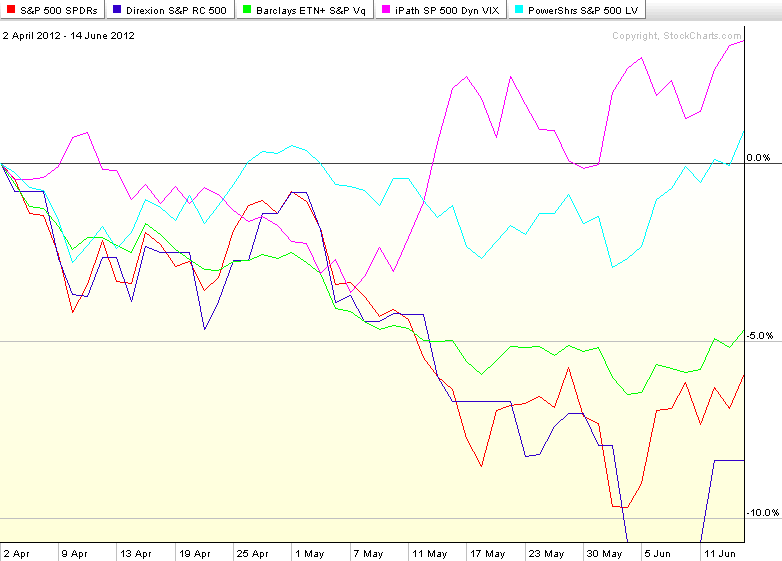
With the S&P 500 index down about 6.3% through yesterday’s close from its April 2nd high, it is reasonable to ask how these approaches have been performing during this bearish phase. The chart below shows the performance of SPY in red. Two of the approaches employed have had a performance trajectory that is almost indistinguishable from that of SPY: VQT (green line); and VSPY (dark blue line), which is thinly traded.

The two standouts during the past 2 ½ months are SPLV (light blue line) and XVZ (purple line). You can see from the graphic that SPLV has done exactly was it is supposed to do: minimize volatility. For the better part of the period in question, SPLV has been largely unchanged. Lately it has risen largely due to its substantial exposure to utilities and consumer staples. The other standout is XVZ, which essentially uses the slope of VIX futures term structure to determine how it allocates between long and short volatility positions. With the VIX futures in contango (front months less expensive than more distant months) since last November, this product has been able to capitalize on negative roll yield, while also providing protection against a spike in the VIX.

While this data should be of interest to traders who are looking for volatility-based hedges or even speculative applications going forward, today is definitely a case where past performance should not serve as a guideline for what to expect in the next week or two.

For those who are looking for more powerful VIX hedges, long positions in VIX calls and VXX calls (including the weeklys) will provide the most robust long volatility hedges. For those who are looking to minimize portfolio volatility going forward, the four approaches outlined above (as well as the links below) should warrant further investigation.

Related posts:

[source(s): StockCharts.com]

Disclosure(s): long XVZ and short VXX at time of writing

DISCLAIMER: "VIX®" is a trademark of Chicago Board Options Exchange, Incorporated. Chicago Board Options Exchange, Incorporated is not affiliated with this website or this website's owner's or operators. CBOE assumes no responsibility for the accuracy or completeness or any other aspect of any content posted on this website by its operator or any third party. All content on this site is provided for informational and entertainment purposes only and is not intended as advice to buy or sell any securities. Stocks are difficult to trade; options are even harder. When it comes to VIX derivatives, don't fall into the trap of thinking that just because you can ride a horse, you can ride an alligator. Please do your own homework and accept full responsibility for any investment decisions you make. No content on this site can be used for commercial purposes without the prior written permission of the author. Copyright © 2007-2023 Bill Luby. All rights reserved.
 
Web Analytics