Showing posts with label PHDG. Show all posts

Sunday, December 6, 2015

The Current VIX ETP Landscape

I have been writing about VIX ETPs since the launch of the initial duo of VXX and VXZ back in January 2009 and from 2010 onward I have been plotting all of them on a leverage/maturity grid like the one below. It is amazing how often various VIX ETP investors mentioned one of these charts when I talk to them. Even through the VIX ETP space has been relatively stable as of late, I have not updated this graphic since early 2014, so a refresh is long overdue.

For those who have not been following along over the years, I have plotted every VIX-based ETP using leverage on the Y-axis and maturity on the X-axis. With the advent of what I am calling VIX strategy ETPs, I have isolated in their own box in the lower right hand corner a half dozen of these products whose characteristics do not necessarily imply a fixed point on Cartesian coordinate system.

The key at the bottom highlights various salient features of each of these products. From previous incarnations, I have retained the presence of non-VIX legs (typically positions in SPX/SPY), the combination of both long and short legs, dynamic allocation of the legs and optionability. I have also shaded areas where there is high leverage/compounding risk as well as high roll yield risk. Not surprisingly, these risks converge at TVIX and UVXY, two of the more infamous VIX ETPs.  Another carryover is font color, where black indicates ETFs and blue is for ETNs.  This time around I have also added yellow stars for those ETPs with an average daily volume of 1,000,000 or higher and pink stars for ETPs with an average daily volume between 100,000 and 1,000,000. Note that while CVOL technically makes the cut, at today’s closing price of 0.40, any sort of meaningful reverse split to raise the price about 5 or 10 would highlight just how illiquid this issue is. In fact, only six VIX ETPs pass the one million share screen: TVIX, UVXY, VIXY, VXX, SVXY and XIV.

VIX ETPs 120615

[source(s): VIX and More]

There are three new additions to this graphic. The most notable of these are VXUP and VXDN, which were launched by AccuShares back in May. These products deserve a post (or series of posts) dedicated to some of the issues surrounding them, but the short version is that high complexity, frequent distributions and consistent tracking errors resulted in a product that investors decided was not worth their trouble. The other “new” products is, VQTS, the first ETP that tracks the SPX VEQTOR Switch Index, making it a relative of VQT and PHDG, but one which uses a dynamic allocation to VIX futures to achieve a 10% target realized (historical) volatility. VQTS was launched in December 2014 and like most VIX ETPs, has struggled to reach critical mass.

While the VIX ETP market is showing some signs of maturing, there are many new and exciting developments in terms of low volatility ETPs and more broadly in the ETP space in general. As I am currently at the IMN 20th Annual Global Indexing & ETF Conference – and scheduled to speak on a panel, “Trading the VIX: Riding Today's Waves of Volatility” with Larry McDonald, Mark Shore and Matt Moran tomorrow – this seems like a good time to devote more time to writing and in particular to resurrecting the “and More” portion of this blog.

Related posts (a selection from literally hundreds of posts on VIX ETPs):

Disclosure(s): net short VIX, VXX, UVXY and TVIX; net long SVXY, XIV and ZIV at time of writing

Wednesday, October 23, 2013

Performance of VIX ETPs During the Recent Debt Ceiling Crisis

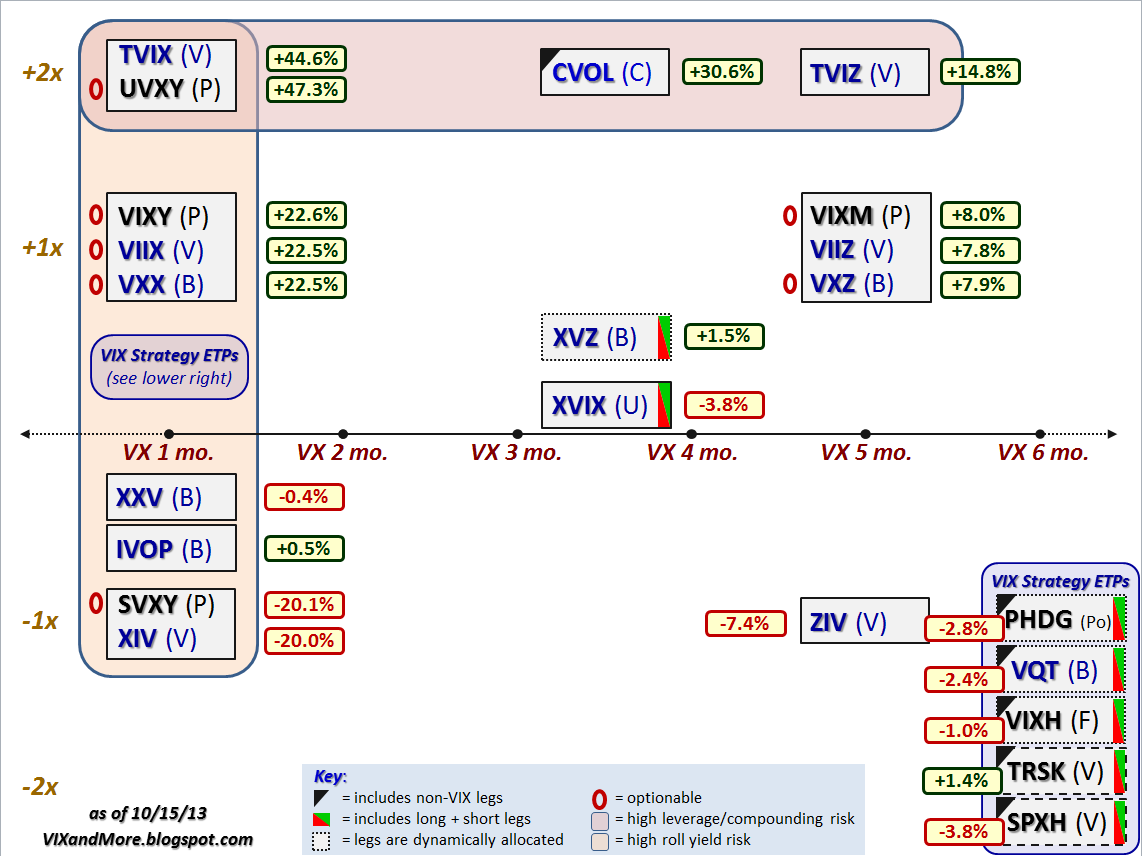
Since the first big wave of VIX ETPs hit in 2010, I have periodically plotted all these products on a grid that used the y-axis for leverage and the x-axis for target maturity. While the initial intent was to highlight roll yield risk and leverage/compounding risk, over time I was unable to resist the urge to indicate which ETPs were optionable, which had both long and short legs, which had legs that were dynamically allocated, which had non-VIX components, etc. In other words, I fell victim to my unceasing need to try to tell an entire story on one slide, no doubt due in part to having seen too many 80-page presentations put together by consulting teams…

That being said, today’s iteration of my graphical depiction (“field guide”) of the VIX ETP universe is somewhat of a compromise. This compromise is due in part to the proliferation of VIX ETPs that combine long and short legs and have those legs dynamically allocated. The first of these to launch (back on August 31, 2010) was the Barclays ETN+ S&P VEQTOR ETN (VQT), which was followed by the First Trust CBOE S&P 500 Tail Hedge Fund ETF (VIXH) on August 29, 2012 and later by the PowerShares S&P 500Downside Hedged Portfolio (PHDG) on December 6, 2012. The field became considerably more crowded this year when VelocityShares launched the Tail Risk Hedged Large Cap ETF (TRSK) and the Volatility Hedged Large Cap ETF (SPXH) on June 24, 2013.

Rather than cramming these five similar products into the same narrow space, I have separated them from the grid and given them their own “VIX Strategy ETPs” box. With VIXH and PHDG now having a reasonable body of historical data to analyze, I have had a fair amount to say about these products already and will have more to say about them in the near future. TRSK and SPXH present an entirely different approach to hedging with volatility products and I will devote a separate post to these in short order.

In the meantime, the graphic below shows the performance of all the VIX and volatility ETPs from September 20 (when the VIX closed at 13.12) to October 8 (when the VIX closed at 20.34), when the VIX spiked 55% increase in just 12 trading days. As the graphic shows, for the most part the higher the leverage and the shorter the duration, the better the VIX ETP performed during the crisis. The performance of the VIX strategy ETPs was a mixed bag, with only TRSK posting a gain during this period. Another perennial hedging favorite, XVZ, also posted a gain.

[source(s): CBOE, Yahoo, VIX and More]

The trick with these hedges is one of timing.  As has been noted here on many instances in the past, the top performers in a crisis are typically those which are ravaged by price decay due to roll yield and/or compounding when the VIX does not spike. Compare the winners and losers in the graphic below with the winners and losers tallied in VIX ETP Performance in 2012 to gets a sense of how expensive it can be to carry speculative long volatility positions as well as more dynamic hedging positions over the course of an extended period. The bottom line is that it is almost impossible to create a VIX ETP that will perform well when the VIX spikes and when there is below average volatility or expectations of future volatility.

This is not to say that it is impossible to time long and short volatility positions in order to be positioned to take advantage of increases and decreases in volatility, only that most buy-and-hold scenarios have a negative long-term expectation and timing the volatility market is probably more difficult than timing the equities market.

The bottom line is that if you think Democrats and Republicans might have some difficulty navigating the January 15 deadline for funding the government or the February 7 deadline for raising the debt ceiling once again, then look no farther than the graphic above for some ideas about how to trade these events.

Related posts:

Disclosure(s): none

Wednesday, August 14, 2013

Expanded Performance of Volatility-Hedged and Related ETPs

When I recently assembled Top Posts of 2013 (Through First Half of Year), several themes jumped off the page. The top four posts of the year summarize what many investors have been worrying about this year:

  1. The Low Volatility Story in Pictures
  2. Four Years of SPX Pullbacks in One Plot
  3. VIX ETP Performance in 2012
  4. All-Time VIX Spike #11 (and a treasure trove of VIX spike data)

The issues are related to pullbacks in stocks, the VIX spikes associated with them, how to minimize portfolio volatility when these types of events happen and what the implications are for various VIX exchange-traded products.

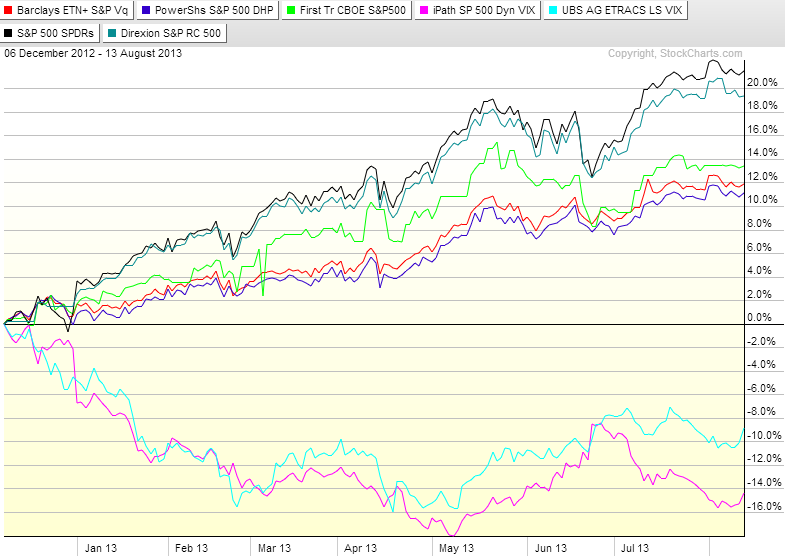
With that backdrop and a stock market that has been looking fatigued while it has meandered sideways for the past month, quite a few investors are thinking about how to hedge a portfolio that has a long-equity bias. In the graphic below, I capture the recent performance of a number of ETPs which may be suitable for hedging that type of portfolio.

[source(s): StockCharts.com]

Interestingly, the performance of these securities appears to fall into three distinct groups.

The top group has two ETPs:

  • SPY (black line), included largely for reference purposes
  • Direxion S&P 500 RC Volatility Response Shares (VSPY), which employs a market timing mechanism that dynamically allocates between stocks and bonds according to measures of market volatility (blue-green line)

The second group contains the core of the VIX-based dynamic hedging products:

  • First Trust CBOE S&P 500 Tail Hedge Fund ETF (VIXH), which is essentially a portfolio consisting of 99-100% of SPY, augmented by a dynamic allocation of 0-1% of VIX options (light green line)
  • Barclays ETN+ S&P VEQTOR ETN (VQT), which has a dynamic allocation of VIX futures that fluctuates based on realized volatility and the trend in implied volatility (red line)
  • PowerShares S&P 500Downside Hedged Portfolio (PHDG), like VQT, has a dynamic allocation of VIX futures and is based on the S&P 500 Dynamic VEQTOR Index (dark purple line)

The bottom group includes two performers:

  • UBS ETRACS Daily Long-Short VIX ETN (XVIX), which is equivalent to a fixed allocation of a 100% long position in VXZ, offset by a 50% short position in VXX. I have included XVIX (aqua blue line) here largely to show how closely the performance corresponds to that of XVZ
  • iPath S&P 500 Dynamic VIX ETN (XVZ), utilizes the slope of the VIX:VXV ratio (SPX 30-day implied volatility to SPX 93-day implied volatility) to determine the dynamic allocation to short-term and medium-term VIX futures. In this case, the allocation to short-term VIX futures (think VXX) can be either long or short, while the allocation to medium-term VIX futures will always be long, though it is variable (fuchsia line)

Keep in mind that the most aggressive hedges are almost always the ones that underperform the most in bullish periods. If you want a very different look at how some of these products perform when stocks decline sharply, check out Performance of VIX ETP Hedges in Current Selloff.

The links below provide some background information on some of these products as well as performance data and should serve as excellent starting points for more comprehensive research.

Related posts:

Disclosure(s): long VQT and short VXX at time of writing

Friday, January 4, 2013

VIX ETP Performance in 2012

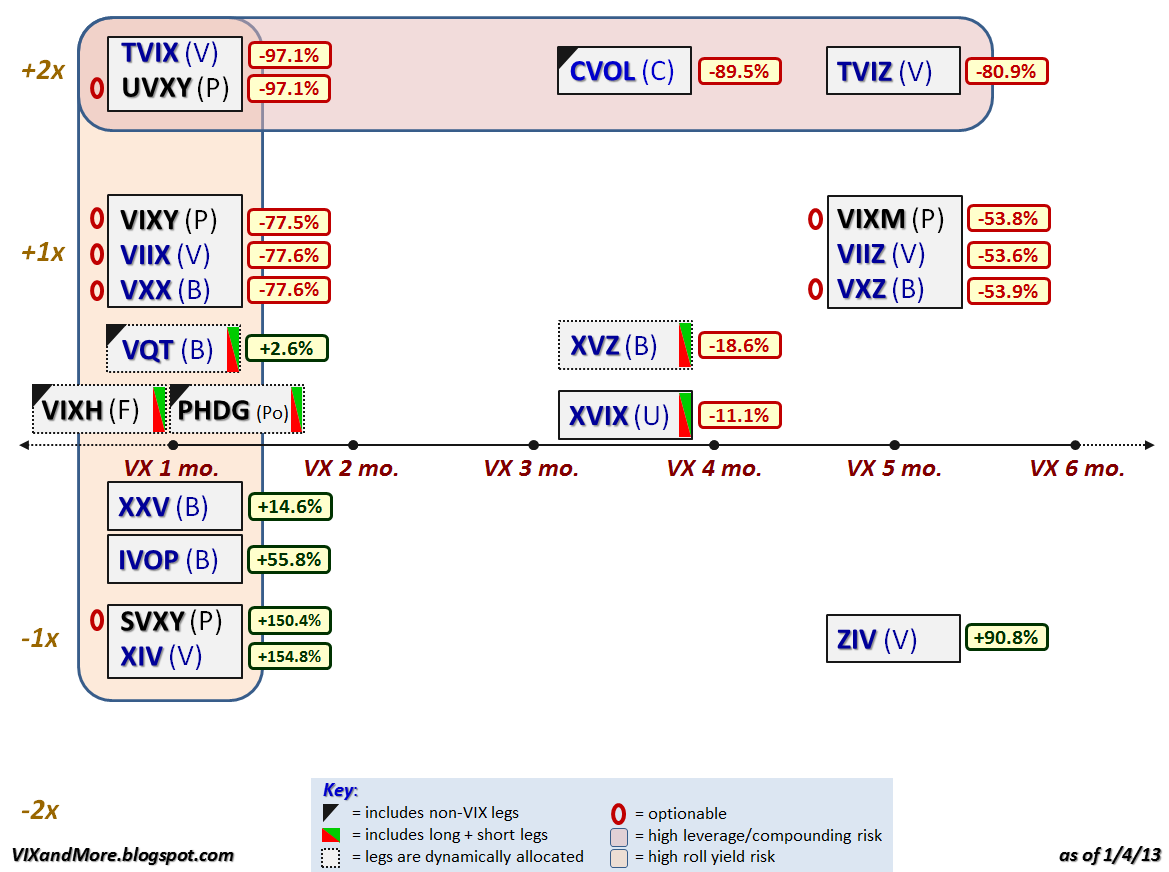
For anyone who pays attention to the VIX exchange-traded products space, 2012 was the year of the inverse (short) VIX futures ETP. The graphic below recaps the performance of the VIX ETPs that were trading as of the end of 2012 and it is easy to see that if you were long the inverse products (XIV, SVXY, ZIV, etc.) and were able to hold on to these positions during volatility storms such as the Greek elections, yield spikes on the sovereign debt of Italy and Spain, the fiscal cliff, etc. (all of which required nerves of steel and a creative risk management approach), then 2012 was a very good year for you. If not, then let the performance ups and downs be a reminder that most of the VIX ETPs are not well-suited for mainstream investors.

Instead of going into too much detail about the performance and reiterating much of what I have already said in the past, I encourage readers to investigate the links below, which include some predictions about future price moves and risk-reward ratios that have been borne out by the events of 2012.

If your new to this product space, perhaps the first place you should begin your research is with posts tagged with labels such as contango, roll yield and term structure – subjects that I have been writing about since the first VIX ETPs were launched, three years ago this month.

[Note that there are no performance numbers for VIXH or PHDG, as these products were launched during the year and have not yet accumulated full-year performance data.]

Related posts:

Disclosure(s): long XIV, SVXY and ZIV at time of writing

DISCLAIMER: "VIX®" is a trademark of Chicago Board Options Exchange, Incorporated. Chicago Board Options Exchange, Incorporated is not affiliated with this website or this website's owner's or operators. CBOE assumes no responsibility for the accuracy or completeness or any other aspect of any content posted on this website by its operator or any third party. All content on this site is provided for informational and entertainment purposes only and is not intended as advice to buy or sell any securities. Stocks are difficult to trade; options are even harder. When it comes to VIX derivatives, don't fall into the trap of thinking that just because you can ride a horse, you can ride an alligator. Please do your own homework and accept full responsibility for any investment decisions you make. No content on this site can be used for commercial purposes without the prior written permission of the author. Copyright © 2007-2023 Bill Luby. All rights reserved.
 
Web Analytics