Showing posts with label SVXY. Show all posts

Thursday, April 14, 2022

UVXY Dominates VIX ETPs By Dollar-Weighted Volume

At various times in the 13-year history of VIX ETPs there have been as many of 30+ different versions of these VIX-based products on the market.  Initially, it was the +1x VXX that dominated the space, later supplanted by the +2x TVIX and then the -1x XIV as the top dog.  All three of these products have run into various issues (see VIX ETPs – What Can Go Wrong?), with XIV dead, TVIX relegated to irrelevance and trading by appointment on the pink sheets as TVIXF and VXX currently wounded by regulatory issues (Barclays Suspends Creation Units for VXX).

In the wake of all this carnage, which products are still viable?  A month ago I would probably have argued that VXX was the most important product in the space, but with VXX’s creation unit troubles, the +1.5x UVXY ETF from ProShares is the clear market share leader, with 63.3% of the dollar-weighted volume in the VIX ETP product space.  The ProShares -0.5x SVXY ETF has the second highest dollar-weighted volume in the space at 19.4% and in third place at 9.8% is the +1.0x VIXY ETF.  VXX from Barclays has fallen to fourth place at 5.8%.  For now, the VIX ETP space is dominated by the ProShares product suite.  The two new kids on the block, the +2.0x UVIX and the -1.0x SVIX from Volatility Shares are gaining some traction, but still have only 0.7% dollar-weighted volume share.

In the graphic below I show the dollar-weighted volume as of yesterday’s data.  Note that the top six products all have a weighted-average maturity of one month while the two laggards, VIXM and VXZ, both have a weighted-average maturity of five months.


 [source(s):  Yahoo, VIX and More]


Further Reading:
UVIX and SVIX Join the VIX-Based ETP Landscape
VIX ETPs – What Can Go Wrong?
Successful Launch for SVIX and UVIX
VIX ETPs Flash Some Green in 2016
Every Single VIX ETP (Long and Short) Lost Money in 2015
Performance of VIX ETPs During the Recent Debt Ceiling Crisis
Expanded Performance of Volatility-Hedged and Related ETPs
Performance of Volatility-Hedged ETPs
Performance of VIX ETP Hedges in Current Selloff
Slicing and Dicing all 31 Flavors of the VIX ETPs
Charting the Assets of the Volatility-Based ETPs

For those who may be interested, you can always follow me on Twitter at @VIXandMore

Disclosure(s): net short VXX, UVIX and UVXY, net long SVIX at time of writing


Monday, April 4, 2022

VIX ETPs – What Can Go Wrong?

For many years, I’ve had a tagline at the bottom of my email: “In volatility there is opportunity!”  The tagline is a reminder that when things look darkest in the financial markets, this is often an area of maximum opportunity.

On the other hand, the VIX ETPs have quite a few quirks and as a result of these quirks and their high volatility, there are considerable risks for both longs and shorts.  How much risk?  Quite a lot.  Consider that on a split-adjusted basis, the +2x long TVIX launched at 2.66 billion (not a typo!) and trades anywhere from less than a dollar (the TVIX.IV indicative value) to 2.45 TVIXF (on the pink sheets), depending upon how you wish to measure the magnitude of the bloodbath.  On the other side of the coin, the -1x short XIV fell 93% on one day back in the February 2018 volatility spike now known as Volmageddon that resulted in an acceleration event (triggered when the price of XIV fell by more than 80% on a single day) and the closing of XIV.

From the 30,000-foot perspective, the big risk in being short volatility is that a big one-day VIX spike can theoretically destroy the value of your entire position.  On the other hand, the big risk in being long volatility is that you die a death by a thousand cuts and suffer the same 85% per year compound annual decline experienced by a product like TVIX.

There are many individual risk factors that are responsible for the total risk of an individual VIX ETP.  I have spelled out a number of these in the past, spending considerable time on contango and negative roll yield.  Way back in May 2009, I summarized some of my thinking in the likes of VXX Calculations, VIX Futures and Time Decay and elaborated on some of those themes in October 2009 in Why VXX Is Not a Good Short-Term or Long-Term Play.  I also addressed the subject of how reverse splits are the only thing keeping some of these products from falling to zero in Will TVIX Go to Zero? in February 2012.  In that post, I highlighted this gem from the TVIX prospectus:

“The long term expected value of your ETNs is zero. If you hold your ETNs as a long-term investment, it is likely that you will lose all or a substantial portion of your investment.”

One of my better summaries of the factors putting downward pressure on the price of TVIX came in Four Key Drivers of the Price of TVIX in 2012.  Here is the meat of that post:

1.  Volatility – this seems obvious, but in the short-term, the movements of the front month and second month VIX futures explain almost all of the change in the price of TVIX. For day traders, TVIX becomes essentially a substitute for trading the VIX futures and with the exception of leverage, the other factors below are inconsequential.

2.  Leverage – another obvious factor, the 2x leverage in TVIX means that on average it moves about as quickly up and down in percentage terms as the VIX does and twice as quickly as a basket of front month and second month VIX futures. In the short-term, leverage means mostly that the moves in the underlying are exaggerated; in the long-term, leverage enhances volatility compounding and has a negative impact on price.

3.  Contango – thanks to the emergence of VIX ETPs as the cornerstone of volatility as an asset class, issues related to the VIX futures term structure in general and contango and negative roll yield in particular have become among the most frequently discussed issues in this space. Simply stated, the front month and second months of VIX futures are in contango more than 75% of the time, with the result being a monthly drag on TVIX’s price that exceeds the current annual yield on the 30-Year U.S. Treasury bond.

4.  Volatility compounding – the more volatility a leveraged security exhibits, the more that volatility will have a negative impact on performance over an extended period. The issue is the same as someone who owns a dress shop and marks the dress down 50% and then up 50% or reverses the chronology and marks the dress up 50% and then down 50%. Either way, the value of that dress declines by 25%. The same is true for leveraged ETPs and the degree of the price decay is a direct function of volatility.

While the number of VIX ETNs is dwindling, ETNs have their own set of issues, as these are debt securities – essentially a promise to pay the value of the underlying index – rather than a portfolio of VIX futures, as is the case with VIX ETFs.  We have seen issues related to VIX ETNs come to the fore with TVIX in 2012 when Credit Suisse suspended new creation units in TVIX only to resume new creation units a little more than a month later – roiling the supply and demand dynamics as well as the TVIX market price in both directions.  Last month something similar happened with Barclays and VXX when Barclays suspended new creation units in this product.  There are issues related to ETNs that are unique to these types of securities and include credit risk, counterparty risk, price risk relative to indicative value, etc.  The SEC summarizes some of these ETN-specific risks in this investor bulletin.

If you want to better understand some of the risk factors involved in these products, I highly recommend you review the prospectuses of some of the following ETNs and ETFs:

I am often asked if these products were designed to go to zero.  No, they were not designed to go to zero.  The original intent was that these products would be short-term hedging or speculative instruments for institutions.  They do, however, have structural flaws that begin to appear as soon as these products are held for more than one day.  Over time, these structural flaws compound and will dominate the price action.

For all the reasons state above, I urge anyone considering trading VIX ETPs to review all relevant prospectuses and make a concerted effort to educate yourself on the products, their price histories and the reasons behind those price movements.  For those who insist on trading these products, it is always safest to consider defined risk trades so that the maximum loss is known in advance.  This may be a long position, a long or short position with an options hedge, or an options position such as a vertical spread that is a defined risk trade.

In the graphic below, I show the lifetime history of TVIX/TVIXF in black and TVIX.IV in red (it was the same as TVIX until it was delisted in July 2020).  Note that the Y-axis is on a log scale so that the data captures the relatively constant percentage declines, rather than the precipitous drop in price.  For fun, try to pick out any major spike in volatility on this chart other than the pandemic.

[source(s):  Yahoo, VIX and More]

Further Reading:
VXX Upside vs. Downside Risk with No New Creation Units
Barclays Suspends Creation Units for VXX
Four Key Drivers of the Price of TVIX
Will TVIX Go to Zero?
TVIX Creation Units Return; What It Means for Investors
Credit Suisse Suspends Creation Units in TVIX: What it Means
Why VXX Is Not a Good Short-Term or Long-Term Play
VXX Calculations, VIX Futures and Time Decay
Using Options to Control Risk in Leveraged ETFs

For those who may be interested, you can always follow me on Twitter at @VIXandMore

Disclosure(s): net short VXX and UVXY, long SVIX at time of writing

Tuesday, May 2, 2017

Euro Zone VSTOXX ETNs Land on U.S. Beaches!

Think the market is too complacent about this weekend’s election in France?  Worried that the euro area is going to crumble under the weight of Italy’s struggles?  Convinced that Greece, Portugal or Spain are just one more kicked can away from a disaster?

As of tomorrow, investors in the U.S. will have another way to translate these ideas into actionable trades with tomorrow’s launch of two new exchange-traded notes (ETNs) – EVIX (long euro zone volatility) and EXIV (inverse euro zone volatility) – from VelocityShares and UBS that put a European face on existing U.S. VIX-based products such as VIIX and perennial favorite XIV.

Based on the VSTOXX, the VIX-like volatility index for the EURO STOXX 50 Index of 50 blue-chip stocks from 11 euro zone countries, EVIX and EXIV should be familiar to those who are knowledgeable about VXX and VIIX on the long volatility side as well as XIV and SVXY on the short volatility side.  EVIX and EXIV are based on VSTOXX futures and have a target maturity of 30 days – a maturity that is maintained by rolling a portion of the portfolio each day and therefore subjecting both products to the vagaries of contango and backwardation.  In the event these are terms you are not familiar with, I strongly recommend that you click on the links above and educate yourself.  Believe it or not, this is the ninth year I have been talking about the VIX futures term structure, negative roll yield, contango and backwardation.  (Those who have been paying attention since the early days of VXX and VXZ have no doubt profited mightily from this knowledge.)

The beauty of EVIX and EXIV is that these products create so much flexibility for investors who maintain a global, cross-asset class view of volatility.  In the run-up to the first round of the French election, for example, VSTOXX spiked dramatically and pushed the VSTOXX:VIX ratio below 1.00, creating some interesting arbitrage opportunities and/or pairs trades in the process.  Now investors can trade euro zone volatility against U.S. volatility, use targeted hedges for risk that is specific to the euro zone or speculate more easily about the direction of volatility in the euro zone.

I encourage everyone to study the EVIX and EXIV prospectus closely.

This is a huge development in the volatility space and if options on EVIX and EXIV follow later this week, as expected, the volatility trading landscape will be much richer and more diverse. 

Now if we can only get liquid volatility products for gold volatility (GVZ) and crude oil volatility (OVX), I won’t even have to set out a stocking next to the chimney this Christmas.

While I’m at it, why are there no options on XIV?  This is such a popular high-beta product that it deserves options so traders can express a broader range of opinions on volatility.  Readers, it never hurts to nudge the CBOE on these issues.  An outpouring of popular sentiment can make a difference.

As the risk of charging off into full rant mode, I feel compelled to say that I hope volatility investors know a good thing when they see it.  It is a shame that VXST futures did not attract enough attention to hang around and that VMAX and VMIN are not trading with higher volumes.  One of the best volatility products ever created, ZIV, nearly died of neglect before investors finally paid it some attention.

As I see it, EVIX and EXIV as well as VMAX and VMIN are test cases for the future of the breadth of volatility products.  If you would like a diverse tapestry of volatility products in the future, it would not hurt to “buy local” volatility ETPs rather than sticking to the handful of already successful products.  If you don’t vote with your feet, you had better be happy playing in a small and rather limited sandbox.  I am fond of saying, “In volatility, there is opportunity!” – but that opportunity is a function of the richness of the various volatility product platforms.

Last but not least, I know Eurozone and eurozone are the preferred spellings, but I am sticking to the two-word “euro zone” with as much stubbornness as I can muster.  What can I say, I am short convention…

Further Reading:

For those who may be interested, you can always follow me on Twitter at @VIXandMore

Disclosure(s): net short VXX and VMAX; net long XIV and ZIV at time of writing.  The CBOE is an advertiser on VIX and More.

Wednesday, January 4, 2017

VIX ETPs Flash Some Green in 2016

Last year I shocked quite a few investors and media outlets with the publication of Every Single VIX ETP (Long and Short) Lost Money in 2015.  My intent was not to tar and feather the VIX exchange-traded products landscape, but to highlight the fact that in an environment characterized by sharp VIX spikes and other volatility extremes, the power of volatility compounding price decay can overwhelm both long and inverse ETPs. 

In sharp contrast to across-the-board losses in 2015, the performance of VIX ETPs in 2016 was much more balanced and in line with historical norms.  While there were some sharp VIX spikes, the combination moderate volatility, above-average contango and persistent mean reversion translated into a sharp down year for the long VIX ETPs and a strong up year for the inverse VIX ETPs.  The more complex multi-leg, long-short and dynamic VIX strategy ETPs were closest to breaking even for the year, with half of these posting modest gains and half posting small losses.

In the graphic below, I have plotted the performance of all twenty VIX-based ETPs with respect to leverage and maturity, using leverage on the y-axis and maturity on the x-axis.  This group includes five VIX strategy ETPs that have no easily discernible point on the leverage-maturity grid.  Depending on how finely you wish to split hairs, these twenty ETPs account for anywhere from fourteen to eighteen unique ways to trade volatility long and short, across various maturities and according to a wide variety of strategic approaches. 


[source(s): VIX and More]

On the plus side, while both XIV and SVXY were up over 80% during calendar 2016, this performance falls short of the 2012 and 2013 numbers, where each ETP gained more than 100% in both years.  Similarly, while losses of over 93% for UVXY and TVIX must sound like a worst-case scenario for these two products, losses were over 97% in 2012 and just slightly better – at -92% – in 2013.  In terms of consistent winners, while their numbers have been more modest, the most consistent gainers in the VIX ETP space have been ZIV, TRSK and SPXH.

Two new VIX ETPs entered the fray in 2016:  VMIN and VMAX.  While these products have not yet attracted the interest of investors that I believe is warranted (VMAX and VMIN Poised to Be Most Important VIX ETP Launch in Years), there is still time for investors to discover these products.  For the record, VMIN was launched on May 2, 2016 and outperformed both XIV and SVXY from the launch date until the end of the year, racking up an impressive 80.5% return in just eights months of trading.  Going forward, I would expect VMIN to regularly be the top performer in any period in which the inverse ETPs post positive returns.

For those who may be wondering, the VIX index was down 22.9% for the year, while the front month VIX futures product ended the year with a loss of 18.3%.

As is typically the case, contango was a significant performance driver during the course of the year.  Contango affecting the front month and second month VIX futures averaged a relatively robust 8.3% per month during the year (the highest since 2012), while contango between the fourth month and seventh month was slightly above average at 1.8% per month.

During the course of the year, five VIX ETPs were shuttered.  These include VXUP and VXDN, XVIX, CVOL and VQTS.  The biggest factors in the demise of these products was a lack of volume and assets.  In the case of VXUP and VXDN, the product complexity and cumbersome array of distributions also helped to quell investor enthusiasm.  Last but not least, I elected to drop XXV and IVOP from this list as these zombie ETPs both have less than 1% exposure to their underlying volatility index due to the lack of daily rebalancing.  As a result, these have become almost entirely all-cash vehicles, with a dash of volatility.  (For those who are curious about these instruments, follow the links above, click on the link to the prospectus and do a keyword search for “participation.”)

As an aside, for those who may be wondering, the flurry of recent posts is not an anomaly.  There is a lot to be said about the VIX, volatility, ETPs, market sentiment and many of my other areas of interest. With the the-year anniversary of the VIX and More blog just three days away, this seems like a good time to dive head first back into the fray.

Related posts:


For those who may be interested, you can always follow me on Twitter at @VIXandMore


Disclosure(s): net short VXX, VMAX, UVXY and TVIX; net long XIV, SVXY and ZIV at time of writing

Sunday, December 6, 2015

The Current VIX ETP Landscape

I have been writing about VIX ETPs since the launch of the initial duo of VXX and VXZ back in January 2009 and from 2010 onward I have been plotting all of them on a leverage/maturity grid like the one below. It is amazing how often various VIX ETP investors mentioned one of these charts when I talk to them. Even through the VIX ETP space has been relatively stable as of late, I have not updated this graphic since early 2014, so a refresh is long overdue.

For those who have not been following along over the years, I have plotted every VIX-based ETP using leverage on the Y-axis and maturity on the X-axis. With the advent of what I am calling VIX strategy ETPs, I have isolated in their own box in the lower right hand corner a half dozen of these products whose characteristics do not necessarily imply a fixed point on Cartesian coordinate system.

The key at the bottom highlights various salient features of each of these products. From previous incarnations, I have retained the presence of non-VIX legs (typically positions in SPX/SPY), the combination of both long and short legs, dynamic allocation of the legs and optionability. I have also shaded areas where there is high leverage/compounding risk as well as high roll yield risk. Not surprisingly, these risks converge at TVIX and UVXY, two of the more infamous VIX ETPs.  Another carryover is font color, where black indicates ETFs and blue is for ETNs.  This time around I have also added yellow stars for those ETPs with an average daily volume of 1,000,000 or higher and pink stars for ETPs with an average daily volume between 100,000 and 1,000,000. Note that while CVOL technically makes the cut, at today’s closing price of 0.40, any sort of meaningful reverse split to raise the price about 5 or 10 would highlight just how illiquid this issue is. In fact, only six VIX ETPs pass the one million share screen: TVIX, UVXY, VIXY, VXX, SVXY and XIV.

VIX ETPs 120615

[source(s): VIX and More]

There are three new additions to this graphic. The most notable of these are VXUP and VXDN, which were launched by AccuShares back in May. These products deserve a post (or series of posts) dedicated to some of the issues surrounding them, but the short version is that high complexity, frequent distributions and consistent tracking errors resulted in a product that investors decided was not worth their trouble. The other “new” products is, VQTS, the first ETP that tracks the SPX VEQTOR Switch Index, making it a relative of VQT and PHDG, but one which uses a dynamic allocation to VIX futures to achieve a 10% target realized (historical) volatility. VQTS was launched in December 2014 and like most VIX ETPs, has struggled to reach critical mass.

While the VIX ETP market is showing some signs of maturing, there are many new and exciting developments in terms of low volatility ETPs and more broadly in the ETP space in general. As I am currently at the IMN 20th Annual Global Indexing & ETF Conference – and scheduled to speak on a panel, “Trading the VIX: Riding Today's Waves of Volatility” with Larry McDonald, Mark Shore and Matt Moran tomorrow – this seems like a good time to devote more time to writing and in particular to resurrecting the “and More” portion of this blog.

Related posts (a selection from literally hundreds of posts on VIX ETPs):

Disclosure(s): net short VIX, VXX, UVXY and TVIX; net long SVXY, XIV and ZIV at time of writing

Friday, January 4, 2013

VIX ETP Performance in 2012

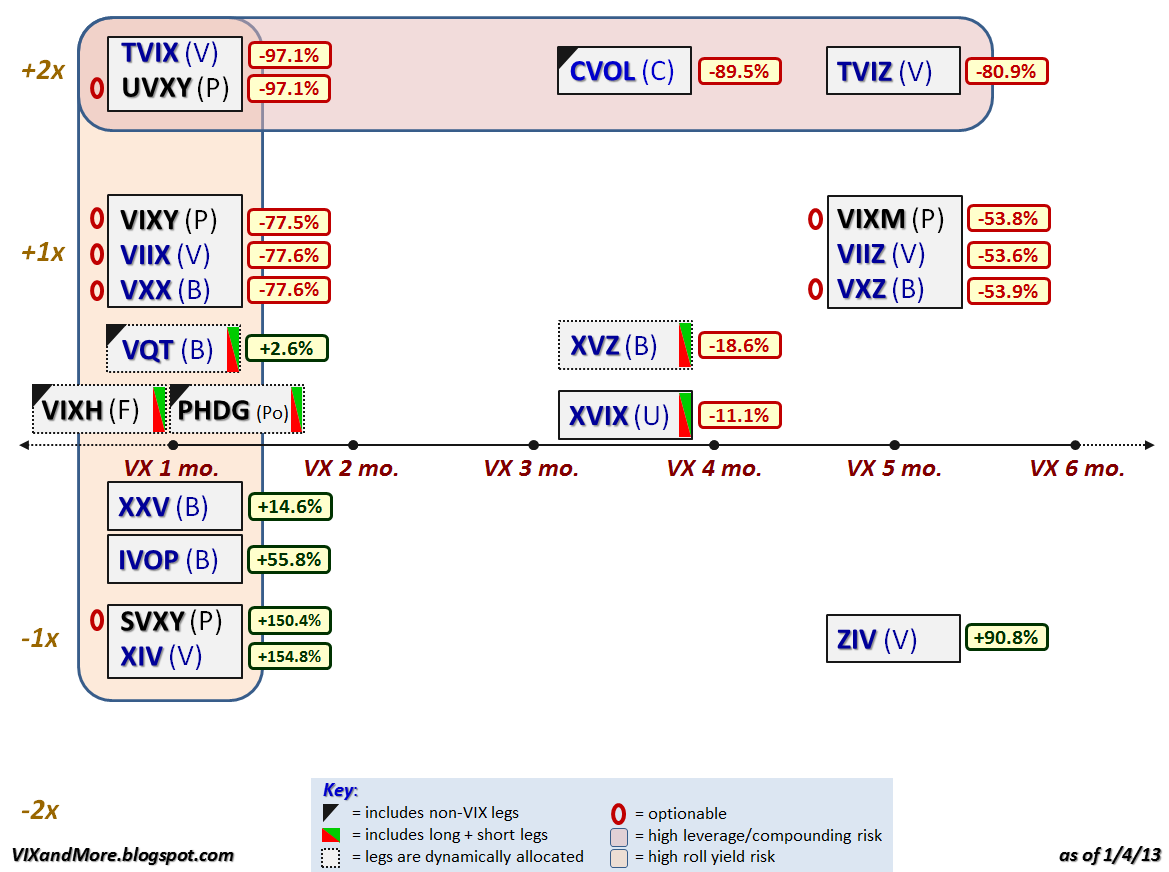
For anyone who pays attention to the VIX exchange-traded products space, 2012 was the year of the inverse (short) VIX futures ETP. The graphic below recaps the performance of the VIX ETPs that were trading as of the end of 2012 and it is easy to see that if you were long the inverse products (XIV, SVXY, ZIV, etc.) and were able to hold on to these positions during volatility storms such as the Greek elections, yield spikes on the sovereign debt of Italy and Spain, the fiscal cliff, etc. (all of which required nerves of steel and a creative risk management approach), then 2012 was a very good year for you. If not, then let the performance ups and downs be a reminder that most of the VIX ETPs are not well-suited for mainstream investors.

Instead of going into too much detail about the performance and reiterating much of what I have already said in the past, I encourage readers to investigate the links below, which include some predictions about future price moves and risk-reward ratios that have been borne out by the events of 2012.

If your new to this product space, perhaps the first place you should begin your research is with posts tagged with labels such as contango, roll yield and term structure – subjects that I have been writing about since the first VIX ETPs were launched, three years ago this month.

[Note that there are no performance numbers for VIXH or PHDG, as these products were launched during the year and have not yet accumulated full-year performance data.]

Related posts:

Disclosure(s): long XIV, SVXY and ZIV at time of writing

Thursday, April 12, 2012

Buying SVXY Calls when the VIX Spikes

Based upon some of the emails I have received this week, it appears that a number of readers have been focused on buying some of the inverse VIX ETPs, notably XIV and SVXY, when they saw the VIX spike. Some have preferred shorting VXX, TVIX and UVXY, based partly on availability, while others have preferred to trade VXX options, generally by buying puts or limiting risk with the likes of a bear call spread.

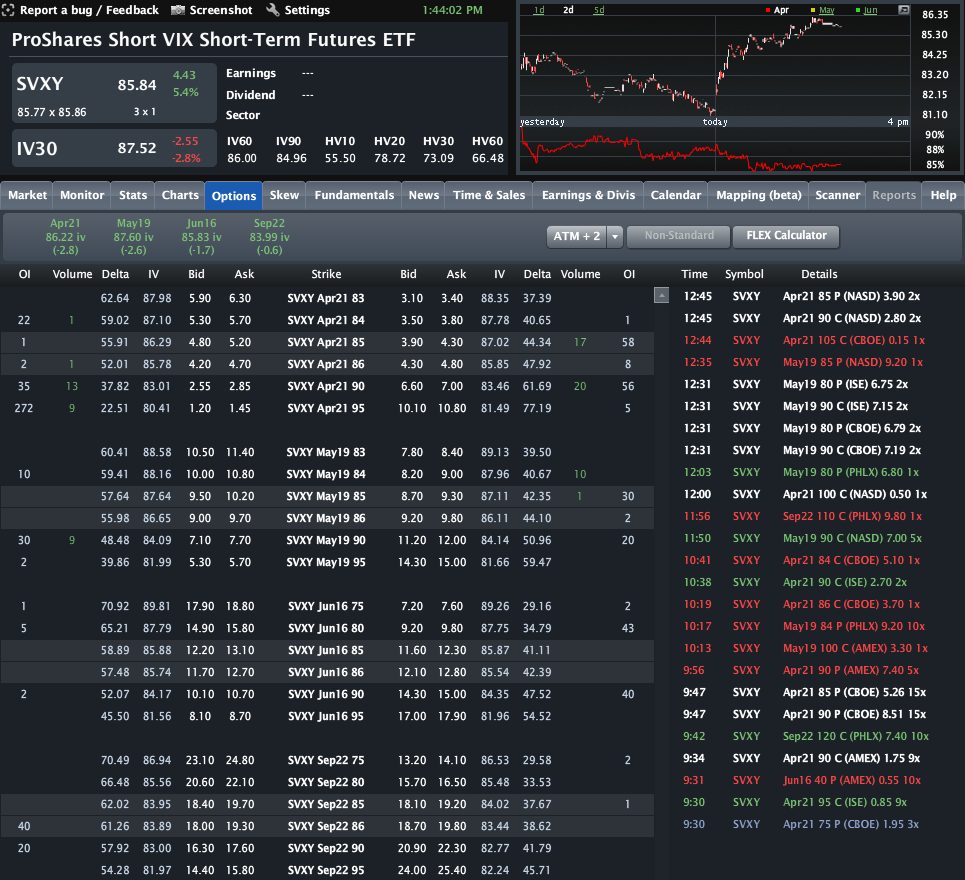
I had thought that my recent Options on UVXY and SVXY Open Up New VIX ETP Trading Approaches might nudge some traders into considering strategies involving the +2x leveraged long VIX short-term futures ETF (UVXY) and perhaps utilize the -1x short VIX short-term futures ETF (SVXY) as well, but based on the volumes, these issues are still in the process of gaining a broader audience. In fact, UVXY did see record call volume of 7300 contracts on Tuesday, but SVXY has been the laggard so far, as the graphic below illustrates.

So here is a thought: the next time the VIX has a significant spike, one of the first trades you should investigate is fading that spike by buying SVXY out-of-the-money calls. This is a simple trade and has the potential to be quite profitable. The SVXY April 90 calls, for instance, have jumped 40% from Tuesday’s close.

The exciting news about options on SVXY and UVXY is that traders can now easily structure a broad variety of trades that involve defined risk and substantial upside. While VXX (and VIX) options are still the gold standard in terms of liquidity, SVXY and UVXY options also deserve some love – even if the spreads are still wider than those of VXX.

Related posts:

[source(s): LivevolPro.com]

Disclosure(s): long XIV and SVXY, short VXX, TVIX and UVXY at time of writing; Livevol is an advertiser on VIX and More

Tuesday, April 3, 2012

VIX ETP Returns for Q1 2012

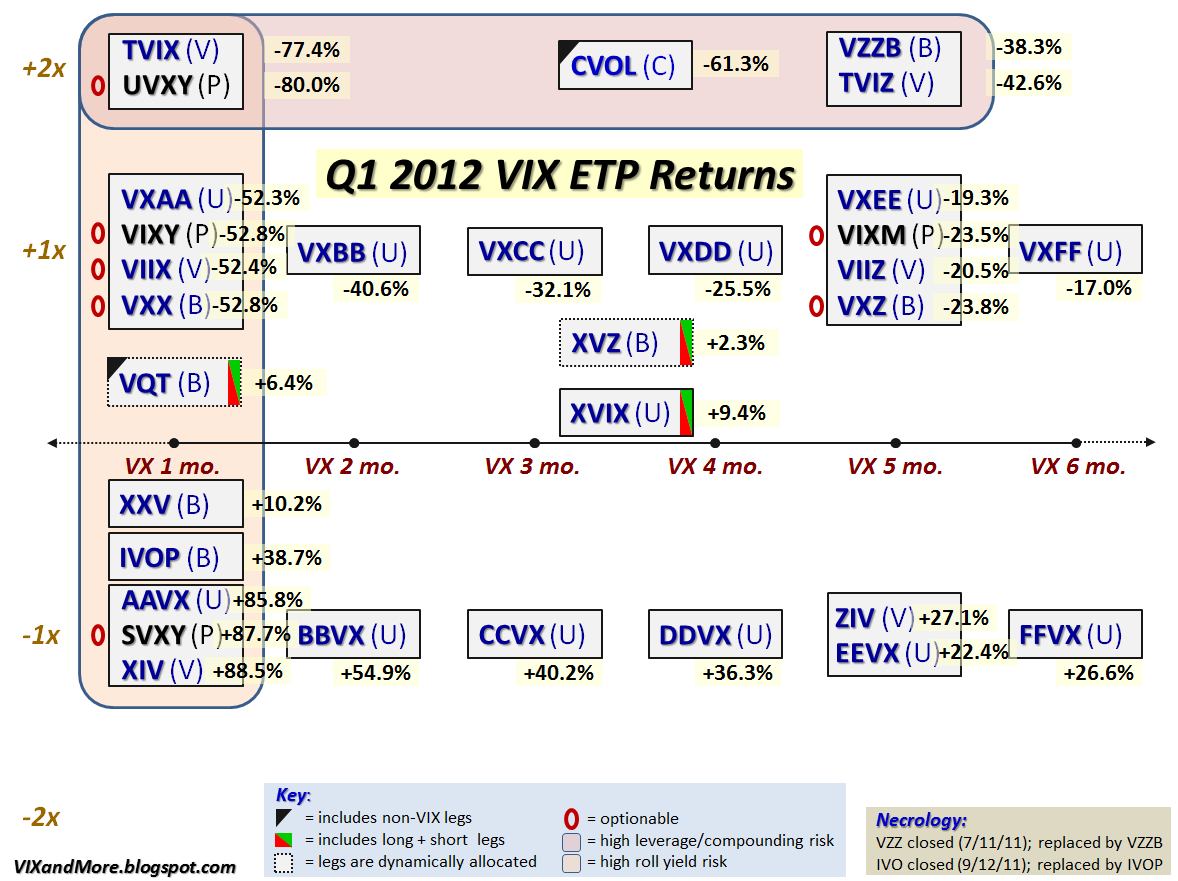
Back in my consulting days, I convinced myself that there were rare instances when an ugly chart crammed full of data should take precedence over a clean and simple graphic that focused on the key takeaways. For my purposes at least, the graphic below, while unlikely to garner accolades from the likes of Information Aesthetics of Flowing Data, is one of those instances and suits my purposes perfectly. [After all, this blog is really just a place for me to archive my own idiosyncratic ideas and the two million interlopers are just a curious side effect, but I digress…]

Getting back to the main point, the graphic below updates the VIX exchange-traded products (ETP) landscape (the only additions are two new red 0s to indicate that UVXY and SVXY are now optionable) and adds performance data for the first quarter of 2012.

Of course anyone who has checked in on this space periodically certainly has already realized that the first quarter saw record contango and negative roll yield across the full spectrum of the VIX futures term structure. As a result of this, the long volatility products had a horrendous three months, the inverse ETPs racked up huge gains and those products with dynamic allocations (VQT and XVZ) or offsetting long and short volatility legs (XVIX) were able to manage small(er) gains.

Following the usual pattern, the products with the shortest target maturities were the most volatile, while those with longer target maturities saw much less movement.

Also notice the symmetry of the return structure. For all the long products that were getting whacked (TVIX, UVXY, VXX, TVIZ, etc.) there were corresponding inverse products (XIV, SVXY, ZIV, etc.) that were racking up larger gains than the losses suffered by their long volatility counterparts.

Last but not least, perhaps the distribution of the returns will help to explain why I have organized my previous VIX ETP ‘field guides’ in this fashion.

This graphic should implicitly raise a bunch of issues and the links below are good jumping off points for further exploration regarding a number of those issues.

For the time being I will leave additional analysis to those in the comments section.

Related posts:

Disclosure(s): long XIV, ZIV, BBVX and XVZ; short TVIX, UXY and VXX at time of writing

Tuesday, March 27, 2012

Options on UVXY and SVXY Open Up New VIX ETP Trading Approaches

Whether or not I find it useful to flog the wounded horse otherwise known as the VelocityShares Daily 2x VIX Short-Term ETN (TVIX), it seems as if investors and the media insist that the wild and crazy story of this +2x VIX futures ETN remain on the front page for now.

While the TVIX story is indeed a fascinating one (see links below for more details), I fear it has crowded out a potentially more useful development from last week that has been criminally overlooked, the launch of options on two important VIX ETFs:

  • ProShares Ultra VIX Short-Term Futures ETF (UVXY)
  • ProShares Short VIX Short-Term Futures ETF (SVXY)

First off, note that the fact that these two products are exchange-traded funds instead of exchanged-traded notes means that it was much easier for options to be approved. While their more famous ETN counterparts, TVIX and XIV, grab most of the headlines, the addition of options means that traders now have much more flexibility in terms of strategy and tactics with UVXY and SVXY. 

In the past when I have mentioned how options on VIX ETPs were critical to their long-term success, I was met with a few (electronic) blank stares. Part of this reflects that fact that many have been drawn to the VIX ETPs for the potential to reap huge profits in a short period of time (more on this in The Trader Development Stage Model and the Jump from Stocks to Options) with leveraged trades. Talk to most professional options traders, however, and leverage is rarely a factor they mention as a reason for their focus on options trading. In fact, pros are more likely to cite the two key advantages of options as their flexibility and ability to structure defined risk (or limited risk) trades.

This brings me back to options on UVXY and SVXY. With UVXY down 83% for the quarter as of yesterday’s close, one would think that defined risk positions – on the long or short side – would be a critical factor in structuring future trades. With the huge contango and negative roll yield currently in the VIX futures, a directional bet in either direction entails huge risk. For shorts, this means that a short position can have its risk capped by buying UVXY calls. For longs this means that a long position can also limit risk by buying puts.

There are other ways to implement defined risk trades, notably with vertical credit spreads and vertical debit spreads, where gains and losses are limited to the distance between strikes. Traders can also just simply buy puts and calls to put a directional idea to work, knowing that their maximum loss will be limited to the purchase price.

In hard to borrow situations – which are common with some VIX ETPs – traders can also use options to create a synthetic position. For instance, a long put plus a short call is the equivalent of a synthetic short, so if no shares are available to borrow, a synthetic position might be an excellent proxy, with the same profit and loss potential as a standard short position, yet typically tying up a lot less trading capital.

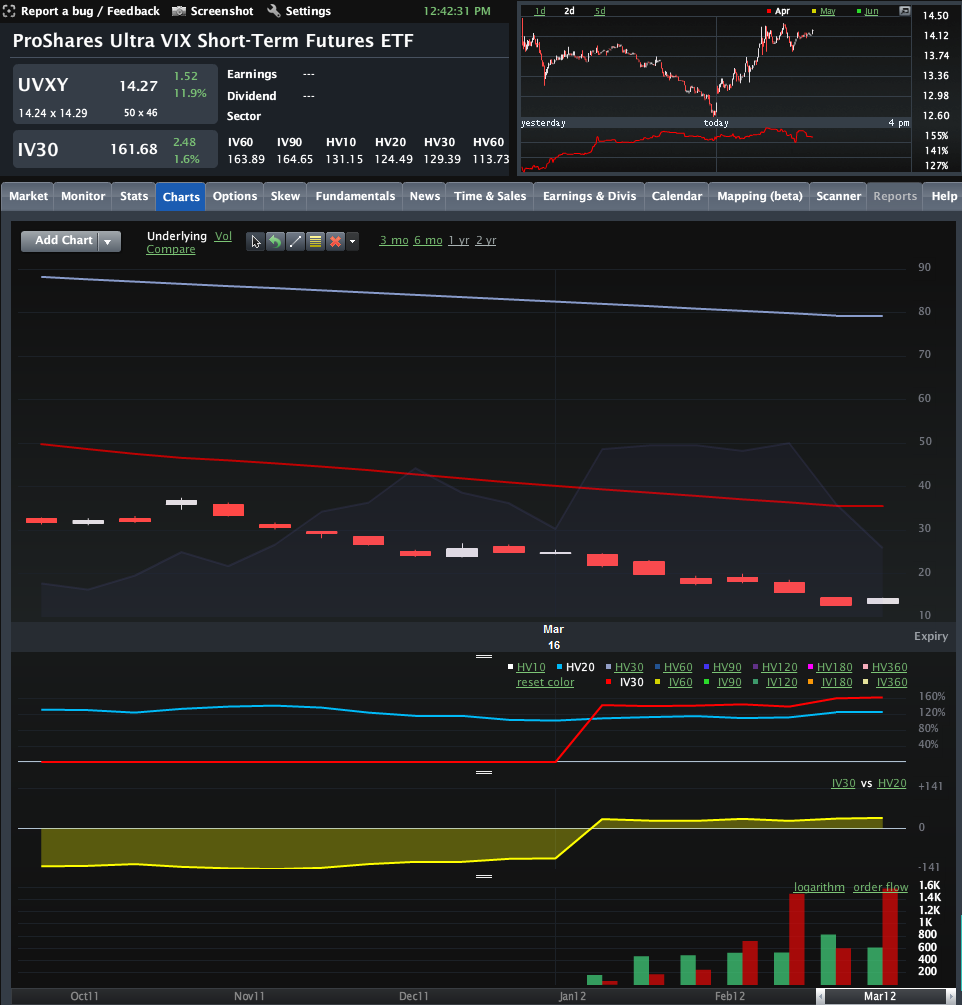
Note that the markets for options in UVXY and SVXY are only one week old and not particularly liquid at this stage. On the other hand, volumes are ramping up quickly (see graphic of UVXY options volume, etc. below) and the flexibility and risk control inherent in options products makes these attractive, particularly so when applied to highly volatile products like UVXY and SVXY.

Related posts:

[source(s): LivevolPro.com]

Disclosure(s): long XIV and SVXY, short TVIX and UVXY at time of writing; Livevol is an advertiser on VIX and More

Thursday, March 22, 2012

TVIX Creation Units Return; What It Means for Investors

One month and one day after Credit Suisse (CS) announced the suspension of new creation units in the VelocityShares Daily 2x VIX Short-Term ETN (TVIX), the issuer announced today that it plans to reopen issuance of TVIX “on a limited basis” effective tomorrow.

In a twist, the press release also noted:

“Beginning March 23, 2012, Credit Suisse may from time to time issue the ETNs into inventory of its affiliates to make the ETNs available for lending at or about rates that prevailed prior to the temporary suspension of issuances of the ETNs. Also, beginning as soon as March 28, 2012, Credit Suisse may issue additional ETNs from time to time to be sold solely to authorized market makers. Credit Suisse may condition its acceptance of a market maker’s offer to purchase the ETNs on its agreeing to sell to Credit Suisse specified hedging instruments consistent with Credit Suisse’s hedging strategy, including but not limited to swaps. Any such hedging instruments will be executed on the basis of the indicative value of the ETNs at that time, will not reflect any premium or discount in the trading price of the ETNs over their indicative value and will be on terms acceptable to Credit Suisse, including the counterparty meeting Credit Suisse’s creditworthiness requirements, margin requirements, minimum size and duration requirements and such other terms as Credit Suisse deems appropriate in its sole discretion.” [emphasis added]

The references to hedging instruments consistent with Credit Suisse’s hedging strategy, swaps, counterparty creditworthiness, margin requirements, etc. may shine a light on some of the issues that Credit Suisse encountered when they elected to close the creation unit window last month.

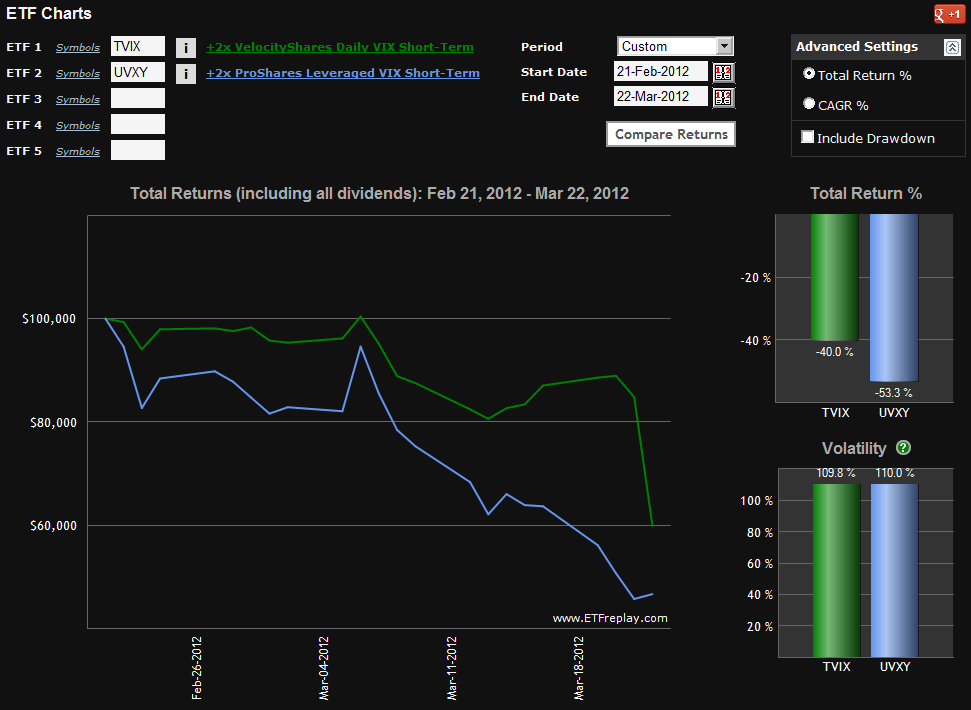
Today’s price action has already raised some eyebrows, with TVIX falling 29.3% during the regular trading session and dropping another 11.8% after hours, while a near equivalent security, the ProShares Ultra VIX Short-Term Futures ETF, UVXY, rose 2.1% during the standard session and was essentially unchanged after hours. As best as I can determine, news of the reopening of the creation units window broke at about 7:34 p.m. ET, at which point TVIX was already down more than 33% from Wednesday’s close. Given that the 30 million shares traded today was about as many shares as had exchanged hands in the prior week, it is reasonable to conclude that at least one party believed that new creation units were imminent and had hoped to profit by shorting TVIX ahead of the announcement. In fact the price action of TVIX was so disconnected from UVXY and the rest of the VIX ETPs that I fielded dozens of questions on the subject and concluded (Twitter, blog comments), “The continued decline in TVIX has me wondering if someone is speculating about CS re-opening the creation units window.”

Of course investors are more interested in what will happen next than what flotsam has already drifted under the bridge.

As for tomorrow’s open, first keep in mind that TVIX ended today’s after-hours session at 9.00, while indicative value is still a good deal lower at 7.83. While Credit Suisse would no doubt like to see TVIX trade back at indicative value levels as soon as possible, the “on a limited basis” phrasing is likely to give some investors pause. Also, there are no guarantees that Credit Suisse might not feel compelled to suspend creation units again at some point in the future. For this reason, I would not at all be surprised to see TVIX continue to trade with a premium in the neighborhood of 5-10% or so at times tomorrow, dropping down to something along the lines of 2-5% next week. These numbers are pure speculation at this stage. A large part of the premium story will depend upon how limited the new creation units are and how aggressively Credit Suisse seeks to drive down the market price to the indicative value. No matter how this plays out, investors should expect that at least 90% of the divergence between TVIX and UVXY over the last month (see graphic below) will disappear tomorrow.

On a related note, investors who have become wary of TVIX during the past month have embraced UVXY to the extent that UVXY’s daily dollar volume has been running ahead of that of TVIX during the past week.  As of Monday, UVXY also has the benefit of being supported by options, with April strikes from 14 through 35 already seeing a fair amount of action. With the advents of options on UVXY (and also on the -1x inverse VIX futures ETF, SVXY) a new universe of trading opportunities becomes available for those who wish to speculate or hedge with VIX-based ETPs. What is most encouraging is that investors can now easily trade VIX products with defined (limited) risk positions by utilizing options. More on this at a later juncture.

In the meantime, [T]VIX and More will do its best to cover the TVIX story as it continues to develop.

Finally, I would be remiss in failing to point out that this space was the only place that one could find information about TVIX before and during the suspension of the creation units. The links below, which are arranged largely in reverse chronological order, provide a wealth of information about TVIX, UVXY and many of the issues facing these products.

Related posts:

[source(s): ETFreplay.com]

Disclosure(s): short TVIX and UVXY at time of writing

DISCLAIMER: "VIX®" is a trademark of Chicago Board Options Exchange, Incorporated. Chicago Board Options Exchange, Incorporated is not affiliated with this website or this website's owner's or operators. CBOE assumes no responsibility for the accuracy or completeness or any other aspect of any content posted on this website by its operator or any third party. All content on this site is provided for informational and entertainment purposes only and is not intended as advice to buy or sell any securities. Stocks are difficult to trade; options are even harder. When it comes to VIX derivatives, don't fall into the trap of thinking that just because you can ride a horse, you can ride an alligator. Please do your own homework and accept full responsibility for any investment decisions you make. No content on this site can be used for commercial purposes without the prior written permission of the author. Copyright © 2007-2023 Bill Luby. All rights reserved.
 
Web Analytics