Showing posts with label VIXM. Show all posts

Thursday, April 14, 2022

UVXY Dominates VIX ETPs By Dollar-Weighted Volume

At various times in the 13-year history of VIX ETPs there have been as many of 30+ different versions of these VIX-based products on the market.  Initially, it was the +1x VXX that dominated the space, later supplanted by the +2x TVIX and then the -1x XIV as the top dog.  All three of these products have run into various issues (see VIX ETPs – What Can Go Wrong?), with XIV dead, TVIX relegated to irrelevance and trading by appointment on the pink sheets as TVIXF and VXX currently wounded by regulatory issues (Barclays Suspends Creation Units for VXX).

In the wake of all this carnage, which products are still viable?  A month ago I would probably have argued that VXX was the most important product in the space, but with VXX’s creation unit troubles, the +1.5x UVXY ETF from ProShares is the clear market share leader, with 63.3% of the dollar-weighted volume in the VIX ETP product space.  The ProShares -0.5x SVXY ETF has the second highest dollar-weighted volume in the space at 19.4% and in third place at 9.8% is the +1.0x VIXY ETF.  VXX from Barclays has fallen to fourth place at 5.8%.  For now, the VIX ETP space is dominated by the ProShares product suite.  The two new kids on the block, the +2.0x UVIX and the -1.0x SVIX from Volatility Shares are gaining some traction, but still have only 0.7% dollar-weighted volume share.

In the graphic below I show the dollar-weighted volume as of yesterday’s data.  Note that the top six products all have a weighted-average maturity of one month while the two laggards, VIXM and VXZ, both have a weighted-average maturity of five months.


 [source(s):  Yahoo, VIX and More]


Further Reading:
UVIX and SVIX Join the VIX-Based ETP Landscape
VIX ETPs – What Can Go Wrong?
Successful Launch for SVIX and UVIX
VIX ETPs Flash Some Green in 2016
Every Single VIX ETP (Long and Short) Lost Money in 2015
Performance of VIX ETPs During the Recent Debt Ceiling Crisis
Expanded Performance of Volatility-Hedged and Related ETPs
Performance of Volatility-Hedged ETPs
Performance of VIX ETP Hedges in Current Selloff
Slicing and Dicing all 31 Flavors of the VIX ETPs
Charting the Assets of the Volatility-Based ETPs

For those who may be interested, you can always follow me on Twitter at @VIXandMore

Disclosure(s): net short VXX, UVIX and UVXY, net long SVIX at time of writing


Sunday, October 21, 2012

The 2012 VIX Futures Term Structure as an Outlier

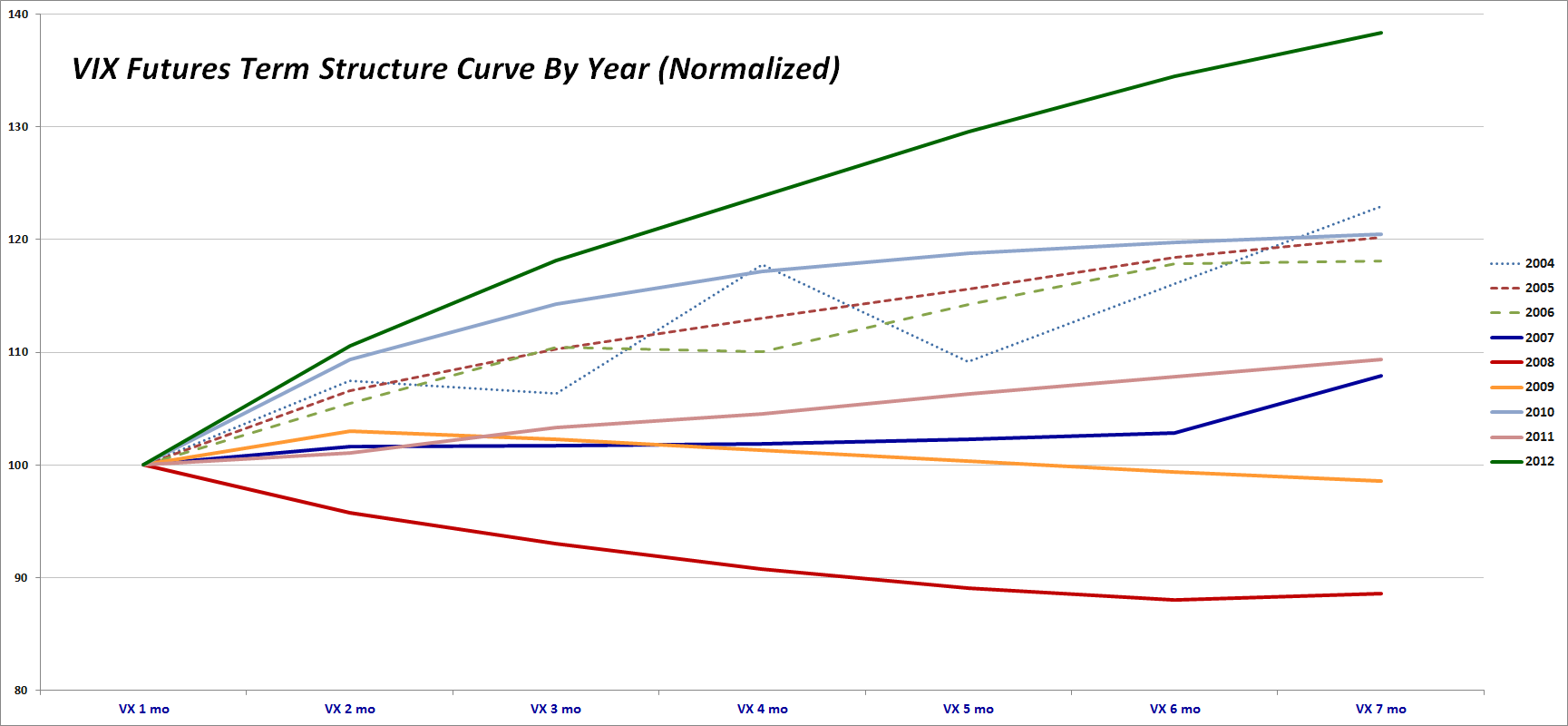
Investors who have been trading the VIX futures, VIX options and VIX exchange-traded products in 2012 have no doubt observed that there has been a wide gulf between the volatility predicted by the VIX front month futures and the back month futures. How wide? Well the graphic below shows the average (mean) normalized term structure for each year since the VIX futures were launched, back in 2004. In normalizing the data, I have set the average front month VIX futures contract to 100 and have expressed the averages of the second through seven months as multiples of the front month.

[Note that while the VIX futures were launched in 2004, consecutive VIX futures contracts for the first six months were not available until October 2006, hence the dotted lines for these years to reflect the erratic nature of the data. Also, I have included the seventh month contract in the calculations because this month is critical to the calculations of a number of VIX ETPs, including VXZ, VIXM, ZIV, etc.]

[source(s): CBOE]

For anyone who has followed the VIX futures closely, it should come as no surprise that 2008 (solid red line) is the only year in which the full VIX futures term structure was in backwardation (front months higher than back months) in aggregate. During 2009 (solid orange line), the term structure transitioned from backwardation to contango (front months higher than back months) and for the most of the balance of its life, the VIX futures term structure has remained in contango.

The graphic shows no discernible trend of extreme contango evolving over the past few years. While 2010 is the year with the second highest degree of contango across the full term structure, contango was decidedly muted during 2011. In fact, 2011 saw the longest continuous stretch of backwardation during the height of the European sovereign debt crisis.

Looking closely at the differences between 2012 and 2010, there is very little difference in contango out to the second month. The normalized term structure curves begin to diverge substantially only after the third month, where the 2010 term structure begins to flatten and the 2012 term structure continues an almost linear ascent. In fact the most distinctive feature of the 2012 term structure is the absence of any significant flattening in the VIX futures curve in months four, five, six and seven. This is part of the reason that while XIV is up 165% for the year, ZIV has managed a gain of 72%.

As this series continues, I will examine some of the possible causes of the recent persistent steep contango in the VIX futures term structure, particularly in some of the back months.

Posts in current series on VIX futures:

Related posts:

Disclosure(s): long XIV and ZIV at time of writing

Wednesday, January 26, 2011

Now Sixteen Volatility ETPs, Four of Which Are Optionable

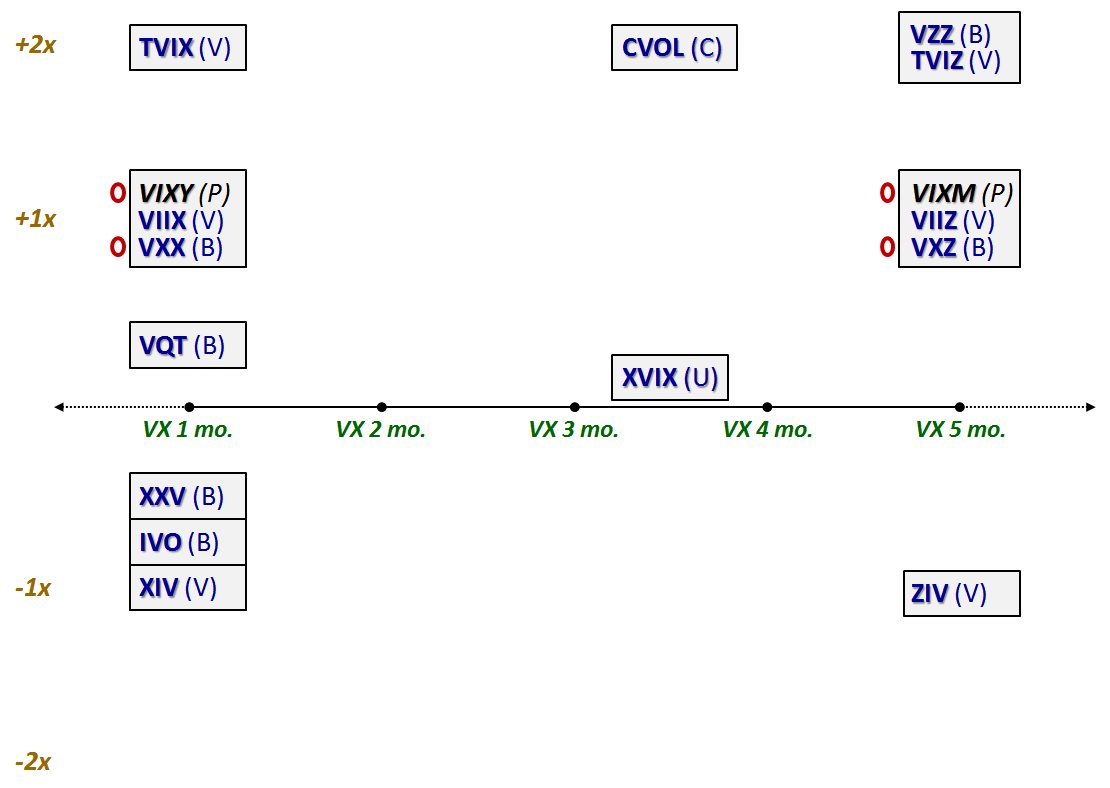
The graphic below is part of my ongoing effort not only to maintain a list of all the volatility-based exchange-traded products, but present them in a manner which helps to highlight the distinctions among these products.
Since I last updated this picture, in early December, three new VIX-based ETPs have entered the fold. Two of these are the first VIX-based ETFs and also represent the first products in this space from industry heavyweight and leveraged/inverse ETF heavyweight ProShares:

  • ProShares VIX Short-Term Futures (VIXY)
  • ProShares VIX Mid-Term Futures (VIXM)
As the chart below shows, VIXY enters the already-crowded space of VIX-based ETPs targeting VIX futures with one month maturity, while VIXM is aimed at the five month maturity space. ProShares undoubtedly hopes that by differentiating its products as ETFs rather than ETNs, the absence of credit risk associated with ETNs will resonate with investors. I have highlighted this distinction by using black italics for the ticker symbol of both ETFs.

ProShares has also been fortunate in that as of this week options are now being offered on VIXY and VIXM, making these only the third and fourth optionable volatility-based ETPs, following in the footsteps of VXX and VXZ. Note that all four optionable ETPs have a red O preceding their ticker.

The third new product to be launched in the past month is the iPath Inverse January 2021 S&P 500 VIX Short-Term Futures ETN, which trades under the ticker IVO. The launch of this ETN apparently confused some observers, but is likely an attempt by Barclays to come up with an ETF that does a better job of tracking the inverse of VXX. My concern is that over time IVOs ability to mirror changes in VXX will undergo the same dilution that happened to XXV. It is possible that Barclays will periodically trot out newer versions of XXV and IVO, but until then, I see these two products as performing more like a fractional inverse ETN than XIV. For this reason, I have put XXV and IVO in separate boxes in the one month -1x space to reflect this important distinction (see Shorting VXX and Long XXV or XIV for more details.)

There are several other small changes in this chart, including moving XVIX closer to the neutral volatility line to reflect the fact that on average the long and short volatility components of this ETN net out to a very limited exposure to volatility and more direct exposure to the VIX futures term structure.

With sixteen volatility-based ETPs available for trading and options on four of those, it is not an exaggeration to say that the number of possible volatility strategies and trades is limited only by the imagination.

Related posts:


Disclosure(s): short VXX; long XIV, VXZ and XVIX at time of writing

DISCLAIMER: "VIX®" is a trademark of Chicago Board Options Exchange, Incorporated. Chicago Board Options Exchange, Incorporated is not affiliated with this website or this website's owner's or operators. CBOE assumes no responsibility for the accuracy or completeness or any other aspect of any content posted on this website by its operator or any third party. All content on this site is provided for informational and entertainment purposes only and is not intended as advice to buy or sell any securities. Stocks are difficult to trade; options are even harder. When it comes to VIX derivatives, don't fall into the trap of thinking that just because you can ride a horse, you can ride an alligator. Please do your own homework and accept full responsibility for any investment decisions you make. No content on this site can be used for commercial purposes without the prior written permission of the author. Copyright © 2007-2023 Bill Luby. All rights reserved.
 
Web Analytics