Showing posts with label VIXY. Show all posts

Thursday, April 14, 2022

UVXY Dominates VIX ETPs By Dollar-Weighted Volume

At various times in the 13-year history of VIX ETPs there have been as many of 30+ different versions of these VIX-based products on the market.  Initially, it was the +1x VXX that dominated the space, later supplanted by the +2x TVIX and then the -1x XIV as the top dog.  All three of these products have run into various issues (see VIX ETPs – What Can Go Wrong?), with XIV dead, TVIX relegated to irrelevance and trading by appointment on the pink sheets as TVIXF and VXX currently wounded by regulatory issues (Barclays Suspends Creation Units for VXX).

In the wake of all this carnage, which products are still viable?  A month ago I would probably have argued that VXX was the most important product in the space, but with VXX’s creation unit troubles, the +1.5x UVXY ETF from ProShares is the clear market share leader, with 63.3% of the dollar-weighted volume in the VIX ETP product space.  The ProShares -0.5x SVXY ETF has the second highest dollar-weighted volume in the space at 19.4% and in third place at 9.8% is the +1.0x VIXY ETF.  VXX from Barclays has fallen to fourth place at 5.8%.  For now, the VIX ETP space is dominated by the ProShares product suite.  The two new kids on the block, the +2.0x UVIX and the -1.0x SVIX from Volatility Shares are gaining some traction, but still have only 0.7% dollar-weighted volume share.

In the graphic below I show the dollar-weighted volume as of yesterday’s data.  Note that the top six products all have a weighted-average maturity of one month while the two laggards, VIXM and VXZ, both have a weighted-average maturity of five months.


 [source(s):  Yahoo, VIX and More]


Further Reading:
UVIX and SVIX Join the VIX-Based ETP Landscape
VIX ETPs – What Can Go Wrong?
Successful Launch for SVIX and UVIX
VIX ETPs Flash Some Green in 2016
Every Single VIX ETP (Long and Short) Lost Money in 2015
Performance of VIX ETPs During the Recent Debt Ceiling Crisis
Expanded Performance of Volatility-Hedged and Related ETPs
Performance of Volatility-Hedged ETPs
Performance of VIX ETP Hedges in Current Selloff
Slicing and Dicing all 31 Flavors of the VIX ETPs
Charting the Assets of the Volatility-Based ETPs

For those who may be interested, you can always follow me on Twitter at @VIXandMore

Disclosure(s): net short VXX, UVIX and UVXY, net long SVIX at time of writing


Monday, April 4, 2022

VIX ETPs – What Can Go Wrong?

For many years, I’ve had a tagline at the bottom of my email: “In volatility there is opportunity!”  The tagline is a reminder that when things look darkest in the financial markets, this is often an area of maximum opportunity.

On the other hand, the VIX ETPs have quite a few quirks and as a result of these quirks and their high volatility, there are considerable risks for both longs and shorts.  How much risk?  Quite a lot.  Consider that on a split-adjusted basis, the +2x long TVIX launched at 2.66 billion (not a typo!) and trades anywhere from less than a dollar (the TVIX.IV indicative value) to 2.45 TVIXF (on the pink sheets), depending upon how you wish to measure the magnitude of the bloodbath.  On the other side of the coin, the -1x short XIV fell 93% on one day back in the February 2018 volatility spike now known as Volmageddon that resulted in an acceleration event (triggered when the price of XIV fell by more than 80% on a single day) and the closing of XIV.

From the 30,000-foot perspective, the big risk in being short volatility is that a big one-day VIX spike can theoretically destroy the value of your entire position.  On the other hand, the big risk in being long volatility is that you die a death by a thousand cuts and suffer the same 85% per year compound annual decline experienced by a product like TVIX.

There are many individual risk factors that are responsible for the total risk of an individual VIX ETP.  I have spelled out a number of these in the past, spending considerable time on contango and negative roll yield.  Way back in May 2009, I summarized some of my thinking in the likes of VXX Calculations, VIX Futures and Time Decay and elaborated on some of those themes in October 2009 in Why VXX Is Not a Good Short-Term or Long-Term Play.  I also addressed the subject of how reverse splits are the only thing keeping some of these products from falling to zero in Will TVIX Go to Zero? in February 2012.  In that post, I highlighted this gem from the TVIX prospectus:

“The long term expected value of your ETNs is zero. If you hold your ETNs as a long-term investment, it is likely that you will lose all or a substantial portion of your investment.”

One of my better summaries of the factors putting downward pressure on the price of TVIX came in Four Key Drivers of the Price of TVIX in 2012.  Here is the meat of that post:

1.  Volatility – this seems obvious, but in the short-term, the movements of the front month and second month VIX futures explain almost all of the change in the price of TVIX. For day traders, TVIX becomes essentially a substitute for trading the VIX futures and with the exception of leverage, the other factors below are inconsequential.

2.  Leverage – another obvious factor, the 2x leverage in TVIX means that on average it moves about as quickly up and down in percentage terms as the VIX does and twice as quickly as a basket of front month and second month VIX futures. In the short-term, leverage means mostly that the moves in the underlying are exaggerated; in the long-term, leverage enhances volatility compounding and has a negative impact on price.

3.  Contango – thanks to the emergence of VIX ETPs as the cornerstone of volatility as an asset class, issues related to the VIX futures term structure in general and contango and negative roll yield in particular have become among the most frequently discussed issues in this space. Simply stated, the front month and second months of VIX futures are in contango more than 75% of the time, with the result being a monthly drag on TVIX’s price that exceeds the current annual yield on the 30-Year U.S. Treasury bond.

4.  Volatility compounding – the more volatility a leveraged security exhibits, the more that volatility will have a negative impact on performance over an extended period. The issue is the same as someone who owns a dress shop and marks the dress down 50% and then up 50% or reverses the chronology and marks the dress up 50% and then down 50%. Either way, the value of that dress declines by 25%. The same is true for leveraged ETPs and the degree of the price decay is a direct function of volatility.

While the number of VIX ETNs is dwindling, ETNs have their own set of issues, as these are debt securities – essentially a promise to pay the value of the underlying index – rather than a portfolio of VIX futures, as is the case with VIX ETFs.  We have seen issues related to VIX ETNs come to the fore with TVIX in 2012 when Credit Suisse suspended new creation units in TVIX only to resume new creation units a little more than a month later – roiling the supply and demand dynamics as well as the TVIX market price in both directions.  Last month something similar happened with Barclays and VXX when Barclays suspended new creation units in this product.  There are issues related to ETNs that are unique to these types of securities and include credit risk, counterparty risk, price risk relative to indicative value, etc.  The SEC summarizes some of these ETN-specific risks in this investor bulletin.

If you want to better understand some of the risk factors involved in these products, I highly recommend you review the prospectuses of some of the following ETNs and ETFs:

I am often asked if these products were designed to go to zero.  No, they were not designed to go to zero.  The original intent was that these products would be short-term hedging or speculative instruments for institutions.  They do, however, have structural flaws that begin to appear as soon as these products are held for more than one day.  Over time, these structural flaws compound and will dominate the price action.

For all the reasons state above, I urge anyone considering trading VIX ETPs to review all relevant prospectuses and make a concerted effort to educate yourself on the products, their price histories and the reasons behind those price movements.  For those who insist on trading these products, it is always safest to consider defined risk trades so that the maximum loss is known in advance.  This may be a long position, a long or short position with an options hedge, or an options position such as a vertical spread that is a defined risk trade.

In the graphic below, I show the lifetime history of TVIX/TVIXF in black and TVIX.IV in red (it was the same as TVIX until it was delisted in July 2020).  Note that the Y-axis is on a log scale so that the data captures the relatively constant percentage declines, rather than the precipitous drop in price.  For fun, try to pick out any major spike in volatility on this chart other than the pandemic.

[source(s):  Yahoo, VIX and More]

Further Reading:
VXX Upside vs. Downside Risk with No New Creation Units
Barclays Suspends Creation Units for VXX
Four Key Drivers of the Price of TVIX
Will TVIX Go to Zero?
TVIX Creation Units Return; What It Means for Investors
Credit Suisse Suspends Creation Units in TVIX: What it Means
Why VXX Is Not a Good Short-Term or Long-Term Play
VXX Calculations, VIX Futures and Time Decay
Using Options to Control Risk in Leveraged ETFs

For those who may be interested, you can always follow me on Twitter at @VIXandMore

Disclosure(s): net short VXX and UVXY, long SVIX at time of writing

Friday, March 25, 2022

Flight-to-Safety ETP Performance During Invasion of Ukraine

Russia invaded Ukraine a little over a month ago, creating turmoil and panic in stocks and across a wide variety of asset classes and instruments. 

In the graphic below, I capture the performance of ETPs covering a variety of traditional flight-to-safety instruments that are used to de-risk or hedge an equity-centric portfolio.  These include: 
SHY: 1-3 Year Treasuries (solid red line)
GLD: Gold (dark purple line)
UUP: U.S. Dollar (light green line)
FXY: Japanese Yen (violet line)
FXF: Swiss Franc (light blue line)
VIXY: Short-Term VIX Futures (black line)

Note that normally I would use VXX, but the price distortions due to the suspension of new creation units makes VIXY a more accurate measure.

The graphic shows that none of the ETPs above turned in particularly strong performance.  Long volatility has been the best performer for the first two weeks, but is now down more than the S&P 500 Index, with a loss of over 12%.  The top performer for the entire period is gold, which has had a fairly steady if unremarkable return during this period.  The second-best performer is the dollar, which has seen a steady upside, but has consistently trailed gold.  Three ETPs have also generated losses, following a slight uptick the first few days.  The worst performer has been the Japanese yen and the other underperformers have been the Swiss Franc and 1-3 Year Treasuries.

All in all, these traditional or generic hedges have been a disappointment.  In my next post, I will look at some hedges that are better suited to the Russia-Ukraine situation and have delivered much better results.


[source(s):  StockCharts.com]

Further Reading:
Safe Haven Options Shrinking?
Chart of the Week: Flight-to-Safety ETPs
Revisiting the Flight-to-Safety Trade
Chart of the Week: The Flight-to-Safety Trade
Why Not Point Hedges?
Forces Acting on the VIX
A Conceptual Framework for Volatility Events


While it has not been updated in a while, new readers may also enjoy older posts that have been tagged with the Hall of Fame label.

For those who may be interested, you can always follow me on Twitter at @VIXandMore

Disclosure(s): Net short VXX and long GLD and SHY at time of writing

Tuesday, March 15, 2022

Barclays Suspends Creation Units for VXX

 Earlier today, Barclays announced the suspension of issuance of new creation units as well as sales from inventory for two of its ETNs: the iPath Series B S&P 500® VIX Short-Term Futures ETN (VXX); and the iPath Pure Beta Crude Oil ETN (OIL).  VXX is the premier VIX-based ETP and has been the most popular subject on this blog for the past 13 years.  It was the first VIX ETP to launch back on January 30, 2009 (along with VXZ) and remains the flagship product in the volatility space, averaging 70 million shares traded per day and regularly placing among the top five ETPs in terms of both share volume and options volume.

While the news from Barclays was a surprise, it was not unprecedented.  Credit Suisse suspended creation units in TVIX (a +2x version of VXX) twice: once in dramatic fashion in February 2012; and again in July 2020, when the product was delisted and moved to the pink sheets to trade under the TVIXF ticker.

The first time around, on February 21, 2012, there was not a VIX spike, per se, that triggered the event.  Instead, it was the general popularity of the product and the size of holdings in the TVIX note (ETNs are an unsecured debt note) that concerned the bank.  Credit Suisse acknowledged that the TVIX note violated the bank’s risk management rules related to the “internal limits on the size of the ETNs” and thus triggered the suspension of creation units.

The second time around, on July 12, 2020, the record volatility spike associated with the onset of the pandemic caused the size of the TVIX note to be roughly half of the size of the bank.  As a result, Credit Suisse concluded that the risk of continuing with this product was too high, so they decided to exit the ETN business, stop issuing new creation units and delist nine ETNs.

In both 2012 and 2020, the absence of new creation units led to a supply shortage and a large premium in the market price relative to the intraday indicative value (IV).  In 2012, new creation units were halted for a month and a day, with the price of TVIX rising to an 89% premium to TVIX.IV at one point.  When TVIX creation units were restored, TVIX fell 60% in three days and soon was trading within 1% of indicative value.  In 2020, the cessation of new creation units was final and irreversible, so TVIXF has now been trading on the pink sheets for 21 months without any new creation units.  Initially, there was almost no premium in TVIXF to TVIX.IV, but the Reddit r/wallstreetbets crowd eventually latched onto the potential for a short squeeze in TVIX in early February 2021 and spiked the price of TVIXF from parity to a 43% premium in two days.  Since the initial targeting by r/wallstreetbets, the premium in TVIXF to TVIX.IV has averaged about 72% and has been as high as 160% at one point.

An even more famous and noteworthy example of investors targeting a product with no creation unit capabilities for a short squeeze is the plight of the VelocityShares Daily 3x Inverse Natural Gas ETN (DGAZF), which spiked from 400 to 24,000 in a week in August 2020.  The VelocityShares Daily 3x Inverse Natural Gas ETN was traded under the ticker DGAZ when it delisted, with no new creation units along with TVIX on July 12, 2020.  The combination of longs targeting a short squeeze, limited liquidity in the OTC pink sheets, no new creation units and 3x leverage made for a historic spike of 12,000% in one week.  While such a scenario is unlikely to unfold in VXX, it is important to understand the history and the potential for outsized short squeezes when there are no creation units available to arbitrage away the difference between the heavily shorted underlying and its indicative value.

There are many other examples of ETPs that have had their creation units suspended, with resultant price anomalies.  Deutsche Bank did it with a variety of commodities ETNs in 2011 and 2012.  PowerShares also suspended creation units in the popular PowerShares DB Oil Fund (DBO) in 2015, with yet another large price spike.

While buyer beware is a good mantra to keep in mind when purchasing ETFs or particularly ETNs, it is even more important for short sellers to understand the risks of holding one or more of these products short when creation units are suspended and particularly when the products are delisted, with trading moving to the OTC pink sheets.

As for VXX, the reasons for the halt in creation units are not exactly clear.  Barclays says in their press release:

“This suspension is being imposed because Barclays does not currently have sufficient issuance capacity to support further sales from inventory and any further issuances of the ETNs. These actions are not the result of the crisis in Ukraine or any issue with the market dynamics in the underlying index components. Barclays expects to reopen sales and issuances of the ETNs as soon as it can accommodate additional capacity for future issuances.”

The underlying cause of the issuance capacity issue may be a number of factors, including the cost of hedging the position, exchange position limits or other factors.  Without knowing the underlying cause, it is difficult to predict when new creation units will be restored.  That said, as VXX appreciates in price, the size of the problem Barclays needs to tackle will continue to rise, which may further complicate the resolution process.

Of course, when new creation units are restored, one can expect that the price of VXX will almost immediately fall to that of VXX.IV.  Investors, therefore, need to understand the risks associated with long positions going forward and not find themselves in an air pocket like TVIX longs did back in March 2012.  For this reason, anyone who is insistent upon holding a long or short position in VXX should consider constructing a defined-risk position using options.  Alternatively, VIXY is an ETP issued by ProShares that holds a basket of VIX futures rather than an unsecured bank note with a promise to return the same performance as that basket of VIX futures.

It should go without saying that everything here I addressed relative to VXX is true for OIL as well and with all the turmoil in the oil markets related to events in Ukraine and Russia, there is already the potential for huge moves in the underlying.

I covered the TVIX creation units issue in considerable detail in 2012 and the links below probably provide the most comprehensive review of this matter anywhere on the internet.  I have also provided links to a number of tangential issues related to VIX ETPs and pricing anomalies.

In the graphic below, I show the divergence between VXX and VXX.IV during today’s regular trading hours (Pacific Time).  I find it interesting that it took more than three hours after the initial press release before VXX began to uncouple from VXX.IV and spike higher, ultimately reaching a 12% premium before the divergence began to narrow during the last half hour of trading.

Long-term, I still think VXX is likely to remain the premier VIX-based ETP, but Barclays has some work to do to get the creation units back and the product trading with a normal supply-demand balance.  Until then, keep a close eye on the varying premium of VXX and VXX.IV, while evaluating alternatives such as VIXY and UVXY.


Sunday, December 6, 2015

The Current VIX ETP Landscape

I have been writing about VIX ETPs since the launch of the initial duo of VXX and VXZ back in January 2009 and from 2010 onward I have been plotting all of them on a leverage/maturity grid like the one below. It is amazing how often various VIX ETP investors mentioned one of these charts when I talk to them. Even through the VIX ETP space has been relatively stable as of late, I have not updated this graphic since early 2014, so a refresh is long overdue.

For those who have not been following along over the years, I have plotted every VIX-based ETP using leverage on the Y-axis and maturity on the X-axis. With the advent of what I am calling VIX strategy ETPs, I have isolated in their own box in the lower right hand corner a half dozen of these products whose characteristics do not necessarily imply a fixed point on Cartesian coordinate system.

The key at the bottom highlights various salient features of each of these products. From previous incarnations, I have retained the presence of non-VIX legs (typically positions in SPX/SPY), the combination of both long and short legs, dynamic allocation of the legs and optionability. I have also shaded areas where there is high leverage/compounding risk as well as high roll yield risk. Not surprisingly, these risks converge at TVIX and UVXY, two of the more infamous VIX ETPs.  Another carryover is font color, where black indicates ETFs and blue is for ETNs.  This time around I have also added yellow stars for those ETPs with an average daily volume of 1,000,000 or higher and pink stars for ETPs with an average daily volume between 100,000 and 1,000,000. Note that while CVOL technically makes the cut, at today’s closing price of 0.40, any sort of meaningful reverse split to raise the price about 5 or 10 would highlight just how illiquid this issue is. In fact, only six VIX ETPs pass the one million share screen: TVIX, UVXY, VIXY, VXX, SVXY and XIV.

VIX ETPs 120615

[source(s): VIX and More]

There are three new additions to this graphic. The most notable of these are VXUP and VXDN, which were launched by AccuShares back in May. These products deserve a post (or series of posts) dedicated to some of the issues surrounding them, but the short version is that high complexity, frequent distributions and consistent tracking errors resulted in a product that investors decided was not worth their trouble. The other “new” products is, VQTS, the first ETP that tracks the SPX VEQTOR Switch Index, making it a relative of VQT and PHDG, but one which uses a dynamic allocation to VIX futures to achieve a 10% target realized (historical) volatility. VQTS was launched in December 2014 and like most VIX ETPs, has struggled to reach critical mass.

While the VIX ETP market is showing some signs of maturing, there are many new and exciting developments in terms of low volatility ETPs and more broadly in the ETP space in general. As I am currently at the IMN 20th Annual Global Indexing & ETF Conference – and scheduled to speak on a panel, “Trading the VIX: Riding Today's Waves of Volatility” with Larry McDonald, Mark Shore and Matt Moran tomorrow – this seems like a good time to devote more time to writing and in particular to resurrecting the “and More” portion of this blog.

Related posts (a selection from literally hundreds of posts on VIX ETPs):

Disclosure(s): net short VIX, VXX, UVXY and TVIX; net long SVXY, XIV and ZIV at time of writing

Friday, January 28, 2011

TVIX Finally Getting Its Due as Day Trading Rocket Fuel

Launched at the end of November 2010, I am surprised it has taken so long for TVIX to become a popular short-term trading vehicle. I predicted in the middle of December that TVIX “will hit a tipping point and become the darling of day traders,” but in the absence of meaningful volatility during the last few months, it has sometimes been difficult to see the potential of TVIX.

With today’s sell off in stocks, however, TVIX was up as much as 18.5% at one point and traded a record 120,000 shares in the first half of today’s session, easily eclipsing its prior volume mark.

Shortly after Direxion launched the first triple ETFs in November 2008, I came out with what sounded like an outrageous claim at the time: Prediction: Direxion Triple ETFs Will Revolutionize Day Trading. It took awhile, but eventually these products became the preferred vehicles for many short-term traders. Their popularity was undercut somewhat when margin requirements were raised to match the leverage built into these trades. With TVIX, which is essentially a +2x version of VXX, VIXY and VIIX, I expect that the tipping point has arrived today. With new liquidity, short-term traders now have a product where 10% daily moves will be relatively common and margin issues should be minimal.

Of course, as a buy and hold vehicle, TVIX will present several significant obstacles, including negative roll yield due to VIX futures term structure/contango issues, as well as the loss in value associated with volatility + compounding that plague leveraged ETFs.

Related posts:

Disclosure(s): short VXX at time of writing

Wednesday, January 26, 2011

Now Sixteen Volatility ETPs, Four of Which Are Optionable

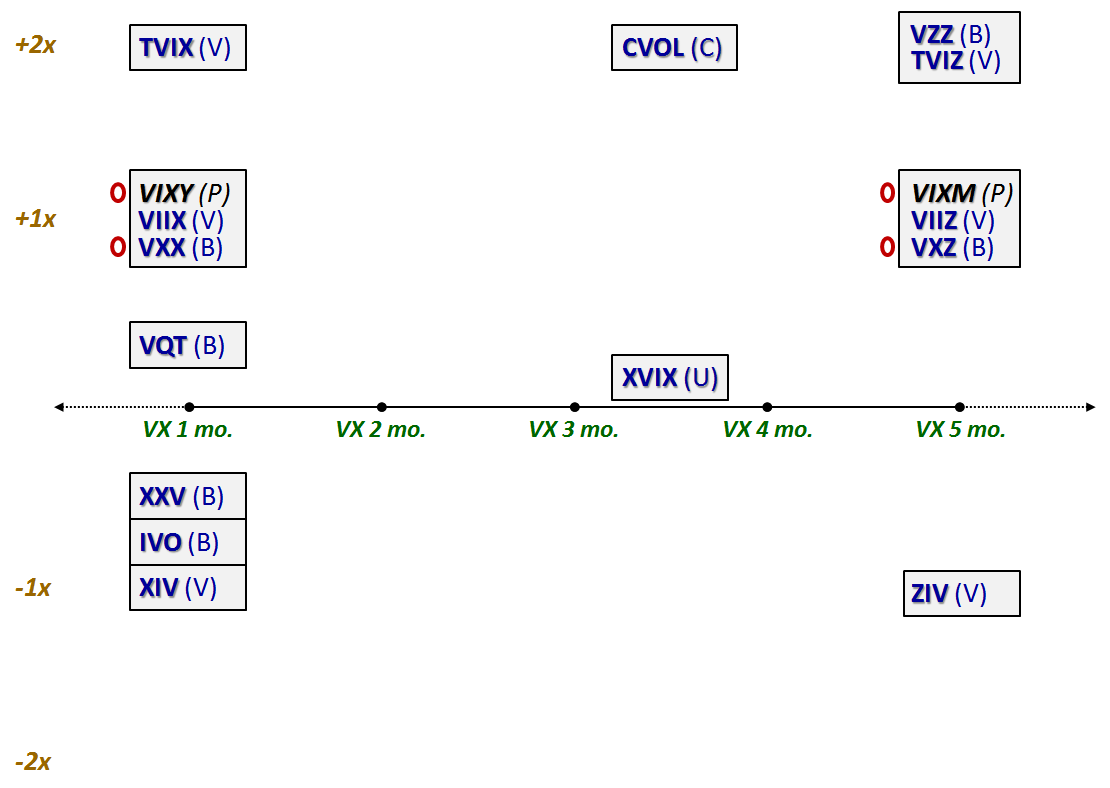
The graphic below is part of my ongoing effort not only to maintain a list of all the volatility-based exchange-traded products, but present them in a manner which helps to highlight the distinctions among these products.
Since I last updated this picture, in early December, three new VIX-based ETPs have entered the fold. Two of these are the first VIX-based ETFs and also represent the first products in this space from industry heavyweight and leveraged/inverse ETF heavyweight ProShares:

  • ProShares VIX Short-Term Futures (VIXY)
  • ProShares VIX Mid-Term Futures (VIXM)
As the chart below shows, VIXY enters the already-crowded space of VIX-based ETPs targeting VIX futures with one month maturity, while VIXM is aimed at the five month maturity space. ProShares undoubtedly hopes that by differentiating its products as ETFs rather than ETNs, the absence of credit risk associated with ETNs will resonate with investors. I have highlighted this distinction by using black italics for the ticker symbol of both ETFs.

ProShares has also been fortunate in that as of this week options are now being offered on VIXY and VIXM, making these only the third and fourth optionable volatility-based ETPs, following in the footsteps of VXX and VXZ. Note that all four optionable ETPs have a red O preceding their ticker.

The third new product to be launched in the past month is the iPath Inverse January 2021 S&P 500 VIX Short-Term Futures ETN, which trades under the ticker IVO. The launch of this ETN apparently confused some observers, but is likely an attempt by Barclays to come up with an ETF that does a better job of tracking the inverse of VXX. My concern is that over time IVOs ability to mirror changes in VXX will undergo the same dilution that happened to XXV. It is possible that Barclays will periodically trot out newer versions of XXV and IVO, but until then, I see these two products as performing more like a fractional inverse ETN than XIV. For this reason, I have put XXV and IVO in separate boxes in the one month -1x space to reflect this important distinction (see Shorting VXX and Long XXV or XIV for more details.)

There are several other small changes in this chart, including moving XVIX closer to the neutral volatility line to reflect the fact that on average the long and short volatility components of this ETN net out to a very limited exposure to volatility and more direct exposure to the VIX futures term structure.

With sixteen volatility-based ETPs available for trading and options on four of those, it is not an exaggeration to say that the number of possible volatility strategies and trades is limited only by the imagination.

Related posts:


Disclosure(s): short VXX; long XIV, VXZ and XVIX at time of writing

DISCLAIMER: "VIX®" is a trademark of Chicago Board Options Exchange, Incorporated. Chicago Board Options Exchange, Incorporated is not affiliated with this website or this website's owner's or operators. CBOE assumes no responsibility for the accuracy or completeness or any other aspect of any content posted on this website by its operator or any third party. All content on this site is provided for informational and entertainment purposes only and is not intended as advice to buy or sell any securities. Stocks are difficult to trade; options are even harder. When it comes to VIX derivatives, don't fall into the trap of thinking that just because you can ride a horse, you can ride an alligator. Please do your own homework and accept full responsibility for any investment decisions you make. No content on this site can be used for commercial purposes without the prior written permission of the author. Copyright © 2007-2023 Bill Luby. All rights reserved.
 
Web Analytics