Showing posts with label VXX. Show all posts

Thursday, April 28, 2022

The Latest on VXX and Additional Creation Unit Suspensions by Barclays

It has been 1 ½ months since Barclays announced the suspension of new creation units in the popular iPath Series B S&P 500® VIX Short-Term Futures ETN (VXX).  Today, we received some additional information from Barclays in conjunction with their earnings report. 

In a press release today, Barclays announced that it has suspended new creation units in an 31 Barclays iPath ETNs in addition to the VXX and OIL creation unit suspensions from March 14th.  The full list of ETNs with suspended creation units, sorted by average volume, can be found here, with a top five consisting of VXX, DJP, OIL, GRN and JJN.

Barclays provided some context for what is going on behind the scenes:

“Barclays PLC announced today that Barclays Bank plans to restate the financial statements included in its Annual Report on Form 20-F for the year ended December 31, 2021 (the “Form 20-F”) filed with the Securities and Exchange Commission (the “SEC”) and to amend the Form 20-F to reflect such restatement and to change its conclusions with respect to the effectiveness of its internal control over financial reporting and disclosure controls and procedures.  Because the registration statement and prospectus under which Barclays Bank makes sales of each series of ETNs incorporates by reference the Form 20-F, Barclays Bank and its affiliates cannot continue to make sales under such registration statement and prospectus until the restatement is completed and Barclays Bank files an amended Form 20-F and a new shelf registration statement. Barclays Bank expects to reopen sales of the ETNs when the amended Form 20-F and new shelf registration statement have been filed with the SEC and will make a further public announcement when this action is taken.”

In a nutshell, we are now going to have to wait until we have an earnings restatement for FY 2021 – and the timetable for that is highly uncertain.

In today’s Barclays PLC Q1 2022 Results Announcement release, the company discusses the matter in more detail in the notes section on (original numbering) pp. 29-31 and highlights the following:

“Barclays remains committed to its structured products business in the US and expects BBPLC to file a new shelf registration statement with the SEC as soon as practicable following the amendment of the BBPLC 2021 Form 20-F. For further details, please refer to the notes to the condensed consolidated financial statements accompanying this Q122 results announcement.”

This likely means that Barclays has no intention of shutting down VXX and accelerating the termination at the indicative value price.  That said, the earnings restatement hurdle does not seem like a quick fix, so…both longs and shorts have significant risks (see Further Reading links below for more details) with the VXX premium to its intraday indicative value (IV) (VXX.IV) currently at 13.6%.

Further Reading:
VXX Premium to Indicative Value Falls Slightly to 26%
VXX Upside vs. Downside Risk with No New Creation Units
Barclays Suspends Creation Units for VXX
Attempt at TVIX Short Squeeze Fizzling Out
The Resurrection of TVIX
TVIX Premium to Indicative Value Creeping Back Up
TVIX Creation Units Return; What It Means for Investors
Is TVIX Now Just a More Docile UVXY?
Recent TVIX Volume and VIX Futures Volume
The Story of VIX ETPs Relative to their Intraday Indicative Values
The Ups and Downs of the New Premium in TVIX
Credit Suisse Suspends Creation Units in TVIX: What it Means
Four Key Drivers of the Price of TVIX
Will TVIX Go to Zero?
Who Is Trading TVIX?
Volatility Becomes Unhinged on Friday
TVIX Finally Getting Its Due As Day Trading Rocket Fuel
All About UVXY

For those who may be interested, you can always follow me on Twitter at @VIXandMore

Disclosure(s): net short VXX at time of writing

Tuesday, April 19, 2022

SPX Weekly Options Will Soon Be Available with Expirations Every Day of the Week

Yesterday, the CBOE listed the first batch of SPX weekly options with a Tuesday expiration, starting with the April 26th and May 3rd expirations.  Interest is strong, as halfway through today’s session, there were already more than 12,000 contracts traded for just the April 26th expiration.

Readers may recall that the CBOE began to expand from monthly SPX settlements to add weekly Friday settlements back in 2005 and then began to embrace a broader scope of underlying issues with weekly options in 2010, including both VXX and VIX weeklys.  Once the Friday weeklys took off, the CBOE added SPX weekly options that expired on Mondays and Wednesdays.  In the intervening decade or so, weekly options have generated a substantial following, being used for event-specific hedging, short-term trading and day trading.  Weeklys showed their market power when organized retail traders of meme stocks used weekly options to trigger gamma squeezes that dramatically spiked the prices of the underlying stocks.  For more information on this, check out an informative CBOE article, How Meme Stocks Impact Options Trading.

While I am not likely to use this space to advocate day trading weekly options, these options have clearly added significantly to the trading toolbox.  Looking ahead, on Wednesday, May 11th, the CBOE will complete the suite of SPX weekly options, when they list SPX weekly options with a Thursday expiration, likely targeting May 19th and May 26th at the outset.

When this happens, in less than a month, there will be SPX options expiring every day of the week!

The implications for traders and investors are substantial.  You can have options that expire on every day there is an important economic data release, earnings report, FOMC meeting, election, astrological market timing signal or whatever floats your boat.  For those who trade calendar spreads, diagonal spreads or are otherwise interested in fine-tuning the time component of their options expirations, the full suite of weeklys with daily expirations will create a great deal of flexibility in trade structuring, trade adjustment, pricing of positions, etc.  The bottom line:  SPX options expiring every day of the week will introduce a whole new set of opportunities.

What’s next?  Do I hear any votes for hourly options?


[source(s):  LiveVol Pro / CBOE]


Further Reading:
Weekly Options Coming on Strong
What a Difference a Weekly Makes
VIX Weekly Options Coming on September 28
Weekly Options Gain Momentum

For those who may be interested, you can always follow me on Twitter at @VIXandMore

Disclosure(s): net short VXX and VIX at time of writing; the CBOE is an advertiser on VIX and More

 [source(s):  LiveVol Pro / CBOE]

Thursday, April 14, 2022

UVXY Dominates VIX ETPs By Dollar-Weighted Volume

At various times in the 13-year history of VIX ETPs there have been as many of 30+ different versions of these VIX-based products on the market.  Initially, it was the +1x VXX that dominated the space, later supplanted by the +2x TVIX and then the -1x XIV as the top dog.  All three of these products have run into various issues (see VIX ETPs – What Can Go Wrong?), with XIV dead, TVIX relegated to irrelevance and trading by appointment on the pink sheets as TVIXF and VXX currently wounded by regulatory issues (Barclays Suspends Creation Units for VXX).

In the wake of all this carnage, which products are still viable?  A month ago I would probably have argued that VXX was the most important product in the space, but with VXX’s creation unit troubles, the +1.5x UVXY ETF from ProShares is the clear market share leader, with 63.3% of the dollar-weighted volume in the VIX ETP product space.  The ProShares -0.5x SVXY ETF has the second highest dollar-weighted volume in the space at 19.4% and in third place at 9.8% is the +1.0x VIXY ETF.  VXX from Barclays has fallen to fourth place at 5.8%.  For now, the VIX ETP space is dominated by the ProShares product suite.  The two new kids on the block, the +2.0x UVIX and the -1.0x SVIX from Volatility Shares are gaining some traction, but still have only 0.7% dollar-weighted volume share.

In the graphic below I show the dollar-weighted volume as of yesterday’s data.  Note that the top six products all have a weighted-average maturity of one month while the two laggards, VIXM and VXZ, both have a weighted-average maturity of five months.


 [source(s):  Yahoo, VIX and More]


Further Reading:
UVIX and SVIX Join the VIX-Based ETP Landscape
VIX ETPs – What Can Go Wrong?
Successful Launch for SVIX and UVIX
VIX ETPs Flash Some Green in 2016
Every Single VIX ETP (Long and Short) Lost Money in 2015
Performance of VIX ETPs During the Recent Debt Ceiling Crisis
Expanded Performance of Volatility-Hedged and Related ETPs
Performance of Volatility-Hedged ETPs
Performance of VIX ETP Hedges in Current Selloff
Slicing and Dicing all 31 Flavors of the VIX ETPs
Charting the Assets of the Volatility-Based ETPs

For those who may be interested, you can always follow me on Twitter at @VIXandMore

Disclosure(s): net short VXX, UVIX and UVXY, net long SVIX at time of writing


Monday, April 4, 2022

VIX ETPs – What Can Go Wrong?

For many years, I’ve had a tagline at the bottom of my email: “In volatility there is opportunity!”  The tagline is a reminder that when things look darkest in the financial markets, this is often an area of maximum opportunity.

On the other hand, the VIX ETPs have quite a few quirks and as a result of these quirks and their high volatility, there are considerable risks for both longs and shorts.  How much risk?  Quite a lot.  Consider that on a split-adjusted basis, the +2x long TVIX launched at 2.66 billion (not a typo!) and trades anywhere from less than a dollar (the TVIX.IV indicative value) to 2.45 TVIXF (on the pink sheets), depending upon how you wish to measure the magnitude of the bloodbath.  On the other side of the coin, the -1x short XIV fell 93% on one day back in the February 2018 volatility spike now known as Volmageddon that resulted in an acceleration event (triggered when the price of XIV fell by more than 80% on a single day) and the closing of XIV.

From the 30,000-foot perspective, the big risk in being short volatility is that a big one-day VIX spike can theoretically destroy the value of your entire position.  On the other hand, the big risk in being long volatility is that you die a death by a thousand cuts and suffer the same 85% per year compound annual decline experienced by a product like TVIX.

There are many individual risk factors that are responsible for the total risk of an individual VIX ETP.  I have spelled out a number of these in the past, spending considerable time on contango and negative roll yield.  Way back in May 2009, I summarized some of my thinking in the likes of VXX Calculations, VIX Futures and Time Decay and elaborated on some of those themes in October 2009 in Why VXX Is Not a Good Short-Term or Long-Term Play.  I also addressed the subject of how reverse splits are the only thing keeping some of these products from falling to zero in Will TVIX Go to Zero? in February 2012.  In that post, I highlighted this gem from the TVIX prospectus:

“The long term expected value of your ETNs is zero. If you hold your ETNs as a long-term investment, it is likely that you will lose all or a substantial portion of your investment.”

One of my better summaries of the factors putting downward pressure on the price of TVIX came in Four Key Drivers of the Price of TVIX in 2012.  Here is the meat of that post:

1.  Volatility – this seems obvious, but in the short-term, the movements of the front month and second month VIX futures explain almost all of the change in the price of TVIX. For day traders, TVIX becomes essentially a substitute for trading the VIX futures and with the exception of leverage, the other factors below are inconsequential.

2.  Leverage – another obvious factor, the 2x leverage in TVIX means that on average it moves about as quickly up and down in percentage terms as the VIX does and twice as quickly as a basket of front month and second month VIX futures. In the short-term, leverage means mostly that the moves in the underlying are exaggerated; in the long-term, leverage enhances volatility compounding and has a negative impact on price.

3.  Contango – thanks to the emergence of VIX ETPs as the cornerstone of volatility as an asset class, issues related to the VIX futures term structure in general and contango and negative roll yield in particular have become among the most frequently discussed issues in this space. Simply stated, the front month and second months of VIX futures are in contango more than 75% of the time, with the result being a monthly drag on TVIX’s price that exceeds the current annual yield on the 30-Year U.S. Treasury bond.

4.  Volatility compounding – the more volatility a leveraged security exhibits, the more that volatility will have a negative impact on performance over an extended period. The issue is the same as someone who owns a dress shop and marks the dress down 50% and then up 50% or reverses the chronology and marks the dress up 50% and then down 50%. Either way, the value of that dress declines by 25%. The same is true for leveraged ETPs and the degree of the price decay is a direct function of volatility.

While the number of VIX ETNs is dwindling, ETNs have their own set of issues, as these are debt securities – essentially a promise to pay the value of the underlying index – rather than a portfolio of VIX futures, as is the case with VIX ETFs.  We have seen issues related to VIX ETNs come to the fore with TVIX in 2012 when Credit Suisse suspended new creation units in TVIX only to resume new creation units a little more than a month later – roiling the supply and demand dynamics as well as the TVIX market price in both directions.  Last month something similar happened with Barclays and VXX when Barclays suspended new creation units in this product.  There are issues related to ETNs that are unique to these types of securities and include credit risk, counterparty risk, price risk relative to indicative value, etc.  The SEC summarizes some of these ETN-specific risks in this investor bulletin.

If you want to better understand some of the risk factors involved in these products, I highly recommend you review the prospectuses of some of the following ETNs and ETFs:

I am often asked if these products were designed to go to zero.  No, they were not designed to go to zero.  The original intent was that these products would be short-term hedging or speculative instruments for institutions.  They do, however, have structural flaws that begin to appear as soon as these products are held for more than one day.  Over time, these structural flaws compound and will dominate the price action.

For all the reasons state above, I urge anyone considering trading VIX ETPs to review all relevant prospectuses and make a concerted effort to educate yourself on the products, their price histories and the reasons behind those price movements.  For those who insist on trading these products, it is always safest to consider defined risk trades so that the maximum loss is known in advance.  This may be a long position, a long or short position with an options hedge, or an options position such as a vertical spread that is a defined risk trade.

In the graphic below, I show the lifetime history of TVIX/TVIXF in black and TVIX.IV in red (it was the same as TVIX until it was delisted in July 2020).  Note that the Y-axis is on a log scale so that the data captures the relatively constant percentage declines, rather than the precipitous drop in price.  For fun, try to pick out any major spike in volatility on this chart other than the pandemic.

[source(s):  Yahoo, VIX and More]

Further Reading:
VXX Upside vs. Downside Risk with No New Creation Units
Barclays Suspends Creation Units for VXX
Four Key Drivers of the Price of TVIX
Will TVIX Go to Zero?
TVIX Creation Units Return; What It Means for Investors
Credit Suisse Suspends Creation Units in TVIX: What it Means
Why VXX Is Not a Good Short-Term or Long-Term Play
VXX Calculations, VIX Futures and Time Decay
Using Options to Control Risk in Leveraged ETFs

For those who may be interested, you can always follow me on Twitter at @VIXandMore

Disclosure(s): net short VXX and UVXY, long SVIX at time of writing

Wednesday, March 30, 2022

Successful Launch for SVIX and UVIX

Today was the first launch of a VIX ETP in six years, at least by my count.  It appears to be worth the wait, as SVIX (Volatility Shares -1x Short VIX Futures ETF) had very robust volume, with 380,385 shares handily topping the 215,700 shares VXX traded in its debut back on January 30, 2009.  UVIX (Volatility Shares 2x Long VIX Futures ETF) just missed the VXX debut mark with 213,688 shares traded.

As an added bonus, I understand that options are scheduled to begin trading on both SVIX and UVIX tomorrow.

I previously opined, in UVIX and SVIX Join the VIX-Based ETP Landscape, on how I believe the superior product design and daily rebalancing methodology for SVIX and UVIX have the potential to make these the top two products in the VIX ETP space.  That said, it is still early days and when it comes to VIX ETPs, big surprises often lurk just around the corner.

[source(s):  Yahoo]

Further Reading:
UVIX and SVIX Join the VIX-Based ETP Landscape
First Day of Trading in VXX and VXZ a Success

For those who may be interested, you can always follow me on Twitter at @VIXandMore

Disclosure(s): net short VXX and long SVIX at time of writing

Tuesday, March 29, 2022

VXX Premium to Indicative Value Falls Slightly to 26%

It has been two weeks since Barclays surprised volatility investors by announcing the suspension of new creation units in the popular iPath Series B S&P 500® VIX Short-Term Futures ETN (VXX).  Yesterday, a Barclays press release clarified some of what happened, noting that the firm had issued $15.2 billion more in VXX than had been authorized in an August 2019 $20.2 billion shelf registration.  Barclays has elected to conduct a rescission offer to eligible purchasers and is also dealing with regulatory authorities on this matter.

As for the future of VXX, Barclays was vague, but ended their press release with the following statement:

“Barclays intends to file a new automatic shelf registration statement with the SEC as soon as practicable.  Barclays remains committed to its structured products business in the United States.”

It is worth noting that VXX is a small part of the $12.7 billion structured products business in the United States that Barclays has pledged to continue with.  In that respect, the future of VXX is uncertain, but the intent to file a new automatic shelf registration “as soon as practicable” is certainly a favorable development.

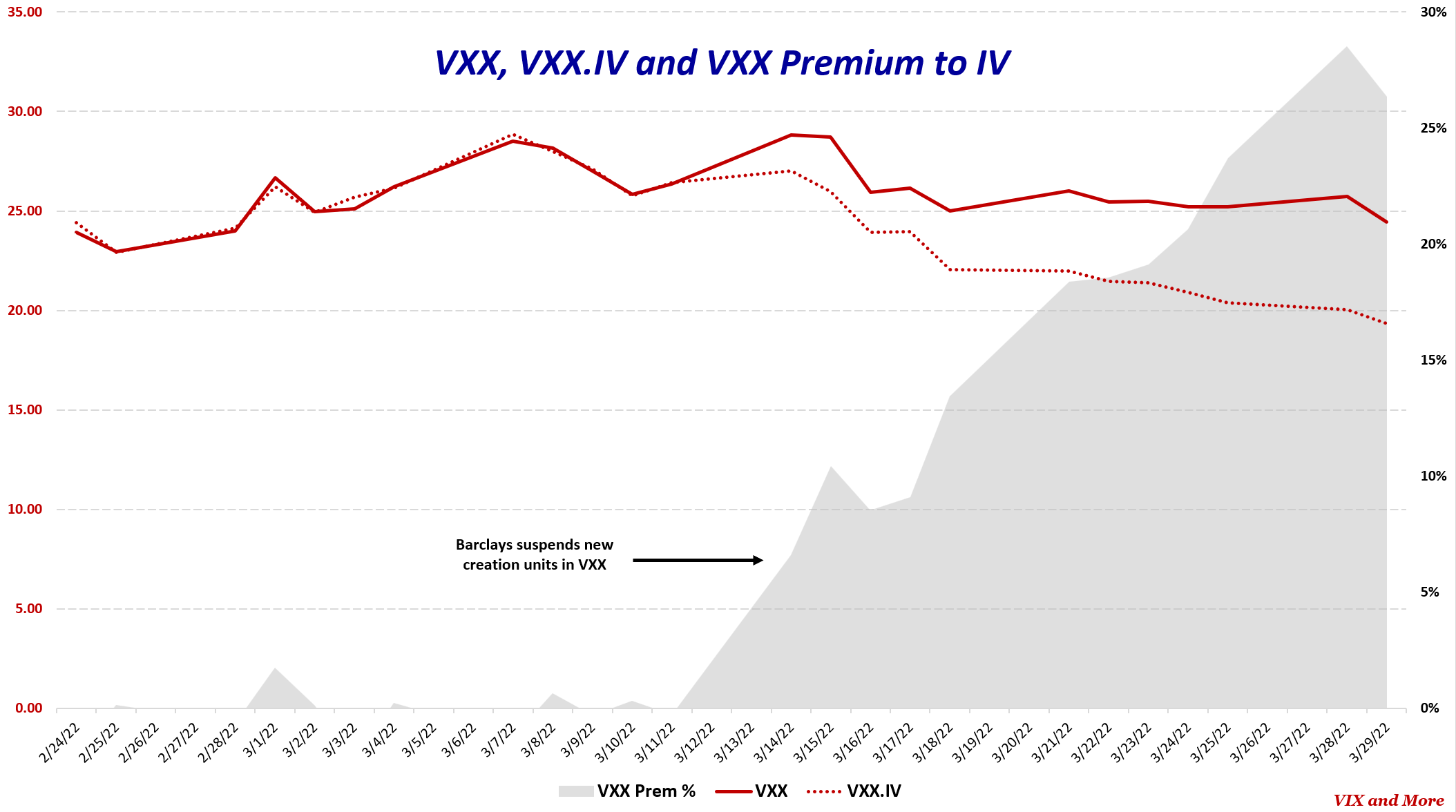
VXX is down today with positive developments in the talks between Russia and Ukraine, but for the first time since March 16th, the VXX premium relative to its intraday indicative value (IV) is down from the previous day, currently at 26.3%, down from yesterday’s 28.5% at the close.

The chart below captures the journey in VXX relative to indicative value (VXX.IV) going back to the Russian invasion of Ukraine.

As noted previously, the risk for shorts is that the short squeeze will continue and maybe even accelerate, perhaps in dramatic fashion, with the VXX premium to VXX.IV rising sharply.  On the other hand, the risk for longs is that Barclays will suddenly announce a new automatic shelf registration and the premium to IV will suddenly collapse to zero, as was the case with TVIX and Credit Suisse back in 2012.

While options in VXX are expensive (implied volatility is at 120), defined risk options trades are typically the best way to proceed when there is substantial “jump risk” (or overnight gap up or gap down risk) in both directions.

Finally – and for completeness sake – I should note that the OIL ETN that also had its creation units suspended in conjunction with VXX continues to behave relative to its indicative value, currently showing a premium of just 0.05 over indicative value.

[source(s):  TD Ameritrade]

Further Reading:
VXX Upside vs. Downside Risk with No New Creation Units
Barclays Suspends Creation Units for VXX
Attempt at TVIX Short Squeeze Fizzling Out
The Resurrection of TVIX
TVIX Premium to Indicative Value Creeping Back Up
TVIX Creation Units Return; What It Means for Investors
Is TVIX Now Just a More Docile UVXY?
Recent TVIX Volume and VIX Futures Volume
The Story of VIX ETPs Relative to their Intraday Indicative Values
The Ups and Downs of the New Premium in TVIX
Credit Suisse Suspends Creation Units in TVIX: What it Means
Four Key Drivers of the Price of TVIX
Will TVIX Go to Zero?
Who Is Trading TVIX?
Volatility Becomes Unhinged on Friday
TVIX Finally Getting Its Due As Day Trading Rocket Fuel
All About UVXY

While it has not been updated in a while, new readers may also enjoy older posts that have been tagged with the Hall of Fame label.

For those who may be interested, you can always follow me on Twitter at @VIXandMore

Disclosure(s): net short VXX at time of writing

Friday, March 25, 2022

Flight-to-Safety ETP Performance During Invasion of Ukraine

Russia invaded Ukraine a little over a month ago, creating turmoil and panic in stocks and across a wide variety of asset classes and instruments. 

In the graphic below, I capture the performance of ETPs covering a variety of traditional flight-to-safety instruments that are used to de-risk or hedge an equity-centric portfolio.  These include: 
SHY: 1-3 Year Treasuries (solid red line)
GLD: Gold (dark purple line)
UUP: U.S. Dollar (light green line)
FXY: Japanese Yen (violet line)
FXF: Swiss Franc (light blue line)
VIXY: Short-Term VIX Futures (black line)

Note that normally I would use VXX, but the price distortions due to the suspension of new creation units makes VIXY a more accurate measure.

The graphic shows that none of the ETPs above turned in particularly strong performance.  Long volatility has been the best performer for the first two weeks, but is now down more than the S&P 500 Index, with a loss of over 12%.  The top performer for the entire period is gold, which has had a fairly steady if unremarkable return during this period.  The second-best performer is the dollar, which has seen a steady upside, but has consistently trailed gold.  Three ETPs have also generated losses, following a slight uptick the first few days.  The worst performer has been the Japanese yen and the other underperformers have been the Swiss Franc and 1-3 Year Treasuries.

All in all, these traditional or generic hedges have been a disappointment.  In my next post, I will look at some hedges that are better suited to the Russia-Ukraine situation and have delivered much better results.


[source(s):  StockCharts.com]

Further Reading:
Safe Haven Options Shrinking?
Chart of the Week: Flight-to-Safety ETPs
Revisiting the Flight-to-Safety Trade
Chart of the Week: The Flight-to-Safety Trade
Why Not Point Hedges?
Forces Acting on the VIX
A Conceptual Framework for Volatility Events


While it has not been updated in a while, new readers may also enjoy older posts that have been tagged with the Hall of Fame label.

For those who may be interested, you can always follow me on Twitter at @VIXandMore

Disclosure(s): Net short VXX and long GLD and SHY at time of writing

Tuesday, March 22, 2022

VXX Upside vs. Downside Risk with No New Creation Units

One week ago, Barclays announced the suspension of issuance of new creation units as well as sales from inventory for two of its ETNs: the iPath Series B S&P 500 VIX Short-Term Futures ETN (VXX); and the iPath Pure Beta Crude Oil ETN (OIL). 

The purpose of this post is to explain the risks for both long and short holders of VXX and to get a sense of how this story is likely to play out.

First of all, the announcement came before regular trading hours on March 14th and during the entire session, VXX traded at a premium of up to 3.28 points relative to its intraday indicative value (IV), as captured in a graphic in Barclays Suspends Creation Units for VXX.  By the end of the day, VXX was trading at a 1.73 point premium to indicative value -- which is what VXX would be trading at if new creation units were still enabled.

It wasn’t until March 15th that the fireworks begin.  That morning, VXX opened up another 2.08 points at 30.89, up 6.7% from the previous day’s close.  Right from the open there was some intense buying pressure that resulted in a short squeeze, with VXX briefly spiking as high as 41.65, up 44.6% from the previous day’s close.  That short squeeze was retraced over the course of the day and by the end of the session, VXX was down 0.11 on the day.  The action during the last five days has been relatively uneventful, though the volume in VXX has dropped approximately 90% from a pre-suspension average of about 50 million shares per day to less than 5 million today.  As of today’s close, VXX was at 25.44, some 3.93 points (15.4%) over indicative value.

The chart below captures the journey of VXX relative to indicative value (VXX.IV) in the seven days going back to the original announcement of the suspension of new creation units.  Note that for the last week, the VXX premium relative to VXX.IV has been in a range between 1.50 and 5.00, with that early short squeeze premium of 15.11 now firmly in the rear-view mirror.  At various times it appeared that traders had settled on 3.50 or 4.00 as an appropriate amount of premium for VXX in the absence of new creation units that could be used to arbitrage the price of VXX back down to VXX.IV.

The big questions are what to expect going forward and what are the risks to both long and short holders of VXX.  At the risk of stating the obvious, nobody outside of Barclays knows what will happen going forward, but Barclays described their move as a temporary suspension of creation units.  With VXX having assets of $729 million and a fee of 0.89% per year, Barclays has an incentive to find a solution for the creation units problem – and whatever is behind it – so that they can collect their $6.5 million annual fee from this product.  Credit Suisse was able to resolve a similar problem with the suspension TVIX new creation units in a month and a day back in 2012.  Barclays and VXX have been at this game longer than anyone else, with an initial launch of VXX back on January 30, 2009.  They have had 13 years to prepare for the present situation, which is likely a least partly related to hedging risks and costs associated with how Vladimir Putin proceeds with the invasion of Ukraine.  I expect they will find a solution to the new creation units problem in relatively short order, but I have no insight into whether this will be a matter of days or weeks.

Going forward, both longs and shorts have to expect that Barclays will bring VXX creation units back and when they do, the VXX premium relative to VXX.IV is likely to disappear almost instantly.  Truth be told, when Credit Suisse brought back creation units in TVIX back in 2012, it took two days for most of the indicative value premium to be wiped out, but those days were excruciating losses of 29.3% and 29.8% that left investors reeling and confused.  This time around the premium at risk of another new creation units air pocket is “only” 15.4% -- but there is very little to prevent this number from growing much larger.

This brings us to the other side of the equation.  How much higher can a short squeeze take VXX?  While 90% of the daily volume in VXX has evaporated in the past seven days, the current 5 million shares per day will likely have to shrink considerably more before a short squeeze has much in the way of potential staying power.  The DGAZ story from 2020 is a stark reminder that not only is it theoretically possible to see a spike of 12,000%, but such a spike has recently happened.  The problem for longs is that in waiting for a potential short squeeze, each day brings them one day closer to the seemingly inevitable announcement of a restoration of creation units and a 15.4% contraction in the price of VXX.  In addition to that potential 15.4% haircut, long holders should also keep in mind that VXX has lost an average of 56% per year going back to 2009 due to structural weaknesses such as contango, negative roll yield and daily compounding decay (which I have summarized in posts such as Four Key Drivers of the Price of TVIX), so time is not on the side of VXX longs.

In summary, the risk for shorts is the potential for a successful short squeeze along the lines of the DGAZ fiasco.  As volume in VXX decreases, which is likely to be the case until Barclays resolves the new creation units issue, the risk of a short squeeze rises.  On the other hand, the risk for longs is the resumption of new creation units almost immediately wiping out the premium over indicative value.  Both longs and shorts are likely to see their risks go up over time.  For VXX short, the assumption is that volume will continue to go down over time, increasing the risk of a short squeeze.  For VXX longs, the risk is that a solution to the creation units problem is just around the corner and could be announced at any time.  An announcement is unlikely to come out during the trading day, but overnight risk should be treated as considerably higher than intraday risk.

This situation is exactly the type of “jump risk” (or gap risk) that makes options an attractive way to structure a trade – either on the long or short side.  That said, note that implied volatility in VXX options is presently at an elevated level of 102, making outright purchases of VXX puts and calls expensive in the current environment.

I should note that VXX long holders may also be subject to acceleration risk, which means that this product is subject to early redemption or an “accelerated” maturity date, at which point the ETN would be redeemed at indicative value (VXX.IV) not at the current market price.  For more information on the risks associated with ETNs, FINRA has a good summary of the issues.

Last but not least, I should mention that the OIL ETN that had its creation units halted at the same time as VXX has seen very little in the way of premium over indicative value, with the biggest exception being a smaller squeeze/spike on the second day that coincided with the big spike in VXX.  Right now, the premium in OIL is a mere 0.03.  This does not mean that the Reddit wallstreetbets crowd will not suddenly pile into the OIL trade in an effort to squeeze the shorts in a lower volume name, but so far at least, the WSB crowd does not see OIL in the same way they saw the VXX or Opportunity of a Lifetime trade.

So, whether you are long or short VXX, understand the risks associated with your position and the time and volume factors also at work.  For those who insist on trading this name, consider structuring positions as defined-risk options trades.

In the graphic below, I show the premium of VXX to VXX.IV over the course of the last seven days, using 30-minute bars.


[source(s):  Yahoo, TD Ameritrade, VIX and More]

Further Reading:
Barclays Suspends Creation Units for VXX
Attempt at TVIX Short Squeeze Fizzling Out
The Resurrection of TVIX
TVIX Premium to Indicative Value Creeping Back Up
TVIX Creation Units Return; What It Means for Investors
Is TVIX Now Just a More Docile UVXY?
Recent TVIX Volume and VIX Futures Volume
The Story of VIX ETPs Relative to their Intraday Indicative Values
The Ups and Downs of the New Premium in TVIX
Credit Suisse Suspends Creation Units in TVIX: What it Means
Four Key Drivers of the Price of TVIX
Will TVIX Go to Zero?
TVIX Topples VXX as Highest Volume VIX ETP
Who Is Trading TVIX?
Volatility Becomes Unhinged on Friday
TVIX Finally Getting Its Due As Day Trading Rocket Fuel
TVIX Trades One Million Shares for First Time
All About UVXY

While it has not been updated in a while, new readers may also enjoy older posts that have been tagged with the Hall of Fame label.

For those who may be interested, you can always follow me on Twitter at @VIXandMore

Disclosure(s): net short VXX at time of writing

Tuesday, March 15, 2022

Barclays Suspends Creation Units for VXX

 Earlier today, Barclays announced the suspension of issuance of new creation units as well as sales from inventory for two of its ETNs: the iPath Series B S&P 500® VIX Short-Term Futures ETN (VXX); and the iPath Pure Beta Crude Oil ETN (OIL).  VXX is the premier VIX-based ETP and has been the most popular subject on this blog for the past 13 years.  It was the first VIX ETP to launch back on January 30, 2009 (along with VXZ) and remains the flagship product in the volatility space, averaging 70 million shares traded per day and regularly placing among the top five ETPs in terms of both share volume and options volume.

While the news from Barclays was a surprise, it was not unprecedented.  Credit Suisse suspended creation units in TVIX (a +2x version of VXX) twice: once in dramatic fashion in February 2012; and again in July 2020, when the product was delisted and moved to the pink sheets to trade under the TVIXF ticker.

The first time around, on February 21, 2012, there was not a VIX spike, per se, that triggered the event.  Instead, it was the general popularity of the product and the size of holdings in the TVIX note (ETNs are an unsecured debt note) that concerned the bank.  Credit Suisse acknowledged that the TVIX note violated the bank’s risk management rules related to the “internal limits on the size of the ETNs” and thus triggered the suspension of creation units.

The second time around, on July 12, 2020, the record volatility spike associated with the onset of the pandemic caused the size of the TVIX note to be roughly half of the size of the bank.  As a result, Credit Suisse concluded that the risk of continuing with this product was too high, so they decided to exit the ETN business, stop issuing new creation units and delist nine ETNs.

In both 2012 and 2020, the absence of new creation units led to a supply shortage and a large premium in the market price relative to the intraday indicative value (IV).  In 2012, new creation units were halted for a month and a day, with the price of TVIX rising to an 89% premium to TVIX.IV at one point.  When TVIX creation units were restored, TVIX fell 60% in three days and soon was trading within 1% of indicative value.  In 2020, the cessation of new creation units was final and irreversible, so TVIXF has now been trading on the pink sheets for 21 months without any new creation units.  Initially, there was almost no premium in TVIXF to TVIX.IV, but the Reddit r/wallstreetbets crowd eventually latched onto the potential for a short squeeze in TVIX in early February 2021 and spiked the price of TVIXF from parity to a 43% premium in two days.  Since the initial targeting by r/wallstreetbets, the premium in TVIXF to TVIX.IV has averaged about 72% and has been as high as 160% at one point.

An even more famous and noteworthy example of investors targeting a product with no creation unit capabilities for a short squeeze is the plight of the VelocityShares Daily 3x Inverse Natural Gas ETN (DGAZF), which spiked from 400 to 24,000 in a week in August 2020.  The VelocityShares Daily 3x Inverse Natural Gas ETN was traded under the ticker DGAZ when it delisted, with no new creation units along with TVIX on July 12, 2020.  The combination of longs targeting a short squeeze, limited liquidity in the OTC pink sheets, no new creation units and 3x leverage made for a historic spike of 12,000% in one week.  While such a scenario is unlikely to unfold in VXX, it is important to understand the history and the potential for outsized short squeezes when there are no creation units available to arbitrage away the difference between the heavily shorted underlying and its indicative value.

There are many other examples of ETPs that have had their creation units suspended, with resultant price anomalies.  Deutsche Bank did it with a variety of commodities ETNs in 2011 and 2012.  PowerShares also suspended creation units in the popular PowerShares DB Oil Fund (DBO) in 2015, with yet another large price spike.

While buyer beware is a good mantra to keep in mind when purchasing ETFs or particularly ETNs, it is even more important for short sellers to understand the risks of holding one or more of these products short when creation units are suspended and particularly when the products are delisted, with trading moving to the OTC pink sheets.

As for VXX, the reasons for the halt in creation units are not exactly clear.  Barclays says in their press release:

“This suspension is being imposed because Barclays does not currently have sufficient issuance capacity to support further sales from inventory and any further issuances of the ETNs. These actions are not the result of the crisis in Ukraine or any issue with the market dynamics in the underlying index components. Barclays expects to reopen sales and issuances of the ETNs as soon as it can accommodate additional capacity for future issuances.”

The underlying cause of the issuance capacity issue may be a number of factors, including the cost of hedging the position, exchange position limits or other factors.  Without knowing the underlying cause, it is difficult to predict when new creation units will be restored.  That said, as VXX appreciates in price, the size of the problem Barclays needs to tackle will continue to rise, which may further complicate the resolution process.

Of course, when new creation units are restored, one can expect that the price of VXX will almost immediately fall to that of VXX.IV.  Investors, therefore, need to understand the risks associated with long positions going forward and not find themselves in an air pocket like TVIX longs did back in March 2012.  For this reason, anyone who is insistent upon holding a long or short position in VXX should consider constructing a defined-risk position using options.  Alternatively, VIXY is an ETP issued by ProShares that holds a basket of VIX futures rather than an unsecured bank note with a promise to return the same performance as that basket of VIX futures.

It should go without saying that everything here I addressed relative to VXX is true for OIL as well and with all the turmoil in the oil markets related to events in Ukraine and Russia, there is already the potential for huge moves in the underlying.

I covered the TVIX creation units issue in considerable detail in 2012 and the links below probably provide the most comprehensive review of this matter anywhere on the internet.  I have also provided links to a number of tangential issues related to VIX ETPs and pricing anomalies.

In the graphic below, I show the divergence between VXX and VXX.IV during today’s regular trading hours (Pacific Time).  I find it interesting that it took more than three hours after the initial press release before VXX began to uncouple from VXX.IV and spike higher, ultimately reaching a 12% premium before the divergence began to narrow during the last half hour of trading.

Long-term, I still think VXX is likely to remain the premier VIX-based ETP, but Barclays has some work to do to get the creation units back and the product trading with a normal supply-demand balance.  Until then, keep a close eye on the varying premium of VXX and VXX.IV, while evaluating alternatives such as VIXY and UVXY.


Sunday, October 25, 2020

Updating the Current VIX-Based ETP Landscape

There is a lot going on in the markets, with several themes weighing on volatility or the potential for more volatility.  COVID-19 cases are spiking to new highs in Europe and the U.S. and could be at an inflection point in the U.S.  Election uncertainty is also unnerving investors with the election only nine days away.  Lasts and not least, markets are strongly influenced by the Pelosi-Mnuchin stimulus dance, which appears to have migrated from a tango to a polka – but at least the music is still playing.

In the time since I was a regular contributor in this space, a lot has happened in the volatility world and the VIX ETP space has also changed dramatically.  For this reason, it seems like a good time to update a favored VIX ETP graphic to reflect the many products that have closed, matured and been moved to the pink sheets.  In keeping with tradition (this graphic has been published many times in various incarnations since 2010), I have plotted all of the VIX ETPs with respect to their target maturity (X-axis) and leverage (Y-axis).

It has taken more a decade, but the bottom line is that the VIX ETP space has essentially been narrowed down to two dominant products:

VXX (iPath Series B S&P 500 VIX Short-Term Futures ETN) – the pioneering +1 long volatility ETN that launched back on January 30, 2009 and has been the dominant product in the VIX ETP space throughout its lifetime

UVXY (ProShares Ultra VIX Short-Term Futures ETF) – the +1.5x ETF that spent most of its life as a +2x product and moved to +1.5x following the February 2018 Volmageddon event which resulted in the termination of XIV

Both VXX and UVXY trade an average of over 30 million shares per day and both are regularly in the top 5-10 highest volume ETPs as well as ETP options volume leaders.  The remaining VIX ETPs have been largely relegated to niche product status.  Additionally, Credit Suisse delisted and suspended its VelocityShares ETNs, meaning that the former TVIX, VIIX and ZIV now trade in the OTC market under the symbols TVIXF, VIIXF and ZIVZF.  For this reason and because of low liquidity and the increased risk with trading on the OTC “pink sheets.” I have highlighted these tickers in red.


[source(s):  VIX and More]


Further Reading:
VIX ETPs Flash Some Green in 2016
Every Single VIX ETP (Long and Short) Lost Money in 2015
Performance of VIX ETPs During the Recent Debt Ceiling Crisis
Expanded Performance of Volatility-Hedged and Related ETPs
Performance of Volatility-Hedged ETPs
Performance of VIX ETP Hedges in Current Selloff
Slicing and Dicing all 31 Flavors of the VIX ETPs
Charting the Assets of the Volatility-Based ETPs

For those who may be interested, you can always follow me on Twitter at @VIXandMore

Disclosure(s): net short VXX and UVXY at time of writing


Tuesday, May 2, 2017

Euro Zone VSTOXX ETNs Land on U.S. Beaches!

Think the market is too complacent about this weekend’s election in France?  Worried that the euro area is going to crumble under the weight of Italy’s struggles?  Convinced that Greece, Portugal or Spain are just one more kicked can away from a disaster?

As of tomorrow, investors in the U.S. will have another way to translate these ideas into actionable trades with tomorrow’s launch of two new exchange-traded notes (ETNs) – EVIX (long euro zone volatility) and EXIV (inverse euro zone volatility) – from VelocityShares and UBS that put a European face on existing U.S. VIX-based products such as VIIX and perennial favorite XIV.

Based on the VSTOXX, the VIX-like volatility index for the EURO STOXX 50 Index of 50 blue-chip stocks from 11 euro zone countries, EVIX and EXIV should be familiar to those who are knowledgeable about VXX and VIIX on the long volatility side as well as XIV and SVXY on the short volatility side.  EVIX and EXIV are based on VSTOXX futures and have a target maturity of 30 days – a maturity that is maintained by rolling a portion of the portfolio each day and therefore subjecting both products to the vagaries of contango and backwardation.  In the event these are terms you are not familiar with, I strongly recommend that you click on the links above and educate yourself.  Believe it or not, this is the ninth year I have been talking about the VIX futures term structure, negative roll yield, contango and backwardation.  (Those who have been paying attention since the early days of VXX and VXZ have no doubt profited mightily from this knowledge.)

The beauty of EVIX and EXIV is that these products create so much flexibility for investors who maintain a global, cross-asset class view of volatility.  In the run-up to the first round of the French election, for example, VSTOXX spiked dramatically and pushed the VSTOXX:VIX ratio below 1.00, creating some interesting arbitrage opportunities and/or pairs trades in the process.  Now investors can trade euro zone volatility against U.S. volatility, use targeted hedges for risk that is specific to the euro zone or speculate more easily about the direction of volatility in the euro zone.

I encourage everyone to study the EVIX and EXIV prospectus closely.

This is a huge development in the volatility space and if options on EVIX and EXIV follow later this week, as expected, the volatility trading landscape will be much richer and more diverse. 

Now if we can only get liquid volatility products for gold volatility (GVZ) and crude oil volatility (OVX), I won’t even have to set out a stocking next to the chimney this Christmas.

While I’m at it, why are there no options on XIV?  This is such a popular high-beta product that it deserves options so traders can express a broader range of opinions on volatility.  Readers, it never hurts to nudge the CBOE on these issues.  An outpouring of popular sentiment can make a difference.

As the risk of charging off into full rant mode, I feel compelled to say that I hope volatility investors know a good thing when they see it.  It is a shame that VXST futures did not attract enough attention to hang around and that VMAX and VMIN are not trading with higher volumes.  One of the best volatility products ever created, ZIV, nearly died of neglect before investors finally paid it some attention.

As I see it, EVIX and EXIV as well as VMAX and VMIN are test cases for the future of the breadth of volatility products.  If you would like a diverse tapestry of volatility products in the future, it would not hurt to “buy local” volatility ETPs rather than sticking to the handful of already successful products.  If you don’t vote with your feet, you had better be happy playing in a small and rather limited sandbox.  I am fond of saying, “In volatility, there is opportunity!” – but that opportunity is a function of the richness of the various volatility product platforms.

Last but not least, I know Eurozone and eurozone are the preferred spellings, but I am sticking to the two-word “euro zone” with as much stubbornness as I can muster.  What can I say, I am short convention…

Further Reading:

For those who may be interested, you can always follow me on Twitter at @VIXandMore

Disclosure(s): net short VXX and VMAX; net long XIV and ZIV at time of writing.  The CBOE is an advertiser on VIX and More.

Tuesday, May 17, 2016

Updated VIX ETP Landscape, Including VMAX and VMIN

Now that the recently launched REX VolMAXX Long VIX Weekly Futures Strategy ETF (VMAX) and REX VolMAXX Inverse VIX Weekly Futures Strategy ETF (VMIN) VIX exchange-traded products have started to achieve critical mass, I thought it would be a good time to update my VIX ETP landscape chart.

In the graphic below, I have plotted all of the VIX ETPs with respect to their target maturity (X-axis) and leverage (Y-axis). 


[source(s):  VIX and More]

The most interesting change in this chart is the addition of VMAX and VMIN, which are on track to trade over 100,000 as a pair today for the first time since their launch two weeks ago.  In deciding where to plot these two issues, I note that the 10-day historical volatility of VMAX and VMIN is approximately 30% higher than their more popular competitors, VXX and XIV.  As VMAX and VMIN are actively managed and do not have a fixed target maturity, I am electing to assume that based on the early history, the target maturity is in the 2-3 week range.  Additionally, while there is no leverage being used in the traditional sense, as is the case with UVXY, TVIX and TVIZ, so far the use of VIX weekly futures in addition to the standard monthly VIX futures means that VMAX and VMIN have a higher beta than VXX and XIV.  For this reason, I have also plotted VMAX and VMIN as having slightly higher "leverage" than the group of VIX ETPs that have a target maturity of thirty days, such as VXX, XIV, etc.

Frankly, I am a little surprised that VMAX and VMIN have not attracted more interest in the trading community, as these products have features that should be very attractive to short-term traders.  For now, the bid ask-spreads are typically in the 0.05 – 0.10 range, but as these tighten up, I expect volume and trading interest will ramp up quickly.

One necrology housekeeping note of interest:  Citibank has decided to redeem early its C-Tracks Exchange-Traded Notes Based on the Citi Volatility Index Total Return (CVOL).  The last day of trading for CVOL will be May 23, 2016, with cash payments to be made to investors on May 24, 2016.  The diagonal “X” through the ticker symbol in the chart indicates that this is the last time CVOL will appear on this graphic.

Finally, when one is trading VIX ETPs, it is always essential to consider the degree of contango (or backwardation) in the VIX futures, which can translate into substantial negative roll yield.  For the record, the current month is on track to have the third largest average negative roll yield for the month in the thirteen-year history of the VIX futures.  For those who may be interested, the top two months in terms of extreme negative roll yield were March 2012 and July 2004.

Related posts:


Disclosure(s): net short VXX, VMAX, UVXY, TVIX and TVIZ; net long XIV, VMIN and ZIV at time of writing

[source(s):  VIX and More]

DISCLAIMER: "VIX®" is a trademark of Chicago Board Options Exchange, Incorporated. Chicago Board Options Exchange, Incorporated is not affiliated with this website or this website's owner's or operators. CBOE assumes no responsibility for the accuracy or completeness or any other aspect of any content posted on this website by its operator or any third party. All content on this site is provided for informational and entertainment purposes only and is not intended as advice to buy or sell any securities. Stocks are difficult to trade; options are even harder. When it comes to VIX derivatives, don't fall into the trap of thinking that just because you can ride a horse, you can ride an alligator. Please do your own homework and accept full responsibility for any investment decisions you make. No content on this site can be used for commercial purposes without the prior written permission of the author. Copyright © 2007-2023 Bill Luby. All rights reserved.
 
Web Analytics