Showing posts with label Spain. Show all posts

Tuesday, March 10, 2020

Looking at Coronavirus Cases per Million, by Country


Further to yesterday’s Coronavirus (COVID-19), post, Tracking the Trajectory and Peak of Coronavirus Cases, I want to make sure we are thinking not just in terms of the absolute number of confirmed cases, but also cases per million. 

The graphic below highlights the countries which have been hit hardest on a per capita basis.  Using this criterion, Iceland is the country where the coronavirus is most prevalent, followed by Italy, South Korea, Iran, China and Switzerland.  These six countries stand out as having passed an inflection point.  Given the data out of Western Europe in the past 48 hours, it appears as if Spain, Sweden, France and Denmark are not far behind.  The U.S. currently ranks 41st in terms of cases per million, with just 1/100th of the penetration in Iceland.

[source(s):  Wikipedia, VIX and More]

Assuming the distribution of new cases continues to trace a parabolic path, being able to reasonably estimate the terminal penetration rate – which will no doubt vary by country – could help to set expectations about the progress and timeline of new cases.

Finally, to follow up on yesterday’s post, I am now dating the first day of 100 new cases in the U.S. at March 7th.  Using the 8-14 day window for 100 new cases to peak new cases means the U.S. could see peak new cases in the March 15th – March 22nd time frame, with an outside shot of the peak extending out to March 29th.  Of course, this projection are merely an extrapolation from the experience in other countries and will be largely dependent upon the rate at which testing is ramped up in the U.S.

Further Reading:

For those who may be interested, you can always follow me on Twitter at @VIXandMore

Disclosure(s):
none

Monday, March 9, 2020

Tracking the Trajectory and Peak of Coronavirus Cases


I have seen a lot written about the Coronavirus, a.k.a. COVID-19, but I have yet to see any informed discussion about the trajectory of cases in various regions, the cycle time to peak new cases or meaningful predictions about the future course of the spread of the virus.

So here are some thoughts on the subject, using historical data from Wikipedia that is more standardized in time and collection methodology than any other data I have been able to find on the Web.  First, I examined the entire history of case data by country and found inflection points that roughly correspond to 10 new cases and 100 new cases per day.  As identification of initial cases is somewhat problematic given the variable protocols for testing, availability of testing kits, timing of nearby positive cases, etc. I elected to use the 100 new cases per day threshold.

It turns out that there have been seven countries so far that have logged 100 new COVID-19 cases in a single day.  In order of reaching that 100 new cases threshold, they are:  China (January 21st), South Korea (February 21st), Italy (February 26th), Iran (February 27th), France (March 5th), Germany (March 6th) and Spain (March 6th).  The U.S. has come close to the 100 new case threshold and may indeed hit that mark today or tomorrow.

The graphic below shows the daily number of new cases in each of the seven 100+ new case countries.  Note that it is reasonable to expect some sort of parabolic pattern for new cases with a steep jump in new cases that eventually flattens out, peaks and declines in a similar fashion.  This pattern probably would have been the case in China, except that on February 10th, China changed the methodology for counting new “confirmed” cases from relying strictly on the basis of a positive result from a lab testing kit to cases that included patients where CT scans for pneumonia allowed for a “confirmed” case clinical diagnosis for likely COVID-19 cases without having to wait for a lab test and results.

[source(s):  Wikipedia, VIX and More]

To summarize the data in the graph, three of the four countries that are at least ten days from the initial 100-case day have seen what appears to be a peak in new cases.  In China, it was 22 days from 100 cases to peak new cases, though it is possible that peak new cases might have been 14 days if China had not expanded the methodology for defining new cases to include a clinical diagnosis.

In South Korea, a concerted effort to ramp up testing as quickly as possible is probably responsible for the fact that South Korea saw a peak in new cases just 9 days after the first 100-case day.

While the peak in new case data in Iran should be considered provisional, the current peak in new cases was only 8 days after the first 100-case day, perhaps aided by the steep trajectory in new cases during the first five days.

Italy is the outlier in that there are no signs of a peak some ten days after the first 100-case day, though it is reasonable to expect that the newly implemented national lockdown and public gathering measures will help to slow the rate of new cases going forward.

The remaining three Western European countries – France, Germany and Spain are only 3-4 days into their post-100 timeline, so it is too early to talk about a peak.

The first quick takeaway is that the time from 100 new cases to peak new cases seems to cluster around 8-14 days or perhaps 8-22 days if you overlook the changes in the methodology for counting new cases in China.

Second, with the U.S. new case count hovering just below 100, it is reasonable to expect that the 8-14 day window for new cases will also apply to the U.S. putting a likely peak count in the March 17th – March 24th time frame, with an outside shot of the peak extending out to April 1st.  This assumes, of course, that the U.S. follows a similar trajectory to the other countries.  Along those lines, it will be interesting to see if Italy’s new cases peak during the next week.

Obviously, there are a number of factors that can affect how successful a country can be in containing the COVID-19 outbreak, conduct an appropriate number of tests and other factors. Japan, for instance, had its first case almost two months ago and has yet to approach 100 new cases in a day.

More to come on the COVID-19 global outbreak, the VIX, volatility and more.

Further Reading:

For those who may be interested, you can always follow me on Twitter at @VIXandMore

Disclosure(s): none

Tuesday, May 2, 2017

Euro Zone VSTOXX ETNs Land on U.S. Beaches!

Think the market is too complacent about this weekend’s election in France?  Worried that the euro area is going to crumble under the weight of Italy’s struggles?  Convinced that Greece, Portugal or Spain are just one more kicked can away from a disaster?

As of tomorrow, investors in the U.S. will have another way to translate these ideas into actionable trades with tomorrow’s launch of two new exchange-traded notes (ETNs) – EVIX (long euro zone volatility) and EXIV (inverse euro zone volatility) – from VelocityShares and UBS that put a European face on existing U.S. VIX-based products such as VIIX and perennial favorite XIV.

Based on the VSTOXX, the VIX-like volatility index for the EURO STOXX 50 Index of 50 blue-chip stocks from 11 euro zone countries, EVIX and EXIV should be familiar to those who are knowledgeable about VXX and VIIX on the long volatility side as well as XIV and SVXY on the short volatility side.  EVIX and EXIV are based on VSTOXX futures and have a target maturity of 30 days – a maturity that is maintained by rolling a portion of the portfolio each day and therefore subjecting both products to the vagaries of contango and backwardation.  In the event these are terms you are not familiar with, I strongly recommend that you click on the links above and educate yourself.  Believe it or not, this is the ninth year I have been talking about the VIX futures term structure, negative roll yield, contango and backwardation.  (Those who have been paying attention since the early days of VXX and VXZ have no doubt profited mightily from this knowledge.)

The beauty of EVIX and EXIV is that these products create so much flexibility for investors who maintain a global, cross-asset class view of volatility.  In the run-up to the first round of the French election, for example, VSTOXX spiked dramatically and pushed the VSTOXX:VIX ratio below 1.00, creating some interesting arbitrage opportunities and/or pairs trades in the process.  Now investors can trade euro zone volatility against U.S. volatility, use targeted hedges for risk that is specific to the euro zone or speculate more easily about the direction of volatility in the euro zone.

I encourage everyone to study the EVIX and EXIV prospectus closely.

This is a huge development in the volatility space and if options on EVIX and EXIV follow later this week, as expected, the volatility trading landscape will be much richer and more diverse. 

Now if we can only get liquid volatility products for gold volatility (GVZ) and crude oil volatility (OVX), I won’t even have to set out a stocking next to the chimney this Christmas.

While I’m at it, why are there no options on XIV?  This is such a popular high-beta product that it deserves options so traders can express a broader range of opinions on volatility.  Readers, it never hurts to nudge the CBOE on these issues.  An outpouring of popular sentiment can make a difference.

As the risk of charging off into full rant mode, I feel compelled to say that I hope volatility investors know a good thing when they see it.  It is a shame that VXST futures did not attract enough attention to hang around and that VMAX and VMIN are not trading with higher volumes.  One of the best volatility products ever created, ZIV, nearly died of neglect before investors finally paid it some attention.

As I see it, EVIX and EXIV as well as VMAX and VMIN are test cases for the future of the breadth of volatility products.  If you would like a diverse tapestry of volatility products in the future, it would not hurt to “buy local” volatility ETPs rather than sticking to the handful of already successful products.  If you don’t vote with your feet, you had better be happy playing in a small and rather limited sandbox.  I am fond of saying, “In volatility, there is opportunity!” – but that opportunity is a function of the richness of the various volatility product platforms.

Last but not least, I know Eurozone and eurozone are the preferred spellings, but I am sticking to the two-word “euro zone” with as much stubbornness as I can muster.  What can I say, I am short convention…

Further Reading:

For those who may be interested, you can always follow me on Twitter at @VIXandMore

Disclosure(s): net short VXX and VMAX; net long XIV and ZIV at time of writing.  The CBOE is an advertiser on VIX and More.

Friday, January 4, 2013

VIX ETP Performance in 2012

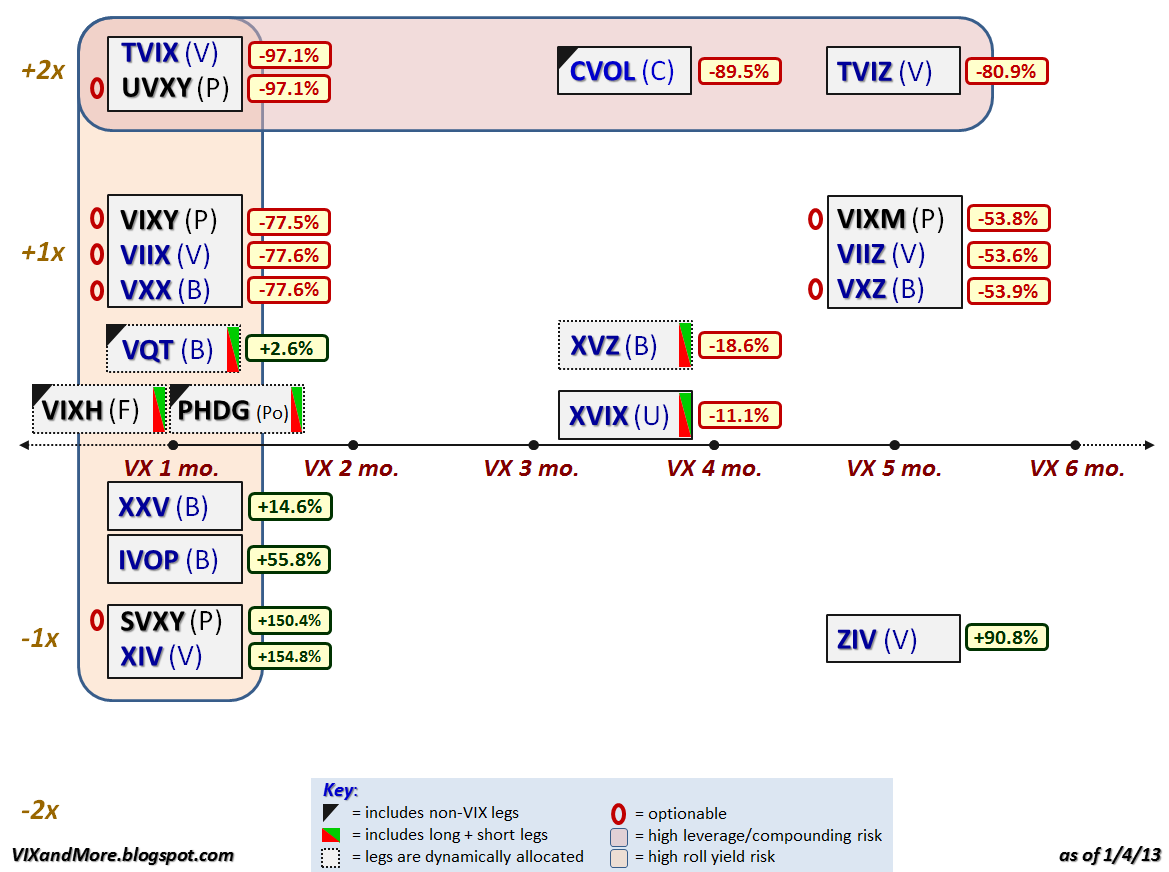
For anyone who pays attention to the VIX exchange-traded products space, 2012 was the year of the inverse (short) VIX futures ETP. The graphic below recaps the performance of the VIX ETPs that were trading as of the end of 2012 and it is easy to see that if you were long the inverse products (XIV, SVXY, ZIV, etc.) and were able to hold on to these positions during volatility storms such as the Greek elections, yield spikes on the sovereign debt of Italy and Spain, the fiscal cliff, etc. (all of which required nerves of steel and a creative risk management approach), then 2012 was a very good year for you. If not, then let the performance ups and downs be a reminder that most of the VIX ETPs are not well-suited for mainstream investors.

Instead of going into too much detail about the performance and reiterating much of what I have already said in the past, I encourage readers to investigate the links below, which include some predictions about future price moves and risk-reward ratios that have been borne out by the events of 2012.

If your new to this product space, perhaps the first place you should begin your research is with posts tagged with labels such as contango, roll yield and term structure – subjects that I have been writing about since the first VIX ETPs were launched, three years ago this month.

[Note that there are no performance numbers for VIXH or PHDG, as these products were launched during the year and have not yet accumulated full-year performance data.]

Related posts:

Disclosure(s): long XIV, SVXY and ZIV at time of writing

Wednesday, January 2, 2013

The Year in VIX and Volatility (2012)

Every year I assemble a chart that is my retrospective look at the year in volatility. While 2012 was the first year since 2006 that the VIX failed to make it out of the 20s, this was not due to an absence of threats to the stock market.

During the first half of the year, the euro zone was the primary concern for most investors, with the events surrounding the two nail-biting elections in Greece haunting the markets from April through June. With Greece off of the front page, focus of the European sovereign debt crisis shifted to unsustainable government debt yields in Spain and Italy, which only began to turn around after Mario Draghi pledged to do “whatever it takes” to save the euro in July.

Meanwhile, markets in the United States were relatively calm due to the repeated intervention of the Fed, which offered up QE 2.5, QE3 and QE4. The global economy also found support in the form of central bank stimulus plans from China, Japan and the euro zone.

The last hurrah for the VIX and volatility in 2012 was the fiscal cliff, which was largely overlooked during the U.S. elections, but dominated the headlines even before the last vote was counted. The fiscal cliff issue remained the #1 source of concern for investors throughout the balance of the year and had the VIX moving counter to its usual direction for most of December.

As 2013 dawns, fears related to the fiscal cliff are plummeting and dragging the VIX down with it, but clearly the issues that have kept the financial markets on edge for the past few years are not yet behind us and unseen risks are always lurking just over the horizon.

[source(s): StockCharts.com]

Related posts:

Disclosure(s): none

Friday, July 13, 2012

Rally Leaves Spanish Banks Behind

Stocks are firing on all cylinders today, with the S&P 500 index up more than 1.4% as I type this and most heat maps showing nothing but various shades of green. Even European stocks are strong today. With Europe’s exchanges closed for the weekend, the European country ETFs have followed the U.S. markets higher, though Spain’ ETF (EWP) has been a laggard.

Look at the ADRs for Spain’s banks, however, and it appears that the banks are not participating in today’s rally. Spain’s largest bank, Banco Santander (ticker SAN, previously STD until one month ago today) had managed a gain of just 0.03 today, while the country’s #2 bank, Banco Bilbao Vizcaya Argentaria (BBVA), is off 0.04.

In short, it appears that no matter what the U.S. markets do or the euro zone leaders say or do, stocks for these Spanish banks continue to act as if they are swimming in concrete shoes.

The chart below shows the price action in BBVA since the beginning of 2011, as well as a study on top of the main chart that tracks the performance of BBVA relative to SPY for the same period. In the ratio chart study, I have thrown a 200-day moving average of BBVA:SPY (solid blue line) to underscore that not only has the trend been consistently down, but the ratio has not even come close to trading over its 200-day moving average at any point in the past 1 ½ years.

For the record, the chart for SAN and the SAN:SPY ratio is equally ugly and a similar chart of EWP:SPY is no better than a chart of the Spanish banks.

It remains to be see how the situation with Spain and its banks will be resolved, but until there is some sort of resolution on the horizon, I would to continue to expect to see considerable activity in the puts of SAN and BBVA.

Related posts:

[source(s): StockCharts.com]

Disclosure(s): short SAN and BBVA at time of writing

Saturday, July 7, 2012

Chart of the Week: As Goes Spain…

Two years ago today, in Spain rallies, I posted a chart of the Spanish ETF, EWP, that showed EWP had rallied off of a bottom and looked like it was poised for a bullish breakout.

In July 2010, I saw Spain as the keystone in the euro zone puzzle:

“Spain is the tipping point in the European sovereign debt crisis as I see it. In a nutshell, as goes Spain, so goes Europe.”

Two years later, I still believe that Spain is the most important line in the sand that euro zone leaders have to grapple with and the country whose fate is probably most intertwined with the future of the euro.

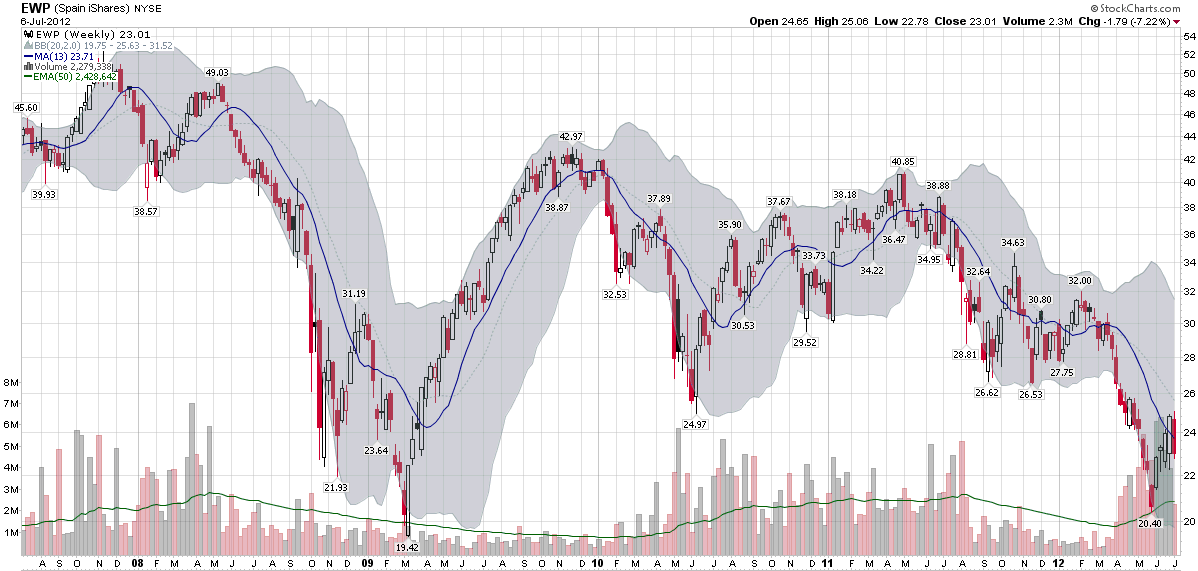
The chart of the week below shows weekly bars of EWP going back five years. The dominant feature in this chart is the financial crisis of 2008-2009. Various iterations of the euro zone crisis can be identified in the bottoms in June 2010, September 2011, November 2011, etc. EWP was in a gradual downtrend from April 2011 to March 2012, but fell sharply until the beginning of June. The most recent bounce in the Spanish ETF still looks somewhat tentative on the charts and is likely to be tested in the weeks and months ahead.

As concerning as the equity situation looks in Spain, the country’s credit default swaps (just 8% off of their all-time highs at 578) and yields on sovereign debt (yields on the 10-year bond are 5% below their all-time highs at 6.95%) indicate an even greater degree of financial stress.

At one time or another, I would expect Italy, France to find their way back into the crosshairs of traders who are looking to capitalize on euro zone angst, but as far as I am concerned, Spain will continue to the most critical line in the sand.

Related posts:

[source(s): StockCharts.com]

Disclosure(s): none

Thursday, June 28, 2012

The Evolution of European Equity Risk

There are many ways in which investors can evaluate risk related to the euro zone. Credit default swaps for sovereign debt are one way to evaluate the risk of country default. Sovereign bond yields are a good proxy for a country’s access to funding via the credit markets. The euro crosses and related directional moves are a barometer of the strength of the currency and the euro zone countries as a whole, while various Intrade contracts can lend a sense of the probabilities that investors assign to various events, such as to the risk of one or more countries dropping the euro.

On the volatility side, the VSTOXX (EURO STOXX 50 Volatility Index) the EVZ (CBOE EuroCurrency Volatility Index) provide a market assessment of risk and uncertainty in euro zone stocks as well as the currency.

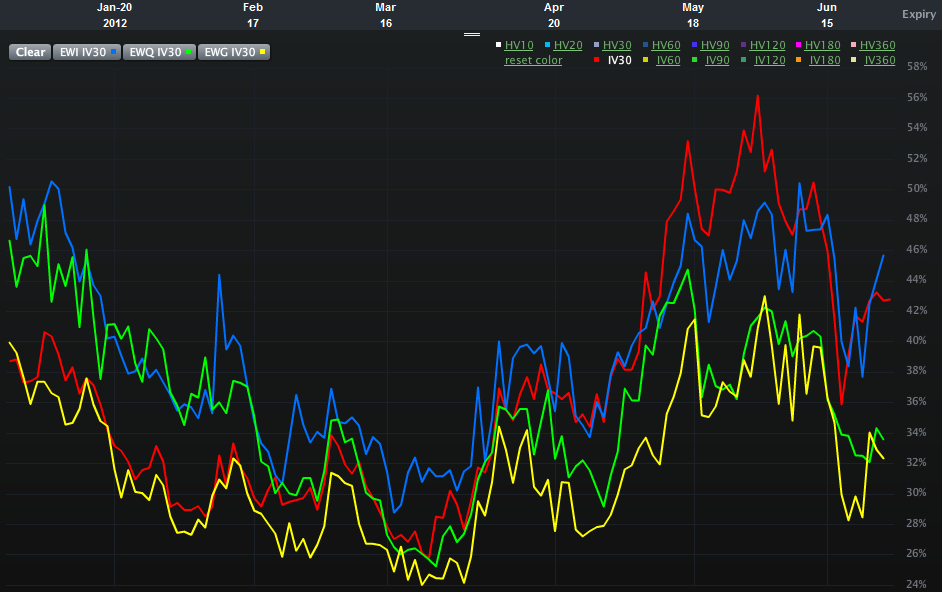
One piece of analysis I have not seen, however, is an assessment of the relative risk and uncertainty for equity markets in some of the more important euro zone nations. Specifically, Spain, Italy, France and Germany. The chart below attempts to offer up that very information, using 30-day implied volatility for the various country ETFs over the course of the past six months:

  • EWP – Spain (red line)
  • EWI – Italy (blue line)
  • EWQ – France (green line)
  • EWG – Germany (yellow line)

Looking at the chart, what initially catches my eye is the recent evolution of the two-tiered risk system. In the first half of the year, the higher risk is clearly associated with Italy and France, whereas Spain and Germany appear to be considerably less risky in terms of implied volatility. By the March the risk appears to have lessened across the board and the distinctions between individual countries is more difficult to discern. Over the course of the last 1 ½ months or so, a new two-tiered system has appeared. This time around it is Italy and Spain where the risk to equities is considered to be the greatest, with France now joining Germany in the lower risk tier.

In essence, Italy has persisted in the high risk tier and Germany has been a constant in the lower risk category. Over the course of the past few months, the interesting development has been the switch between France and Spain, with the former improving from being a peer of Italy to a peer of Germany, while Spain has moved in the opposite direction.

One could certainly argue that all four countries are in the same boat (taking on water, with shoddy life preservers, in shark-infested waters and being one small mutiny away from having no captain…), but clearly investors think there are important distinctions to be made in terms of equity risk and uncertainty. Perhaps of more interest, these fortunes appear to be shifting, with little perceptible difference not just between Spain and Italy, but also between Germany and France.

Related posts:

[source(s): LivevolPro.com]

Disclosure(s): Livevol is an advertiser on VIX and More

Wednesday, June 27, 2012

Euro Volatility and Risk

With the euro zone summit looming, investors are scrambling to find all sorts of measuring sticks to evaluate the risks of a sharp move in the financial markets. Based on some of the emails I have received, many are skeptical of the VIX right now, which is trading in the mid 19s, some 5% below its lifetime mean. At 27.54, the VSTOXX (EURO STOXX 50 Volatility Index) is showing much more uncertainty, but even that number is low relative to the range of the VSTOXX for the past three months.

Whether Spain, Italy or Greece is the fixation du jour, the questions investors really want answers to ultimately all cluster around the future of the euro. I have addressed this question relative to the risk of one or more countries leaving the euro in the context of various Intrade contracts (see links below), but another overlooked manner of measuring risk and uncertainty in the euro is the CBOE EuroCurrency Volatility Index (EVZ). Sometimes referred to as the “euro VIX,” EVZ uses the VIX methodology to measure the market’s expectations of future volatility in the euro. In theory, therefore, EVZ should also be a proxy for risk and uncertainty in the euro. One might even go as far as to consider EVZ as a euro zone fear indicator.

So what is a chart of EVZ telling us on the eve of another euro zone summit?

The chart below shows that at 11.27, EVZ is currently in the lower portion of its range of 9.23 – 20.34 for the past year. Indeed EVZ is only in the 18th percentile of the range of values over the course of the past year. Also of interest, the current 20-day historical volatility of EVZ (60) is lower than the 180-day historical volatility measure (65) – as has been the case for the majority of the last six months. Last but not least, EVZ has been on a notable downtrend since June 18th.

Headlines aside, traders do not see a lot of currency risk in the euro right now, at least relative to the last year or so and as far as the 30-day forward-looking window defined by EVZ is concerned.

So if you think the VIX is depressed and understating market risk, don’t expect the EVZ to be signaling something different. Currency risk and uncertainty seem surprisingly low at current levels. If you think the market has underpriced the potential for a large move in the euro, then consider some long straddles on the euro or its ETF counterpart, FXE.

Related posts:

[source(s): LivevolPro.com]

Disclosure(s): Livevol is an advertiser on VIX and More

Tuesday, June 12, 2012

Greek Elections and the Future of the Euro

While this week’s news cycle has been Spain, Spain, Italy and Spain so far (reminiscent of an old Monty Python skit, but I digress), it is easy to forget for a moment or so that Greece is holding another round of elections on Sunday.

As Greek law prohibits polling or publishing poll results in the 14 days leading up to an election, we do not know how voter sentiment about the bailout and remaining in the euro may be ebbing or flowing. Greek voters have certainly a great deal to think about, some of which may have been complicated by the positioning of Syriza’s leader, Alexis Tsipras, who insists that it is possible to repudiate the bailout agreement, start afresh with a new plan that is based on stimulating economic growth and job creation – yet never have to leave the euro zone in the process.

So just how will the Greek elections influence the future of the euro?

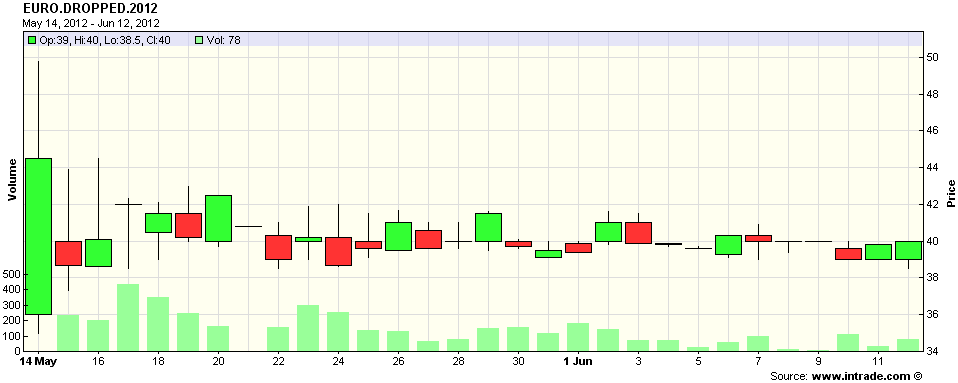
Without polls, the Intrade contract that specifies “Any country currently using the Euro to announce intention to drop it before midnight ET 31 Dec 2012” now becomes an even more valuable informational resource. The problem is that in spite of a fair amount of activity, the price of the contract has remained essentially unchanged for the last month, hugging the 40 level (see chart below), which means that participants continue believe that the chance of a Greek exit (I refuse to say ‘Grexit’) by the end of the year is about 40%.

By Monday we will have a much more information, but once again, the process of forming a coalition government may prove to be troublesome…or worse.

For those looking for hedges against some panic in the financial markets next week, keep in mind that VIX options do not expire this week, but next Wednesday, June 20th. As such, VIX calls may prove to be an appropriate hedge against at least short-term post-election anxiety. For those looking for volatility hedges on a week-to-week rather than monthly basis, it might be helpful to investigate VXX weekly options (A Favorite Trade: VXX Weeklys) as well. Last but not least, a reader favorite is a thought piece on the process of constructing hedges is Cheating with Partial Hedges.

Related posts:

[source(s): Intrade.com]

Disclosure(s): short VXX at time of writing

Thursday, May 17, 2012

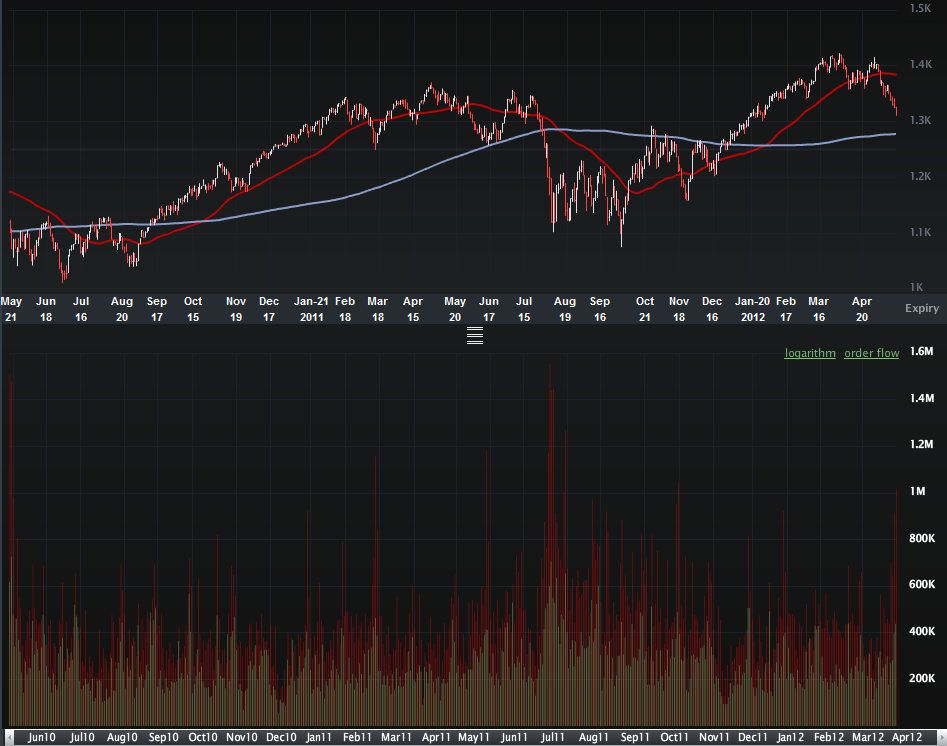
A Million SPX Put Contracts Traded Today…a Contrarian Timing Signal

With a half hour to go in today’s trading session, over one million put contracts have already been traded on the S&P 500 index, which is about 2 ½ times the average daily volume. This elevated put volume comes on top of 913,000 SPX put contracts yesterday, which was the second highest for 2012.

The one million level is rarely seen in SPX puts and generally indicates an extreme amount of hedging on the part of institutional investors, as well as increased speculative activity.

Looking at the chart below, which goes back two years, one can see that in those rare instances when put volume (vertical red bars on lower half of chart) reached one million, this typically coincided with a bottom in stocks.  [Edit:  today’s finally tally is 1.28 million SPX puts, the highest total since August 9, 2011]

In addition to puts in the SPX, I also closely follow the ISEE equities only call to put ratio. The indicator I have developed which is based on the ISEE is now showing is greatest contrarian bullish bias (due to a preponderance of put volume) since the end of June 2010, just two days before the SPX put in an key bottom at 1010.

Of course, history is not guaranteed to repeat itself or even rhyme in the face of the current worries about Greece and Spain, but the odds now favor stocks finding at least a short-term bottom very soon.

Related posts:

[source(s): LivevolPro.com]

Disclosure(s): Livevol is an advertiser on VIX and More

Thursday, May 3, 2012

Guest Columnist at The Striking Price for Barron’s: Why I Am Short Fear

Today I am a guest columnist for The Striking Price on behalf of Steven Sears at Barron’s, weighing in with Be Greedy While Others Are Fearful.

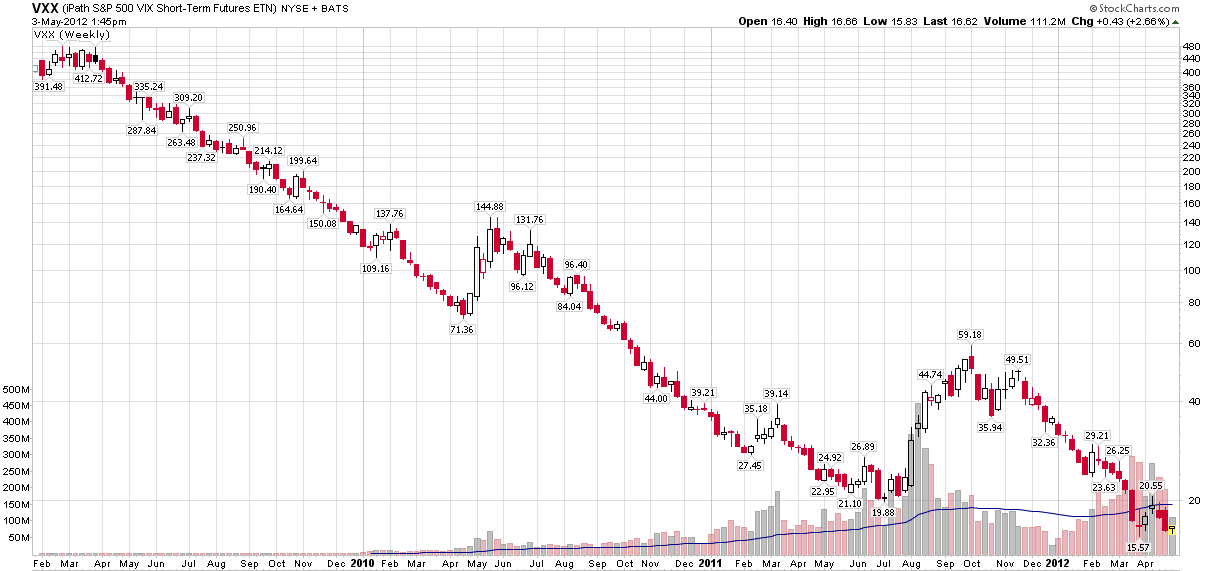
The Barron’s article is a quick summary of some of the reasons I am short fear. Essentially, I am short fear not because I have a Panglossian view of the world and am unconcerned about events in Spain, China, Iran and other global flash points, but rather because fear is almost always overpriced – and by a wide margin. Between the volatility risk premium and persistent negative roll yield, long VIX strategies generally face an uphill battle.

I spell out the details of my thinking in the Barron’s article, but readers can find some similar themes in the links below.

Related posts:

A full list of my Barron’s contributions:

[source(s): StockCharts.com]

Disclosure(s): short VXX at time of writing

Sunday, April 15, 2012

Chart of the Week: Don’t Blame China

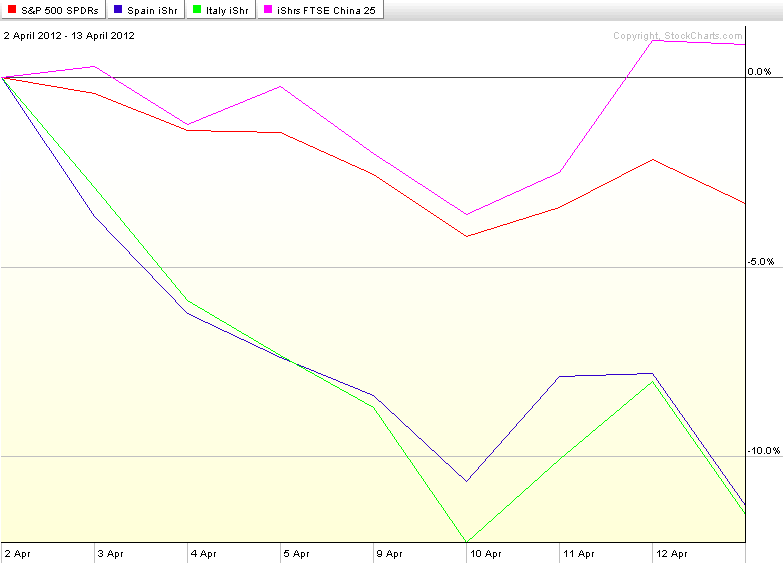
Last week’s financial headlines were dominated by Spain and China. In the case of Spain, this was largely due to increased borrowing by Spanish banks from the European Central Bank. For China the culprit was Q1 GDP growth of only 8.1%, which was down from 8.9% in Q4 2011 and well short of the 9.0% whisper number that made the rounds in the day leading up to Friday’s announcement. In fact, once could certainly argue that it was China’s GDP whisper number that was the main catalyst for Thursday’s big rally that was essentially reversed on Friday.

The chart of the week below shows the performance of SPY as well as country ETFs for Spain (EWP), Italy (EWI) and China (FXI) since stocks put in a top two weeks ago tomorrow. The chart shows that while SPY has been declining, country ETFs for Spain and Italy have been falling approximately three times as quickly as their American counterparts. And China? Well, don’t blame China for the woes in the U.S. stock market. While U.S. stocks have been selling off, the performance of the popular iShares FTSE/Xinhua China 25 Index, FXI, has managed to post a 0.9% gain.

[As a side note, about a year ago I discontinued the Chart of the Week, an extremely popular feature in this space since its launch in 2008, as my posting had become sporadic. Going forward I hope to be able to continue my recent regular posting and make this a weekly feature that not only shines a light on key developments of the past week, but also has some archival value as well.]

Related posts:

[source(s): StockCharts.com]

Disclosure(s): none

Friday, April 13, 2012

Banco Santander Finally Tackles One Huge Problem: Its Ticker

With Spain firmly in the crosshairs of Act N+1 of the European sovereign debt crisis, it was with great comfort that I noted yesterday’s announcement from Spain’s largest and most important bank, Banco Santander (STD), that the company was finally addressing what I considered to be a seriously overlooked problem, its ticker symbol. After kicking the can down the road for what must have been countless meetings and conference calls, the marketing and PR people can finally claim a small victory now that Banco Santander has indicated it will change the NYSE ticker symbol of its American Depositary Shares from “STD” to “SAN” effective at the commencement of trading on June 14, 2012.

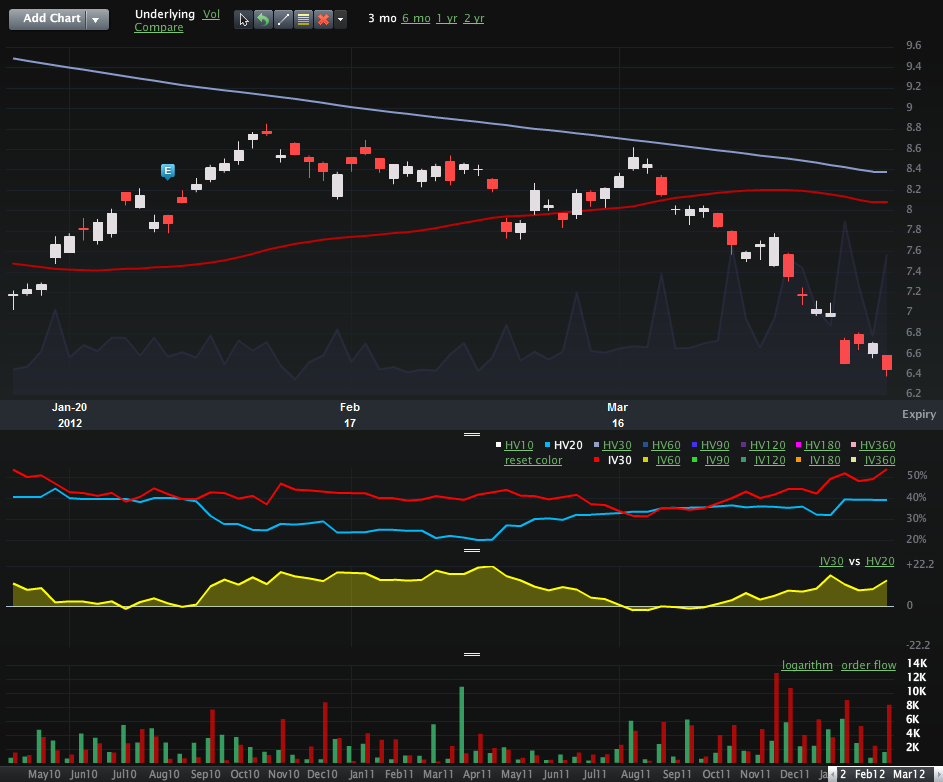
In the meantime, traders continue to favor STD puts and puts from Spain’s second largest bank, Banco Bilbao Vizcaya Argentaria (BBVA), both of which have a more liquid options market than that of Spain’s ETF, EWP.

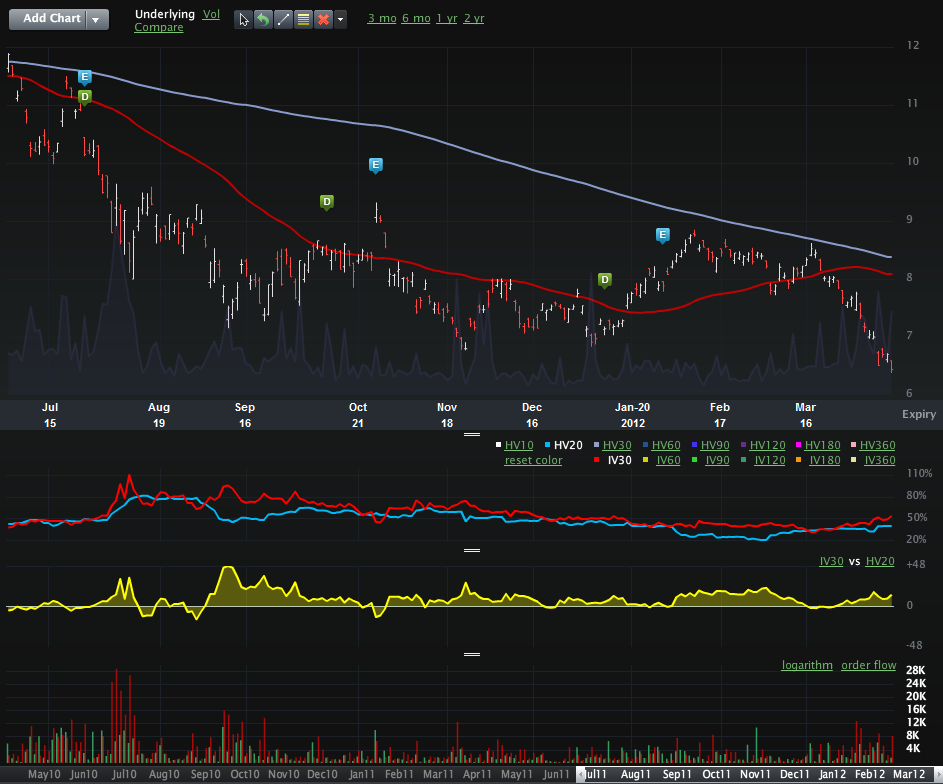
The top chart below shows put activity (red columns in bottom section of graph) ramping up in STD over the course of the last two weeks or so. The lower chart, however, puts recent options activity in the context of the August-October peak in the sovereign debt crisis, with a graphic that dates from July 1, 2011 and shows peak put activity (28.791 contracts per day) and implied volatility (111) dating from the week of August 4 – August 11, 2012.

As far as options traders are concerned, the current situation, while fraught with potential land mines, still pales in comparison to the challenges on the horizon six months ago.

Of course a new ticker won’t help address the underlying problems facing Banco Santander and Spain as a whole, but at least it might cut down on the snickers…

[VIX and More occasionally tilts at humor.  For more on these efforts, check out posts with the “lighter side” label.]

Related posts:

[source(s): LivevolPro.com]

Disclosure(s): short STD and BBVA at time of writing

Tuesday, November 30, 2010

Edward Hugh and A Fistful of Euros

Ever since the European sovereign debt crisis began flaring up, I have made it a habit to read Edward Hugh’s excellent A Fistful of Euros. While The Economist and the Financial Times are two top notch resources for U.S. investors hoping to avoid an Americentric bias and incorporate a European perspective into events as they unfold across the pond, it continues to appear that ultimately the fate of the euro zone will be determined by events in Spain. Given the likely trajectory of events, I can’t think of a better time than the present to be reading what Barcelona-based economist Hugh has to say about Spain and the European financial difficulties.

For starters, check out Hugh’s last three offerings:

…then be sure to check out the archives for a comprehensive set of charts and data about the Spanish economy, more commentary, etc.

Readers, what other top European-based economics blogs should we all be reading?

Related posts:
Disclosure(s): none

Wednesday, July 7, 2010

Spain Rallies

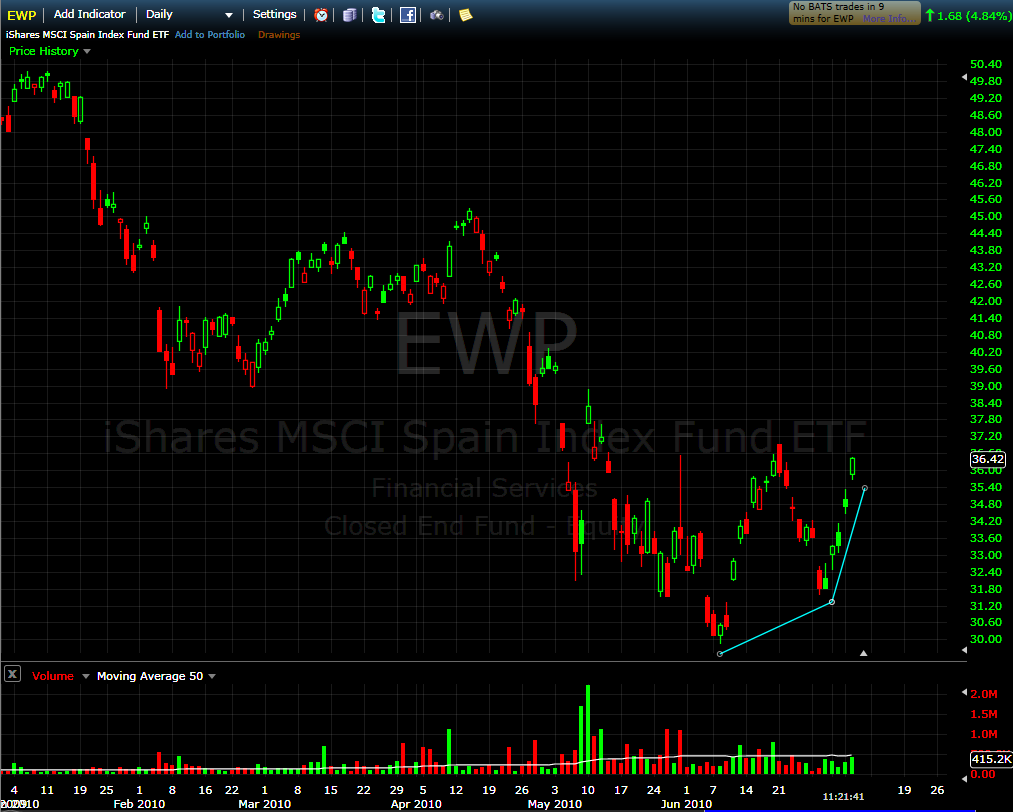
With all the excitement over the performance of Spain’s soccer team in the World Cup, it has been easy to overlook the performance of the Spanish ETF, EWP. From a low of 29.85 almost a month ago, EWP has now rallied 22.1%, even as the country’s credit default swaps have remained elevated.

As the chart below shows, a close above 37 could signal a new breakout and perhaps a significant uptrend.

More importantly, Spain is the tipping point in the European sovereign debt crisis as I see it. In a nutshell, as goes Spain, so goes Europe.

For more on related subjects, readers are encouraged to check out:


[source: FreeStockCharts.com]

Disclosure(s): long EWP at time of writing

Sunday, June 20, 2010

Chart of the Week: U.S. Open Scorecards

I was pulled in quite a few different directions when considering this week’s chart of the week. There was the rally in the euro, some positive debt offerings in Spain, new highs in gold, BP’s $20 billion escrow fund, etc. On the volatility front, the last week was the first time ever that the VIX fell more than 15% in consecutive weeks.

Of all the things that stuck in my mind this week, however, the one I found the most compelling was the course the United States Golfing Association assembled this week at Pebble Beach to test the world’s best golfers in the world for the U.S. Open championship.

While this was a relatively short course, the challenges posed by natural obstacles, difficult greens and the U.S. Open’s notoriously long and unforgiving rough were such that not one of the 156 golfers was able to break par. In keeping with tradition, the U.S. Open course was set up to extract the maximum penalty for any missed shot.

In fact, as I see it, the championship was decided not by how many birdies a golfer was able to make, but by how well he was able to avoid trouble. The scorecards of the top three finishers tell the story and together comprise this week’s chart of the week. In the end, the winner, Graeme McDowell, persevered by not allowing the course to bully him into anything worse than a bogey. Runner-up Gregory Havret had only one double bogey on his scorecard, but it was just enough to keep him one stroke back from McDowell. Third place finisher Ernie Els, who plays with the demeanor of someone who is always unflappable, ended up with two double bogeys and finished two strokes back. In the end, it was the disastrous double bogeys – and one’s ability to avoid them – that spelled the difference.

The reason the Pebble Beach odyssey stuck in my mind is that it reminded me that traders should approach trading the way they would approach a golf course like Pebble Beach. The goal should be to play for pars and look to capitalize on any birdie opportunities that arise. To the extent possible, this means keeping the ball away from hazards and obstacles, as well as avoiding low percentage plays. It also means not compounding small mistakes by pressing and trying to make up lost shots in a hurry. Impulsive play is almost always penalized; patience and discipline are the only way to survive.

In golf and in trading, it is better to be able to drive the ball into the fairway than to hit it 300 yards and not control where it is going. Consistency, precision, patience and opportunistic aggression. That is the recipe for winning golf and winning trading – at Pebble Beach or in your own back yard.

For more on related subjects, readers are encouraged to check out:


[source: U.S. Open]

Disclosure(s): none

Tuesday, May 11, 2010

Recent Performance Divergence in European ETFs

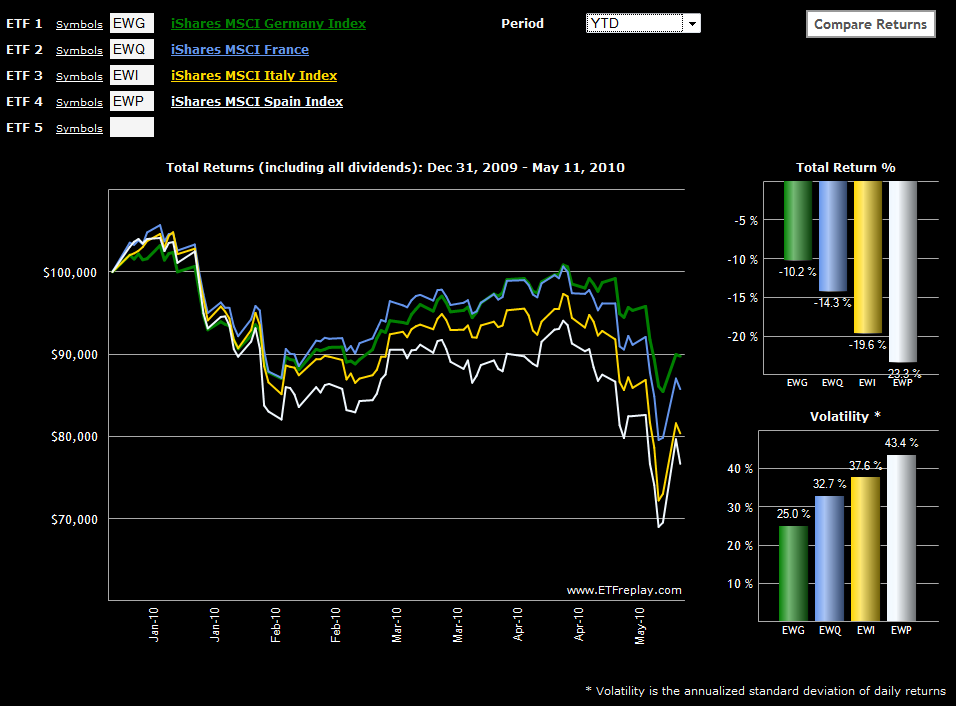
With all the turmoil in Europe, I thought it would be interesting to check on some of the single country ETFs for those nations which have been closest to the sovereign debt crisis. The chart below, courtesy of ETFreplay.com, captures the year-to-date price movements and (historical) volatility for the likes of Germany, France, Italy and Spain.

Not surprisingly, Germany has held up the best and Spain has been the worst performer in 2010. France, which had been tracking fairly close to Germany, has fallen into second as the country’s bank exposure to Greece has saddled France with additional risk. Italy, which has been on the periphery of the contagion concerns, has fared only slightly better than Spain and has actually been the worst performer of the four during the last month and a half as the crisis has deepened.

Also, note that as is often the case, volatility is negatively correlated with performance in these countries, as the largest moves have been negative ones.

For more on related subjects, readers are encouraged to check out:


[source: ETFreplay.com]

Disclosure(s): long EWG at time of writing

Thursday, May 6, 2010

S&P 500 Index Correction at Post-March ’09 Average of 5.6%

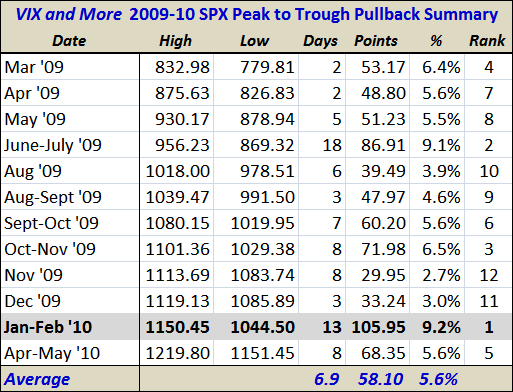
A few minutes ago the S&P 500 index made an intraday low of 1151.49. While it remains to be seen whether this line in the sand will hold, it is important to note that the SPX is now 68.35 points below the high water mark of 1219.80 from April 26th. This means the index has corrected 5.6%, which is exactly the average (mean) pullback over the course of the past 14 months

The table below summarizes the 12 most significant pullbacks since stocks bottomed in March 2009. In percentage terms, the current pullback ranks 5th out of 12. Note that the pullbacks ranked fifth through eighth are all clustered around the 5.6% average.

Ultimately, the significance of a 5.6% pullback pales in comparison to fundamental issues surrounding Greece, Portugal and Spain (where the investors should pay the most attention), but given that 1150 also happens to be the high that preceded the January-February 9.2% pullback, the largest pullback since the bull market began, support in the area of 1150 to 1151 should be taken very seriously.


Disclosure(s):
none

Thursday, April 29, 2010

VIX Unspikes as Stocks Rebound

How many days does it take to undo a 30% spike in the VIX? This time around, the VIX retraced 82% of Tuesday’s 30.6% VIX spike in just two days, a bigger reversal than I had anticipated. By comparison, the S&P 500 index reclaimed slightly less ground, recovering 73% of the 38.18 point loss.

The chart below details the most significant pullbacks since stocks bottomed in March 2009, with this week’s 3.1% drop being the 10th largest in 13 months and considerably below the average drop of 5.4% during the period. Note that a 5.4% pullback from a high of SPX 1219 would put that index back at 1153, which is very close to January’s high of 1150.

I have fielded quite a few questions on VIX options, VIX futures and VXX this week, many by readers who wish to know why these securities have been relatively placid compared to the seemingly more dynamic cash/spot VIX. The reason these securities have not retraced as much of Tuesday’s spike as the VIX is because while VIX May futures rose 2.3 points on Tuesday, they have only fallen 1.4 points or 61% in the past two days, largely due to the fact that mean reversion expectations are built into the pricing of VIX futures.

Ultimately the numbers will take back seat to the fundamentals of the European debt crisis, where there has been more evidence of contagion in Portugal, Spain and even Italy where yields on sovereign debt have increased dramatically in the past few days.

The SPX fell 6.5% during the relatively short-lived Dubai debt crisis of October-November 2009. The likelihood that the current European debt crisis will be resolved as quickly and smoothly as the Dubai situation strikes me as remote, which is why I will be looking to take profits on short volatility positions quickly.

For more on related subjects, readers are encouraged to check out:


Disclosure(s): Short VIX and VXX at time of writing

DISCLAIMER: "VIX®" is a trademark of Chicago Board Options Exchange, Incorporated. Chicago Board Options Exchange, Incorporated is not affiliated with this website or this website's owner's or operators. CBOE assumes no responsibility for the accuracy or completeness or any other aspect of any content posted on this website by its operator or any third party. All content on this site is provided for informational and entertainment purposes only and is not intended as advice to buy or sell any securities. Stocks are difficult to trade; options are even harder. When it comes to VIX derivatives, don't fall into the trap of thinking that just because you can ride a horse, you can ride an alligator. Please do your own homework and accept full responsibility for any investment decisions you make. No content on this site can be used for commercial purposes without the prior written permission of the author. Copyright © 2007-2023 Bill Luby. All rights reserved.
 
Web Analytics