Showing posts with label farther afield. Show all posts

Friday, February 3, 2012

Suppressing Volatility and The Black Swan of Cairo

First published in the May/June 2011 issue of Foreign Affairs, The Black Swan of Cairo: How Suppressing Volatility Makes the World Less Predictable and More Dangerous is a thought-provoking effort by co-authors Nassim Nicholas Taleb and Mark Blyth to advance the idea the efforts of policy-makers to smooth out the peaks and troughs of volatility actually has the unintended consequence of making the world a more volatile place.

I was reminded of the Taleb and Blyth article when I recently read Suppressing Volatility Makes the World More Dangerous, by Kurt Cobb of Resource Insights. Here Cobb extends the thinking of Taleb and Blyth and argues that not only do efforts to suppress volatility backfire in the economic and political realms, but also in areas such as agriculture and public health.

Of course, I could probably argue that Jeff Goldblum’s ranting against the instability of complex systems in Jurassic Park some two decades ago outflanked Taleb, Blyth and Cobb, but on a week when a low VIX seems to have many vexed, ruminating on the ideas of Taleb, Blyth and Cobb may help readers flesh out some insights into what may lie ahead. Along the same lines, I believe the links below might also contain some provocative and related thought starters.

Related posts:

Disclosure(s): none

Sunday, June 20, 2010

Chart of the Week: U.S. Open Scorecards

I was pulled in quite a few different directions when considering this week’s chart of the week. There was the rally in the euro, some positive debt offerings in Spain, new highs in gold, BP’s $20 billion escrow fund, etc. On the volatility front, the last week was the first time ever that the VIX fell more than 15% in consecutive weeks.

Of all the things that stuck in my mind this week, however, the one I found the most compelling was the course the United States Golfing Association assembled this week at Pebble Beach to test the world’s best golfers in the world for the U.S. Open championship.

While this was a relatively short course, the challenges posed by natural obstacles, difficult greens and the U.S. Open’s notoriously long and unforgiving rough were such that not one of the 156 golfers was able to break par. In keeping with tradition, the U.S. Open course was set up to extract the maximum penalty for any missed shot.

In fact, as I see it, the championship was decided not by how many birdies a golfer was able to make, but by how well he was able to avoid trouble. The scorecards of the top three finishers tell the story and together comprise this week’s chart of the week. In the end, the winner, Graeme McDowell, persevered by not allowing the course to bully him into anything worse than a bogey. Runner-up Gregory Havret had only one double bogey on his scorecard, but it was just enough to keep him one stroke back from McDowell. Third place finisher Ernie Els, who plays with the demeanor of someone who is always unflappable, ended up with two double bogeys and finished two strokes back. In the end, it was the disastrous double bogeys – and one’s ability to avoid them – that spelled the difference.

The reason the Pebble Beach odyssey stuck in my mind is that it reminded me that traders should approach trading the way they would approach a golf course like Pebble Beach. The goal should be to play for pars and look to capitalize on any birdie opportunities that arise. To the extent possible, this means keeping the ball away from hazards and obstacles, as well as avoiding low percentage plays. It also means not compounding small mistakes by pressing and trying to make up lost shots in a hurry. Impulsive play is almost always penalized; patience and discipline are the only way to survive.

In golf and in trading, it is better to be able to drive the ball into the fairway than to hit it 300 yards and not control where it is going. Consistency, precision, patience and opportunistic aggression. That is the recipe for winning golf and winning trading – at Pebble Beach or in your own back yard.

For more on related subjects, readers are encouraged to check out:


[source: U.S. Open]

Disclosure(s): none

Monday, June 14, 2010

Bernard Lagat and Trading Strategy

Over the weekend I had an opportunity to watch on television as Bernard Lagat ran the 1500 meters in the adidas Grand Prix track and field meet in New York. Just one week after establishing a new American record at the 5000 meters distance in Oslo, Lagat ran a tactically strong race, but was outkicked at the end and finished in fifth place.

A world champion at both the 1500 and 5000 meter distances in 2007, Lagat’s 35-year-old body is now probably better suited to longer distances than 1500 meters, where he was once the second fastest man in history. The graphic below show’s Lagat’s progression over the course of the past dozen years or so. Note that Lagat peaked in 2001 in the 1500 meter distance and his times have gradually slowed since then. On the other hand, while Lagat's speed may be on the decline, his endurance is improving, with the proof that he is now 36 seconds faster in the 5000 meters than he was in 2001.

After watching the race, it occurred to me that something similar has happened to my trading – and at least anecdotally to a large number of other traders. Back in 2001, the majority of my trades were day trades, but as my opponents have become younger, faster and more technologically sophisticated, I find myself, like Lagat, refocusing my efforts on longer time horizons, where my skills and experience match up better than they do against the high-frequency trading crowd.

Whereas Carlos Lopes won the Olympic marathon at the age of 37, I can almost guarantee that Usain Bolt will not win the 100 meters at the 2024 Olympics. Similarly, it makes little sense for me to return to day trading when my skills are a better match for the longer distance events.

As traders, we each need to know our optimal time horizons. Of course, it is important to continue to experiment with strategies across a broad range of time frames, but ultimately we need to be specialists in a specific time frame that best suits our skills and personality, yet preparing for the possibility that our optimal time horizon may be a moving target as we accumulate new knowledge and expertise.

[As an aside, I intend to stray more frequently into the realm of metaphor and analogy in the future in order to provide a broader context in which to discuss trading in general and volatility in particular. With this in mind, I have decided to tag these posts (as well as today’s post and some previous efforts) with the label of “farther afield.” Let the journey begin.]

For more on related subjects, readers are encouraged to check out:


[source: DiamondLeague.com]


Disclosure(s): none

Friday, September 18, 2009

Comfort Zones, Focus and Thinking Like a Biotech Firm

In Wednesday’s post, Kafka, Surrealism and Trading, I talked about the importance of getting out of one’s comfort zone in order to enhance trading. One reader expressed concern that that pushing the envelope too far and straying from one’s comfort zone was an excellent way to learn some expensive lessons and potentially an approach that invites disaster.

The reader makes some excellent points, so let me expand upon and clarify my thinking.

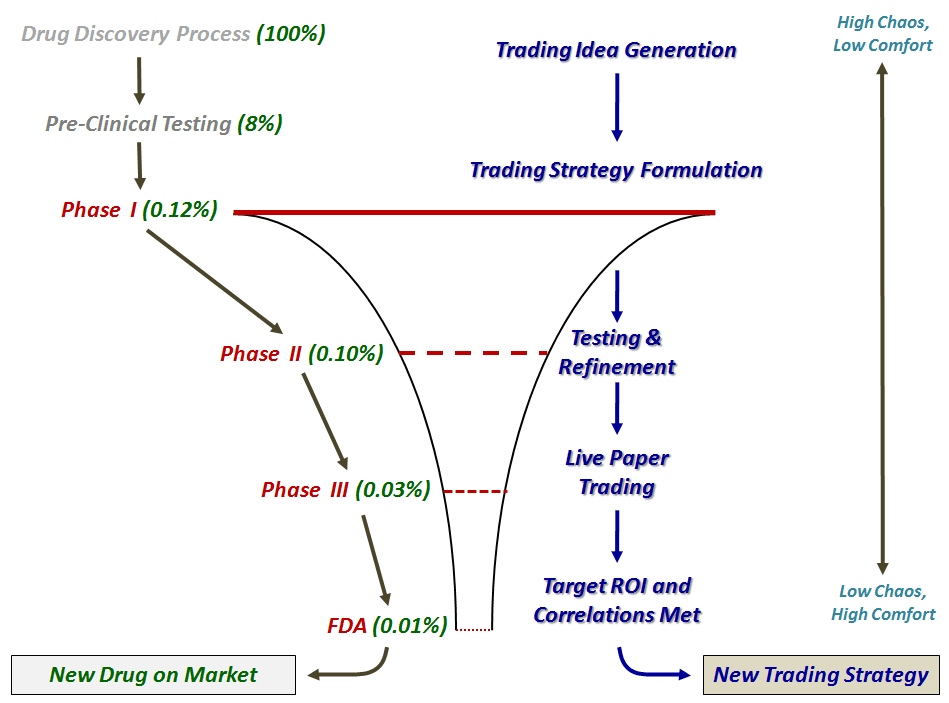
Consider a biotechnology company as a metaphor for trading and specifically for trading strategy development. A biotechnology firm manages a pipeline of drugs in development and in many cases, also has drugs on the market that are generating revenue. Think of the drugs in the pipeline as analogous to investment ideas that the trader is still incubating, testing and deciding whether or not they have sufficient potential to warrant implementing with trading capital.

For drugs in the pipeline, there are various stages of development before the drugs are tested for efficacy and side effects. As drugs progress through the pipeline, they go through internal gated approval processes known formally as Phase 1, Phase 2 and Phase 3 and eventually through an FDA final approval process that determines whether the drug can be sold to the public. Only a small percentage (approximately 8%) of potential new drug ideas make into pre-clinical trials and less than 1% are deemed sufficient to warrant the investment associated with Phase 1 trials. As drugs encounter the gated approval process at the end of each trial phase, the number of high potential candidates is continually winnowed down, as issues related to efficacy or side effects are subjected to rigorous statistical analysis. As these drugs advance through the pipeline, the financial investment increases substantially. Ultimately, only about 1 in 10,000 of the original drugs involved in the drug discovery process makes it all the way through to FDA approval and ends up on the market. On average, the process takes about ten years.

Investors should look at their investment ideas and strategies as a pipeline management process too. There is limited capital available and only the best strategies should be funded. At the beginning of the pipeline, investors should focus the most attention on getting out of their comfort zone, formulating wild new trading ideas and translating these into actionable strategies. This is the best time to get out of one’s comfort zone and embrace some chaos. As the ideas then progress through some sort of internal approval process, then focus become more important. Is the idea robust? Can the idea be translated into effective strategies? Is there enough liquidity to implement these strategies? What will the slippage costs be? What do the initial backtesting results show in terms of potential? Etc.

As new ideas progress through an internal approval process, the trader should move from an area of discomfort to an area of extreme comfort. By the time a trading strategy is ready to be deployed, the trader’s mind set should have evolved from one of high chaos and low comfort to low/no chaos and high comfort. A corollary of the trading idea development process, which I have sketched out in the graphic below, is that the more one is able to get out of their comfort zone at the beginning of the trading idea pipeline, the better the trading results and the more likely there will be uncorrelated strategies when the chaos of idea generation is translated into focused strategies.

For more on trading strategy development, four excellent blogs to follow are:
Thursday, March 1, 2007

Dogs and Earthquakes: Dueling Metaphors?

While talking about my dog as a volatility laboratory has probably been the most fun I have had writing on this blog to date, there is another volatility metaphor that should be kept top of mind as well: earthquakes.

Living in the San Francisco Bay Area, earthquakes are something I am forced to think about from time to time, whether I like it or not. A little known fact is that approximately a half dozen small earthquakes are recorded here every day. Something on the order of 99% of these are not felt by humans and are picked up only by seismographs.

On those rare occasions when I feel an earthquake, my second thought (the first one being whether I should start hedging my real estate investments with CME real estate futures) is one of relief that an earthquake has reduced some of the stress along a nearby fault. Without getting too deeply into the relevant seismology, it is generally accepted that stress builds up along faults as a result of plate tectonics, which describe the movements of the earth’s crust. Since that stress can only be relieved through the forces released by an earthquake, if earthquakes are too few and far between, the pressure on the fault builds up and scientists start worrying about an increased likelihood of The Big One.

In much the same way scientists worry about large earthquakes in the absence of smaller ones, many investors should worry about the increased likelihood of a large VIX spike in the absence of smaller ones. This same line of thinking, which I happen to agree with, would dictate that we should have been particularly concerned because the Dow had gone a record 949 straight sessions (almost four years) without a single day drop of 2% or more. More stress on the investment fault had clearly been building up below the surface, increasing the likelihood of not just a 2% drop, but also of a 3% or 4% one day drop – which is part of the reason that Tuesday’s selloff was so sharp.

Those who are paying attention may wonder if we can have it both ways: can my dog and plate tectonics both explain volatility? My dog would suggest that volatility clusters and trends. Plate tectonics suggests that volatility oscillates.

In fact, volatility clusters and trends in the short term in the same manner that large earthquakes sometimes trigger secondary earthquakes (aka “aftershocks” – akin to echo volatility) and are preceded by smaller earthquakes that are helpful in predicting large earthquakes. Over the longer term, however, my dog goes back to sleep, stress on the fault is relieved and volatility reverts to the mean – until the pressure on the fault starts to build up again and the cycle is repeated.

Tuesday, January 30, 2007

What My Dog Can Tell Us About Volatility

I am fortunate that my dog, Logan, is a well-adjusted, happy-go-lucky, 1 ½-year-old canine. To put things in perspective, his idea of a bad day in the market is any time we come home from the grocery store without cheese.

It turns out, however, that he is a walking (or running) volatility laboratory. A typical example of this is the occasional distant noise that just barely penetrates his perceptual radar, particularly on those quiet evenings when he is napping contentedly with the family. Upon hearing the noise, Logan’s altertness instantly spikes, he lets out an involuntary woof, then carefully tunes his ears to their most sensitive setting, seeking any information that will help identify the source of the noise. Usually there are no other disturbances to follow and the noise is catalogued and soon forgotten. His alertness level slowly subsides over the next 10-15 minutes or so and he goes back to napping, a little more fitfully this time and just a little bit on edge.

Things get a little more interesting when another noise surfaces shortly after the first one. What could once be dismissed as the wind, the house settling or some such insignificant event now must be treated as a threat – and just to be safe, a threat of the highest order. Now the appropriate response is a series of barks, nervous glances in the direction of the other members of the pack, brief pacing around, and a rushing off in the direction of the noise to investigate, with a flurry of barks meant to sound more menacing than the source of the noise. Who or what is it? How much harm can they cause? How grave is the threat?

It is the second noise – and any subsequent noises – that creates the equivalent of the Homeland Security red alert and triggers a response similar to what I call “echo volatility” in the markets. Once the elevated level of alertness has been established, it takes a long period of relative serenity for it to subside. On the other hand, when on red alert, any additional noises – big or small – will be magnified and regarded with the utmost caution.

In some respects, my dog is a lot like your typical investor and once he hears two or three threatening noises in a short time frame, it is a good bet that the second leg of a volatility spike is just around the corner.

DISCLAIMER: "VIX®" is a trademark of Chicago Board Options Exchange, Incorporated. Chicago Board Options Exchange, Incorporated is not affiliated with this website or this website's owner's or operators. CBOE assumes no responsibility for the accuracy or completeness or any other aspect of any content posted on this website by its operator or any third party. All content on this site is provided for informational and entertainment purposes only and is not intended as advice to buy or sell any securities. Stocks are difficult to trade; options are even harder. When it comes to VIX derivatives, don't fall into the trap of thinking that just because you can ride a horse, you can ride an alligator. Please do your own homework and accept full responsibility for any investment decisions you make. No content on this site can be used for commercial purposes without the prior written permission of the author. Copyright © 2007-2023 Bill Luby. All rights reserved.
 
Web Analytics