Showing posts with label Germany. Show all posts

Monday, March 9, 2020

Tracking the Trajectory and Peak of Coronavirus Cases


I have seen a lot written about the Coronavirus, a.k.a. COVID-19, but I have yet to see any informed discussion about the trajectory of cases in various regions, the cycle time to peak new cases or meaningful predictions about the future course of the spread of the virus.

So here are some thoughts on the subject, using historical data from Wikipedia that is more standardized in time and collection methodology than any other data I have been able to find on the Web.  First, I examined the entire history of case data by country and found inflection points that roughly correspond to 10 new cases and 100 new cases per day.  As identification of initial cases is somewhat problematic given the variable protocols for testing, availability of testing kits, timing of nearby positive cases, etc. I elected to use the 100 new cases per day threshold.

It turns out that there have been seven countries so far that have logged 100 new COVID-19 cases in a single day.  In order of reaching that 100 new cases threshold, they are:  China (January 21st), South Korea (February 21st), Italy (February 26th), Iran (February 27th), France (March 5th), Germany (March 6th) and Spain (March 6th).  The U.S. has come close to the 100 new case threshold and may indeed hit that mark today or tomorrow.

The graphic below shows the daily number of new cases in each of the seven 100+ new case countries.  Note that it is reasonable to expect some sort of parabolic pattern for new cases with a steep jump in new cases that eventually flattens out, peaks and declines in a similar fashion.  This pattern probably would have been the case in China, except that on February 10th, China changed the methodology for counting new “confirmed” cases from relying strictly on the basis of a positive result from a lab testing kit to cases that included patients where CT scans for pneumonia allowed for a “confirmed” case clinical diagnosis for likely COVID-19 cases without having to wait for a lab test and results.

[source(s):  Wikipedia, VIX and More]

To summarize the data in the graph, three of the four countries that are at least ten days from the initial 100-case day have seen what appears to be a peak in new cases.  In China, it was 22 days from 100 cases to peak new cases, though it is possible that peak new cases might have been 14 days if China had not expanded the methodology for defining new cases to include a clinical diagnosis.

In South Korea, a concerted effort to ramp up testing as quickly as possible is probably responsible for the fact that South Korea saw a peak in new cases just 9 days after the first 100-case day.

While the peak in new case data in Iran should be considered provisional, the current peak in new cases was only 8 days after the first 100-case day, perhaps aided by the steep trajectory in new cases during the first five days.

Italy is the outlier in that there are no signs of a peak some ten days after the first 100-case day, though it is reasonable to expect that the newly implemented national lockdown and public gathering measures will help to slow the rate of new cases going forward.

The remaining three Western European countries – France, Germany and Spain are only 3-4 days into their post-100 timeline, so it is too early to talk about a peak.

The first quick takeaway is that the time from 100 new cases to peak new cases seems to cluster around 8-14 days or perhaps 8-22 days if you overlook the changes in the methodology for counting new cases in China.

Second, with the U.S. new case count hovering just below 100, it is reasonable to expect that the 8-14 day window for new cases will also apply to the U.S. putting a likely peak count in the March 17th – March 24th time frame, with an outside shot of the peak extending out to April 1st.  This assumes, of course, that the U.S. follows a similar trajectory to the other countries.  Along those lines, it will be interesting to see if Italy’s new cases peak during the next week.

Obviously, there are a number of factors that can affect how successful a country can be in containing the COVID-19 outbreak, conduct an appropriate number of tests and other factors. Japan, for instance, had its first case almost two months ago and has yet to approach 100 new cases in a day.

More to come on the COVID-19 global outbreak, the VIX, volatility and more.

Further Reading:

For those who may be interested, you can always follow me on Twitter at @VIXandMore

Disclosure(s): none

Monday, November 12, 2012

Fear Poll: Fiscal Cliff Fears Spike, Concerns About Excessive Central Bank Intervention Rise

For the fourth week in a row, the U.S. fiscal cliff topped the list of investor fears about the stock market. With all the media attention heaped on the fiscal cliff since the election, it should come as no surprise that the fiscal cliff outpolled the second-place European sovereign debt crisis by 10.9%, the widest margin since the Fear Poll began four weeks ago.

Concerns about continued weak corporate earnings held on to the #3 spot, even as the earnings season winds down, while anxiety about problems related to excessive central bank interventions moved into the #4 slot. Among write-in votes, the biggest issue is frustration with government and politicians, which is certainly related to some of fears about how the fiscal cliff and euro zone problems will be resolved.

The Americentric perspective was once again in evidence this week, with U.S. respondents seeing the fiscal cliff as more concerning than the European sovereign debt crisis by a margin of 16.2%, while non-U.S. respondents saw the two issues as almost equally important, with the fiscal cliff winning out by only 1.8%. Interestingly, this parochialism seems to be a largely American phenomenon, as Israeli respondents have been less concerned about Iran than non-Israeli respondents and German respondents have been less concerned about the European sovereign debt crisis than the rest of the world.

With the U.S. elections now in the rear view mirror, U.S. respondents were no doubt at least partly influenced by the media pivoting away from the elections and toward the fiscal cliff issues – a development I analyzed yesterday in The Rise of Fiscal Cliff Concerns.

Thanks to all who have participated in these polls and have helped to generate a very interesting data set. Clearly we have a lot to learn about what drives fear and how those fears can be amplified by geography, media and proximity in time.

Related posts:

Disclosure(s): none

Tuesday, August 7, 2012

Another Way to Play Short EUR/USD: Travel!

There are many ways to translate an opinion about the financial markets into a particular trade. Recently, I decided to act upon my belief that the euro would weaken against the dollar by booking a couple of weeks in Europe. The trader/VIXologist itinerary would have probably run something like Ireland > Portugal > Greece > Spain > Italy, but instead I elected to steer to the north, vising the Netherlands, Belgium, Luxembourg, Germany and the Czech Republic.

For the first time in many moons, parliamentary votes, etc., the markets were reasonably well behaved during my vacation and the VIX didn’t even make it into the 30s.

As someone who spends a great deal of time nine time zones away from the events behind the European headlines, I was somewhat surprised to see the relative calmness and lack of concern in the people I spoke with about the European sovereign debt crisis. This is not to say that the consensus was that the most difficult phases of the crisis were in the rear-view mirror, only that in due time, all would be sorted out and life would go on in a manner similar to the way it was prior to 2008.

That being said, I was surprised to see that in the sculptures above the Gate of Giants, which forms the entrance to Prague Castle, one forward-thinking artist had captured the essence of the discussions between the Troika and the Greek government…

Related posts:

[photo: Gate of Giants, Prague Castle]

Disclosure(s): long VIX at time of writing

Thursday, June 28, 2012

The Evolution of European Equity Risk

There are many ways in which investors can evaluate risk related to the euro zone. Credit default swaps for sovereign debt are one way to evaluate the risk of country default. Sovereign bond yields are a good proxy for a country’s access to funding via the credit markets. The euro crosses and related directional moves are a barometer of the strength of the currency and the euro zone countries as a whole, while various Intrade contracts can lend a sense of the probabilities that investors assign to various events, such as to the risk of one or more countries dropping the euro.

On the volatility side, the VSTOXX (EURO STOXX 50 Volatility Index) the EVZ (CBOE EuroCurrency Volatility Index) provide a market assessment of risk and uncertainty in euro zone stocks as well as the currency.

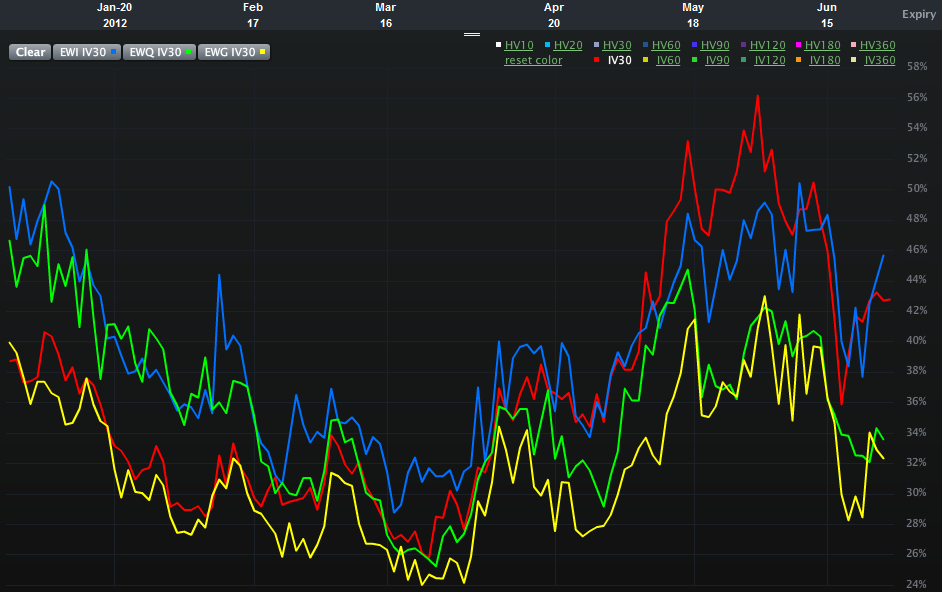
One piece of analysis I have not seen, however, is an assessment of the relative risk and uncertainty for equity markets in some of the more important euro zone nations. Specifically, Spain, Italy, France and Germany. The chart below attempts to offer up that very information, using 30-day implied volatility for the various country ETFs over the course of the past six months:

  • EWP – Spain (red line)
  • EWI – Italy (blue line)
  • EWQ – France (green line)
  • EWG – Germany (yellow line)

Looking at the chart, what initially catches my eye is the recent evolution of the two-tiered risk system. In the first half of the year, the higher risk is clearly associated with Italy and France, whereas Spain and Germany appear to be considerably less risky in terms of implied volatility. By the March the risk appears to have lessened across the board and the distinctions between individual countries is more difficult to discern. Over the course of the last 1 ½ months or so, a new two-tiered system has appeared. This time around it is Italy and Spain where the risk to equities is considered to be the greatest, with France now joining Germany in the lower risk tier.

In essence, Italy has persisted in the high risk tier and Germany has been a constant in the lower risk category. Over the course of the past few months, the interesting development has been the switch between France and Spain, with the former improving from being a peer of Italy to a peer of Germany, while Spain has moved in the opposite direction.

One could certainly argue that all four countries are in the same boat (taking on water, with shoddy life preservers, in shark-infested waters and being one small mutiny away from having no captain…), but clearly investors think there are important distinctions to be made in terms of equity risk and uncertainty. Perhaps of more interest, these fortunes appear to be shifting, with little perceptible difference not just between Spain and Italy, but also between Germany and France.

Related posts:

[source(s): LivevolPro.com]

Disclosure(s): Livevol is an advertiser on VIX and More

Friday, June 25, 2010

A German Perspective on the Recovery

Yesterday, in Fundamentals and the Recovery, I offered up a snapshot of the recovery in the United States in terms of industrial production, income, employment, and retail sales.

Today, I thought I’d at least temporarily jettison my overly Americentric view of the investment universe and look at the recovery in the same areas through the eyes of Germany. As the graphic below shows, relative to past periods of economic recovery, the current recovery looks more typical than atypical. With a continued weak euro, I would not at all be surprised to see the performance of the German economy to begin to accelerate to the upside, which would bode well for the Germany ETF, EWG.

Of course, the bigger issue may turn out to be the exposure of German banks to Greece and some of the other troubled euro zone economies, per a recent Wall Street Journal, Data Show Big Exposure for Banks in Euro Zone.

For more on related subjects, readers are encouraged to check out:


[source: Federal Reserve Bank of St. Louis]

Disclosure(s): none

Tuesday, May 11, 2010

Recent Performance Divergence in European ETFs

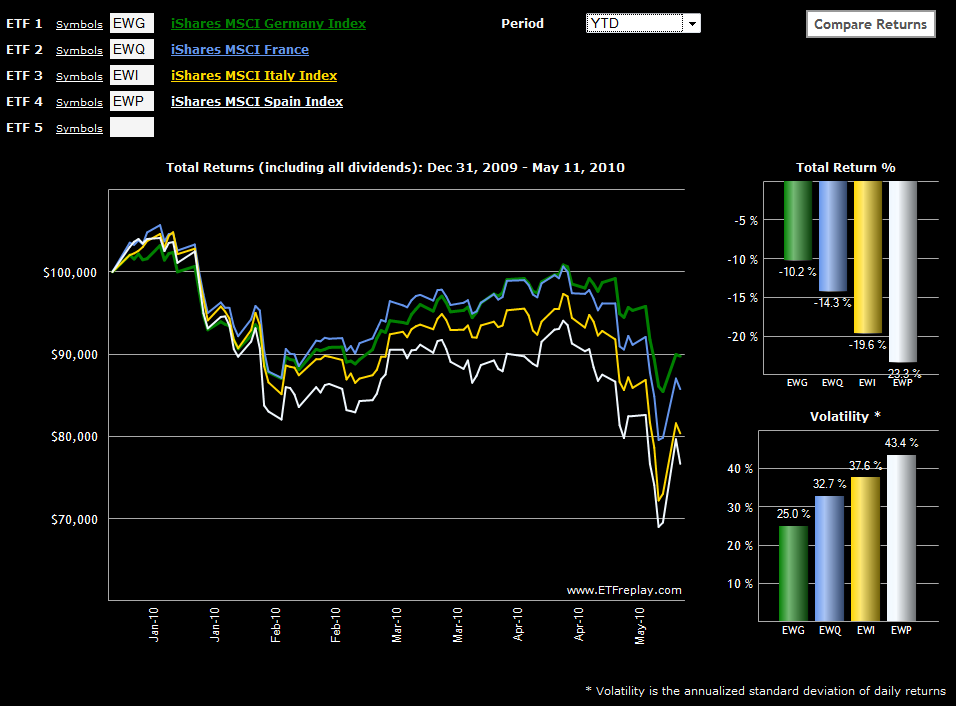
With all the turmoil in Europe, I thought it would be interesting to check on some of the single country ETFs for those nations which have been closest to the sovereign debt crisis. The chart below, courtesy of ETFreplay.com, captures the year-to-date price movements and (historical) volatility for the likes of Germany, France, Italy and Spain.

Not surprisingly, Germany has held up the best and Spain has been the worst performer in 2010. France, which had been tracking fairly close to Germany, has fallen into second as the country’s bank exposure to Greece has saddled France with additional risk. Italy, which has been on the periphery of the contagion concerns, has fared only slightly better than Spain and has actually been the worst performer of the four during the last month and a half as the crisis has deepened.

Also, note that as is often the case, volatility is negatively correlated with performance in these countries, as the largest moves have been negative ones.

For more on related subjects, readers are encouraged to check out:


[source: ETFreplay.com]

Disclosure(s): long EWG at time of writing

Tuesday, February 9, 2010

Are You Watching Greece?

Retail investors in the United States sometimes have difficulty staying on top of events and markets in Europe.

In the last week, I have suggested several ways to monitor the status of various pockets of interest in Europe, including Spain (via the iShares MSCI Spain Index ETF, EWP) and the euro. I certainly also could have included the VSTOXX, the volatility index tied to the Dow Jones STOXX 50 index of European companies.

While I love proxies, ground zero for the European financial crisis is Greece, where ongoing discussions with European Union leaders, particularly those from Germany, are wrestling with the best way to balance national and regional interests.

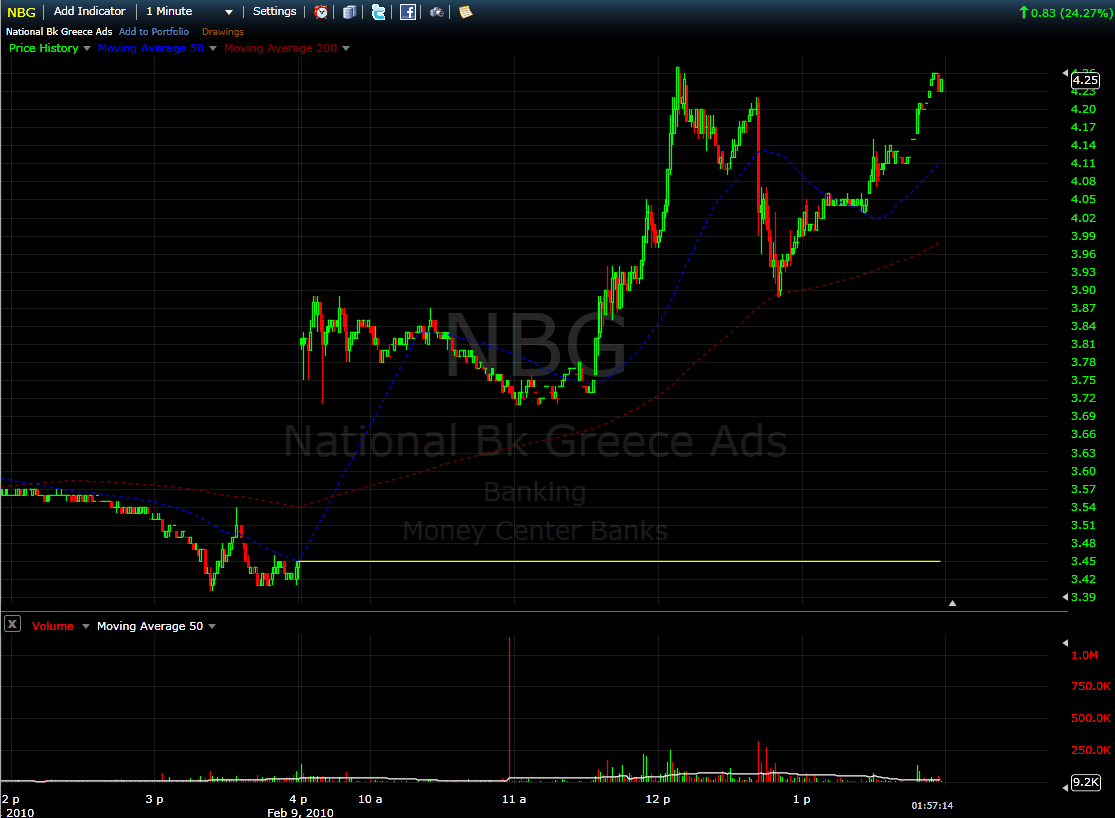
There is not currently a Greek ETF, but as proxies for Greece go, the National Bank of Greece (NBG) is an excellent one. This bank trades millions of shares per day and has a market cap of $12.5 billion. So whether you just wish to take the temperature of the Greek financial situation or want to speculate on a particular outcome, NBG is a worthy addition to any watch list.

For related posts on these subjects, readers are encouraged to check out:


Disclosures: long NBG and EWP at time or writing

[source: FreeStockCharts.com]

Tuesday, February 24, 2009

Germany and China Faring Relatively Well in Downturn

With the SPX perched precariously above its November low and pundits monitoring the vital signs around the clock, coverage of the stock markets in the U.S. has once again taken on a very Americentric tone. For the most part, focusing on the U.S. financial system and the U.S. economy makes sense. One of the many lessons to come out of the current financial crisis, however, is the end of the decoupling myth. In fact, we are all butterflies flapping our wings on a global stage now.

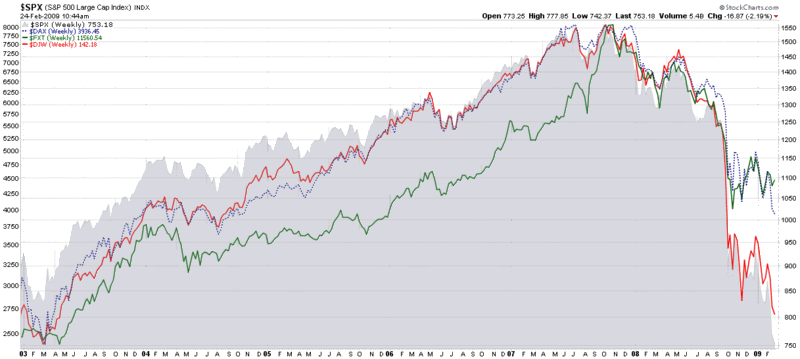
As always, some countries are faring better than others. The chart of the Nikkei 225 looks sufficiently like that of the SPX that I elected to omit it from the graphic below. Instead, I have chosen to compare the stock market indices of the world’s third and fourth largest economies, China (FXT, the index that forms the basis of the popular ETF, FXI) and Germany (DAX), in the context of the S&P 500 and the Dow Jones World Stock Index (DJW).

Note that relative to the October/November lows, China has shown a distinct pattern of making higher lows – in sharp contrast to U.S. and global indices. Germany has also shown considerable resiliency. Even though the DAX is now trading below its November low, Germany stocks have outperformed their global counterparts.

Scrolling back to 2003, I find it interesting that both China and Germany still are well above their 2003 lows, while the Dow Jones World Stock Index is now only about 5% above the lows from that bear market.

So while most investors are currently focusing their attention on the Dow Jones Industrial Average, the S&P 500, the NASDAQ indices and the Russell 2000, support levels and trends in key international indices may hold equally important clues about global buying and selling patterns – and the possibility of finding a bottom.

[source: StockCharts]

DISCLAIMER: "VIX®" is a trademark of Chicago Board Options Exchange, Incorporated. Chicago Board Options Exchange, Incorporated is not affiliated with this website or this website's owner's or operators. CBOE assumes no responsibility for the accuracy or completeness or any other aspect of any content posted on this website by its operator or any third party. All content on this site is provided for informational and entertainment purposes only and is not intended as advice to buy or sell any securities. Stocks are difficult to trade; options are even harder. When it comes to VIX derivatives, don't fall into the trap of thinking that just because you can ride a horse, you can ride an alligator. Please do your own homework and accept full responsibility for any investment decisions you make. No content on this site can be used for commercial purposes without the prior written permission of the author. Copyright © 2007-2023 Bill Luby. All rights reserved.
 
Web Analytics