Showing posts with label Fear poll. Show all posts

Saturday, December 31, 2016

The Year in VIX and Volatility (2016)

The consensus called for a big uptick in volatility in 2016 and while there was a lot of drama, the VIX spikes were relatively manageable and short-lived.  The VIX opened the year at 22.48 and ended the year at just 14.04.  For the full year, the median VIX was 14.31, while SPX historical volatility for the full year ended up at a mere 13.12.

That being said, there were five distinct VIX spikes in the graphic below, listed according to chronology:
  • Fears related to slowing growth in China (January)
  • A plunge in crude oil prices to $26.05/bbl. for WTIC, as investors grappled with the possibility that Cushing storage facilities would be exhausted (February)
  • The surprise Brexit vote result in favor of the U.K. leaving the E.U. (June)
  • A cocktail of nearly simultaneous shocks from Fed President Rosengren (suddenly sounding hawkish), Jeff Gundlach (interest rates have bottomed) and the European Central Bank (no additional stimulus) puts pressure on stocks (September)
  • Increasing uncertainty leading up to the U.S. election (November) 

In all five instances, the VIX moved up sharply, but in defiance of historical precedent, the volatility index moved down almost as sharply as it moved up.  In fact, some of the biggest extremes for the year came in the form of volatility crushes, where the VIX had an unprecedented series of sharp downward one-day move.  Checking the record books, the only previous year that the VIX posted three top 20 one-day declines was 2007 – and clearly investors were in denial that year.  This year the Trump election caused the sixth largest one-day drop in the history of the VIX, whereas the Thursday before and Tuesday after the Brexit vote triggered the eighteenth and tenth largest one-day VIX declines.

On the other side of the ledger, some of the upward moves in the VIX made the record books as well.  The day following the Brexit vote saw a 49.3% VIX spike – the fifth highest one-day spike on record.  What was even more surprising was the Rosengren/Gundlach/ECB cocktail noted above triggered a 39.9% spike (eleventh highest in history) in what seemed to be a relatively calm market environment in September.  It turns out the VIX was just getting warmed up for greater things, including a record nine consecutive up days leading up to the November election.

Even with these extremes, the highs and lows in the VIX were rather middling, with the VIX peaking at 32.09 on January 20th and hitting an annual low of 10.93 on December 21st.

The graphic below captures these and other highlights from 2016:


[source(s): StockCharts.com, VIX and More]

Included in the non-VIX highlights are a 5000+ year low in interest rates in Europe and Japan (where negative interest rates prevailed) as well as a thirteen-year low in the price of crude oil.  On the geopolitical front, political craziness of one kind or another abounded in Brazil, South Korea, Turkey, Italy, Colombia and South Africa, among other locations.  Terrorism also left its footprint again in 2016 and Zika also created considerable political and social turmoil.  In the financial realm, European banks had a very difficult year and begin 2017 on shaky footing.

While the year ended on a relatively quiet not, I suspect 2017 will have much more in the way of new surprises, including swans of many dark hues.  Next week I will resume the VIX and More fear poll and find out what the consensus is for volatility and its causes in the coming year.

Finally, since 2011, I have been maintaining a proprietary Macro Risk Index that measures volatility and risk across a broad range of asset classes, including U.S. equities, foreign equities, commodities, currencies and bonds.  In 2016, the Macro Risk Index was trending down most of the year, punctuated by significant spikes in February (crude oil) and again in June (European currencies). 

How did 2016 measure up to expectations?  I sum up the year in My Low Volatility Prediction for 2016: Both Idiocy and Genius.  Also worth investigating are a pair of Barron’s articles from one year ago laying out two opposing perspectives on volatility in 2016.  For the case for rising volatility and what to do about it, try Jared Woodard’s Prepare for Rising Volatility in 2016.  I provide the contrarian point of view in The Case Against High Stock-Market Volatility in 2016.

Have a happy, healthy and profitable 2017!

Related posts:


For those who may be interested, you can always follow me on Twitter at @VIXandMore

Disclosure(s): the CBOE is an advertiser on VIX and More

Tuesday, January 5, 2016

The Year in VIX and Volatility (2015)

Every year one of my most-read posts is my annotated overview of the year in VIX and volatility.  Now that I have been doing this for the past eight years, the aggregated view of volatility from 2008 to the present makes for a fascinating concise history not just of volatility, but more broadly of the financial markets and of economic activity in general.

The graphic below captures most of the highlights from 2015 and from a volatility perspective, it was a year for the record books.  During August we saw the largest one-week VIX spike (+113%) that resulted from unprecedented back-to-back days of VIX spikes of more than 45%!  The cumulative jump in the VIX pushed the VIX to a high of 53.29 – the only time outside of the 2008-09 financial crisis since the launch of the VIX in 1993 that the VIX has topped 50.


[source(s): VIX and More]

While most investors pointed to China as the proximate cause of the record VIX spike(s), a VIX and More fear poll one week after the big VIX spike also highlighted “market structural integrity (HFT, flash crash, exchange issues, etc.)” as almost on par with China concerns, with “market technical factors (breach of support, end of trend, etc.)” not that far behind.

The balance of the year saw a wide variety of events that moved the markets, including the Fed’s first rate hike in nine years; crude oil plummeting to $34/bbl.; shock waves in the high-yield bond market due to low oil prices; chilling terrorist attacks in Paris and in California; Puerto Rico announcing it will default on some of its debt; turmoil in the currency markets when the Swiss National Bank ended the peg of the Swiss franc to the euro; a dramatic boom-bust cycle in Chinese A-shares – and a flurry of ineffective interventions on the part of the Chinese government to restore stability; a proxy war between Saudi Arabia and Iran in Yemen; and the European Central Bank committing to $1.2 trillion of quantitative easing.

As noted previously, even with all of the volatility, Every Single VIX ETP (Long and Short) Lost Money in 2015.

Finally, since 2011, I have been maintaining a proprietary Macro Risk Index that measures volatility and risk across a broad range of asset classes, including U.S. equities, foreign equities, commodities, currencies and bonds.  In 2015, the Macro Risk Index was consistently higher than it has been during any year since the 2011 inception.

What does high volatility in 2015 mean for 2016?  During the past two weeks, Barron’s published two opposing (but not necessarily inconsistent) perspectives on volatility in 2016.  For the case for rising volatility and what to do about it, try Jared Woodard’s Prepare for Rising Volatility in 2016.  I provide the contrarian point of view in The Case Against High Stock-Market Volatility in 2016.


Related posts:


Disclosure(s): net short VIX at time of writing

Wednesday, September 2, 2015

China Growth and Market Structural Integrity Top List of Fear Poll Concerns

After a hiatus of almost a year (the October 2014 pullback, to be exact), I have reprised the VIX and More Fear Poll in an attempt to get some insight into which issues have been responsible for bring fear back into the investing equation and in so triggering the highest VIX spike (53.29) outside of the 2008-09 financial crisis and the #5 and #6 one-day VIX spikes ever on consecutive days.

In the chart below, I have summarized the top ten responses from almost 400 voters, covering 40 countries over the past two days.  The question:  “Which of the following makes you most fearful anxious or uncertain about the stock market?”

VIX and More Fear Poll results 090215

[source(s): VIX and More]

I should note that Tuesday’s responses had “Market structural integrity (high-frequency trading, flash crashes, exchange stability, etc.)” as the #1 concern, but a late flurry of votes today for “China – weak economic growth” put China concerns over the top. Combining Chinese growth concerns with concerns about a bubble in Chinese stocks and/or housing makes it a landslide in favor of all things China. Without too much of a stretch, one could also lump in the likes of currency problems, deflation, low crude oil prices and falling commodities prices in general into a broader China-related bucket and suddenly the China + ripple effect accounts for about 50% of the votes.

As always, I love to see how the American view of the world contrasts with those non-U.S. respondents. This time around, the area most overemphasized by Americans relative to the rest of the world is, in classic Americentric myopia fashion…”U.S. – weak economic growth,” which 8.7% more Americans label as their #1 concern than their non-U.S. counterparts. Conversely, the biggest blind spot for Americans – at least relative to the concerns of the rest of the world – is commodities prices, which Americans underweight by 5.1%. A close second in the American myopia sweepstakes is Chinese bubbles in stocks and/or housing. I do not find the commodities oversight to be surprising, but certainly the relatively low concern about Chinese bubbles is unexpected.

For those who have not seen some of the earlier incarnations of this poll, these dataeback to 2012 and chronicle a U.S. public that was so obsessed with the fiscal cliff that they did not fully appreciate the gravity of the European sovereign debt crisis.

Related posts:

Disclosure(s): none

Thursday, October 16, 2014

Fear Poll: Fed/QE, Ebola and Technicals Top Worry List

Stocks may be in the process of putting in a bottom, but with the VIX hitting 31.06 yesterday at the same time VIX futures were setting new volume records, investor fear and anxiety is as high as it has been since the 2011 European sovereign debt crisis.

As the VIX and More Fear Poll results reflect, the current situation is particularly difficult for investors to grapple with because there is so much disagreement about what the biggest worry is and how some of these fears may be connected.

In the chart below, I have summarized the almost 400 votes from some 35 countries, with the U.S. accounting for 65% of all respondents.

It is worth noting that the responses appear to be somewhat headline driven, as yesterday Ebola topped the list of worries, only to be supplanted by concerns about the impact of the Fed ending quantitative easing and in so doing removing the safety net that has helped keep liquidity high, volatility low and investors more confident. I also find it particularly interesting that “market technical factors (breach of support, end of trend, weak internals, etc.)” are so important to a broad range of investors, which raises the question of whether technicals are more of a cause or effect in the recent downturn.

Looking at global economic weakness, slightly more investors expressed concern about the U.S. economy than that of the euro zone, with concerns about the Chinese economy a distant third.

In these types of polls, I am always interested to see how U.S. respondents differ from those outside of the U.S. In the current market environment, U.S. respondents tend to place more emphasis on the weak U.S. economy and the Ebola virus, while paying less attention to currency issues and China. Some of the detailed results certainly have a whiff of provincialism, yet it remains to be seen whether the global or Americentric perspective does a better job of honing in on what to focus on – a subject I will delve into at a later date.

For those who might be interested in the results of prior VIX and More Fear Poll data, the links below should be a helpful reference.

Last but not least, many thanks to everyone who participated in this poll, which I intend to periodically reprise as market conditions warrant.

VAM Fear Poll 101614

[source(s): VIX and More]

Related posts:

Disclosure(s): none

Monday, March 11, 2013

Lowest VIX Close Since Day Before Biggest VIX Spike Ever

I’m generally not one for sensationalist headlines, fear-mongering or otherwise stirring up trouble unnecessarily, but when facts line up in a manner that I know others will find interesting, I do feel an obligation to point that out.

So…at the risk of being splashed all over the Zero Hedge comments stream I thought it worth noting that today the VIX closed at 11.56. While this marks the lowest close in the VIX in over six years, a surprising portion of this low VIX is the result of a calculation quirk I described earlier today in The VIX, Interpolation and the Roll. In other words, I would characterize today’s VIX as artificially low and considerably lower than the near-term VIX calculation (VIN).

That being said, there is no denying that the last time the VIX closed below today’s close was February 26, 2007, the day before The Biggest VIX Spike Ever, a 64% jump in one day.

Do I expect a new record VIX spike tomorrow? Hardly, though I should note that just two weeks ago today we did see the #11 all-time VIX spike for a single day.

What is more likely to happen is that the negative coefficient for the weighting of the far-term VIX calculation (VIF) will slowly dissipate over the course of the week and that in itself should lift the VIX about three-quarters of a point. Throw in a just one or two days of declining stocks triggering the purchase of SPX puts for portfolio protection and it would be very easy to see the VIX up more than 20% from its current level by the end of the week.

Looking back at the concerns that dominated my fear poll a couple of months ago, most of these have dramatically receded. For this reason, it looks like it will take one of those unexpected threats to get the VIX airborne once again.

Related posts:

Disclosure(s): none

Monday, January 7, 2013

Investor Fears Pivot to U.S. Deficit and Debt Ceiling Following Cliff Deal

Just one week after Democrats and Republicans cobbled together a last-minute fiscal cliff deal, investors turned their focus to the next battleground in the fiscal crisis, tabbing the U.S. deficit and debt ceiling as their #1 concern in the VIX and More weekly fear poll. Fears associated with governments and politicians polled a distant second, while ongoing worries related to weak corporate earnings finished in third place, one day before Alcoa (AA) unofficially kicks of the Q4 earnings reporting season.

The two issues that dominated the fear poll during the last quarter seem to have receded from the consciousness of most investors. While the legacy of the fiscal cliff lives on in the debt ceiling discussions, the immediate threat has passed. Meanwhile, in spite of warnings from the likes of Angela Merkel, concerns related to the European sovereign debt crisis remain at low levels and continue to decline.

On the institutional front, one of the residual effects of the fiscal cliff is a persistent worry that the fiscal cliff is merely a symptom of a dysfunctional bi-partisan government with a newfound affection for brinksmanship. On the other hand, worries about excessive central bank intervention are falling, no doubt helped in that regard by the recent FOMC minutes from the December 11-12th meeting.

With the VIX posting a record one-week decline last week, it is reasonable to conclude that investor worries about the fiscal cliff were of a much higher magnitude than those related to the U.S. debt ceiling and deficit. In fact, there are some divergent opinions about the relationship between the declining VIX and the fiscal cliff deal. For more on this subject, check out the comments from Jared Woodard of Condor Options in The Market Is As Nervous as Ever About Austerity Fetishisms, in which Jared picks up on a theme from a recent note by Alec Phillips of Goldman Sachs (GS).

Once again, thanks to all who participated in this weekly poll.

Related posts:

Disclosure(s): none

Monday, December 31, 2012

Just a Change of Venue? (Fears About U.S. Deficit/Debt Ceiling Replacing Fiscal Cliff Worries)

With the U.S. fiscal cliff negotiations going down to the wire, it is not surprising that fears related to the fiscal cliff topped the list of investor threats to the stock market for the eleventh week in a row in the VIX and More weekly fear poll. Fears associated with governments and politicians as well as excessive central bank intervention polled in second and third place, respectively.

What I found particularly interesting is the sudden rise in fears related to the U.S. deficit and debt ceiling, as investors appear to be concluding that the current fiscal cliff negotiations are now just one more skirmish in the ongoing war between Democrats and Republicans regarding how to address the U.S. budget deficit. With Treasury Secretary Timothy Geithner saying that the U.S. will hit its debt ceiling today and have to resort to extraordinary measures to keep under the legal limit, the stage is set for the next pitched battle when these extraordinary measures can no longer do their trick, in about two months.

So what problems will a fiscal cliff deal resolve? Part of the answer to this question depends upon whether the pending (we hope) deal is merely a stopgap measure or addresses some of the more politically thorny underlying issues related to the budget deficit in a comprehensive way. Of course the trick is structuring the deal in such a way that it does so in a manner which limits any negative impact on the economy.

Stay tuned. A fiscal cliff deal may only signal a change of venue and redirect investor fears to the next battleground.

Once again, thanks to all who participated in this weekly poll.

Related posts:

Disclosure(s): none

Monday, December 24, 2012

Fiscal Cliff Widens Lead as #1 Investor Concern

Extending a recent trend, the U.S. fiscal cliff topped the list of investor threats to the stock market for the tenth consecutive week in the VIX and More weekly fear poll. Fears associated with excessive central bank intervention were a distant second, while more general concerns about government and politicians finished third in the poll.

The gap between the fiscal cliff and the runner-up issue was 10.6% this week, the largest in six weeks and the second largest since the inception of the poll some ten weeks ago.

For the second week in a row, geographical differences among the respondents were relatively small, with only minor differences between U.S. and non-U.S. respondents. The regional myopia that had separated U.S. and non-U.S. respondents on the relative importance of the fiscal cliff vs. the European sovereign debt crisis for most of the last three months appears to have subsided over the last two weeks, in conjunction with the widespread lessening of fears over the future of the euro zone.

Once again, thanks to all who participated in this weekly poll.

Last but not least, Merry Christmas, happy holidays and best wishes for a joyful, healthy, happy and profitable 2013!

Related posts:

Disclosure(s): none

Monday, December 17, 2012

Fiscal Cliff Continues to Top Fear Poll

In a week in which there appears to have been little progress in the U.S. fiscal cliff negotiations, investors continue to cite the fiscal cliff as the largest threat to the stock market in the VIX and More weekly fear poll. Fears related to government and politicians beat out concerns about excessive central bank intervention as the #2 issue, while anxiety related to the European sovereign debt crisis finished in a tie for fourth.

The poll marked only the third time in nine weeks that U.S. and non-U.S. respondents agreed on the top threat and was the first time that U.S. and non-U.S. respondents placed the top two threats in the same order. In fact, agreement on the order of the threats was the same through the top three.

In another sign that geographical proximity bias has receded, U.S. respondents gave more weight to the European sovereign debt crisis than non-U.S. respondents (the majority of whom are European), while non-U.S. respondents gave more weight to the fiscal cliff than U.S. respondents. In previous weeks, there had been strong evidence of regional myopia.

Another item of note, with last week’s dramatic change in Fed policy away from a timetable to targeted unemployment and inflation rates, one might expect the balance of fear to tilt more in the direction of inflation or deflation this week. Instead, there was a notable jump in concerns over both inflation and deflation, particularly from U.S. respondents.

It is reasonable to ask what might happen if there is a deal in the fiscal cliff in the next week or two. Will a deal also have a significant impact on concerns related to government and politicians or will concerns related to institutions persist and prove to be something more than an event-specific concern? Finally, if the fiscal cliff fears disappear with a deal, which new fears will bubble up to take its place? This week several respondents submitted write-in votes related to high-frequency trading (HFT) and algorithmic trading. Will this be the next fear to stalk the stock market?

Once again, thanks to all who participated in this weekly poll.

Related posts:

Disclosure(s): none

Monday, December 10, 2012

Fear Poll Respondents Focus on Fiscal Cliff, Dismissive of European Financial Crisis

For the eighth week in a row, concerns about the U.S. fiscal cliff topped the VIX and More weekly fear poll. Fears related to excessive central bank intervention nudged out concerns related to government and politicians as the #2 issue, but perhaps the most interesting development is the how much the anxiety related to the European sovereign debt crisis continues to subside.

From a geographical perspective, U.S. and non-U.S. respondents had a relatively low divergence of opinion this week. That being said, whereas U.S. respondents cited the fiscal cliff as the top concern, non-U.S. respondents were most concerned about excessive central bank intervention in the economy. Perhaps part of the fallout from the fiscal cliff negotiations is that U.S. respondents see governments and politicians as much more likely to be the top threat to the stock market, by a margin of 5.6% over non-U.S. respondents.

Interestingly, both U.S. and non-U.S. respondents expressed much less concern about the euro zone problems, with only 4.9% of U.S. respondents citing euro zones as the #1 concern, while 5.9% of non-U.S. respondents put the euro zone issues at the top of the list.

With the FOMC meeting scheduled to wind up on Wednesday, the fiscal cliff talks inching closer to that last day on which legislation can be introduced in Congress for the year (December 18th, based upon a December 21st recess) and Alcoa scheduled to report Q4 earnings and unofficially kick of the next earnings reporting season on January 8th, there is the potential for quite a few things to hit the fan in the coming month.

In spite of all these threats looming just around the corner, the VIX remains subdued and is still in a position to reinforce the notion that December Is the Cruelest Month…for the VIX.

Once again, thanks to all who participated in this weekly poll.

Related posts:

Disclosure(s): none

Monday, December 3, 2012

Fear of Governments and Politicians Climb Rapidly as Euro Zone Worries Wane

While concerns about the U.S. fiscal cliff topped the VIX and More weekly fear poll for the seventh week in a row, the big story is that investors are increasingly more concerned about the governments and politicians who are tasked with finding the solutions to these crises than the crises themselves.

Even though it is a global concern, fears and anxieties related to governments and politicians is most evident in the United States, where governments and politicians outpolled the fiscal cliff by a margin of 27.9% to 26.7%. Frustrations over the actions (or lack thereof) of governments and politicians were only the #4 concern outside of the U.S., where the fiscal cliff polled in the #1 slot, followed by the European sovereign debt crisis and continued weak earnings.

Respondents across the globe now see enough progress in the euro zone that the financial crisis in Europe has been relegated to a second tier of worries.

Another development worth noting is the sudden disappearance of an Americentric bias in the fiscal cliff issue. Over the past six weeks U.S. based respondents have been 13.1% more likely than non-U.S. respondents to cite the fiscal cliff as their top concern. This week was the first week that non-U.S. respondents saw the fiscal cliff as a bigger fear than their U.S. counterparts. Of course if one were to attribute most of the anxiety over governments and politicians in the U.S. to the fiscal cliff, then the results of this poll might say more about how different populations see the root cause of the fiscal cliff issue than anything else.

As noted last week, if one adds up the fiscal cliff, euro zone, central bank and government + politicians responses, it is possible to pin some 75-80% of all investor fears on institutions such as central banks and governments, with the fiscal cliff and the euro zone financial crisis merely symptoms of a larger underlying problem.

Once again, thanks to all who participated in this weekly poll.

Related posts:

Disclosure(s): none

Monday, November 26, 2012

Fiscal Cliff Concerns Top Fear Poll, But Central Banks and Politicians Seen as Key Systemic Threats

Concerns about the U.S. fiscal cliff continued to top the VIX and More weekly fear poll, while investor anxiety regarding weak earnings, Israel and China all declined substantially.

The biggest change in investor fears over the course of the past two weeks is a growing trend toward the mistrust of the role of institutions such as central banks and governments in economic matters. Concerns about central bankers and politicians are significant enough to poll in the #3 and #4 spots for all respondents, but rate even higher in the U.S., where government and politicians were the #2 concern and excessive central bank intervention worries garnered the #3 spot.

If one considers the fiscal cliff and the European sovereign debt crisis (still polling in the #2 slot on a global basis) to be situations that have been caused by and/or exacerbated by central banks, governments and politicians, then it is not too difficult to pin some 75-80% of all investor fears on central banks and governments.

As noted in previous weeks, the persistent Americentric bias shows no signs of abating. This week, for example, 12.4% more of the U.S. respondents cited the fiscal cliff as the top concern over the European sovereign debt crisis. For non-U.S. respondents, however, the fiscal cliff outpolled the European sovereign debt crisis by only 2.8%.

Once again, thanks to all who participated in this weekly poll.

Related posts:

Disclosure(s): none

Monday, November 19, 2012

Fiscal Cliff and European Sovereign Debt Concerns Recede, Earnings Worries Linger

Concerns about the U.S. fiscal cliff and the European sovereign debt crisis both declined over the course of the past week, as stocks made a concerted effort to establish a bottom, following an 8.9% decline in the S&P 500 index, according to the VIX and More weekly fear poll.

Even though the earnings reporting season is almost over, investors continued to express concern about weak earnings and guidance going forward, with earnings worries finishing a close third in the poll.

The biggest changes in investor sentiment have come in the form of growing discontent with institutions such as central banks and governments and concerns that their intervention in economic matters will have more of a negative than positive effect. Fears about excessive intervention on the part of central banks as well as more broadly with the role of governments and politicians were largely absent just two weeks ago. Taken together, this lack of trust with respect to the two influential policy-making institutions is now as big as concern as that of the fiscal cliff or the euro zone woes, as shown in the graphic below.

The persistent Americentric bias is still apparent. This week, for example, 8.5% more of the U.S. respondents cited the fiscal cliff as the top concern over the European sovereign debt crisis. For non-U.S. respondents, however, the European sovereign debt crisis outpolled the fiscal cliff by a margin of 3.2%.

Also of note from a geographical perspective, U.S. respondents were 1.8% more likely than non-U.S. respondents to tab excessive central bank intervention as their top fear and 5.9% more likely to point to government and politicians as their biggest concern. In addition to placing higher emphasis on the European sovereign debt crisis, non-U.S. respondents also expressed much more concern about China and deflation.

Once again, thanks to all who participated in this weekly poll.

Related posts:

Disclosure(s): none

Guest Columnist at The Striking Price for Barron’s: Calm Down and Exploit Others’ Anxieties

On Wednesday I had an opportunity to serve as a guest columnist for The Striking Price on behalf of Steven Sears at Barron’s for the eighth time, focusing my attention on some of the early findings from the VIX and More Fear Poll in Calm Down and Exploit Others’ Anxieties.

In some respects, the most recent Barron’s article is a companion piece to another Barron’s article I penned in May: Be Greedy While Others Are Fearful. This time around I delve into some of the emerging behavioral finance aspects of the survey results, specifically related to geographical and temporal proximity bias. I also discuss the merits of a SPY short straddle trade as well as long VIX puts as a means to take advantage of some market distortions due to that bias.

As far as the most recent Fear Poll goes, this week the race for the top spot looks as if it will go down to the wire and for the first time so far, there are more than two viable candidates for the top slot. [If you have not voted in the weekly poll yet, now is as good a time as any…]

Related posts:

A full list of my Barron’s contributions:

Disclosure(s): none

Monday, November 12, 2012

Fear Poll: Fiscal Cliff Fears Spike, Concerns About Excessive Central Bank Intervention Rise

For the fourth week in a row, the U.S. fiscal cliff topped the list of investor fears about the stock market. With all the media attention heaped on the fiscal cliff since the election, it should come as no surprise that the fiscal cliff outpolled the second-place European sovereign debt crisis by 10.9%, the widest margin since the Fear Poll began four weeks ago.

Concerns about continued weak corporate earnings held on to the #3 spot, even as the earnings season winds down, while anxiety about problems related to excessive central bank interventions moved into the #4 slot. Among write-in votes, the biggest issue is frustration with government and politicians, which is certainly related to some of fears about how the fiscal cliff and euro zone problems will be resolved.

The Americentric perspective was once again in evidence this week, with U.S. respondents seeing the fiscal cliff as more concerning than the European sovereign debt crisis by a margin of 16.2%, while non-U.S. respondents saw the two issues as almost equally important, with the fiscal cliff winning out by only 1.8%. Interestingly, this parochialism seems to be a largely American phenomenon, as Israeli respondents have been less concerned about Iran than non-Israeli respondents and German respondents have been less concerned about the European sovereign debt crisis than the rest of the world.

With the U.S. elections now in the rear view mirror, U.S. respondents were no doubt at least partly influenced by the media pivoting away from the elections and toward the fiscal cliff issues – a development I analyzed yesterday in The Rise of Fiscal Cliff Concerns.

Thanks to all who have participated in these polls and have helped to generate a very interesting data set. Clearly we have a lot to learn about what drives fear and how those fears can be amplified by geography, media and proximity in time.

Related posts:

Disclosure(s): none

Sunday, November 11, 2012

The Rise of Fiscal Cliff Concerns

How much of the recent selloff in stocks has been triggered by media’s sudden obsession with the U.S. fiscal cliff? Is it possible that very little has changed under the surface, but the decibels associated with this issue are now off the charts?

For the last three weeks, VIX and More Fear Poll respondents have rated the issues surrounding the U.S. fiscal cliff as their biggest source of fear about the future of the stock market. Now that the election is behind us and the earnings season is winding down, these fears have been buttressed by a huge amount of media scrutiny suddenly being devoted to the subject.

The fiscal cliff is one of those issues that has been on the horizon for many months, but only recently have investors begun to pay attention to the problem. Part of the reason for this sudden interest in the fiscal cliff is that Congress and the Obama Administration were not going to address the fiscal cliff during the campaign season and consequently no one expected any progress on the fiscal cliff issues during this period. Now that the election is over, the issue is seen as a ticking time bomb, with a much shorter fuse each day.

While politicians, economists and business leaders across the globe have called for a speedy resolution of the fiscal cliff negotiations between Democrats and Republicans, the highly respected Congressional Budget Office added some new urgency to the dialogue with the publication of two new documents on Thursday:

  1. Economic Effect of Policies Contributing to Fiscal Tightening in 2013
  2. Choices for Deficit Reduction

I cannot say that I pay much attention to the likes of CNBC and Bloomberg TV, but I understand that the fiscal cliff issue is now dominating the business television airwaves as well.

All this makes me wonder just how much of the recent selloff in stocks is driven by substance and how much is driven by the media frenzy.

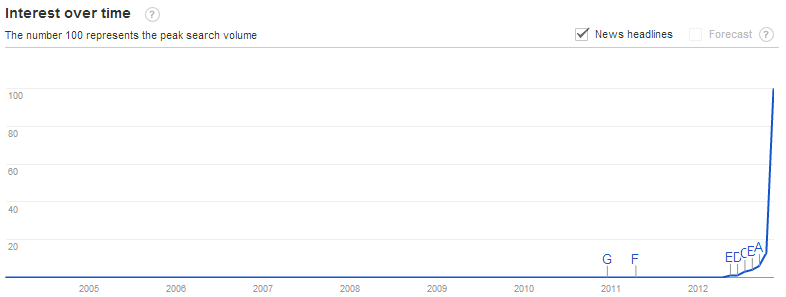
I took a look at the Google Trends data for “fiscal cliff” and discovered that the issue barely registered on Google’s radar until about May of this year.

[source(s): Google Trends]

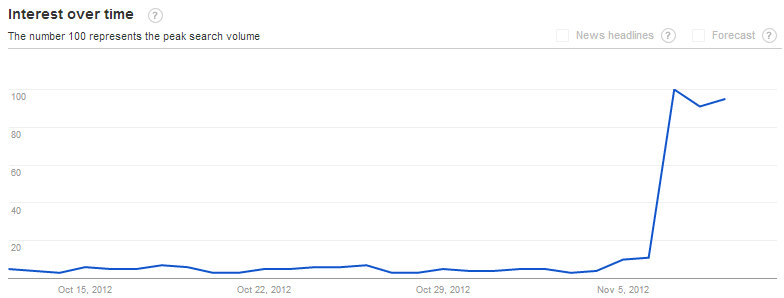
There was an occasional mention of the fiscal cliff up through last Sunday, then on Monday, the day before the U.S. election, new interest in the subject began to surface. The big spike in interest in the fiscal cliff happened on the day following the election, when Google search volume in “fiscal cliff” rose tenfold and the media frenzy began.

[source(s): Google Trends]

Over the weekend, concerns about the fiscal cliff have been outpolling (voting is still open) concerns about the ongoing European sovereign debt crisis by the largest margin yet. The real question is whether this is due largely to a redirection of attention by the media and by investors or by changes in the underlying nature of the issue or the likelihood of a timely resolution to the problem. My guess is that more of the former is at work than the latter.

Related posts:

Disclosure(s): none

Monday, November 5, 2012

Fiscal Cliff Worries Grow As Election Nears

Anxiety over the outcome of the U.S. fiscal cliff topped the list of investor fears about the stock market for the third week in a row, outpolling the European sovereign debt crisis, which finished a distant second, and U.S. elections, which edged out weak earnings for third place.

With 65% of responses coming from U.S. voters, the poll results were once again skewed toward an Americentric perspective. Three weeks into this poll, it appears as if geographical and temporal proximity are having a strong effect on respondents. For third week in a row, U.S., respondents were much more concerned about events in their own country. For example, the fiscal cliff outpolled the European sovereign debt crisis by 14.8% in the U.S., while non-U.S. respondents had these two issues deadlocked in a tie for first place. Similarly, 13.9% of U.S. respondents cited U.S. elections as their top worry, while just 5.3% of non-U.S. respondents placed U.S. elections at the top of the list.

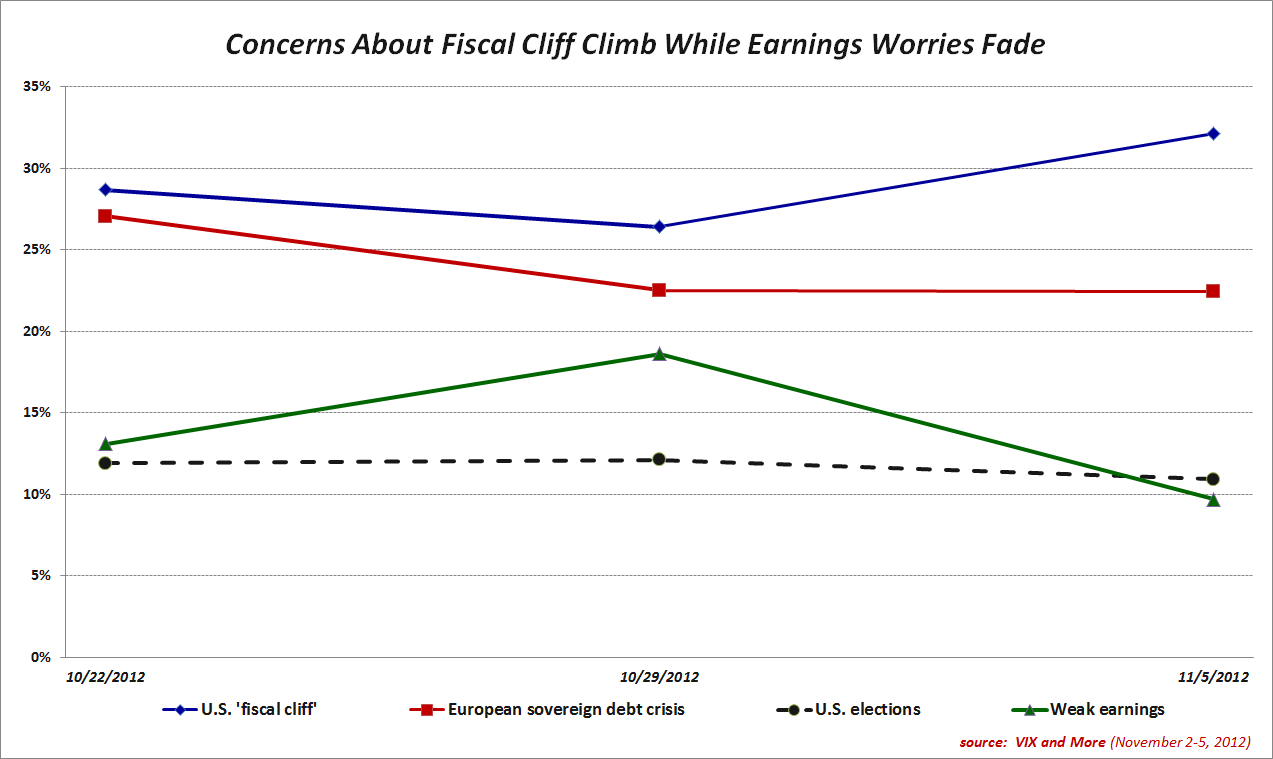
Not surprisingly, concerns about a weak earnings season fell sharply over the course of the past week, from 18.6% to 9.7%, as most of the critical earnings reports are already in the books and the potential for meaningful surprises has diminished substantially, as shown in the graphic below.

With most of the election uncertainty about to be resolved tomorrow, I anticipate that the fiscal cliff and the European sovereign debt crisis will once again separate from the pack in the next week. Whether this will place upward or downward pressure on the VIX remains to be seen.

Related posts:

Disclosure(s): none

Monday, October 29, 2012

U.S. Fiscal Cliff Fears Top VIX and More Fear Poll Again

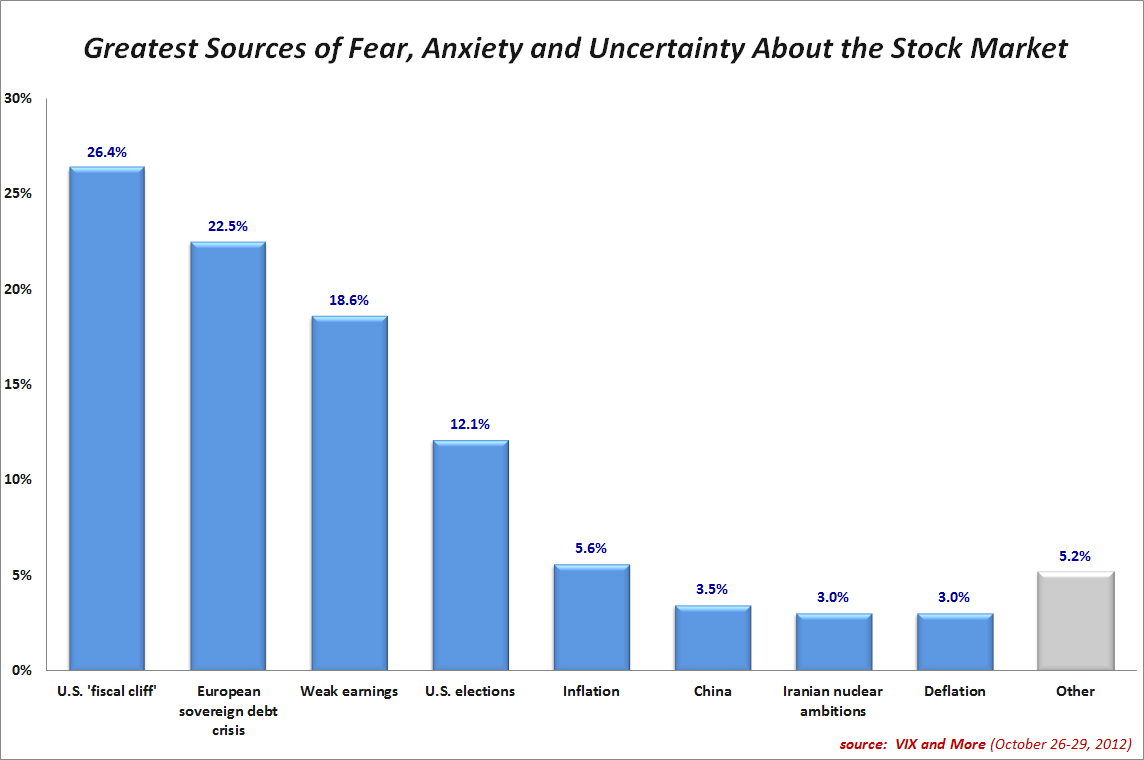
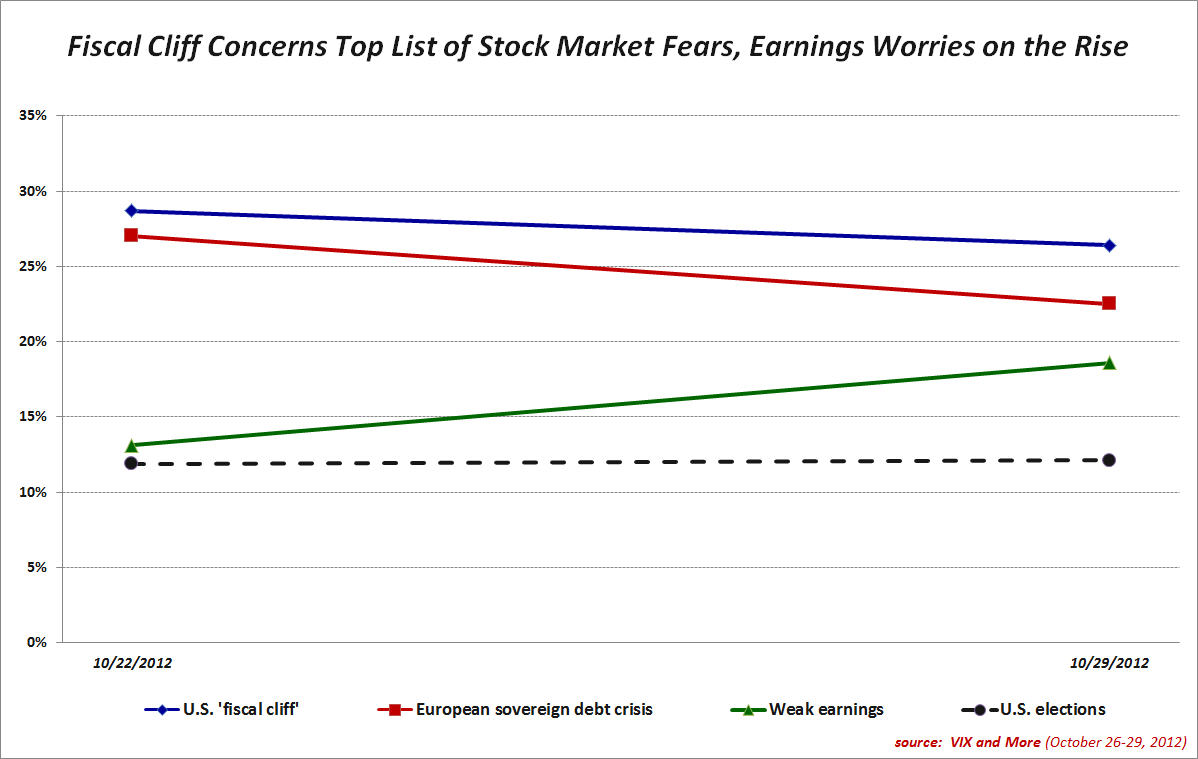
For the second week in a row, investors cited the U.S. fiscal cliff as the top risk to the stock market, followed closely by fears about the European sovereign debt crisis. Concerns about weak earnings, a distant third last week, gained significant ground as Apple (AAPL) and others continued to report disappointing earnings and revenues while guiding future expectations lower.

As was the case last week, geography appears to have a significant influence on results, with a clear Americentric bias coming from U.S.-based respondents. In the U.S., for instance, concerns about the fiscal cliff outpolled the European sovereign debt crisis by 9.5%, but outside of the U.S. the European sovereign debt crisis topped concerns about the fiscal cliff by 8.2%. Similarly, 15.2% of U.S. respondents cited U.S. election uncertainty as the biggest risk to stocks while just 5.5% of non-U.S. respondents judged U.S. elections to be the top risk factor.

This week I added inflation and deflation to the list of pre-populated answers. Both responses fell far down the list of concerns, but almost twice as many respondents expressed concern about inflation relative to deflation.  While the graphic below shows the week-to-week changes in the top four issues driving stock market fears, it will probably be several more weeks before this graphic offers meaningful insights.

Once again, there were quite a few write-in votes, but there was no discernible theme among write-in responses.

With U.S. stock markets closed today due to hurricane Sandy, the VIX currently stands at 17.81, some 7.2% higher than it was a week ago when I published the results of the inaugural VIX and More Fear Poll.

Related posts:

Disclosure(s): long VIX and short AAPL at time of writing

Monday, October 22, 2012

U.S. Fiscal Cliff Concerns Top Results in Inaugural VIX and More Fear Poll

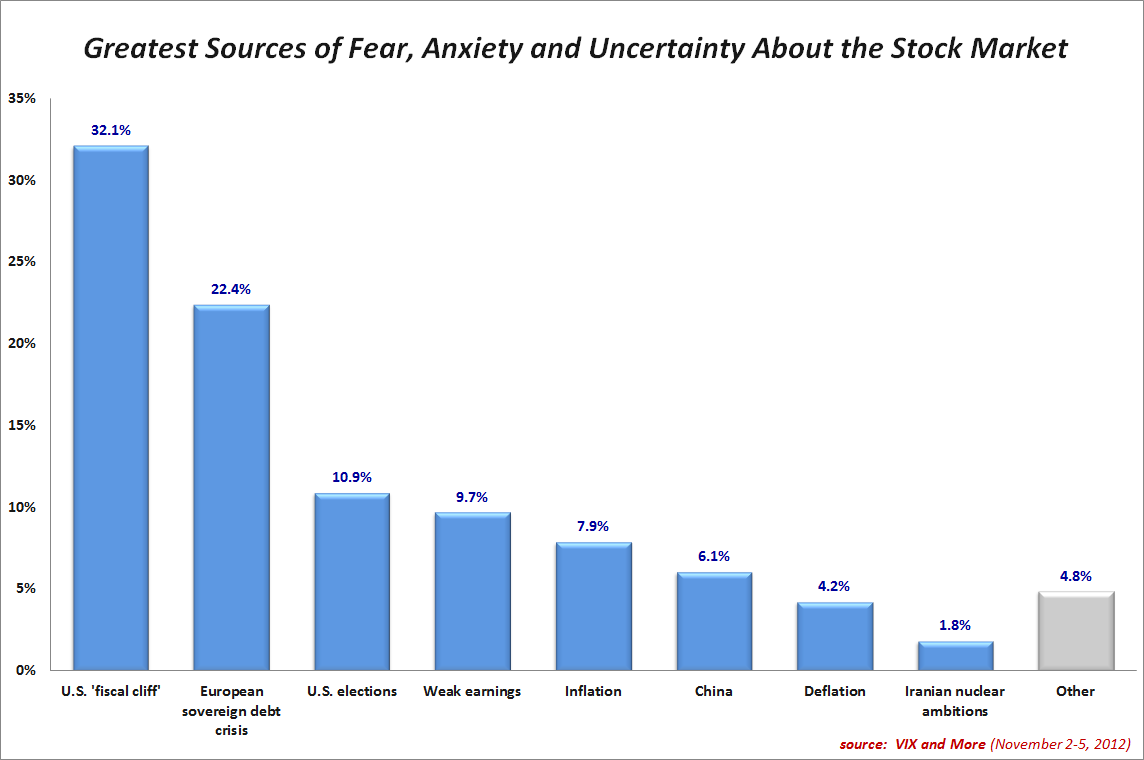
Today I closed the books on the first VIX and More Fear Poll, which I consider to be an unqualified success and a first step in establishing longitudinal data about the types of geopolitical, macroeconomic, technical and other issues that make investors fearful, anxious and uncertain about the future of the stock market.

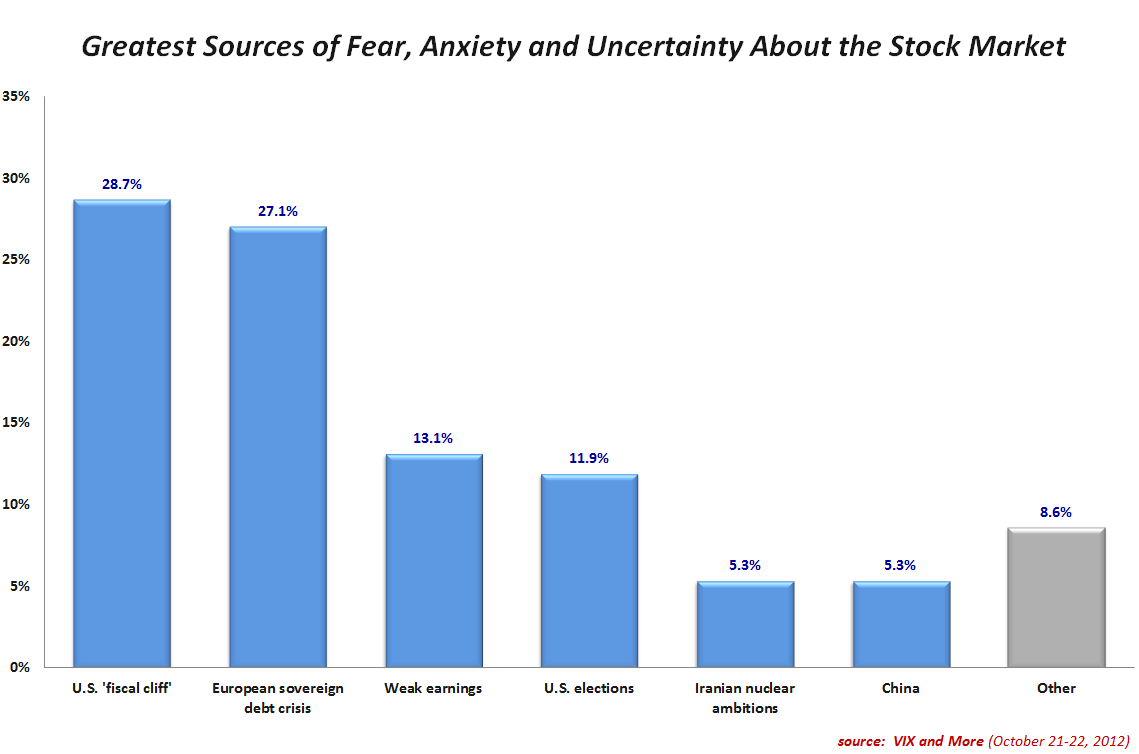
In a battle that went down to the wire, 28.7% investors voted the U.S. fiscal cliff as their #1 concern right now, followed closely by fears about the European sovereign debt crisis, which 27.1% labeled as their top issue. The prospect of a weak earnings season was a distant third at 13.1%.

[source(s): VIX and More]

There were some interesting findings when the 244 responses were broken out geographically. In the U.S., for instance, the fiscal cliff issue dominated the European sovereign debt crisis, 31.5% to 22.2%, with weak earnings third at 15.4%. Looking at non-U.S. responses, the Americentric bias disappears, as 36.6% of respondents tab the European sovereign debt crisis as their top worry, followed by the fiscal cliff (23.2%) and U.S. elections (9.8%).

While there were quite a few write-in votes, no theme emerged from these responses, though central bank interventions, U.S. debt, deleveraging, higher interest rates, high-frequency trading, demographics and technical factors were among the issues cited.

Among some of the questions raised by the results are the role of local and national media in shaping investors’ fears and the tendency of investors to overemphasize events that are closest to home. These are just two of the issues that I hope to explore going forward, making use of some of the data generated by this poll over time and comparing the ebb and flow of concerns against the ebb and flow of the VIX.

Going forward, I anticipate a weekly VIX and More Fear Poll each weekend, with the results and some takeaways to be published at about the same time every week.

Related posts:

Disclosure(s): none

DISCLAIMER: "VIX®" is a trademark of Chicago Board Options Exchange, Incorporated. Chicago Board Options Exchange, Incorporated is not affiliated with this website or this website's owner's or operators. CBOE assumes no responsibility for the accuracy or completeness or any other aspect of any content posted on this website by its operator or any third party. All content on this site is provided for informational and entertainment purposes only and is not intended as advice to buy or sell any securities. Stocks are difficult to trade; options are even harder. When it comes to VIX derivatives, don't fall into the trap of thinking that just because you can ride a horse, you can ride an alligator. Please do your own homework and accept full responsibility for any investment decisions you make. No content on this site can be used for commercial purposes without the prior written permission of the author. Copyright © 2007-2023 Bill Luby. All rights reserved.
 
Web Analytics