Showing posts with label VIX ETF. Show all posts

Tuesday, April 3, 2012

VIX ETP Returns for Q1 2012

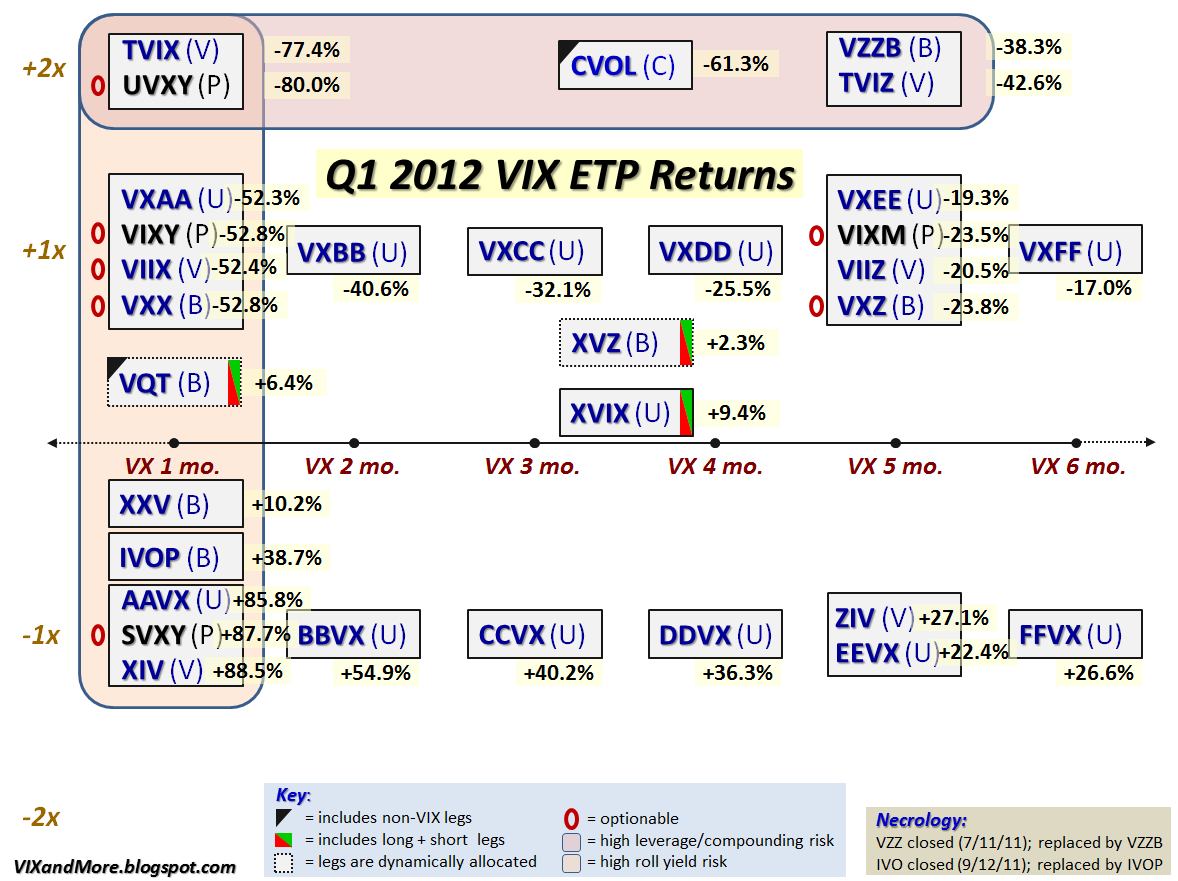
Back in my consulting days, I convinced myself that there were rare instances when an ugly chart crammed full of data should take precedence over a clean and simple graphic that focused on the key takeaways. For my purposes at least, the graphic below, while unlikely to garner accolades from the likes of Information Aesthetics of Flowing Data, is one of those instances and suits my purposes perfectly. [After all, this blog is really just a place for me to archive my own idiosyncratic ideas and the two million interlopers are just a curious side effect, but I digress…]

Getting back to the main point, the graphic below updates the VIX exchange-traded products (ETP) landscape (the only additions are two new red 0s to indicate that UVXY and SVXY are now optionable) and adds performance data for the first quarter of 2012.

Of course anyone who has checked in on this space periodically certainly has already realized that the first quarter saw record contango and negative roll yield across the full spectrum of the VIX futures term structure. As a result of this, the long volatility products had a horrendous three months, the inverse ETPs racked up huge gains and those products with dynamic allocations (VQT and XVZ) or offsetting long and short volatility legs (XVIX) were able to manage small(er) gains.

Following the usual pattern, the products with the shortest target maturities were the most volatile, while those with longer target maturities saw much less movement.

Also notice the symmetry of the return structure. For all the long products that were getting whacked (TVIX, UVXY, VXX, TVIZ, etc.) there were corresponding inverse products (XIV, SVXY, ZIV, etc.) that were racking up larger gains than the losses suffered by their long volatility counterparts.

Last but not least, perhaps the distribution of the returns will help to explain why I have organized my previous VIX ETP ‘field guides’ in this fashion.

This graphic should implicitly raise a bunch of issues and the links below are good jumping off points for further exploration regarding a number of those issues.

For the time being I will leave additional analysis to those in the comments section.

Related posts:

Disclosure(s): long XIV, ZIV, BBVX and XVZ; short TVIX, UXY and VXX at time of writing

Tuesday, March 27, 2012

Options on UVXY and SVXY Open Up New VIX ETP Trading Approaches

Whether or not I find it useful to flog the wounded horse otherwise known as the VelocityShares Daily 2x VIX Short-Term ETN (TVIX), it seems as if investors and the media insist that the wild and crazy story of this +2x VIX futures ETN remain on the front page for now.

While the TVIX story is indeed a fascinating one (see links below for more details), I fear it has crowded out a potentially more useful development from last week that has been criminally overlooked, the launch of options on two important VIX ETFs:

  • ProShares Ultra VIX Short-Term Futures ETF (UVXY)
  • ProShares Short VIX Short-Term Futures ETF (SVXY)

First off, note that the fact that these two products are exchange-traded funds instead of exchanged-traded notes means that it was much easier for options to be approved. While their more famous ETN counterparts, TVIX and XIV, grab most of the headlines, the addition of options means that traders now have much more flexibility in terms of strategy and tactics with UVXY and SVXY. 

In the past when I have mentioned how options on VIX ETPs were critical to their long-term success, I was met with a few (electronic) blank stares. Part of this reflects that fact that many have been drawn to the VIX ETPs for the potential to reap huge profits in a short period of time (more on this in The Trader Development Stage Model and the Jump from Stocks to Options) with leveraged trades. Talk to most professional options traders, however, and leverage is rarely a factor they mention as a reason for their focus on options trading. In fact, pros are more likely to cite the two key advantages of options as their flexibility and ability to structure defined risk (or limited risk) trades.

This brings me back to options on UVXY and SVXY. With UVXY down 83% for the quarter as of yesterday’s close, one would think that defined risk positions – on the long or short side – would be a critical factor in structuring future trades. With the huge contango and negative roll yield currently in the VIX futures, a directional bet in either direction entails huge risk. For shorts, this means that a short position can have its risk capped by buying UVXY calls. For longs this means that a long position can also limit risk by buying puts.

There are other ways to implement defined risk trades, notably with vertical credit spreads and vertical debit spreads, where gains and losses are limited to the distance between strikes. Traders can also just simply buy puts and calls to put a directional idea to work, knowing that their maximum loss will be limited to the purchase price.

In hard to borrow situations – which are common with some VIX ETPs – traders can also use options to create a synthetic position. For instance, a long put plus a short call is the equivalent of a synthetic short, so if no shares are available to borrow, a synthetic position might be an excellent proxy, with the same profit and loss potential as a standard short position, yet typically tying up a lot less trading capital.

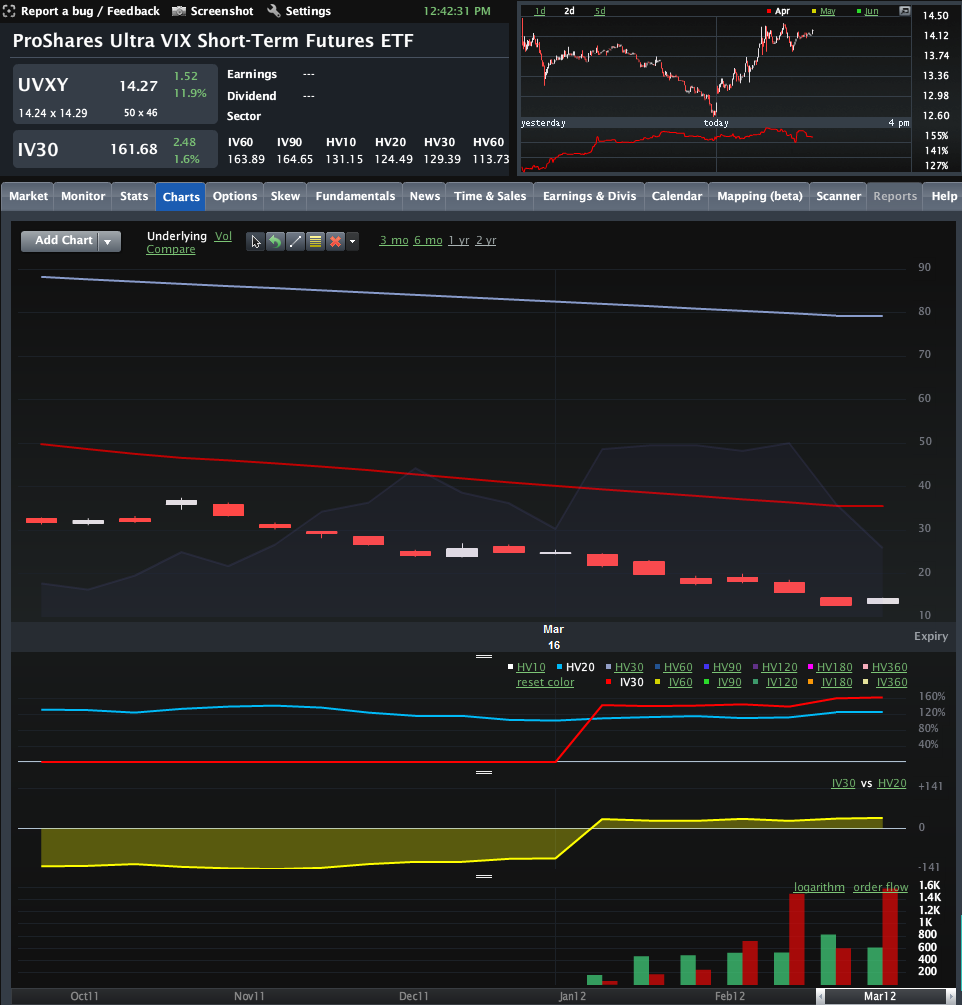
Note that the markets for options in UVXY and SVXY are only one week old and not particularly liquid at this stage. On the other hand, volumes are ramping up quickly (see graphic of UVXY options volume, etc. below) and the flexibility and risk control inherent in options products makes these attractive, particularly so when applied to highly volatile products like UVXY and SVXY.

Related posts:

[source(s): LivevolPro.com]

Disclosure(s): long XIV and SVXY, short TVIX and UVXY at time of writing; Livevol is an advertiser on VIX and More

Thursday, March 22, 2012

TVIX Creation Units Return; What It Means for Investors

One month and one day after Credit Suisse (CS) announced the suspension of new creation units in the VelocityShares Daily 2x VIX Short-Term ETN (TVIX), the issuer announced today that it plans to reopen issuance of TVIX “on a limited basis” effective tomorrow.

In a twist, the press release also noted:

“Beginning March 23, 2012, Credit Suisse may from time to time issue the ETNs into inventory of its affiliates to make the ETNs available for lending at or about rates that prevailed prior to the temporary suspension of issuances of the ETNs. Also, beginning as soon as March 28, 2012, Credit Suisse may issue additional ETNs from time to time to be sold solely to authorized market makers. Credit Suisse may condition its acceptance of a market maker’s offer to purchase the ETNs on its agreeing to sell to Credit Suisse specified hedging instruments consistent with Credit Suisse’s hedging strategy, including but not limited to swaps. Any such hedging instruments will be executed on the basis of the indicative value of the ETNs at that time, will not reflect any premium or discount in the trading price of the ETNs over their indicative value and will be on terms acceptable to Credit Suisse, including the counterparty meeting Credit Suisse’s creditworthiness requirements, margin requirements, minimum size and duration requirements and such other terms as Credit Suisse deems appropriate in its sole discretion.” [emphasis added]

The references to hedging instruments consistent with Credit Suisse’s hedging strategy, swaps, counterparty creditworthiness, margin requirements, etc. may shine a light on some of the issues that Credit Suisse encountered when they elected to close the creation unit window last month.

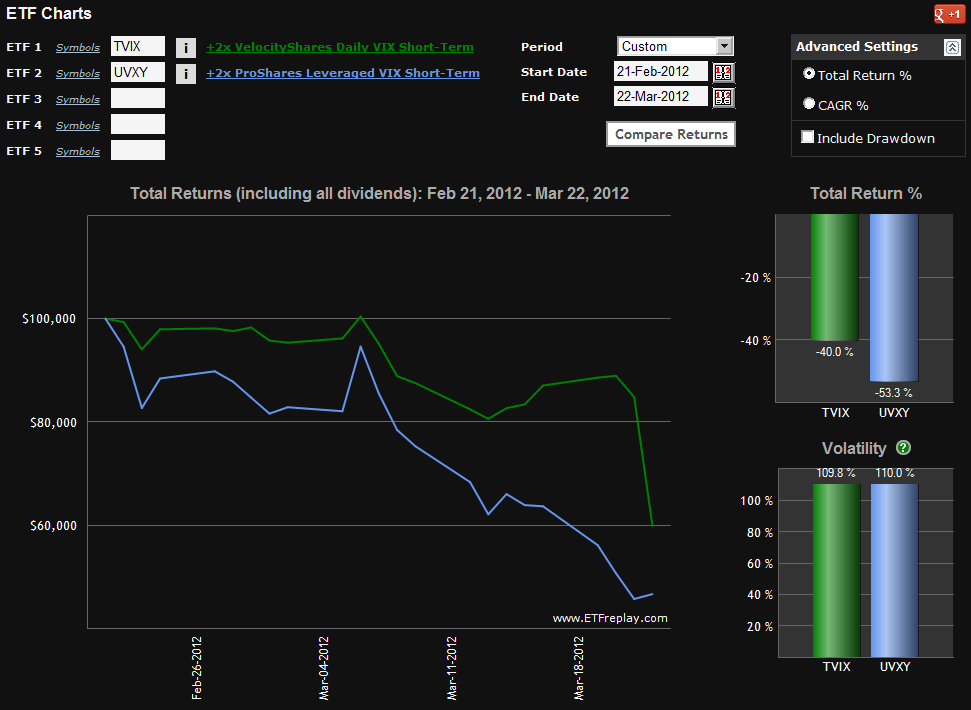
Today’s price action has already raised some eyebrows, with TVIX falling 29.3% during the regular trading session and dropping another 11.8% after hours, while a near equivalent security, the ProShares Ultra VIX Short-Term Futures ETF, UVXY, rose 2.1% during the standard session and was essentially unchanged after hours. As best as I can determine, news of the reopening of the creation units window broke at about 7:34 p.m. ET, at which point TVIX was already down more than 33% from Wednesday’s close. Given that the 30 million shares traded today was about as many shares as had exchanged hands in the prior week, it is reasonable to conclude that at least one party believed that new creation units were imminent and had hoped to profit by shorting TVIX ahead of the announcement. In fact the price action of TVIX was so disconnected from UVXY and the rest of the VIX ETPs that I fielded dozens of questions on the subject and concluded (Twitter, blog comments), “The continued decline in TVIX has me wondering if someone is speculating about CS re-opening the creation units window.”

Of course investors are more interested in what will happen next than what flotsam has already drifted under the bridge.

As for tomorrow’s open, first keep in mind that TVIX ended today’s after-hours session at 9.00, while indicative value is still a good deal lower at 7.83. While Credit Suisse would no doubt like to see TVIX trade back at indicative value levels as soon as possible, the “on a limited basis” phrasing is likely to give some investors pause. Also, there are no guarantees that Credit Suisse might not feel compelled to suspend creation units again at some point in the future. For this reason, I would not at all be surprised to see TVIX continue to trade with a premium in the neighborhood of 5-10% or so at times tomorrow, dropping down to something along the lines of 2-5% next week. These numbers are pure speculation at this stage. A large part of the premium story will depend upon how limited the new creation units are and how aggressively Credit Suisse seeks to drive down the market price to the indicative value. No matter how this plays out, investors should expect that at least 90% of the divergence between TVIX and UVXY over the last month (see graphic below) will disappear tomorrow.

On a related note, investors who have become wary of TVIX during the past month have embraced UVXY to the extent that UVXY’s daily dollar volume has been running ahead of that of TVIX during the past week.  As of Monday, UVXY also has the benefit of being supported by options, with April strikes from 14 through 35 already seeing a fair amount of action. With the advents of options on UVXY (and also on the -1x inverse VIX futures ETF, SVXY) a new universe of trading opportunities becomes available for those who wish to speculate or hedge with VIX-based ETPs. What is most encouraging is that investors can now easily trade VIX products with defined (limited) risk positions by utilizing options. More on this at a later juncture.

In the meantime, [T]VIX and More will do its best to cover the TVIX story as it continues to develop.

Finally, I would be remiss in failing to point out that this space was the only place that one could find information about TVIX before and during the suspension of the creation units. The links below, which are arranged largely in reverse chronological order, provide a wealth of information about TVIX, UVXY and many of the issues facing these products.

Related posts:

[source(s): ETFreplay.com]

Disclosure(s): short TVIX and UVXY at time of writing

Tuesday, February 21, 2012

An Updated Field Guide to VIX ETPs

With the sudden success of TVIX, it seems as if the entire VIX exchange-traded product (ETP) space has a large number of new converts. Growing from just two products at the end of 2009 (VXX and VXZ) to 12 by the end of 2010 and 31 by the end of 2011, VIX ETPs are a growth industry.

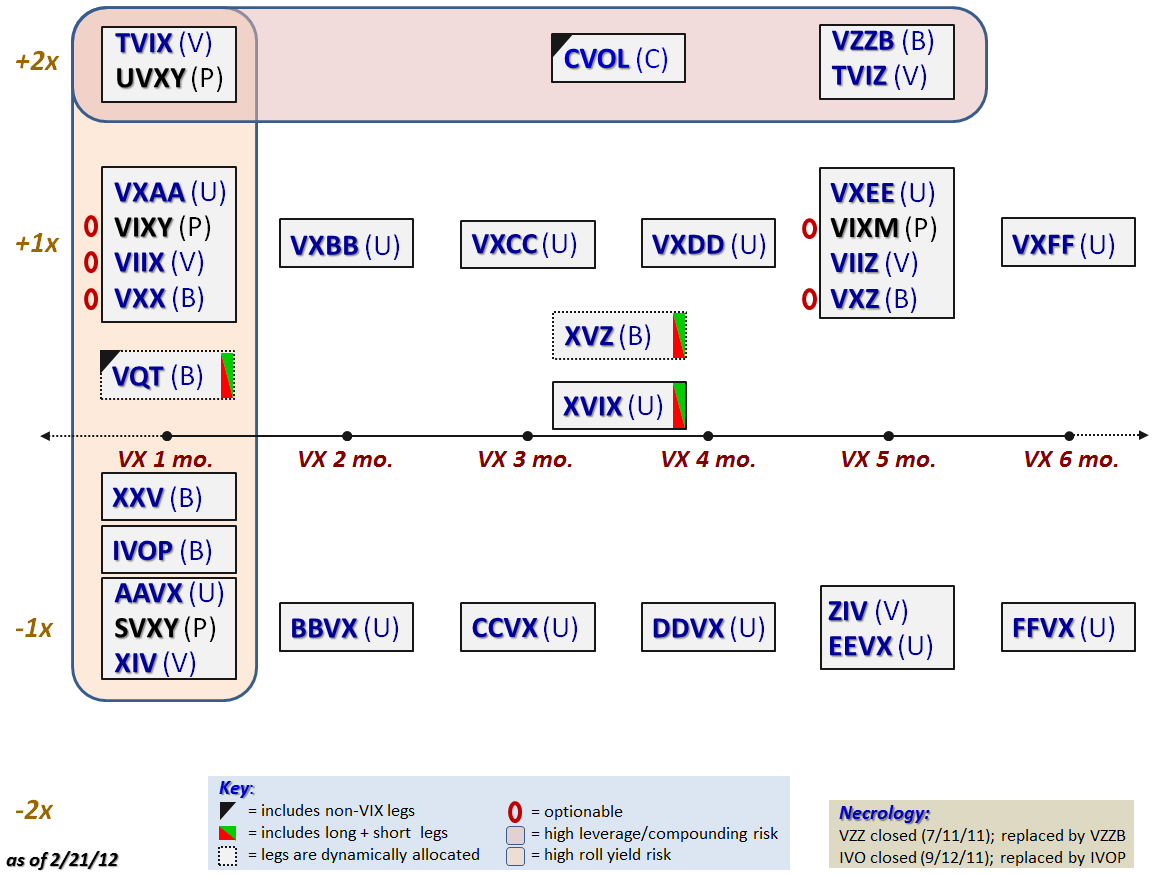
For those who trade or invest in the VIX ETP space, I thought the graphic below – a field guide of sorts – might be of assistance. The intent of the graphic is to differentiate between the various VIX and volatility-based ETPs primarily by mapping them according to target duration and leverage. The key at the bottom of the graphic highlights some additional distinctions, such as:

  • ETPs that hold some non-VIX securities in their portfolio are marked by a black triangle. These include VQT and CVOL, which hold long or short positions in SPX/SPY
  • ETPs that include both long and short VIX positions in their portfolio (VQT, XVZ and XVIX) are flagged with a red/green rectangle
  • ETPs with a dotted outline (VQT and XVZ) have a rule-based dynamic allocation of volatility components
  • the red ovals highlight those five VIX ETPs that are currently optionable
  • the large light red shaded area incorporates all the ETPs that use 2x leverage (there are no 3x VIX ETPs)
  • the large orange shaded area incorporates all the ETPs which have a target average weighted one month duration and thus are particularly susceptible to the influence of contango and negative roll yield in the VIX futures portion of their holdings

There are some other important distinctions that are difficult to work into the chart, but one I did incorporate was to flag VIX ETFs (from ProShares) in a black font, while all the ETNs are in a blue font.

For the sake of completeness, I also included a necrology of the two VIX ETPs that were closed last year. Interestingly, both were immediately succeeded with virtually identical products that trade under a similar ticker.

Going forward I fear that the next round of VIX ETPs may make it impossible to capture the same level of detail as I have done in this single page, but for now at least, this is my reference of choice for VIX ETPs.

Related posts:

Disclosure(s): long XVZ, short VXX and short TVIX at time of writing

Tuesday, April 29, 2008

Ten Things Everyone Should Know About the VIX

I have had quite a few requests to present some introductory material on the VIX, so with that in mind I offer up the following in question and answer format:

Q: What is the VIX?
A: In brief, the VIX is the ticker symbol for the volatility index that the Chicago Board Options Exchange (CBOE) created to calculate the implied volatility of options on the S&P 500 index (SPX) for the next 30 calendar days. The formal name of the VIX is the CBOE Volatility Index.

Q: How is the VIX calculated?
A: The CBOE utilizes a wide variety of strike prices for SPX puts and calls to calculate the VIX. In order to arrive at a 30 day implied volatility value, the calculation blends options expiring on two different dates, with the result being an interpolated implied volatility number. For the record, the CBOE does not use the Black-Scholes option pricing model. Details of the VIX calculations are available from the CBOE in their VIX white paper.

Q: Why should I care about the VIX?
A: There are several reasons to pay attention to the VIX. Most investors who monitor the VIX do so because it provides important information about investor sentiment that can be helpful in evaluating potential market turning points. A smaller group of investors use VIX options and VIX futures to hedge their portfolios; other investors use those same options and futures as well as VIX exchange traded notes (primarily VXX) to speculate on the future direction of the market.

Q: What is the history of the VIX?
A: The VIX was originally launched in 1993, with a slightly different calculation than the one that is currently employed. The ‘original VIX’ (which is still tracked under the ticker VXO) differs from the current VIX in two main respects: it is based on the S&P 100 (OEX) instead of the S&P 500; and it targets at the money options instead of the broad range of strikes utilized by the VIX. The current VIX was reformulated on September 22, 2003, at which time the original VIX was assigned the VXO ticker. VIX futures began trading on March 26, 2004; VIX options followed on February 24, 2006; and two VIX exchange traded notes (VXX and VXZ) were added to the mix on January 30, 2009.

Q: Why is the VIX sometimes called the “fear index”?
A: The CBOE has actively encouraged the use of the VIX as a tool for measuring investor fear in their marketing of the VIX and VIX-related products. As the CBOE puts it, “since volatility often signifies financial turmoil, [the] VIX is often referred to as the ‘investor fear gauge’”. The media has been quick to latch onto the headline value of the VIX as a fear indicator and has helped to reinforce the relationship between the VIX and investor fear.

Q: How does the VIX differ from other measures of volatility?
A: The VIX is the most widely known of a number of volatility indices. The CBOE alone recognizes nine volatility indices, the most popular of which are the VIX, the VXO, the VXN (for the NASDAQ-100 index), and the RVX (for the Russell 2000 small cap index). In addition to volatility indices for US equities, there are volatility indices for foreign equities (VDAX, VSTOXX, VSMI, VX1, MVX, VAEX, VBEL, VCAC, etc.) as well as lesser known volatility indices for other asset classes such as oil, gold and currencies.

Q: What are normal, high and low readings for the VIX?
A: This question is more complicated than it sounds, because some people focus on absolute VIX numbers and some people focus on relative VIX numbers. On an absolute basis, looking at a VIX as reformulated in 2003, but using data reverse engineered going back to 1990, the mean is a little bit over 20, the high is just below 90 and the low is just below 10. Just for fun, using the VXO (original VIX formulation), it is possible to calculate that the VXO peaked at about 172 on Black Monday, October 19, 1987.

Q: Can I trade the VIX?
A: At this time it is not possible to trade the cash or spot VIX directly. The only way to take a position on the VIX is through the use of VIX options and futures or on two VIX ETNs that are based on VIX futures: VXX, which targets VIX futures with 1 month to maturity; and VXZ, which targets 5 months to maturity. An inverse VIX futures ETN, XXV, was launched on 7/19/10. This product targets VIX futures with 1 month to maturity. As of May 2010, options have been available on the VXX and VXZ ETNs.

Q: How can the VIX be used as a hedge?
A: The VIX is appropriate as a hedging tool because it has a strong negative correlation to the SPX – and is generally about four times more volatile. For this reason, portfolio managers often find that buying of out of the money calls on the VIX to be a relatively inexpensive way to hedge long portfolio positions. Similar hedges can be constructed using VIX futures or the VIX ETNs.

Q: How do investors use the VIX to time the market?
A: This is a subject for a much larger space, but in general, the VIX tends to trend in the very short-term, mean-revert over the short to intermediate term, and move in cycles over a long-term time frame. The devil, of course, is in the details.

[Last updated on 7/22/2010]

Monday, December 31, 2007

VWSI at Zero as Year Coasts to a Close

A year ago, the VIX stood at 11.56. Last week it ended the week at 20.74, up 79%. Of course, in the absence of a VIX ETF (or ETN), it was almost impossible for volatility aficionados to capture that 79% gain.

For the moment, at least, things seem to be quiet on the volatility front. Last week the VIX gained 2.27 points (12.3%) to bring the index to a level just 0.17 below the 10 day simple moving average and 0.93 below the 20 day SMA. Partly because of this, the VWSI is back at zero and indicating no directional bias for the beginning of 2008.

As is my weekly custom, for a survey of the best in current thinking about the markets, Barry Ritholtz at The Big Picture sums up the week that was and the week that will be in his New Year’s Linkfest.

Finally, as volatility tends to run in 2-4 year cycles, it is appropriate to ask whether the 79% gain in the VIX in 2007 marks the beginning of a new volatility macro cycle. In spite of the historical precedent, I am on the record as saying that the most likely volatility scenario for 2008 is a VIX in the low to mid-20s.

(Note that in the above temperature gauge, the "bullish" and "bearish" labels apply to the VIX, not to the broader markets, which are usually negatively correlated with the VIX.)

Wine pairing: For a VWSI of zero, I began the year recommending some Rhone blends and later expanded the category to include any expensive blend. For 2007, I will close out the year with my two favorite inexpensive blends: the $8 Oakley Five Reds (the 2003 vintage is a blend of 41% syrah, 27% zinfandel, 22% petite sirah, 10% alicante bouschet, and 1% mourvedre from Cline Cellars); and the 2005 vintage of The Hermit Crab from D’Arenberg, a delicious $13 blend of 70% viognier and 30% marsanne.

Wednesday, November 14, 2007

Catching Up On Reader Mail

Thanks to all who have commented and e-mailed me in the ten months the blog has been up and running. Readers have been a great source of ideas for my research and have helped to sharpen my thinking about the markets and ultimately my ability to trade them successfully.
Some interesting comments and mail have been coming over the transom lately and I thought I’d address a couple of these in public.

There have been a couple of questions about VIX futures. I have not traded them to date, but it is something that I will definitely play with in the coming year. Even though I do not trade them, I certainly watch VIX futures closely, particularly the spread between the front month and the six month futures. Anyone interested in getting a sense of my emerging thinking in this area should check out posts with a VIX futures label. Also, note that the fifth and sixth links from the top in the “VIX and Sentiment Links” in the upper right hand corner of the blog both concern VIX futures.

Straying only a little from VIX futures, someone mentioned VXV, a new product from the CBOE which was launched on Monday and calculates the three month implied volatility in the SPX. The VXV may provide an interesting contrast to the one month IV in the SPX that is reflected in the VIX. I will certainly be taking a close look at the VXV and post my thoughts about it in short order.

Another reader asked if there is any way to invest in the cash or spot VIX directly. Unfortunately, the answer is no, though it is possible that a VIX ETF may be on the horizon. Some technical aspects of creating a VIX ETF (or ETN) are fairly daunting, but given the demand for volatility products, I would expect that it is only a matter of time before we see the launch of at least one volatility ETF.

Finally, one question concerned whether it is possible to replicate the spot VIX by buying a basket of delta-hedged SPX options to essentially re-create how the VIX is calculated. This is certainly possible, if a little complicated. A simpler approach would be to use SPX or SPY options, where you could go long or short volatility with straddles and strangles. If you prefer to hedge your short volatility positions, as I do, you might want to stick to butterflies and condors.

DISCLAIMER: "VIX®" is a trademark of Chicago Board Options Exchange, Incorporated. Chicago Board Options Exchange, Incorporated is not affiliated with this website or this website's owner's or operators. CBOE assumes no responsibility for the accuracy or completeness or any other aspect of any content posted on this website by its operator or any third party. All content on this site is provided for informational and entertainment purposes only and is not intended as advice to buy or sell any securities. Stocks are difficult to trade; options are even harder. When it comes to VIX derivatives, don't fall into the trap of thinking that just because you can ride a horse, you can ride an alligator. Please do your own homework and accept full responsibility for any investment decisions you make. No content on this site can be used for commercial purposes without the prior written permission of the author. Copyright © 2007-2023 Bill Luby. All rights reserved.
 
Web Analytics