Showing posts with label RVX. Show all posts

Tuesday, August 12, 2008

Crude Oil Volatility Slides with Crude Prices

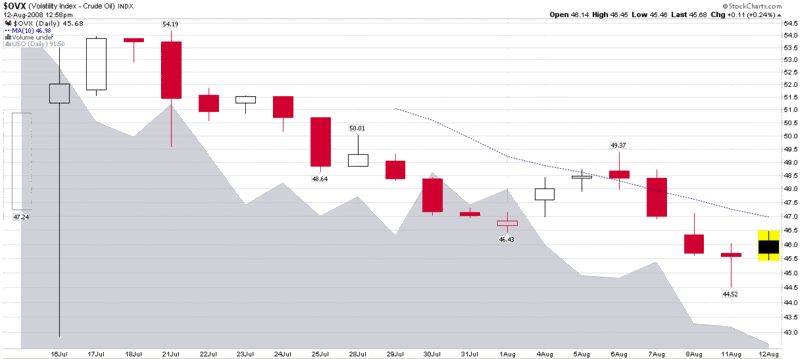
Based on the large number of Google searches that have recently been landing on the blog, there is considerable interest in the CBOE’s new “Oil VIX” or crude oil volatility index (ticker OVX), which was launched exactly four weeks ago today.

While it is still too early to pluck much in the way of useful conclusions from the OVX, I have included a chart of the new volatility index below. So far what may surprise most newcomers to crude oil volatility is that the OVX has fallen in concert with crude oil prices (as measured by the USO crude oil ETF). My analysis of USO options suggests that crude oil implied volatility and the price of the underlying are likely to be largely uncorrelated going forward, which is in sharp contrast to the strong negative correlation between equities and their corresponding volatility indices, such as the VIX, the VXN, and the RVX.

Wednesday, June 11, 2008

Unusual Chart of the Month: VXO and RVX

In the past, I have been accused of dreaming up strange and unusual charts just for the fun of it. I will gladly enter a guilty plea on that one. In fact, I enjoy cajoling the Department of Strange and Unusual Charts to come up with something that readers have never encountered before.

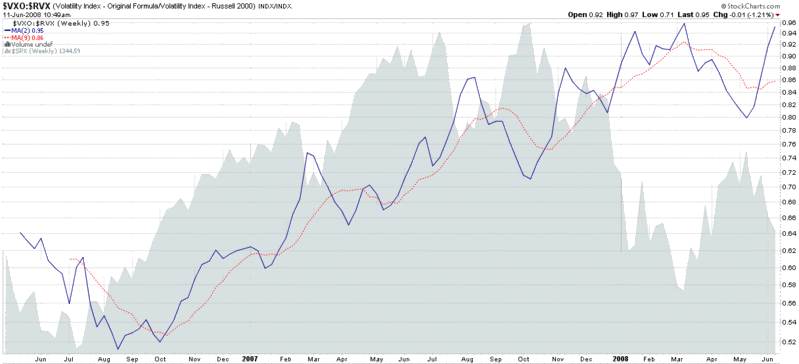
If the chart below looks a little out of the ordinary, chalk it up to that personality disorder I have already confessed to. Before trying to interpret whether the chart has any possible validity, it is important to take a step back. Consider that each chart contains at least one hypothesis about a relationship between various data points and/or data sets. At first glance that hypothesis might seem outrageous or merely coincidental. The point of the strange and unusual charts is that it is more important to drag those hypotheses out into the open and give readers an opportunity to pause and reflect on them than it is to present each hypothesis as unassailable .

In the long run, it is those strange and unusual relationships that no one else sees, but which persist over time, that provide a meaningful trading edge. So keep an open mind and keep looking.

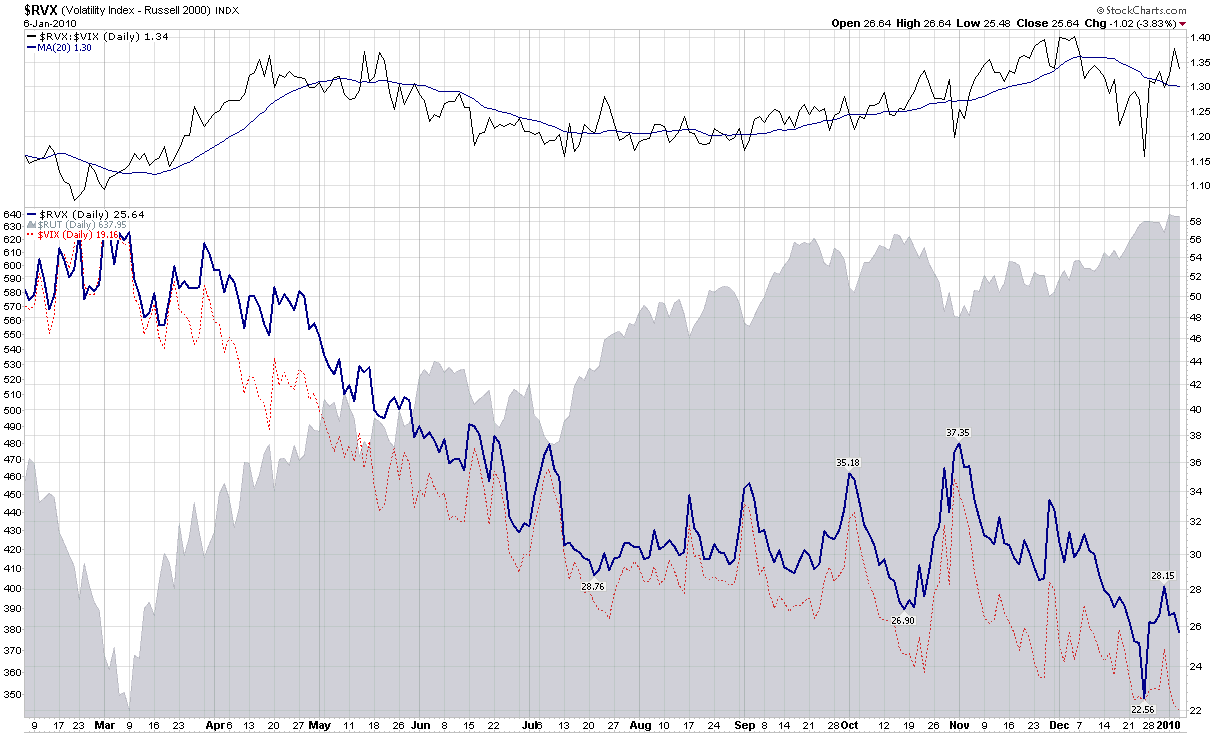
Turning to the ratio of the VXO to the RVX, recall that the VXO is the ‘original VIX’ and reflects the volatility associated with the large cap S&P 100 index (OEX). The RVX, on the other hand, is the volatility index for the Russell 2000 small cap index (RUT). Small caps have been outperforming large caps lately, so it is not surprising to see recent volatility trending higher with the large caps. What did surprise me, however, was to see that a spike in the VXO relative to the RVX has been an excellent indicator of market bottoms over the past two years. If we extrapolate from the past, the current levels of the VXO versus the RVX also suggest a likely intermediate market bottom, at least in the SPX, which is represented by a gray area chart in the graph. Unassailable? No. Worth watching going forward? Absolutely.

Wednesday, May 28, 2008

Comparative Volatility Indices

I am a strong believer in simplifying life – and one’s approach to investing – as much as possible. Less is more.

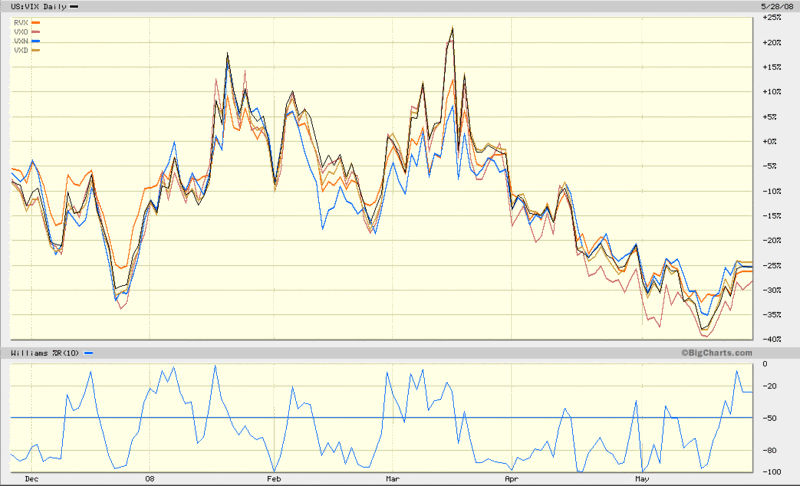
With that thought in mind, I pulled up a six month chart of the five major US volatility indices: VIX, VXO, VXN, RVX, and VXD. The chart, which comes courtesy of BigCharts, shows that over the past six months, the difference between the volatility indices are no more than subtle nuances. Keep in mind that during this period, the financial sector was extremely hard hit. Moreover, financials are overrepresented in the VIX and VXO, underrepresented in the RVX, and absent from the VXN. The sector distinction is all but lost in the charts (except perhaps from mid-February to mid-March) and if there were ever a time for the indices to diverge in a meaningful way, this was it.

The bottom line is that for most market observers, it makes sense to follow only the VIX. Volatility aficionados may also choose to follow the VXN, but after adding a second volatility index to one’s radar, the incremental return on effort and complexity diminishes rapidly.

When there are important divergences between these indices, I will be quick to point these out, but for the most part, expect my comments about the VIX to apply to the entire volatility index family tree as a whole.

Tuesday, April 29, 2008

Ten Things Everyone Should Know About the VIX

I have had quite a few requests to present some introductory material on the VIX, so with that in mind I offer up the following in question and answer format:

Q: What is the VIX?
A: In brief, the VIX is the ticker symbol for the volatility index that the Chicago Board Options Exchange (CBOE) uses to calculate the implied volatility of options on the S&P 500 index (SPX) for the next 30 days.

Q: How is the VIX calculated?
A: The CBOE utilizes a wide variety of strike prices for SPX puts and calls to calculate the VIX. In order to arrive at a 30 day implied volatility value, the calculation blends options expiring on two different dates, with the result being an interpolated implied volatility number. For the record, the CBOE does not use the Black-Scholes option pricing model. Details of the VIX calculations are available from the CBOE in their VIX white paper.

Q: Why should I care about the VIX?
A: There are several reasons to pay attention to the VIX. Most investors who monitor the VIX do so because it provides important information about investor sentiment that can be helpful in evaluating potential market turning points. A smaller group of investors use VIX options and VIX futures to hedge their portfolios; and an even smaller bunch use those same options and futures to speculate on the future direction of the market.

Q: What is the history of the VIX?
A: The VIX was originally launched in 1993, with a slightly different calculation than the one that is currently employed. The ‘original VIX’ (which is still tracked under the ticker VXO) differs from the current VIX in two main respects: it is based on the S&P 100 (OEX) instead of the S&P 500; and it targets at the money options instead of the broad range of strikes utilized by the VIX. The current VIX was reformulated on September 22, 2003, at which time the original VIX was assigned the VXO ticker. VIX futures began trading on March 26, 2004 and VIX options followed on February 24, 2006.

Q: Why is the VIX sometimes called the “fear index”?
A: The CBOE has actively encouraged the use of the VIX as a tool for measuring investor fear in their marketing of the VIX and VIX-related products. As the CBOE puts it, “since volatility often signifies financial turmoil, [the] VIX is often referred to as the ‘investor fear gauge’”. The media has been quick to latch onto the headline value of the VIX as a fear indicator and has helped to reinforce the relationship between the VIX and investor fear.

Q: How does the VIX differ from other measures of volatility?
A: The VIX is the most widely known of a number of volatility indices. The CBOE alone recognizes nine volatility indices, the most popular of which are the VIX, the VXO, the VXN (for the NASDAQ-100 index), and the RVX (for the Russell 2000 small cap index). In addition to volatility indices for US equities, there are volatility indices for foreign equities (VDAX, VSTOXX, VSMI, VX1, MVX, VAEX, VBEL, VCAC, etc.) as well as lesser known volatility indices for other asset classes such as currencies.

Q: What are normal, high and low readings for the VIX?
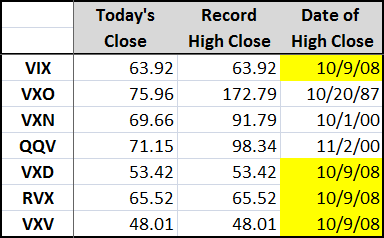
A: This question is more complicated than it sounds, because some people focus on absolute VIX numbers and some people focus on relative VIX numbers. On an absolute basis, looking at a VIX as reformulated in 2003, but using data reverse engineered going back to 1990, the mean is a little bit over 19, the high is just below 50 and the low is just below 10. Just for fun, using the VXO (original VIX formulation), it is possible to calculate that the VXO peaked at about 172 on Black Monday, October 19, 1987.

Q: Can I trade the VIX?
A: At this time it is not possible to trade the cash or spot VIX directly. The only way to take a position on the VIX is through the use of VIX options and futures. It is possible that at some point there will be a VIX ETF or a VIX ETN, but no such products have been announced.

Q: How can the VIX be used as a hedge?
A: The VIX is appropriate as a hedging tool because it has a strong negative correlation to the SPX – and is more than four times more volatile. For this reason, portfolio managers often find that buying of out of the money calls on the VIX to be a relatively inexpensive way to hedge long portfolio positions. Similar hedges can be constructed using VIX futures.

Q: How do investors use the VIX to time the market?
A: This is a subject for a much larger space, but in general, the VIX tends to trend in the very short-term, mean-revert over the short to intermediate term, and move in cycles over a long-term time frame. The devil, of course, is in the details.

Wednesday, February 13, 2008

VIX February Options Calendar Anomaly

Just a quick note to remind anyone who is trading VIX options that the February options expirations calendar [which is pinned at the bottom of the "VIX & Sentiment Links" in the upper right hand corner of the blog] has some unusual features that are the result of the timing of Good Friday, which falls on expiration week in March this year.

Without getting into all the details, the bottom line is that the expiration day for February's VIX options is Tuesday, February 19th, instead of the usual Wednesday. With the President’s Day holiday falling on Monday the 18th, this moves the last trading day in VIX options up to Friday, February 15th – the day after tomorrow. Note that the same expiration and last trading dates also apply to VXN and RVX options.

Anyone who wishes to dive into the details of the VIX options calendar and other related information is encouraged to brush up on the VIX options contract specifications.

Tuesday, November 13, 2007

VXN Reversal Signal

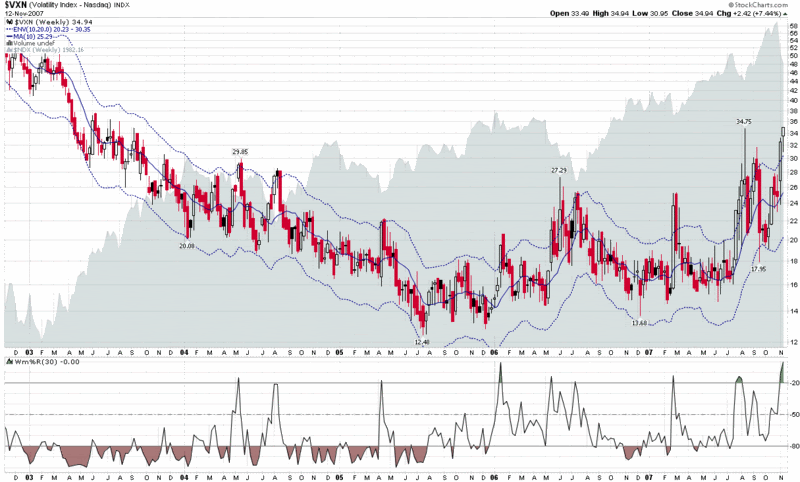
The attached chart shows the VXN (volatility index for the NASDAQ-100 or NDX) over the past five years, with a 10 day simple moving average, flanked by dotted lines representing 20% above and below the 10 day SMA.

Anybody who has been paying attention knows that the last several days have been highly unusual. As the chart shows, the VXN, which rarely closes outside of those 20% bands, is currently 38.2% above the 10 day SMA. This is about as extreme as it gets for volatility outliers and suggests a high probability of a sharp reversion to the mean in the VXN, coincident with a bounce back in the NDX.

For the record, the same market bottom signal is coming from the VIX and SPX, but without the extreme reading that is characterized by the VXN and NDX. By contrast, the signal from the RXV and RUT is substantially weaker and only marginally tradeable.

Volatility signals with this level of confidence are extremely rare, so if you are looking for an excuse to get long in a big way for the short term, or to trade VIX along the lines recently suggested by Brian Overby, today is an excellent opportunity to try to time the markets.

Friday, September 28, 2007

Volatility Index Options Menu Expands: VXN and RVX Options Now Available

When I started this blog, one of the reasons I decided to call it “VIX and More” was that unlike other options indices, it was possible to trade VIX options. Well…I won’t be renaming the blog, but as of yesterday, the CBOE is now trading options on the VXN (NASDAQ-100 Volatility Index) and RVX (Russell 2000 Volatility Index.)

I reported on this development when it was first announced and recently offered up some graphs on comparative performance of the major US volatility indices, but clearly it is time to update the full volatility options tree.

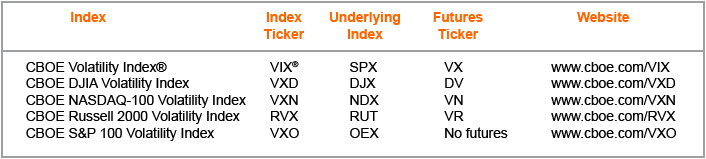
With the new VXN and RVX options, the US volatility indices now stack up as follows:

Additionally, the CBOE has added a new splash page for all five of the volatility indices, which I have pinned to the upper right hand corner of the blog.

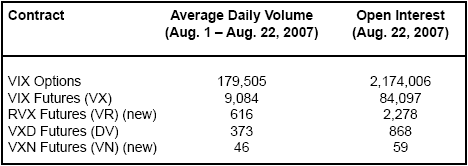
The CBOE has also used the occasion of the launch of options on the VXN and RVX to provide some data on these indices that may be of interest to readers. I found it particularly interesting that in terms of activity in the futures (launched July 6, 2007), investors have so far favored the RVX to the VXN by a large margin:

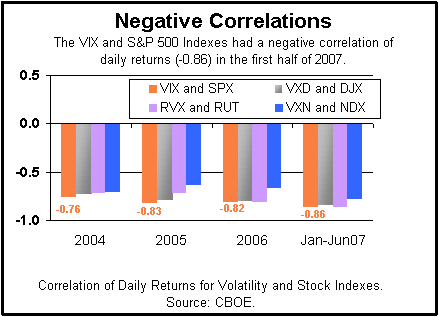
Perhaps related to the above, while a graphic published by the CBOE shows that the VIX has a stronger (negative) correlation to the SPX than do the other volatility indices to their counterparts, it also seems that the relationship between the RVX and the RUT is stronger than that of the VXN and the NDX:

Finally, those interested in implied volatility for the new options can click on the RVX and VXN links to get the appropriate information and graphs from iVolatility.com. From a historical volatility perspective, these two indices look fairly similar at the moment, but I will keep a close eye on them going forward and report any noteworthy divergences.

Friday, September 7, 2007

Volatility Index Comparison

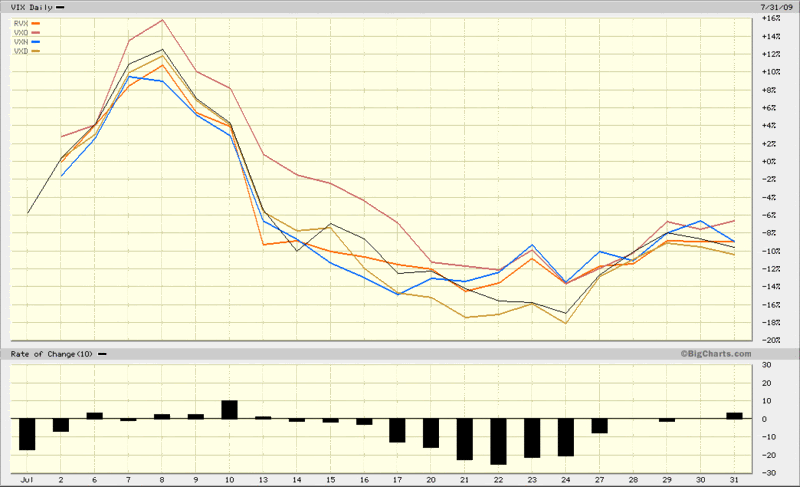
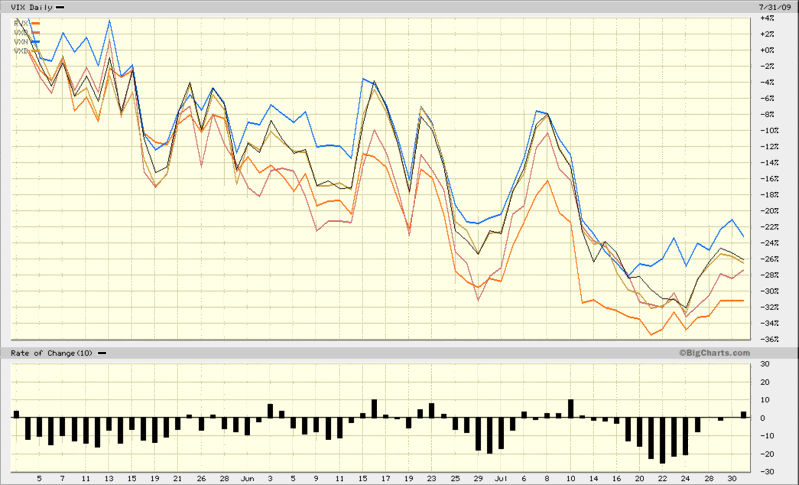
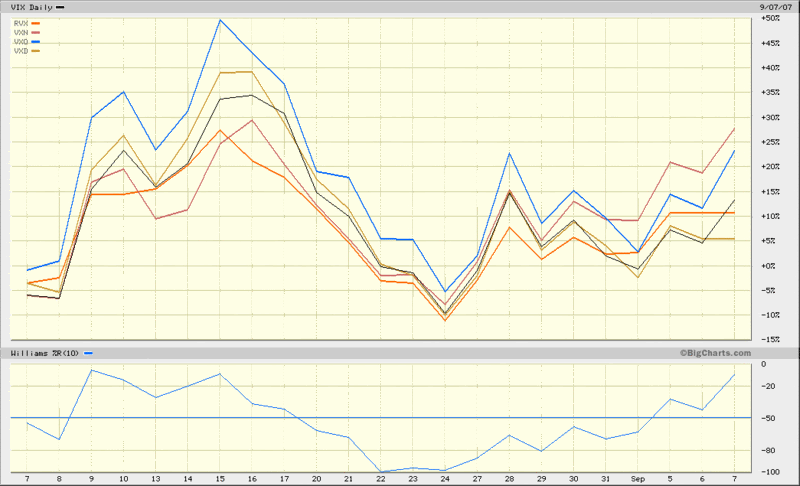
I last put up a chart of the five US equity volatility indices in mid-March, following the February 27th VIX spike. Now that we also have about three weeks following the VIX spike, I thought I might put up a similar chart of the volatility indices for the recent market action.

The recent volatility spike (top chart) shows VXO once again leading the charge upward, with VXN the laggard -- just as was the case in March. Interestingly, during the secondary surge in volatility over the past two weeks or so, the VXN has been the most sensitive.

With VXN and RVX options just around the corner, the relative movements of these volatility indices are becoming increasingly more interesting (and important) to watch.


VXN and RVX Options Coming September 27th

The CBOE announced yesterday that it plans to begin trading options on the VXN (NASDAQ-100 Volatility Index) and the RVX (Russell 2000 Volatility Index) as of September 27, 2007.

This announcement comes just two months after the CBOE began trading futures in the VXN and RVX.

While VIX and More will not quite provide tick by tick coverage of VXN and RVX options, it is a fairly safe bet that I will have more to say about them than just about anyone else.

Monday, July 30, 2007

RUT Hedge Fund Puke?

On the off chance that there are readers out there who have not bothered to read Bernie Schaeffer’s market commentary because it requires a free registration to Schaeffer’s Research, you really should rethink that idea. Take, for instance, Schaffer’s “Monday Morning Outlook: Fear Swells Amid Market Pullback,” which was published earlier this morning. Here Schaeffer pulls a gem from Stonebrook Structured Products, a provider of hedge fund replication strategies:

“A large part of hedge fund returns are driven by shorting large-cap growth and the going long small-cap value and emerging market equity. True alpha accounts for only 20-25% of industry returns.”

Schaeffer extends this idea to come up with a hypothesis for the recent substantial performance gap for small caps (as evidenced by the Russell 2000 falling almost three times as hard as the large cap indices):

“Once the more volatile smaller-cap stocks began to seriously under perform the S&P, their short S&P hedges were not sufficiently protecting them (which caused them to be ‘too long’ in a market correction) and the hedge funds then needed to go out and sell stock from their portfolios and/or short the IWM or buy IWM puts. And all of this served to further blast the IWM.”

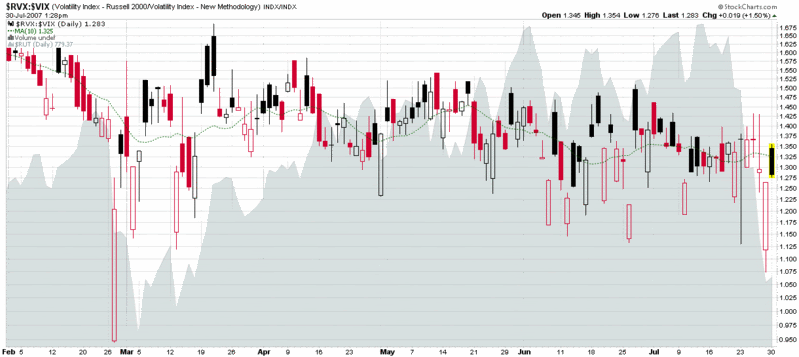
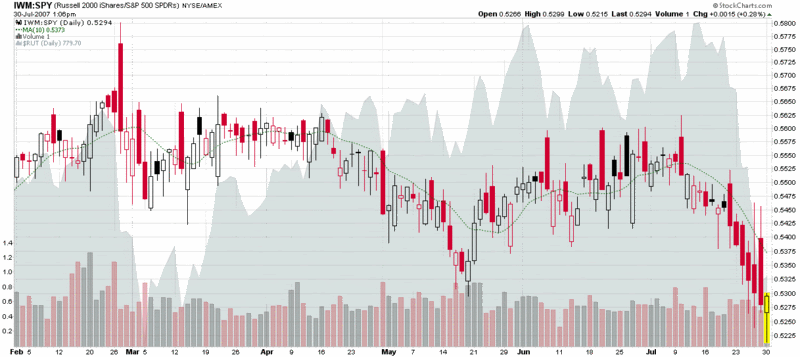
Interestingly, a look at the volatility of the Russell 2000 index (RVX) compared to the VIX does not reveal the underlying dynamic that Schaeffer suggested, but a study of the ratio of the IWM to the SPY does support his contention. See the two charts below for a better sense of this.

One key takeaway from this exercise is that some important volatility-related information is flying under the radar of the volatility indices. Another key takeaway is that ETFs are not only the driving the force in the markets these days, but they need to be a central part of any market technician’s analytical toolbox as well.


Saturday, July 7, 2007

Futures Now Available on VXN and RVX

From the in-case-you-missed-it department, comes a June 11 announcement by the CBOE that the CBOE Futures Exchange (CFE) has launched "two new volatility index futures contracts on the CBOE Nasdaq-100 Volatility Index (ticker symbol VXN, futures symbol VN) and the CBOE Russell 2000 Volatility Index (ticker symbol RVX, futures symbol VR) beginning July 6, 2007."

More information is available from the CBOE for the VXN futures and RVX futures in the links to the left.

Among other things, this means I will now be paying much closer attention to the VXN and the RVX.

Friday, March 16, 2007

Meet the Spikers

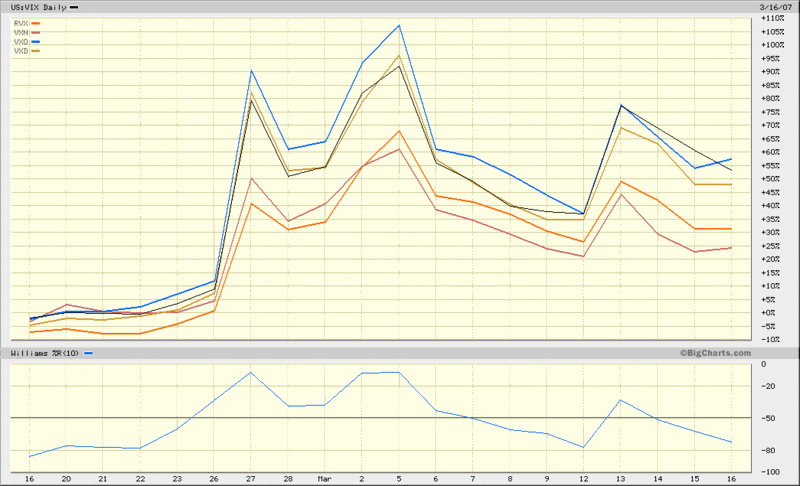
Quadruple witching day seems like as good a day as any to meet the family. Having already introduced VDAX, the VIX’s German cousin, today we look at the US relatives. First, the handy chart:

Due to marriages, divorces, name changes and the like, a more detailed look at the US extended family can get complicated, but here are the five key players, roughly in order of their current significance in the markets:

VIX – measures implied volatility for S&P 500 (SPX) options for all near term at-the-money SPX puts and calls and out-of-the-money puts and calls. Deep-in-the-money options are excluded. The current methodology has been in use since 9/22/03. The VIX was officially introduced on 4/1/93, but the CBOE has calculated synthetic historical VIX data going back to the beginning of 1990.

VXN – measures implied volatility for the Nasdaq 100 (NDX) options for all near term at-the-money NDX puts and calls and out-of-the-money puts and calls. Deep-in-the-money options are excluded. The current methodology has been in use since 9/22/03; the index was originally introduced on 1/22/01.

VXO – is calculated by taking the weighted average of the implied volatility of 8 S&P 100 OEX calls and puts with an average time to expiration of 30 days. Note that this is the methodology that was used to calculate the VIX prior to 9/22/03. On that date, the method used to calculate the VIX was changed and a new ticker symbol and name was introduced to provide continuity with the historical method of calculating the "old VIX" prior to 9/22/03.

From the CBOE site:

"VIX measures market expectation of near term volatility conveyed by stock index option prices. The original VIX was constructed using the implied volatilities of eight different OEX option series so that, at any given time, it represented the implied volatility of a hypothetical at-the-money OEX option with exactly 30 days to expiration.

The New VIX still measures the market's expectation of 30-day volatility, but in a way that conforms to the latest thinking and research among industry practitioners. The New VIX is based on S&P 500 index option prices and incorporates information from the volatility ‘skew’ by using a wider range of strike prices rather than just at-the-money series."

VXD – measures implied volatility for the Dow Jones Industrial Average options for all near term at-the-money DJIA puts and calls and out-of-the-money puts and calls. Deep-in-the-money options are excluded. Introduced on 4/25/05.

RVX – measures implied volatility for the Russell 2000 (RUT) options for all near term at-the-money NDX puts and calls and out-of-the-money puts and calls. Deep-in-the-money options are excluded. Introduced on 5/5/06.

While there is a very high degree of correlation among the volatility indices, like any family, this family does not always move in lockstep fashion, as the graph below demonstrates. In the coming weeks, I will talk more about divergence among the volatility indices and attempt to provide a framework for interpreting them.