Showing posts with label VIX calls. Show all posts

Saturday, July 11, 2015

Seizing Opportunity From Stock Market Volatility (Guest Columnist at Barron’s)

Steve Sears and I have a running joke that whenever I am tapped as a guest columnist for The Striking Price at Barron’s, we should both start buying VIX calls as inevitably something is going to come along and cause a volatility spike just in time to give me something topical to discuss.

This time around I thought China might be the culprit or Greece or Puerto Rico or the Fed or maybe even the NYSE. In fact, it was a cocktail of everything that has turned a relatively quiet Q2 into a much more menacing volatility environment in Q3. In Seizing Opportunity From Stock Market Volatility, which appears today in Barron’s, I turn my attention to small caps (RUT, IWM) and use IWM vs. SPY as a way to think about relative volatility in the context of exposure to China, the euro zone and a strong dollar. Focusing on the Russell 2000 Volatility Index (RVX) and VIX, investors have been attributing roughly the same level of uncertainty and relative risk for small caps as large caps, which I see as questionable when one considers the very different exposure each asset class has to global issues and the dollar.

Given that RVX futures (VU) are thinly traded, it probably does not make sense to be short VU and long VX, the VIX futures. Another way to translate the thinking above into a strict volatility trade would be to short an at-the-money straddle for RUT or IWM, while going long an at-the-money straddle for SPX or SPY. That type of trade is probably a stretch for most Barron’s readers, but I suspect is probably right in the wheelhouse of many readers in this space. For the Barron’s article, I came up with something simpler to execute, an IWM Aug 121/123 bull put spread, which has both volatility and directional components to it and is disengaged from volatility in SPX/SPY.

In the Barron’s article, I talk a little bit about selling volatility in a post-crisis market environment or following a significant volatility event, observing:

“Selling options on the downslope of a volatility spike is often only marginally less profitable than selling options at the top of a volatility spike.”

If any of this sounds a little bit like a corollary to some of my work on “disaster imprinting” then some readers clearly have very good memories.

Related posts:

A full list of my (16) Barron’s contributions:

Disclosure(s): none

Tuesday, March 19, 2013

Another Record in VIX Call Volume

Exactly three weeks ago today, I thought I would break some news on an intraday basis with a post that I titled, Record VIX Options Volume and Large Purchases of VIX Calls. As it turns out, by the time the day’s total volume was tallied, February 26th turned out to be an all-time record for VIX options volume in general and VIX calls in particular.

The events of three weeks ago now look a little less impressive in light of today’s new record in VIX call volume. Truth be told, VIX options seem to be attracting the attention of a new group of investors. In fact, during the CBOE Risk Management Conference earlier this month, there was a great deal of speculation surrounding who some of the new players in the VIX space might be that are responsible for the new growth in VIX futures and VIX options that appears to be independent of the volume driven by VIX ETPs.  [Hedge funds, proprietary trading firms, commodity trading pools/advisors, insurance companies, bond traders, FX traders and others were among the names that were bandied about…]

As is typically the case with the VIX, call volume outpaced put volume by a substantial margin. Today the call to put ratio was about 2.2 to 1, slightly higher than the average of 1.9 to 1. That being said, put buyers appeared to be a little more aggressive than call buyers, with 42% of all puts bought on the ask, as opposed to 30% of the calls, according to data provided by LivevolPro.

Investors are always looking for an interpretive overlay for these VIX options transactions. Frankly, on the day before the March VIX expiration, a great deal of the options activity is the result of large investors closing out March positions or attempting to game the special opening quotation (VIX SOQ) from tomorrow’s open that establishes the settlement price for VIX options and futures.  As a result of that low signal to noise ratio, the day prior to expiration is generally not a productive time for reading options entrails, though there will no doubt be some who are hell-bent on some sort of options divination regardless of where we are in the VIX expiration cycle.  For today at least, I would suggest that the links below might bear more fruit. 

Related posts:

[source(s): LivevolPro.com]

Disclosure(s): Livevol and the CBOE are advertisers on VIX and More

Tuesday, February 26, 2013

Record VIX Options Volume and Large Purchases of VIX Calls

With about a half hour left in today’s trading session, purchases of VIX options are unusually high – much higher than yesterday. As I type this, over 855,000 VIX calls have been traded, with today likely to see the highest VIX call volume since the August 2011 market panic. Data from LivevolPro indicate that 28% of VIX call transactions are being bought on the ask, versus 16% sold at the bid, reflecting a lack of price sensitivity on the part of the buyers of VIX calls, who are the driving force behind these transactions. All told, a record 1.3 million VIX options contracts have been traded, breaking the old record of 1.22 million from September 11, 2012.

Note also that while the VIX’s implied volatility has been on the rise as of late, at its current level it is in the middle of its 2012 range.

The equities market may feel more orderly and composed today, but in the options market, there are signs of increasing anxiety and concern.

[source(s): LivevolPro.com]

Related posts:

Disclosure(s): neutral position in VIX via options; Livevol is an advertiser on VIX and More

Thursday, November 20, 2008

Markets Rallying (for now), But VIX Still Rising

It is unusual to see the markets bounce off of a bottom and the VIX still continue to climb, but that is exactly what has happened over the past few minutes, with the VIX up to 80.35. This divergence usually resolves in a bearish fashion.

Interestingly, the VIX December 100 calls that I referenced in the previous post have pulled back to a bid/ask of 0.75 - 1.00, with 774 contracts now traded.

VIX at 78.62; December 100 Calls Trade at 1.05

There have already been 213 contract traded for the VIX December 100 calls. The current bid/ask is 1.05 - 1.15.

Thursday, October 16, 2008

VIX Spikes to Record of 77.72

...in relatively orderly selling. The VIX just surpassed the previous all-time high of 76.92, which was set last Friday.

Also of interest, Oct 100 calls just traded at 1.00

Wednesday, October 1, 2008

A Week in the Life of VIX Calls

Last week I talked a little bit about VIX Options as Catastrophe Insurance and talked about how VIX options are priced off of VIX futures, not the cash/spot VIX index that is quoted in the press. A lot can happen in a week.

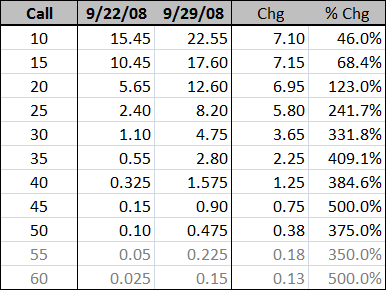
In the graphic below, I compare VIX October calls for selected strikes from 10 to 60 as they were quoted (using the midpoint of the bid and ask) at about 2:30 p.m. EDT on September 22nd and again after the market closed on September 29th.

During the course of the week, the VIX jumped from 31.74 to 46.72, a 14.98 point gain or 47% increase. As you can see, even the deep in the money VIX calls (i.e., the 10 and 15 strikes) failed to move even half as much in absolute terms as the cash VIX. The 30 strike, which was below the cash VIX prior to the spike, only moved about ¼ as much as the cash VIX. Looking out to the 45 strike, those VIX options gained all of 0.75, or about 5% as much as the cash VIX moved during the week.

For the record, from September 22 to September 29, the VIX October futures advanced approximately 21%, from a little over 25 to a little over 31.

I will have much more to say about the behavior of VIX options and futures, particularly in and around the September 29 VIX spike, going forward.

[NOTE: The grayed out numbers means there was no bid, so the calculation above is half of the ask]

Tuesday, June 24, 2008

SPY Put Volume Study

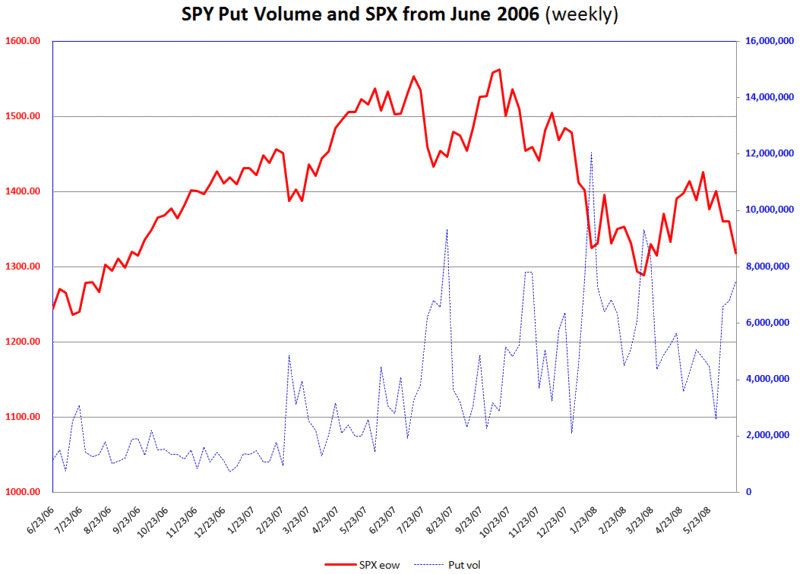
For those who were underwhelmed by yesterday’s monthly charts of the call volume and put to call ratios for the VIX, I am going to try to whelm you a little more by switching over to weekly charts of SPY (the ETF for the S&P 500 index) puts.

The logic here is that those who may not want to be short the market (or hedge long positions) with the additional leverage of VIX calls may prefer the increased liquidity, dollar strike price increments, and penny pricing benefits of SPY puts.

Looking at the chart below, the SPY put volume correlates nicely with intermediate bottoms in the SPX/SPY. Note the current spike in put volume. It is something to think about, anyway, as you contemplate what the Fed could possibly say that might put a stop to the slide in the equities market.

Monday, June 23, 2008

VIX Put to Call Ratios and Call Option Volume

I have not yet posted much about VIX call options volume on the blog, but the subject of VIX option volume and put to call ratios is an interesting one that I will return to periodically.

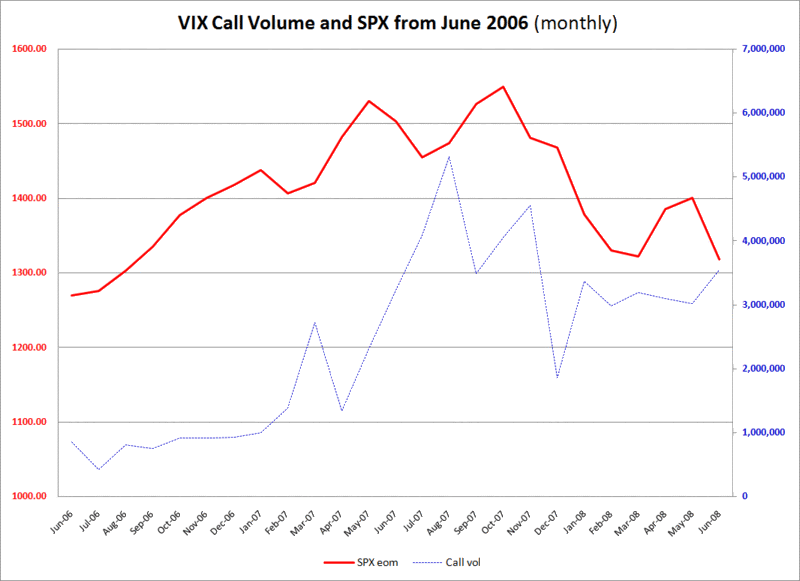
First, I should set some context by pointing out that two years ago, it was rare for VIX options volume to hit one million contracts in a single month. Following the record 64% one day spike in the VIX on February 27, 2007, VIX options suddenly surged in popularity, with their monthly volume rising steadily and peaking in August 2007 at 7.15 million. Interestingly, since last August, VIX options volume has been fairly steady month to month and has been averaging about 4 million contracts per month.

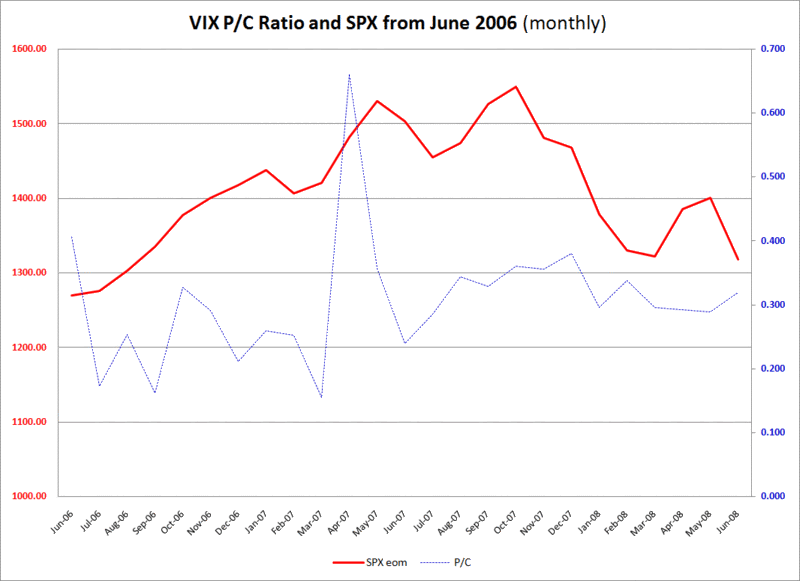
Given the general increase in activity in VIX options volume, it should come as no surprise that the call volume has surged with the overall options activity. For this reason I have included two VIX options charts, each with the monthly close in the SPX for reference. The top chart shows two years of the VIX monthly put to call ratio. From a quick visual study, it is difficult to conclude that this data provides much in the way of meaningful clues about future trends in the SPX. The bottom chart is a two year history the VIX monthly call volume (with projected end of month volume for June based on data through 6/20/08) and shows a moderate negative correlation between the VIX put to call ratio and movements in the SPX, particularly during 2007. I mention this because VIX call volume for the month of June is on track to be at its highest level in at least 7 months, with the spike in VIX calls increasing the likelihood of a market bottom in the near term.

Consider this an appetite whetter; I will delve more into VIX options and various interpretations of VIX options data in this space going forward.


Wednesday, June 20, 2007

VIX Implied Volatility at a 52 Week Low

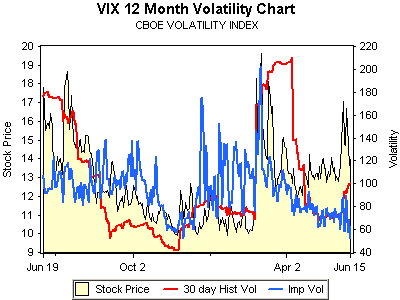
There is always a risk of trying to cram too much information into one graphic, but with the image to the right, I figured it was worth a try.
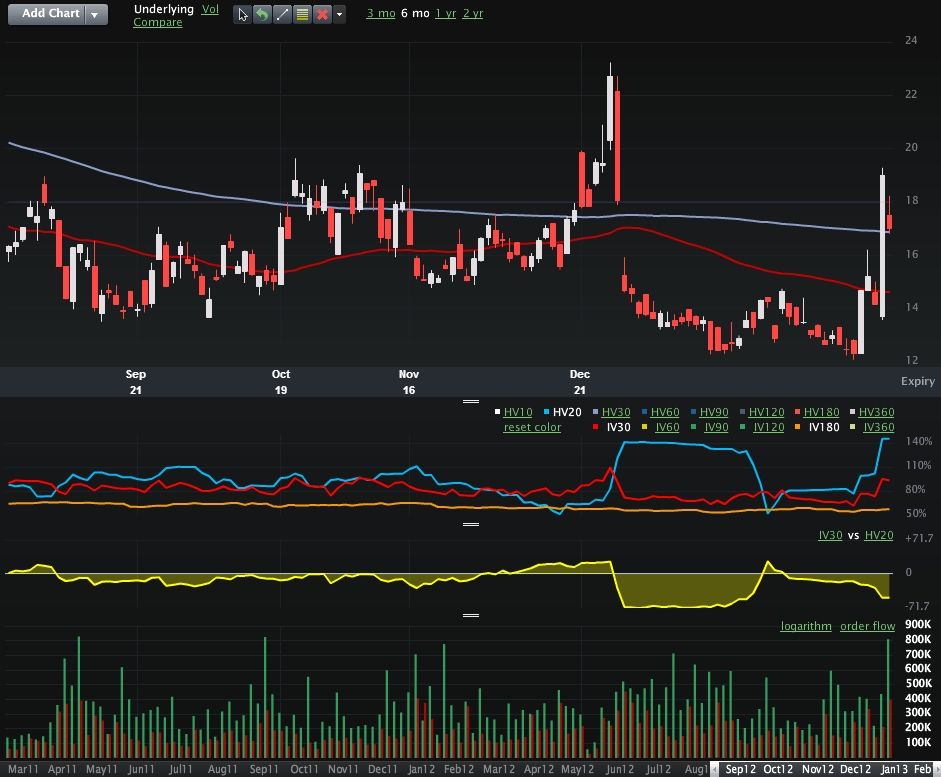
The chart, which comes courtesy of optionsXpress, depicts implied and historical volatility in VIX options over the past year, in addition to the VIX price, which is part of the reason why it is messier than the (more elegant and readable) iVolatility VIX options chart that shows only implied and historical volatility.

The reason I bother mentioning any of this is that VIX call options closed yesterday with their lowest implied volatility reading of the past 52 weeks. So if you think the market is getting toppy, but you are reluctant to go long the VIX because it is still a fair distance from single digits, consider that the volatility premium for VIX calls is as cheap as it has been in a long time.

Thursday, April 12, 2007

VIX May OTM Calls

Once again, Jim Kingsland of The Kingsland Report is talking about significant buying activity in OTM VIX calls, this time the May 19s. You may recall the last time he made a similar observation and I commented on it here that is was only a couple of days before all hell broke loose on the VIX front.

This time around it feels a lot different from where I sit. The last time I could sense The Coming Storm and was surprised only that it took so long before it finally arrived. This time my intuition is tuned to things like the put to call ratio and is telling me not to worry, so I am more likely to be on the selling end of those May 19 calls. The problem is that my intuition, which is generally right about 51% of the time, is not as good at sniffing out a VIX spike as that of Jim Kingsland or not-so-random Roger Nusbaum. That's okay, though. It gives me something to work on while I watch the time decay on those May 19s.

Friday, February 23, 2007

VIX March OTM Calls

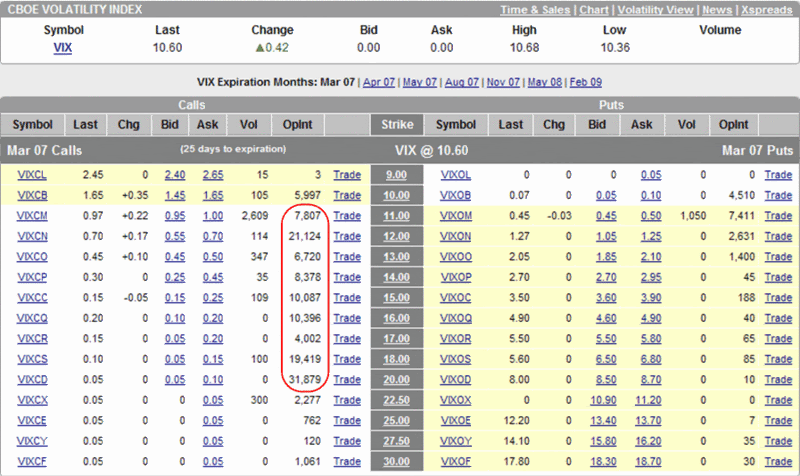
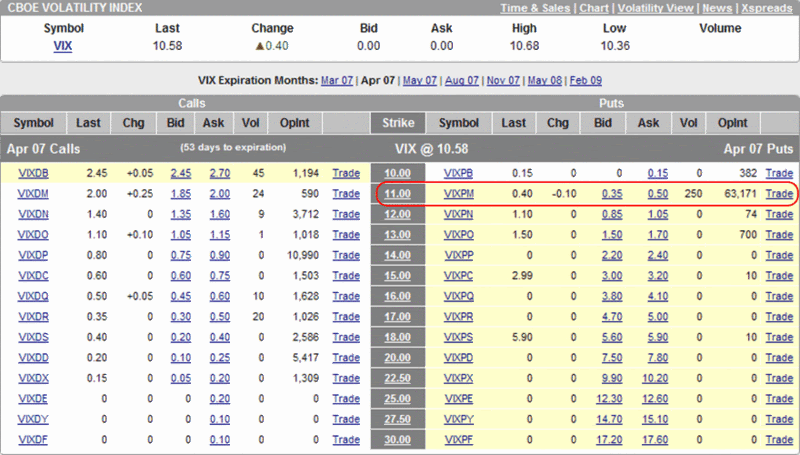
Jim Kingsland of The Kingsland Report claims he’s on vacation, but he continues to ponder the significance of the large open interest March VIX calls all the way up to the 20 strike.

From looking at the open interest patterns out through February 2009, I can only find one other area where it looks like a snake swallowed a cow: the open interest of 63,171 in April 11 puts. My (highly inexpert) guess is that someone has taken a significant long position in April 11 puts and hedged some of this in March with long calls across the 15-20 strike range. If this is the case, it is an interesting way to play the current volatility environment and suggests that a lot of money is going on the fat tails and betting against the type of orderly rise in volatility that would be associated with a mild correction in the SPX.


DISCLAIMER: "VIX®" is a trademark of Chicago Board Options Exchange, Incorporated. Chicago Board Options Exchange, Incorporated is not affiliated with this website or this website's owner's or operators. CBOE assumes no responsibility for the accuracy or completeness or any other aspect of any content posted on this website by its operator or any third party. All content on this site is provided for informational and entertainment purposes only and is not intended as advice to buy or sell any securities. Stocks are difficult to trade; options are even harder. When it comes to VIX derivatives, don't fall into the trap of thinking that just because you can ride a horse, you can ride an alligator. Please do your own homework and accept full responsibility for any investment decisions you make. No content on this site can be used for commercial purposes without the prior written permission of the author. Copyright © 2007-2023 Bill Luby. All rights reserved.
 
Web Analytics