Showing posts with label historical volatility. Show all posts

Thursday, February 25, 2021

The Evolution of the VIX (1)

 
Volatility is notorious for clustering in the short-term, mean-reverting in the medium-term and settling into multi-year macro cycles over the long-term.  I have chronicled each of these themes in this space in the past.

Apart from volatility, I have also taken great pains to talk about the movements of the VIX, which is one of the most famous instances of implied volatility and represents investor expectations about future volatility in the S&P 500 Index for the next thirty calendar days.  Surprising to some, the VIX and volatility (which generally refers to realized or historical volatility), while correlated, are very different animals.  Not only are these two very different, their evolutions have been very different as well.  Volatility, which has a much longer history, seems to exhibiting the same traits that it has exhibited throughout its lifetime, with relatively modest tweaks around the edges from time to time.

The same cannot be said for the VIX.  One thing about the VIX that has changed in the three decades or so of VIX data is the speed at which the VIX has moved up and down.  In a nutshell, VIX cycle times have shortened dramatically.  In other words, the VIX now has a tendency to spike much faster and mean-revert downward much faster as well.  This phenomenon has been ongoing for the past decade or so, but it became more pronounced following the Brexit craziness – or at least the first chapter of the Brexit craziness.

One way you can see how the changes in the VIX have differed from the changes in the volatility of the SPX is to look at volatility spikes.

In the first graphic, below, I show the number of days per year with 2% and 4% moves in the SPX going back to 1990.  Take note of the ebbs and flows in volatility and the clustering of volatility around the dotcom bubble and again around the 2008 Great Recession.

[source(s):  CBOE, Yahoo, VIX and More]

In the second graphic, I plot annual VIX spikes of 20% or more for each year going back to 1990.  Note that while visual inspection does not reveal any obvious trend in the SPX volatility data, the VIX spike data for the same period show a pronounced upward trend, reflecting the heightened sensitivity of the VIX to changes in volatility of the SPX.  In other words, even though volatility may be the same, the VIX is becoming more sensitive to volatility.  Another example that supports this point:  of all the one-day spikes in the VIX of 30% or more, 71% have happened in the past decade and only 29% are from the previous two decades.  The volatility landscape may or may not be changing, but the VIX is.

[source(s):  CBOE, Yahoo, VIX and More]

Further Reading:
Clustering of Volatility Spikes
Putting Low Stock Volatility to Good Use (Guest Columnist at Barron’s)
What My Dog Can Tell Us About Volatility
My Low Volatility Prediction for 2016: Both Idiocy and Genius
What Is Historical Volatility?
Calculating Centered and Non-centered Historical Volatility
Rule of 16 and VIX of 40
Shrinking VIX Macro Cycles
Chart of the Week: VIX Macro Cycles and a New Floor in the VIX
The New VIX Macro Cycle Picture
Recent Volatility and VIX Macro Cycles
VIX Macro Cycle Update
Was 2007 the Beginning of a New Era in Volatility?
VIX Macro Cycles
Last Two Days Are #5 and #6 One-Day VIX Spikes in History
2014 Had Third Highest Number of 20% VIX Spikes
Today’s 34% VIX Spike and What to Expect Going Forward
All-Time VIX Spike #11 (and a treasure trove of VIX spike data)
The Biggest VIX Spike Ever: A Retrospective
VIX Sets Some New Records, Suggesting Volatility Near Peak
Highest Intraday VIX Readings
Short-Term and Long-Term Implications of the 30% VIX Spike
VIX Spike of 35% in Four Days Is Short-Term Buy Signal
VXO Chart from 1987-1988 and Explanation of VIX vs. VXO
Volatility History Lesson: 1987
Volatility During Crises
Chart of the Week: VXV and Systemic Failure
Forces Acting on the VIX
A Conceptual Framework for Volatility Events

For those who may be interested, you can always follow me on Twitter at @VIXandMore

Disclosure(s): short VIX at time of writing

Sunday, February 26, 2017

Clustering of Volatility Spikes

Last week, my Putting Low Stock Volatility to Good Use (Guest Columnist at Barron’s) triggered a bunch of emails related to the clustering of low volatility.  Most readers expressed an interest in the phenomenon of volatility clusters occurring in both high and low volatility environments and were curious about the differences between high and low volatility clusters.

When it comes to measuring volatility clusters I am of the opinion that realized or historical volatility is a more important measurement than implied volatility measurements, such as is provided by the VIX.  When I think in terms of VIX spikes, I generally focus on two single-day realized volatility thresholds:  a 2% decline in the S&P 500 Index and a 4% decline.

The graphic below is in many respects the inverse of the graphic in Putting Low Stock Volatility to Good Use (Guest Columnist at Barron’s) – and this should come as no surprise.  Simply stated:  while both high volatility and low volatility cluster in the short-term, volatility regimes tend to persist for several years, so it is very rare to see a clustering of high and low volatility in the same years.  This is exactly the principle I laid out more than ten years ago regarding echo volatility in What My Dog Can Tell Us About Volatility.

[source(s):  CBOE, Yahoo, VIX and More]

Note also that in spite of all the talk in the past few years of the potential implosion of the euro zone, a hard landing in China, central banks across the globe creating the seeds of our destruction, increasingly bipartisan politics creating deep divides across the nation, etc., etc. – volatility has been relatively mild during the past 5-6 years.

The interesting thing about volatility regimes is that they eventually transition from low volatility environments to high volatility environments and vice versa and create what I call VIX macro cycles in the process.  The volatility transition phases are some of the most interesting times in the market and can certainly be some of the most profitable.  These inflection points are sure to be a target of some of my future writing on volatility.

So, as VIX and More sails off into its second decade of publication, I vow to flesh out some of my evolving thinking on subjects I have touched upon above (some of which have lain dormant in this space for several years) at the same time I charge off into new areas.  While I will continue to have a laser focus on volatility (particularly its global, multi-asset class aspects), it is time to pay more attention to the “and More” portion of this title of this blog and make a push into new frontiers.  Said another way:  my thinking likes to cluster, but it likes to spike as well.

Finally, most posts tend to touch on one or two key ideas, so I typically put a half dozen or so links below that I refer to as “Related posts.”  Today, it seems as if I have touched briefly on so many subjects that more links (I’m sure today’s is a new record) seem appropriate and instead of referring to these as related posts, they are now officially Further Reading going forward.  Enjoy!

Further Reading:
For those who may be interested, you can always follow me on Twitter at @VIXandMore

Disclosure(s): none

Friday, December 30, 2016

My Low Volatility Prediction for 2016: Both Idiocy and Genius

A year ago, Steve Sears of Barron’s asked me to pen a guest column for The Striking Price and use the opportunity to opine on how I saw the volatility landscape unfolding in 2016.  Without thinking about it too much, I was fairly certain I was going to devote the column to the many threats that had the potential to spiral out of control during the course of the year, but before I had an opportunity to start translating my thoughts into writing, other pundits started weighing in with their predictions for 2016 and without exception, everyone who ventured a guess on the direction of volatility was adamant that volatility would be substantially higher in 2016 than 2015.

Not wanting to follow the herd and always on the lookout for a more provocative point of view, I decided to fade the consensus, rip up the script in my head and adopt a contrarian outlook:  The Case Against High Stock-Market Volatility in 2016.  The column began as follows:

“Looking at all the market predictions for 2016, one thing is certain: Almost all of the pundits agree that volatility will be up, making a bet on rising volatility one of the year’s most popular trading ideas.

But, as is the case with much of the investment landscape, when most of the pundits agree about how the future will unfold, it pays to investigate the contrarian point of view.

As to volatility, the contrarian perspective is particularly compelling for 2016 because volatility is notoriously hard to predict; investors have a habit of dramatically overestimating its future level; and, when it comes to forecasting the causes of volatility, “experts” and investors alike have a penchant for fighting the last war.”

Then came January.  For those who have tried to put it out of their memory, January was one of the worst first months on record, with the S&P 500 Index falling 7.3% for the month.  The bearish trend continued into February, as fears related to China and crude oil had investors selling en masse.  By the time stocks found a bottom on February 11th, the S&P 500 Index was down 11.4% -- by some measures the worst beginning for stocks in history.  Volatility, of course, was spiking and the VIX had already topped 30.00 on three separate occasions just seven weeks into the year.

My prediction of lower volatility:  complete idiocy.

But the year was not over and we still had to grapple with Brexit, the crazy and unpredictable election season in the U.S., a Fed interest rate hike and persistent political turmoil in places like Italy and Brazil.  Amazingly, stocks showed a tremendous amount of resiliency and all the VIX spikes were given the Whac-A-Mole treatment as VIX mean reversion emerged as a key theme during 2016.

Now that the year is (almost) in the books, it turns out my contrarian low volatility prediction was spot on and the rest of the pundits ended up on the wrong side of a crowded losing trade, assuming one was patient enough to take a full-year perspective.  Genius?  Probably not, but definitely more right than wrong, despite my having to wear a dunce cap for the first two months of the year.

The graphic below shows the annual average VIX and historical volatility going back to 1990.  Note that while the average VIX fell from 16.67 to 15.83 this year, there was an even larger drop in realized or historical volatility, which fell sharply from 15.53 to 13.14.

[source(s):  CBOE, Yahoo, VIX and More]

As far as takeaways are concerned, there is the obvious lesson regarding the herd mentality and crowded trades.  Additionally, there are also issues regarding how investors frame a problem or potential problem.  For example, when one expects an increase in volatility they are more likely to be overprepared for that development and/or overreact when there are initial signs of an increase in volatility.  Ironically, if investors load up on SPX puts or VIX calls, then this makes it much more difficult for panic to filter into the market.  This leads to a theme that has been repeated often in this space:  VIX spikes are notoriously difficult to predict and it is also more difficult to anticipate a change in volatility regimes than many believe.

Last but not least, as the graphic above shows, predictions of future volatility almost always overshoot realized volatility, which is why in the last 27 years only the extreme turmoil in 2008 saw realized volatility higher than the VIX over the course of a full year.

As for 2017, when it comes to volatility, expect the unexpected.

Related posts:


For those who may be interested, you can always follow me on Twitter at @VIXandMore

Disclosure(s): the CBOE is an advertiser on VIX and More

Thursday, December 29, 2016

Average VIX and Volatility for Last Fourteen Presidents

What kind of VIX is appropriate for the Trump Administration? 

For investors in general and volatility traders in particular, this is one of the more interesting questions going into 2017.  Should the VIX be higher or lower in the context of a Trump Administration relative to the Obama Administration?  How much economic policy uncertainty is there in Trumponomics?  How will various geopolitical issues wax and wane in the context of a Trump-Tillerson foreign policy agenda?

While these questions are difficult ones, what is not difficult is looking in the rear-view mirror for some historical context, so that is exactly what I did, calculating the historical volatility for each presidency going back to the Hoover Administration.  In order to take advantage of stock data prior to the 1950s, one has to make use of the DJIA rather than S&P averages.  While VIX data is even more interesting, the VIX was not launched until Bill Clinton’s inauguration and historically reconstructed data from the CBOE only extends back to George H. W. Bush’s presidential term.

The results of the number crunching are included in the chart below and show Herbert Hoover’s historical volatility of 42.87 more than double that of the runner-up, Franklin Delano Roosevelt who posted a historical volatility of 20.88.  The only other president to top the 20 level in terms of historical volatility was George W. Bush at 20.28.  At the other end of the spectrum, the least volatile presidency was that of Lyndon B. Johnson, where HV averaged an amazingly low 9.12.  Following LBJ on the low end are Dwight Eisenhower at 10.70 and Harry Truman at 12.20.


[source(s):  CBOE, Yahoo, VIX and More]

Among recent presidents, three of the last four presidencies (George W. Bush is the exception) have seen middling volatility, with Barack Obama 6th of 14 as of today’s data, while Bill Clinton is 7th and George H. W. Bush in 8th place.

Since the eye canot help but see trends and patterns whether they exist in real life or not, I am obliged to observe that since the LBJ presidency there is a pattern of higher highs and higher lows.  Could volatility by presidential term be trending up?  I am certainly not ready to go that far.

In terms of key takeaways, it is worth noting that the median historical volatility (combining data from Bill Clinton and George H. W. Bush) indicates that a middle-of-the-road presidency can expect historical volatility of 14.65 and a VIX of 18.91.  As far as the VIX is concerned, the 18.91 number aligns nicely with current VIX futures quotes for May and June 2017.

Related posts:


For those who may be interested, you can always follow me on Twitter at @VIXandMore


Disclosure(s): the CBOE is an advertiser on VIX and More

Thursday, January 2, 2014

Was the VIX Too Low in 2013? No…

There was a time when investors would generally fret about the VIX being “too high” and the resulting possibility that there was some sort of unseen threat to the financial markets that was not showing up on their radar. In the last few years, the situation has reversed and now I find investors expressing more concern about a low VIX more often than a high VIX. Yes, there are some (many, actually) who start to get anxious and fearful when the markets are not reflecting as much anxiety and fear as they think they should. For those who still think about the battle scars from 2008, this phenomenon seems to be a recurring issue.  (See my posts on disaster imprinting for more information on this.)

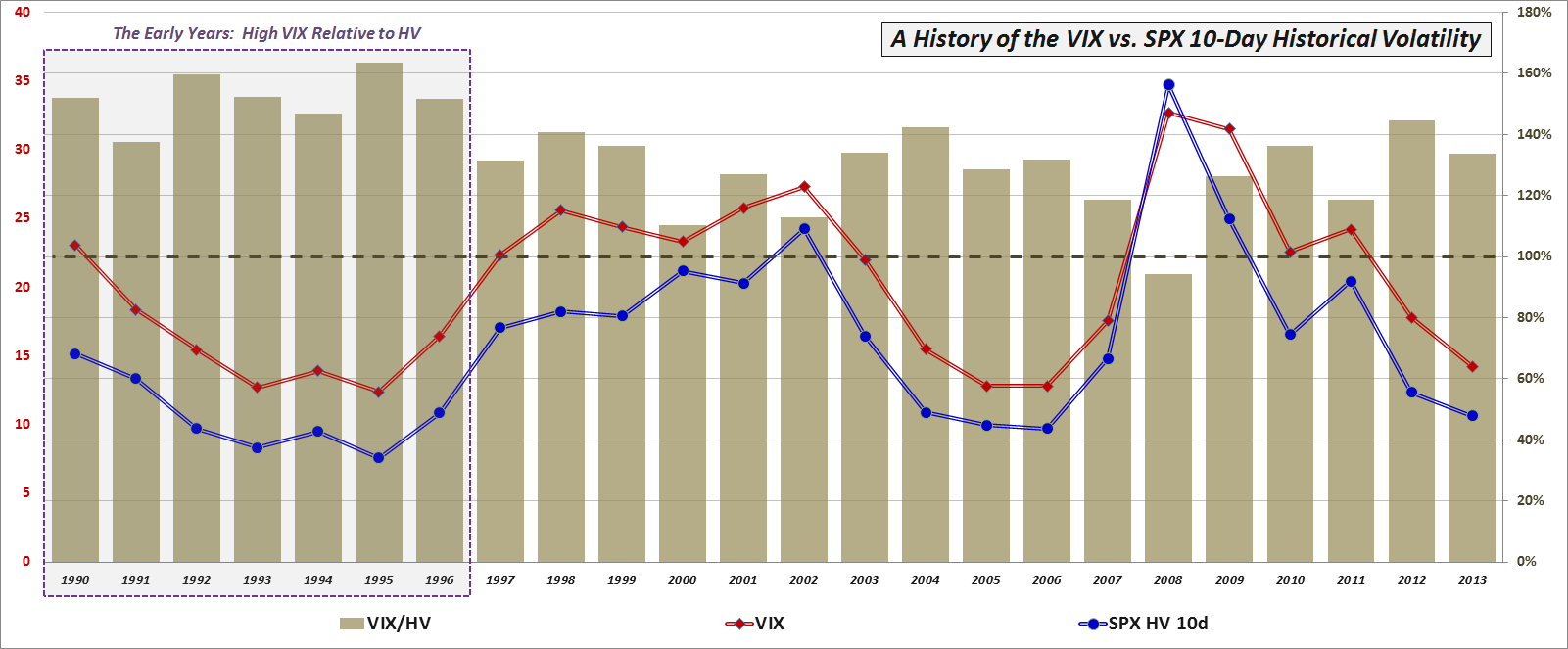
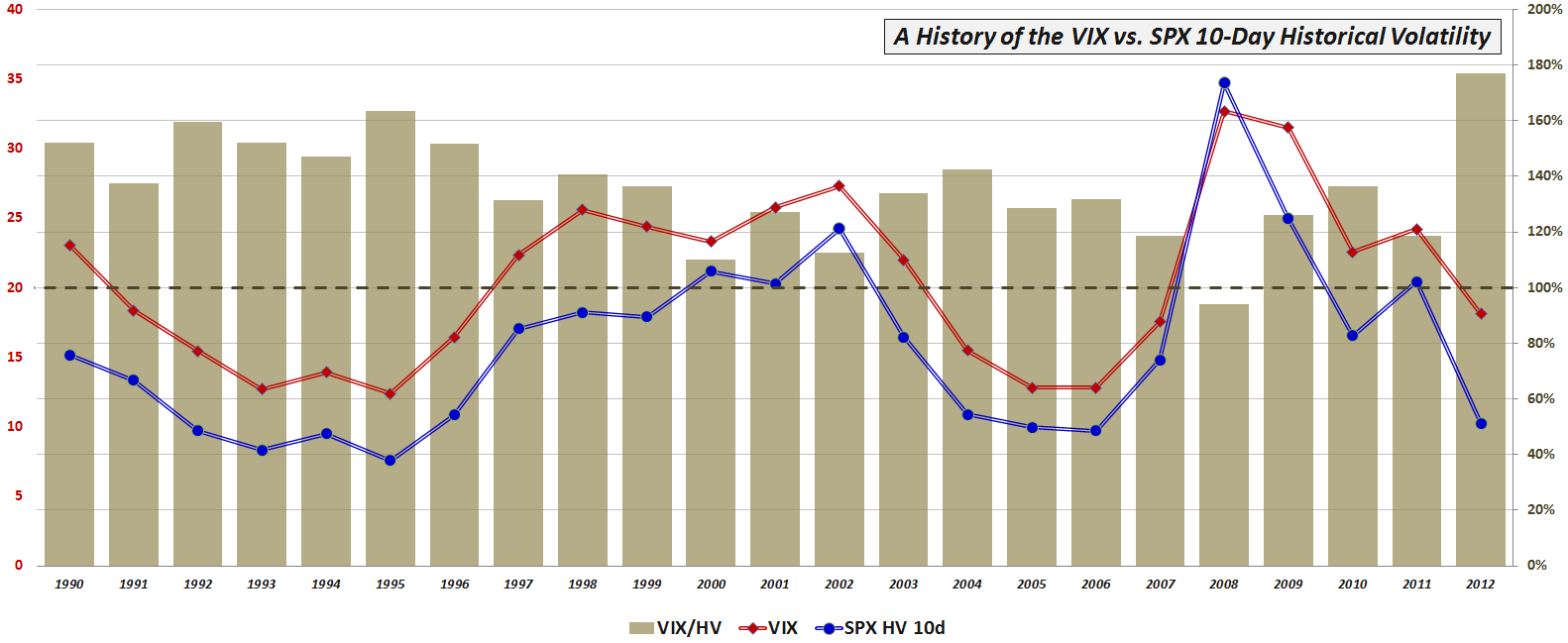
So…was the VIX too low in 2013? In order to answer this question, I am updating a chart I last presented in October 2012 in Ratio of VIX to Realized Volatility Higher than Any Year Since 1996.

As the chart shows, both the (mean) VIX and 10-day historical volatility (HV) of the S&P 500 index were are relatively low levels during 2013. More importantly, the VIX maintained an average premium of 34% to the 10-day HV of the SPX during the year, which is right in line with historical norms going back to 1990 of a premium of about 35%.

[source(s): CBOE, Yahoo]

While I have used data provided by the CBOE going back to 1990 in calculating historical norms, I think it is worth noting that from 1990-1996, the VIX typically had a much higher premium relative to historical volatility in the SPX than it has in more recent years, so whereas the long-term VIX premium to HV stands at about 35%, the post-1996 average premium is closer to 26%. As a result, if you really need to drive home the point that the VIX was “too low” in 2013, you can always trot out the post-1996 data, but otherwise consider the VIX to be just about exactly where it should have been – at least in relation to historical volatility – during the past year.

Last but not least, the chart also illustrates that while the VIX and SPX HV do have a tendency to trend over the course of several years, the ratio of the two has a much more random movement and is therefore much more difficult to predict for 2014.

Related posts:

Disclosure(s): CBOE is an advertiser on VIX and More

Friday, January 18, 2013

The Inverted Percentile VIX

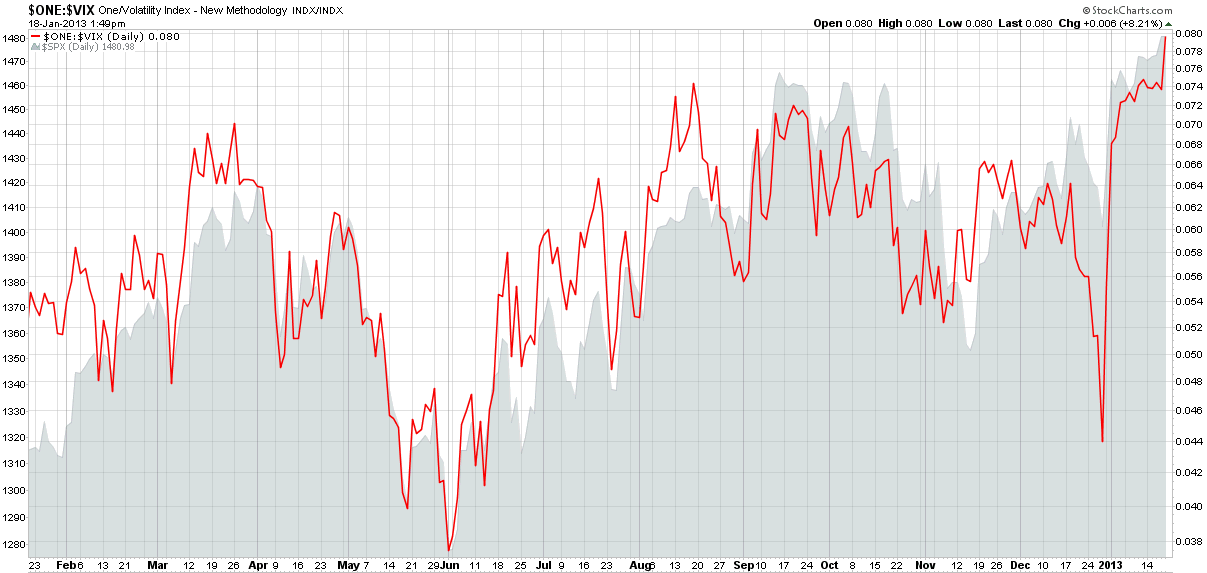
Of the many reasons that investors have a tendency to struggle with an interpretation of the VIX, one of the most obvious is an issue of orientation: for the most part, the VIX moves in the opposite direction of stocks. Frankly, it is difficult to appreciate some of the nuances of an upside-down world unless you spend a lot of time hanging upside down looking out at the world, like a bat.

It is partly for this reason that I created the “inverted VIX” back in August 2007. At that time, the VIX had just spiked into the mid-20s only two months after having traded in the 12s. The chart below is an updated version of the inverted VIX over the course of the past year and demonstrates that for the most part, the SPX and the inverted VIX track fairly closely, though there are times, such as just prior to the fiscal cliff denouement, when the VIX sometimes strikes out on its own path.

[source(s): StockCharts.com]

Today we are seeing a VIX of about 12.50 – the lowest the index has been since June 2007 – and once again investors are grappling for the proper context. Let me throw a new concept into the mix that may help: the inverted percentile VIX, a distant cousin of the inverted VIX. The way to think about the inverted percentile VIX is in terms of the lifetime of VIX values, in which a VIX of 12.50 is in the 12.2 percentile. The inverse of that is the 87.8 percentile, which corresponds with a VIX of 28.67. Now I am guessing that for most investors a VIX of 12.50 feels much lower than a VIX of 28.67 feels high. Statistically they are almost identical in terms of being outliers, so if a 28.67 VIX doesn’t sound like a scary high number, then a VIX of 12.50 should not sound like a scary low number that is reflecting too much complacency.

Investors may wish to consider recalibrating their emotions and expectations or, failing that, take advantage of the relatively low VIX by buying some VIX calls so as to profit when the rest of the world comes to the realization that a VIX in the 12s is making them too nervous. Keep in mind, however, that current 10-day historical volatility of the SPX is in the 5s, so that number would have to double just to be able to support the current level of the VIX going forward.

Related posts:

Disclosure(s): none

Friday, December 21, 2012

Volatility During Crises

[The following first appeared in the August 2011 edition of Expiring Monthly: The Option Traders Journal. I thought I would share it because it might help some readers put the current fiscal cliff crisis in historical context.]

The events of the last three weeks are a reminder that financial crises and stock market volatility can appear almost instantaneously and mushroom out of control before some investors even have a chance to ask what is happening. A case in point: on August 3rd investors were breathing a sigh of relief after the United States had finalized an agreement to raise the debt ceiling; at that time, the VIX stood at 23.38, reflecting a relative sense of calm, yet just three days later, the VIX jumped to 48.00 as two new crises displaced the debt ceiling issue.

Spanning the globe from Northern Africa, Japan, Europe and the United States, 2011 has seen no shortage of crises in the first eight months of the year. Given this pervasive crisis atmosphere, it is reasonable for investors to consider how much volatility they should anticipate during a crisis. In this article I will attempt to put crises and volatility in some historical perspective and address a variety of factors that affect the magnitude and duration of volatility during a crisis, drawing upon fundamental, technical and psychological causes.

Volatility in the Twentieth Century

Every generation likes to think that the issues of their time are more daunting and more complex than those faced by prior generations. No doubt investors fall prey to this kind of thinking as well. With a highly interconnected global economy, a news cycle that races around the globe at the speed of light and high-frequency and algorithmic trading systems that have transferred the task of trading from humans to machines, there is a lot to be said for the current batch of concerns. Looking at just the first half of the twentieth century, however, investors had to cope with the Great Depression, two world wars and the dawn of the nuclear age.

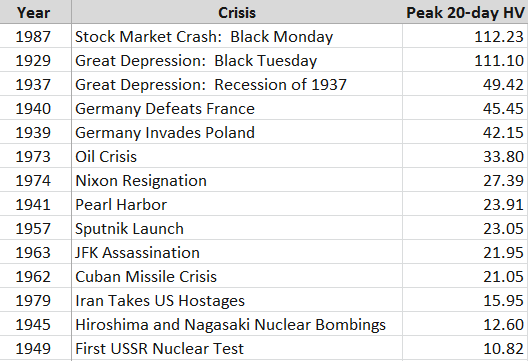
Given that the CBOE Volatility Index (VIX) was not launched until 1993, any evaluation of the volatility component of various crises prior to the VIX must rely on measures of historical volatility (HV) rather than implied volatility. As the S&P 500 index on which the VIX is based only dates back to 1957, I have elected to use historical data for the Dow Jones Industrial Average dating back to before the Great Depression. In Figure 1 below, I have collected peak 20-day historical volatility readings for selected crises from 1929 to the present.

Before studying the table, readers may wish to perform a quick exercise by making a mental list of some of the events of the 20th century that constituted immediate or deferred threats to the United States, then compare the magnitude of that threat with the peak historical volatility observed in the Dow Jones Industrial Average. If you are like most historians and investors, after looking at the data you will probably conclude that the magnitude of the crisis and the magnitude of the stock market volatility have at best a very weak correlation.
[source(s): Yahoo]

Any ranking of crises in which the Cuban Missile Crisis and the attack on Pearl Harbor rank in the lower half of the list is certain to raise some eyebrows. Frankly I would have been surprised if even one of these events failed to trigger a historical volatility reading of 25, but seeing that was the case for half the crises on this list certainly provides a fair amount of food for thought.

Volatility in the VIX Era

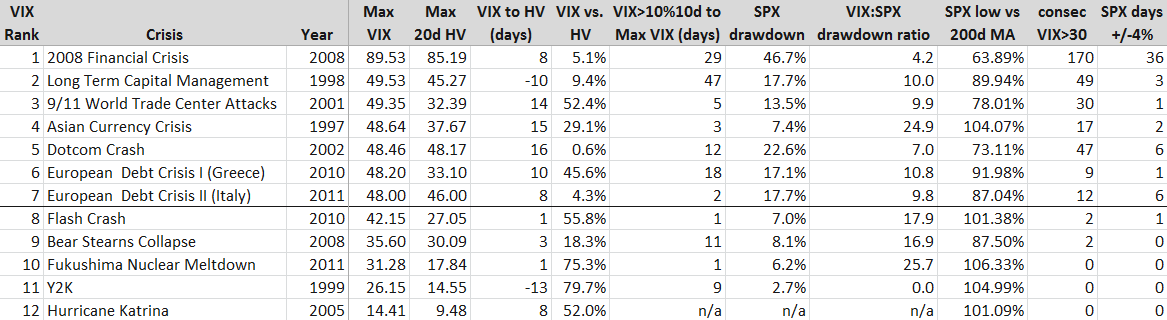
With the launch of the VIX it became possible not only to evaluate historical volatility, but implied volatility as well. With only 18 years of data to draw upon, there is a limited universe of crises to examine, so in the table in Figure 2 below, I have highlighted the seven crises in the VIX era in which intraday volatility has reached at least 48. Additionally, I have included five other crises with smaller VIX spikes for comparison purposes.
[source(s): CBOE, Yahoo]

[Some brief explanatory notes will probably make the data easier to interpret. First, the crises are ranked by maximum VIX value, with the maximum historical volatility in an adjacent column for an easy comparison. The column immediately to the right of the MAX HV data captures the number of days from the peak VIX reading to the maximum 20-day HV reading, with negative numbers (LTCM and Y2K) indicating that HV peaked before the VIX did. The VIX vs. HV column calculates the amount in percentage terms that the peak VIX exceeded the peak HV. The VIX>10%10d… column reflects how many days transpired from the first VIX close above its 10-day moving average to the peak VIX reading. The SPX Drawdown column calculates the maximum peak to trough drawdown in the S&P 500 index during the crisis period, not from any pre-crisis peak. The VIX:SPX drawdown ratio calculates the percentage change in the VIX from the SPX crisis high to the SPX crisis low relative the percentage change in the SPX during the same period (of course these are not necessarily the VIX highs and lows during the period.) The SPX low relative to the 200-day moving average is the maximum amount the SPX fell below its 200-day moving average during the crisis. Finally, the last two columns capture the number of consecutive days the VIX closed at or above 30 during the crisis and the number of days the SPX closed at least 4% above or below the previous day’s close during the crisis.]

Looking at the VIX era numbers, it is not surprising that the financial crisis of 2008 dominates in many of the categories. Reading across the rows, one can get an interesting cross-section of each crisis in terms of various volatility metrics, but I think some of the more interesting analysis comes from examining the columns, where we can learn something not just about the nature of the crises, but also about volatility as well. One important caveat is that the limited number of data points does not allow for this to be a statistically valid sample, but that does not preclude the possibility of drawing some potentially valuable and actionable conclusions.

Looking at the peak VIX reading relative to the peak HV reading I note that in all instances the VIX was ultimately higher than the maximum 20-day historical volatility reading. In the five lesser crises, the VIX was generally 50-80% higher than peak HV. In the seven major crises, not surprisingly HV did approach the VIX in several instances, but in the case of the 9/11 attack and the 2010 European sovereign debt crisis the VIX readings grossly overestimated future realized volatility.

One of my hypotheses about the time between the first VIX close above its 10-day moving average and the ultimate maximum VIX reading was that the longer the period between the initial VIX breakout and the maximum VIX, the higher the VIX spike would be. In this case the Long-Term Capital Management (LTCM) and 2008 crises support the hypothesis, but the data is spotty elsewhere. The current European debt crisis, Asian Currency Crisis of 1997 and 9/11 attack all reflect a very rapid escalation of the VIX to its crisis high. In the case of the May 2010 ‘Flash Crash’ and the Fukushima Nuclear Meltdown, the maximum VIX reading happened just one day after the initial VIX breakout. As many traders use the level of the VIX relative to its 10-day moving averages as a trading trigger, the data in this column could be of assistance to those looking to fine-tune entries or better understand the time component of the risk management equation.

Turing to the SPX drawdown data, the Asian Currency Crisis stands out as one instance where the VIX spike seems in retrospect to be out of proportion to the SPX peak to trough drawdown during the crisis. On the other side of the ledger, the drawdown during the Dotcom Crash appears to be consistent with a much higher VIX reading. Here the fact that it took some 2 ½ years for stocks to find a bottom meant that when the market finally bottomed, investors were somewhat desensitized and some of the fear and panic had already left the market, which is similar to what happened at the time of the March 2009 bottom. Note that the median VIX:SPX drawdown ratio for all twelve crises is 10.0, which is about 2 ½ times the movement in the VIX that one would expect during more normal market conditions.

The data for the SPX Low vs. 200-day Moving Average is similar to that of the SPX drawdown. For the most part, any drawdown of 10% or more is likely to take the index below its 200-day moving average. In the seven major crises profiled above, all but the Asian Currency Crisis dragged the index below its 200-day moving average; on the other hand, in all but one of the lesser crises the SPX never dropped below its 200-day moving average. Based on this data at least, one might be inclined to include the 200-day moving average breach as one aspect which helps to differentiate between major and minor crises.

As I see it, the last two columns – consecutive days of VIX closes over 30 and number of days in which the SPX has a 4% move – are central to the essence of the crisis volatility equation. Since the dawn of the VIX, the SPX has experienced a 2% move in about 80% of its calendar years, the VIX has spiked over 30 about 60% of the years, and the SPX has seen at least one 4% move in about 40% of those years. Those 4% moves are rare enough so that they almost always occur in the context of some sort of major crisis. In fact, one could argue that a 4% move in the SPX is a necessary condition for a financial crisis and/or a significant volatility event.

Fundamental, Technical and Psychological Factors in Crisis Volatility

Crises have many different causes. In the pre-VIX era, we saw a mix of geopolitical crises and stock market crashes, where the driving forces were largely fundamental ones. During the VIX era, I would argue that technical and psychological factors become increasingly important. The rise of quantitative trading has given birth to algorithmic trading, high-frequency trading and related approaches which place more emphasis on technical data than fundamental data. At the same time, retail investing has been revolutionized by a new class of online traders and the concomitant explosion in self-directed traders. This increased activity at the retail level has added a new layer of psychology to the market.

In terms of fundamental factors, one could easily argue that the top nine VIX spikes from the list of VIX era crises all arise from just two meta-crises, whose causes and imperfect resolution has created an interconnectedness in which subsequent crises are to a large extent just downstream manifestations of the ripple effect of the original crisis.

The first example of the meta-crisis effect was the 1997 Asian Currency Crisis, which migrated to Russia in the form of the 1998 Russian Ruble Crisis, which played a major role in the collapse of Long-Term Capital Management.

The second example of meta-crisis ripples begins with the Dotcom Crash and the efforts of Alan Greenspan to stimulate the economy with ultra-low interest rates. From here it is easy to draw a direct line of causation to the housing bubble, the collapse of Bear Stearns, the 2008 Financial Crisis and the recurring European Sovereign Debt Crisis. In each case, the remedial action for one crisis helped to sow the seeds for the next crisis.

In addition to the fundamental interconnectedness of these recent crises, it is also worth noting that the lower volatility crises were largely point or one-time-only events. There was, for instance, only one Hurricane Katrina, one turn of the clock for Y2K and one earthquake plus tsunami in Japan. As a result, the volatility associated with these events was compressed in time and accordingly the contagion potential was limited. By contrast, the major volatility events are more accurately thought of as systemic threats that ebbed and flowed over the course of an extended period, typically with multiple volatility spikes. In the same vein, the attempted resolution of these events generally included a complex government policy cocktail, whose effects were gradual and of largely indeterminate effectiveness.

Apart from the fundamental thread running through these crises, I also believe there is a psychological thread that sometimes spans multiple crises. Specifically, I am referring to the shadow that one crisis casts on future crises that follow it closely in time. I call this phenomenon ‘disaster imprinting’ and psychologists characterize something similar as availability bias. Simply stated, disaster imprinting refers to a phenomenon in which the threats of financial and psychological disaster are so severe that they leave a permanent or semi-permanent scar in one’s psyche. Another way to describe disaster imprinting might be to liken it to a low-level financial post-traumatic stress disorder. Following the 2008 Financial Crisis, most investors were prone to overestimating future risk, which is why the VIX was consistently much higher than realized volatility in 2009 and 2010.

While it is impossible to prove, my sense is that if the events of 2008 were not imprinted in the minds of investors, the current crisis atmosphere might be characterized by a much lower degree of volatility and anxiety.

Conclusion

As this goes to press, the current volatility storm is drawing energy from concerns about the European Sovereign Debt Crisis as well as fears of a slowdown in global economic activity. The rise in volatility has coincided with a swift and violent selloff in stocks that has seen six days in which the S&P 500 index has moved at least 4% either up or down – a rate that is unprecedented outside of the 2008 Financial Crisis.

Ultimately, the severity of a volatility storm is a function of both the magnitude and the duration of the crisis, as well as the risk of contagion to other geographies, sectors and institutions. Act I of the European Sovereign Debt Crisis, in which Greece played the starring role, can trace its origins back to December 2009. In the intervening period, it has spread across Europe and has sent shockwaves across the globe.

By historical standards the volatility aspect of the current crisis is more severe than at any time during World War II, the Cuban Missile Crisis and just about any crisis other than the Great Depression, Black Monday of 1987 and the 2008 Financial Crisis.

In the data and commentary above, I have attempted to establish some historical context for volatility during various crises extending back to 1929 and in the process give investors some metrics for evaluating current and future volatility spikes. In addition, it is my hope that concepts such as meta-crises and disaster imprinting can help to bolster the interpretive framework for investors who are seeking a deeper understanding of volatility storms and the crises from which they arise.

Related posts:

Disclosure(s): none

Tuesday, October 16, 2012

Ratio of VIX to Realized Volatility Higher Than Any Year Since 1996

Before I dive into a series of posts about the VIX futures, I think it is important to add some context in the form of several observations about the relationship between the VIX and the historical volatility (HV) of the S&P 500 index. In the absence of any information about the future, it turns out that historical volatility (a.k.a. realized volatility or statistical volatility) can provide a reasonably accurate measure of future volatility. In fact, it is more difficult than one might imagine to incorporate information about the future to come up with a better estimate of future volatility than what can be gleaned just by extrapolating from recent realized volatility.

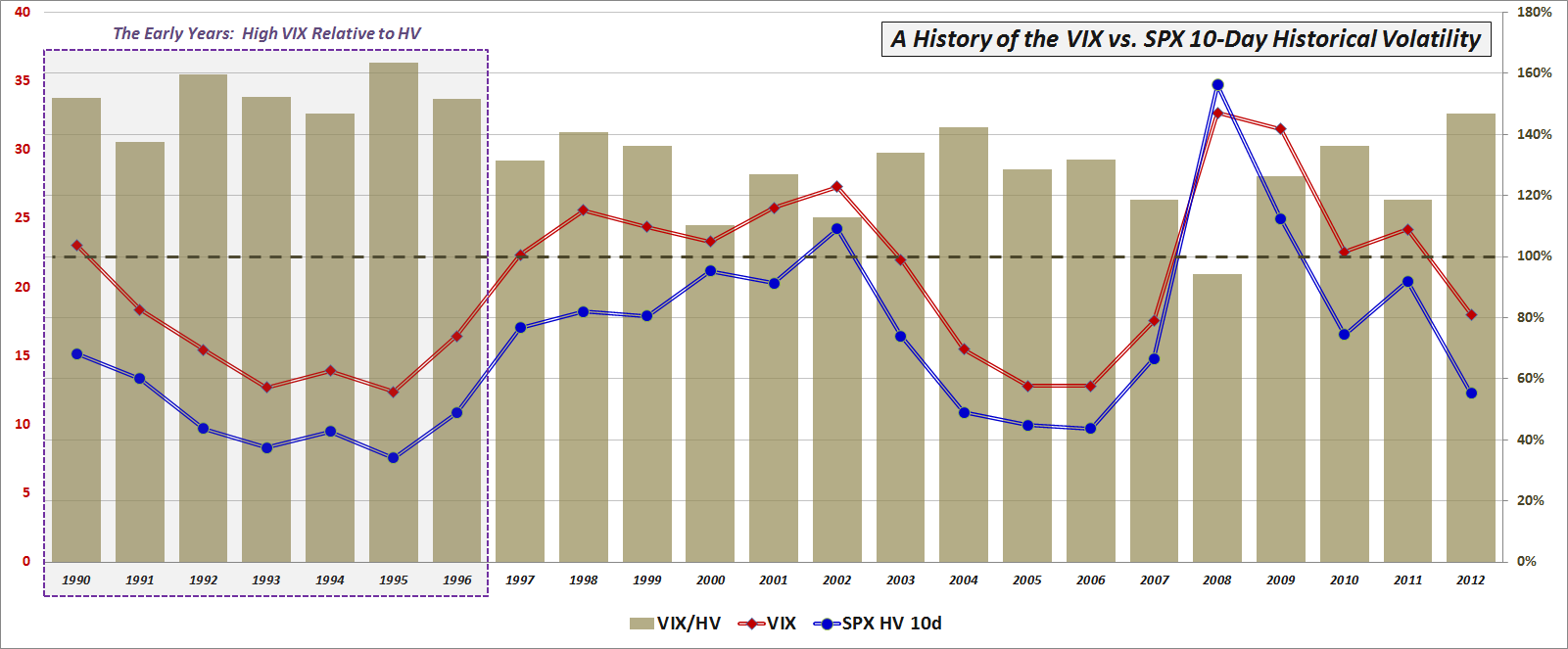
Looking at historical data, the VIX has an established history of overestimating future realized volatility. In fact, in the 23 years of VIX historical data, there was only one year – 2008 – in which realized volatility turned out to be higher than that which was predicted by the VIX.

As the chart below shows, early traders made a habit of dramatically overestimating future volatility. From 1990-1996, for instance, the VIX overshot realized volatility by an average of 49%. Since 1997, the magnitude of that overshoot has dropped dramatically, to about 24%, as investors apparently began to realize that they had been overpaying for portfolio protection in particular and for options in general.

[source(s): CBOE, Yahoo]

That being said, 2012 has been an unusual instance in which the VIX has overestimated 10-day historical volatility in the SPX by 47% – the biggest cushion since 1996. Not surprisingly, low realized volatility tends to depress the VIX and the front end of the VIX futures term structure in general. For that reason, the unusually low average 10-day historical volatility of 12.25 experienced so far in 2012 can serve as a partial explanation for the steepness of the VIX futures term structure (extreme contango) yet given the history of even lower volatility numbers during 2004-2007, the low historical volatility for 2012 is at best a very small portion of the full explanation. Two better potential explanations for the steep VIX futures term structure are the psychology of the 2008 financial crisis and its aftermath (i.e., disaster imprinting, availability bias, the recency effect, etc.) and expectations of future higher volatility due to a geopolitical and macroeconomic overhang that has generated a much higher level of anxiety about future prospects than in more uneventful economic times. Then, of course, there is the issue of the role of mushrooming growth in VIX exchange-traded products as an influence on the VIX futures term structure.

Before I address those issues in more detail, however, the next installment in this series is a discussion of the evolution of the VIX futures term structure.

Related posts:

Disclosure(s): none

Wednesday, June 27, 2012

Huge Gap Between VIX IV and HV, But Is The Direction Wrong?

It is not that difficult to come up with data and charts that have many investors wondering if risk and uncertainty are being underpriced in advance of the euro zone summit. Earlier today, I offered up one possible example in Euro Volatility and Risk. Since the VIX receives top billing in this space (and not too long ago carried the mostly tongue-in-cheek moniker, “Your One-Stop VIX-Centric View of the World…”), I thought a VIX-specific example might also be of interest.

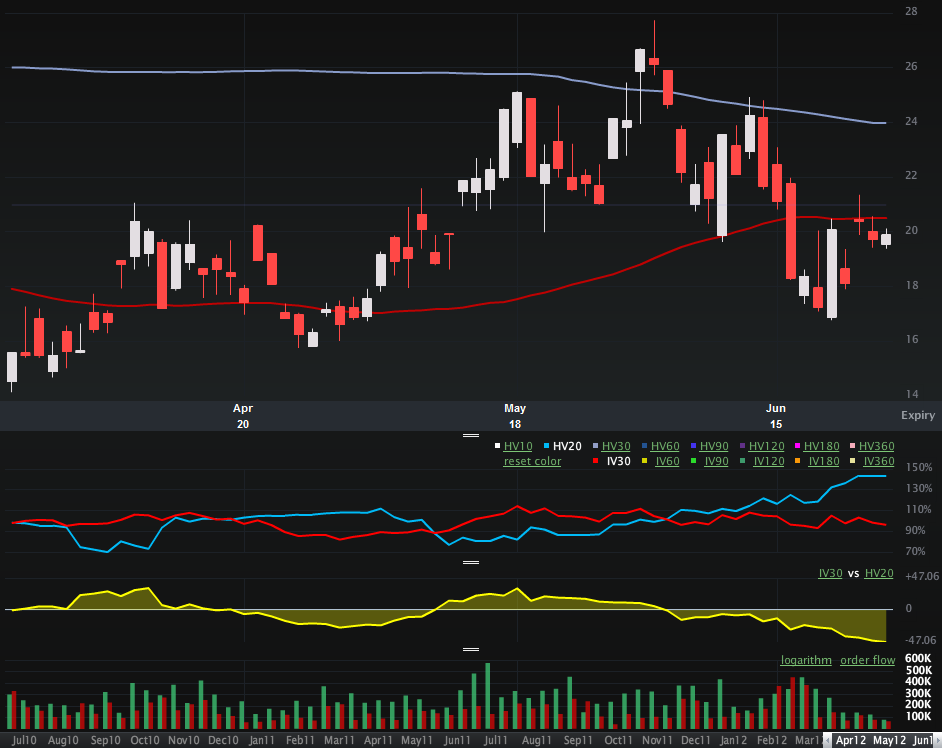
The chart below shows the last three months of VIX data, with VIX candlesticks on the main chart on the top. The second chart from the top compares the 20-day historical volatility of the VIX (blue line) with the 30-day implied volatility of the VIX (red line), with the yellow area chart just below it calculating the HV minus IV. Much to my surprise the current 20-day HV is 144, while the current IV is only 98. In other words, the markets expect the VIX to be considerably less volatile in the month ahead than it has been over the course of the last month. I am not surprised to see the gap, but do the markets have the direction of the gap right? In terms of trading opportunities, if you disagree with the market consensus, then VIX straddles probably look fairly cheap right now.

The VIX IV also raises the question: just where is the fear in the markets right now?

Note that the CBOE recently launched the CBOE VVIX Index (VVIX), which is essentially a VIX of the VIX and is very similar to the VIX IV30 measure that is calculated by Livevol in the chart below. You can find more information about VVIX at the CBOE’s VVIX micro site. I will certainly have a lot to say about this intriguing index going forward.

Related posts:

[source(s): LivevolPro.com]

Disclosure(s): Livevol and CBOE are advertisers on VIX and More

Wednesday, April 4, 2012

VIX Premium to SPX Historical Volatility at Record High in Q1

Back in September 2010, in VIX and Historical Volatility Settling Back into Normal Range, I presented an earlier version of the chart below to explain that in spite of the protestations of the time, the relationship between the VIX and historical volatility (a.k.a. realized volatility) was actually right in line with historical norms.

The same claim cannot be made for 2012.

In fact, as low as the VIX appears to many, for the first three months of 2012 the VIX has been tracking at 177% of the 10-day historical volatility of the S&P 500 index. This ratio is well above the long-term average of 129% and also above the record for a single year – 162% in 1995 – which was back in the time when the premium of the VIX over realized volatility in the SPX (“volatility risk premium”) was routinely much higher than it has been in recent years.

Consider for a moment that from January 27 to March 7, 10-day historical volatility of the SPX never crossed above 10.00. Had the VIX volatility risk premium been at the typical historical level of 129%, the VIX would have been below 13.00 for this entire period.  Of course, the VIX never traded below 13.00 during this six-week period.  Instead, investors were unwilling to accept a VIX this low (i.e., drop prices in SPX options) in spite of low realized volatility, which is part of the reason (perhaps along with disaster imprinting and related issues) why the volatility risk premium was at a record high during the first quarter.

Going forward, one can reasonably expect that either realized volatility will increase or the VIX will continue to fall so that the volatility risk premium approaches historical norms – and more likely that the future will combine elements of both scenarios.

Now that I have opened another Pandora’s box here, expect more to follow vis-Ă -vis the volatility risk premium.

Related posts:

[source(s): CBOE, Yahoo]

Disclosure(s): none

Tuesday, March 20, 2012

IMOS Up 54% in Two Weeks; IV Still Lags HV

ChipMOS Technologies (Bermuda) LTD (IMOS), is up 54% in two weeks and slightly less than that in the 12 days since I mentioned the stock in IMOS Breaks Out, But Implied Volatility Fails to React.

While the company did report earnings last Friday, the stock did not appear to have an immediate reaction to that report. After trading in a wide range on Friday, the stock closed up 1.5%. Yesterday, however, it was off to the races again, with the stock up another 14%.

Part of what makes IMOS intriguing is the paucity of public information associated with this Taiwan-based company. As a result, the stock is highly responsive to technical factors and also has a high emotional component associated with the price action.

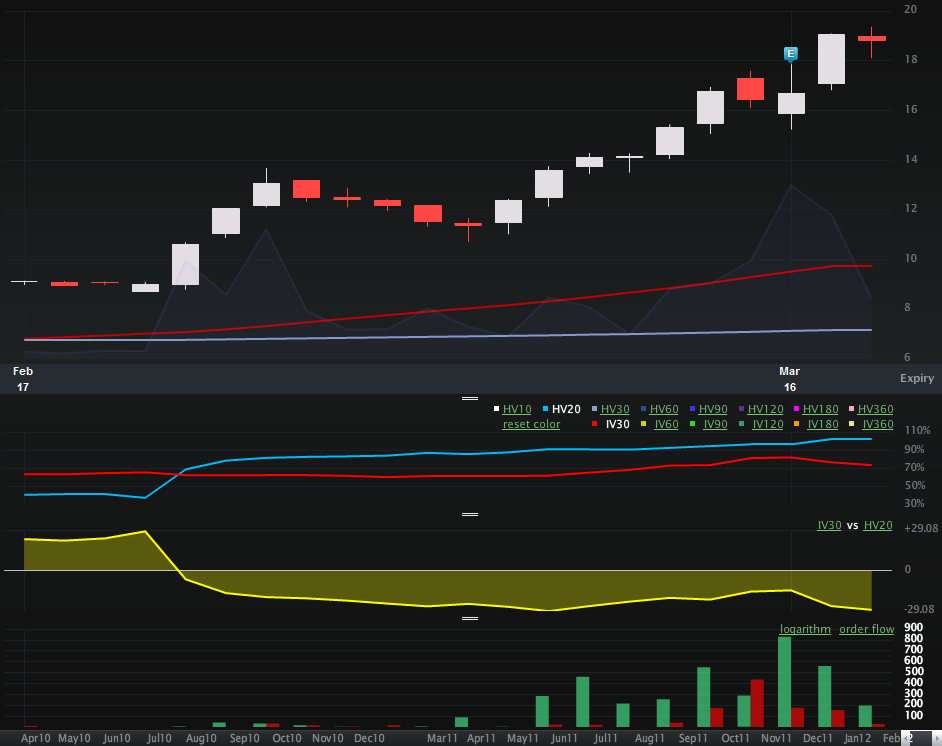
The last time around I posted about IMOS largely because I thought it was interesting that a stock which was breaking out ahead of earnings had such low implied volatility (red IV 30 line) in spite of the fact that IMOS was now apparently “in play” at least in the minds of some investors. I commented at the time that “the current HV 20 of 91 is a better estimate of future volatility than the current IV 30 of 62.”

A little less than two weeks later, some interesting things have happened. In the one month chart below, once can see that IV 30 has risen to 75, even after accounting for the 10% decline following the earnings announcement. With historical volatility (blue HV20 line) now at 102, implied volatility still looks like a conservative estimate of the potential future moves in IMOS, particularly when one considers that daily trading volumes are now running at about five times the three month average.

Options volume has also picked up dramatically and almost all of the action has been on the call side.

In terms of trading, this is the type of freight train that I generally prefer not to step in front of, but having closed out my long positions, I now find that there are a couple of defined risk trades on the short side that have some potential.

Related posts:

[source(s): LivevolPro.com]

Disclosure(s): short IMOS at time of writing; Livevol is an advertiser on VIX and More

Thursday, March 8, 2012

IMOS Breaking Out, But Implied Volatility Fails to React

While I generally trade more ETPs than single stocks, I am always keeping an eye on what is moving in the stock world, particularly in terms of new highs, as it helps inform some of my thinking in terms of bottoms up sector analysis. One of the stocks that recently hit my new high radar is ChipMOS Technologies (Bermuda) LTD (IMOS), a provider of total semiconductor testing and packaging solutions to fabless companies, integrated device manufacturers and foundries.

What I find particularly interesting about IMOS is that in spite of the fact that it has made new 52-week highs four times in the past two weeks on a huge spike in volume (gray area in upper chart) and historical volatility (blue HV20 line) has jumped along with price, implied volatility (red IV 30 line) appears to be completely indifferent to the big price move.

Now IMOS options are thinly traded, but still, this stock is clearly breaking out and finding some action from momentum traders. Frankly, I am not sure why IV has not responded. Perhaps options traders are certain that this breakout will fail and see no need to adjust their prices. A better bet, as far as I am concerned, is that HV is doing a better job of pricing future stock moves than IV right now, which makes IMOS options very cheap, even considering the reasonably wide bid-ask spreads. My guess is that the current HV 20 of 91 is a better estimate of future volatility than the current IV 30 of 62. Either way, this could be an interesting breakout to watch – and perhaps even throw some options at.

Related posts:

[source(s): LivevolPro.com]

Disclosure(s): long IMOS at time of writing; Livevol is an advertiser on VIX and More

Friday, January 13, 2012

Comparing SPLV and VQT

Based on some of the questions and comments that came out of Wednesday’s Three New Risk Control ETFs from Direxion, there appears to be a significant portion of the investment community that is uncertain about just how some ETPs are attempting to dampen volatility and control risk.

Today I am going to differentiate between three types of risk control approaches and compare two ETPs that have a little performance history. The approaches and an example ETPs are as follows:

  1. Using low beta stocks to minimize portfolio volatility (SPLV)
  2. Using a market timing mechanism that dynamically allocates between stocks and bonds according to measures of market volatility (VSPY)
  3. Using a market timing mechanism that dynamically allocates between stocks and VIX futures according to measures of market volatility (VQT)
While it may be partly semantics, I would not call SPLV a hedge in the sense that it does not attempt to hold securities that are negatively correlated with stocks. Instead, this approach is heavy on defensive stocks, with the current top sector allocations in utilities, consumer staples and health care stocks (see SPLV’s top holdings here.)

On the other hand, the approaches employed by VSPY and VQT are hedges in the traditional sense in that they switch into asset classes (bonds and volatility) that are generally negatively correlated with stocks when measures of volatility such as implied volatility and historical volatility signal an environment that poses greater risk to long equity positions.

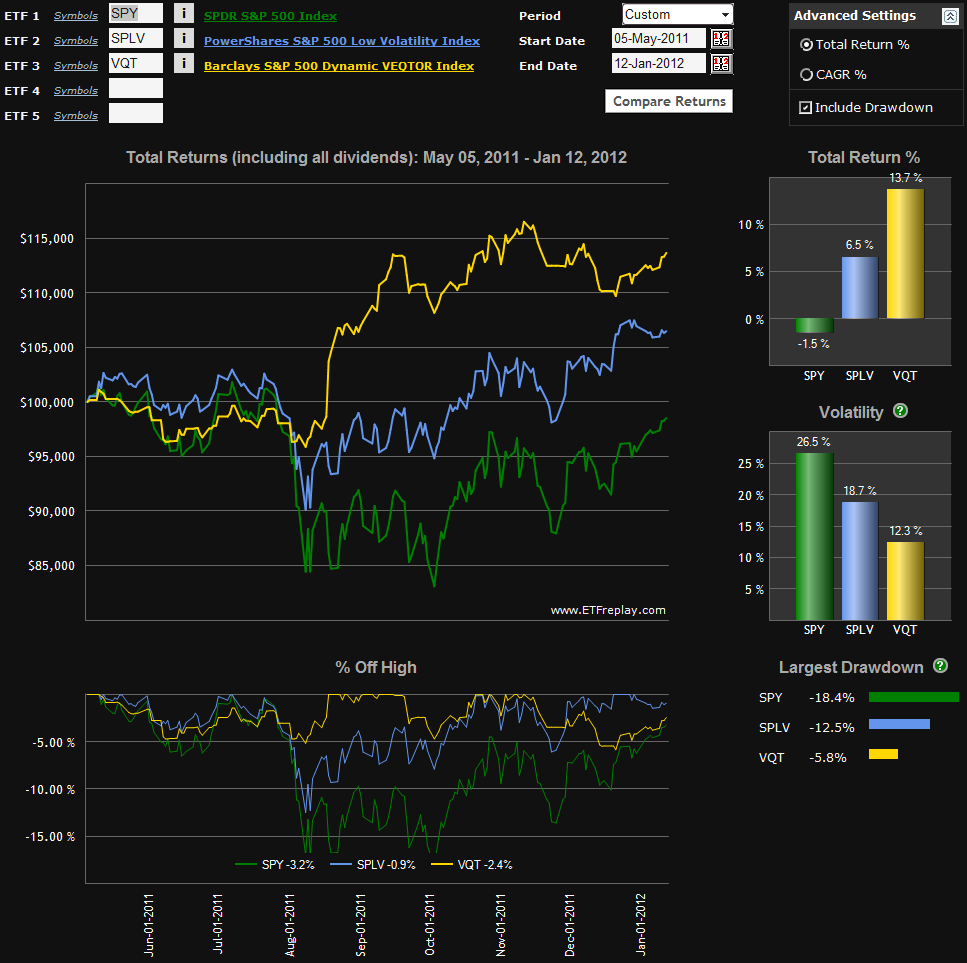
As VSPY was just launched this week, it is too early to talk about the performance of this approach, but the chart below captures the performance of both SPLV and VQT since the launch of the former on May 5, 2011.

Note that both SPLV and VQT are less volatile than SPY, had a lower drawdown, had a smaller peak to trough drawdown during the August-October selloff, and dramatically outperformed SPY during the period covered by the chart. Once VSPY establishes some meaningful historical data, I will return to this subject and offer a more detailed comparison of all three approaches to controlling risk.

For those interested in pursuing some of these subjects further, there is a good deal of information in the links below.

Related posts:
 
[source(s): ETFreplay.com]


Disclosure(s): none

Thursday, January 12, 2012

Tight VIX Range Keeps Overbought Signals at Bay

Yesterday’s little dose of VIX trivia (VIX Has Smallest Intraday Range Ever!) was just the kind of post that I suspected would raise quite a few eyebrows, until everyone concluded that the headline was out of proportion to the actual data point. Ironically, that was a large part of the intent of the post: to poke fun at statistical outliers and extreme readings that have dubious predictive value.

The more I thought about the tight intraday VIX range, the more I believe it is a good segue to a more important related point: that a narrow trading range for the VIX – and also for stocks in general (10-day historical volatility in the SPX is down into the 12s) is allowing for stocks to rise without triggering any overbought signals.

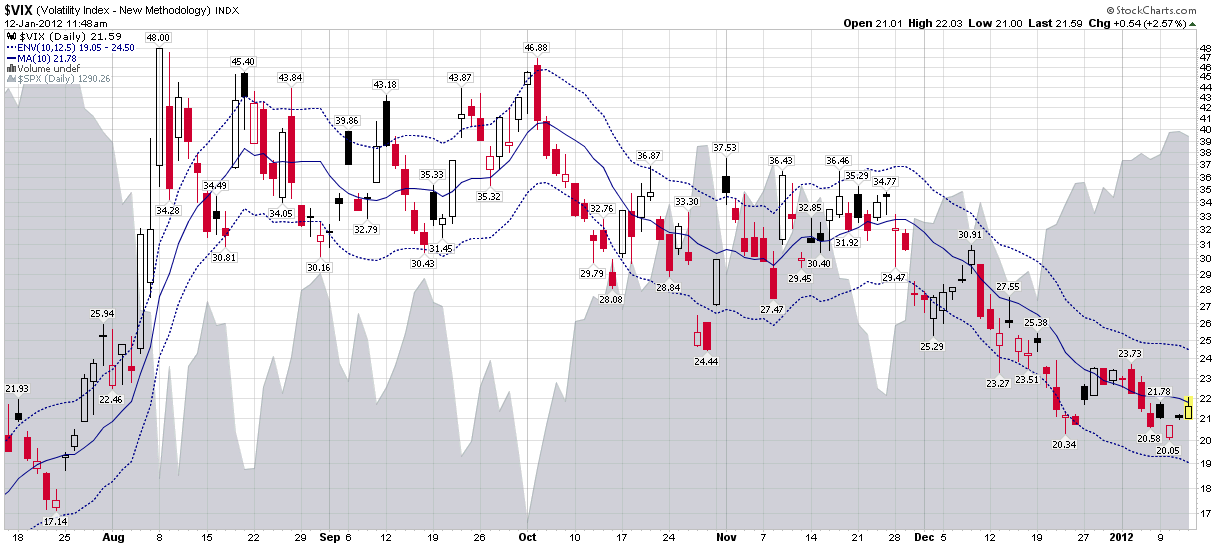
One way I track whether the VIX is signaling an overbought or oversold condition is to use a ratio of the VIX to its 10-day moving average. To make this easy on the eyes, I am partial to using moving average envelopes (MAEs) which quickly flag when the VIX (or any other underlying) has strayed a large distance from its moving average, similar to the manner in which Bollinger bands measure outliers.

My personal preference is to use the VIX 10-day moving average as the baseline and set the MAEs to 10%, 12.5% or 15%, depending upon the underlying volatility in the market. In the chart below, I have set the MAEs to 10 days and 12.5%. The result is a VIX that has hugged the center line (the 10-day moving average) for the past 2 ½ weeks, never threatening the dotted blue MAE lines.

In many respects, the recent activity in the VIX is a microcosm of the action in general in the markets: stocks continue to rise, but not rapidly enough to trigger many of the favored overbought alarms.

Related posts:

[source(s): StockCharts.com]

Disclosure(s): none

Tuesday, December 27, 2011

Q & A: The Historical Volatility of VQT

Questions from readers are where I get to learn which aspects of volatility cause the most confusion and consternation among investors, so one of the things I will strive to do in 2012 is take more of the Q&A exchanges that might be buried in the comments sections of previous posts and shine some light on them here.

I was reminded of the importance of Q&A when I stumbled upon the following comment to VIX Exchange-Traded Products: The Year in Review, 2011, which I fear may have been lost in the holiday shuffle. [For the record, I tagged that post with my elusive “hall of fame” label, which I typically use to honor only handful of posts each year.]

The comment/question was posted as follows:

Thank you for alerting me to VQT. Where does one find the realized volatility number on it...or is this number just the VIX?

Before I dive into the issue of the realized or historical volatility (the two terms are synonymous) of VQT, I would be remiss in not pointing out that the question suggests some confusion between realized volatility and the VIX.

First things first, realized volatility is also known as historical volatility because it is based on past price moves, has already been observed, and can be calculated with great precision (see Calculating Centered and Non-Centered Historical Volatility for more details.) This is essentially what an investor sees out his or her rear view mirror.

Implied volatility is a very different animal from its realized/historical cousin. It boils down to the market’s best guess as to what (historical) volatility will look like in the future, based on how much investors are currently paying for options. The VIX is a specific instance of implied volatility and is based on options on the S&P 500 index over the course of the next 30 days. To return to the car analogy, it is what the consensus of drivers believe will be around the next bend and over the horizon.

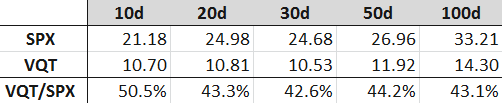
Getting back to VQT, the chart below captures historical volatility based on past daily price moves in VQT for lookback periods of 10 days, 20 days, 30 days, 50 days and 100 days. As these are calculated based on price moves, they are necessarily based on trading days, not calendar days, which are the unit of time used for implied volatility data.

Looking at the table, these historical volatility numbers for VQT are in 10.50 - 10.90 range for the past 30 trading days. The 100-day lookback window takes us back to early August, so it is not surprising that 100-day historical volatility is higher at 14.30.

I have also included some historical volatility data for the S&P 500 index (SPX) for comparison purposes. Note that historical volatility for the SPX has been 100 – 130% higher than it has been for VQT during the same lookback periods.

One can find historical volatility data on sites from brokers that specialize in options (optionsXpress, TradeMonster, Trade King, thinkorswim/TD Ameritrade, etc.) or from options data providers such as Livevol and iVolatility.

Related posts:


Disclosure(s): 

optionsXpress, TradeMonster, Trade King and Livevol are advertisers on VIX and More

Monday, January 3, 2011

S&P 500 Index 20-Day Historical Volatility Hits 39-Year Low

Since I haven’t seen it mentioned anywhere else, I thought I should note that 20-day historically volatility in the S&P 500 index hit its lowest level since April 1971, the same month that the Rolling Stones released Sticky Fingers and Charles Manson was sentenced to death.

Now there are multiple ways to calculate historical volatility. I outlined my preferred non-centered methodology in Calculating Centered and Non-Centered Historical Volatility, which yielded a 20-day HV of just 4.57 as of Friday’s close, barely 25% of the VIX’s closing value of 17.75 from the same day.

Of course, some of this disconnect is due to the holiday effect or calendar reversion, but given that we are seeing near-record lows in some volatility measures just two years and a couple of weeks removed from a VIX of 80+ should certainly raise some eyebrows.

In terms of implications going forward, today’s big(ger) move should herald the return of more normal volatility, as well as more middling implied and historical volatility measures.

Related posts:

Disclosure(s): none

DISCLAIMER: "VIX®" is a trademark of Chicago Board Options Exchange, Incorporated. Chicago Board Options Exchange, Incorporated is not affiliated with this website or this website's owner's or operators. CBOE assumes no responsibility for the accuracy or completeness or any other aspect of any content posted on this website by its operator or any third party. All content on this site is provided for informational and entertainment purposes only and is not intended as advice to buy or sell any securities. Stocks are difficult to trade; options are even harder. When it comes to VIX derivatives, don't fall into the trap of thinking that just because you can ride a horse, you can ride an alligator. Please do your own homework and accept full responsibility for any investment decisions you make. No content on this site can be used for commercial purposes without the prior written permission of the author. Copyright © 2007-2023 Bill Luby. All rights reserved.
 
Web Analytics