Showing posts with label expiring monthly. Show all posts

Friday, December 21, 2012

Volatility During Crises

[The following first appeared in the August 2011 edition of Expiring Monthly: The Option Traders Journal. I thought I would share it because it might help some readers put the current fiscal cliff crisis in historical context.]

The events of the last three weeks are a reminder that financial crises and stock market volatility can appear almost instantaneously and mushroom out of control before some investors even have a chance to ask what is happening. A case in point: on August 3rd investors were breathing a sigh of relief after the United States had finalized an agreement to raise the debt ceiling; at that time, the VIX stood at 23.38, reflecting a relative sense of calm, yet just three days later, the VIX jumped to 48.00 as two new crises displaced the debt ceiling issue.

Spanning the globe from Northern Africa, Japan, Europe and the United States, 2011 has seen no shortage of crises in the first eight months of the year. Given this pervasive crisis atmosphere, it is reasonable for investors to consider how much volatility they should anticipate during a crisis. In this article I will attempt to put crises and volatility in some historical perspective and address a variety of factors that affect the magnitude and duration of volatility during a crisis, drawing upon fundamental, technical and psychological causes.

Volatility in the Twentieth Century

Every generation likes to think that the issues of their time are more daunting and more complex than those faced by prior generations. No doubt investors fall prey to this kind of thinking as well. With a highly interconnected global economy, a news cycle that races around the globe at the speed of light and high-frequency and algorithmic trading systems that have transferred the task of trading from humans to machines, there is a lot to be said for the current batch of concerns. Looking at just the first half of the twentieth century, however, investors had to cope with the Great Depression, two world wars and the dawn of the nuclear age.

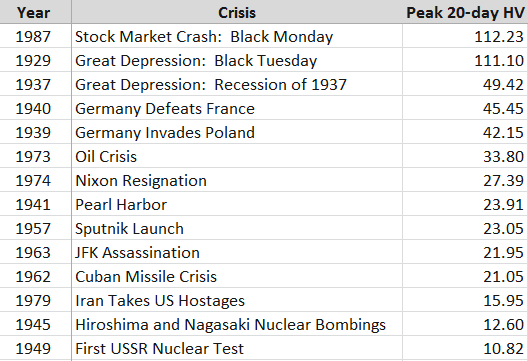
Given that the CBOE Volatility Index (VIX) was not launched until 1993, any evaluation of the volatility component of various crises prior to the VIX must rely on measures of historical volatility (HV) rather than implied volatility. As the S&P 500 index on which the VIX is based only dates back to 1957, I have elected to use historical data for the Dow Jones Industrial Average dating back to before the Great Depression. In Figure 1 below, I have collected peak 20-day historical volatility readings for selected crises from 1929 to the present.

Before studying the table, readers may wish to perform a quick exercise by making a mental list of some of the events of the 20th century that constituted immediate or deferred threats to the United States, then compare the magnitude of that threat with the peak historical volatility observed in the Dow Jones Industrial Average. If you are like most historians and investors, after looking at the data you will probably conclude that the magnitude of the crisis and the magnitude of the stock market volatility have at best a very weak correlation.
[source(s): Yahoo]

Any ranking of crises in which the Cuban Missile Crisis and the attack on Pearl Harbor rank in the lower half of the list is certain to raise some eyebrows. Frankly I would have been surprised if even one of these events failed to trigger a historical volatility reading of 25, but seeing that was the case for half the crises on this list certainly provides a fair amount of food for thought.

Volatility in the VIX Era

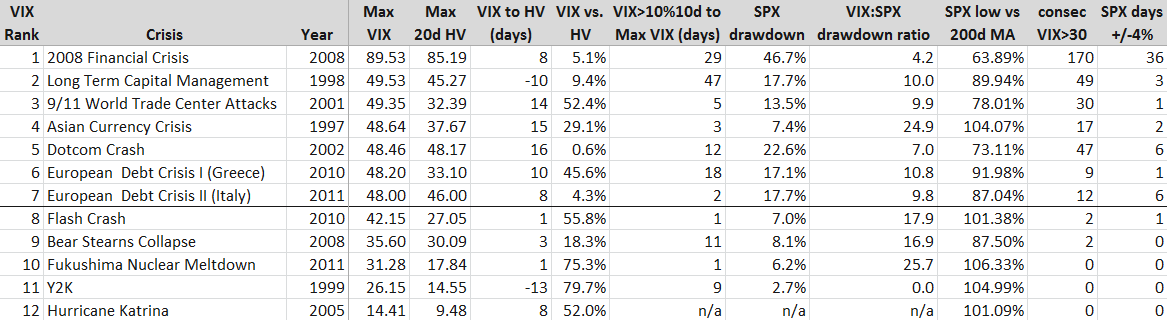
With the launch of the VIX it became possible not only to evaluate historical volatility, but implied volatility as well. With only 18 years of data to draw upon, there is a limited universe of crises to examine, so in the table in Figure 2 below, I have highlighted the seven crises in the VIX era in which intraday volatility has reached at least 48. Additionally, I have included five other crises with smaller VIX spikes for comparison purposes.
[source(s): CBOE, Yahoo]

[Some brief explanatory notes will probably make the data easier to interpret. First, the crises are ranked by maximum VIX value, with the maximum historical volatility in an adjacent column for an easy comparison. The column immediately to the right of the MAX HV data captures the number of days from the peak VIX reading to the maximum 20-day HV reading, with negative numbers (LTCM and Y2K) indicating that HV peaked before the VIX did. The VIX vs. HV column calculates the amount in percentage terms that the peak VIX exceeded the peak HV. The VIX>10%10d… column reflects how many days transpired from the first VIX close above its 10-day moving average to the peak VIX reading. The SPX Drawdown column calculates the maximum peak to trough drawdown in the S&P 500 index during the crisis period, not from any pre-crisis peak. The VIX:SPX drawdown ratio calculates the percentage change in the VIX from the SPX crisis high to the SPX crisis low relative the percentage change in the SPX during the same period (of course these are not necessarily the VIX highs and lows during the period.) The SPX low relative to the 200-day moving average is the maximum amount the SPX fell below its 200-day moving average during the crisis. Finally, the last two columns capture the number of consecutive days the VIX closed at or above 30 during the crisis and the number of days the SPX closed at least 4% above or below the previous day’s close during the crisis.]

Looking at the VIX era numbers, it is not surprising that the financial crisis of 2008 dominates in many of the categories. Reading across the rows, one can get an interesting cross-section of each crisis in terms of various volatility metrics, but I think some of the more interesting analysis comes from examining the columns, where we can learn something not just about the nature of the crises, but also about volatility as well. One important caveat is that the limited number of data points does not allow for this to be a statistically valid sample, but that does not preclude the possibility of drawing some potentially valuable and actionable conclusions.

Looking at the peak VIX reading relative to the peak HV reading I note that in all instances the VIX was ultimately higher than the maximum 20-day historical volatility reading. In the five lesser crises, the VIX was generally 50-80% higher than peak HV. In the seven major crises, not surprisingly HV did approach the VIX in several instances, but in the case of the 9/11 attack and the 2010 European sovereign debt crisis the VIX readings grossly overestimated future realized volatility.

One of my hypotheses about the time between the first VIX close above its 10-day moving average and the ultimate maximum VIX reading was that the longer the period between the initial VIX breakout and the maximum VIX, the higher the VIX spike would be. In this case the Long-Term Capital Management (LTCM) and 2008 crises support the hypothesis, but the data is spotty elsewhere. The current European debt crisis, Asian Currency Crisis of 1997 and 9/11 attack all reflect a very rapid escalation of the VIX to its crisis high. In the case of the May 2010 ‘Flash Crash’ and the Fukushima Nuclear Meltdown, the maximum VIX reading happened just one day after the initial VIX breakout. As many traders use the level of the VIX relative to its 10-day moving averages as a trading trigger, the data in this column could be of assistance to those looking to fine-tune entries or better understand the time component of the risk management equation.

Turing to the SPX drawdown data, the Asian Currency Crisis stands out as one instance where the VIX spike seems in retrospect to be out of proportion to the SPX peak to trough drawdown during the crisis. On the other side of the ledger, the drawdown during the Dotcom Crash appears to be consistent with a much higher VIX reading. Here the fact that it took some 2 ½ years for stocks to find a bottom meant that when the market finally bottomed, investors were somewhat desensitized and some of the fear and panic had already left the market, which is similar to what happened at the time of the March 2009 bottom. Note that the median VIX:SPX drawdown ratio for all twelve crises is 10.0, which is about 2 ½ times the movement in the VIX that one would expect during more normal market conditions.

The data for the SPX Low vs. 200-day Moving Average is similar to that of the SPX drawdown. For the most part, any drawdown of 10% or more is likely to take the index below its 200-day moving average. In the seven major crises profiled above, all but the Asian Currency Crisis dragged the index below its 200-day moving average; on the other hand, in all but one of the lesser crises the SPX never dropped below its 200-day moving average. Based on this data at least, one might be inclined to include the 200-day moving average breach as one aspect which helps to differentiate between major and minor crises.

As I see it, the last two columns – consecutive days of VIX closes over 30 and number of days in which the SPX has a 4% move – are central to the essence of the crisis volatility equation. Since the dawn of the VIX, the SPX has experienced a 2% move in about 80% of its calendar years, the VIX has spiked over 30 about 60% of the years, and the SPX has seen at least one 4% move in about 40% of those years. Those 4% moves are rare enough so that they almost always occur in the context of some sort of major crisis. In fact, one could argue that a 4% move in the SPX is a necessary condition for a financial crisis and/or a significant volatility event.

Fundamental, Technical and Psychological Factors in Crisis Volatility

Crises have many different causes. In the pre-VIX era, we saw a mix of geopolitical crises and stock market crashes, where the driving forces were largely fundamental ones. During the VIX era, I would argue that technical and psychological factors become increasingly important. The rise of quantitative trading has given birth to algorithmic trading, high-frequency trading and related approaches which place more emphasis on technical data than fundamental data. At the same time, retail investing has been revolutionized by a new class of online traders and the concomitant explosion in self-directed traders. This increased activity at the retail level has added a new layer of psychology to the market.

In terms of fundamental factors, one could easily argue that the top nine VIX spikes from the list of VIX era crises all arise from just two meta-crises, whose causes and imperfect resolution has created an interconnectedness in which subsequent crises are to a large extent just downstream manifestations of the ripple effect of the original crisis.

The first example of the meta-crisis effect was the 1997 Asian Currency Crisis, which migrated to Russia in the form of the 1998 Russian Ruble Crisis, which played a major role in the collapse of Long-Term Capital Management.

The second example of meta-crisis ripples begins with the Dotcom Crash and the efforts of Alan Greenspan to stimulate the economy with ultra-low interest rates. From here it is easy to draw a direct line of causation to the housing bubble, the collapse of Bear Stearns, the 2008 Financial Crisis and the recurring European Sovereign Debt Crisis. In each case, the remedial action for one crisis helped to sow the seeds for the next crisis.

In addition to the fundamental interconnectedness of these recent crises, it is also worth noting that the lower volatility crises were largely point or one-time-only events. There was, for instance, only one Hurricane Katrina, one turn of the clock for Y2K and one earthquake plus tsunami in Japan. As a result, the volatility associated with these events was compressed in time and accordingly the contagion potential was limited. By contrast, the major volatility events are more accurately thought of as systemic threats that ebbed and flowed over the course of an extended period, typically with multiple volatility spikes. In the same vein, the attempted resolution of these events generally included a complex government policy cocktail, whose effects were gradual and of largely indeterminate effectiveness.

Apart from the fundamental thread running through these crises, I also believe there is a psychological thread that sometimes spans multiple crises. Specifically, I am referring to the shadow that one crisis casts on future crises that follow it closely in time. I call this phenomenon ‘disaster imprinting’ and psychologists characterize something similar as availability bias. Simply stated, disaster imprinting refers to a phenomenon in which the threats of financial and psychological disaster are so severe that they leave a permanent or semi-permanent scar in one’s psyche. Another way to describe disaster imprinting might be to liken it to a low-level financial post-traumatic stress disorder. Following the 2008 Financial Crisis, most investors were prone to overestimating future risk, which is why the VIX was consistently much higher than realized volatility in 2009 and 2010.

While it is impossible to prove, my sense is that if the events of 2008 were not imprinted in the minds of investors, the current crisis atmosphere might be characterized by a much lower degree of volatility and anxiety.

Conclusion

As this goes to press, the current volatility storm is drawing energy from concerns about the European Sovereign Debt Crisis as well as fears of a slowdown in global economic activity. The rise in volatility has coincided with a swift and violent selloff in stocks that has seen six days in which the S&P 500 index has moved at least 4% either up or down – a rate that is unprecedented outside of the 2008 Financial Crisis.

Ultimately, the severity of a volatility storm is a function of both the magnitude and the duration of the crisis, as well as the risk of contagion to other geographies, sectors and institutions. Act I of the European Sovereign Debt Crisis, in which Greece played the starring role, can trace its origins back to December 2009. In the intervening period, it has spread across Europe and has sent shockwaves across the globe.

By historical standards the volatility aspect of the current crisis is more severe than at any time during World War II, the Cuban Missile Crisis and just about any crisis other than the Great Depression, Black Monday of 1987 and the 2008 Financial Crisis.

In the data and commentary above, I have attempted to establish some historical context for volatility during various crises extending back to 1929 and in the process give investors some metrics for evaluating current and future volatility spikes. In addition, it is my hope that concepts such as meta-crises and disaster imprinting can help to bolster the interpretive framework for investors who are seeking a deeper understanding of volatility storms and the crises from which they arise.

Related posts:

Disclosure(s): none
Sunday, October 14, 2012

EVALS and the Stock of the Week Continue to Post Impressive Numbers

Lately I have been fielding quite a few questions about the VIX and More Subscriber Newsletter, and particularly about VIX and More EVALS, which is a model portfolio dedicated to trading VIX and volatility-centric exchange-traded products.

Rather than get into too many details in this space, I have elected to elaborate a little about each service on their respective blogs. For the newsletter, today I posted Q3 2012 Newsletter Update, with Stock of the Week +107% YTD and +4473% Since Inception, in which I provide some details about how I select the Stock of the Week, discuss some recent picks, and provide performance data going back to the March 2008 inception. As far as EVALS is concerned, this service has gone through two iterations, with the most recent iteration dating from November 2011 and focusing on VIX ETPs. In EVALS Q3 2012 Update: Up 70.59% Since November 2011 Inception I delve into some details about this model portfolio and provide a fair amount of data with respect to trades and performance.

For the record, I still generate content on a regular basis even when blog may appear to be dormant, as has been the case lately. While my personal trading is my first priority, content priority always goes to subscriber-based content such as the newsletter (published every Wednesday), EVALS, and Expiring Monthly magazine, where my contributions for the September issue included The FOMC 3 + 3 Trade as well as Trade Example: The September 2012 3 + 3.

For anyone who may be confused about how to differentiate between what I am writing about in various publications and locations, a good graphical reference can be found in Highlighting Newsletter Content Focus with Content Pyramid. I have also included pointers to a summary of my Expiring Monthly articles and Barron’s columns in the links below.

Last but not least, it appears my longer-than-expected hiatus on the VIX and More blog is now over and I can get back to posting free content on a regular basis. I also realize there are quite a few emails and blog comments which I need to attend to; I hope to address these in short order.


Related posts:

Disclosure(s): none

Friday, May 25, 2012

First Day of Trading in Nasdaq-100 Volatility Index (VXN) Futures

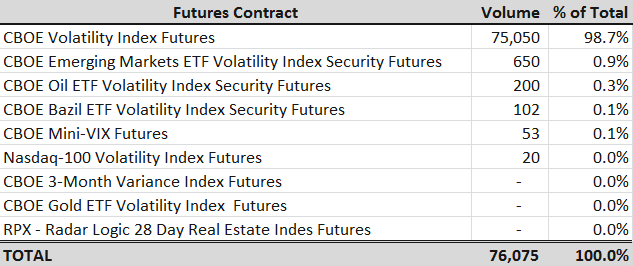
You really need a scorecard to keep up with the new product launches at the CBOE. Today was potentially a big one, with the launch of futures on the Nasdaq-100 Volatility Index, which most of us simply refer to as VXN or Vixen.

As the table below shows, the VIX continues to account for approximately 99% of the volatility index futures at the CBOE Futures Exchange (CFE). Today VXN futures (VN) traded 20 contracts on its opening day. While futures in the CBOE Emerging Markets ETF Volatility Index (VXEEM) are currently positioned at the #2 product at the CFE, VXN futures certainly have a lot of potential, with the likes of Apple (AAPL), Facebook (FB) and Google (GOOG) and other technology high fliers folded into this security.

On a related note, for anyone who may be interested, I authored the feature article, The Expanding Volatility Megaplex, in the current edition of Expiring Monthly. This article chronicles the history of volatility indices and looks at how the CBOE has recently begun to aggressively expand the scope of volatility indices and turn these into product platforms for futures, options and exchanged-traded products.

Related posts:

[source(s): CBOE Futures Exchange]

Disclosure(s): The CBOE is an advertiser on VIX and More

Tuesday, May 15, 2012

Cheating with Partial Hedges

[The following first appeared in the May 2011 edition of Expiring Monthly: The Option Traders Journal. I thought I would share it because of the strong positive feedback I received as well as the large number of questions I have recently fielded about hedges.]

After more than two years of a surging bull market that has seen the major stock market indices more than double, it is not surprising that many investors are becoming more concerned about protecting existing profits than finding ways to increase existing account balances.

As someone who makes a living trading options, you would think that finding a way to hedge my portfolio using options ought to be second nature by now. In fact, I have always placed more emphasis on offense than defense, not because I underestimate the importance of risk management, but because I generally find the opportunity cost of portfolio protection to be too high. I am sure this will sound like heresy to some, but the truth is that I never want to pay the full price for portfolio protection, so my efforts at hedging my portfolio have always emphasized finding the narrowest possible hedge for my needs and limiting the cost of that hedge as much as possible. In a nutshell, my approach is to try to figure out where the best place is to cut the corners and shave the odds, without significantly increasing my exposure. An academic may refer to this as creating a bespoke or customized hedge. I prefer to think in lay terms of cheating the odds. With the above in mind, the balance of this article attempts to explain how I look at constructing custom partial hedges.

Three Approaches to Hedging

First off, I have little interest in a hedge that caps my upside potential. For this reason, I generally steer clear of collars, unless I am going on a vacation and have no intention of watching the markets.

I find the following three types of hedging strategies have the greatest appeal:

1) Disaster Protection Hedge – A hedge that only pays off after a specified drawdown threshold, say 10% or 20%, similar to an insurance contract with a large deductible

2) Gap Protection Hedge – Has all the features of a disaster protection hedge, but also includes a cap, with the result that the hedge pays off only in a specified range, such as from a 10% - 20% drawdown

3) Proportional Protection Hedge – Instead of using thresholds and caps, proportional protection provides insurance against losses for a fixed percentage of each dollar lost

The common theme in each of the above three hedging strategy approaches is that an investor chooses partial protection rather than full protection, based on an assessment of the extent to which he or she finds losses to be an acceptable risk and at what losses must be hedged in order to preserve trading capital.

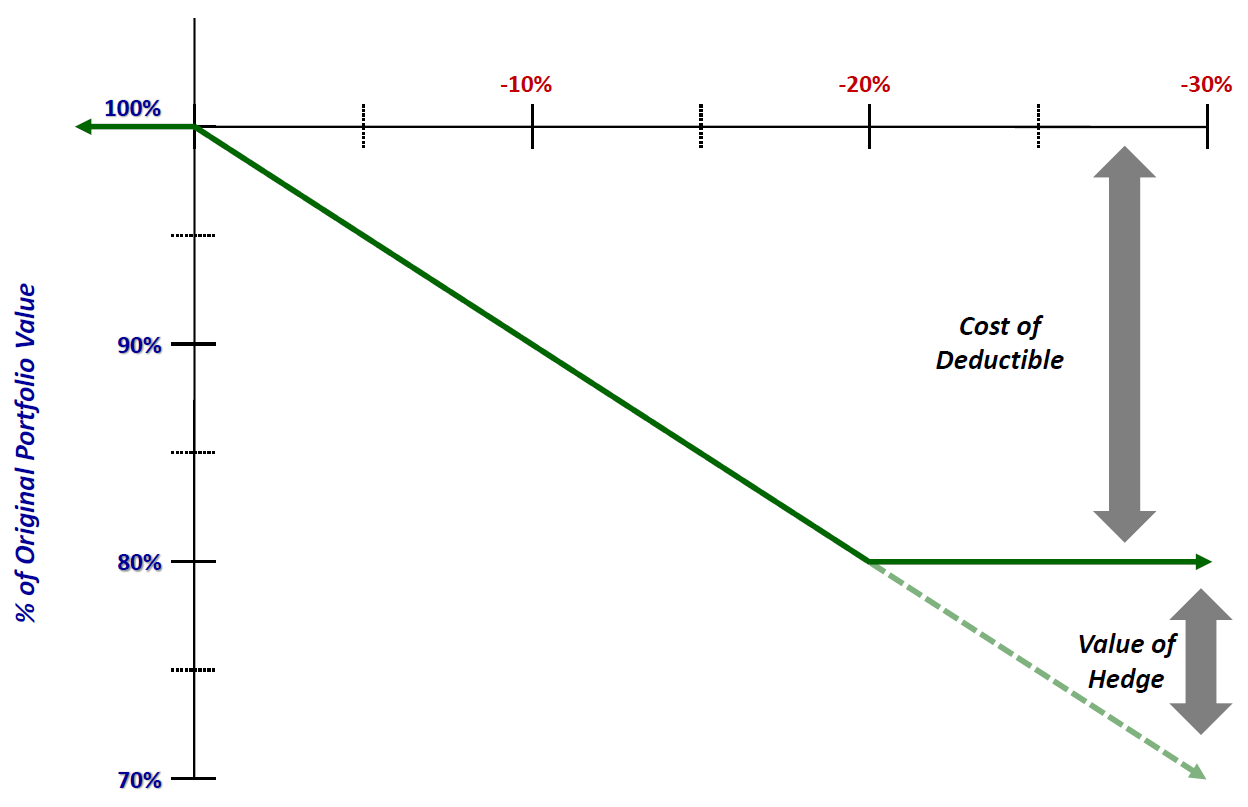
In the description of the three types of hedges, I have adopted some terminology normally associated with the insurance industry in order help clarify some important concepts. Specifically, I use the term deductible to describe the portion of a portfolio that is unhedged and thus 100% at risk. As Figure 1 below shows, in the case of a Disaster Protection Hedge, the deductible amount is equal to the first 20% of the losses that are unhedged, before the insurance threshold is triggered. In options parlance, the example in Figure 1 would be equivalent to holding a long position in SPY at 130 and having the position hedged with long SPY 104 puts, as 104 = 130 * 80%.

Figure 1:  Disaster Protection Hedges 80% of Portfolio with a 20% Deductible Before Insurance Kicks In (source: VIX and More)

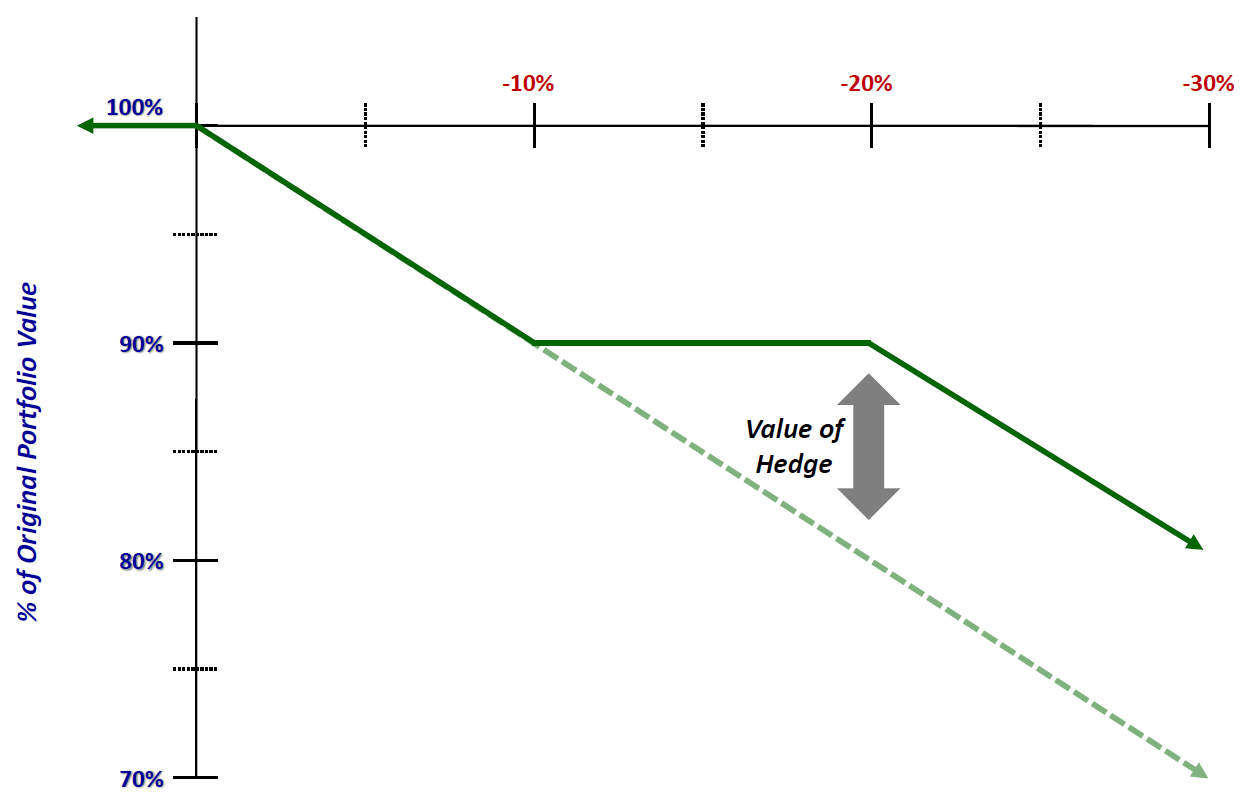
While every investor should think long and hard about being hedged against a disastrous fall in stocks, such as the experience in 2008, in reality a 100-year flood does not happen very often and can be an expensive hedge to maintain on a daily basis. For this reason, I like the idea of what I call a Gap Protection Hedge. As shown in Figure 2 below, an investor might think that it is unlikely stocks will decline 20% or more, so he or she might prefer to remain unprotected for a 10% drop (i.e., a 10% deductible), yet be hedged dollar for dollar for any loss from 10% up to 20%. The maximum benefit of this hedge is capped at 20%, so once losses begin to exceed 20%, the investor is fully exposed to any incremental losses. In the options world, this type of protection would be similar to holding a long position in SPY at 130, with a hedge consisting of long SPY 117 puts and an equal amount of short SPY 104 puts.

Figure 2:  Gap Protection Hedges Only for a Specified Range, Here from 10% to 20% (10% Deductible, 20% Cap) (source: VIX and More)

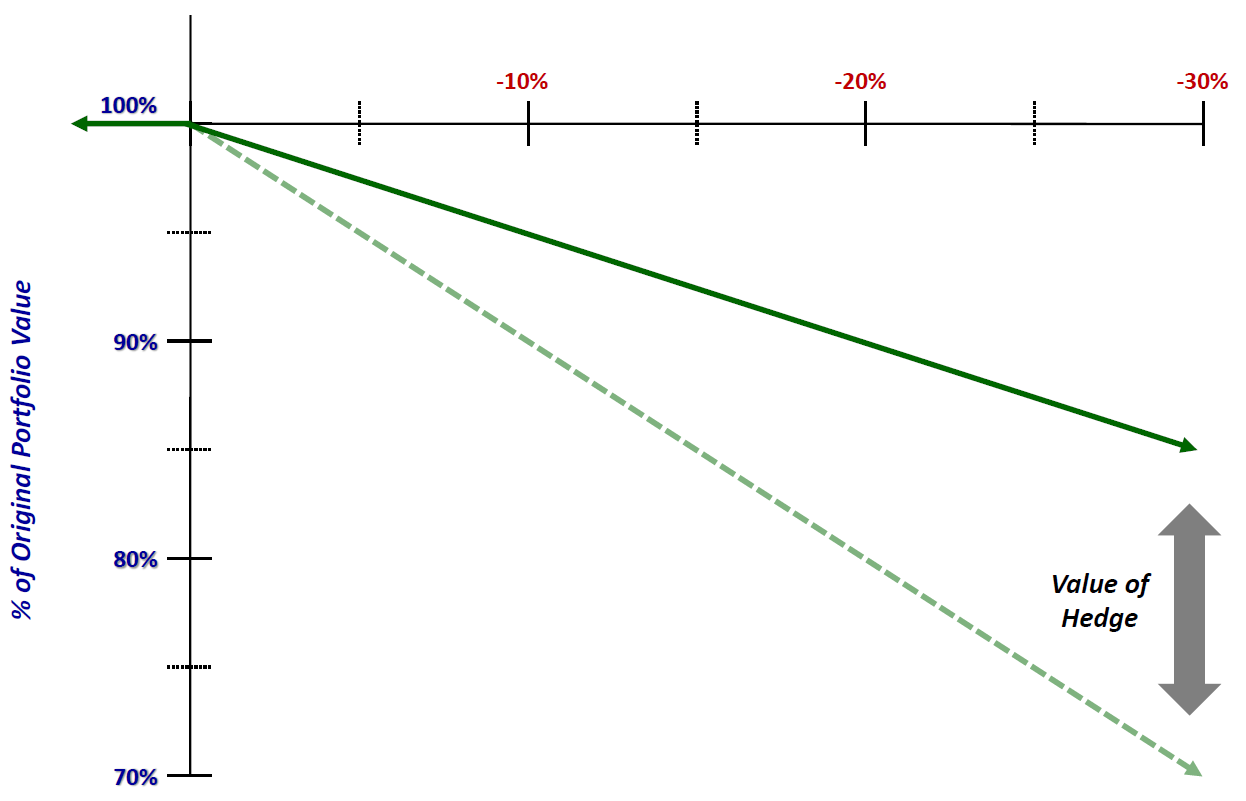
While I find it helpful to think about hedged in terms of deductible thresholds and maximum benefits caps, proportional protection has the benefit of simplicity. In insurance terms, this is similar in some respects to a co-pay. As illustrated in Figure 3 below, there is no deductible or cap with proportional protection and the insurance coverage begins with the first dollar lost. This example shows how 50% proportional protection looks in graphical form. Here a 20% drop in the stock market only translates into a 10% loss due to the partial offset of the hedge. In the example below, the options equivalent for this strategy would be a position of 1000 shares of SPY that are hedged by 5 at-the-money puts. Of course, as the contract multiplier for SPY options is 100 shares, one can fully hedge 1000 shares with 10 puts, meaning that 5 puts would represent a 50% hedge.

Figure 3:  Proportional Protection Begins Immediately, But Only Covers a Percentage of Losses (Think 50% Co-Pay) (source: VIX and More)

Combining Multiple Hedging Approaches

While some investors might be happy sticking to one of the three type of partial hedging strategies mentioned above, the real fun begins when you consider these hedges as building blocks which allow an investor to design custom hedges.

For example, let us assume one is comfortable with accepting the first 10% drawdown as a cost of doing business and is willing to remain unhedged for the first 10% of portfolio losses. At some point, an investor will likely want a hedge to begin to offset some portion of incremental losses, yet might still think protection is too expensive to warrant being fully covered at a pullback of 10% or 20%. This investor might also think that stocks are unlikely to fall more than 30%, yet may not want his or her portfolio to suffer losses in excess of 20%.

One way to structure a hedge that meets all these requirements would be to buy gap protection for stock market losses from 10% to 20%, have proportional protection of 50% to cover losses from 20% to 30% and rely on disaster insurance in the event losses exceed 30%. Here the total maximum loss is 20% (the first 10% and 50% of the next 20%) and the hedge is structured in such a way that the investor pays nothing for the most expensive insurance (the first 10%), gets a discount on the next most expensive insurance (the proportional insurance for the next 20%) and only pays full price for the most unlikely events, where the markets fall more than 30%.

Conclusion

There is no denying that hedges are very expensive, particularly for those who put more faith in their trading skills than their hedging skills. Like any high wire-act, however, successful traders need a safety net to allow them to perform complex and dangerous maneuvers.

Traders who are able to define their risk tolerance in terms of worst case scenarios and potential maximum drawdowns have many ways in which to structure hedges to limit their risk. This article highlights three different approaches to structuring partial hedges for the purpose of maximizing portfolio protection while minimizing the cost of these hedges as well as the magnitude of certain types of risk. By combining these different partial hedging strategies, traders can customize their risk exposure to match individual needs and ensure that appropriate hedges can be constructed in a manner that is as cost efficient as possible.

Related posts:

Disclosure(s): I am one of the founders and owners of Expiring Monthly

Wednesday, March 14, 2012

Third Steepest First-Second Month VIX Futures Contango Ever

For a variety of reasons, investors seem unwilling to embrace the current rally and with each day the market rises, I see a scramble in the indicator forest to find some sort of proof that stocks are finally, inevitably going to correct…and soon. I need to give this phenomenon a name, so I am going to call it indicator hunting and define it as a companion to confirmation bias.

I discussed this subject a little over a month ago in What the VIX Kitchen Sink Chart Says (it hasn’t said much lately, but I’m trying to teach it sign language), when I noted:

“One of the more interesting developments of 2012 has been to watch the diminution of the strident bearish narrative that has been focused largely on the collision course between a preponderance of debt and low or negative growth. The bullish beginning to 2012, however, has not prompted many in the way of converts to the bullish camp. Instead, there have been whispers of ‘…overbought…’ that have turned into a soft murmur and are now verging on becoming loud chorus. Suddenly the general consensus seems to be that stocks just do not deserve their current lofty valuation.

In this type of environment, many investors become particularly susceptible to confirmation bias and scramble to find one or more indicators which will tell them what they have already begun to believe: that a major correction is likely just around the corner.”

Not surprisingly, the clamoring has only become more strident as stocks have continued to rise.

One of the current targets of indicator hunting is the huge contango in the VIX futures term structure. Some are saying it is steeper than it has ever been before (it isn’t) and others are convinced that this means the presumably omniscient SPX options traders are foretelling something between a steep selloff and a market crash just around the corner.

While selling fear is a proven media strategy and sometimes an attractive investment strategy, I submit that these pundits are giving SPX options traders too much credit and are substantially off the mark in their analysis.

In next week’s issue of Expiring Monthly: The Option Traders Journal, I analyze the VIX term structure as a predictor of future changes in stocks and volatility. Let’s just say that, at a minimum, that these same pundits are going to be surprised by the results.

To illustrate my point, consider that yesterday’s close marked the third steepest contango reading for the first and second month VIX futures. The chart below highlights the first and second steepest (front month and second month) VIX futures contango readings on record, which date back to July 2004, some 3 ½ months after the CBOE launched VIX futures. Looking at the chart, those two consecutive days appear almost to have been selected at random, coming at a time in which the SPX was 3.5% below a high from two weeks earlier and four weeks prior to a cycle low that would see the SPX decline another 4.2%. In the bigger picture, however, the record VIX futures contango came at a time when stocks were taking a breather before embarking on another huge bull leg. Ironically, the VIX was also hovering at about 15.00 when the VIX futures contango established the record, but five months later it would be trading in the 11s and one year later we even saw a sub-10 VIX.

Now I would be foolish to rule out the possibility of another sharp pullback, but I think it is even more foolish to stubbornly stick to preconceived notions, ignore the market action and confirmation bias and indicator hunting (perhaps even availability bias and disaster imprinting as well) drag down your portfolio.

Related posts:

[source(s): StockCharts.com]

Disclosure(s): the CBOE is an advertiser on VIX and More

Saturday, March 3, 2012

Recent Research Projects and Expiring Monthly

It occurred to me than in a recent post, Five Years of VIX and More, I neglected to mention my contributions to Expiring Monthly: The Option Traders Journal, where I tend to publish some of my proprietary research and analysis in a somewhat longer form (1000-4000 words) than I do in this space.

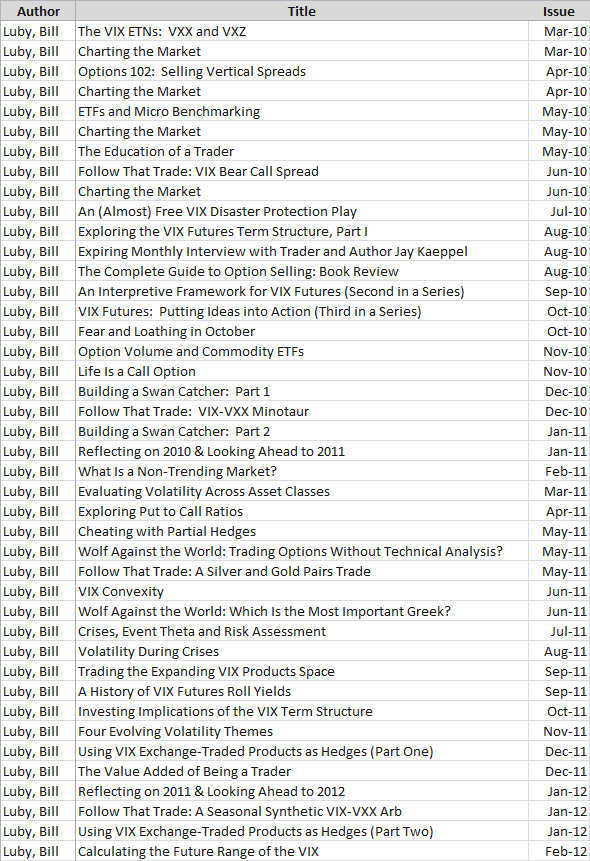
Rather than my typical screen shot of the table of contents and some brief comments on what I have been thinking about and writing for the magazine as of late, I thought that as the second year of Expiring Monthly has just concluded, it might be interesting to list all the titles of the 42 articles I have written for the magazine to give readers a sense of some of my more detailed research interests.

Accordingly, the graphic below lists all the articles I have written for Expiring Monthly in chronological order, up to and including Calculating the Future Range of the VIX, which was part of the February 2012 issue that was published last week.

I recently republished The VIX-VXX Minotaur Trade, which first appeared in the December 2010 edition of Expiring Monthly, in this space. The Education of a Trader, which also originated at Expiring Monthly in our editorial Back Page column, was republished here as well. Going forward, I think I will start pulling additional articles from the Expiring Monthly archives (perhaps 1-2 articles per year that are at least one year past publication) and see if they can find a wider audience here. Given all the recent interest in hedging, something like Cheating with Partial Hedges is certainly a candidate for finding its way onto these pages.

More information on prior issues can be found by following all the posts tagged herein with the Expiring Monthly label.  For those who are interested in subscription information and additional details about the magazine, you can find all that and more at http://www.expiringmonthly.com/.

Related posts:

Disclosure(s): short VXX at time of writing; I am one of the founders and owners of Expiring Monthly

Monday, January 30, 2012

Expiring Monthly January 2012 Issue Recap

I may have been away on vacation for the last two weeks, but that doesn’t mean my brain was entirely at rest.

In fact I was particularly busy in the January 2012 edition of Expiring Monthly: The Option Traders Journal, which was published last week and is available for subscribers to download. As the table of contents below shows, this time around I penned three articles, all with a distinctive VIX flavor:

  • Reflections on 2011 and Thoughts on 2012
  • Using VIX Exchange-Traded Products as Hedges (Part Two)
  • Follow that Trade: A Seasonal Synthetic VIX–VXX Arb

As noted here last week in The VIX-VXX Minotaur Trade, the last of those three articles advances some of the thinking I first presented in the December 2010 issue of the magazine.

Since a number of readers have expressed some interest in a listing of all the titles of my articles for Expiring Monthly, I intend to post a full list of all those at the end of the week.

Finally, now that I am back on the grid, I can devote some research and analysis to some of the developments that transpired while I was away – so expect regular posting to resume later today.

For those who are interested in subscription information and additional details about the magazine, you can find all that and more at (the newly redesigned) http://www.expiringmonthly.com/. More information on prior issues (and some of my research interests) can be found by following all the posts tagged herein with the Expiring Monthly label.

Related posts:

[source: Expiring Monthly]

Disclosure(s): short VXX at time of writing; I am one of the founders and owners of Expiring Monthly

Tuesday, January 24, 2012

The VIX-VXX Minotaur Trade

[The following first appeared in the December 2010 edition of Expiring Monthly: The Option Traders Journal. I thought I would share it partly because I have an article, “Synthetic Seasonal VIX-VXX Arb,” which appears in the just published January 2012 issue of Expiring Monthly that expands upon some of the ideas presented below.]


Rationale

In Greek mythology a Minotaur was a hybrid creature with the body of a man and the head of a bull. Such a creature provided the inspiration for a pairs trade involving short VXX at-the-money calls and long VIX at-the-money calls.

The holiday season has a shortage of trading days and a history of a bullish bias. As a result, December VIX futures have a tendency to remain relatively muted when compared to January VIX futures. Assuming I am able to establish this position for a net credit, a seasonal play on volatility involving short VXX calls paired with long VIX calls has an opportunity to profit if any one of three critical factors dominates:

  1. volatility declines and both options expire worthless
  2. the VIX futures remain in contango
  3. volatility spikes and the VIX is more sensitive to the spike than VXX

It is possible to back test this strategy, but sometimes I like to put the trade on, see how it develops and get a sense of some of the potential hurdles. I fully understand that the results will not be statistically significant and making any inferences about a strategy from one trade is dangerous, but I do find some value in what I call these “proof-of-concept” trades with real money.

With most trades, achieving maximum profitability at minimum risk is the only goal. With a proof-of-concept trade, profits are important, but so is information. For this reason, I have a tendency to leave proof-of-concept trades on longer than I would when trading with an established strategy.

In terms of ratios, my intent is to keep this simple. The VIX is trading at just under 49% of the VXX at the moment and my research indicates that VXX generally moves about 48% as much as the VIX on a daily basis, so with the VIX at about 22 and VXX at about 45, I elect to do this pairs trade on a 1:1 ratio basis, using 10 contracts of each to keep the math simple.


Setup and Entry

In a world of maximum profitability, I would probably wait for some sort of relatively high VIX level before entering this trade, but because I am also focusing on the informational value of the trade, I choose to open the position early in the trading day on November 22nd, with the VIX at about the middle of its 10-day range.

With the VIX at 22.03 and VXX at 44.98, there is a strong temptation to stay strictly at the money and short the VXX December 45 calls while going long the VIX December 22 calls. For ten contracts, the potential profit should both options expire worthless is less than $1000. Given my expectations for seasonally low volatility and also given the high level of contango in the VIX futures, I elect to shave the odds a little and short the slightly in-the-money VXX December 44 calls and go long the VIX December 22 calls. This raises the potential profit if both options expire worthless by another $200. After trying to work the order a little, I relent and take what the market gives me, recording slippage of $175 on the VIX side of the trade and $100 on the VXX side of the trade. I still manage to pocket $800 on the trade, which leaves me long VIX December 22 calls for 2.30 and short VIX December 44 calls for 3.10.


Position Management

The first important point to keep in mind while managing these two positions is that they run on different expiration cycles. The VIX options expire on December 17th and the VXX options expire five days later on December 22nd. For that reason, I anticipate that I will exit the position no later than December 16th, which is the last day the VXX options are traded.

Monday, November 22 – As luck would have it, the VIX fell 8.3% between the time the trade was executed and the end of the day, pushing both calls out of the money and securing a $500 profit for the position.

Tuesday, November 23 – The VIX reversed to the upside today and is now 0.60 higher than when the VIX calls were purchased. VXX lagged during today’s spike and is 0.06 below where it was when the VXX calls were sold. The relative weakness in the VXX sounds positive for my position, but VXX calls jumped 64% today while the VIX calls rose only 39%. The profitability of trade has turned from +$500 to -$175 in 24 hours.

Monday, November 29 – After some seesaw action immediately before and after Thanksgiving, the weekend saw the Irish bailout formalized and tensions heating up on the Korean Peninsula. Both the VIX and the VIX December (front month) futures closed near the 21.50 level, while VXX spiked up to 46.10. The VIX calls and VXX calls are both in the money and my position is now down $475 in one week. I am now the beneficiary of $36 of theta each day, but I am disappointed that the VIX spike has had more of an impact on the VXX calls than the VIX calls.

Tuesday, November 30 – The VIX closed at 23.54, its highest closing level since September, as concerns lingered about the future of the euro zone and the Koreas. My VIX long calls are now 15% in the money and my VXX short calls are 10.7% in the money, yet the VXX calls continue to be more sensitive to increases in volatility. Today the VXX calls jumped 62% while the VIX calls rose 54%. The position lost $975 today and is now down $1450 in aggregate. If this were not a proof-of-concept trade I would either be exiting the trade or making adjustments to limit risk at this stage. As it is, I will let the trade ride, as my preferred indicators suggest the VIX is ‘overbought’ and is ripe for some mean reversion. My $36 of theta is just a drop in the bucket now.

Wednesday, December 1 – Today was a huge turnaround. The VIX fell 10.2% and VXX declined only 5%, yet the VXX calls lost 50% of their value while the VIX calls dropped only 27%. The result saw the position swing $2000 to a gain of $550.

Friday, December 3 – After falling more than 10% on both Wednesday and Thursday, the VIX fell another 7.7% today, as geopolitical and macroeconomic concerns faded and were replaced by a rising sense of optimism. Over the course of three days, the VIX has fallen 23.5% from 23.54 to 18.0 while VXX has fallen 16.2% from 49.29 to 41.30. With both calls well out of the money and the aggregate gain in the position up to $825 (above the $800 profit target), here is where I would exit the position and lock in profits, but this is a proof-of-concept trade, so I will let it ride…

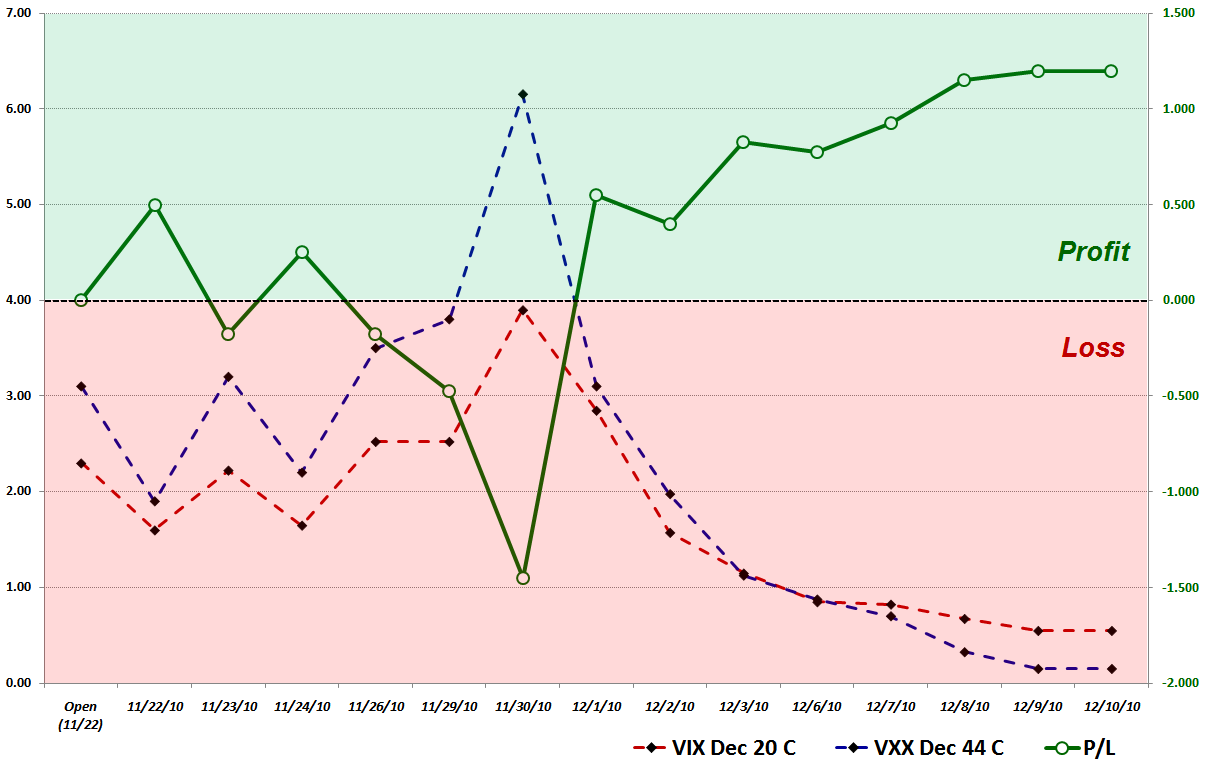
Friday, December 10 – The graphic below details the full lifecycle of this trade, which is coming to an end today. Of notable interest, during the last week the VIX was relatively steadfast, while VXX lost significant value due to negative roll yield and a general drop across the VIX futures term structure. The result is that VXX, which was 2.1% in the money when the calls were shorted is now 15.4% out of the money, with the calls fetching only 0.15. The VIX has fared much better, starting out 0.1% in the money and now 13.6% in the money. Due to the greater volatility of VIX options and also the extra five days in the VIX expiration cycles, the calls still hold a value of 0.55. For the last three days, the position has been registering a profit in the $1150-$1200 range. As this is almost certainly going to be whittled back to $800 in the 1 ½ weeks until expiration, I am electing to pull the plug on this trade.


Epilogue and Takeaways

The first key takeaway is that with a little patience, a VIX Minotaur trade with a net short VXX position can indeed be profitable. On the flip side, this trade can be highly volatile and requires that significant attention be given to risk management. In anything other than a proof-of-concept environment, I would have exited this trade for a loss long before it had a chance to work its way back to profitability.

I was a little disappointed that the VIX spike did not provide the same lift to VIX options that it did to VXX options. This was due to the fact that VXX options turned out to be much more sensitive to changes in the underlying than VIX options, which is a key learning. Future trades should attempt to establish whether this is a persistent theme.

Another important consideration is the timing of the two expiration cycles. In this instance the position benefitted from the fact that VIX options expiration was after VXX options expiration. In August and September VIX options expired before VXX options, so I would have expected a more challenging environment for this trade during those two expiration cycles.

Future efforts may wish to tweak the degree to which both the VIX and VXX options are out of the money and also adjust the units in the ratio to give a higher weighting to VIX options.

Finally, score one point for the proof-of-concept trade. When real money is on the line, perceptions are more acute, emotional responses and their interaction with the trade are more realistic and ultimately any lessons learned are more deeply etched in the trading psyche.

Related posts:

Disclosure(s): short VXX at time of writing; I am one of the founders and owners of Expiring Monthly

Thursday, August 11, 2011

VIX Suggests Investors Don’t Believe Rally Is Sustainable

Back in 2007 and 2008 I had a shipload of posts talking about the SPX:VIX correlation, its implications for stocks and the like. I even came up with a plot that I called a “fearogram” to map how changes in the VIX relative to the SPX compared with historical norms and recently dove into the subject of VIX convexity and the movements of the VIX relative to the SPX in a June 2011 Expiring Monthly article, VIX Convexity.

I mention all this because in the recent downturn the VIX has moved much faster to the upside than the SPX has to the downside, given the historical rule of thumb that for every 1% change in the SPX the VIX moves approximately 4% in the opposite direction. For instance, from August 3 to August 8 the SPX lost 11% over the course of three trading days. During the same period the VIX more than doubled, gaining 105%, considerably more than the 44% or so one would have expected. One could argue that much of the move in the VIX over and above the anticipated 44% gain represented fear and irrationality flooding into the markets.

As I write this the S&P 500 index is up 5.2%. At the same time, the VIX is down about 11.8%, close to half of the anticipated -4x move.

So to recap, the VIX rose more than twice as fast as one would expect and is falling almost half as fast it has over the course of its history. That, in a nutshell, is the fear in the market. Another way of looking at the stubbornly high VIX is that investors do not believe the current rally is likely to be sustained, so options sellers are not marking down options prices with any sense of urgency, estimating that continued high implied volatility will persist.

Related posts:


Disclosure(s): short VIX at time of writing

Thursday, May 26, 2011

Expiring Monthly May 2011 Issue Recap

A quick reminder that the May edition of Expiring Monthly: The Option Traders Journal was published earlier this week and is available for subscribers to download.

This month’s feature article, Understanding Order Flow, Part One: Reading It, is authored by Mark Sebastian and delves into subjects such as the impact of large trades on implied volatility and skew. Mark will be back with part two of this illuminating feature in the June edition.

Another article that breaks new ground and offers more than a few surprises is Jared Woodard’s Why Black-Scholes Is Better Than We Think, which evaluates how robust the Black-Scholes model is in the context of delta hedging.

One of my favorite parts of the magazine is the interview segment. This month Mark Sebastian interviews TradeKing Chairman and CEO Donald Montanaro. Their conversation traces the history of the discount brokerage industry, the role of options in the discount brokerage world, and the evolution from bricks and mortar to online options trading.

In this month’s issue I am responsible for three articles. The one I enjoyed the most I call Cheating with Partial Hedges, which explores the subject of creating custom portfolio hedges which minimizing cost and risk, while maximizing coverage where it matters most. I also was responsible for the monthly Follow That Trade column. This month I follow a silver and gold pairs trade that combines some bottom-fishing characteristics with a short implied volatility flavor. Last but not least, in the Wolf Against the World column I square off with Mark Wolfinger (whose New Options Trader column is a great resource for those who are new to trading options) to debate the merits of using technical analysis in trading options. My argument relies heavily on the use of TA for position management and exits.

In keeping with tradition, I have reproduced a copy of the Table of Contents for the May issue below for those who may be interested in learning more about the magazine. Thanks to all who have already subscribed. For those who are interested in subscription information and additional details about the magazine, you can find all that and more at (the newly redesigned) http://www.expiringmonthly.com/.
Related posts:


[source: Expiring Monthly]

Disclosure(s):
I am one of the founders and owners of Expiring Monthly

Tuesday, April 19, 2011

Expiring Monthly April 2011 Issue Recap

The April edition of Expiring Monthly: The Option Traders Journal was published yesterday (in keeping with our practice of publishing on the Monday following options expiration) and is available for subscribers to download.

In this month’s issue I author the feature article, Exploring Put to Call Ratios. This is somewhat of a departure from the bulk of the content of the magazine, which continues to focus on options as trading vehicles. For many of us, however, options are not only highly flexible trading vehicles, but also the source of quite a few slices of data that can serve as indicators, most notably the VIX and put to call ratios.

Some of my favorite articles in the current issue of Expiring Monthly include a Mark Sebastian interview noted options guru Larry McMillan; a guest article on the CBOE PutWrite Index (PUT) from Jason Ungar; and a thought-provoking piece from Jared Woodard on three volatility plays for the European sovereign debt crisis.

Mark Sebastian also interviews Ping Zhou, a co-author of Trading on Corporate Earnings News and pens the monthly Follow That Trade column, which focuses on position management for an OEX butterfly. Mark Wolfinger continues to be a prolific contributor, speaking out on options brokers are putting limits on customer trading on the last trading day of the expiration cycle, debating the role of options as speculative vehicles and offering some thoughts to the new options trader around risk, timing and money.

All in all I am delighted by the quality of our fourteenth issue, thrilled by the positive feedback I have received from readers, and excited by some of the articles that are currently taking shape for the coming months.

In keeping with tradition, I have reproduced a copy of the Table of Contents for the April issue below for those who may be interested in learning more about the magazine. Thanks to all who have already subscribed. For those who are interested in subscription information and additional details about the magazine, you can find all that and more at (the newly redesigned) http://www.expiringmonthly.com/.

Related posts:


[source: Expiring Monthly]

Disclosure(s): I am one of the founders and owners of Expiring Monthly

Monday, March 28, 2011

Expiring Monthly March 2011 Issue Recap

Just a quick reminder that as Expiring Monthly: The Option Traders Journal publishes on the Monday following options expiration, the March issue was published a week ago today and is (still) available for subscribers to download.

Note that the Expiring Monthly web site was recently overhauled to make for a better user experience, offer archived articles and provide a better platform for further content enhancements. While I may be biased, there is no doubt it is a substantial improvement over the previous version of the web site.

The March issue includes a feature article from guest author Michael McCarty and is titled, A Multi-Dimensional Look at Implied Volatility: Several New Releases from the CBOE. My contribution is a complementary one: Evaluating Volatility Across Asset Classes. Among the other articles of interest is an interview with Jeff Augen, whose recent publications have helped to shed light on the workings of volatility, particularly at the end of the options expiration cycle and at earnings announcements.

I should also note that last month I did not provide a recap of the February issue of Expiring Monthly. That issue had a feature article on non-directional trading and some additional content related non-directional trading, including an article I authored for the diagnostically-oriented trader, which is titled, What Is a Non-Trending Market?

In keeping with tradition, I have reproduced a copy of the Table of Contents for the March issue below for those who may be interested in learning more about the magazine. Thanks to all who have already subscribed. For those who are interested in subscription information and additional details about the magazine, you can find all that and more at http://www.expiringmonthly.com/.

Related posts:


[source: Expiring Monthly]

Disclosure(s): I am one of the founders and owners of Expiring Monthly

Tuesday, January 25, 2011

Expiring Monthly January 2011 Issue Recap

A reminder that the January issue of Expiring Monthly: The Option Traders Journal was published yesterday and is available for subscribers to download.

In this month’s feature section, the contributing editors reflect on key developments across the options landscape in 2010 and venture forth with predictions for the coming year in subjects ranging from macroeconomic issues to new products to the state of volatility.

This month there are two interviews, presumably following a surprise 2-1 split of the original interview feature. Mark Sebastian interviews author Sergey Izraylevich, whose recent book, Systematic Options Trading, is, as the title suggests, a comprehensive review of a systematic approach to trading options. Also, Jared Woodard sits down with Robert Krause and Charles Barwis of The Volatility Exchange, a new exchange dedicated to realized volatility contracts for currencies, equities, commodities and interest rates whose first products will be launched on February 7th.

The full slate of articles is captured in the table of contents below, but for those who are volatility fanatics, I feel obliged to point out that Jared Woodward talks five different approaches for forecasting SPX volatility in 2011. Also, guest author Chris McKhann of optionMONSTER delves into some of the nuances of volatility in calendar spreads.

I penned (keyboarded?) two articles for the January issue. The first of these details my thoughts on the options space in 2010 and includes a slew of predictions for 2011. The second article is the conclusion of a two-part series about tweaking a “Swan Catcher” model I introduced last month. The intent of the Swan Catcher is to a position that should profit from extreme moves in the market, without losing too much money while one waits for these events to occur.

For those who are interested in subscription information and additional details about the magazine, you can find all that and more at http://www.expiringmonthly.com/.

Related posts:


[source: Expiring Monthly]

Disclosure(s): I am one of the founders and owners of Expiring Monthly; optionMONSTER is an advertiser on VIX and More

Tuesday, December 21, 2010

Expiring Monthly December 2010 Issue Recap

A reminder that the December issue of Expiring Monthly: The Option Traders Journal was published yesterday and is available for subscribers to download.

This month’s issue has a feature article from Mark Sebastian on the future of options exchanges. On a related subject, Mark Longo interviews Gary Katz, President and CEO of the International Securities Exchange (ISE).  Additional subjects covered in the magazine include how market makers use volatility to update their quotes, delta hedging, analyzing opening gap tendencies, payment for order flow, directional vs. non-directional strategies, the role of luck and skill in trading, and a review of Ron Ianieri’s recent options book.

I contribute two articles to the December issue. Unintentionally blurring zoomorphism with mythology, one article is based on a trade I call “the Minotaur” while the other has earned the name of “the Swan Catcher.” The Minotaur turns out to be a VIX-VXX pairs trade and here I embark on a proof-of-concept approach. The Swan Catcher trade also represents something of a bottoms-up approach to developing options strategies. In part one of a two-part series, I seek a way to structure options positions to profit from extreme moves in the market, without losing too much money while one waits for these events to occur.

As is now my habit, I have reproduced a copy of the Table of Contents for the December issue below for those who may be interested in learning more about the magazine. Thanks to all who have already subscribed. For those who are interested in subscription information and additional details about the magazine, you can find all that and more at http://www.expiringmonthly.com/.

Related posts:


[source: Expiring Monthly]

Disclosure(s): I am one of the founders and owners of Expiring Monthly

Tuesday, November 23, 2010

Expiring Monthly November 2010 Issue Recap

A reminder that the November issue of Expiring Monthly: The Option Traders Journal was published yesterday and is available for subscribers to download.

This month’s issue has what may be my favorite feature article to date, The Volatility Risk Premium in Commodity Options, authored by Jared Woodard. If you have an interest in options on commodities, this issue has seven articles devoted to various aspects of that subject.

I have two contributions to the November issue. The first is Options Volume and Commodities ETFs, in which I discuss some of my thoughts on volume as it applies to combining market timing and options. The second piece comes from the back page column of the magazine (the same place where The Education of a Trader first appeared) and is necessarily more tangential to the options world than the other articles in the magazine. I have given this effort the title of Life Is A Call Option and will leave it at that in order to retain at least a little mystique.

I have reproduced a copy of the Table of Contents for the November issue below for those who may be interested in learning more about the magazine. Thanks to all who have already subscribed. For those who are interested in subscription information and additional details about the magazine, you can find all that and more at http://www.expiringmonthly.com/.

Related posts:


[source: Expiring Monthly]

Disclosure(s): I am one of the founders and owners of Expiring Monthly

Monday, October 18, 2010

Expiring Monthly October 2010 Issue Recap

Just a quick reminder that the October issue of Expiring Monthly: The Option Traders Journal was published today and is available for subscribers to download.

This month I authored two pieces that I think readers might find particularly interesting. The first is the monthly feature, Fear and Loathing in October, which examines seasonality from an anecdotal, statistical and a behavioral finance perspective and puts the September through January period under the analytical microscope. Also of interest is the third and final installment in my series on the VIX futures term structure. VIX Futures: Putting Ideas into Action takes a six-part framework for analyzing VIX futures and discusses some of the implications for trading VIX options and VIX ETNs such as VXX.

I have reproduced a copy of the Table of Contents for the October issue below for those who may be interested in learning more about the magazine. Subscription information and additional details about the magazine are available at http://www.expiringmonthly.com/.

Related posts:


[source: Expiring Monthly]

Disclosure(s): I am one of the founders and owners of Expiring Monthly

Monday, September 20, 2010

Expiring Monthly September 2010 Issue Recap

Just a quick reminder that a new options expiration cycle means a new issue of Expiring Monthly: The Option Traders Journal is available. In fact the September issue was published today and is available for subscribers to download.

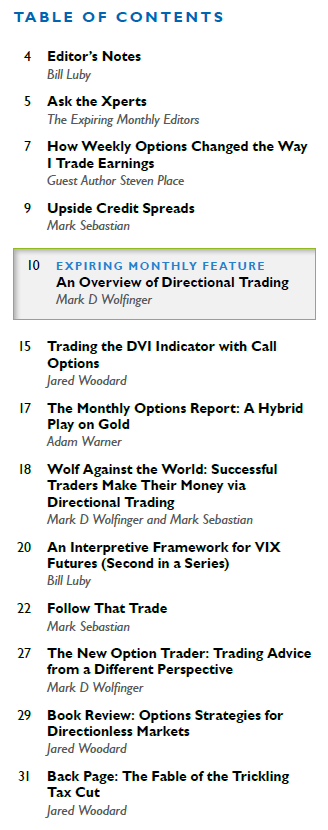
The September edition features a handful of articles on the subject of directional trading with options, including a feature article from Mark Wolfinger and a guest article from Steven Place of Investing with Options.

In addition to my regular gig as authoring Editor’s Notes, this month I have also contributed the second in a three-part series on the VIX futures term structure. The current installment lays out a six-part framework for analyzing VIX futures which establishes a foundation for next month’s finale, in which I discuss some of the implications for various VIX term structure patterns as they apply to trading VIX options and VIX ETNs such as VXX.

I have reproduced a copy of the Table of Contents for the September issue to the right for those who may be interested in learning more about the magazine. Subscription information and additional details about the magazine are available at http://www.expiringmonthly.com/.

Related posts:

[source: Expiring Monthly]

Disclosure(s): I am one of the founders and owners of Expiring Monthly

Tuesday, August 24, 2010

Expiring Monthly August 2010 Issue Recap

As last week was options expiration, this means the August issue of Expiring Monthly: The Option Traders Journal was published yesterday and is available for subscribers to download.

This month’s feature section includes three articles on weekly options: a guest article from Vance Harwood of the Six Figure Investing blog; a punchy piece from Adam Warner with the suspiciously familiar title, Weeklys & More Weeklys; and a Wolf Against the World segment in which Adam and Mark Wolfinger debate the merits of weeklies.

I was particularly active for this issue, interviewing Jay Kaeppel on a wide variety of subjects from the VIX to futures to options; reviewing The Complete Guide to Options Selling (2nd edition), by James Cordier and Michael Gross; and launching the first in a series of articles on the VIX futures term structure – a subject on which readers of this blog appear to have more questions than answers.

With six issues of the magazine to reflect on, I must say that the cumulative body of work has exceeded my very high expectations.

I have attached a copy of the Table of Contents for the August issue below for those who may be interested in learning more about the magazine. Subscription information and additional details about the magazine are available at http://www.expiringmonthly.com/.

For more on related subjects, readers are encouraged to check out:


[source: Expiring Monthly]

Disclosure(s): I am one of the founders and owners of Expiring Monthly

Wednesday, July 21, 2010

Expiring Monthly July Issue Recap

Personal and technical issues have conspired to keep this blog quiet for a few days, but that is about to change.

Before I get back to regular posting, I wanted to inform Expiring Monthly readers and potential new subscribers that Monday marked the publication of the July issue of Expiring Monthly: The Option Traders Journal.

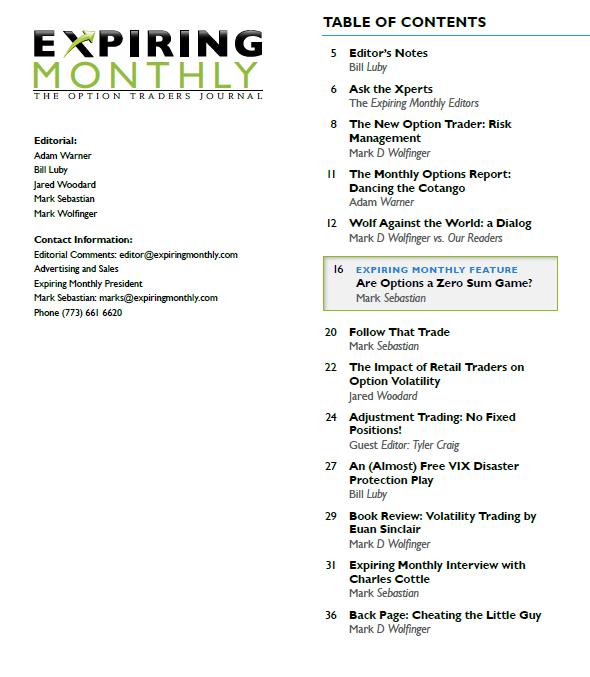
The July issue is rich in volatility content. Among my favorite volatility-centric articles are a piece from Adam Warner on the VIX term structure and contango, a thought-provoking discussion of how retail traders influence options volatility by Jared Woodard, and Mark Wolfinger’s review of Euan Sinclair’s excellent book, Volatility Trading. My main contribution this month comes in the form of an article on VIX call backspreads in “An (Almost) Free VIX Disaster Protection Play.” I also detail some of my thinking and analysis of VIX futures contango as it applies to VXX in the “Ask the Experts” Q&A section.

In this month’s feature article, Mark Sebastian addresses the not-so-simple question of whether options are a zero-sum game. Mark also interviews renowned author Charles Cottle.

I have attached a copy of the Table of Contents for the July issue below for those who may be interested in what this magazine is all about. Subscription information and additional details about the magazine are available at http://www.expiringmonthly.com/.

For more on related subjects, readers are encouraged to check out:


[source: Expiring Monthly]

Disclosure(s): I am one of the founders and owners of Expiring Monthly

DISCLAIMER: "VIX®" is a trademark of Chicago Board Options Exchange, Incorporated. Chicago Board Options Exchange, Incorporated is not affiliated with this website or this website's owner's or operators. CBOE assumes no responsibility for the accuracy or completeness or any other aspect of any content posted on this website by its operator or any third party. All content on this site is provided for informational and entertainment purposes only and is not intended as advice to buy or sell any securities. Stocks are difficult to trade; options are even harder. When it comes to VIX derivatives, don't fall into the trap of thinking that just because you can ride a horse, you can ride an alligator. Please do your own homework and accept full responsibility for any investment decisions you make. No content on this site can be used for commercial purposes without the prior written permission of the author. Copyright © 2007-2023 Bill Luby. All rights reserved.
 
Web Analytics