Showing posts with label PUT. Show all posts

Thursday, February 28, 2013

The Options and Volatility ETPs Landscape

For several years I have publishing a graphical overview of the VIX ETPs landscape, with all the ETPs plotted on the basis of leverage and target maturity, such as the recent VIX ETP Returns for 2012.

Lately, however, an expanding crop of options and volatility ETPs has been taking root in a space that is closer to the VIX products than any of the other ETPs. I talked about the low volatility ETPs at some length in yesterday’s Beyond SPLV: The Expanding Universe of Low Volatility ETPs.

The graphic below is a plot of these securities, with the their geography, market cap and asset class in the rows and strategy/approach in the columns. I have talked about PBP in this space and was particularly interested to see that the buy-write / covered call approach is now being applied to gold in the form of the recent launch of GLDI.

Part of what prompted today’s approach is the launch of U.S. Equity High Volatility Put Write Index ETF (HVPW), which is the first put-write ETP on the market. I have talked about put-write strategies and the CBOE S&P 500 PutWrite Index (PUT) at some length here in the past and have included some links below for additional reading.

In the convertible bond space, CWB has been the most popular ETP in this space for the last few years. Earlier this week, PowerShares closed its competing Convertible Securities Portfolio ETF (CVRT), essentially ceding this space to CWB for now.

The other portion of the graphic below is my attempt at translating much of yesterday’s text into a format that makes for a more handy reference.

I will keep tabs on all of these ETPs going forward and in particularly look to see how HVPW and GLDI do in terms of both risk-adjusted performance and investor acceptance. I certainly hope it does not take investors as long to discover these products as it did for them to warm up to the likes of ZIV.


Related posts:

Disclosure(s): long PBP at time of writing

Wednesday, January 2, 2013

Guest Columnist at The Striking Price for Barron’s: The Case for Options Trading

Once again I am delighted to have an opportunity to serve as a guest columnist for The Striking Price on behalf of Steven Sears at Barron’s. While the title of the column is The Case for Options Trading, the focus of the article tilts in the direction of selling options and lists some of the reasons why new and relatively inexperienced options traders should invest some of their time during the coming year to learn more about selling puts and calls – and not just defined risk positions, but naked (uncovered) options as well.

The Barron’s article lays out some of the rationale behind my thinking, but this is a topic I plan to return to on a regular basis that dovetails with some related subjects I have been discussing in this space and are highlighted in the links below.

Related posts:

A full list of my Barron’s contributions:

Disclosure(s): none

Tuesday, April 19, 2011

Expiring Monthly April 2011 Issue Recap

The April edition of Expiring Monthly: The Option Traders Journal was published yesterday (in keeping with our practice of publishing on the Monday following options expiration) and is available for subscribers to download.

In this month’s issue I author the feature article, Exploring Put to Call Ratios. This is somewhat of a departure from the bulk of the content of the magazine, which continues to focus on options as trading vehicles. For many of us, however, options are not only highly flexible trading vehicles, but also the source of quite a few slices of data that can serve as indicators, most notably the VIX and put to call ratios.

Some of my favorite articles in the current issue of Expiring Monthly include a Mark Sebastian interview noted options guru Larry McMillan; a guest article on the CBOE PutWrite Index (PUT) from Jason Ungar; and a thought-provoking piece from Jared Woodard on three volatility plays for the European sovereign debt crisis.

Mark Sebastian also interviews Ping Zhou, a co-author of Trading on Corporate Earnings News and pens the monthly Follow That Trade column, which focuses on position management for an OEX butterfly. Mark Wolfinger continues to be a prolific contributor, speaking out on options brokers are putting limits on customer trading on the last trading day of the expiration cycle, debating the role of options as speculative vehicles and offering some thoughts to the new options trader around risk, timing and money.

All in all I am delighted by the quality of our fourteenth issue, thrilled by the positive feedback I have received from readers, and excited by some of the articles that are currently taking shape for the coming months.

In keeping with tradition, I have reproduced a copy of the Table of Contents for the April issue below for those who may be interested in learning more about the magazine. Thanks to all who have already subscribed. For those who are interested in subscription information and additional details about the magazine, you can find all that and more at (the newly redesigned) http://www.expiringmonthly.com/.

Related posts:


[source: Expiring Monthly]

Disclosure(s): I am one of the founders and owners of Expiring Monthly

Tuesday, January 13, 2009

More on PUT Returns

Given the surprising interest in put-write strategies and the CBOE PutWrite Index (PUT), I have spent some additional time with the PUT data to see what sort of secrets I might be able to uncover.

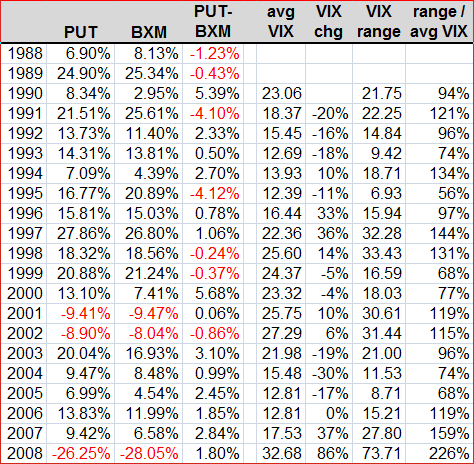
I must confess that the more I dig, the more I am intrigued by this index put-write approach. Since there has been considerable discussion about the differences in return between the PUT and the closely related CBOE BuyWrite (BXM) Index, I will start by showing a table that has a year-by-year comparison of the PUT and the BXM. Just for fun I threw in the average VIX for each year, the change in the average VIX from year to year, the VIX range for the year and a ratio of that range divided by the average VIX. While none of these additional data points provides a smoking gun, each offers up a piece of the overall performance puzzle.

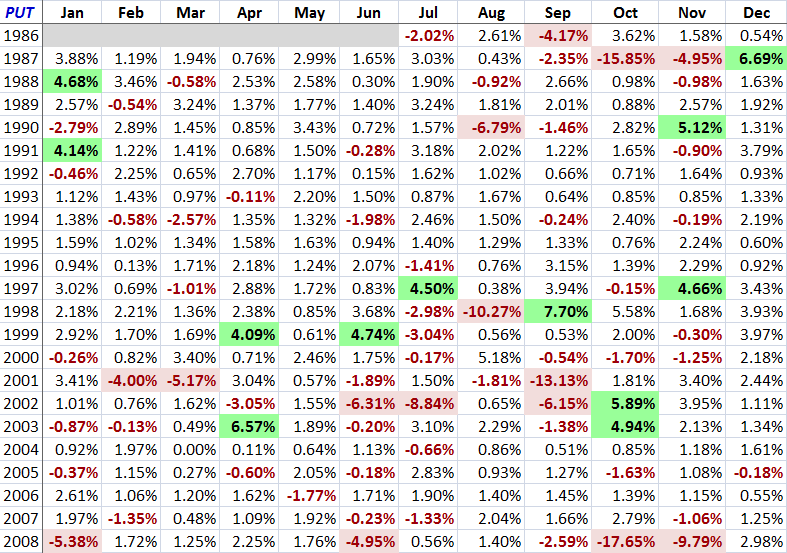
The second graphic is a simple matrix of monthly returns for the PUT since 1986. Not surprisingly, the two worst monthly returns were during the volatility peaks in October 1987 and October 2008. In a related note, several of the most profitable months for the PUT came just after high volatility events.

[Source: CBOE, VIX and More]

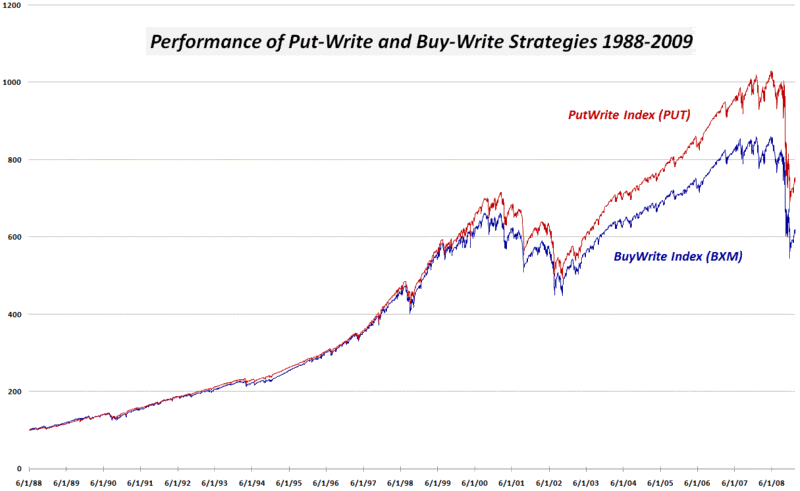
For those looking to dig deeper into this issue, consider that put-write absolute and relative returns are largely a function of implied volatility, the trending characteristics of the SPX and interest rates. Note also that that upper chart only goes back to June 1st, 1988 because that is when Standard & Poor’s began reporting daily dividends for the S&P 500 Total Return Index.

Monday, January 12, 2009

Graphical Comparison of Performance of PutWrite and BuyWrite Indices

I was pleased to see the strong response generated by Friday’s The Often Overlooked Put Writing Strategy, particularly in some of the comments at Seeking Alpha, where the post was republished. A number of questions came up regarding the reasons why two strategies that are synthetically equivalent (i.e. share the same profit and loss graph), would have different performance characteristics. I cited the main reason for the performance delta as the skew that results from a tendency to price puts higher than calls, particularly during times of extreme market stress, when demand for puts often exceeds the demand for calls.

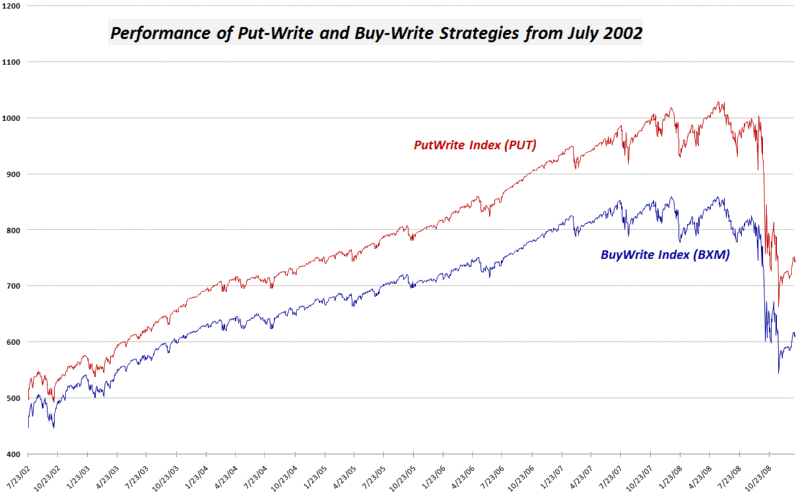
I am not sure that I can prove beyond a reasonable doubt the skew hypothesis in this space, but I did assemble two performance graphs that might help to inform any further discussion. Using the CBOE PutWrite Index (PUT) and the CBOE BuyWrite Index (BXM) as my source data, I have plotted the two indices from their 1988 inception (above) and from 2002 (below), when the indices begin to substantially diverge.

From the two graphs, I find it interesting that the put-write strategy begins to generate separation from the buy-write strategy during the 2002-07 bull market. As volatility increases during 2007, the put-write strategy continues to widen the gap, with the recent bear market having very little impact on the performance differential between the strategies.

Those who have any thoughts on the reasons behind the performance differential during different market cycles, please feel free to chime in.

[source: CBOE, VIX and More]

Friday, January 9, 2009

The Often Overlooked Put Writing Strategy

Shame on me for going a year and a half without mentioning the CBOE S&P 500 PutWrite Index (PUT), a recipient of the Most Innovative Benchmark Index award at last year’s Super Bowl of Indexing Conference.

Given all the market volatility for the past three months or so, I suspect that a put writing strategy is probably not top of mind for most investors at the moment. In fact, a put write strategy like one tracked by the PutWrite Index will generally outperform the S&P 500 index in a down trending market and significantly outperform the S&P 500 index in a sideways market. Much like a covered call strategy, however, a put write approach will not match the gains of the underlying index in a strong bull market rally.

The CBOE describes the PutWrite Index methodology as follows:

“The PUT strategy is designed to sell a sequence of one-month, at-the-money, S&P 500 Index puts and invest cash at one- and three-month Treasury Bill rates. The number of puts sold varies from month to month, but is limited so that the amount held in Treasury Bills can finance the maximum possible loss from final settlement of the SPX puts.”
Additional information about the PutWrite Index is available at the CBOE PutWrite Index splash page.
I mention put write strategies for four reasons:
  1. If we continue in a non-trending market, as I expect we will, this is an excellent investment approach
  2. Ennis Knupp just published a superb analysis of the PutWrite Index: Evaluating the Performance Characteristics of the CBOE PutWrite Index
  3. Put write strategies have historically outperformed the more widely utilized buy write strategies
  4. Properly implemented, a put write strategy is not as risky as most investors expect
At a minimum, readers should check out the Ennis Knupp paper and get a better sense of the essence of put write strategies. Those who expect the markets to do anything other than rally significantly might also want to start implementing that strategy on their own.

Note that while there are currently no ETFs that utilize a put write strategy, it is a volatility strategy that is practiced by hedge funds.

DISCLAIMER: "VIX®" is a trademark of Chicago Board Options Exchange, Incorporated. Chicago Board Options Exchange, Incorporated is not affiliated with this website or this website's owner's or operators. CBOE assumes no responsibility for the accuracy or completeness or any other aspect of any content posted on this website by its operator or any third party. All content on this site is provided for informational and entertainment purposes only and is not intended as advice to buy or sell any securities. Stocks are difficult to trade; options are even harder. When it comes to VIX derivatives, don't fall into the trap of thinking that just because you can ride a horse, you can ride an alligator. Please do your own homework and accept full responsibility for any investment decisions you make. No content on this site can be used for commercial purposes without the prior written permission of the author. Copyright © 2007-2023 Bill Luby. All rights reserved.
 
Web Analytics