Showing posts with label put-write. Show all posts

Sunday, December 27, 2015

Enhancing Performance with Low Volatility ETPs

One theme that I will spend more time on in 2016 and beyond is the low volatility anomaly, which has been discussed in considerable detail in the academic world, leading to papers such as the following:


In a nutshell, the research supports the claim that low volatility and low beta stocks in the United States and across the globe outperform high volatility and high beta stocks, with low volatility stocks generating substantially higher risk-adjusted returns.

Not coincidentally, the groundswell of research pointing to outperformance by low volatility stocks has created a land rush for low volatility ETPs in the first generation of “smart beta” or factor-based investment products in ETP wrappers.  Since I believe smart beta or factor-based ETPs is one of the key revolutionary ideas to appear in the investment world in recent memory, I will have a great deal to say about this subject and the many tangential ideas that arise from it going forward.  After nine years focusing primarily on the VIX, volatility and related subjects, it is time to charge off in some new directions, starting with some that have a whiff of volatility and ETP innovation.

For now I am going to be content with updating a February 2013 post, with the title The Options and Volatility ETPs Landscape.  At that time, I wanted to capture those ETPs which employed a buy-write / covered call approach, employed a put-write strategy, focused on the convertible bond space or targeted low volatility stocks.  Well, a lot has changed in the past three years, notably in the low volatility space.  This time around, I have some enhancements to the options and volatility ETPs graphic.  As is the case with The Current VIX ETP Landscape, I have added yellow stars for those ETPs with an average daily volume of 1,000,000 or higher and pink stars for ETPs with an average daily volume between 100,000 and 1,000,000.  Additionally, I have highlighted the new currency-hedged crop of low volatility ETPs by using a red font and have captured the demise of HFIN, a financials buy-write ETF that closed in March 2015 with a X-HFIN designation. 


[source(s): VIX and More]

There are a number of other sub-categorizations I will delve into at a future data, but note that whereas FTHI is a buy-write only, FTLB adds an out-of-the-money put.  Three other relatively new arrivals, CFO, CDC and CSF, are structured so that they will hold up to 75% of portfolio assets in cash in adverse market conditions.  Another intriguing new entrant, SLOW, attempts to avoid sector bias by forcing greater sector diversification than most other low volatility ETPs.

So if you found 2015 volatility to be daunting and are looking to dampen volatility in your portfolio in 2016 or tap into the performance benefits of the low volatility anomaly, keep the list above in mind.  While comprehensive and including many ETPs with marginal liquidity, this list may not touch upon some of the many new and illiquid products that might be flying under the radar.

Related posts:


Disclosure(s): none

Thursday, May 16, 2013

ETPs Turn to Selling Options to Generate Income

Not long after I penned The Options and Volatility ETPs Landscape, Credit Suisse (CS) added another buy-write / covered call ETP to the mix: the Credit Suisse Silver Shares Covered Call ETN (SLVO).

With SLVO, Credit Suisse is essentially extending the methodology they pioneered with the Credit Suisse Gold Shares Covered Call ETN (GLDI). In the case of both GLDI and SLVO, the ETPs are selling covered calls against the underlying commodity ETF for gold (GLD) and silver (SLV) in an effort to generate some income, and in so doing, choosing to forego some upside potential. In both instances, the ETP starts selling covered calls with 39 days until expiration and completes the sales with 35 days to expiration. One month later, the ETP buys these covered calls back over a period ranging from five to nine days prior to expiration. The net proceeds of these covered call transactions are then paid out as a monthly dividend. This dividend payment is not guaranteed and can fluctuate substantially from month to month. In the first four months following its launch, the monthly dividend for GLDI has been 0.1146, 0.0724, 0.1319 and 0.0572.

As silver is generally much more volatile than gold, SLVO elects to sell calls that are 6% out-of-the-money, while GLDI sells calls that are only 3% OTM. Other than this difference in strike selection or moneyness, the strategies employed by GLDI and SLVO are essentially the same.

Of course, covered call strategies work best when the price of the underlying is flat or when the underlying is appreciating slowly. During the recent sharp drop in GLD and SLV, the covered calls did provide a small amount of downside protection, but with GLD falling 13% over the course of just two trading days last month, the downside protection offered by a covered call was barely more than a rounding error. Covered calls and buy-write strategies generally outperform a long position in the underlying in all instances except when the underlying experiences a strong bull move.  (See graphic below for details.)

Thinking more broadly, the introduction of GLDI and SLVO should reinforce the idea that with ETPs now spanning a wide variety of asset classes and alternative investments, covered call strategies can be implemented in many non-traditional ways. The most popular of the traditional methods is PowerShares S&P 500 BuyWrite (PBP), which sells covered calls against the popular equity index. There is no reason, however, why there cannot be a similar product that sells covered calls against more volatile groups or sectors, such as emerging markets (EEM), small caps (IWM) or semiconductors (SMH), just to name a few. One can even bring alternative assets under the covered call tent. I’m not talking just about the likes of crude oil, copper or corn, but why not have covered calls on real estate, currencies or even volatility ETPs?

Better yet, why stop at covered calls? A strategy that I have discussed here on a number of occasions is selling cash-secured puts. The recent launch of U.S. Equity High Volatility Put Write Index ETF (HVPW) brought the put-write strategy into the ETP marketplace.  It is unfortunate that put-write strategies have not found a wider audience at this point or they too would be ripe for extending beyond the comfortable confines of the S&P 500 index.

Assuming this market eventually stops going up almost every day, investors are going to have to look for other ways to grow their portfolio and the scramble for yield will no doubt intensify. With ETPs now selling options to generate income, investors may want to look at some of the shrink-wrapped products mentioned above or consider how they might wish to implement similar strategies on their own.

[source(s): StockCharts.com]

Related posts:

Disclosure(s): long GLDI and HVPW at time of writing

Thursday, February 28, 2013

The Options and Volatility ETPs Landscape

For several years I have publishing a graphical overview of the VIX ETPs landscape, with all the ETPs plotted on the basis of leverage and target maturity, such as the recent VIX ETP Returns for 2012.

Lately, however, an expanding crop of options and volatility ETPs has been taking root in a space that is closer to the VIX products than any of the other ETPs. I talked about the low volatility ETPs at some length in yesterday’s Beyond SPLV: The Expanding Universe of Low Volatility ETPs.

The graphic below is a plot of these securities, with the their geography, market cap and asset class in the rows and strategy/approach in the columns. I have talked about PBP in this space and was particularly interested to see that the buy-write / covered call approach is now being applied to gold in the form of the recent launch of GLDI.

Part of what prompted today’s approach is the launch of U.S. Equity High Volatility Put Write Index ETF (HVPW), which is the first put-write ETP on the market. I have talked about put-write strategies and the CBOE S&P 500 PutWrite Index (PUT) at some length here in the past and have included some links below for additional reading.

In the convertible bond space, CWB has been the most popular ETP in this space for the last few years. Earlier this week, PowerShares closed its competing Convertible Securities Portfolio ETF (CVRT), essentially ceding this space to CWB for now.

The other portion of the graphic below is my attempt at translating much of yesterday’s text into a format that makes for a more handy reference.

I will keep tabs on all of these ETPs going forward and in particularly look to see how HVPW and GLDI do in terms of both risk-adjusted performance and investor acceptance. I certainly hope it does not take investors as long to discover these products as it did for them to warm up to the likes of ZIV.


Related posts:

Disclosure(s): long PBP at time of writing

Wednesday, May 26, 2010

Expiring Monthly May Issue Recap

Just a quick note to confirm that on Monday marked the publication of the May issue of Expiring Monthly: The Option Traders Journal.

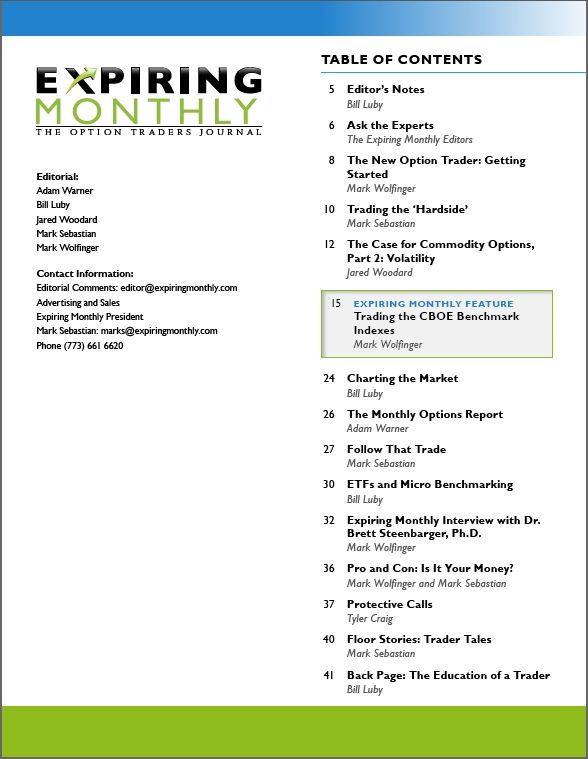
I have attached a copy of the Table of Contents for the May issue below. The cover story for this issue was written by Mark Wolfinger and focuses on the CBOE benchmark indices for buy-write (covered call) put-write and collar strategies. In my opinion, these three options strategies are attractive ways for investors who seek to outperform the broad-based indices in declining, sideways and slightly bullish markets – which is not a bad description of the market activity we have been seeing lately. In the case of collars, one can also have complete protection against market crashes and fund this approach entirely by selling calls.

For the current issue, I contributed a feature article on ETFs and micro benchmarking (the art of finding a very narrow slice of the investment universe as an appropriate gauge of portfolio performance) as well as my recurring column, Charting the Market, which makes heavy use of options data. In addition to the introductory Editor’s Note, I also penned the Back Page commentary, which puts my personal slant on the process of educating a trader.

Additional details about the magazine are available at http://www.expiringmonthly.com/.

Note that next week I will be inviting reader submissions for the Chart of the Week and will award an annual subscription to my favorite submission.

For more on related subjects, readers are encouraged to check out:


[source: Expiring Monthly]

Disclosure(s): I am one of the founders and owners of Expiring Monthly

Thursday, January 15, 2009

Selling Naked Puts in Current Environment

During my recent trilogy on the put-write strategy, my intent was to identify an approach that performs well in a non-trending market. While I still believe we are stuck in a range defined by about 820-980 on the S&P 500 index, a strategy that involves selling puts generally performs at maximum levels toward the bottom of a well-defined trading range. In short, the current situation looks like an excellent time to write some cash-secured puts.

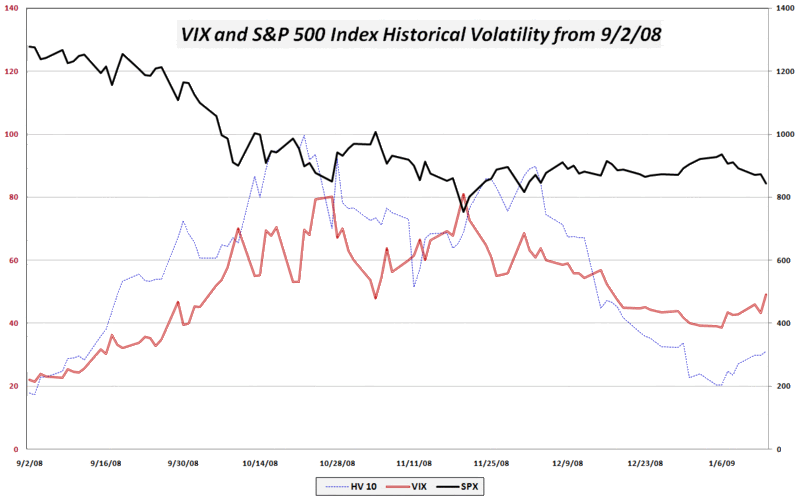
Several factors indicate that the timing for put sales may be ideal right now. With the VIX up over 51 once again as the market opens this morning and most measures of short-term historical volatility (such as the 10 day HV in the chart below) showing that the VIX is well above actual volatility we have experienced during the past few weeks, a likely conclusion is that volatility is overpriced at current levels. Further, with the SPX right at 830 as I type this, we are near the bottom of the trading range in the SPX, with significant support likely to be found in the 820-830 range.

Finally, the news flow has been so negative lately, from financials to retailers to Steve Jobs to global trade, etc. that a larger fear and anxiety component is starting to creep into implied volatility measures like the VIX.

For those looking to limit risk, cash-secured puts on indices or ETFs covering a group of stocks can help to eliminate single stock down side risk. Those who are interested in limiting risk from writing puts may prefer to look at a bull put spread, where the writer sells a put near the money and buys another out of the money put to limit losses.

[source: VIX and More]

Tuesday, January 13, 2009

More on PUT Returns

Given the surprising interest in put-write strategies and the CBOE PutWrite Index (PUT), I have spent some additional time with the PUT data to see what sort of secrets I might be able to uncover.

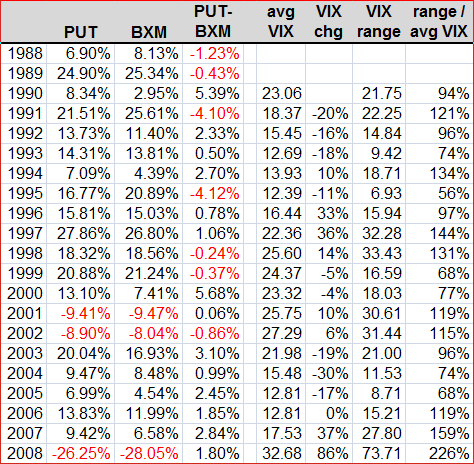
I must confess that the more I dig, the more I am intrigued by this index put-write approach. Since there has been considerable discussion about the differences in return between the PUT and the closely related CBOE BuyWrite (BXM) Index, I will start by showing a table that has a year-by-year comparison of the PUT and the BXM. Just for fun I threw in the average VIX for each year, the change in the average VIX from year to year, the VIX range for the year and a ratio of that range divided by the average VIX. While none of these additional data points provides a smoking gun, each offers up a piece of the overall performance puzzle.

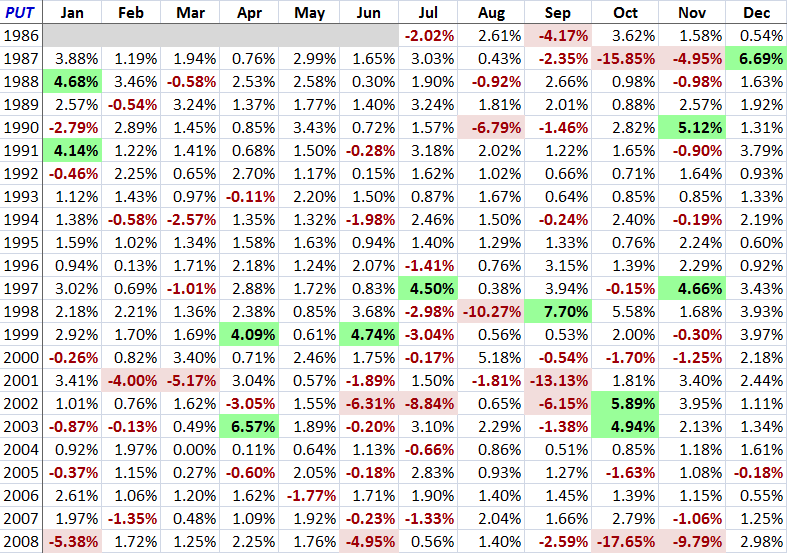
The second graphic is a simple matrix of monthly returns for the PUT since 1986. Not surprisingly, the two worst monthly returns were during the volatility peaks in October 1987 and October 2008. In a related note, several of the most profitable months for the PUT came just after high volatility events.

[Source: CBOE, VIX and More]

For those looking to dig deeper into this issue, consider that put-write absolute and relative returns are largely a function of implied volatility, the trending characteristics of the SPX and interest rates. Note also that that upper chart only goes back to June 1st, 1988 because that is when Standard & Poor’s began reporting daily dividends for the S&P 500 Total Return Index.

Monday, January 12, 2009

Graphical Comparison of Performance of PutWrite and BuyWrite Indices

I was pleased to see the strong response generated by Friday’s The Often Overlooked Put Writing Strategy, particularly in some of the comments at Seeking Alpha, where the post was republished. A number of questions came up regarding the reasons why two strategies that are synthetically equivalent (i.e. share the same profit and loss graph), would have different performance characteristics. I cited the main reason for the performance delta as the skew that results from a tendency to price puts higher than calls, particularly during times of extreme market stress, when demand for puts often exceeds the demand for calls.

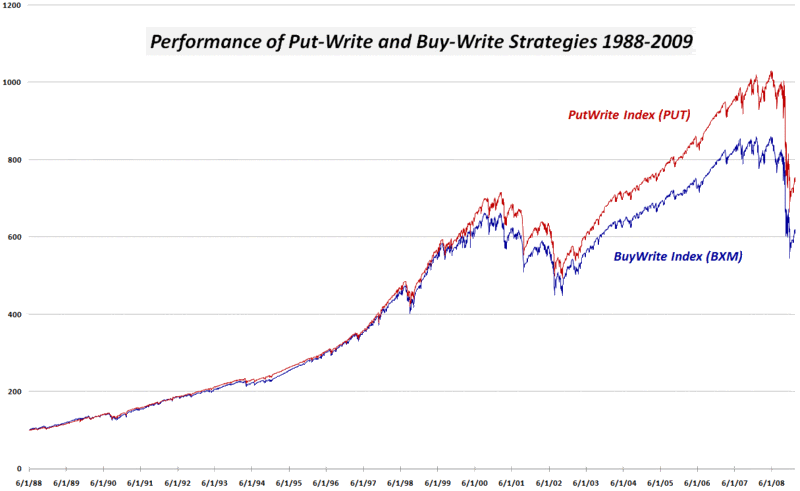
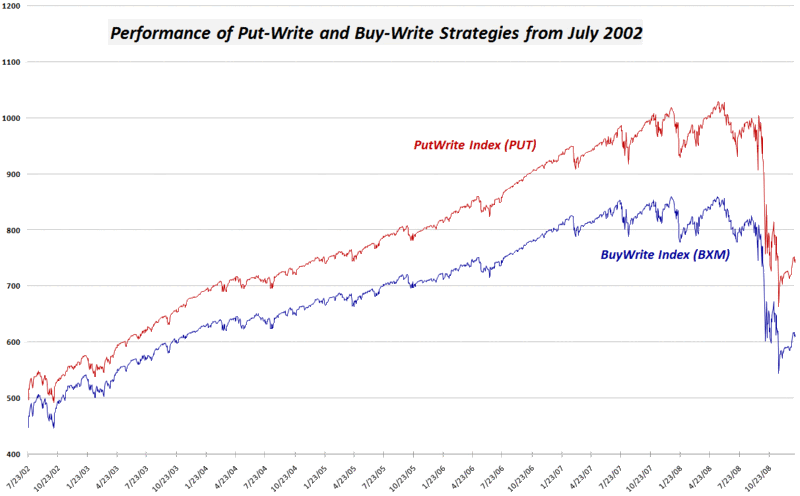
I am not sure that I can prove beyond a reasonable doubt the skew hypothesis in this space, but I did assemble two performance graphs that might help to inform any further discussion. Using the CBOE PutWrite Index (PUT) and the CBOE BuyWrite Index (BXM) as my source data, I have plotted the two indices from their 1988 inception (above) and from 2002 (below), when the indices begin to substantially diverge.

From the two graphs, I find it interesting that the put-write strategy begins to generate separation from the buy-write strategy during the 2002-07 bull market. As volatility increases during 2007, the put-write strategy continues to widen the gap, with the recent bear market having very little impact on the performance differential between the strategies.

Those who have any thoughts on the reasons behind the performance differential during different market cycles, please feel free to chime in.

[source: CBOE, VIX and More]

Friday, January 9, 2009

The Often Overlooked Put Writing Strategy

Shame on me for going a year and a half without mentioning the CBOE S&P 500 PutWrite Index (PUT), a recipient of the Most Innovative Benchmark Index award at last year’s Super Bowl of Indexing Conference.

Given all the market volatility for the past three months or so, I suspect that a put writing strategy is probably not top of mind for most investors at the moment. In fact, a put write strategy like one tracked by the PutWrite Index will generally outperform the S&P 500 index in a down trending market and significantly outperform the S&P 500 index in a sideways market. Much like a covered call strategy, however, a put write approach will not match the gains of the underlying index in a strong bull market rally.

The CBOE describes the PutWrite Index methodology as follows:

“The PUT strategy is designed to sell a sequence of one-month, at-the-money, S&P 500 Index puts and invest cash at one- and three-month Treasury Bill rates. The number of puts sold varies from month to month, but is limited so that the amount held in Treasury Bills can finance the maximum possible loss from final settlement of the SPX puts.”
Additional information about the PutWrite Index is available at the CBOE PutWrite Index splash page.
I mention put write strategies for four reasons:
  1. If we continue in a non-trending market, as I expect we will, this is an excellent investment approach
  2. Ennis Knupp just published a superb analysis of the PutWrite Index: Evaluating the Performance Characteristics of the CBOE PutWrite Index
  3. Put write strategies have historically outperformed the more widely utilized buy write strategies
  4. Properly implemented, a put write strategy is not as risky as most investors expect
At a minimum, readers should check out the Ennis Knupp paper and get a better sense of the essence of put write strategies. Those who expect the markets to do anything other than rally significantly might also want to start implementing that strategy on their own.

Note that while there are currently no ETFs that utilize a put write strategy, it is a volatility strategy that is practiced by hedge funds.

DISCLAIMER: "VIX®" is a trademark of Chicago Board Options Exchange, Incorporated. Chicago Board Options Exchange, Incorporated is not affiliated with this website or this website's owner's or operators. CBOE assumes no responsibility for the accuracy or completeness or any other aspect of any content posted on this website by its operator or any third party. All content on this site is provided for informational and entertainment purposes only and is not intended as advice to buy or sell any securities. Stocks are difficult to trade; options are even harder. When it comes to VIX derivatives, don't fall into the trap of thinking that just because you can ride a horse, you can ride an alligator. Please do your own homework and accept full responsibility for any investment decisions you make. No content on this site can be used for commercial purposes without the prior written permission of the author. Copyright © 2007-2023 Bill Luby. All rights reserved.
 
Web Analytics