Enhancing Performance with Low Volatility ETPs
One theme that I
will spend more time on in 2016 and beyond is the low
volatility anomaly, which has been discussed in considerable detail in the
academic world, leading to papers such as the following:
- Benchmarks as Limits to Arbitrage: Understanding the Low Volatility Anomaly (Malcolm Baker, Brendan Bradley and Jeffrey Wurgler)
- Stock return volatility, operating performance and stock returns: International evidence on drivers of the ‘low volatility’ anomaly (Tanuj Dutt and Mark Humphery-Jenner)
- The Limits to Arbitrage and the Low-Volatility Anomaly (Xi Li, Rodney N. Sullivan and Luis Garcia-Feijóo)
- Low Risk Stocks Outperform within All Observable Markets of the World (Nardin L. Baker and Robert A. Haugen)
In a nutshell,
the research supports the claim that low
volatility and low beta stocks in the United States and across the globe
outperform high volatility and high beta stocks, with low volatility stocks generating
substantially higher risk-adjusted returns.
Not
coincidentally, the groundswell of research pointing to outperformance by low
volatility stocks has created a land rush for low volatility ETPs in the first
generation of “smart
beta” or factor-based
investment products in ETP wrappers.
Since I believe smart beta or factor-based ETPs is one of the key revolutionary
ideas to appear in the investment world in recent memory, I will have a great
deal to say about this subject and the many tangential ideas that arise from it
going forward. After nine years focusing
primarily on the VIX, volatility and related subjects, it is time to charge off
in some new directions, starting with some that have a whiff of volatility and
ETP innovation.
For now I am
going to be content with updating a February 2013 post, with the title The
Options and Volatility ETPs Landscape.
At that time, I wanted to capture those ETPs which employed a buy-write / covered call
approach, employed a put-write strategy,
focused on the convertible
bond space or targeted low volatility stocks. Well, a lot has changed in the past three
years, notably in the low volatility space.
This time around, I have some enhancements to the options and volatility
ETPs graphic. As is the case with The
Current VIX ETP Landscape, I have added yellow stars for those ETPs with an
average daily volume of 1,000,000 or higher and pink stars for ETPs with an
average daily volume between 100,000 and 1,000,000. Additionally, I have highlighted the new
currency-hedged crop of low volatility ETPs by using a red font and have captured
the demise of HFIN, a financials buy-write ETF that closed in March 2015 with a
X-HFIN designation.

[source(s): VIX and More]
There are a
number of other sub-categorizations I will delve into at a future data, but
note that whereas FTHI
is a buy-write only, FTLB
adds an out-of-the-money put. Three
other relatively new arrivals, CFO, CDC and CSF, are structured
so that they will hold up to 75% of portfolio assets in cash in adverse market
conditions. Another intriguing new
entrant, SLOW,
attempts to avoid sector bias by forcing greater sector diversification than
most other low volatility ETPs.
So if you found
2015 volatility to be daunting and are looking to dampen volatility in your
portfolio in 2016 or tap into the performance benefits of the low volatility
anomaly, keep the list above in mind.
While comprehensive and including many ETPs with marginal liquidity, this
list may not touch upon some of the many new and illiquid products that might
be flying under the radar.
Related posts:
- The Low Volatility Story in Pictures
- The Expanding Universe of Low Volatility ETPs
- High and Low Volatility ETPs
- Comparing SPLV and VQT
- Expanded Performance of Volatility-Hedged and Related ETPs
- Performance of Volatility-Hedged ETPs
- Performance of VIX ETP Hedges in Current Selloff
- Three New Risk Control ETFs from Direxion
- The Case for VQT
- Direxion and S&P Bring Dynamic Volatility Hedging to ETFs with VEQTOR
- The Options and Volatility ETPs Landscape
- Investing with a Target Volatility Approach
- The Current VIX ETP Landscape
Disclosure(s): none


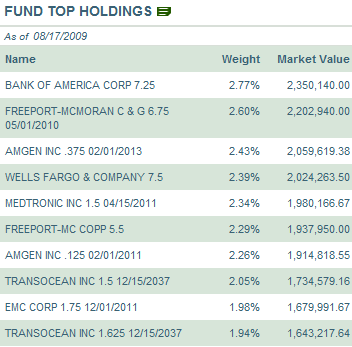 The table to the right shows the ETFs top holdings as of yesterday’s close, which include a top three of Bank of America (