Showing posts with label PBP. Show all posts

Tuesday, April 15, 2014

The Correction As Seen in the ETP Landscape

Since stocks bottomed in March 2009, I have periodically been publishing an SPX pullback table and occasionally a plot of all those pullbacks and their duration. The recent selloff in stocks, however, has been anything but an SPX pullback. I toyed with the idea of presenting comparable data for the NASDAQ Composite or NASDAQ-100 Index (NDX), but here again, the selling has been disproportionate in some areas of the NASDAQ universe, even though it has been hit harder than the SPX.

This time around I have opted instead for a chart that shows the peak-to-trough drawdown across the equity ETP universe, focusing on sector groups that I believe are among the most important to watch.

ETP Landscape 2014 DDs 041514

[source(s): Yahoo, VIX and More]

The data above cover only 2014 and indicate the maximum drawdown since the 2014 peak. While many of these maximum drawdowns are from earlier today, there are quite a few instances in which the maximum drawdown was established earlier in the year.

Note that while the NASDAQ gets most of the attention, it is the small caps (IWM) that have suffered the most among the major market index ETPs.

Not surprisingly, biotechnology (IBB), social media (SOCL) and Russia (RSX) have seen the largest declines, but among cyclicals, defensive stocks and European country ETPs, there is very little to choose from.

Finally, just for fun I have added four alternative ETPs with an equity flavor (SPLV, PBP, CWB and PFF) to show how low volatility, covered call, convertible bond and preferred stock ETPs have fared.

Related posts:

Disclosure(s): none

Thursday, May 16, 2013

ETPs Turn to Selling Options to Generate Income

Not long after I penned The Options and Volatility ETPs Landscape, Credit Suisse (CS) added another buy-write / covered call ETP to the mix: the Credit Suisse Silver Shares Covered Call ETN (SLVO).

With SLVO, Credit Suisse is essentially extending the methodology they pioneered with the Credit Suisse Gold Shares Covered Call ETN (GLDI). In the case of both GLDI and SLVO, the ETPs are selling covered calls against the underlying commodity ETF for gold (GLD) and silver (SLV) in an effort to generate some income, and in so doing, choosing to forego some upside potential. In both instances, the ETP starts selling covered calls with 39 days until expiration and completes the sales with 35 days to expiration. One month later, the ETP buys these covered calls back over a period ranging from five to nine days prior to expiration. The net proceeds of these covered call transactions are then paid out as a monthly dividend. This dividend payment is not guaranteed and can fluctuate substantially from month to month. In the first four months following its launch, the monthly dividend for GLDI has been 0.1146, 0.0724, 0.1319 and 0.0572.

As silver is generally much more volatile than gold, SLVO elects to sell calls that are 6% out-of-the-money, while GLDI sells calls that are only 3% OTM. Other than this difference in strike selection or moneyness, the strategies employed by GLDI and SLVO are essentially the same.

Of course, covered call strategies work best when the price of the underlying is flat or when the underlying is appreciating slowly. During the recent sharp drop in GLD and SLV, the covered calls did provide a small amount of downside protection, but with GLD falling 13% over the course of just two trading days last month, the downside protection offered by a covered call was barely more than a rounding error. Covered calls and buy-write strategies generally outperform a long position in the underlying in all instances except when the underlying experiences a strong bull move.  (See graphic below for details.)

Thinking more broadly, the introduction of GLDI and SLVO should reinforce the idea that with ETPs now spanning a wide variety of asset classes and alternative investments, covered call strategies can be implemented in many non-traditional ways. The most popular of the traditional methods is PowerShares S&P 500 BuyWrite (PBP), which sells covered calls against the popular equity index. There is no reason, however, why there cannot be a similar product that sells covered calls against more volatile groups or sectors, such as emerging markets (EEM), small caps (IWM) or semiconductors (SMH), just to name a few. One can even bring alternative assets under the covered call tent. I’m not talking just about the likes of crude oil, copper or corn, but why not have covered calls on real estate, currencies or even volatility ETPs?

Better yet, why stop at covered calls? A strategy that I have discussed here on a number of occasions is selling cash-secured puts. The recent launch of U.S. Equity High Volatility Put Write Index ETF (HVPW) brought the put-write strategy into the ETP marketplace.  It is unfortunate that put-write strategies have not found a wider audience at this point or they too would be ripe for extending beyond the comfortable confines of the S&P 500 index.

Assuming this market eventually stops going up almost every day, investors are going to have to look for other ways to grow their portfolio and the scramble for yield will no doubt intensify. With ETPs now selling options to generate income, investors may want to look at some of the shrink-wrapped products mentioned above or consider how they might wish to implement similar strategies on their own.

[source(s): StockCharts.com]

Related posts:

Disclosure(s): long GLDI and HVPW at time of writing

Thursday, February 28, 2013

The Options and Volatility ETPs Landscape

For several years I have publishing a graphical overview of the VIX ETPs landscape, with all the ETPs plotted on the basis of leverage and target maturity, such as the recent VIX ETP Returns for 2012.

Lately, however, an expanding crop of options and volatility ETPs has been taking root in a space that is closer to the VIX products than any of the other ETPs. I talked about the low volatility ETPs at some length in yesterday’s Beyond SPLV: The Expanding Universe of Low Volatility ETPs.

The graphic below is a plot of these securities, with the their geography, market cap and asset class in the rows and strategy/approach in the columns. I have talked about PBP in this space and was particularly interested to see that the buy-write / covered call approach is now being applied to gold in the form of the recent launch of GLDI.

Part of what prompted today’s approach is the launch of U.S. Equity High Volatility Put Write Index ETF (HVPW), which is the first put-write ETP on the market. I have talked about put-write strategies and the CBOE S&P 500 PutWrite Index (PUT) at some length here in the past and have included some links below for additional reading.

In the convertible bond space, CWB has been the most popular ETP in this space for the last few years. Earlier this week, PowerShares closed its competing Convertible Securities Portfolio ETF (CVRT), essentially ceding this space to CWB for now.

The other portion of the graphic below is my attempt at translating much of yesterday’s text into a format that makes for a more handy reference.

I will keep tabs on all of these ETPs going forward and in particularly look to see how HVPW and GLDI do in terms of both risk-adjusted performance and investor acceptance. I certainly hope it does not take investors as long to discover these products as it did for them to warm up to the likes of ZIV.


Related posts:

Disclosure(s): long PBP at time of writing

Tuesday, January 3, 2012

Covered Calls Finish Strong in 2011

Just looking back at The Year in VIX and Volatility (2011) is enough to make one’s stomach churn. Try to tell someone who has acrophobia that even the scariest roller coaster ride ends up right where it started and you will likely not assuage any fears. Something similar is at work for hikers, bikers or mountain climbers. The amount of effort they will need to call upon has nothing to do with ending up at the same elevation they started, but rather it is the cumulative elevation gain over the course of the trail, road or mountain. As with many things in life, it is all about the journey, not the destination.

For those who may have a touch of acrophobia, prefer their hikes to put less stress on their cardiovascular system and want a portfolio that matches the way they wish to experience the world, covered calls or buy-write strategies might be the answer. I have addressed the subject of covered calls and buy-writes a number of times in the past in this space (see links below), but essentially this is a strategy which sells calls against an existing (covered call) or new (buy-write) long position in order to generate income off of the underlying. Covered calls and buy-writes will generally beat the SPX/SPY if stocks decline, move sideways or rise slowly. The cost to implementing one of these strategies is that if the markets make a sharp bullish move, gains are capped by the covered calls.

In the ETP world, there are two choices when it comes to buy-write strategies:

  • PowerShares S&P 500 BuyWrite Portfolio ETF (PBP)
  • iPath CBOE S&P 500 BuyWrite Index ETN (BWV)

PBP is by far the more liquid of the two alternatives, but some investors may have a reason to prefer BWV’s approach and performance.

In the chart below, I have captured the equity curve of PBP vs. SPY over the course of the second half of 2011 – a period in which stocks generally moved sideways and volatility remained high. In other words, a period that was tailor-made for buy-write strategies. Note that PBP outperformed SPY by 7.7% during this six-month period, with considerably less volatility and also a less peak-to-trough drawdown…or what alpinists would probably call cumulative elevation loss.

Should high volatility persist in 2012 and stocks end up near where they started the year, both PBP and BWV are likely to outperform the major market indices once again.

Related posts:


[source(s): ETFreplay.com]


Disclosure(s): long PBP at time of writing; TradeKing is an advertiser on VIX and More

Monday, September 8, 2008

The Value of Selling Covered Calls

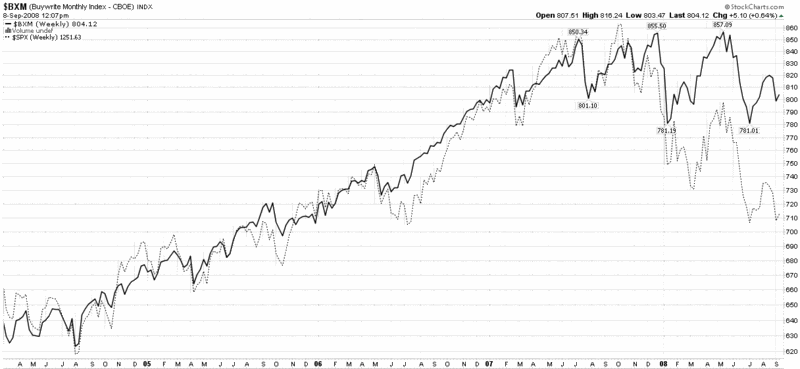
One subject that gets less attention than it deserves is the value investors can extract from selling covered calls. To be fair, a covered call strategy sacrifices what can sometimes be considerable upside in exchange for a fixed return, but this can be a highly effective strategy in a range-bound market.

The chart below is a weekly chart that shows the CBOE S&P 500 Buy-Write Index (BXM), which is designed to replicate a buy-write or covered call strategy for the S&P 500 Index. Note that during the recent bull market, a buy-write strategy resulted in roughly the same returns as owing the SPX, but with less volatility.


[source: StockCharts]

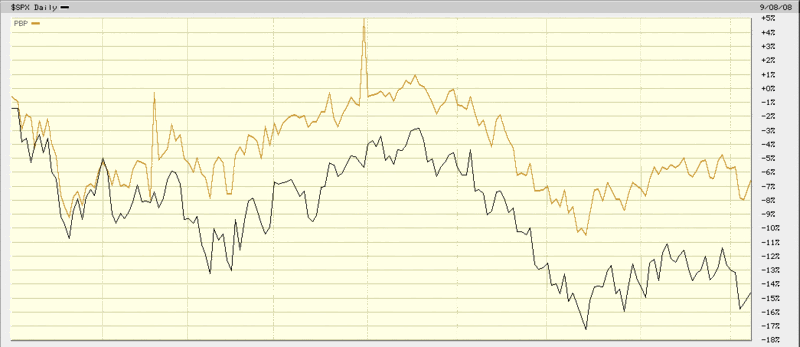
More importantly, over the course of the last year, a buy-write strategy has significantly outperformed the SPX. The details can be seen in the next chart, where a relatively new ETF, the PowerShares S&P 500 BuyWrite Portfolio (PBP) has lost value at less than half of the rate of the losses in the SPX.

In sideways markets, in down markets, and even in up markets, a buy-write or covered call approach like that of the PBP (or first cousins BEP and MCN) can be an excellent way to increase returns and reduce risk.


[source: BigCharts]

Monday, December 24, 2007

VIX Shrinkage Continues; VWSI at +6

During the week, I chronicled The Incredible Shrinking VIX, which addressed the issue of volatility falling in a market that was going mostly sideways to down. By the end of the week, the VIX was down 4.80 points or 20.6% from the previous week, to 18.47 – a level not seen since the beginning of November.

The interesting part of the week is that the SPX had a modest gain of 16.51 (1.1%), so that very little of the move in the VIX (perhaps 1.25 of those 4.80 points) can be attributed to a rise in the SPX. The rest? Some of it certainly comes from a seasonal pattern of historically low volatility around the holidays (see the CXO Advisory Group on U.S. Stock Returns Around the Year-End Holidays), but a considerable account is still unaccounted for. It looks like it may take the unfolding of events in 2008 to explain the shrinking VIX anomaly.

On the VWSI front, the shrinking VIX contributed to a new elevated VWSI reading of +6, suggesting that the VIX should be close to bottoming. Ironically, the VIX is up this morning, and so are the markets…

As is my weekly custom, for a survey of the best in current thinking about the markets, Barry Ritholtz at The Big Picture sums up the week that was and the week that will be in his Christmas Linkfest.

Finally, good news for those who are content to sit on the sidelines and wait for a more compelling market signal before committing to a specific direction, PowerShares is launching three new Buy-Write ETFs:

  • PowerShares DJIA BuyWrite Portfolio (PGB)
  • PowerShares S&P 500 BuyWrite Portfolio (PBP)
  • PowerShares NASDAQ-100 BuyWrite Portfolio (PWBW)
These join old standbys MCN, BEP and BWV in the buy-write stable.

(Note that in the above temperature gauge, the "bullish" and "bearish" labels apply to the VIX, not to the broader markets, which are usually negatively correlated with the VIX.)

Wine pairing: For a VWSI of +6 I favor a semillon. This often overlooked varietal tag teams with sauvignon blanc to form the white wines of Bordeaux, otherwise known as Graves. The thin skinned semillon grape is particularly susceptible to the Botrytis fungus, which means that semillon is also the primary grape used in the classic dessert wine known as Sauternes.

In the New World, semillon has gained a strong foothold in Australia, where it is frequently blended with chardonnay and sauvignon blanc, but also sold on its own. Last I checked, Peter Lehmann Wines produces four different semillons, with the Barossa Valley one of the most widely distributed in the US. Skipping a little to the east, just this evening I had an excellent 2002 Alpha Domus semillon from New Zealand, but the Kiwis have yet to show the same enthusiasm for semillon that they have for sauvignon blanc. Still, the Alpha Domus effort proves that the potential is there.

It is harder to pick a particular US producer that has built a reputation for semillon, but one to keep an eye on is L'Ecole Nº 41, from the Walla Walla, Washington area. This is, by a considerable margin, my favorite non-French semillion tasted in the past 25 years, a mineraly stunner that may have you rethinking how often you should be drinking this varietal.

For more information on semillon, StarChefs.com has a good discussion of the varietal, along with a handful of recommended producers in Australia and South Africa.

DISCLAIMER: "VIX®" is a trademark of Chicago Board Options Exchange, Incorporated. Chicago Board Options Exchange, Incorporated is not affiliated with this website or this website's owner's or operators. CBOE assumes no responsibility for the accuracy or completeness or any other aspect of any content posted on this website by its operator or any third party. All content on this site is provided for informational and entertainment purposes only and is not intended as advice to buy or sell any securities. Stocks are difficult to trade; options are even harder. When it comes to VIX derivatives, don't fall into the trap of thinking that just because you can ride a horse, you can ride an alligator. Please do your own homework and accept full responsibility for any investment decisions you make. No content on this site can be used for commercial purposes without the prior written permission of the author. Copyright © 2007-2023 Bill Luby. All rights reserved.
 
Web Analytics