Showing posts with label VWSI. Show all posts

Sunday, May 11, 2008

Subscriber Newsletter Update

I have received a number of questions about the subscriber newsletter and I thought this might be a good time to address them.

First, thanks to all who have subscribed. I have been extremely pleased by the response to date. I appreciate all the support and am particularly encouraged by the fact that so far the renewal rate has been 100%.

In terms of content, the Sunday format has already been standardized. The typical Sunday issue is six pages long and has the following sections:

  • The Week in Review – my thoughts on what constituted the important macroeconomic, fundamental, and technical news for the past week
  • The Week Ahead: What to Look For – includes suggestions on earnings to watch, important government data releases, critical technical support/resistance levels, etc.
  • Market Sentiment Update – a discussion of the readings and related implications from two of my proprietary sentiment indicators, the Options Sentiment Indicator (OSI) and the Aggregate Market Sentiment Indicator (AMSI). In some respects these two indicators are descendants of the VIX Weekly Sentiment Indicator (VWSI)
  • Asset Class Outlook – where I update my outlook over the short-term (1-3 weeks), intermediate-term (1-3 months), and long-term (6-12 months) time frames for ten important asset classes that cover US equities, foreign equities, bonds, currencies, and commodities
  • Current Investment Thesis – my take on what is driving the markets, in which direction, and why
  • VIX and More Focus Model Portfolios – three different model portfolios (Aggressive Trader, Growth, and Foreign Growth) consisting of 5-7 stocks each that have returns of +18.0%, -2.7%, and +2.1% since the March 30, 2008 inception
  • Stock of the Week – a single weekly stock selection that has a cumulative return of +48.5% since the initial March 30th selection

The Wednesday issue is much more like the blog, but with a more detailed analysis and a place where I offer more in terms of conclusions and takeaways. It generally runs 4-6 pages and has three standard sections:

  • Market Commentary – updates my thinking as laid out on Sunday
  • Market Sentiment Update – similar to the Sunday section, but may drill down more on specific issues, such as volatility, put to call data, market breadth, volume, etc.
  • Volatility-Based Sector Rotation Model – one of my current research interests is using volatility to time trades on a variety of ETFs, including sectors, geographies, commodities, and currencies. This is not a model portfolio, per se, but I have been providing commentary on what the model is suggesting in terms of sector rotation strategies, what geographies to be long or short in, as well as plays in commodities and currencies

In addition to the three standard sections, Wednesday usually includes several feature sections where the subject matter varies from week to week. Some of the features from the past three issues include:

  • The VIX:VXV Ratio Continues to Perform Well
  • NYSE Total Volume Suggests Rally May Have Run Out of Steam
  • ‘Stock of the Week’ Averages Up 5% in One Day
  • CBOE Equity Put to Call Ratio Remains Bullish (a shorter, updated version of this post went up on the blog a week later)
  • A Long-Term Look at the VIX and the VXN
  • Yield Curve Déjà Vu and Other Musings (a much shorter version of this post went up on the blog later)
  • Is the Fed Done Cutting Rates?
  • Market Breadth and Sustaining a Rally
  • Highs and Lows in the S&P 500 Index

If anyone has any additional questions or comments about the subscriber newsletter, please feel free to email me at bill.luby@gmail.com or check out the subscriber newsletter blog.

Monday, April 14, 2008

VIX Back Above 10 Day SMA; VWSI at Zero

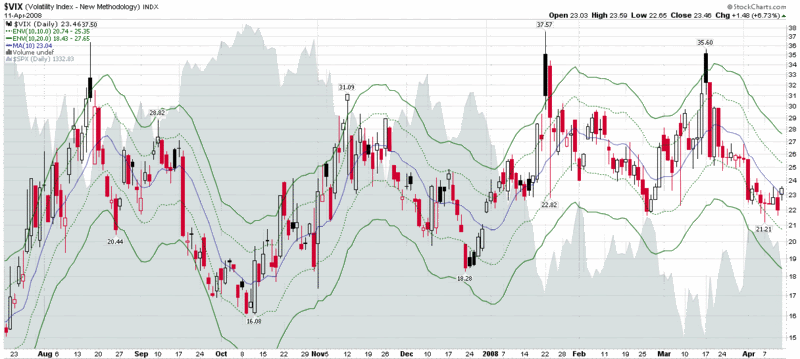
Last week's bearish action in the equity markets moved the VIX back over its 10 day simple moving average for the first time in three weeks. As the markets enter a pivotal earnings week, it will be interesting to watch the VIX to see how damaging any earnings surprises turn out to be -- or how much bad news has already been discounted.

The VIX Weekly Sentiment Index (VWSI) is back at zero, down from +3 the previous week, meaning that the volatility forecast for the next 1-2 weeks is neutral, with a roughly equal probability of a spike in volatility or a continuation of the move down.

Sunday, April 6, 2008

VWSI at +3 as VIX Keeps Falling

The VIX fell 3.26 (12.7%) to end the week at 22.45, the lowest end of the week close for 2008 so far. Last week's move brings the drop in the VIX to 8.71 points or 28% over the past three weeks and brings the index to a level about 8.9% the 10 day SMA and 15.3% below the 20 day SMA.

While these may sound like fairly extreme readings, the VWSI has only ticked up from +1 to +3 in the past week (but up from -4 three weeks ago), suggesting a most likely scenario of only a mild increase in volatility over the next week or two.

With all the recent attention being given to the VIX and the 200 day SMA (currently at 22.90), I thought I should weigh in by expanding upon some comments I have made previously. Specifically, it is my opinion that technical analysis does not work well with a derivative in which one cannot trade the underlying. Part of my thinking is that there is no such thing as support for the VIX at the 200d SMA (or any moving average) because one cannot trade the VIX directly when it hits a support (or resistance) point. In a more general sense, many TA techniques are on shaky ground with derivatives in which the underlying is not traded, so I am skeptical about the value of technical analysis of the VIX.

That being said, if enough people use the VIX as a market timing tool, some of the market's response to important TA VIX signals can filter down to the VIX itself and have somewhat of a reinforcing effect. I suspect that the effect, if any, is quite small.

Those who want to eyeball the significance of the 200d SMA are encouraged to look at a chart of the VIX with the 200d SMA going back 5 years or more. The only time that the 200d SMA appears to have served as even minor support or resistance was in July 2006 -- and that looks more like a small coincidence on the long-term chart than solid technical support. For the most part, the 200d SMA has been irrelevant throughout the history of the VIX -- and there is no reason to think that fact should change in the present environment.

Sunday, March 30, 2008

VWSI at +1, But Who Is Left to Panic?

With the launch of the subscriber newsletter, I am in the process of making decisions about what content is directed toward the blog and what content is reserved for the newsletter. I suspect that blog readers should see very little in the way of changes, though I have dropped the weekly update to the Portfolio A1, which did not seem to be generating a great deal of interest.

I also used to do a weekly VIX and VWSI update, with a few snippets about market activity thrown in. These will remain, albeit not necessarily with the same level of commentary about put to call ratios and other market sentiment indicators.

Speaking of which, the VIX lost 0.91 (3.4%) last week to close at 25.71. During the course of the week, the VIX oscillated in a tight range between 24.75 and 27.04. This is the narrowest weekly range for the VIX since the year began (actually the smallest range in percentage terms since the week before the 2/27/07 VIX spike), and the VWSI responded to the slow week in volatility by ticking up from zero to +1.

I have had several readers comment about the possibility of an impending VIX spike, but these are notoriously difficult to predict. Further, with the constant drumbeat of gloom and doom, I find it difficult to believe that there are many out there who might consider buying puts, but have not already done so. If there is to be another VIX spike, there must be a sufficient element of surprise to cause a panic, yet each new negative headline or financial implosion scenario probably does more to reduce the pool of future put buyers than anything else. For that reason, I see a VWSI of +1 to be entirely plausible, even when the VIX has been drifting down in the face of continued uncertainty.

Monday, March 3, 2008

Put to Calls and TRIN More Skittish than VIX, VWSI

A quick programming note: henceforth, I am going to be a little more freeform with my end of week commentary, making it less VIX and VWSI-centric. Lately the VIX has been at best a sub-plot in the market turmoil and the VWSI has not generated any extreme readings, so I will be expanding my weekly scope to include some of my other favorite indicators: put to call ratios, market breadth data, TRIN numbers, etc. going forward – or whatever else looks to be most newsworthy.



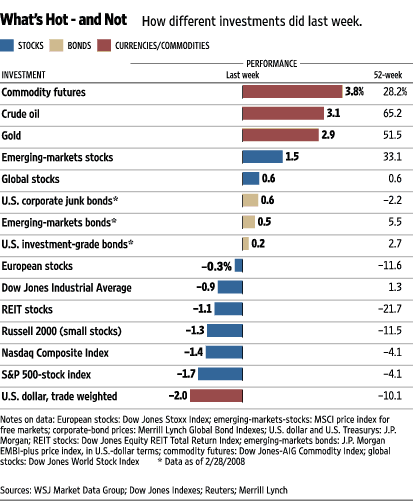
The Wall Street Journal “What’s Hot and Not” graphic shows where the action was last week – and this story is starting to look familiar. Oil, gold and other commodities were the biggest gainers last week, with a weak dollar and a weak US stock market accounting for the biggest losers.

The VIX ended the week up 2.48 (+10.3%) to 26.54, with the VWSI slipping back to zero. More interesting was the action in the put to call data, where the ISEE set all-time records lows for the 20, 50 and 100 day moving averages each day from Tuesday through Friday and the CPCE (CBOE Equity Put to Call Ratio) hit a new high of 1.50. In the wake of Friday’s precipitous drop, the TRIN and NASDAQ TRIN also ended the week with extreme readings of 2.46 and 2.76, respectively.

All this continues to mean one of two things: either the market is extremely oversold and anxious investors are going to create a massive wall of worry for a nice rebound…or we are in the midst of a financial meltdown not seen in the lifetime of most investors. I continue to reside in the former camp, but am watching SPX 1310 and NDX 1725 for signs of additional cracks in the dike.

Monday, February 25, 2008

Amidst Symmetrical Triangles, VIX and VWSI Slide

With market indices in a symmetrical triangle consolidation pattern, trading ranges have been shrinking as of late. The VIX has reflected this lack of action by dropping to its lowest levels relative to its 20, 50 and 100 day simple moving averages since the beginning of the year. After touching 26.95 on Wednesday, the VIX fell back to end the four day week at 24.06, down 0.96 (3.8%) from the previous week.

A symmetrical triangle pattern is often resolved by a dramatic move one way or the other. In the current market environment, the direction of that move is anyone’s guess, but for now, I am positioned for a move to the upside.

The VWSI is a little more cautious and is showing a +1 reading at the moment, down from a +3 last week and, essentially neutral about market volatility in the near-term, suggesting that a sideways to slightly more volatile market is the most likely course of events for the coming week.

As is my weekly custom, for a survey of the best in current thinking about the markets, Barry Ritholtz at The Big Picture sums up the week that was and the week that is on tap in his Oscar Night Linkfest.

I am toying with introducing a multi-faceted sentiment indicator in this weekly VWSI space, but for now I am sticking with the VWSI:

(Note that in the above temperature gauge, the "bullish" and "bearish" labels apply to the VIX, not to the broader markets, which are usually negatively correlated with the VIX.)

Wine pairing: For a VWSI of +1, I recommend a guwurztraminer. My favorite American version of this wine is the dry gewurztraminer from Londer Vineyards of Anderson Valley. I have not yet sampled the 2006 vintage, but the 2005 was an unforgettable wine that I would love to see in a blind tasting against some of the top Alsatian competition.

In my previous roundup of California gewurztraminer, I suggested Navarro and Harvest Moon. For some of my top selections from Alsace, check out Trimbach; Hugel; and Domaine Weinbach. You can also check out the top-rated gewurztraminers in the 2007 San Francisco Chronicle Wine Competition.

Tuesday, February 19, 2008

More Sideways VIX and VWSI Action While ISEE Plummets

From a volatility perspective, 2008 continues to unfold in a curious manner. The markets are decidedly bearish – and even when they briefly recover or drift sideways, the doom and gloom headlines continue to cast a long shadow over investors’ expectations about the markets going forward. The VIX, on the other hand, hardly seems to care, registering an increase of 1.08 over the last seven weeks. The same is true for the VWSI, which has treaded water in the +3 to -3 range during this period.

Last week was more of the same. The VIX dropped 2.99 (10.7%) to 25.02. The VWSI moved more significantly, from 0 to +3, but the +3 reading from the end of the week is still consistent with a neutral outlook.

As is my weekly custom, for a survey of the best in current thinking about the markets, Barry Ritholtz at The Big Picture sums up the week that was and the week that is on tap in his 3-Day-Weekend Linkfest!

In the realm of interesting market sentiment data, I continue to be most interested in the ISEE, which ended the week with several record low readings. This is normally a bullish contrarian indicator, but as I have noted here on several occasions, the divergence with the volatility indices is a bearish signal.

(Note that in the above temperature gauge, the "bullish" and "bearish" labels apply to the VIX, not to the broader markets, which are usually negatively correlated with the VIX.)

Wine pairing: For previous VWSI readings of +3, I highlighted sauvignon blancs from Cloudy Bay and the Marlborough region of New Zealand, as well as some excellent California producers whose sauvignon blanc can be had locally for $10 or less: Bogle; Chateau St. Jean (where it goes under the fumé blanc moniker); Concannon; Kenwood; and Sterling. More recently, I was impressed by a complex sauvignon blanc, with a little bit of oak, from Gary Farrell Vineyards. Their 2005 effort can be had for about $25; for my money, it knocks the socks off almost all of the chardonnays in that price range.

Finally, for an entertaining (think the mannerisms of Joe Pesci and Woody Allen blended with the enthusiasm of Jim Cramer) and informative look at sauvignon blanc, I encourage the reader to sample Gary Vaynerchuk's "Sauvignon Blanc Taste-Off" on wine library tv.

Monday, February 11, 2008

VWSI at Zero Even though VIX Jumps 16.6%

It is very unusual to see the VIX make a significant move and the VWSI to register a zero reading, particularly given the mean-reverting bias built in to the VWSI calculations. As a result, last weeks 16.6% jump in the VIX has me suspecting that the VIX may be a better barometer of market volatility in the coming week or two.

Officially, the VIX ended the week at 28.01, up 3.99 or 16.6%. While the VIX has been mostly going sideways the past three weeks, the current level is still 66% higher than the 18.47 close just seven weeks ago.

Normally, when I see the VIX jump 15% or more in one week, I start to think about selling some VIX options. With the VWSI at zero, however, there doesn’t seem to be a tradeable edge in the current situation. Furthermore, a quick glance at the VIX COT report chart shows the commercials continuing to add to long positions even as the VIX trends higher (the orange line is the ‘net commercials’ and dark line is the ‘net large traders’) – a very unusual posture for a group that generally prefers to fade the big moves. Perhaps something wicked this way comes

(Note that in the above temperature gauge, the "bullish" and "bearish" labels apply to the VIX, not to the broader markets, which are usually negatively correlated with the VIX.)

Wine pairing: For a VWSI of zero, I began 2007 by recommending some Rhone blends and later expanded the category to include any expensive blend. Over the course of the year, my two favorite inexpensive blends turned out to be the $8 Oakley Five Reds (the 2003 vintage is a blend of 41% syrah, 27% zinfandel, 22% petite sirah, 10% alicante bouschet, and 1% mourvedre from Cline Cellars); and the 2005 vintage of The Hermit Crab from D’Arenberg, a delicious $13 blend of 70% viognier and 30% marsanne.

Monday, February 4, 2008

VWSI at +1 as Put to Call Numbers Raise Eyebrows

It may sound strange given all the market drama that has played out so far this year, but 2008 has been a relatively uneventful year so far for those who follow the VIX. Sure there was that two day blip where the VIX traded in the mid-30s during January 22-23, but even then the action in the VIX paled in comparison to everything else that was hitting the fan across the investment universe.

Last week was more of the same. The markets bounced, albeit weakly, and the VIX dropped 5.06 points (17.4%) to end the week at 24.02. While the VIX move looks impressive on paper, it merely brought the volatility index right back to the 50 day simple moving average. The VWSI is also largely discounting last week’s drop in the VIX, as it ticked up from zero +1.

As is my weekly custom, for a survey of the best in current thinking about the markets, Barry Ritholtz at The Big Picture sums up the week that was and the week that is on tap in his Superbowl Linkfest.

Getting back to the VIX and the VWSI, while these numbers are unremarkable, the action in the ISEE suggests that tectonic forces are indeed at work just under the surface, with the ISEE’s 20 day SMA just missing an all-time low on Friday.

(Note that in the above temperature gauge, the "bullish" and "bearish" labels apply to the VIX, not to the broader markets, which are usually negatively correlated with the VIX.)

Wine pairing: For a VWSI of +1, I recommend a guwurztraminer. My favorite American version of this wine is the dry gewurztraminer from Londer Vineyards of Anderson Valley. I have not yet sampled the 2006 vintage, but the 2005 was an unforgettable wine that I would love to see in a blind tasting against some of the top Alsatian competition.

In my previous roundup of California gewurztraminer, I suggested Navarro and Harvest Moon. For some of my top selections from Alsace, check out Trimbach; Hugel; and Domaine Weinbach. You can also check out the top-rated gewurztraminers in the 2007 San Francisco Chronicle Wine Competition.

Monday, January 28, 2008

VWSI at Zero After VIX Hits 5 ½ Year High

You know it’s an interesting market when the VIX hits a 5 ½ year high (37.57) on Tuesday, while the VWSI actually manages to end the week down a point at zero.

Part of the reason for these statistical oddities is that the VIX fell 23% from Tuesday’s high to Friday’s close, resulting in a weekly gain of ‘only’ 1.9 (7%.) The 29.08 close is the second highest end of week close since March 2003, behind only the 29.99 close in the middle of August 2007.

With a 23% move already accounted for, the VWSI has a neutral volatility outlook going into the week, apparently viewing last week’s volatility snap back move as already having fully discounted future mean reversion opportunities.

As is my weekly custom, for a survey of the best in current thinking about the markets, Barry Ritholtz at The Big Picture sums up the crazy week that was and the week that lies ahead in his End of January Linkfest.

As we wait for the Fed to announce their next move(s), this might be a good time to cut back on trading an brush up on some reading. In case you missed it, I would start with Roger Lowenstein’s [author of When Genius Failed: The Rise and Fall of Long-Term Capital Management] The Education of Ben Bernanke from last Sunday’s New York Times. Three books I have recently enjoyed that are particularly pertinent to current markets are:

Also, for links to Fed speeches, charts of market action on Fed Days, etc., don’t forget my collection of Fed Links.

(Note that in the above temperature gauge, the "bullish" and "bearish" labels apply to the VIX, not to the broader markets, which are usually negatively correlated with the VIX.)

Wine pairing: For a VWSI of zero, I began 2007 by recommending some Rhone blends and later expanded the category to include any expensive blend. Over the course of the year, my two favorite inexpensive blends turned out to be the $8 Oakley Five Reds (the 2003 vintage is a blend of 41% syrah, 27% zinfandel, 22% petite sirah, 10% alicante bouschet, and 1% mourvedre from Cline Cellars); and the 2005 vintage of The Hermit Crab from D’Arenberg, a delicious $13 blend of 70% viognier and 30% marsanne.

Tuesday, January 22, 2008

VWSI at +1 as Historic Meltdown Approaches

In light of the oncoming freight train that is today’s session, it seems somewhat academic to recount the action in the VIX last week. For the record, last week the VIX gained 3.50 points (14.8%) to close out the week at 27.18. The VWSI rose one tick to +1.

As is my weekly custom, for a survey of the best in current thinking about the markets, Barry Ritholtz at The Big Picture sums up the week that was and takes a stab at what will likely be a historic trading week in his 3 Day Weekend Linkfest: Review/Preview (authored Sunday evening, so it doesn’t include the thinking coming out of yesterday’s carnage.)

I am estimating that the VIX will open between 35 and 36, then move higher from that level as the rush to the exits precludes the need for anyone to yell “Fire!” A VIX north of 40 would not surprise me, nor would a short-term bottom forming sometime later in the week.

(Note that in the above temperature gauge, the "bullish" and "bearish" labels apply to the VIX, not to the broader markets, which are usually negatively correlated with the VIX.)

Wine pairing: For a VWSI of +1, I recommend a guwurztraminer. For the record, my favorite American version of this wine is the dry gewurztraminer from Londer Vineyards of Anderson Valley. I have not yet sampled the 2006 vintage, but the 2005 was an unforgettable wine that I would love to see in a blind tasting against some of the top Alsatian competition.

In my previous roundup of California gewurztraminer, I suggested Navarro and Harvest Moon. For some of my top selections from Alsace, check out Trimbach; Hugel; and Domaine Weinbach. You can also check out the top-rated gewurztraminers in the 2007 San Francisco Chronicle Wine Competition.

Monday, January 14, 2008

VWSI at Zero as VIX Meanders

There is probably a better word out there to describe the recent lack of action in the VIX, but I’m going to stick with ‘meander’ for now. After weekly changes of 9% or more in one direction or the other for 11 out of the past 12 weeks, the VIX dropped a mere 0.26 (1.1%) last week to end the week at 23.68. Perhaps more important, in spite of those 12 relatively volatile weeks, last week’s close leaves the VIX just 0.10 above the 50 day SMA, indicating that this has been a lot of running hard simply to stay in the same place.

The VIX Weekly Sentiment Indicator (VWSI) is as unimpressed by the recent market downturn as the VIX, currently registering a zero, which indicates no bias toward increasing volatility.

As is my weekly custom, for a survey of the best in current thinking about the markets, Barry Ritholtz at The Big Picture sums up the week that was and the week that will be in his Mid January Linkfest: Review / Preview.

Looking forward, I am still puzzling over the implications of the recent lackluster VIX. Three possible conclusions immediately jump out at me:

  1. the markets have a lot longer to fall and won’t bottom until we have a meaningful VIX spike (I consider this possible, but certainly not a fait accompli, as I spelled out in Can the Markets Bottom Without a VIX Spike?);

  2. investors are not particularly fearful at the moment because after six months of hearing about an upcoming disaster have bought all the puts they want and/or are getting desensitized to additional bad news;

  3. the VIX no longer has the predictive value it once had, due in part to the flourishing of double inverse ETFs like the QID and other increasingly popular instruments for the bearishly inclined.

I will be evaluating all three possibilities going forward and will update my thinking here as it evolves.

(Note that in the above temperature gauge, the "bullish" and "bearish" labels apply to the VIX, not to the broader markets, which are usually negatively correlated with the VIX.)

Wine pairing: For a VWSI of zero, I began 2007 by recommending some Rhone blends and later expanded the category to include any expensive blend. Over the course of the year, my two favorite inexpensive blends turned out to be the $8 Oakley Five Reds (the 2003 vintage is a blend of 41% syrah, 27% zinfandel, 22% petite sirah, 10% alicante bouschet, and 1% mourvedre from Cline Cellars); and the 2005 vintage of The Hermit Crab from D’Arenberg, a delicious $13 blend of 70% viognier and 30% marsanne.

Sunday, January 6, 2008

Muted Reaction from VWSI as Markets Drop

The US markets sold off in dramatic fashion last week, with critical technical support levels failing to hold in a number of key indices, including the tech heavy NASDAQ Composite and NASDAQ 100, as well as the small cap Russell 2000. For a change, the damage in tech stocks was greater than it was in the SPX, where financials continue to be the most highly weighted sector.

As I chronicled on Friday, this has been a “low fear selloff” even when one focuses on the volatility index of the hard hit NASDAQ 100, the VXN. In terms of the VIX, the reaction has also been comparatively mild. Last week the VIX rose 3.20 points (15.4%) to 23.94. While this is the highest end of week close in six weeks, an SPX drop of 4.5% typically triggers a rise of about 19% in the VIX, so a 15.4% rise has to be considered a lackluster move relative to market conditions.

Consistent with a lackluster VIX in the face of considerable selling, the VWSI dropped only to -3, suggest a slight mean reverting bias going forward.

As is my weekly custom, for a survey of the best in current thinking about the markets, Barry Ritholtz at The Big Picture sums up the week that was and the week that will be in his Linkfest 2008 Review/Preview.

Looking ahead, it is worth noting that the two consecutive weekly jumps of 10% or more in the VIX has only happened six time since 9/11 – and the last five of those have seen the VIX fall in the subsequent week. After two weeks of 12.3% and 15.4% gains, I would not be surprised to see the VIX pull back a little in the coming week.

(Note that in the above temperature gauge, the "bullish" and "bearish" labels apply to the VIX, not to the broader markets, which are usually negatively correlated with the VIX.)

Wine pairing: For a VWSI of -3, I continue to recommend a barbera. While Italy produces the best know barberas, Barbera d’Asti and Barbera d’Alba, it is fruity, highly drinkable version of this wine from the Sierra Foothills that recently tickled my fancy: the 2005 Renwood Sierra Series barbera. If you are looking for a different varietal to add to your list of everyday reds, seek this one out. For only $9 at my local wine store, it’s a bargain and a great change of pace.

If you are interested in an entertaining and informative look at Italian barbera, I encourage you to check out Gary Vaynerchuk at Wine Library TV, with The Barbera Episode.

Monday, December 31, 2007

VWSI at Zero as Year Coasts to a Close

A year ago, the VIX stood at 11.56. Last week it ended the week at 20.74, up 79%. Of course, in the absence of a VIX ETF (or ETN), it was almost impossible for volatility aficionados to capture that 79% gain.

For the moment, at least, things seem to be quiet on the volatility front. Last week the VIX gained 2.27 points (12.3%) to bring the index to a level just 0.17 below the 10 day simple moving average and 0.93 below the 20 day SMA. Partly because of this, the VWSI is back at zero and indicating no directional bias for the beginning of 2008.

As is my weekly custom, for a survey of the best in current thinking about the markets, Barry Ritholtz at The Big Picture sums up the week that was and the week that will be in his New Year’s Linkfest.

Finally, as volatility tends to run in 2-4 year cycles, it is appropriate to ask whether the 79% gain in the VIX in 2007 marks the beginning of a new volatility macro cycle. In spite of the historical precedent, I am on the record as saying that the most likely volatility scenario for 2008 is a VIX in the low to mid-20s.

(Note that in the above temperature gauge, the "bullish" and "bearish" labels apply to the VIX, not to the broader markets, which are usually negatively correlated with the VIX.)

Wine pairing: For a VWSI of zero, I began the year recommending some Rhone blends and later expanded the category to include any expensive blend. For 2007, I will close out the year with my two favorite inexpensive blends: the $8 Oakley Five Reds (the 2003 vintage is a blend of 41% syrah, 27% zinfandel, 22% petite sirah, 10% alicante bouschet, and 1% mourvedre from Cline Cellars); and the 2005 vintage of The Hermit Crab from D’Arenberg, a delicious $13 blend of 70% viognier and 30% marsanne.

Monday, December 24, 2007

VIX Shrinkage Continues; VWSI at +6

During the week, I chronicled The Incredible Shrinking VIX, which addressed the issue of volatility falling in a market that was going mostly sideways to down. By the end of the week, the VIX was down 4.80 points or 20.6% from the previous week, to 18.47 – a level not seen since the beginning of November.

The interesting part of the week is that the SPX had a modest gain of 16.51 (1.1%), so that very little of the move in the VIX (perhaps 1.25 of those 4.80 points) can be attributed to a rise in the SPX. The rest? Some of it certainly comes from a seasonal pattern of historically low volatility around the holidays (see the CXO Advisory Group on U.S. Stock Returns Around the Year-End Holidays), but a considerable account is still unaccounted for. It looks like it may take the unfolding of events in 2008 to explain the shrinking VIX anomaly.

On the VWSI front, the shrinking VIX contributed to a new elevated VWSI reading of +6, suggesting that the VIX should be close to bottoming. Ironically, the VIX is up this morning, and so are the markets…

As is my weekly custom, for a survey of the best in current thinking about the markets, Barry Ritholtz at The Big Picture sums up the week that was and the week that will be in his Christmas Linkfest.

Finally, good news for those who are content to sit on the sidelines and wait for a more compelling market signal before committing to a specific direction, PowerShares is launching three new Buy-Write ETFs:

  • PowerShares DJIA BuyWrite Portfolio (PGB)
  • PowerShares S&P 500 BuyWrite Portfolio (PBP)
  • PowerShares NASDAQ-100 BuyWrite Portfolio (PWBW)
These join old standbys MCN, BEP and BWV in the buy-write stable.

(Note that in the above temperature gauge, the "bullish" and "bearish" labels apply to the VIX, not to the broader markets, which are usually negatively correlated with the VIX.)

Wine pairing: For a VWSI of +6 I favor a semillon. This often overlooked varietal tag teams with sauvignon blanc to form the white wines of Bordeaux, otherwise known as Graves. The thin skinned semillon grape is particularly susceptible to the Botrytis fungus, which means that semillon is also the primary grape used in the classic dessert wine known as Sauternes.

In the New World, semillon has gained a strong foothold in Australia, where it is frequently blended with chardonnay and sauvignon blanc, but also sold on its own. Last I checked, Peter Lehmann Wines produces four different semillons, with the Barossa Valley one of the most widely distributed in the US. Skipping a little to the east, just this evening I had an excellent 2002 Alpha Domus semillon from New Zealand, but the Kiwis have yet to show the same enthusiasm for semillon that they have for sauvignon blanc. Still, the Alpha Domus effort proves that the potential is there.

It is harder to pick a particular US producer that has built a reputation for semillon, but one to keep an eye on is L'Ecole Nº 41, from the Walla Walla, Washington area. This is, by a considerable margin, my favorite non-French semillion tasted in the past 25 years, a mineraly stunner that may have you rethinking how often you should be drinking this varietal.

For more information on semillon, StarChefs.com has a good discussion of the varietal, along with a handful of recommended producers in Australia and South Africa.

Monday, December 17, 2007

Lethargic Pre-Christmas VIX Has VWSI at Zero

While last week felt to most investors like a turbulent week in the markets, it must have also been a week in which the VIX was not listening to the gloom and doom reports. While the SPX fell 36.71 (2.4%) on the week, the VIX rose 2.42 points or 11.6%. Historically, when the SPX falls 2.4%, the VIX jumps about 11.4%, so last week was a typical reaction in the volatility markets, with no apparent extra fear factor in the mix. Keep in mind, however, that Adam Warner of the Daily Options Report is maintaining that the VIX is artificially low at the moment because of some idiosyncrasies in the holiday trading calendar.

So here we are, tottering on the precipice of a bear market, but with a relatively mild fear component. My bias has turned bearish, but until we start to see a pattern of lower lows, I will probably play this as more of a sideways market than a downward sloping one.

As is my new weekly custom, for a survey of the best in current thinking about the markets, Barry Ritholtz at The Big Picture sums up the week that was and the week that will be: Winter Solstice Linkfest Review/Review

I suspect that in the coming week and into the new year, headline risk will be one of the largest drivers of investment strategy. Whether you are positioning your portfolios for a potential last minute Santa Claus rally, for the January effect, or for any other strategy, consider some of the headlines you may be seeing in the next few weeks and keep in mind that one of the most important tenets of risk management is to limit potential losses.

(Note that in the above temperature gauge, the "bullish" and "bearish" labels apply to the VIX, not to the broader markets, which are usually negatively correlated with the VIX.)

Wine pairing: For a VWSI of zero, I have heretofore been recommending a variety of inexpensive blends. I recently enjoyed the 2005 Trentadue Old Patch Red, a steal at $12. Previous recommendations for a VWSI of zero have included Brassfield Serenity, as well as a wide variety of Rhone blends.

Monday, December 10, 2007

VWSI Holds at +3 Pre-FOMC

Last week the VIX fell 2.06 (9%) points to 20.85 after briefly trading below 20 for the first time since November 1st.

Volatility has a tendency to spike up dramatically, but rarely does it decline in the same dramatic fashion. In fact, the successive weekly drops in the VIX 11.7% and 9.0% marks only the third instance since the March 2000 market top that the VIX has fallen at least 9% for two consecutive weeks. For mean reversion aficionados, the last four times the VIX has fallen at 9% or more two weeks in a row, in the subsequent week the VIX has changed +40%, +6%, +19%, and -3%.

While my portfolio is leaning in the bullish direction at the moment, the VWSI is holding steady at +3, a marginally bearish signal for the overall markets.

For a survey of the best in current thinking about the markets, Barry Ritholtz at The Big Picture sums up the week that was and the week that will be:

While I wait for the Fed to make a decision on rates, I am in the process of reading Alan Greenspan’s The Age of Turbulence – an excellent read so far. One of the recurring themes in the book is how the resilience of the economy always seems to exceed his expectations. For more on the Fed, try my Fed Links.

(Note that in the above temperature gauge, the "bullish" and "bearish" labels apply to the VIX, not to the broader markets, which are usually negatively correlated with the VIX.)

Wine pairing: For previous VWSI readings of +3, I highlighted sauvignon blancs from Cloudy Bay and the Marlborough region of New Zealand, as well as some excellent California producers whose sauvignon blanc can be had locally for $10 or less: Bogle; Chateau St. Jean (where it goes under the fumé blanc moniker); Concannon; Kenwood; and Sterling. More recently, I was impressed by a complex sauvignon blanc, with a little bit of oak, from Gary Farrell Vineyards. Their 2005 effort can be had for about $25; for my money, it knocks the socks off almost all of the chardonnays in that price range.

Finally, for an entertaining (think the mannerisms of Joe Pesci and Woody Allen blended with the enthusiasm of Jim Cramer) and informative look at sauvignon blanc, I encourage the reader to sample Gary Vaynerchuk's "Sauvignon Blanc Taste-Off" on wine library tv.

Monday, December 3, 2007

VWSI Rises to +3 as Volatility Wanes

The VWSI last hit +3 just eight weeks ago and prompted the headline VWSI Slips to +3; Pressure Builds for Correction. That correction arrived, but the bigger question is whether it is going to be taking a seasonal vacation this year. I suspect that this will not be the case and December will have more than the usual amount of fireworks, so I will be long dry gunpowder.

With a drop of 3.05 points or 11.7% to 22.91, the VIX had its lowest end of week close in five weeks, but I wouldn’t necessarily read too much into these data points. Ultimately it is what the markets do at major support levels that will determine how volatile we are going forward and not volatility that will wag the dog.

For a survey of the best in current thinking about the markets, Barry Ritholtz at The Big Picture sums up the week that was and the week that will be:

Looking ahead, for those with an interest in the COT report, note that the commercials have been getting long volatility as of late. While the track record of this group is not great, it is better than most, so their actions bear watching.

(Note that in the above temperature gauge, the "bullish" and "bearish" labels apply to the VIX, not to the broader markets, which are usually negatively correlated with the VIX.)

Wine pairing: For previous VWSI readings of +3, I highlighted sauvignon blancs from Cloudy Bay and the Marlborough region of New Zealand, as well as some excellent California producers whose sauvignon blanc can be had locally for $10 or less: Bogle; Chateau St. Jean (where it goes under the fumé blanc moniker); Concannon; Kenwood; and Sterling. More recently, I was impressed by a complex sauvignon blanc, with a little bit of oak, from Gary Farrell Vineyards. Their 2005 effort can be had for about $25; for my money, it knocks the socks off almost all of the chardonnays in that price range.

Finally, for an entertaining (think the mannerisms of Joe Pesci and Woody Allen blended with the enthusiasm of Jim Cramer) and informative look at sauvignon blanc, I encourage the reader to sample Gary Vaynerchuk's "Sauvignon Blanc Taste-Off" on wine library tv.

Sunday, November 25, 2007

VWSI Holds at Zero in Advance of Black Friday Data

It was a quiet week in Lake VIXbegone. Very quiet. So quiet, in fact, that the VWSI remained stuck on a zero reading for the second week in a row and the VIX gained only 0.47 points or 1.8%, the fourth lowest weekly change all year.

As is my new custom, I look to Barry Ritholtz at The Big Picture to sum up the week that was and the week that will be:

Consumers were apparently keen on snapping up bargains on Black Friday, where sales were up 8.3% over last year and followed through on Saturday, with sales up 5.4% versus the previous post-Thanksgiving Saturday. The combined Friday-Saturday statistics show a 7.2% increase in sales over 2006, with a 4.8% increase in traffic more than making up for a 3.5% decline in purchases per person.

Whether the surprising strength in consumer spending will take some of the momentum away from the bears remains to be seen, but my personal bias is slightly bullish going into the week, despite the weakness in a number of technical indicators.

(Note that in the above temperature gauge, the "bullish" and "bearish" labels apply to the VIX, not to the broader markets, which are usually negatively correlated with the VIX.)

Wine pairing: For a VWSI of zero, I have heretofore been recommending a variety of inexpensive blends. Just this week I enjoyed the 2005 Trentadue Old Patch Red. This berry explosion is an unusual blend of 70% zinfandel, 20% petite sirah, 5.5% carignane and 4.5% syrah. Surprisingly, the petite sirah comes through as dominant, with the zinfandel playing a rare secondary role, with the exception of what I thought was a touch of residual sugar in the finish. This is a fun wine to drink and at $12 at my local wine store, worth seeking out.

Previous recommendations for a VWSI of zero have included Brassfield Serenity, as well as a wide variety of Rhone blends.

Friday, November 23, 2007

A Dozen Things My Trading Accounts Are Thankful For This Year

I am a strong proponent of taking stock of what is working and what is not working on a regular basis.

That being said, if my trading accounts could speak, these are some things they would be thankful for so far in 2007:

  1. More active use of trailing stops (probably the #1 reason for increased trading success in the past few years)
  2. Increased use of the VIX (and VWSI) to aid in timing the market
  3. Emphasis on put to call ratios (especially the ISEE) to evaluate market sentiment
  4. Lack of hesitation in initiating short selling positions (the end of a long bias approach)
  5. Blogging – and all the cross-pollination of ideas that it has engendered
  6. ETFs – to diversify, go short, apply leverage, etc.
  7. More time stops (including hybrid price/time stops such as a Parabolic SAR)
  8. Better strategies for taking partial profits in options positions
  9. Following the China trend, whichever direction it takes me
  10. Iron condors and other strategies to capture premium associated with high volatility and/or non-trending securities
  11. Numerous enhancements to a detailed and continuously evolving spreadsheet I use to track and analyze all my trades
  12. Standardization on a single momentum indicator for my charts: Williams %R

DISCLAIMER: "VIX®" is a trademark of Chicago Board Options Exchange, Incorporated. Chicago Board Options Exchange, Incorporated is not affiliated with this website or this website's owner's or operators. CBOE assumes no responsibility for the accuracy or completeness or any other aspect of any content posted on this website by its operator or any third party. All content on this site is provided for informational and entertainment purposes only and is not intended as advice to buy or sell any securities. Stocks are difficult to trade; options are even harder. When it comes to VIX derivatives, don't fall into the trap of thinking that just because you can ride a horse, you can ride an alligator. Please do your own homework and accept full responsibility for any investment decisions you make. No content on this site can be used for commercial purposes without the prior written permission of the author. Copyright © 2007-2023 Bill Luby. All rights reserved.
 
Web Analytics