Showing posts with label bear put spread. Show all posts

Thursday, April 18, 2013

Guest Columnist at The Striking Price for Barron’s: How to Insure Your Stock Portfolio

Today’s guest column at The Striking Price on behalf of Steven Sears at Barron’s marks the tenth time I have had the opportunity to write a column for Barron’s and this time around I even managed to suppress the impulse to write about the VIX and volatility – at least directly.

In How to Insure Your Stock Portfolio I drill down on an element of hedging I cited in one of my hall of fame posts, Cheating with Partial Hedges. Specifically, I talk about bear put spreads, which I like to think of as “gap hedges” due to the fact that they offer protection should the underlying fall in between two strikes.

The Barron’s article talks about a specific SPY gap hedge strategy involving buying puts that are 5% out-of-the-money and offsetting some of the cost of the put protection (and capping the downside effectiveness) by selling puts that are 10% out-of-the-money. Done at a 1x1 ratio, this is a classic bear put spread that has the following effect on an SPY position:

[Graphic showing range of protection offered by 5% - 10% bear put spread or “gap hedge”]

What I didn’t have the space to discuss in the Barron’s article is the possibility of converting the 1x1 position into a ratio put spread by selling two 10% OTM puts for every one 5% OTM put that is purchased. With SPY closing at 154.14 today, the strike closest to a 5% pullback is 146, where the July puts currently at 2.55. At the same time, the 10% OTM strike is 139 and the July 139 puts are 1.40. With these numbers, a 1x2 ratio spread can be initiated for a credit of 0.25 (2x1.40 – 2.55) and provide protection down to SPY 139 (9.8% below today’s close) essentially for free. The big caveat here is that there is no such thing a free portfolio protection. What happens here is that in moving from a 1x1 put spread to a 1x2 ratio spread, the position is transformed from a limited risk position to a unlimited risk position where investors are exposed to the possibility of large losses should SPY fall below 139 prior to the July 20th expiration. For this reason, put ratio spreads – or any options trade with unlimited risk – should be utilized only by advanced options traders. In contrast, the standard 1x1 put spread is an excellent trade for beginning and intermediate options traders to seek to master.

Related posts:

A full list of my Barron’s contributions:

Disclosure(s): none

Friday, January 9, 2009

The Often Overlooked Put Writing Strategy

Shame on me for going a year and a half without mentioning the CBOE S&P 500 PutWrite Index (PUT), a recipient of the Most Innovative Benchmark Index award at last year’s Super Bowl of Indexing Conference.

Given all the market volatility for the past three months or so, I suspect that a put writing strategy is probably not top of mind for most investors at the moment. In fact, a put write strategy like one tracked by the PutWrite Index will generally outperform the S&P 500 index in a down trending market and significantly outperform the S&P 500 index in a sideways market. Much like a covered call strategy, however, a put write approach will not match the gains of the underlying index in a strong bull market rally.

The CBOE describes the PutWrite Index methodology as follows:

“The PUT strategy is designed to sell a sequence of one-month, at-the-money, S&P 500 Index puts and invest cash at one- and three-month Treasury Bill rates. The number of puts sold varies from month to month, but is limited so that the amount held in Treasury Bills can finance the maximum possible loss from final settlement of the SPX puts.”
Additional information about the PutWrite Index is available at the CBOE PutWrite Index splash page.
I mention put write strategies for four reasons:
  1. If we continue in a non-trending market, as I expect we will, this is an excellent investment approach
  2. Ennis Knupp just published a superb analysis of the PutWrite Index: Evaluating the Performance Characteristics of the CBOE PutWrite Index
  3. Put write strategies have historically outperformed the more widely utilized buy write strategies
  4. Properly implemented, a put write strategy is not as risky as most investors expect
At a minimum, readers should check out the Ennis Knupp paper and get a better sense of the essence of put write strategies. Those who expect the markets to do anything other than rally significantly might also want to start implementing that strategy on their own.

Note that while there are currently no ETFs that utilize a put write strategy, it is a volatility strategy that is practiced by hedge funds.

Tuesday, July 22, 2008

Natural Gas Implied Volatility Spiking

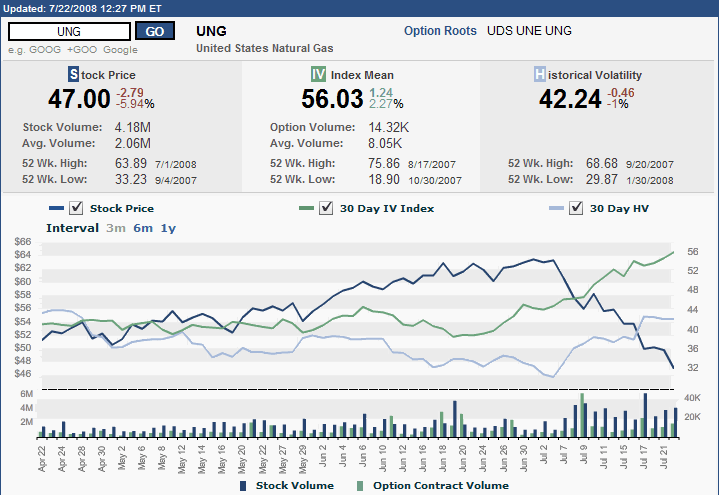
Perhaps it is just a coincidence that the “Oil VIX” appeared on the scene just as the implied volatility in oil futures (or at least as captured by USO) was hitting an eight month high. The “Oil VIX” (formally known as the CBOE Crude Oil Volatility Index; ticker OVX) and crude oil may get the lion’s share of the energy headlines, but lately it has been natural gas that has been making the more dramatic moves.

A look at the three month chart of UNG (the natural gas ETF that is the counterpart to USO), courtesy of the ISE, shows implied volatility steadily increasing over the past five weeks, with the gap between implied volatility and historical volatility continuing to widen – all while natural gas has pulled back about 27%.

Natural gas implied volatility levels are higher than oil implied volatility levels at the moment, and the pullback in natural gas presents some interesting trading opportunities. Some momentum players are already short here and some value hunters are buying on weakness, particularly if they believe in the long-term commodity bull and other supply and demand issues that are specific to natural gas.

The case for natural gas trading sideways from current levels is hard to make. Directional bets are expensive, due to high IV. Two trades I am looking hard at, with a bullish directional bias, are bull put spreads and call backspreads. The former limits upside and downside; the latter is more aggressive and more risky.

DISCLAIMER: "VIX®" is a trademark of Chicago Board Options Exchange, Incorporated. Chicago Board Options Exchange, Incorporated is not affiliated with this website or this website's owner's or operators. CBOE assumes no responsibility for the accuracy or completeness or any other aspect of any content posted on this website by its operator or any third party. All content on this site is provided for informational and entertainment purposes only and is not intended as advice to buy or sell any securities. Stocks are difficult to trade; options are even harder. When it comes to VIX derivatives, don't fall into the trap of thinking that just because you can ride a horse, you can ride an alligator. Please do your own homework and accept full responsibility for any investment decisions you make. No content on this site can be used for commercial purposes without the prior written permission of the author. Copyright © 2007-2023 Bill Luby. All rights reserved.
 
Web Analytics