Showing posts with label call backspread. Show all posts

Saturday, March 12, 2016

Playing Volatile Oil Prices (Guest Columnist at Barron’s)

Today I penned my eighteenth guest column for Barron’s, filling in for Steve Sears and the venerable The Striking Price options column.  Looking back, I was surprised to see that this is the eighth year I have been contributing to Barron’s and while I have generally tilted in the direction of volatility topics during this period, I always like to keep my thoughts topical, but with an unusual twist or two.

In Playing Volatile Oil Prices:  The ins and outs of the backspread trade, I tackled the recent huge moves in crude oil prices, touched upon some of the fundamental and technical influences on the price of crude and used the current environment of chaos following a huge short squeeze as a backdrop to talk about the opportunities associated with a call backspread.

As Barron’s prefers to structure trade ideas around ETPs or single stocks, I elected to use the popular U.S. Oil Fund (USO) ETP as my underlying, though I also like the idea of call backspreads in oil and gas exploration and production (XOP) or Russia (RSX), though the Russia ETP has limited liquidity.  As an aside, readers of this blog will surely know that the prices of futures-based ETPs such as USO and VXX, among others, are strongly influenced by the roll yield associated with the shape of the futures curve.  For this reason, USO acts most like West Texas Intermediate crude oil in the short-term, but over longer periods the price of USO is more strongly affected by the term structure of crude oil futures, similar to the issues associated with VXX and the VIX.

While the Barron’s column discusses the rationale for the trade and some of the details surrounding it, I thought I would post a profit and loss graphic for the USO April 1x2 10.5/11.5 call backspread here as a companion to the Barron’s material.


[source(s):  LivevolPro / CBOE, VIX and More]

I am sure this particular call backspread trade idea is not for everyone, yet I think it is important for everyone to internalize backspreads, their P&L chart and some of the tweaks that can be made.  For instance, one can dramatically change probabilities and payoffs by modifying strikes (including making use of in-the-money strikes, for instance) and expirations, whereas the credit or debit for entering the trade is something that can be strongly influenced by adjusting the ratios to the likes of 2x3, 4x5, etc.

Also of note, readers who are new to backspreads may wish to brush up on bear call spreads (and bull put spreads) before tackling backspreads, as I like to think of backspreads as short vertical spreads that are supplemented by the purchase an extra out-of-the-money option in the time-honored tradition of swinging for the fences with some of the profits from a spread trade.

As I concluded in the column, “In the options world, there are very few trades where you can make money should the underlying shares move sharply in either direction. Backspreads are intriguing in that they have limited risk, unlimited reward (in one direction), and can make money if the underlying moves either up or down.”

Related posts:

A full list of my (18) Barron’s contributions:


Disclosure(s): long XOP and short VXX at time of writing; Livevol and CBOE are advertisers on VIX and More

Thursday, June 17, 2010

BP, Put Backspreads and the Disaster Trade

One of the more interesting trading setups is something I call the disaster trade. This type of trade typically sets up after a stock experiences a crushing blow, crashes once or twice and has shorts swirling all around it betting that the company will either fail or become permanently crippled.

This is exactly the type of situation BP is currently experiencing.

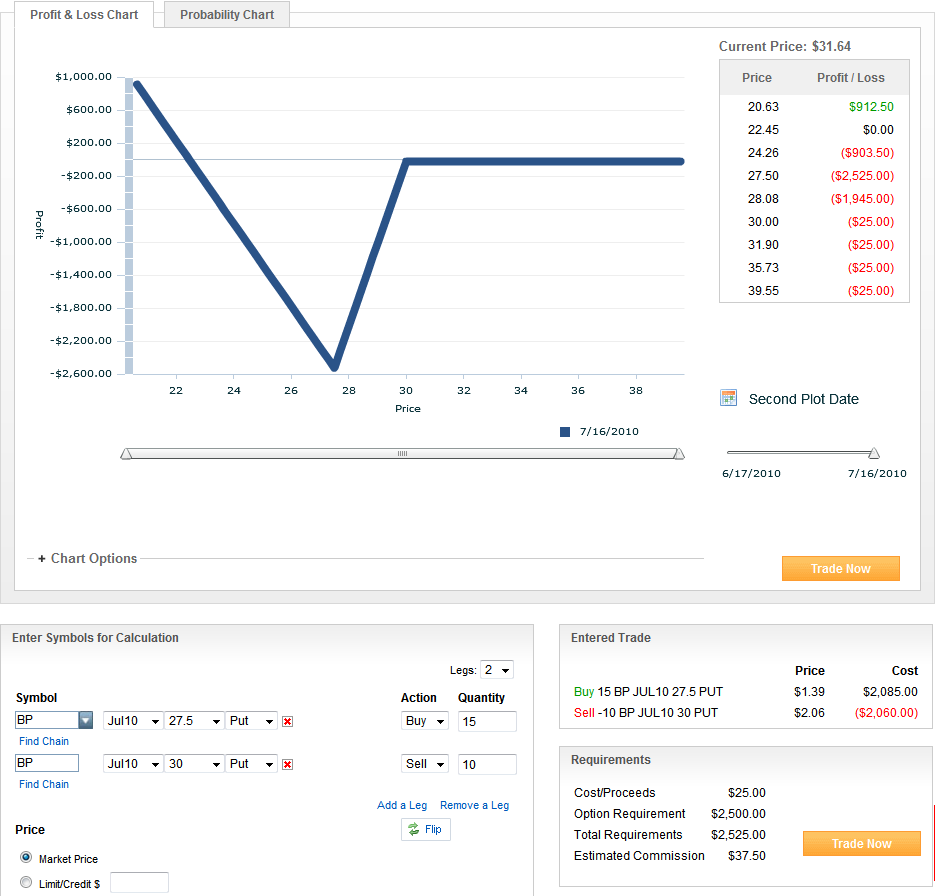
One different sort of way to use options to try to capitalize on the BP situation with limited risk is through the use of a put backspread or a call backspread. A put backspread involves selling a smaller quantity of puts at a higher strike and buying a larger amount of puts at a lower strike. Depending upon market factors, this trade can be either a credit or a debit. In the first graphic below, the trade costs $25 to enter (before commissions.)

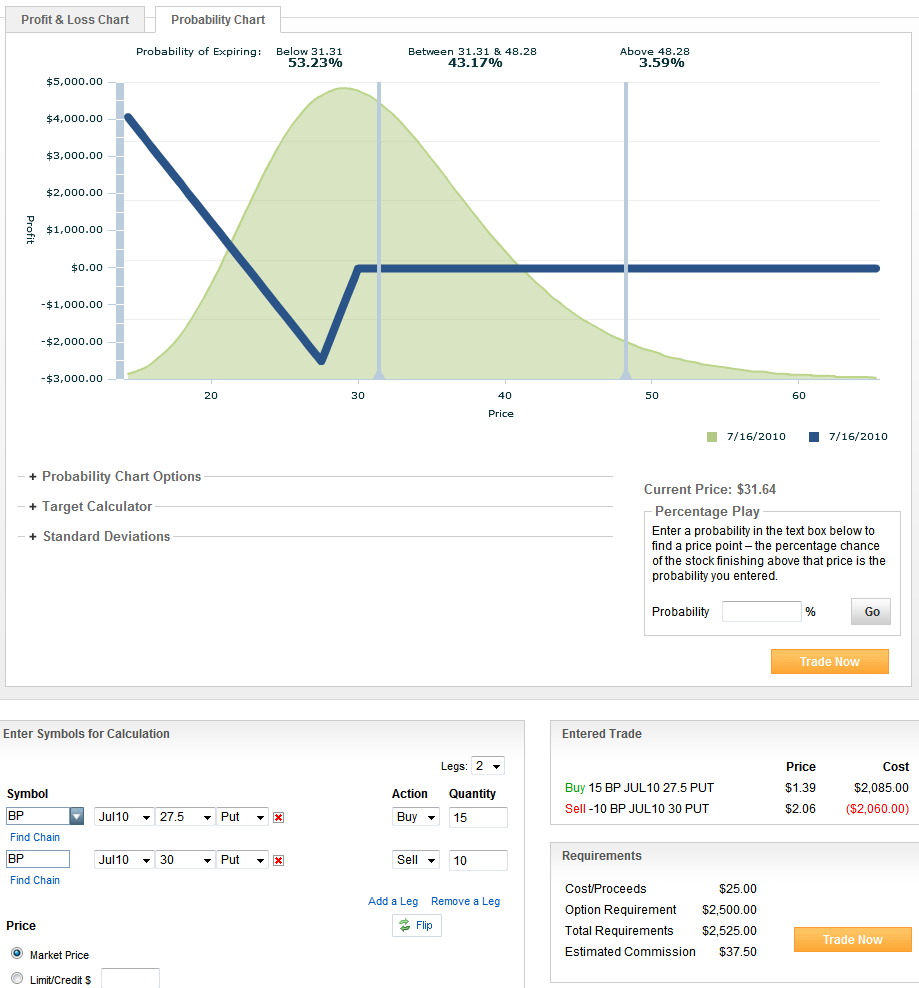
The optionsXpress graphics below illustrate the logic of a put backspread trade, which was mapped out with BP trading at 31.64 and is structured here as short 10 BP July 30 puts and long 15 BP July 27.50 puts. From a high level perspective, three things can happen with this trade:

  1. If BP remains above 30, then the trader loses the $25
  2. If BP falls below 22.45, the trade begins to make money at the rate of $500 per point
  3. The trade loses money if BP settles in the 22.45 – 30.00 range, with a maximum loss of $2525 at 27.50

In sum, a disaster pays off; a mild decline will be painful; and any move up, sideways or slightly down move just about breaks even. (In this case the 15:10 ratio means a $25 loss, but if the ratio were smaller, the sideways to up move would result in a profit. For example, buying 14 July 27.50 puts instead of 15 increases the profitability by $139, so any close over 30 would result in a $114 profit instead of a $25 loss.)

I have included the second graphic to show how optionsXpress uses a lognormal distribution to translate existing options data into an expected probability distribution at the time the July options expire. This helps to visualize the strategy and reinforces the fact that the put backspread is a fat tail disaster play.

Of course, one could flip these graphics around and have a call backspread trade, such as short 10 July 32 calls and long 15 July 35 calls. Here the small profit (about $700 in the example immediately above) would be on the down side and the upward sloping portion of the profit curve would be consistent with a rally instead of a crash.

If you see a beaten down stock that you expect to bounce back strongly, yet still want to make money if the stock continues to sell off, put backspreads are worth investigating. The can be done with out-of-the-money options, as is the case with the examples shown here, using in-the-money-options or with a blend of the two. More broadly, when disaster strikes and you want to place a bet on the situation worsening or improving, backspreads are an interesting way to do so with a defined risk approach.

For more on related subjects, readers are encouraged to check out:


[source: optionsXpress]

Disclosure(s): none

Tuesday, July 22, 2008

Natural Gas Implied Volatility Spiking

Perhaps it is just a coincidence that the “Oil VIX” appeared on the scene just as the implied volatility in oil futures (or at least as captured by USO) was hitting an eight month high. The “Oil VIX” (formally known as the CBOE Crude Oil Volatility Index; ticker OVX) and crude oil may get the lion’s share of the energy headlines, but lately it has been natural gas that has been making the more dramatic moves.

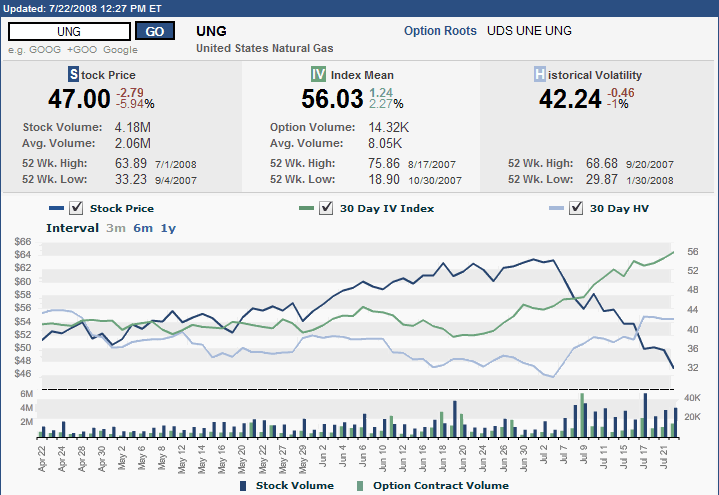
A look at the three month chart of UNG (the natural gas ETF that is the counterpart to USO), courtesy of the ISE, shows implied volatility steadily increasing over the past five weeks, with the gap between implied volatility and historical volatility continuing to widen – all while natural gas has pulled back about 27%.

Natural gas implied volatility levels are higher than oil implied volatility levels at the moment, and the pullback in natural gas presents some interesting trading opportunities. Some momentum players are already short here and some value hunters are buying on weakness, particularly if they believe in the long-term commodity bull and other supply and demand issues that are specific to natural gas.

The case for natural gas trading sideways from current levels is hard to make. Directional bets are expensive, due to high IV. Two trades I am looking hard at, with a bullish directional bias, are bull put spreads and call backspreads. The former limits upside and downside; the latter is more aggressive and more risky.

Monday, January 28, 2008

Crossroads Options

Raise your hand if you think the market is at a crossroads where it is more likely to make a big move in one direction or the other rather than just drift sideways from current levels.

I see a lot of hands going up, which doesn’t surprise me, as I also think the markets are at one of those crossroads that precedes a big move. The problem, of course, is getting the direction right.

The most popular way to play a large anticipated move of undetermined direction is with a long straddle or a long strangle. If you get a big move – and particularly if you get is shortly after initiating the position – you will likely be able to lock in a substantial profit. Losses are limited to the cost of opening the position, but if volatility is widely expected, the position can be expensive to open and time decay can be painful.

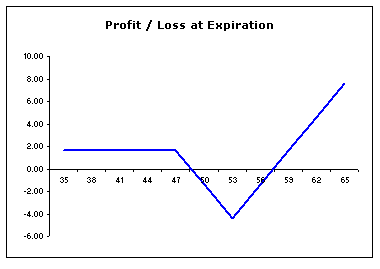
For what it’s worth, I am often partial to a different approach: call backspreads and put backspreads. There a couple of important distinctions between a straddle/strangle approach and a backspread approach. First of all, straddles and strangles can entail a significant initial outlay. With backspreads, on the other hand, you can essentially finance the excess out of the money calls or puts by selling some at the money or slightly out of the money options and end up with a net credit or zero cost transaction. Second, if the options sold are at the money or out of the money, you will make money if the underlying does not move. Finally, as the graphic below (of a call backspread) demonstrates, the big windfall with a back spread is unidirectional. So unlike the straddle or strangle, large profits only accrue when you can call the direction of the move.


If you are interested in learning more about backspreads, check out John Summa’s Backspreads: Good News for Breakout Traders article in Investopedia.com.

Friday, February 9, 2007

Waiting for Godot

As I wait for volatility to return to the markets, I have an almost Waiting for Godot feeling about what lies ahead. At the moment, call me partly resigned and partly hopeful.

Fortunately, this is exactly where a bear call spread and call backspread can satisfy those two apparently conflicting views of volatility. You have to ask yourself two main questions before considering which strategy is the better fit for your view of the market:

· What do you think is the likelihood of a significant increase in volatility?

· If a volatility spike happens, how severe will it be?

If you are of the opinion that a volatility spike is unlikely and/or will not be severe, then you should harvest some of the implied volatility in the VIX with a bear call spread. This is a strategy that has been quite successful over the past 7 or so months, as Adam Warner at the Daily Options Report has pointed out on several occasions.

On the other hand, if you think Godot might eventually show up carrying a large volatility spike, you are willing to forego some of the premium to position yourself to cash in on that spike, then the call backspread is a better way to play the VIX. Of course, you can always buy the calls outright, but with VIX implied volatility currently at a very high level, you will have to paddle hard against the time decay current to make any progress.

For more information, optionsXpress (which generated the graphic on the left) has excellent discussions of the bear call spread and the call backspread. OptionPundit takes a deeper dive on both the bear call spread (aka vertical credit spread) and on call back spreads. These are both excellent resources for those whose options experience consists largely of buying calls and puts outright and selling covered calls – and who are open to more advanced options strategies.

DISCLAIMER: "VIX®" is a trademark of Chicago Board Options Exchange, Incorporated. Chicago Board Options Exchange, Incorporated is not affiliated with this website or this website's owner's or operators. CBOE assumes no responsibility for the accuracy or completeness or any other aspect of any content posted on this website by its operator or any third party. All content on this site is provided for informational and entertainment purposes only and is not intended as advice to buy or sell any securities. Stocks are difficult to trade; options are even harder. When it comes to VIX derivatives, don't fall into the trap of thinking that just because you can ride a horse, you can ride an alligator. Please do your own homework and accept full responsibility for any investment decisions you make. No content on this site can be used for commercial purposes without the prior written permission of the author. Copyright © 2007-2023 Bill Luby. All rights reserved.
 
Web Analytics