Showing posts with label XOP. Show all posts

Saturday, March 12, 2016

Playing Volatile Oil Prices (Guest Columnist at Barron’s)

Today I penned my eighteenth guest column for Barron’s, filling in for Steve Sears and the venerable The Striking Price options column.  Looking back, I was surprised to see that this is the eighth year I have been contributing to Barron’s and while I have generally tilted in the direction of volatility topics during this period, I always like to keep my thoughts topical, but with an unusual twist or two.

In Playing Volatile Oil Prices:  The ins and outs of the backspread trade, I tackled the recent huge moves in crude oil prices, touched upon some of the fundamental and technical influences on the price of crude and used the current environment of chaos following a huge short squeeze as a backdrop to talk about the opportunities associated with a call backspread.

As Barron’s prefers to structure trade ideas around ETPs or single stocks, I elected to use the popular U.S. Oil Fund (USO) ETP as my underlying, though I also like the idea of call backspreads in oil and gas exploration and production (XOP) or Russia (RSX), though the Russia ETP has limited liquidity.  As an aside, readers of this blog will surely know that the prices of futures-based ETPs such as USO and VXX, among others, are strongly influenced by the roll yield associated with the shape of the futures curve.  For this reason, USO acts most like West Texas Intermediate crude oil in the short-term, but over longer periods the price of USO is more strongly affected by the term structure of crude oil futures, similar to the issues associated with VXX and the VIX.

While the Barron’s column discusses the rationale for the trade and some of the details surrounding it, I thought I would post a profit and loss graphic for the USO April 1x2 10.5/11.5 call backspread here as a companion to the Barron’s material.


[source(s):  LivevolPro / CBOE, VIX and More]

I am sure this particular call backspread trade idea is not for everyone, yet I think it is important for everyone to internalize backspreads, their P&L chart and some of the tweaks that can be made.  For instance, one can dramatically change probabilities and payoffs by modifying strikes (including making use of in-the-money strikes, for instance) and expirations, whereas the credit or debit for entering the trade is something that can be strongly influenced by adjusting the ratios to the likes of 2x3, 4x5, etc.

Also of note, readers who are new to backspreads may wish to brush up on bear call spreads (and bull put spreads) before tackling backspreads, as I like to think of backspreads as short vertical spreads that are supplemented by the purchase an extra out-of-the-money option in the time-honored tradition of swinging for the fences with some of the profits from a spread trade.

As I concluded in the column, “In the options world, there are very few trades where you can make money should the underlying shares move sharply in either direction. Backspreads are intriguing in that they have limited risk, unlimited reward (in one direction), and can make money if the underlying moves either up or down.”

Related posts:

A full list of my (18) Barron’s contributions:


Disclosure(s): long XOP and short VXX at time of writing; Livevol and CBOE are advertisers on VIX and More

Monday, October 13, 2014

Largest SPX Pullback of 2014 Hits 6.4%

Every time there is a pullback, it seems as if I receive multiple requests for an updated version of the table below. With the S&P 500 index reeling and still trying to find a bottom, this looks like a good time to put the current pullback in the context of the 27 most significant peak-to-trough declines from new highs since the SPX bottomed in March 2009.

Note that the current 6.4% decline from the September 19th high of 2019 is roughly average in terms of duration, but makes it the second largest pullback in percentage terms since 2012, just eclipsing the January-February 2014 pullback, when emerging markets (EEM) and Crimea were weighing heavily on the minds of investors.

Keep in mind that as ugly has things have been in the SPX, the Russell 2000 small cap index (RUT) is down 13.8% since topping out in early July, while the NASDAQ composite index is down 8.5% since its mid-September top. Of course, some sectors have been hit even harder, with oil and gas exploration and production (XOP) down 33.3% from its 2014 high. Semiconductors (SMH) have declined 14.4% from their 2014 high, yet that high was established less than a month ago.

There is never an easy answer to the question of whether this has been enough pain to warrant a bottom, but after the events of the past week, all sorts of extreme scenarios now seem much more plausible.

SPXpullbackchartasof101314_zps5ff1c9f6[1]

[source(s): Yahoo, VIX and More]

Related posts:

Disclosure(s): none

Wednesday, June 2, 2010

Turmoil in the Oil Patch

Several factors have combined to create turmoil in the oil patch. Most notably, the Deepwater Horizon oil spill has hammered the stocks of BP and Transocean (RIG), while tainting the entire oil and oil services (OIH, XES) sector. On top of the spill, the European sovereign debt crisis has generated concerns about an economic slowdown of the European region and beyond, while manufacturing data and other news out of China hints at the possibility of weakness in the most significant area for future growth in energy demand.
In short, valuations across the sector are way down and yet the long-term supply and demand imbalance will likely suffer no more than a small dent as a result of the events of the last couple of months.
The energy sector has a very promising future and I am looking to add to existing positions on weakness. As the chart below shows, there are some indications that crude oil (USO) may have put in a bottom and the exploration and production ETF (XOP) may also be beginning a bottoming process as well. Outside of fossil fuels, alternative energy plays in solar (TAN, KWT) and wind (FAN, PWND) are somewhat suspect in that critical governmental subsidies from the likes of Spain and Germany appear to be a victim of the sovereign debt crisis. Still, these alternative energy plays, including some broad-based alternative energy ETFs (GEX, PBD), have also been marked down dramatically and should also benefit as crude oil prices start to rebound and governments come under increasing pressure to make use of ecologically sustainable energy sources.
For more on related subjects, readers are encouraged to check out:


[source: ETFreplay.com]

Disclosure(s): long OIH and XOP at time of writing

Thursday, March 25, 2010

ETFreplay.com Brings ETFs, Volatility and Charts Together Under One Roof

As a full-time investor and part-time blogger, I have a weakness for web sites that focus on ETFs, volatility and charts – three of the subjects I feature prominently in this space. For this reason, I was excited when ETFreplay.com appeared on the scene earlier this year specializing in ETFs, offering some unique and compelling graphics, and demonstrating an interest in volatility.

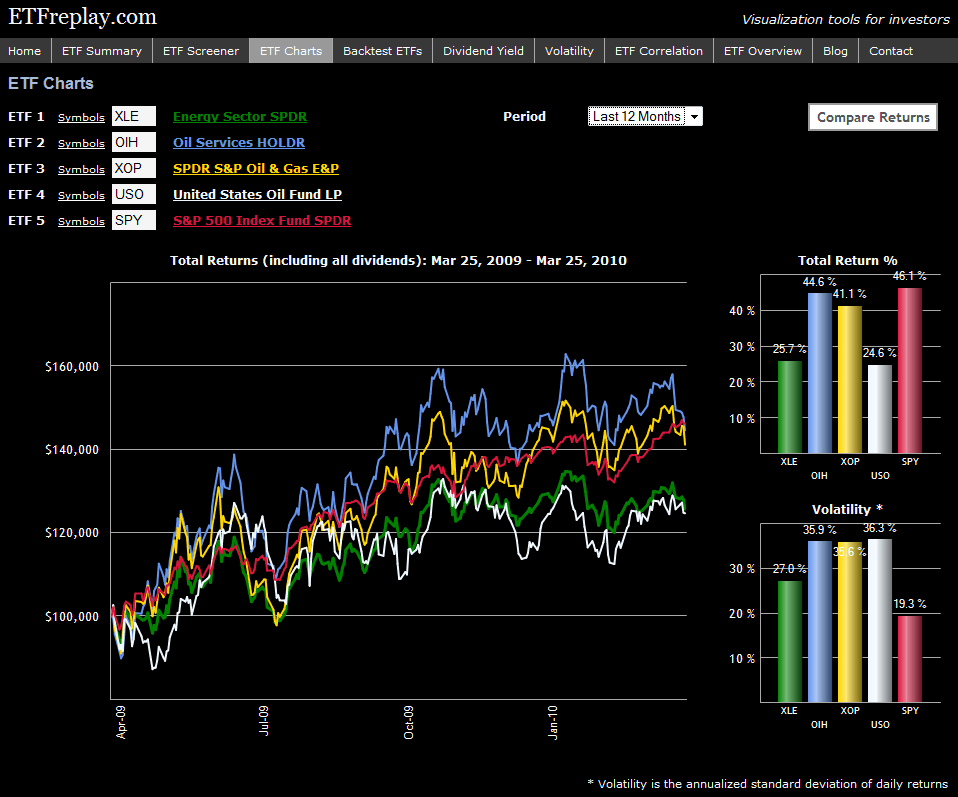
The site is still evolving, but is already a fun an informative destination, particularly for investors who are interested in ETFs. Some of the functionality currently offered includes screening, back testing, correlations, charting, etc. There is also a blog which provides graphics and commentary on a number of issues related to ETFs. The content is excellent, but the graphics are what inspired the tagline, “Visualization tools for investors.” I have included one example graphic below in which I decided to compare the performance and volatility of four popular energy ETFs (XLE, OIH, XOP and USO) relative to the S&P 500 ETF (SPY) over the course of the past year. I'll let the chart speak for itself.

In my opinion, there only a handful of top tier ETF web sites out there. While it may still be a little too early to add ETFreplay.com to that list, based on the speed at which the site is improving, I suspect it will not be long before that gap is closed.

For more on related subjects, readers are encouraged to check out:


[source: ETFreplay.com]

Disclosure(s): long XOP at time of writing

Monday, June 29, 2009

Clean vs. Not-So-Clean Energy

While I have not mentioned it much on the blog, one of my favorite sectors to invest in is the energy sector. When it comes to energy ETFs, the 800 pound gorilla is XLE, the energy select sector SPDR that trades over 20 million shares on a typical day. XLE’s holdings are heavily tilted toward the major integrated oil companies, with Exxon Mobil (XOM) and Chevron (CVX) accounting for slightly more the 1/3 of the ETFs holdings, followed by ConocoPhillips (COP), Schlumberger (SLB), Occidental Petroleum (OXY), etc.

With cap and trade legislation passing the House over the weekend, investing in the energy space is getting even more interesting. XLE is up this morning, as are the popular oil services ETF, OIH (the top five holdings favor drillers and include RIG, SLB, DO, BHI and NE) and the exploration and production ETF, XOP (top five holdings are XEC, PXD, EAC, INT and HK.)

There are a variety of ETFs out there in the clean/green space. Perhaps the best known of these and certainly the most popular is PowerShares WilderHill Clean Energy (PBW), whose largest holdings include a healthy dose of solar companies (top five holdings are FSYS, VLNC, SOLR, ESLR, SOL.) Among the more interesting alternatives is a sibling ETF, PowerShares WilderHill Progressive Energy (PUW), which places more emphasis on energy efficiency and nuclear power and has a list of top holdings which includes MX.TO, ES, PX, USU and CCO.TO. For a solar-only ETF play, Claymore/MAC Global Solar Energy (TAN) is an excellent bet. Note that many of the holdings of TAN are not traded on U.S. exchanges. The current top five holdings are MBTN.SW, FSLR, S92.BE, CTN.DU and SWV.BE. Also in the top ten holdings are two Chinese solar companies whose ADRs are available in the U.S.: STP and TSL.

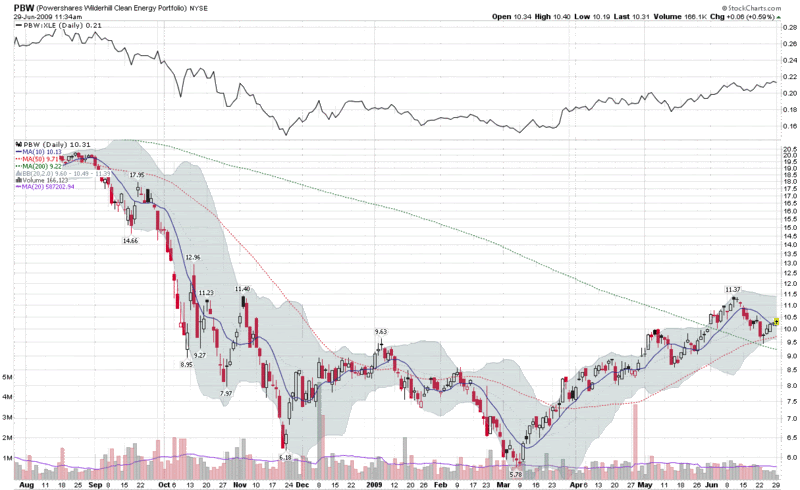
In the chart below, I have highlighted my favorite all-purpose clean energy ETF, PBW and have included a ratio of PBW to XLE in order to get a sense of the relative performance of clean energy with respect to the broad energy sector. While PBW has pulled back with the broader market during the past three weeks, it has continued to perform strongly against the broad energy sector ETF. As the ratio chart hints at, pairs trades involving clean energy ETFs such as PBW, PUW and TAN vs. XLE, XOP and OIH are one way to play the Washington energy legislation game going forward.

[source: StockCharts]

Disclosure: Long OIH, DO, INT and TSL at time of writing.

DISCLAIMER: "VIX®" is a trademark of Chicago Board Options Exchange, Incorporated. Chicago Board Options Exchange, Incorporated is not affiliated with this website or this website's owner's or operators. CBOE assumes no responsibility for the accuracy or completeness or any other aspect of any content posted on this website by its operator or any third party. All content on this site is provided for informational and entertainment purposes only and is not intended as advice to buy or sell any securities. Stocks are difficult to trade; options are even harder. When it comes to VIX derivatives, don't fall into the trap of thinking that just because you can ride a horse, you can ride an alligator. Please do your own homework and accept full responsibility for any investment decisions you make. No content on this site can be used for commercial purposes without the prior written permission of the author. Copyright © 2007-2023 Bill Luby. All rights reserved.
 
Web Analytics