Showing posts with label CVX. Show all posts

Monday, June 29, 2009

Clean vs. Not-So-Clean Energy

While I have not mentioned it much on the blog, one of my favorite sectors to invest in is the energy sector. When it comes to energy ETFs, the 800 pound gorilla is XLE, the energy select sector SPDR that trades over 20 million shares on a typical day. XLE’s holdings are heavily tilted toward the major integrated oil companies, with Exxon Mobil (XOM) and Chevron (CVX) accounting for slightly more the 1/3 of the ETFs holdings, followed by ConocoPhillips (COP), Schlumberger (SLB), Occidental Petroleum (OXY), etc.

With cap and trade legislation passing the House over the weekend, investing in the energy space is getting even more interesting. XLE is up this morning, as are the popular oil services ETF, OIH (the top five holdings favor drillers and include RIG, SLB, DO, BHI and NE) and the exploration and production ETF, XOP (top five holdings are XEC, PXD, EAC, INT and HK.)

There are a variety of ETFs out there in the clean/green space. Perhaps the best known of these and certainly the most popular is PowerShares WilderHill Clean Energy (PBW), whose largest holdings include a healthy dose of solar companies (top five holdings are FSYS, VLNC, SOLR, ESLR, SOL.) Among the more interesting alternatives is a sibling ETF, PowerShares WilderHill Progressive Energy (PUW), which places more emphasis on energy efficiency and nuclear power and has a list of top holdings which includes MX.TO, ES, PX, USU and CCO.TO. For a solar-only ETF play, Claymore/MAC Global Solar Energy (TAN) is an excellent bet. Note that many of the holdings of TAN are not traded on U.S. exchanges. The current top five holdings are MBTN.SW, FSLR, S92.BE, CTN.DU and SWV.BE. Also in the top ten holdings are two Chinese solar companies whose ADRs are available in the U.S.: STP and TSL.

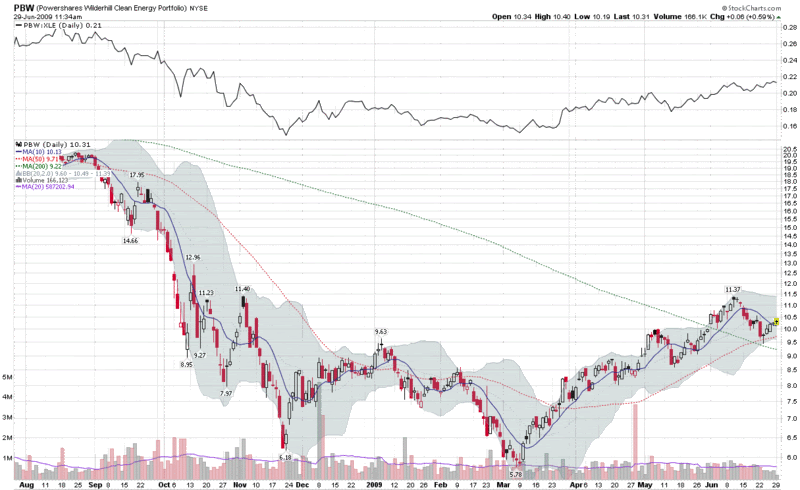
In the chart below, I have highlighted my favorite all-purpose clean energy ETF, PBW and have included a ratio of PBW to XLE in order to get a sense of the relative performance of clean energy with respect to the broad energy sector. While PBW has pulled back with the broader market during the past three weeks, it has continued to perform strongly against the broad energy sector ETF. As the ratio chart hints at, pairs trades involving clean energy ETFs such as PBW, PUW and TAN vs. XLE, XOP and OIH are one way to play the Washington energy legislation game going forward.
[source: StockCharts]

Disclosure: Long OIH, DO, INT and TSL at time of writing.

Wednesday, October 8, 2008

A Conceptual Framework for Volatility Events

I developed a framework to aid in thinking about volatility events awhile back and given the recent volatility, I thought it might be helpful to share that framework.

First, there are many different types of events that affect volatility. Some of these events transpire almost instantaneously according to an exact timetable that is known in advance, even if the facts are a surprise. Examples of exact-instantaneous volatility events include government economic data (e.g., tomorrow’s weekly jobless claims), corporate earnings announcements (e.g., Chevron (CVX) reports tomorrow), and yesterday's speech by Ben Bernanke. Other events unfold incrementally on a fuzzy timetable, with any number of twists and turns. Examples of fuzzy-incremental events include hurricanes (Gustav, Hanna, etc.), geopolitical crises (Georgia/South Ossetia, Iran, Iraq, etc.), and of course, the current financial crisis.

Contagion is an important aspect of volatility events. Will the event spread and trigger other related high volatility events? Sector contagion (institutional interconnectedness in the financial sector) and geographical contagion (the Asian financial crisis) are relatively common, but entity-specific problems (e.g., Enron) generally do not spread to encompass an entire sector (though they might hint at a broader previously unrecognized sector problem.)

Without diving into too much detail in this space, I will mention two other related elements of a conceptual framework for volatility events: recurrence and reversibility. Government data reports are recurring and reversible. Productivity and GDP numbers are released quarterly and are subsequently revised. FOMC announcements and same store sales numbers are recurring, but are not revised. Fuzzy-incremental volatility events are not recurring (in identical form) and are not reversible. Legal rulings, however, are not recurring and are reversible.

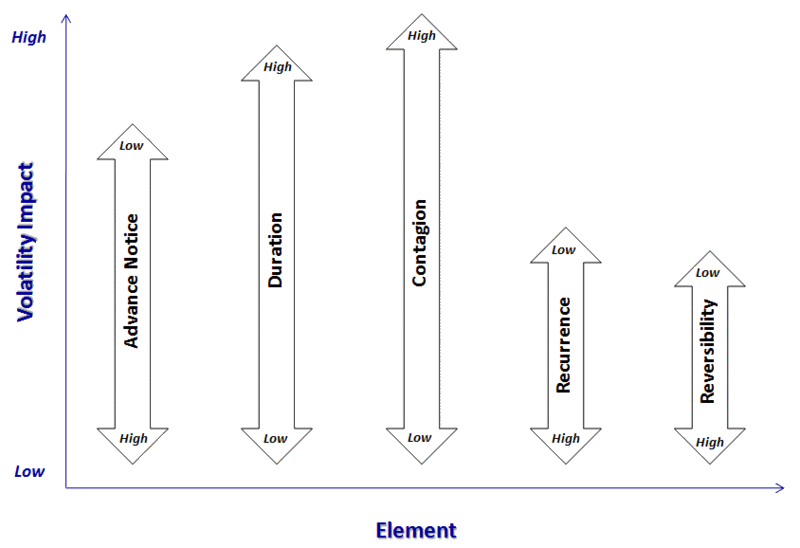
So what does this all mean? It means that most volatility events can be classified along five dimensions and those dimensions can be used to predict the magnitude of the impact that a specific event type will have on volatility.

In the graphic below, I have distilled the above into five dimensions and have provided a framework for thinking about how they impact volatility. A high volatility event would therefore generally have little advance notice (note the “Low” designation at the top of the arrow, meaning that a low level of the element translates into high volatility), have a long duration, involve a high degree of (or potential for) contagion, not be recurring, and not be reversible. Also, the contagion element normally has a greater impact on volatility than advance notice, which tends to be a more important volatility factor than reversibility, etc.

[source: VIX and More]

As always, feedback is encouraged.

DISCLAIMER: "VIX®" is a trademark of Chicago Board Options Exchange, Incorporated. Chicago Board Options Exchange, Incorporated is not affiliated with this website or this website's owner's or operators. CBOE assumes no responsibility for the accuracy or completeness or any other aspect of any content posted on this website by its operator or any third party. All content on this site is provided for informational and entertainment purposes only and is not intended as advice to buy or sell any securities. Stocks are difficult to trade; options are even harder. When it comes to VIX derivatives, don't fall into the trap of thinking that just because you can ride a horse, you can ride an alligator. Please do your own homework and accept full responsibility for any investment decisions you make. No content on this site can be used for commercial purposes without the prior written permission of the author. Copyright © 2007-2023 Bill Luby. All rights reserved.
 
Web Analytics