Showing posts with label bear call spread. Show all posts

Saturday, March 12, 2016

Playing Volatile Oil Prices (Guest Columnist at Barron’s)

Today I penned my eighteenth guest column for Barron’s, filling in for Steve Sears and the venerable The Striking Price options column.  Looking back, I was surprised to see that this is the eighth year I have been contributing to Barron’s and while I have generally tilted in the direction of volatility topics during this period, I always like to keep my thoughts topical, but with an unusual twist or two.

In Playing Volatile Oil Prices:  The ins and outs of the backspread trade, I tackled the recent huge moves in crude oil prices, touched upon some of the fundamental and technical influences on the price of crude and used the current environment of chaos following a huge short squeeze as a backdrop to talk about the opportunities associated with a call backspread.

As Barron’s prefers to structure trade ideas around ETPs or single stocks, I elected to use the popular U.S. Oil Fund (USO) ETP as my underlying, though I also like the idea of call backspreads in oil and gas exploration and production (XOP) or Russia (RSX), though the Russia ETP has limited liquidity.  As an aside, readers of this blog will surely know that the prices of futures-based ETPs such as USO and VXX, among others, are strongly influenced by the roll yield associated with the shape of the futures curve.  For this reason, USO acts most like West Texas Intermediate crude oil in the short-term, but over longer periods the price of USO is more strongly affected by the term structure of crude oil futures, similar to the issues associated with VXX and the VIX.

While the Barron’s column discusses the rationale for the trade and some of the details surrounding it, I thought I would post a profit and loss graphic for the USO April 1x2 10.5/11.5 call backspread here as a companion to the Barron’s material.


[source(s):  LivevolPro / CBOE, VIX and More]

I am sure this particular call backspread trade idea is not for everyone, yet I think it is important for everyone to internalize backspreads, their P&L chart and some of the tweaks that can be made.  For instance, one can dramatically change probabilities and payoffs by modifying strikes (including making use of in-the-money strikes, for instance) and expirations, whereas the credit or debit for entering the trade is something that can be strongly influenced by adjusting the ratios to the likes of 2x3, 4x5, etc.

Also of note, readers who are new to backspreads may wish to brush up on bear call spreads (and bull put spreads) before tackling backspreads, as I like to think of backspreads as short vertical spreads that are supplemented by the purchase an extra out-of-the-money option in the time-honored tradition of swinging for the fences with some of the profits from a spread trade.

As I concluded in the column, “In the options world, there are very few trades where you can make money should the underlying shares move sharply in either direction. Backspreads are intriguing in that they have limited risk, unlimited reward (in one direction), and can make money if the underlying moves either up or down.”

Related posts:

A full list of my (18) Barron’s contributions:


Disclosure(s): long XOP and short VXX at time of writing; Livevol and CBOE are advertisers on VIX and More

Tuesday, August 20, 2013

Pricing of VIX August and September Calls

The monthly VIX futures and options expiration is a fascinating time from an options strategy perspective, as it marks the point in time in which VIX futures prices collide with the cash/spot VIX. Thanks to the VIX Special Opening Quotation (SOQ), that price collision is an inexact one, but for all practical purposes, the VIX front month futures and cash/spot index converge once every month, just after the open on a Wednesday thirty days before the standard monthly option in the S&P 500 Index options the following month.

To make things more interesting, the last day of trading for the front month VIX futures and options is the Tuesday session just prior to expiration.

All these product attributes make it difficult to navigate the complex waters of the VIX product platform just prior to expiration, but because the VIX is capable of such sudden sharp moves [see VIX All-Time Spike #11 (and a treasure trove of VIX spike data) for some details,] options prices have to include the possibility of a sudden VIX spike right up until the moment of expiration.

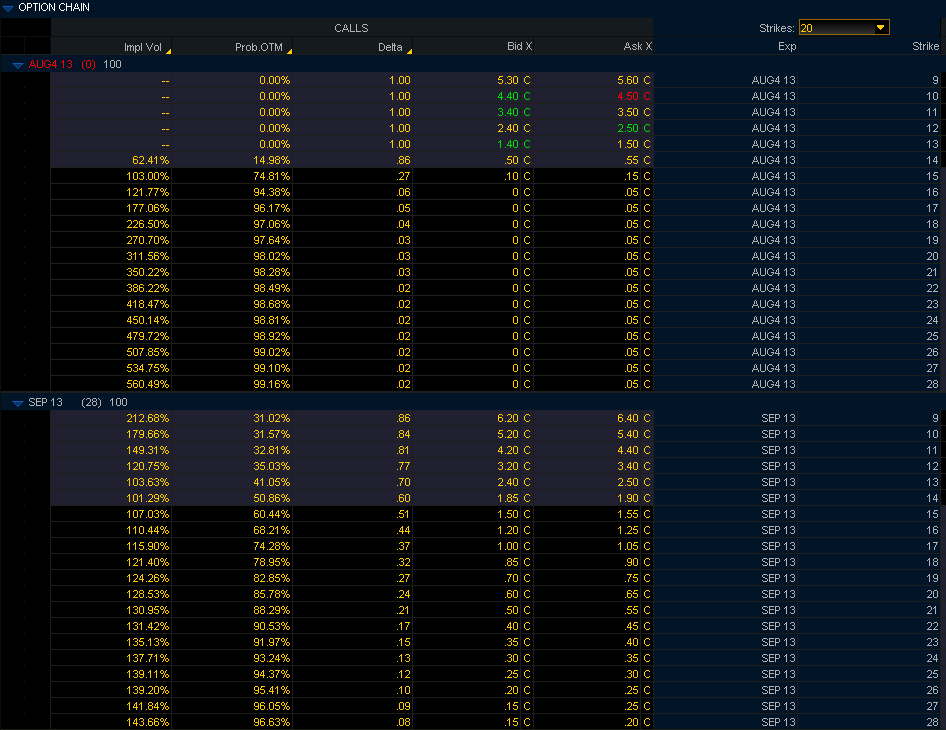
For these reasons, it is sometimes possible to sell VIX options for a surprisingly high premium right before expiration. In the graphic below, I have captured some data from the TD Ameritrade/thinkorswim platform that shows the prices of various VIX calls as of about 2:00 p.m. ET that expire tomorrow, with just more than two hours of trading left in these products. For comparison purposes, I have also included the September options for the same strikes, which will expire on September 18th.  For the record, at the time of this snapshot, the VIX was at 14.48 and the August VX futures (now available on the TD Ameritrade/thinkorswim platform as ticker /VXQ3) were at 14.43.

Note that the TD Ameritrade/thinkorswim platform includes information on the implied volatility calculated for these VIX calls as well as the estimated probability that these will expire out-of-the-money on September 18th. Theoretically at least, the VIX August 25 calls have a more than 1% of expiring in-the-money at tomorrow’s open, while there is more than a 5% chance that the VIX September 25 calls will expire in-the-money. With an implied volatility of 139%, the VIX September 25 calls are currently bid-ask at 0.25 – 0.30.

I am not recommending selling VIX calls just prior to expiration and I certainly would want anyone who is interested in these type of trades to start out with defined risk trades (e.g., bear call spreads) before considering trades with unlimited risk...but the possible trading opportunities are fascinating, to me at least.

[source(s): TD Ameritrade/thinkorswim]

For those interested in additional background on the VIX expiration and some potential trade ideas, the posts below should provide a good jumping off point.

Related posts:

Disclosure(s): neutral position in VIX via options at time of writing

Thursday, April 12, 2012

Buying SVXY Calls when the VIX Spikes

Based upon some of the emails I have received this week, it appears that a number of readers have been focused on buying some of the inverse VIX ETPs, notably XIV and SVXY, when they saw the VIX spike. Some have preferred shorting VXX, TVIX and UVXY, based partly on availability, while others have preferred to trade VXX options, generally by buying puts or limiting risk with the likes of a bear call spread.

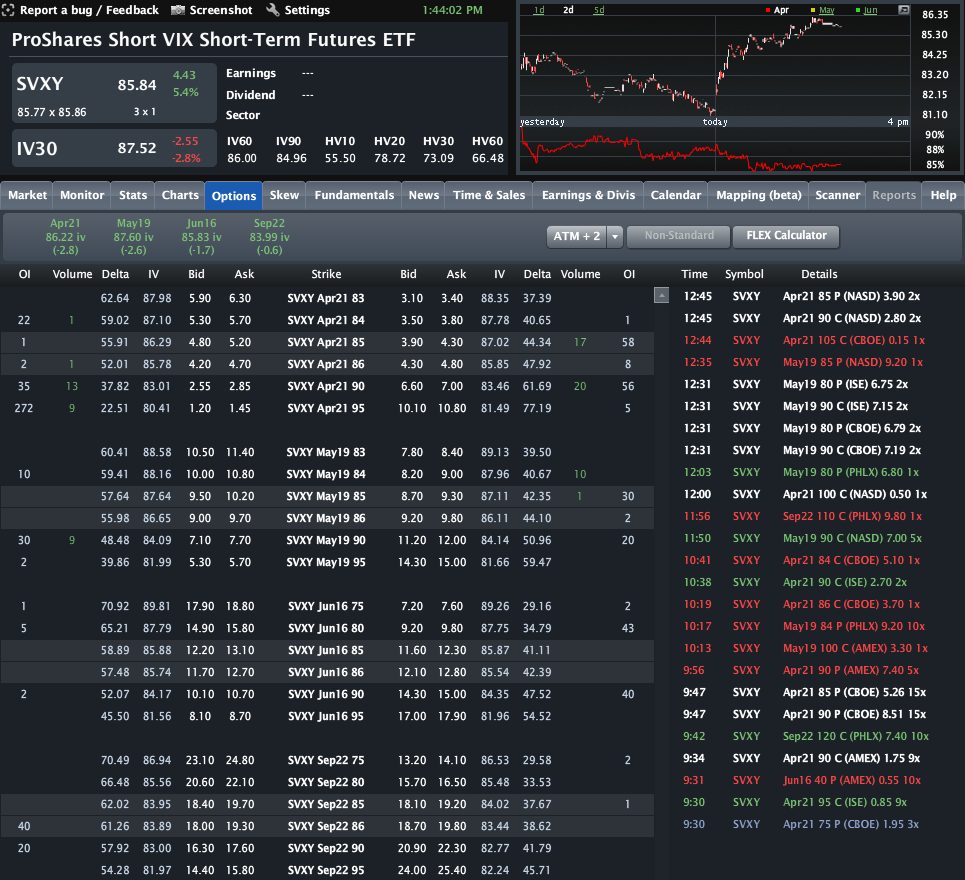
I had thought that my recent Options on UVXY and SVXY Open Up New VIX ETP Trading Approaches might nudge some traders into considering strategies involving the +2x leveraged long VIX short-term futures ETF (UVXY) and perhaps utilize the -1x short VIX short-term futures ETF (SVXY) as well, but based on the volumes, these issues are still in the process of gaining a broader audience. In fact, UVXY did see record call volume of 7300 contracts on Tuesday, but SVXY has been the laggard so far, as the graphic below illustrates.

So here is a thought: the next time the VIX has a significant spike, one of the first trades you should investigate is fading that spike by buying SVXY out-of-the-money calls. This is a simple trade and has the potential to be quite profitable. The SVXY April 90 calls, for instance, have jumped 40% from Tuesday’s close.

The exciting news about options on SVXY and UVXY is that traders can now easily structure a broad variety of trades that involve defined risk and substantial upside. While VXX (and VIX) options are still the gold standard in terms of liquidity, SVXY and UVXY options also deserve some love – even if the spreads are still wider than those of VXX.

Related posts:

[source(s): LivevolPro.com]

Disclosure(s): long XIV and SVXY, short VXX, TVIX and UVXY at time of writing; Livevol is an advertiser on VIX and More

Thursday, April 28, 2011

Reader Q and A: Straddles and Implied Volatility

Right before the close last Wednesday I placed an ATM straddle that proved to be profitable and I closed it after the IV spike on Thursday. I shouldn't have come back for more, but I placed another ATM straddle Monday before the close and even with the huge drop in price on Tuesday the IV collapse only allowed me to break even. These were my first two super short term volatility trades and now I now that the free IV data on the CBOE's website is an end of day service... definitely wouldn't have placed that trade on Monday afternoon. Seeing now that I possibly should have been doing the opposite, shorting volatility, do you suggest any strategies that aren't outright short and don't require a big amount of margin to be put up? 

Also, what service do you use to view real-time IV for ETFs and such?
Adam C.

Hi Adam,

As a newbie, you should make an important distinction between options trades that have unlimited risk and those that you should characterize as limited risk or defined risk. Shorting 10 SLV July 47 calls theoretically opens you up to unlimited risk because SLV can continue to go up and up. Should this happen, depending upon your cash cushion, eventually your broker will hit you with a margin call and you will be forced to cover at a significant loss.

Take the same basic trade and add a second leg as a hedge and your unlimited risk is now limited. Instead of a naked short, a bear call spread involving 10 short SLV July 47 calls plus 10 long SLV July 50 calls caps your loss at the distance between the two strikes. Here that is 50-47 or three points. Three points times 10 options (with a 100 multiplier) puts your maximum loss at $3000.

Make that trade right now and for 10 contracts you should receive a credit of about $1.20 for that spread, so that means your maximum profit is $1200 and maximum loss is $3000 - $1200 or $1800.

This is a directional bet. For a non-directional bet – meaning that you expect SLV to be at about 47.00 at the time of the July expiration, you should probably focus on condors and butterflies, which are essentially the limited risk version of strangles and straddles. Sometimes you will hear a trader refer to “buying the wings.” What that means is they are converting an unlimited risk strangle or straddle into a limited risk condor or butterfly by buying out-of-the-money legs to hedge their risk, just as was the case with the call spread example above. As a matter of fact, one way to think about an iron condor is that it is just a bear call spread plus a bull put spread. Early on I used a more generic label of vertical credit spread on the blog for these strategies. You should be able to follow any of these links to get more information.

An even better way to get up to speed on these strategies is with some online resources. A good place to start is with the Options Industry Council (OIC), where they have an Options Strategy Index. Click on any strategy diagram for more information. Among the many great resources out there, I can highly recommend the CBOE’s Options Institute, where you might want to start with their tutorials. Keep in mind that the options brokers also do an excellent job of educating their customers on options strategies. Two that put a great deal of effort into education are optionsXpress (Education Center) and thinkorswim (Swim Lessons).

Also, the links below should provide some specific posts that will give you some food for thought regarding your recent SLV (?) trade and some alternative approaches.

In terms of real-time IV, I use Livevol Pro, which provides the graphs that I use on the blog for implied volatility and historical volatility. Your favorite options brokers (thinkorswim, optionsXpress, TradeMONSTER, Options House, Trade King, etc.) should also have good real-time or nearly real-time IV data. If you don't have an account at a broker that specializes in options, I highly recommend you open up one with at least one of the brokers mentioned above so you can get your data and place your trades on the same platform.

Related posts:
Disclosure(s): Short SLV at time of writing; Livevol, CBOE, optionsXpress, TradeMONSTER, Options House and Trade King are advertisers on VIX and More
Wednesday, June 23, 2010

Expiring Monthly June Issue Recap

Just a quick note to remind readers and potential new subscribers that Monday marked the publication of the June issue of Expiring Monthly: The Option Traders Journal.

For those who may be interested in what this magazine is all about (hint: we don’t follow SCI, HI, STEI, STON and CSV), I have attached a copy of the Table of Contents for the June issue below. This month the magazine focuses on two subjects in particular: options strategy backtesting and volatility. The feature article, penned by Jared Woodard, puts three volatility trading strategies through their paces via backtesting.

My contributions to the June issue include a Follow That Trade segment consisting of a VIX bear call spread; my recurring column, Charting the Market; and the introductory Editor’s Note.

As a thank you to existing subscribers and inducement to potential new subscribers who may be on the fence, we are offering a “Guess where VXX will close on July 16th” contest. There will be two winners: one existing subscriber is slated to win a Volatility Essentials package from iVolatility.com; and one non-subscriber will win a free one year subscription to the magazine. For details on the contest, follow the link above.

Subscription information and additional details about the magazine are available at http://www.expiringmonthly.com/.

For more on related subjects, readers are encouraged to check out:


[source: Expiring Monthly]

Disclosure(s): I am one of the founders and owners of Expiring Monthly

Friday, May 7, 2010

VIX Implied Volatility Exceeds 2008 Crisis Levels

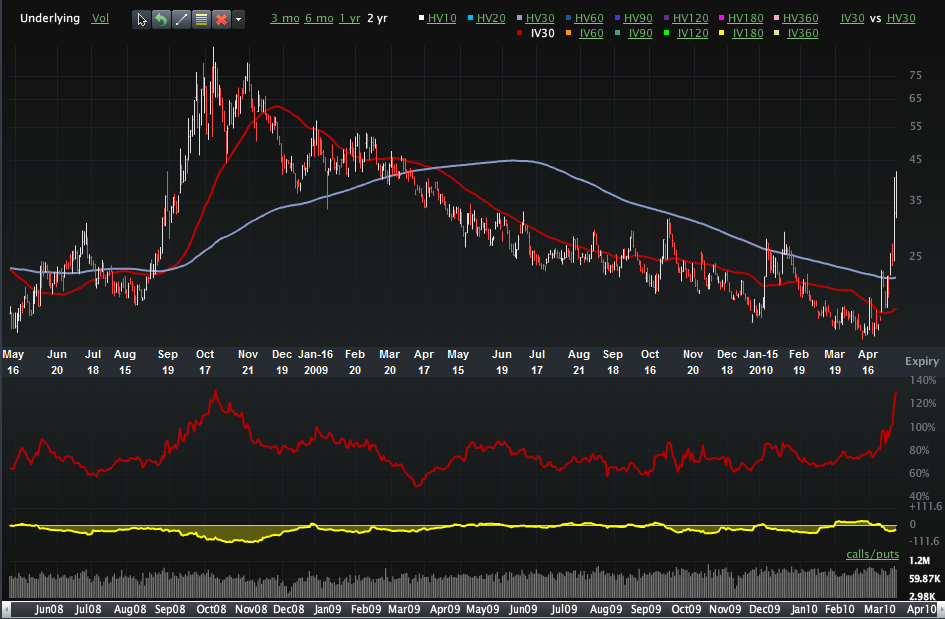
VIX options are attracting so much attention that the implied volatility of the VIX is currently at 133, which exceeds that high of 126 that was hit during the 2008 crisis. The obvious play here is to sell VIX calls, with short call spreads (bear call spreads) one way to limit risk.

For more on related subjects, readers are encouraged to check out:


[source: Livevol Pro]

Disclosure(s): short VIX at time of writing; ivevol is an advertiser on VIX and More

Monday, November 2, 2009

The VIX Spike Conundrum

I have been absolutely astonished by the number of comments I have seen in the past few days to the effect that right now is an excellent time to initiate new long positions on VIX options. I am still not sure what is behind most of this thinking, but it seems as if quite a few investors are excited about the VIX breakout, some have adopted a Roubiniesque pervasive pessimism and others clearly are still operating under the shadow of the 2008 volatility spikes.

For all those who think that a VIX spike of 50% is a good time to get long the VIX, my response is that your ship has already sailed.

I gave this post the title of The VIX Spike Conundrum because like a hot Chinese solar stock, a rising VIX seems to be attracting the momentum crowd. Betting that a 50% rise in the VIX is just the beginning of a larger move is a sucker’s bet. In the event that readers find the data in the two studies linked at the bottom of this post not to be sufficiently compelling, I have added a new study that looks at what happens to the VIX following the first time it spikes high enough to close above 30. Not surprisingly, it is yet another example of mean reversion at work.

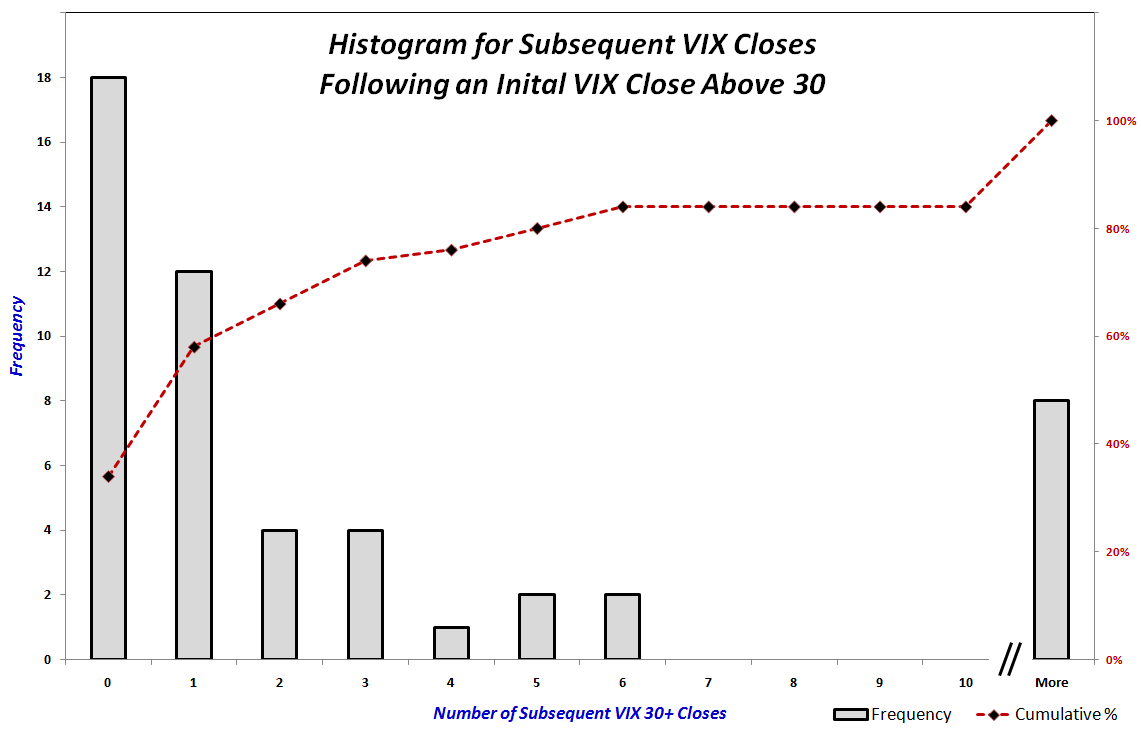
The graphic below is a histogram that summarizes the future VIX action after an initial close above 30. Of the 51 instances the VIX closed above 30 without having closed above 30 in the previous session, 18 times the VIX closed below 30 on the next day and an additional 12 instances reflect the VIX closing below 30 two days hence. This means that 59% of the time the VIX has surrendered the full distance of the close above 30 as well as some additional territory in just two days. Looking out four days, the VIX has already closed below 30 some 75% of the time, as is shown by the dotted red line.

Note that while 84.3% of the time the VIX has already closed below 30 just six days later, the remaining 15.7% of the instances can make or break a trader. Six times (11.8%) the VIX has remained above the 30 level for at least 23 consecutive days following the first close above 30. This is slightly more than one full options cycle. Prior to October 2008, traders who were short VIX calls could reasonably expect that the VIX was not going to spike any higher than 45, which was the all-time record in the VIX at that time. Now that we have had front row seats to witness the VIX spike above 80 on two separate occasions, I suspect investors overestimate the likelihood of a VIX spike of this magnitude happening again. Short of another acute systemic threat, I would be quite surprised to see the VIX rising over the 45 level.

In the current market environment, the odds favor short volatility positions, such as bear call spreads on the VIX. Long positions in VIX calls are not just low probability plays, but they are very expensive as well. I don’t mind, however, if speculators are eager to gobble these up, as I am glad to have a ready audience to buy some VIX calls.

For related posts on this subject, readers are encouraged to check out:

Disclosure: Short VIX at time of writing.

Wednesday, May 27, 2009

Using Options to Control Risk in Leveraged ETFs

Several readers noted that options on leveraged ETFs seemed like a recipe for disaster, as if no good could possibly come from piling leverage on top of leverage. While I certainly understand the sentiment, this type of thinking is typical of investors who have little or no experience in options. To the investor who is not versed in options, the options world often seems to be limited to an occasional covered call or an out-of-the-money call that is barely distinguishable from a lottery ticket – and seems to pay out just about as often.

In fact a large percentage of options traders are attracted to options because they are an excellent way to define, limit and manage risk. Yes, one can buy a put to provide protection for a long stock protection, but in the absence of owning the underlying (be it as stock, ETF, index or whatever), options traders are particularly fond of creating multi-leg options positions where the downside risk is known at the beginning of the trade and does not waver as long as the position is maintained.

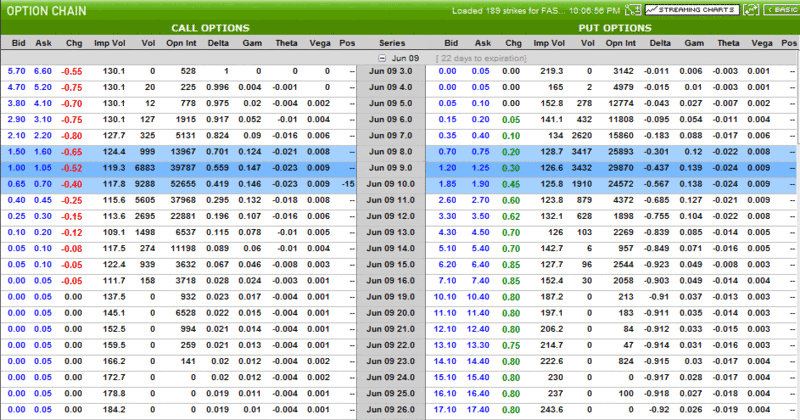
Getting back to leveraged ETFs, I have reproduced a portion of the options chain for FAS, perhaps the most notorious of the Direxion triple ETFs, in the table below. With a current mean implied volatility of 126, FAS is a highly volatile ETF. FAS is so volatile that even with only 17 trading days remaining in the June calls, it is possible to sell the June 15 calls, which are 70% out of the money, for 0.05. The June 11 calls, which are 24.4% out of the money, can be sold for 0.40.

In terms of risk management, let’s say that an investor does not believe that FAS is going to rise more than 24% in the next 3 ½ weeks, so he or she decides to sell the June 11 calls, but hedge that position by buying an equal amount of the June 13 calls at 0.15. This is a bear call spread and will net $25 for each option contract, with a maximum loss of $175 per contract (not including commissions). The trade makes money if FAS expires at 11.25 or less, which means that the position can absorb up to a 27.2% gain in FAS. The trade offers odds of 7-1 ($175 to $25) and the maximum risk is defined up front and cannot change during the life of the trade.

This is but one example of how options can limit the risk of trading triple ETFs. There are many other potential examples.

The bottom line is that options trades can be structured in such a manner that they are much less risky than stock trades, even if the options are on volatile securities such as triple ETFs.

[As an aside, readers may have noticed that up to this point I have somewhat standardized on the options tools and graphics available through optionsXpress. Going forward, I will make an effort do a better job of highlighting some of the tools and content available at various other options brokers in order to illustrate some of what is available to the reader and at the very minimum, provide more visual variety.]


[source: OptionsHouse]

Disclosure: Short FAS at time of writing.

Tuesday, February 10, 2009

Post-Geithner Financial Naked Calls

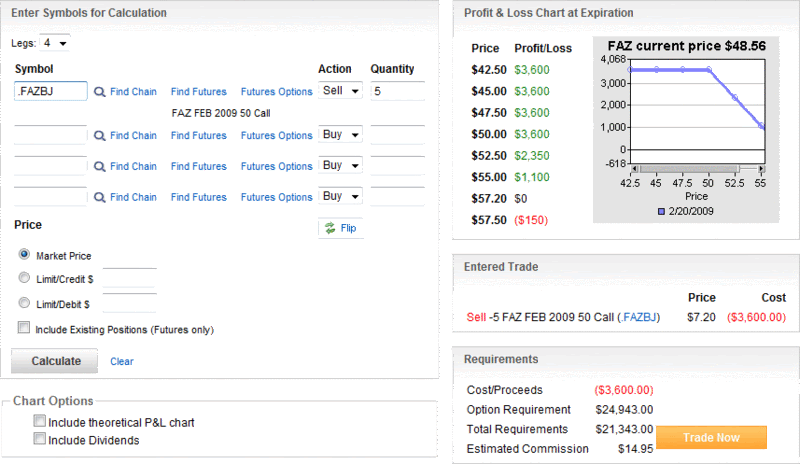
For the extremely aggressive (and well-capitalized) investor who believes volatility in financials is on the high side and may also have some bullish directional bias, something like a bear call spread with FAZ, the -3x financial ETF, might be an interesting trade to look at.

The truly fearless might even look at selling an out of the money FAZ naked call. As I write this, FAZ is trading with a 48 handle and a Feb 50 call sale will bring 7.20, which means there is room for almost 20% upside movement in the ETF before the trade turns unprofitable. Of course, with the likes of triple ETFs FAZ and FAS, 20% moves can happen in a matter of hours…

[source: optionsXpress]

Wednesday, October 15, 2008

Implied Volatility Over 150 in EWZ, the Brazil ETF

Truth be told, I could pick a ticker at random and have a compelling chart of implied volatility. Some, of course, are more compelling than others.

Take EWZ, for instance, the Brazil ETF. This resource-rich country has seen its ETF lose more than half of its value over the past year, coupled with a dramatic rise in volatility over the course of the past month.

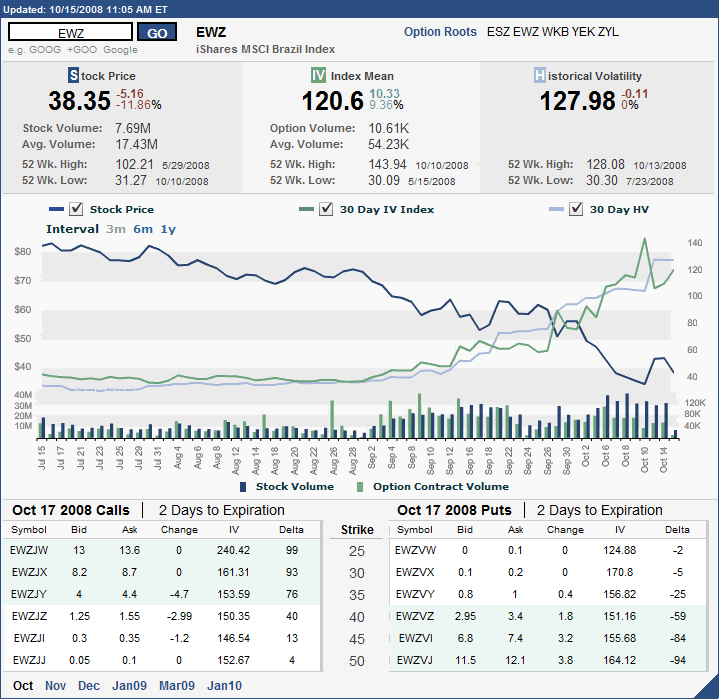
In the chart below, courtesy of the International Securities Exchange, one can discern that implied volatility and historical volatility had been hovering in the range of 40 even as the ETF trended down during the summer. Starting in early September, the increase in volume in both the ETF and the options hints than an even wilder ride is coming.

In fact, implied volatility spiked from 40 to over 140, with historical volatility making similar gains. At the moment, both mean IV and HV are over 120, with both the near the money calls and puts expiring at the end of the week showing implied volatility readings in excess of 150. This is country risk at extreme levels.

Those with a directional preference who are looking to limit risk in high volatility environments may wish to look at bear call spreads for a short bias and bull put spreads for a long bias.

[source: International Securities Exchange]

[Disclosure: long EWZ at time of writing]

Wednesday, October 31, 2007

Selling Fear with a DryShips Bear Call Spread

About a week and a half ago Condor Options suggested an excellent mantra for those whose investing universe is populated by the likes of fear, greed, implied volatility, and the VIX: “Sell your fear to somebody else!”

It’s a simple concept, really, and one that shares much of what I try to do with the VIX. The hard part, of course, is to have the composure to calmly sell fear while others are panicking to such as a degree as to threaten to drive the price of fear even higher.

One obvious way to implement the selling fear strategy would be to do something like sell VIX calls whenever the VIX rises 15% above its 10 day simple moving average.

Consider a similar approach for individual stocks. For example, Adam at Daily Options Report posted an implied volatility chart that shows how implied volatility in DryShips (DRYS) has increased almost 50% in the past few days, as the stock hit an air pocket and fell 14% in a matter of minutes, a feat captured and analyzed nicely by Tim Knight at The Slope of Hope. Buoyed by Cramer, the continued bull market, and other more benign forces, DRYS has rallied almost 10% today, but now has some new battle scars.

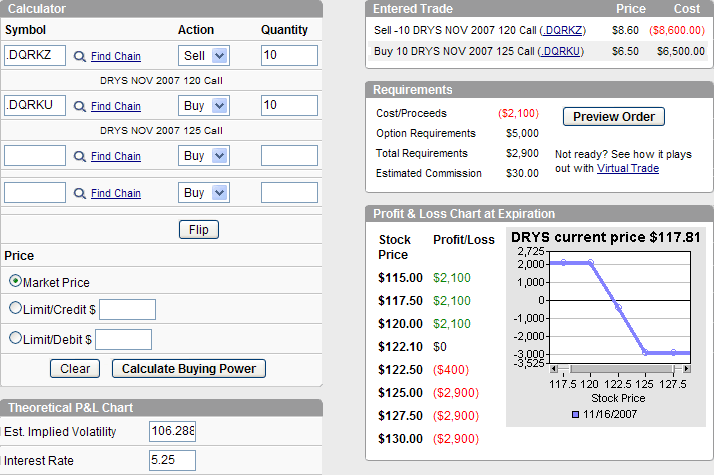
It is possible that DRYS has put in a top and is now broken and vulnerable to bear attacks. Then again, this may be just another brief moment in time where the rocket ship shifts gears (see Tim Knight’s historical perspective above) before accelerating to the moon. I’m not brave enough to be long or short DRYS at the moment, but I will sell volatility at the current level. There are many ways to do this, but one way to harvest premium is with a bear call spread (aka short call spread, vertical credit spread, etc.) Thanks to the prodding I have received from several readers, I have provided an example of a bear call spread trade below from optionsXpress. Note that the trade consists of selling slightly out of the money calls and hedging/reducing risk by buying an equal amount of calls that are farther out of the money at a lower price. This trade is done for a credit, with the difference in cash in the trader’s account up front. Time decay is on the side of the trader, but the position should be actively managed, so that losses can be cut if DRYS moves sharply over 120 and threatens to go after its previous 52 week high. This is a high risk trade (a split of 120/130 or 125/130 would decrease risk significantly), but a lot less risky than a directional play on a stock with a triple digit implied volatility.

Now, did someone say something about an FOMC meeting…?

Wednesday, February 14, 2007

Why is the VIX so Low?

A number of theories have been kicked around recently to explain why the VIX is at historical lows.

Justin Lahart re-ignited this debate with his comments in the WSJ yesterday in which he offered the explanation that:

“The VIX and other measures of implied volatility are low, in part, because investors are selling put and call options — ’selling volatility’ in Wall Street parlance. That helps to drive option prices — and implied volatility — even lower.”

Bernie Schaeffer takes issue with Lahart’s analysis this morning in www.SchaeffersResearch.com, arguing against both the low VIX theory and the likelihood that selling volatility is the cause. Schaeffer cites the recent extremely tight trading range of the OEX as proof that the VIX can go much lower. He also maintains that a large majority of the option activity in question has been initiated by buyers, not sellers.

Striking a similar note, Adam at the Daily Options Report draws comparisons between the current VIX and the range-bound VIX of the early to mid-1990, suggesting that the 10-15 range may be the natural long-term range of the VIX.

As mentioned previously in this space, Jason Goepfert of www.sentimentrader.com has attempted to reconstruct the VIX going back all the way to 1900 and believes that the current VIX readings are not particularly low by the historical standards of the past century.

Finally, in my first entry in this blog, I proposed that the VIX had moved in four macro cycles in the 14 years since it first appeared, with a typical length of 3-5 years per cycle. According to my analysis, the current cycle of decreasing volatility began in April 2002, so the five years will be up in another two months or so.

I have no prediction for what will happen to volatility two months from now and beyond, but I will do my best to use this blog to present the various theories of why the VIX is low and refine my own thinking as I go along. In the meantime, I will continue to fade any large spikes and continue to work the bear call spread angle.

Friday, February 9, 2007

Waiting for Godot

As I wait for volatility to return to the markets, I have an almost Waiting for Godot feeling about what lies ahead. At the moment, call me partly resigned and partly hopeful.

Fortunately, this is exactly where a bear call spread and call backspread can satisfy those two apparently conflicting views of volatility. You have to ask yourself two main questions before considering which strategy is the better fit for your view of the market:

· What do you think is the likelihood of a significant increase in volatility?

· If a volatility spike happens, how severe will it be?

If you are of the opinion that a volatility spike is unlikely and/or will not be severe, then you should harvest some of the implied volatility in the VIX with a bear call spread. This is a strategy that has been quite successful over the past 7 or so months, as Adam Warner at the Daily Options Report has pointed out on several occasions.

On the other hand, if you think Godot might eventually show up carrying a large volatility spike, you are willing to forego some of the premium to position yourself to cash in on that spike, then the call backspread is a better way to play the VIX. Of course, you can always buy the calls outright, but with VIX implied volatility currently at a very high level, you will have to paddle hard against the time decay current to make any progress.

For more information, optionsXpress (which generated the graphic on the left) has excellent discussions of the bear call spread and the call backspread. OptionPundit takes a deeper dive on both the bear call spread (aka vertical credit spread) and on call back spreads. These are both excellent resources for those whose options experience consists largely of buying calls and puts outright and selling covered calls – and who are open to more advanced options strategies.

DISCLAIMER: "VIX®" is a trademark of Chicago Board Options Exchange, Incorporated. Chicago Board Options Exchange, Incorporated is not affiliated with this website or this website's owner's or operators. CBOE assumes no responsibility for the accuracy or completeness or any other aspect of any content posted on this website by its operator or any third party. All content on this site is provided for informational and entertainment purposes only and is not intended as advice to buy or sell any securities. Stocks are difficult to trade; options are even harder. When it comes to VIX derivatives, don't fall into the trap of thinking that just because you can ride a horse, you can ride an alligator. Please do your own homework and accept full responsibility for any investment decisions you make. No content on this site can be used for commercial purposes without the prior written permission of the author. Copyright © 2007-2023 Bill Luby. All rights reserved.
 
Web Analytics