Showing posts with label FAS. Show all posts

Thursday, August 12, 2010

Surfing for Weekly Buy-Write Trades

One half hour into today’s trading, I would expect to see some evidence that the recent spike in volatility in stocks is subsiding. That seems to be the case, as the VIX opened at 27.21 and is now just over 26.00.

Before volatility falls any farther, I will be looking at some possible or buy-write (covered call) trades with the new weekly options that are expiring tomorrow.

When I screen for buy-write candidates, I generally start with a screen for the highest implied volatility stocks, ETFs and indices, then qualify these on liquidity terms, examine the proximity of the current price relative to the various strike prices, then review the charts for some of the finalists and add some sort of secret sauce at the end to come up with trades that fit my objectives.

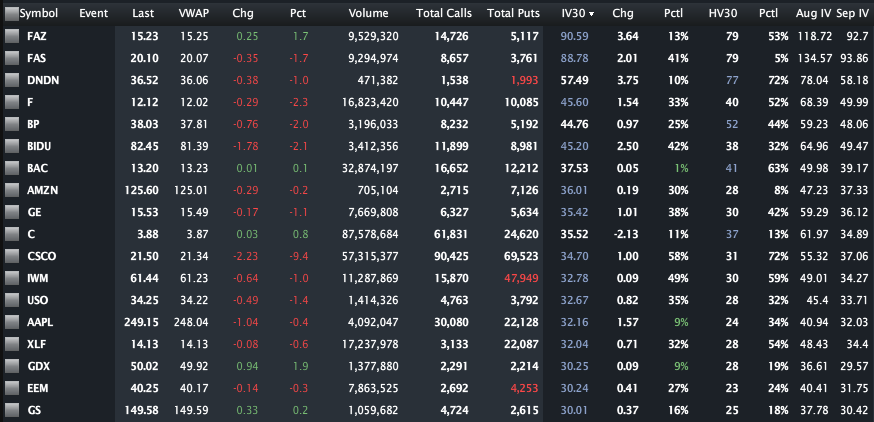
In the graphic below, I have included all of the weekly options in which the underlying has an implied volatility is at least 30. The list has 18 candidates and prominently atop that list is the triple ETF pair for the financial sector: FAS and FAZ. Going down the list, Ford (F) and Bank of America (BAC) show excellent liquidity, while Apple (AAPL) is hovering just under an important round number and strike.

Enterprising souls may even consider buy-writes on both FAS and FAZ.

Volatility is up and the end of the week is nearing. Anyone looking at a buy-write strategy should take a close look at earnings for today and tomorrow which may impact the market, as well as a number of economic reports due out tomorrow morning, most notably the July retail sales data.

For more on related subjects, readers are encouraged to check out:


[source: Livevol Pro]

Disclosure(s): short VIX at time of writing; Livevol is an advertiser on VIX and More

Wednesday, July 8, 2009

Options Available for New S&P 500 Triple ETFs

Though they are less than two weeks old, the two new triple ETFs based on the S&P 500 index already have options available to trade. The bullish 3x ETF, Ultra ProShares (UPRO) has July options that expire one week from Friday with strikes from 60 to 95, including single dollar increments from 80 through 90. The bearish -3x Short ProShares (SPXU) has options available from 70 to 95, with all the strikes in single dollar increments.

In anticipation of a broad range of applications and the potential for some significant movement, the strikes for the December options range all the way from 30 to 140 for UPRO and from 40 to 150 for SPXU.

While both of these triple ETFs have been attracting more volume each day, neither has managed to break the million share mark yet. I anticipate that we will begin to see million share days in each of these ETFs next week and shortly thereafter, UPRO and SPXU will begin to trade in the volumes currently associated with leveraged ETF pairs such as FAS/FAZ and SSO/SDS.

As these triple ETFs are based on the same underlying as the VIX, an entire new genus of trading strategies is being hatched as I write this…

Monday, July 6, 2009

Direxion Announces Reverse Splits for FAS and FAZ

Direxion formally announced today what has been rumored for awhile now, that its two most popular triple ETFs, FAS and FAZ, will undergo reverse splits after the close of trading on Wednesday, July 8th.

FAS (financial 3x ETF), which closed Friday at 8.34, will split 1-for-5, while FAZ (financial -3x ETF), which closed Friday at 5.13 will split 1-for-10.

For more details, check out the Direxion press release.

Tuesday, June 30, 2009

FAS Is Now XLF

For someone who gets a kick out of volatility, the arrival of triple ETFs has been a little bit like manna from heaven. Of course the launch of the Direxion triple ETFs back in early November just happened to coincide with the highest VIX readings in history. There is nothing like record volatility, except perhaps record volatility times three.

But a lot has changed since November. The VIX traded in the 80s the month it was launched; today it was as low as 25.02. At the moment the VIX is exactly 1/3 as high as it was when it peaked in November at 81.38. For those who have been selling options, the ride down the volatility slide has been an unusually profitable one. In fact, it is likely that some of the premiums harvested in the last nine months or so will turn out to be the most bloated we will see in our trading lifetimes.

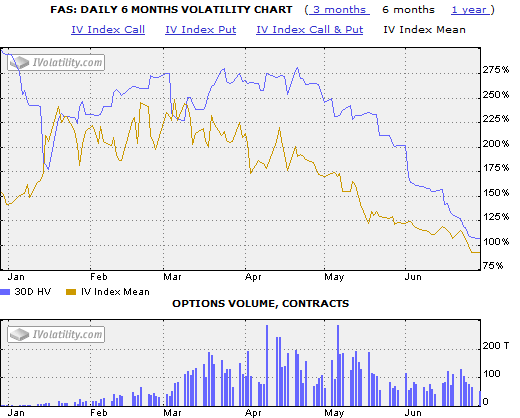
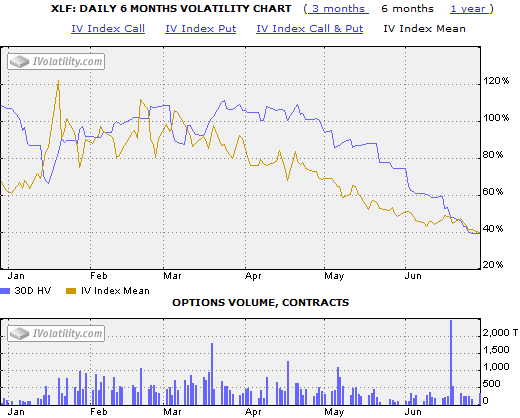
My personal interest in the triple ETFs notwithstanding, these vehicles have received mixed reviews, largely because their suitability as buy and hold investments degrades rapidly after just one trading session – with the problems exacerbated by increases in volatility. On the flip side, the recent decrease in volatility has muted some of the tracking and compounding errors inherent in leveraged ETFs. In fact, in the current environment, the 3x and -3x ETFs are starting to look somewhat tame relative to their history. The two charts below show the (30 day) historical volatility (purple line) and implied volatility (gold line) of the most popular financial sector ETF, XLF, and the 3x financial sector ETF that has taken the trading world by storm, FAS. While there are a number of interesting conclusions to be drawn from these charts, the point I wish to make is that current historical and implied volatility for FAS (top chart) is hovering around the 100 mark, which is about where HV and IV were for XLF (bottom chart) in February, March and April. In other words, the 3x ETF FAS is no more volatile or has more uncertainty in its stock price now than XLF did during the period from October through April. Tracking error aside, FAS is now effectively the ghost of XLF.

[source: iVolatility]

Wednesday, May 27, 2009

Using Options to Control Risk in Leveraged ETFs

Several readers noted that options on leveraged ETFs seemed like a recipe for disaster, as if no good could possibly come from piling leverage on top of leverage. While I certainly understand the sentiment, this type of thinking is typical of investors who have little or no experience in options. To the investor who is not versed in options, the options world often seems to be limited to an occasional covered call or an out-of-the-money call that is barely distinguishable from a lottery ticket – and seems to pay out just about as often.

In fact a large percentage of options traders are attracted to options because they are an excellent way to define, limit and manage risk. Yes, one can buy a put to provide protection for a long stock protection, but in the absence of owning the underlying (be it as stock, ETF, index or whatever), options traders are particularly fond of creating multi-leg options positions where the downside risk is known at the beginning of the trade and does not waver as long as the position is maintained.

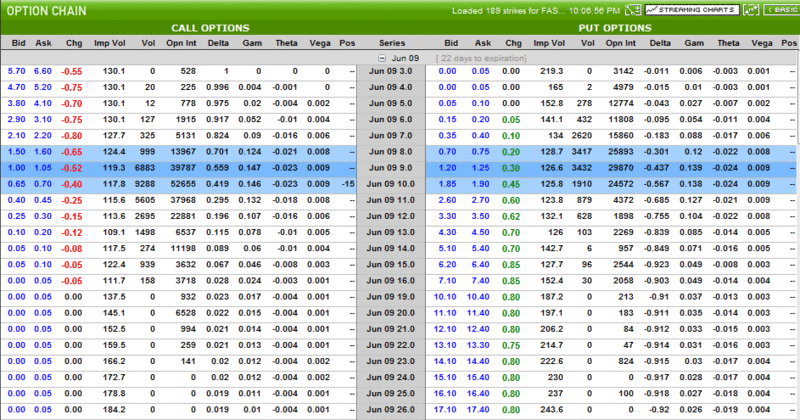
Getting back to leveraged ETFs, I have reproduced a portion of the options chain for FAS, perhaps the most notorious of the Direxion triple ETFs, in the table below. With a current mean implied volatility of 126, FAS is a highly volatile ETF. FAS is so volatile that even with only 17 trading days remaining in the June calls, it is possible to sell the June 15 calls, which are 70% out of the money, for 0.05. The June 11 calls, which are 24.4% out of the money, can be sold for 0.40.

In terms of risk management, let’s say that an investor does not believe that FAS is going to rise more than 24% in the next 3 ½ weeks, so he or she decides to sell the June 11 calls, but hedge that position by buying an equal amount of the June 13 calls at 0.15. This is a bear call spread and will net $25 for each option contract, with a maximum loss of $175 per contract (not including commissions). The trade makes money if FAS expires at 11.25 or less, which means that the position can absorb up to a 27.2% gain in FAS. The trade offers odds of 7-1 ($175 to $25) and the maximum risk is defined up front and cannot change during the life of the trade.

This is but one example of how options can limit the risk of trading triple ETFs. There are many other potential examples.

The bottom line is that options trades can be structured in such a manner that they are much less risky than stock trades, even if the options are on volatile securities such as triple ETFs.

[As an aside, readers may have noticed that up to this point I have somewhat standardized on the options tools and graphics available through optionsXpress. Going forward, I will make an effort do a better job of highlighting some of the tools and content available at various other options brokers in order to illustrate some of what is available to the reader and at the very minimum, provide more visual variety.]


[source: OptionsHouse]

Disclosure: Short FAS at time of writing.

Tuesday, February 10, 2009

Some Early Thoughts on the Performance of VXX, the VIX Short-Term ETN

VXX, the iPath S&P 500 VIX Short-Term Futures (1 month) ETN, has now been traded for all of eight sessions. No one in their right mind would attempt to draw some conclusions on so little data, would they? Well, right-minded or not, I am always up for a challenge.

In no particular order, here are some factoids from those first eight sessions with the new VIX ETN:

  • in eight days, VXX has averaged 204,751 shares (for comparison purposes, FAS, which traded 160 million shares today, averaged 127,851 shares in its first eight days)

  • for seven of the eight days, VXX has moved in the same direction as the VIX (on Monday, 2/2, VXX fell while the VIX rose)

  • on three of the eight days (Thursday through yesterday), VXX has registered a larger move in percentage terms than the VIX

  • on average (mean, median, etc.) VXX has been moving at a rate of about 85% of the VIX

  • the average intraday range for VXX is (4.51%), with a maximum of 6.93% today and a minimum of 2.51% yesterday

  • so far the ratio of the VIX to VXX has hovered around .439

Post-Geithner Financial Naked Calls

For the extremely aggressive (and well-capitalized) investor who believes volatility in financials is on the high side and may also have some bullish directional bias, something like a bear call spread with FAZ, the -3x financial ETF, might be an interesting trade to look at.

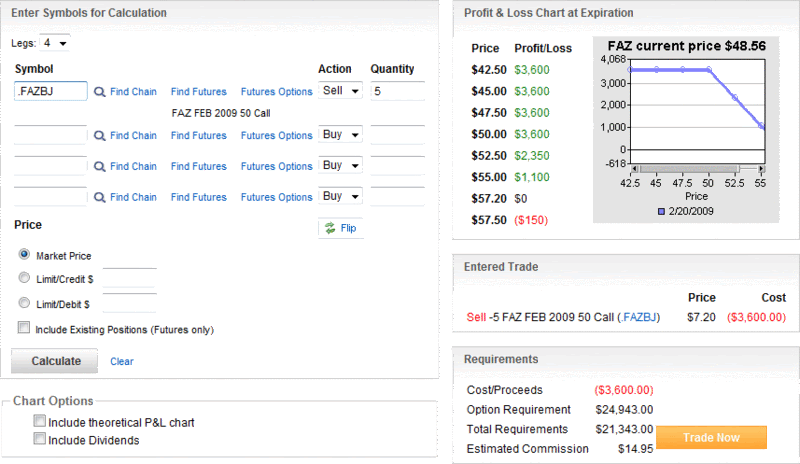
The truly fearless might even look at selling an out of the money FAZ naked call. As I write this, FAZ is trading with a 48 handle and a Feb 50 call sale will bring 7.20, which means there is room for almost 20% upside movement in the ETF before the trade turns unprofitable. Of course, with the likes of triple ETFs FAZ and FAS, 20% moves can happen in a matter of hours…

[source: optionsXpress]

Wednesday, February 4, 2009

Why Is There So Little Volume in the Most Recent Direxion ETFs?

It seems as if every day trader I know has fallen under the spell of the leveraged firepower of the Direxion triple ETFs. Oddly, only the first batch of ETFs that were rolled out in November have caught fire. These include the familiar tickers like FAS, FAZ, TNA, TZA, BGU, BGZ, ERX and ERY.

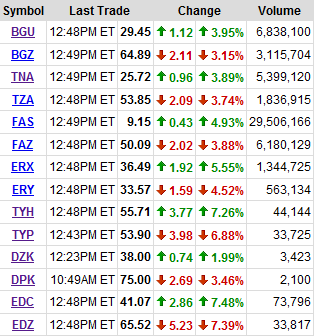
The most recent group of ETFs, which I discussed in Direxion Triple ETFs Add New Horses to Stable, has attracted considerably less interest. Even though they were launched at the end of December, only two of the six ETFs, EDC and TYH, have surpassed the 100,000 single day volume mark and TYH just grazed that bar, with a high volume mark of 101,900. In the chart below, a snapshot taken just past the halfway point of today’s session, the six new ETFs can be seen floundering at the bottom.

Juice is not the problem, as emerging markets (EDC and EDZ) and technology (TYH and TYP) are consistently among the most volatile corners of the market.

The comments on yesterday’s semi-rhetorical question we excellent. Let’s see what sort of explanation the collective wisdom can come up with today.

[source: Yahoo]

Friday, January 30, 2009

First Day of Trading in VXX and VXZ a Success

The first day of trading in the VIX ETNs was an unqualified success. Volume in the iPath S&P 500 VIX Short-Term Futures (1 month) ETN (VXX) hit 215,700 shares, while its 5 month counterpart, (VXZ), traded 73,900 shares.

To put these numbers in perspective, on the first day the Direxion triple ETFs were traded (in early November 2008), they registered volumes of 19,063 (BGU), 30,783 (TNA) and 10,313 (FAS). Less than three months later the least popular of the three ETFs is now consistently trading more than 10 million shares per day.

While predicting success for the Direxion ETFs looked like a no-brainer for me, the idiosyncrasies of the VIX and the VIX ETNs means that it is more difficult to guarantee superstar status for today’s new market entrants, even if they had a more impressive opening day. It may take a while, for instance, for investors to decide whether the new VIX ETNs are best suited to day trading, pairs trading, hedging, arbitrage or other strategies, but clearly VXX and VXZ have the potential to be in the top tier of the ETF/ETN trading vehicles.

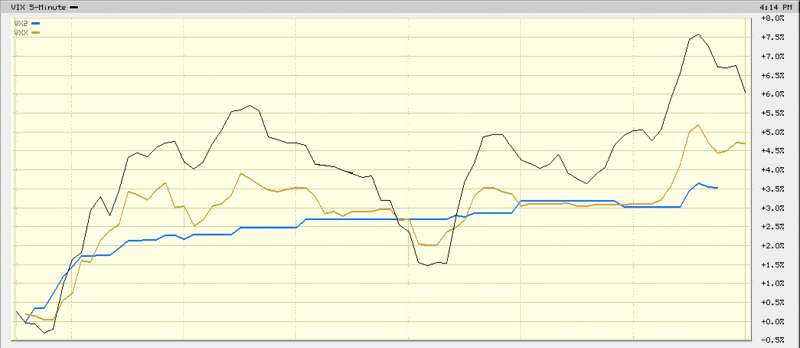
In terms of relative price movement, the chart below highlights the differences between the most volatile cash/spot VIX (black line), the less volatile VXX (gold line), and the comparatively sluggish VXZ (blue line). At different times during the day, VXX moved at about 50-80% of the rate of the VIX. Not surprisingly, the longer-term sibling, VXZ, captured the overall upward trend in volatility, but was reluctant to reverse direction.

It is always difficult to draw meaningful conclusions from one day of data, but now that there are finally some VIX ETN data points to talk about, at least we can begin to extrapolate in the direction of a statistically significant universe.

[source: BigCharts]

Friday, December 12, 2008

Are FAS Options Cheap with an Implied Volatility of 232?

Generally the thought of buying some options on the cheap is not consistent with an implied volatility (IV) of 232.

Today, I have a counterexample to consider.

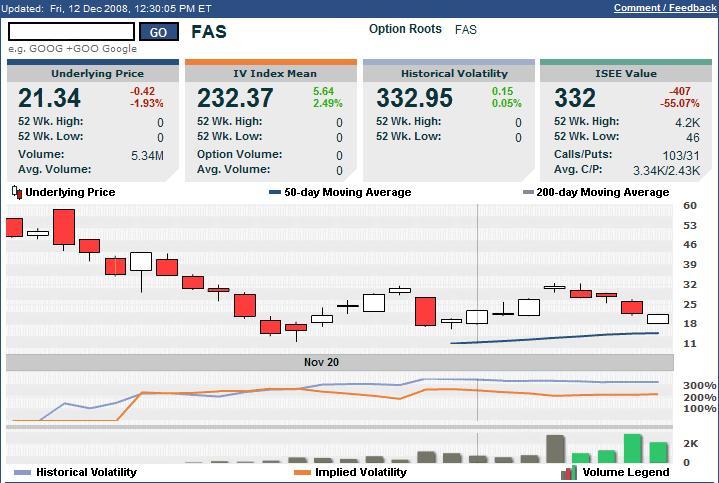
Take the case of FAS, one of the new Direxion triple leverage ETFs. FAS is intended to track 300% of the price performance of the Russell 1000 Financial Services Index. In the recent market environment this has proven to be a daunting task, resulting in FAS racking up a 30 day historical volatility number of 332 – a full 100 points higher than the current implied volatility.

In practical terms, an IV of 232 translates into an anticipated average change of 14.6% per day. For comparison purposes, an IV of 332 translates into an average daily move of 21%. So far the mean one day change in closing prices for FAS has been 17.4%. Looking at recent history, an implied volatility of 232 may turn out to be a bargain and options in FAS may not be as expensive as they look…


[source: International Securities Exchange]

Friday, November 14, 2008

Prediction: Direxion Triple ETFs Will Revolutionize Day Trading

I promised myself that once the new Direxion 3x and -3x ETFs started trading at least a million shares a day that I would take them out for a test drive. Well, I didn’t have to wait very long. Launched just last week, two of the eight new ETFs hit the million share mark yesterday and a third missed only by a rounding error.

To recap for those who do not follow this space, Direxion is the first company to offer ETFs that have a targeted return which is leveraged to three times and minus three times that of the underlying indices. So far the biggest successes have been the large cap 3x bull (BGU) and large cap -3x bear (BGZ) ETFs, which are based on the Russell 1000 index. Also proving popular are the small cap 3x bull (TNA) and small cap -3x bear (TZA) ETFs, which follow the Russell 2000 index.

The sector ETFs are off to a slower start. These include the large cap 3x bull (FAS) and large cap -3x bear (FAZ) based on the Russell 1000 financial services index; and the large cap 3x bull (ERX) and large cap bear (ERY) based on the Russell 1000 energy index.

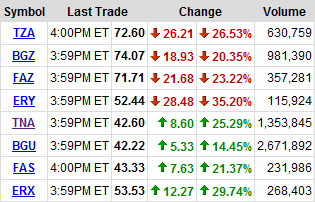
A look at the table below of yesterday’s results shows that these ETFs are like nuclear weapons when it comes to volatility. The average change in these eight ETFs yesterday was a 25% difference from the previous day’s close. ERY closed at 52.44 yesterday. Not only did it lose 28.48 points, but its intra-day range was 35.06 points. It is only a slight exaggeration to say that you can sneeze and miss your position losing ten points. Needless to say, these super-charged ETFs are not for everyone. If you like to go skydiving, keep a pet alligator in the bathtub, and dream of a winter king crab fishing in the Bering Strait, then you will be right at home with the Direxion ETFs.

As I traded these for the first time on yesterday, several interesting things happened. First, just entering a position was an adventure, almost like trying to jump in a Lamborghini while it sped by at 120 mph. I immediately went into position management mode, because the value of my ETF was changing so quickly that it required my full attention. Very quickly, I realized that one cannot trade these triple ETFs without finely honed trading rules and an iron will to act on them at all costs. In this world, there is no room for hoping. Any sort of “it will come back” thinking could quickly turn a 5% loss into a devastating 20% loss. Ironically, the high volatility of these ETFs forces the trader to rely on (or learn) tight trading discipline.

Retail investors might want to take these ETFs out for a test drive too, but be forewarned that there is a disaster scenario looming around every corner. For these very same reasons, I anticipate that hedge funds currently day trading options will find these ETFs to their liking, particularly as volume and liquidity improve. In a deleveraging world, this is one way to stock up on “off balance sheet leverage” and get the extra juice without having to commit to the extra margin.

Not that extra leverage is usually a good thing…

[source: Yahoo]

DISCLAIMER: "VIX®" is a trademark of Chicago Board Options Exchange, Incorporated. Chicago Board Options Exchange, Incorporated is not affiliated with this website or this website's owner's or operators. CBOE assumes no responsibility for the accuracy or completeness or any other aspect of any content posted on this website by its operator or any third party. All content on this site is provided for informational and entertainment purposes only and is not intended as advice to buy or sell any securities. Stocks are difficult to trade; options are even harder. When it comes to VIX derivatives, don't fall into the trap of thinking that just because you can ride a horse, you can ride an alligator. Please do your own homework and accept full responsibility for any investment decisions you make. No content on this site can be used for commercial purposes without the prior written permission of the author. Copyright © 2007-2023 Bill Luby. All rights reserved.
 
Web Analytics