Showing posts with label counterparty risk. Show all posts

Wednesday, May 27, 2009

Using Options to Control Risk in Leveraged ETFs

Several readers noted that options on leveraged ETFs seemed like a recipe for disaster, as if no good could possibly come from piling leverage on top of leverage. While I certainly understand the sentiment, this type of thinking is typical of investors who have little or no experience in options. To the investor who is not versed in options, the options world often seems to be limited to an occasional covered call or an out-of-the-money call that is barely distinguishable from a lottery ticket – and seems to pay out just about as often.

In fact a large percentage of options traders are attracted to options because they are an excellent way to define, limit and manage risk. Yes, one can buy a put to provide protection for a long stock protection, but in the absence of owning the underlying (be it as stock, ETF, index or whatever), options traders are particularly fond of creating multi-leg options positions where the downside risk is known at the beginning of the trade and does not waver as long as the position is maintained.

Getting back to leveraged ETFs, I have reproduced a portion of the options chain for FAS, perhaps the most notorious of the Direxion triple ETFs, in the table below. With a current mean implied volatility of 126, FAS is a highly volatile ETF. FAS is so volatile that even with only 17 trading days remaining in the June calls, it is possible to sell the June 15 calls, which are 70% out of the money, for 0.05. The June 11 calls, which are 24.4% out of the money, can be sold for 0.40.

In terms of risk management, let’s say that an investor does not believe that FAS is going to rise more than 24% in the next 3 ½ weeks, so he or she decides to sell the June 11 calls, but hedge that position by buying an equal amount of the June 13 calls at 0.15. This is a bear call spread and will net $25 for each option contract, with a maximum loss of $175 per contract (not including commissions). The trade makes money if FAS expires at 11.25 or less, which means that the position can absorb up to a 27.2% gain in FAS. The trade offers odds of 7-1 ($175 to $25) and the maximum risk is defined up front and cannot change during the life of the trade.

This is but one example of how options can limit the risk of trading triple ETFs. There are many other potential examples.

The bottom line is that options trades can be structured in such a manner that they are much less risky than stock trades, even if the options are on volatile securities such as triple ETFs.

[As an aside, readers may have noticed that up to this point I have somewhat standardized on the options tools and graphics available through optionsXpress. Going forward, I will make an effort do a better job of highlighting some of the tools and content available at various other options brokers in order to illustrate some of what is available to the reader and at the very minimum, provide more visual variety.]
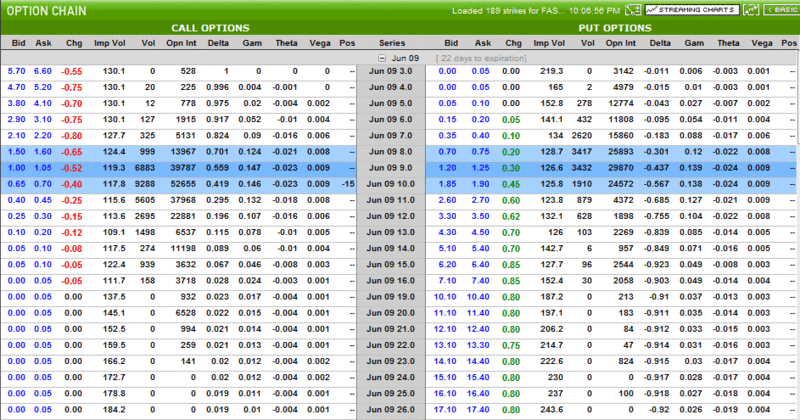

[source: OptionsHouse]

Disclosure: Short FAS at time of writing.

Monday, March 2, 2009

Three Fear Indicators (or…The Three Baritones)

While the VIX gets most of the media attention as a fear indicator, its usefulness is clearly much better for volatility related to U.S. equities than it is for other asset classes and economic threats.

The TED spread received considerable acclaim in 2008 as measure of liquidity and a reasonable proxy for counterparty risk. Of course gold had been around the longest of all and has served as a barometer of risk for all types of investments and other risks for centuries.

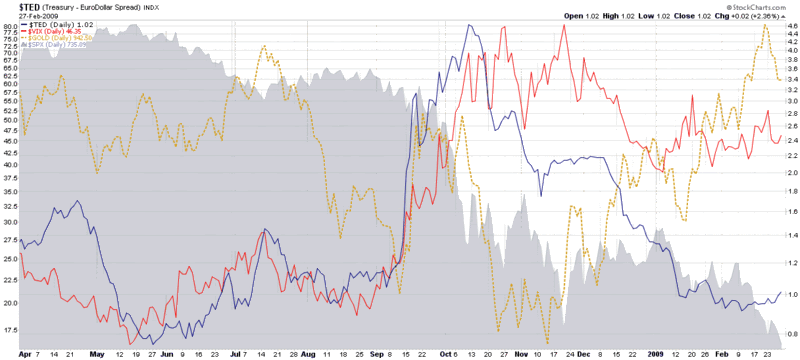
In the chart below, I have overlain the VIX, TED spread and gold against a backdrop of a declining SPX for the past year. Note that the TED spread peaks first among the three, during the second week in October, and subsides rather quickly, as liquidity issues recede to the background. The VIX is next to peak, but it too begins to head down toward the end of November as fears of systemic meltdown slowly begin to subside.

The most interesting line on the chart is that price of gold, which actually bottomed in mid-November and has risen sharply over the past three months, partly as a safe haven for panicky investors, but also as a hedge against the risk of inflation due to various fiscal policy approaches that governments are taking in order to rejuvenate the economy.

In summary, the TED spread has retraced its entire September-October spike, the VIX has retraced about half of its September-November spike, and gold appears to have paused after retracing about 20% of its November-February move. The TED spread and the VIX look like old news at the moment, with the possibility that gold may be the best fear indicator for current market conditions.

[source: StockCharts]

Tuesday, September 16, 2008

CDR Counterparty Risk Index Swamps March High

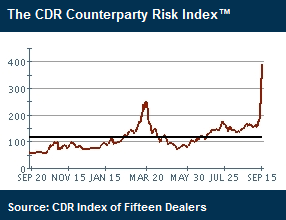
Credit Derivatives Research has a Counterparty Risk Index (and a number of related sub-indices) which calculates the average credit spread of the 15 largest credit derivative dealers. Following the recent turmoil in the credit markets, the index now stands more than 50% higher than the previous March 2008 high.

Not surprisingly, the Markit CDX (credit default swap) indices are seeing similar spikes.

[graphic courtesy of Credit Derivatives Research]

DISCLAIMER: "VIX®" is a trademark of Chicago Board Options Exchange, Incorporated. Chicago Board Options Exchange, Incorporated is not affiliated with this website or this website's owner's or operators. CBOE assumes no responsibility for the accuracy or completeness or any other aspect of any content posted on this website by its operator or any third party. All content on this site is provided for informational and entertainment purposes only and is not intended as advice to buy or sell any securities. Stocks are difficult to trade; options are even harder. When it comes to VIX derivatives, don't fall into the trap of thinking that just because you can ride a horse, you can ride an alligator. Please do your own homework and accept full responsibility for any investment decisions you make. No content on this site can be used for commercial purposes without the prior written permission of the author. Copyright © 2007-2023 Bill Luby. All rights reserved.
 
Web Analytics