Showing posts with label BGU. Show all posts

Tuesday, January 5, 2010

Triple ETF Options Landscape One Month After New Margin Rules

On December 1st, the Financial Industry Regulatory Authority (FINRA) implemented more stringent margin requirements for leveraged ETFs in Increased Margin Requirements for Leveraged Exchange-Traded Funds and Associated Uncovered Options.

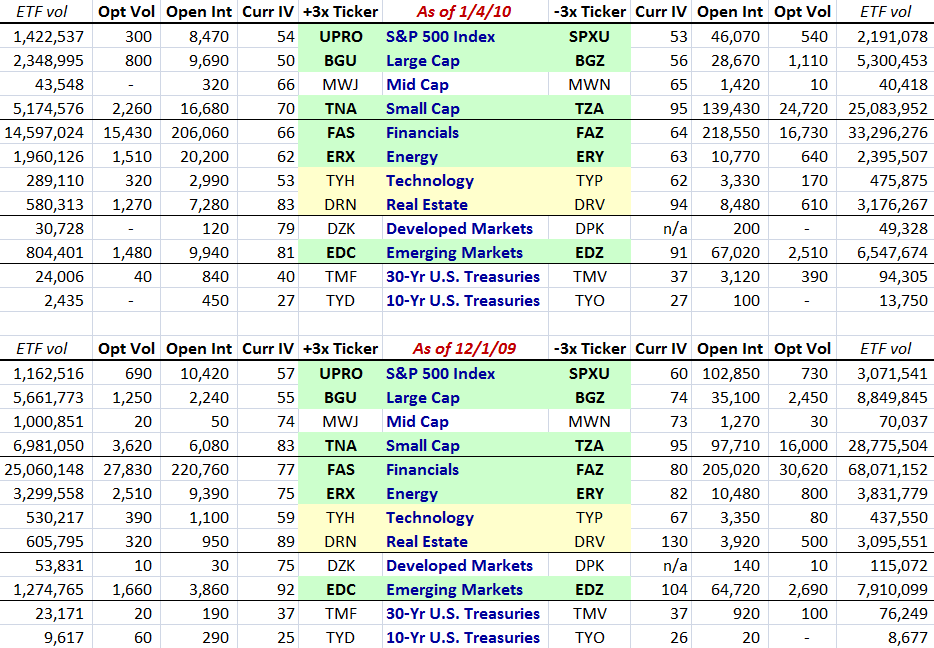
On that day, I updated my table of all the optionable triple ETFs and now that one month has passed, I thought it might be interesting to see how the activity in these ETFs and their options may have been affected by the new margin requirements.

Using data from iVolatility.com, I have captured the highlights below. While not shown here, I should note that in the almost three months from my previous update on September 9th to December 1st, four different triple ETF pairs (UPRO/SPXU, TNA/TZA, DRN/DRV and EDC/EDZ) showed substantial growth in volumes and every single pair showed some signs of increased interest -- so triple ETFs had significant momentum when the new margin rules were implemented. This time around, however, the only notable growth has been in the long bond pair, TMF and TMV, which admittedly comes off of a very small base. Also, there are signs that the large cap pair (BGU/BGZ) and the developed markets pair (DZK/DPK), are starting to lose traction.

Of course, we will never know whether interest in triple ETFs might have plateaued without the FINRA rules, but it is fair to say that FINRA has now stopped the growth momentum of triple ETFs in their tracks.

I will leave it for readers to pick through the data for some other interesting observations, but I would be remiss in not noting that the bear ETF implied volatility has dropped much faster that the bull ETF implied volatility almost across the board.

For the two previous posts in this series, readers are encouraged to check out:
[source: iVolatility.com]

Disclosure: none

Wednesday, February 4, 2009

Why Is There So Little Volume in the Most Recent Direxion ETFs?

It seems as if every day trader I know has fallen under the spell of the leveraged firepower of the Direxion triple ETFs. Oddly, only the first batch of ETFs that were rolled out in November have caught fire. These include the familiar tickers like FAS, FAZ, TNA, TZA, BGU, BGZ, ERX and ERY.

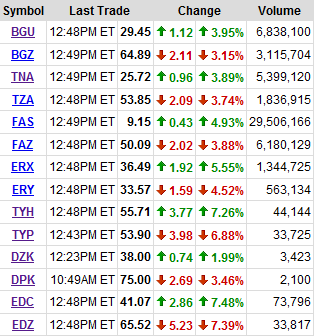
The most recent group of ETFs, which I discussed in Direxion Triple ETFs Add New Horses to Stable, has attracted considerably less interest. Even though they were launched at the end of December, only two of the six ETFs, EDC and TYH, have surpassed the 100,000 single day volume mark and TYH just grazed that bar, with a high volume mark of 101,900. In the chart below, a snapshot taken just past the halfway point of today’s session, the six new ETFs can be seen floundering at the bottom.

Juice is not the problem, as emerging markets (EDC and EDZ) and technology (TYH and TYP) are consistently among the most volatile corners of the market.

The comments on yesterday’s semi-rhetorical question we excellent. Let’s see what sort of explanation the collective wisdom can come up with today.

[source: Yahoo]

Friday, January 30, 2009

First Day of Trading in VXX and VXZ a Success

The first day of trading in the VIX ETNs was an unqualified success. Volume in the iPath S&P 500 VIX Short-Term Futures (1 month) ETN (VXX) hit 215,700 shares, while its 5 month counterpart, (VXZ), traded 73,900 shares.

To put these numbers in perspective, on the first day the Direxion triple ETFs were traded (in early November 2008), they registered volumes of 19,063 (BGU), 30,783 (TNA) and 10,313 (FAS). Less than three months later the least popular of the three ETFs is now consistently trading more than 10 million shares per day.

While predicting success for the Direxion ETFs looked like a no-brainer for me, the idiosyncrasies of the VIX and the VIX ETNs means that it is more difficult to guarantee superstar status for today’s new market entrants, even if they had a more impressive opening day. It may take a while, for instance, for investors to decide whether the new VIX ETNs are best suited to day trading, pairs trading, hedging, arbitrage or other strategies, but clearly VXX and VXZ have the potential to be in the top tier of the ETF/ETN trading vehicles.

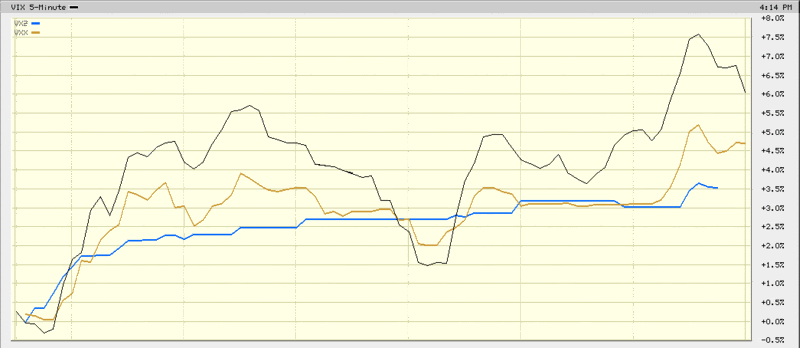
In terms of relative price movement, the chart below highlights the differences between the most volatile cash/spot VIX (black line), the less volatile VXX (gold line), and the comparatively sluggish VXZ (blue line). At different times during the day, VXX moved at about 50-80% of the rate of the VIX. Not surprisingly, the longer-term sibling, VXZ, captured the overall upward trend in volatility, but was reluctant to reverse direction.

It is always difficult to draw meaningful conclusions from one day of data, but now that there are finally some VIX ETN data points to talk about, at least we can begin to extrapolate in the direction of a statistically significant universe.

[source: BigCharts]

Wednesday, December 10, 2008

Is the SPX Going to Stick Close to 900?

It is generally my intent at VIX and More not to recommend specific trades, but to highlight different ways to think about volatility. With that in mind, consider that during the past three days, the S&P 500 index (SPX) has straddled the 900 level in the closest thing to a sideways trading range since August.

Since the November 21st low, I have been anticipating that the SPX would settle in a trading range of 820-980. So far the SPX has not traded north of 920, but I would not be surprised to see this happen.

What is even more interesting is the possibility that the SPX might start to feel some gravitational pull around the 900 mark and start trading in an even narrower range, with the 900 area becoming a No Man’s Land of sorts.

If the No Man’s Land scenario plays out even for just the next seven days, it is possible to lock in some nice gains with a straddle (or strangle, condor, butterfly, etc.) on the SPX, the SPY, or one of the leveraged variants.

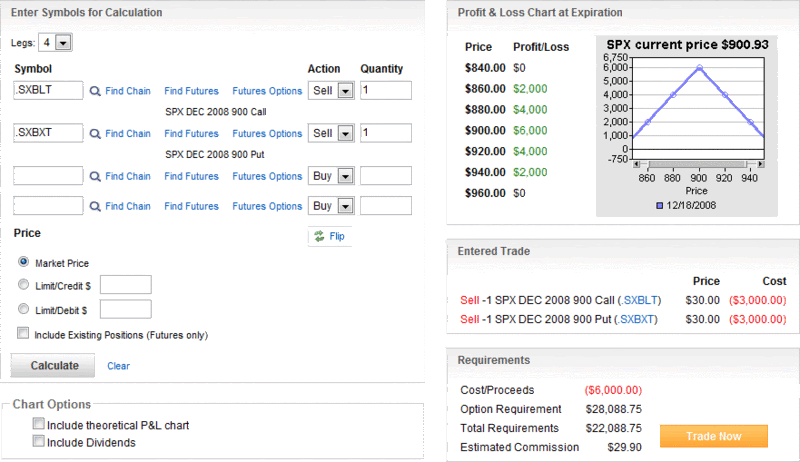
As the graphic below from optionsXpress shows, the bet is essentially that the SPX will remain in a range of 60 points in either direction (a little less than 7%) in a little less than 7 trading days. The bottom line: seven percent in seven days. Volatility tends to decrease during the holidays, which would be a positive factor for those who choose to sell volatility.

If you are thinking about how one of the new 3x ETFs might play out in a similar trade, BGU is currently trading near 36 as I type this and a short straddle would be profitable in a range of about 28 to 42 – essentially a range of 20% in either direction.

[source: optionsXpress]

Monday, December 8, 2008

The Direxion Triple ETF Revolution Has Arrived!

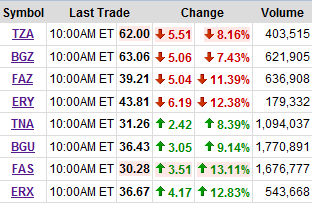
Three weeks ago last Friday I thought I may be sticking my head out a little too far in Prediction: Direxion Triple ETFs Will Revolutionize Day Trading. Well, here we are barely three weeks later and these triple ETFs are racking up more volume in the first half hour of today’s session than they did in an entire trading day when I made my original prediction. (see graphic below)

In short, the revolution has already arrived.

Sure, there have been some issues with tracking error as Adam at Daily Options pointed out in Triple the Fun. On an intra-day basis, however, these ETFs seem to track and trend relatively accurately. And if you get the direction right, are you really going to be upset that you were right a factor of say only 2.7 times the underlying instead of an advertised multiplier of 3.0? Either way, it was still probably a wise allocation of capital.

The next frontier may turn out to be options strategies associated with these 3x and -3x ETFs. All eight of these ETFs are optionable and options activity seems to be picking up rapidly, particularly in BGU, the large cap 3x bull ETF, which currently sports an implied volatility of about 150 and a historical volatility in excess of 200.

[source: Yahoo]

Friday, November 14, 2008

Prediction: Direxion Triple ETFs Will Revolutionize Day Trading

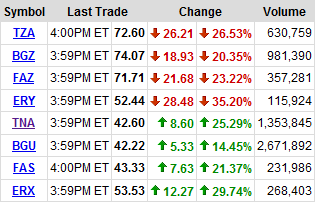
I promised myself that once the new Direxion 3x and -3x ETFs started trading at least a million shares a day that I would take them out for a test drive. Well, I didn’t have to wait very long. Launched just last week, two of the eight new ETFs hit the million share mark yesterday and a third missed only by a rounding error.

To recap for those who do not follow this space, Direxion is the first company to offer ETFs that have a targeted return which is leveraged to three times and minus three times that of the underlying indices. So far the biggest successes have been the large cap 3x bull (BGU) and large cap -3x bear (BGZ) ETFs, which are based on the Russell 1000 index. Also proving popular are the small cap 3x bull (TNA) and small cap -3x bear (TZA) ETFs, which follow the Russell 2000 index.

The sector ETFs are off to a slower start. These include the large cap 3x bull (FAS) and large cap -3x bear (FAZ) based on the Russell 1000 financial services index; and the large cap 3x bull (ERX) and large cap bear (ERY) based on the Russell 1000 energy index.

A look at the table below of yesterday’s results shows that these ETFs are like nuclear weapons when it comes to volatility. The average change in these eight ETFs yesterday was a 25% difference from the previous day’s close. ERY closed at 52.44 yesterday. Not only did it lose 28.48 points, but its intra-day range was 35.06 points. It is only a slight exaggeration to say that you can sneeze and miss your position losing ten points. Needless to say, these super-charged ETFs are not for everyone. If you like to go skydiving, keep a pet alligator in the bathtub, and dream of a winter king crab fishing in the Bering Strait, then you will be right at home with the Direxion ETFs.

As I traded these for the first time on yesterday, several interesting things happened. First, just entering a position was an adventure, almost like trying to jump in a Lamborghini while it sped by at 120 mph. I immediately went into position management mode, because the value of my ETF was changing so quickly that it required my full attention. Very quickly, I realized that one cannot trade these triple ETFs without finely honed trading rules and an iron will to act on them at all costs. In this world, there is no room for hoping. Any sort of “it will come back” thinking could quickly turn a 5% loss into a devastating 20% loss. Ironically, the high volatility of these ETFs forces the trader to rely on (or learn) tight trading discipline.

Retail investors might want to take these ETFs out for a test drive too, but be forewarned that there is a disaster scenario looming around every corner. For these very same reasons, I anticipate that hedge funds currently day trading options will find these ETFs to their liking, particularly as volume and liquidity improve. In a deleveraging world, this is one way to stock up on “off balance sheet leverage” and get the extra juice without having to commit to the extra margin.

Not that extra leverage is usually a good thing…

[source: Yahoo]

DISCLAIMER: "VIX®" is a trademark of Chicago Board Options Exchange, Incorporated. Chicago Board Options Exchange, Incorporated is not affiliated with this website or this website's owner's or operators. CBOE assumes no responsibility for the accuracy or completeness or any other aspect of any content posted on this website by its operator or any third party. All content on this site is provided for informational and entertainment purposes only and is not intended as advice to buy or sell any securities. Stocks are difficult to trade; options are even harder. When it comes to VIX derivatives, don't fall into the trap of thinking that just because you can ride a horse, you can ride an alligator. Please do your own homework and accept full responsibility for any investment decisions you make. No content on this site can be used for commercial purposes without the prior written permission of the author. Copyright © 2007-2023 Bill Luby. All rights reserved.
 
Web Analytics