Showing posts with label TMV. Show all posts

Sunday, April 11, 2010

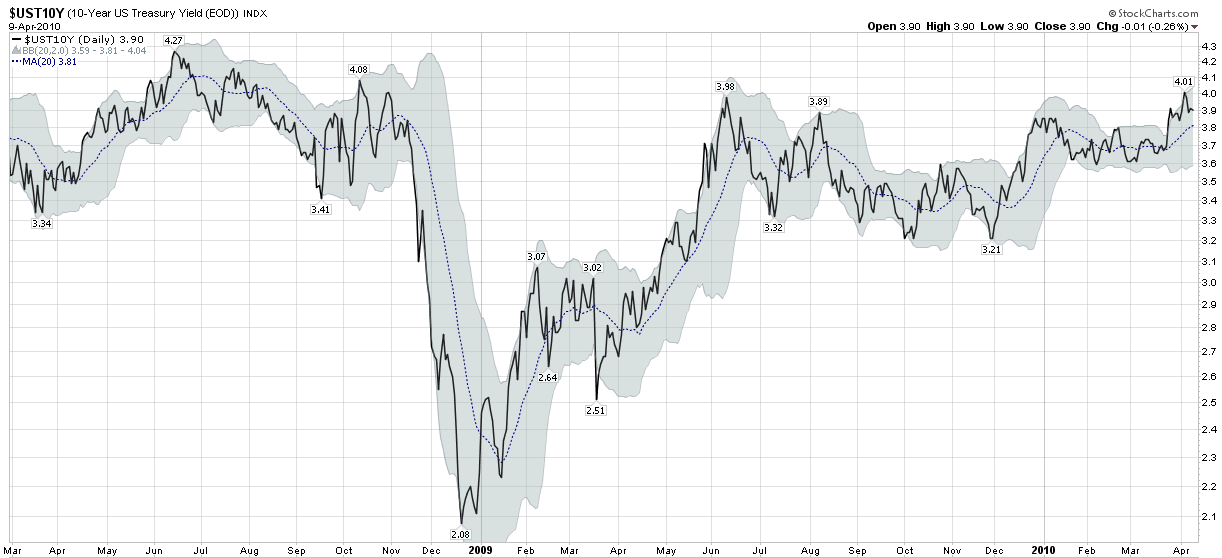
Chart of the Week: 10-Year Treasury Note Yield

I’ll be the first to admit that I have never considered myself a ‘bond guy’ and I spend much less time than I probably should studying the bond market. That being said, I know I have quite a few equity-centric readers who think the bond market moves too slowly to warrant their attention. The attitude is frequently, “I’ll never be a bond trader, so why should I spend my time watching bonds?”

My quick answer to bond skeptics is that bonds can help to divine the direction of interest rates and bonds frequently make major market turns before stocks do. Additionally, with the advent of bond ETFs such as the highly liquid TLT (and its +3x and -3x counterparts, TMF and TMV), it is now much easier for the retail investor to trade the U.S. Treasury long bond and their volatile triple ETF counterparts, as well as some of the shorter-dated Treasury ETFs, such as IEF, which is comprised of U.S. Treasury Notes with a target maturity of 7-10 years.

The bond world is so large that I have singled out one particular bond in this week’s chart of the week as the bond number for non-bond people to follow. The chart is the yield on the 10-Year U.S. Treasury Note, which is the de facto benchmark for government and sometimes even for corporate bonds as well.

Note that the yield on the 10-Year Treasury Note just hit 4.00 last week, attracting buyers such as BlackRock (BLK), which found the steep yield curve a good reason to buy some of the 10-Year Treasury Notes.

For those who wish to dive further into the subject of intermarket relationships such as the link between bonds and stocks, an excellent place to start is with John Murphy’s Intermarket Analysis.

For more on related subjects, readers are encouraged to check out:


[source: StockCharts.com]

Disclosure(s): short TLT at time of writing

Tuesday, January 5, 2010

Triple ETF Options Landscape One Month After New Margin Rules

On December 1st, the Financial Industry Regulatory Authority (FINRA) implemented more stringent margin requirements for leveraged ETFs in Increased Margin Requirements for Leveraged Exchange-Traded Funds and Associated Uncovered Options.

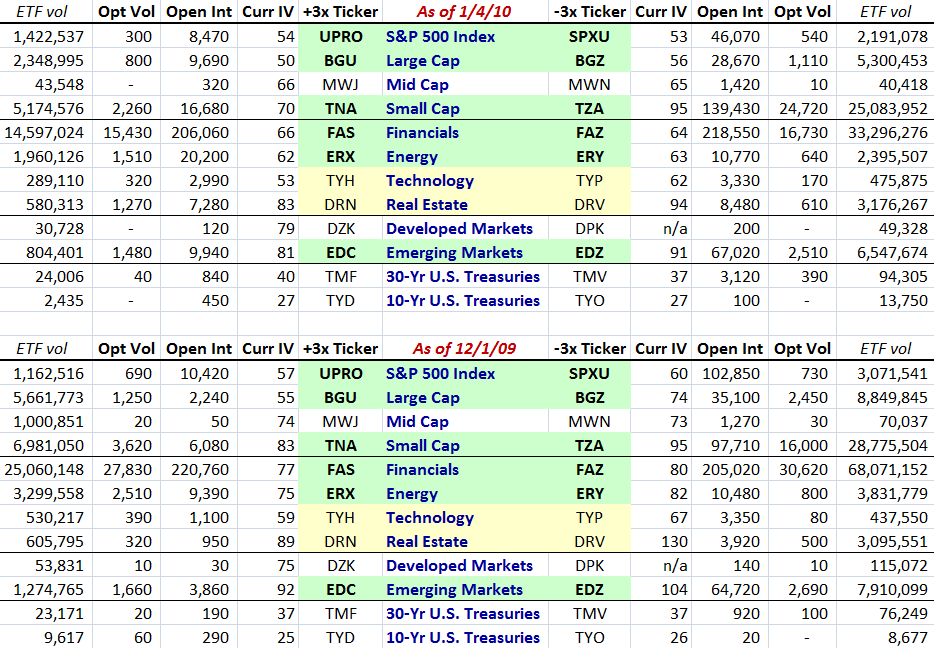
On that day, I updated my table of all the optionable triple ETFs and now that one month has passed, I thought it might be interesting to see how the activity in these ETFs and their options may have been affected by the new margin requirements.

Using data from iVolatility.com, I have captured the highlights below. While not shown here, I should note that in the almost three months from my previous update on September 9th to December 1st, four different triple ETF pairs (UPRO/SPXU, TNA/TZA, DRN/DRV and EDC/EDZ) showed substantial growth in volumes and every single pair showed some signs of increased interest -- so triple ETFs had significant momentum when the new margin rules were implemented. This time around, however, the only notable growth has been in the long bond pair, TMF and TMV, which admittedly comes off of a very small base. Also, there are signs that the large cap pair (BGU/BGZ) and the developed markets pair (DZK/DPK), are starting to lose traction.

Of course, we will never know whether interest in triple ETFs might have plateaued without the FINRA rules, but it is fair to say that FINRA has now stopped the growth momentum of triple ETFs in their tracks.

I will leave it for readers to pick through the data for some other interesting observations, but I would be remiss in not noting that the bear ETF implied volatility has dropped much faster that the bull ETF implied volatility almost across the board.

For the two previous posts in this series, readers are encouraged to check out:

[source: iVolatility.com]

Disclosure: none

Tuesday, May 26, 2009

Options on the Direxion Leveraged ETFs

The last time I checked in with the Direxion triple ETFs was in early February, when I asked Why Is There So Little Volume in the Most Recent Direxion ETFs? While that question did not receive a direct answer, I noted that in subsequent weeks, volume picked up dramatically in the two most volatile new pairs, the emerging markets (EDC and EDZ) and technology (TYH and TYP) ETFs.

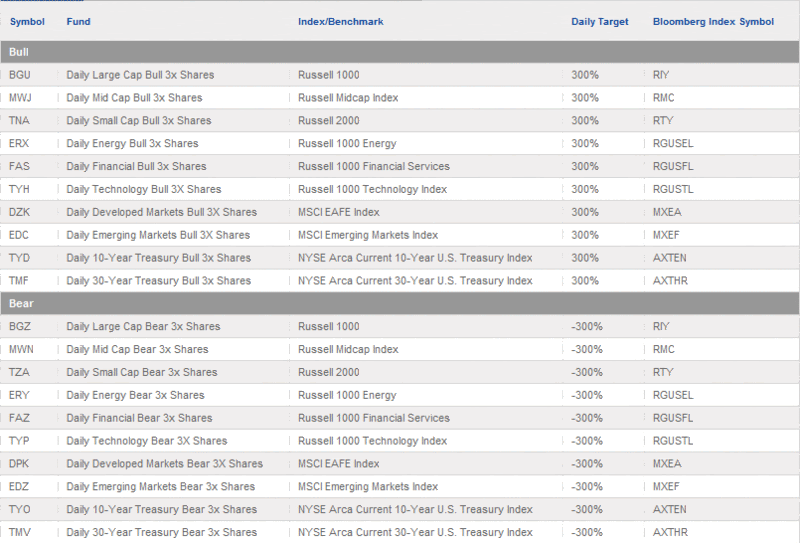
Toward the end of February, Direxion launched another triple ETF pair, the mid cap bull (MWJ) and mid cap bear (MWN) ETFs. In mid-April, Direxion added some triple ETF bonds to the mix, with a 30-Year U.S. Treasury bull (TMF) and bear (TMV) pair, as well as a 10-Year U.S. Treasury bull (TYD) and bear (TYO) pair.

For more details on the current Direxion triple ETF lineup, check out the graphic below or visit the Direxion Shares ETF web site.

In addition to expanding the universe of available triple ETFs, Direxion has sought to address criticism of the tracking error in these ETFs by adding a “Daily” prefix to each ETF name, in order to emphasize that these ETFs are rebalanced on a daily basis and only attempt to match daily moves, not track the target indices over an extended period of time. Interestingly, anyone who visits the Direxion Shares home page is met first with, “Direxion Shares are not for everyone. Are they for you?” and a link that attempts to dissuade what they describe as the conservative investor.

One of the aspects of triple ETFs that I find has some interesting strategic implications is the availability of options. As of this week, there are now options available on all of the Direxion triple ETFs with the exception of the ones based on the EAFE index, DZK and DPK.

Needless to say, there are very few trading vehicles out there with the potential to move as rapidly as options on triple ETFs, but for experienced options traders, these options offer a great deal of potential reward, paired with commensurate risk, of course.

[graphic: Direxion Shares]

Disclosure: Long TYP at time of writing.

DISCLAIMER: "VIX®" is a trademark of Chicago Board Options Exchange, Incorporated. Chicago Board Options Exchange, Incorporated is not affiliated with this website or this website's owner's or operators. CBOE assumes no responsibility for the accuracy or completeness or any other aspect of any content posted on this website by its operator or any third party. All content on this site is provided for informational and entertainment purposes only and is not intended as advice to buy or sell any securities. Stocks are difficult to trade; options are even harder. When it comes to VIX derivatives, don't fall into the trap of thinking that just because you can ride a horse, you can ride an alligator. Please do your own homework and accept full responsibility for any investment decisions you make. No content on this site can be used for commercial purposes without the prior written permission of the author. Copyright © 2007-2023 Bill Luby. All rights reserved.
 
Web Analytics