Showing posts with label weeklys. Show all posts

Tuesday, April 19, 2022

SPX Weekly Options Will Soon Be Available with Expirations Every Day of the Week

Yesterday, the CBOE listed the first batch of SPX weekly options with a Tuesday expiration, starting with the April 26th and May 3rd expirations.  Interest is strong, as halfway through today’s session, there were already more than 12,000 contracts traded for just the April 26th expiration.

Readers may recall that the CBOE began to expand from monthly SPX settlements to add weekly Friday settlements back in 2005 and then began to embrace a broader scope of underlying issues with weekly options in 2010, including both VXX and VIX weeklys.  Once the Friday weeklys took off, the CBOE added SPX weekly options that expired on Mondays and Wednesdays.  In the intervening decade or so, weekly options have generated a substantial following, being used for event-specific hedging, short-term trading and day trading.  Weeklys showed their market power when organized retail traders of meme stocks used weekly options to trigger gamma squeezes that dramatically spiked the prices of the underlying stocks.  For more information on this, check out an informative CBOE article, How Meme Stocks Impact Options Trading.

While I am not likely to use this space to advocate day trading weekly options, these options have clearly added significantly to the trading toolbox.  Looking ahead, on Wednesday, May 11th, the CBOE will complete the suite of SPX weekly options, when they list SPX weekly options with a Thursday expiration, likely targeting May 19th and May 26th at the outset.

When this happens, in less than a month, there will be SPX options expiring every day of the week!

The implications for traders and investors are substantial.  You can have options that expire on every day there is an important economic data release, earnings report, FOMC meeting, election, astrological market timing signal or whatever floats your boat.  For those who trade calendar spreads, diagonal spreads or are otherwise interested in fine-tuning the time component of their options expirations, the full suite of weeklys with daily expirations will create a great deal of flexibility in trade structuring, trade adjustment, pricing of positions, etc.  The bottom line:  SPX options expiring every day of the week will introduce a whole new set of opportunities.

What’s next?  Do I hear any votes for hourly options?


[source(s):  LiveVol Pro / CBOE]


Further Reading:
Weekly Options Coming on Strong
What a Difference a Weekly Makes
VIX Weekly Options Coming on September 28
Weekly Options Gain Momentum

For those who may be interested, you can always follow me on Twitter at @VIXandMore

Disclosure(s): net short VXX and VIX at time of writing; the CBOE is an advertiser on VIX and More

 [source(s):  LiveVol Pro / CBOE]

Monday, November 23, 2015

VIX Weekly Futures and Options Expire Tomorrow (Tuesday); Last Trading Day Is Today

Just a quick public service announcement to remind traders of VIX futures and options that the VIX weekly futures and options, which the CBOE launched earlier this year, will expire tomorrow instead of the usual Wednesday expiration.

The reason for the unusual Tuesday expiration is the Christmas holiday calendar. Keep in mind that VIX options expire 30 days before the underlying S&P 500 Index options on which they are based. As Christmas Day falls on a Friday this year, the SPX weekly options for the fourth week in December have their expiration moved up to Thursday, December 23, with the VIX weeklys for the fourth week in November moved up to tomorrow. Perhaps even more important, this means that this week’s VIX weeklys can last be traded today, so if you harbor any intentions about opening or closing a short-dated VIX weekly options (or futures) position tomorrow, be sure to make that happen today instead.

As an aside, as I see it, the VIX weeklys are the most important product launch in the volatility space in several years. The VIX weekly futures were launched in July, followed by a launch of the VIX weekly options in October. How popular are these products? Well, the VIX weekly options that expire tomorrow have an open interest of just under 100,000 contracts as I type this, as the graphic below demonstrates.

VIX weekly options 122315

[source(s): Livevol Pro / CBOE]

The VIX weeklys have already become a staple of my client portfolios and are something every volatility investor should investigate. If you are one of those who has shied away from weeklys or is not comfortable trading options close to expiration, one book that I’m sure will give you something to think about along those lines is Jeff Augen’s, Trading Options at Expiration.

It should go without saying every options trader should have their own options calendar handy in order to help identify these calendar anomalies in advance. My personal favorites are as follows:

Note that the links above are for 2016. For 2015 or for any other year, just edit the URL accordingly.

Finally, I have missed blogging on a regular basis and am committed to getting back into the game this week, ramping up my activity into the December FOMC meeting.

Related posts:

Disclosure(s): short VIX at time of writing; the CBOE and Livevol are advertisers on VIX and More

Tuesday, December 31, 2013

VIX Futures Term Structure in 2013 Looks a Lot Like 2012

This was a very quiet year for the VIX, with the volatility index posting its second narrowest range for the year since 1995, trailing only 2005, when the Greenspan liquidity flood overwhelmed even the mere thought of a meaningful correction.

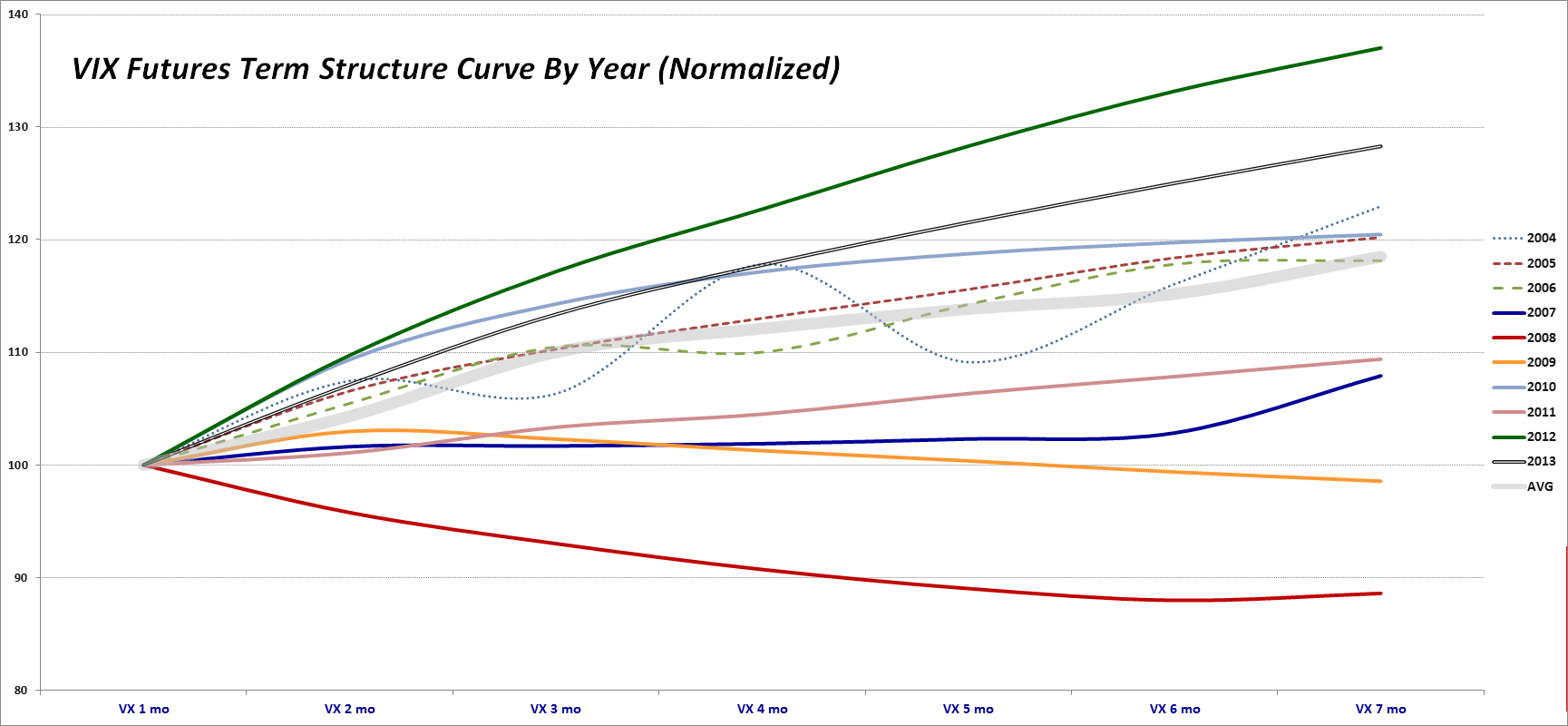
The graphic below shows the average (mean) normalized term structure for each year since the VIX futures were launched, back in 2004. In normalizing the data, I have set the average front month VIX futures contract to 100 and have expressed the averages of the second through seven months as multiples of the front month.

[source(s): CBOE Futures Exchange (CFE)]

Note that although the VIX futures were launched in 2004, consecutive VIX futures contracts for the first six months were not available until October 2006, hence the dotted lines for these years to reflect the erratic nature of the data. Interestingly, the lower VIX years of 2005 and 2006 did not produce the steep term structure that we saw in 2012 and saw again in 2013. Last year I described the 2012 VIX futures term structure as a statistical outlier, but now that 2013 data is in the books, it may be more appropriate to think about how the markets might have changed in the last two years, with potential causes that range from the VIX ETPs, more interest in trading volatility products, the rise of weekly options and other developments.

In the next few days I will devote a series of posts to analyzing some VIX, volatility and related data for 2013, then as 2014 unfolds I will offer some thoughts on how some of these markets are changing and evolving.

At the very least, I expect to ramp up my posting substantially in 2014, now that I have my investment management business up and running and find it easier to wear multiple hats at the same time.

Happy New Year!

Related posts:

Disclosure(s): none

Thursday, October 24, 2013

The New VXST and the VXST:VIX Ratio

At the beginning of the month several interesting announcements came out of the CBOE Risk Management Conference in Portugal. One which particularly caught my interest was the announcement of the launch of the new CBOE Short-Term Volatility Index (VXST), which is essentially identical to the VIX, except that whereas the VIX is looking ahead at a window of 30 calendar days, the VXST measures implied volatility of options on the S&P 500 index (SPX) for the next 9 calendar days.

This means that the CBOE now has three different indices to measure implied volatility expectations in SPX options:

  • 9 days (VXST)
  • 30 days (VIX)
  • 93 days (VXV)

The VXV has been a favorite subject of mine going back to my initial comments on the index and the VIX:VXV ratio I pioneered as an indicator back in December 2007. With the new VXST, investors now have a better gauge of volatility expectations to apply to time frames that are appropriate for weekly options, which are on track to account for about 25% of all options trades by the end of the year.

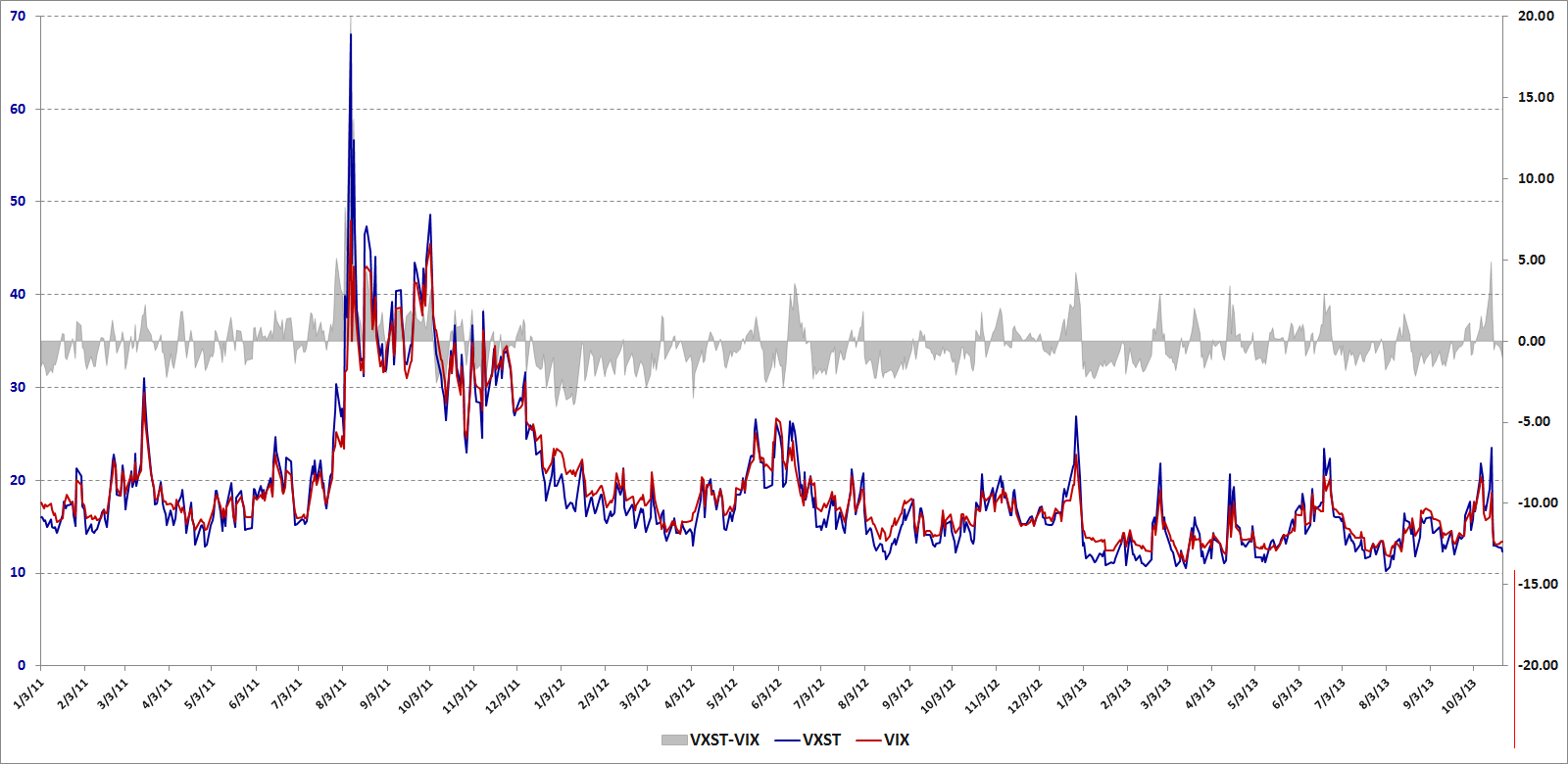
The launch of VXST options opens up a whole new set of possibilities, not the least of which is a VXST:VIX ratio that offers some possibilities as an indicator that are similar to those of the VIX:VXV ratio. In the chart below, I have mapped not the ratio of VXST:VIX, but the differential between the two indices. With VXST historical data going back to the beginning of 2011, it is worth noting that the VIX has been higher than VXST about 61% of the time. Typically, when volatility spikes, VXST spikes much higher than the VIX, with the bulk of the 39% of the instances in which VXST is higher than VIX occurring mostly during periods of elevated volatility.

[source(s): CBOE, VIX and More]

I will go into much greater detail regarding VXST:VIX vs. VIX:VXV at a later point. For now it is worth noting that these ratios have some advantage to comparing the VIX futures term structure in that the indices focus on a fixed time period, while the days to expiration of the VIX futures is constantly in flux.

Also of interest, the CBOE press release notes:

“Plans call for CBOE and CBOE Futures Exchange, LLC (CFE®) to introduce VXST Weeklys options and futures. The launch dates for these tradable VXST products are yet to be determined, pending regulatory approval.”

As compelling as VIX products are for trading, I can imagine that VXST options and futures might be even more attractive to certain types of traders. Also, if VXST futures gain some traction, I can envision ETPs based on these that might rival the interest in VXX at some point.

In other words, this could easily turn out to be a huge development in the volatility space.

Related posts:

Disclosure(s): short VXX at time of writing; the CBOE is an advertiser on VIX and More

Thursday, June 27, 2013

VIX Futures Margin Requirements to Increase After Today’s Close

A number of readers have expressed concern to me privately about today’s increase in the VIX futures margin requirements. The current margin requirements are detailed at the CFE Margins splash page, while the new margin requirements were outlined in CFE Regulatory Circular RG13-019 on Tuesday and were just updated on the CFE (CBOE Futures Exchange) web site here.

Perhaps the most critical of the changes is the substantial increase in margin requirements for spread positions. The current initial margin requirement for a spread is $625 - $1250, with the variation due to the number of months involved in the spread. The maintenance margin for these positions is currently $500 - $1000. After today’s close, the initial margin requirement jumps to $2860 - $4015, with the maintenance margin rising to $2700 - $3650.

For those VIX futures spread traders out there – and I’d imagine that includes just about all VIX futures traders – this is an increase of 5-6 times the current margin requirement and has the potential to trigger some forced liquidations. If you have any concerns about your margin position going into tomorrow’s trading day, I urge you to take the balance of today’s trading session to make the appropriate adjustments.

As best as I can tell, quite a few VIX spread traders are not aware of these margin requirements changes, which could only add to any potential market dislocation.

Of course the VIX futures are also an essential ingredient in the VIX ETPs, notably VXX, which also has weekly options expiring tomorrow…so depending upon how much impact the new margin requirements have on the VIX futures market, VXX, XIV, UVXY, TVIX and their associated options (as well as the full stable of VIX ETPs) could be influenced by tomorrow’s market action.

In addition to the potential issues related to the VIX futures market tomorrow, there are a number of broader issues that are related to the margin requirements. For starters, the CFE used to set margin requirements for the VIX futures. This responsibility recently moved to the OCC, which uses a large-scale Monte Carlo-based risk management methodology, known as System for Theoretical Analysis and Numerical Simulations (“STANS”) that is said to evaluate approximately 7,000 risk factors. Today’s margin requirements change is the first instance in which the OCC made the determination (presumably after STANS crunched the numbers for rising volatility across a wide variety of asset classes) to change margin requirements and essentially directed the CFE to implement this change. Recognizing that this was the first OCC-driven margin requirements change, the CFE issued the regulatory circular referenced above to explain what was happening. Going forward, no such regulatory circular is likely to be issued when there are changes to margin requirements. Instead, traders are expected to learn about changes in margin requirements by visiting the CFE Margins page each morning. This raises another question: if traders think two days’ notice via a regulatory circular is not sufficient notice for margin requirement changes, I can only imagine how they will react when that notice is of the same-day variety.

Of course STANS and the OCC can change margin requirements at any time, but if the VIX futures markets do not operate with their usual efficiency tomorrow and some traders are subject to forced liquidations of relatively illiquid back month legs because they were not aware that margin requirements were about to increase by a factor of five or six, then perhaps it is time to think about some other ways that changes in margin requirements can be implemented and communicated.

Related posts:

Disclosure(s): long VXX, long XIV and short UVXY at time of writing; the CBOE is an advertiser on VIX and More

Friday, June 8, 2012

A Favorite Trade: VXX Weeklys

I might as well admit this up front: weekly options are one of my favorite innovations in many years and VXX weeklys have become one of my preferred trades during the past few months.

Why? Several factors are at play. Huge implied volatility is a plus, as is growing liquidity, the ability to employ VXX for speculative and/or hedging purposes, and the applicability of VIX-based ETPs as trading vehicles for the news cycle.

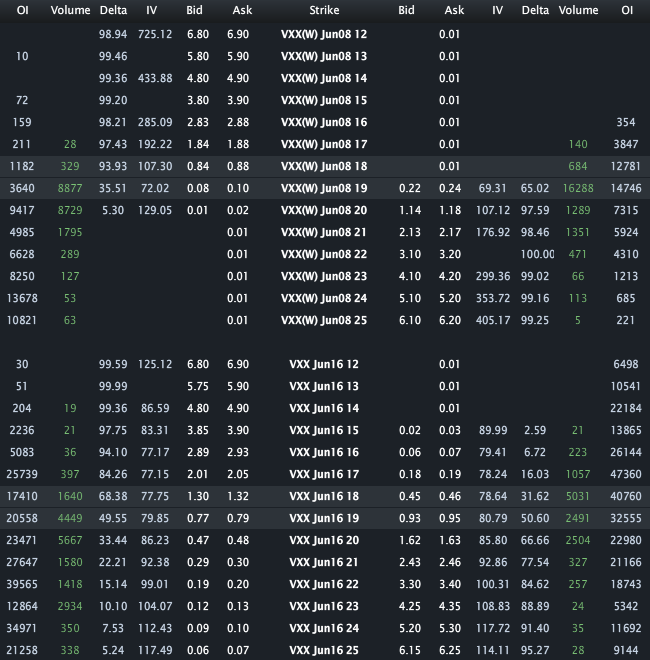
The chart below shows the VXX weekly options that expire today and compares them to options on the standard monthly options expiration cycle, which still have one week left until expiration. Note that with three hours left in today’s trading session, the implied volatility (and skew) of the VXX options is distorted as we approach expiration. Whereas the options that expire next week have an implied volatility reading in the 77 – 125 range, today’s weekly options prices have IVs of over 700 on the call side and over 400 on the put side. While this may seem outrageous, given the fact that the VIX can spike without warning and the VIX futures and VXX will move sharply in conjunction with the cash/spot VIX, options prices (and thus IV) have to account for the possibility of a spike – particularly in light of the recent news cycle.

If you think VXX IV and options prices are crazy, then perhaps it’s time you considered trading the VXX weeklys.

To reiterate what I hope is obvious to everyone who follows the VIX and the options market, VXX options are extremely aggressive trades and are probably best traded as spreads or in other defined risk positions rather than those which expose the trader to unlimited risk.

More on this (these) subject(s) in the coming weeks.

Related posts:

[source(s): LivevolPro.com]

Disclosure(s): Livevol is an advertiser on VIX and More

Friday, April 27, 2012

Weekly Options Coming on Strong

When the CBOE made a push to expand interest in weekly options about two years ago, their efforts were initially met with a fair degree of skepticism. Over time, however, weekly options have found a dedicated following, with the CBOE “weeklys” growing from 1% of total volume to about 15% today. Two years ago there were a handful of index weeklys, as well as a handful of weekly options based on ETPs and individual stocks. The list of weekly options changes every week, but the current list for weeklys expiring on May 4th now includes options on six indexes, 26 ETPs and 119 individual stocks. What was once a curiosity is now a groundswell.

Personally, I have found quite a few uses for weekly options. On Tuesday, for instance, I tweeted that the VXX 18/19 call spreads had the same price for the weekly options as next month’s standard May 19th expiration.

Part of the appeal of the weeklys can be seen in the graphic below of the skew in Amazon (AMZN), where today’s April 27th weeklys (red line) have a huge implied volatility (and therefore price) premium to their counterparts with more distant maturities. Looking at the graphic, one can see that it is not that difficult to construct positions with weekly options (which also include the May 4th options, shown with a yellow line) in which one leg has implied volatility that is 50-100% higher than another leg. If you have a bias toward selling options, as I do, this can sometimes offer up an irresistible mathematical edge.

Lately when I find myself editing my various watch lists, one of the first things I check for is whether the underlying in question has weekly options. If you have weeklys, you are in the big leagues and there are so many more trading opportunities. With ZNGA weekly options being added this week, for instance, the ease and flexibility of trading this issue around yesterday’s earnings report was dramatically improved.

If you haven’t tried weeklys yet, you are missing out. And if you think the volumes are too small and the markets are too thin, think again.

[Note that an excellent source of information for all things related to weekly options is the CBOE Weeklys splash page.]

Related posts:

[source(s): LivevolPro.com]

Disclosure(s): short VXX and ZNGA at time of writing; Livevol is an advertiser on VIX and More

Thursday, March 31, 2011

VIN, VIF and an Obsolete VIX

Mark Sebastian at Option Pit has an interesting post up, Could the VIX Become Obsolete? that I suspect VIX and More readers will enjoy pondering. In it Mark argues that because of the VIX calculation methodology, SPX weeklys frequently offer a better insight into the state of current volatility than the VIX. Mark takes this analysis one step further by wondering aloud if this development could mean the demise of the VIX.

For those who are not familiar with the details of the VIX calculation methodology, the VIX bases its calculations on the front month and second month of the SPX for the majority of the expiration cycle. Eight days prior to the VIX options expiration, the SPX options used for the calculations roll forward one month to the second and third month.

Keeping in mind that the VIX blends SPX options with two different expiration dates to arrive at a constant maturity 30-day weighted average of SPX implied volatility, an example may help to illustrate what is happening. Next month the VIX options expire on Wednesday, April 20th. From today up to Monday, April 11th, the VIX is calculated based on the SPX front month (April) options as well as the second month (May) options. On April 11th, eight trading days prior to VIX options expiration, the SPX options used in the VIX calculations roll forward one month so that the near-term month used in the calculations is May and the far-term month used in the calculations is June.

Now, here is the fun part. It is a little known fact that the CBOE actually maintains separate indices for the near-term month VIX (VIN) and the far-term month VIX (VIF). Just pop those tickers into your streaming quotes and you too can watch not just the VIX, but the two components used in the VIX constant maturity blend. Right now, for instance, I show a VIX of 17.88, a VIN of 16.98 and a VIF or 18.23.  Just be sure to keep track of the SPX options series roll eight trading days before the VIX options expiration.

Of course the VIX really isn’t about to become obsolete. Just like any index, it suffers some limitations from being only one number. If you want a quick snapshot of where market volatility is, the VIX is the gold standard. If you want some more details and are one of those who likes to look under the hood and tweak the engine a little, the VIX futures and the SPX options themselves are probably the most important groups of market volatility data to study. For those who do not have easy access to VIX futures data, consider adding VIN and VIF to your watch list, to broaden your understanding of what is driving the level of the VIX.

Related posts (some excellent information in this group of posts and a particularly helpful graphic in XXV and the New VIX ETN Landscape):

Disclosure(s): none

Wednesday, January 5, 2011

CBOE to Publish VIX-Style Volatility Indices for Individual Stocks

The volatility space continues to expand in the direction of the atomic level, with today’s announcement by the Chicago Board Options Exchange (CBOE) that it will begin disseminating implied volatility data utilizing the VIX calculation methodology for five stocks as of Friday, January 7th.

The five stocks are:

My initial thought include some of the following:
  • It will be interesting to see how much divergence there will be between the CBOE NASDAQ 100 Volatility Index (VXN) and the volatility indices for some of the key components of the NASDAQ-100 index, notably Apple, Google and Amazon
  • A Goldman Sachs volatility index will be particularly useful in terms of financial crisis
  • IBM is an interesting choice for a fifth wheel here, as IBM does not have the same bellwether status that it once did
  • Finally, first with weekly options and now with volatility indices for individual stocks, the CBOE has managed to shorten the scope of volatility analysis both at the issue level and in terms of the time frame. I’m calling this the march toward atomic volatility.
Related posts:
Disclosure(s): the CBOE is an advertiser on VIX and More

Thursday, September 9, 2010

VIX Weekly Options Coming on September 28

The CBOE Futures Exchange (CFE) announced today that it will begin trading weekly options on VIX futures as of Tuesday, September 28. Please note that unlike standard monthly VIX options which expire on Wednesdays, the weekly VIX options will expire on Fridays, as is the case with other weekly options. Also, settlement for weekly options will feature physical settlement - one futures contract for each expiring options contract. [Thanks to Chris McKhann for highlighting this important clarification.]

With the addition of weeklys to the VIX options stable, the proliferation of tradable VIX products has the potential to overwhelm and confuse investors. For example, in just three weeks we will have VIX futures options and VXX options expiring on the same date. The former will trade off of the VIX futures; the latter is based on iPath S&P 500 VIX Short-Term Futures ETN (VXX), which is a weighted portfolio of front month and second month VIX futures.

Among other things, the new VIX weeklys set up some interesting volatility pairs trades, including a VXX-VIX options pair that has the potential to be able to isolate the contango and backwardation components of VXX using VIX options with an identical expiration date.

For volatility traders, 2010 is shaping up to be a banner year in terms of new products.

Related posts:

Disclosure(s): none

Wednesday, August 25, 2010

VXX Weeklys Begin Trading Tomorrow

Thanks to a tweet from Adam Warner of the Daily Options Report for alerting me to the fact that VXX options have just been added to the list of 28 indices, ETFs and stocks on which the CBOE is now trading weekly options, or as the exchange calls them, weeklys.

The VXX ETF and VXX options are two subjects I have covered in considerable detail over the course of the past two years, so rather than repeat myself, I will encourage readers to start with the links to older posts on the subject toward the bottom of this post or refer to the keyword links herein and labels at the very bottom of this post.

Weekly options are the new kid on the block and something I jumped on early and have enjoyed, particularly as someone who has been an aggressive seller of options over the course of the last 1 ½ years. Again, there are links above and below for readers to find some of what I have said on the subject to date.

I should also note, however, that the August issue of Expiring Monthly: The Option Traders Journal (published on Monday) has three articles on weekly options, including a guest article from Vance Harwood of the Six Figure Investing blog. Farther afield, Steven Sears of Barron’s tackles the subject of weeklys in today’s The Striking Price column: The Weeklys Get Stronger.

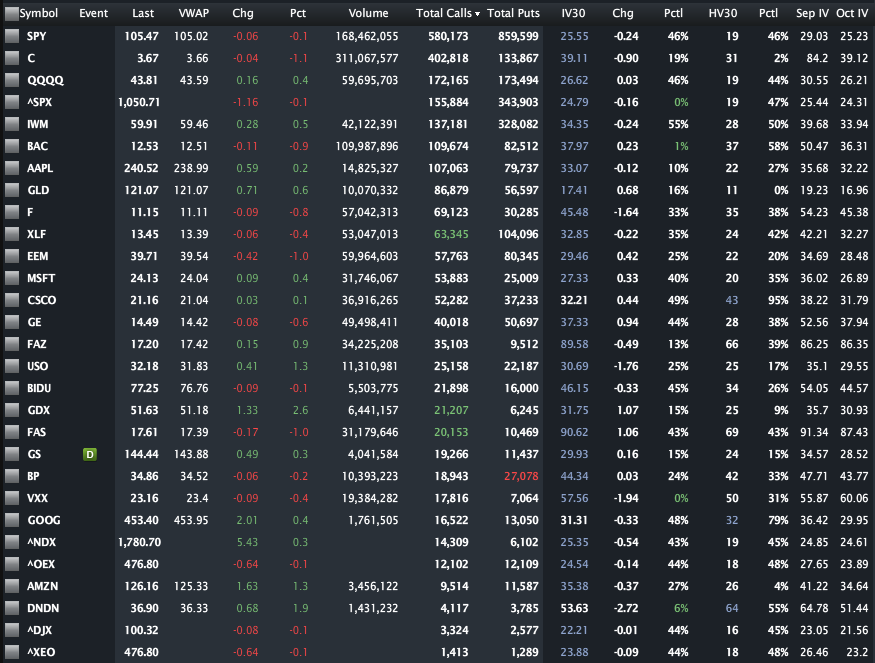
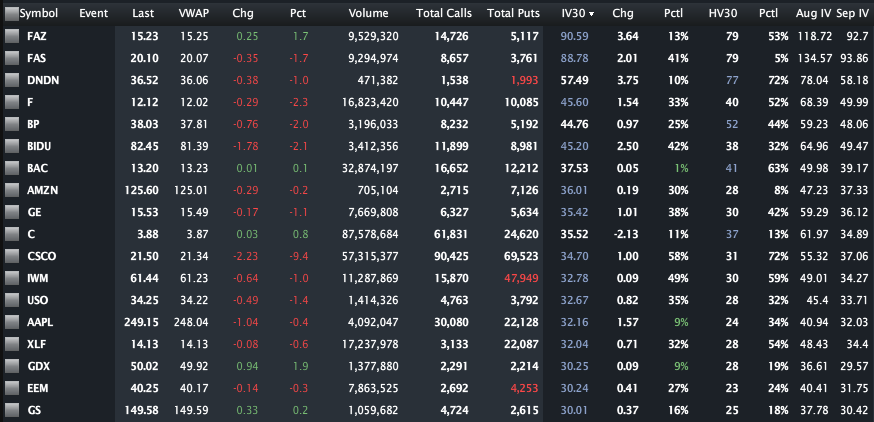
Below I have included a watch list I set up on Livevol Pro that has this week’s 28 weekly options plus next week’s addition, VXX, sorted by call volume. Note that VXX replaces Dendreon (DNDN) and brings the current breakdown of weeklys to 12 equities, 11 ETFs and 5 indices.

Related posts:


[source: Livevol Pro]

Disclosure(s): short VXX at time of writing; Livevol is an advertiser on VIX and More

Thursday, August 12, 2010

Surfing for Weekly Buy-Write Trades

One half hour into today’s trading, I would expect to see some evidence that the recent spike in volatility in stocks is subsiding. That seems to be the case, as the VIX opened at 27.21 and is now just over 26.00.

Before volatility falls any farther, I will be looking at some possible or buy-write (covered call) trades with the new weekly options that are expiring tomorrow.

When I screen for buy-write candidates, I generally start with a screen for the highest implied volatility stocks, ETFs and indices, then qualify these on liquidity terms, examine the proximity of the current price relative to the various strike prices, then review the charts for some of the finalists and add some sort of secret sauce at the end to come up with trades that fit my objectives.

In the graphic below, I have included all of the weekly options in which the underlying has an implied volatility is at least 30. The list has 18 candidates and prominently atop that list is the triple ETF pair for the financial sector: FAS and FAZ. Going down the list, Ford (F) and Bank of America (BAC) show excellent liquidity, while Apple (AAPL) is hovering just under an important round number and strike.

Enterprising souls may even consider buy-writes on both FAS and FAZ.

Volatility is up and the end of the week is nearing. Anyone looking at a buy-write strategy should take a close look at earnings for today and tomorrow which may impact the market, as well as a number of economic reports due out tomorrow morning, most notably the July retail sales data.

For more on related subjects, readers are encouraged to check out:


[source: Livevol Pro]

Disclosure(s): short VIX at time of writing; Livevol is an advertiser on VIX and More

Tuesday, August 10, 2010

What a Difference a Weekly Makes

Last week I made my first trade using weekly options. Part of the reason I am so excited about weeklys is that I would not have made the trade had only standard monthly options been available.

Last Monday, after the markets had jumped more than 2%, I was of the opinion that we would have choppy trading on Tuesday through Thursday, as investors chose to sit on the sidelines in advance of Friday’s nonfarm payrolls report.

My trade of choice was a short straddle and my preferred underlying was IWM, the iShares Russell 2000 Index ETF. When I looked at the available options, the weeklys almost jumped off of the page, with superb liquidity and much higher implied volatility. As the intent of my trade was to take maximum advantage of time decay (theta), choosing the weeklys were a no-brainer.

A look at the chart below shows the difference in IV between the IWM weekly options that expire this Friday (red line) and the standard monthly options that expire the following week (yellow line.) All things being equal (and they never are) the higher implied volatility of the shorter-dated weeklys translates into substantially higher time decay.

So…if you are comfortable trading options that are toward the end of the expiration cycle, take a close look at the weeklys. If you are not comfortable doing this (controlling gamma risk is critical), then perhaps future posts on weekly options will assist in this regard.

For more on related subjects, readers are encouraged to check out:


[source: Livevol Pro]

Disclosure(s): long IWM at time of writing; Livevol is an advertiser on VIX and More

Monday, August 9, 2010

Weekly Options Gain Momentum

Up until a couple of weeks ago, it was almost impossible to find anyone who thought it was worthwhile to mention weekly options: options that have the same terms as standard monthly options, except that they expire on every Friday other than the third Friday of the month (which is when standard monthly options expire.)

For those who find the definition above a little too sparse, the CBOE has an excellent FAQ for weeklys; the Options Industry Council (OIC) also has a weekly options FAQ for those who wish to learn a little more about these products.

Some of my fellow bloggers have already taken up the cause of weekly options and have shared some of their initial thinking on the subject:

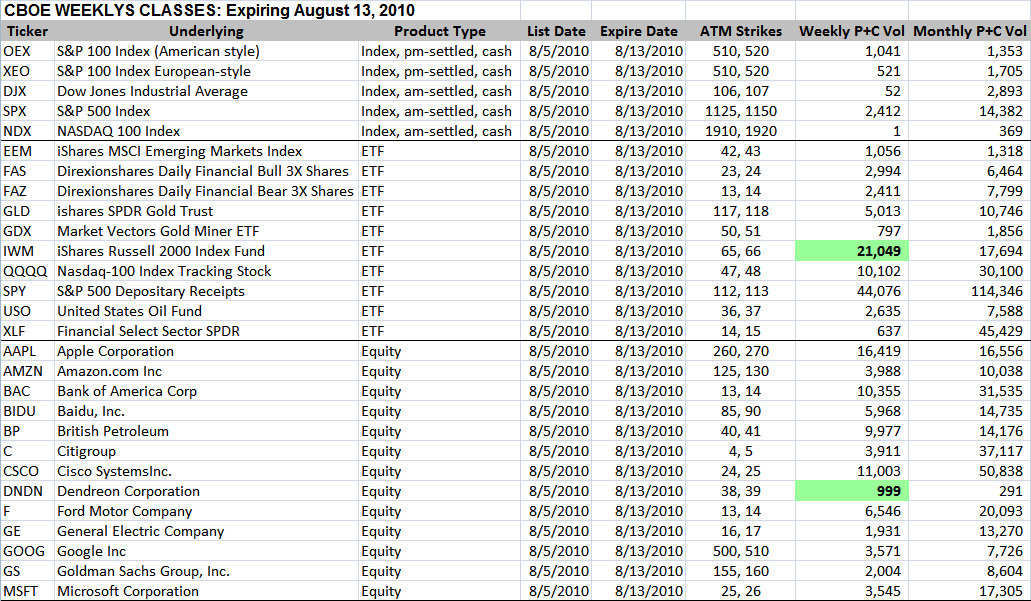
Before anyone gets too excited about new products, one of the first questions is invariably about liquidity and market depth. Rest assured, there is already substantial liquidity and market depth in the weekly options being offered. In the table below, I have calculated today’s volume in weekly options and standard options for the two at-the-money strikes for all the weeklys listed by the CBOE. Note that for the most part, the weekly options volumes are running at about one third to one half of the rate of the standard monthly options. In the case of IWM and DNDN, today’s weekly volume exceeded the volume in the monthly options.

For the record, I made my first weekly option trade last week and I was excited because it was a trade I never would have made unless it was near the end of an expiration cycle – a time frame many options traders avoid, but I like to embrace. Given the increasing popularity of weekly options and new end-of-cycle trading opportunities, I would recommend that anyone who has not already done so to spend some time with Jeff Augen’s excellent Trading Options at Expiration, where many of Jeff’s ideas can now be applied on a weekly basis.

I will have a lot to say about weeklys (blame the CBOE for the spelling choice) going forward. In the meantime, readers looking to learn more about these products should start with the CBOE Weekly Options splash page.


[source: CBOE, Livevol Pro]

Disclosure(s): long IWM at time of writing; both the CBOE and Livevol are advertisers on VIX and More

DISCLAIMER: "VIX®" is a trademark of Chicago Board Options Exchange, Incorporated. Chicago Board Options Exchange, Incorporated is not affiliated with this website or this website's owner's or operators. CBOE assumes no responsibility for the accuracy or completeness or any other aspect of any content posted on this website by its operator or any third party. All content on this site is provided for informational and entertainment purposes only and is not intended as advice to buy or sell any securities. Stocks are difficult to trade; options are even harder. When it comes to VIX derivatives, don't fall into the trap of thinking that just because you can ride a horse, you can ride an alligator. Please do your own homework and accept full responsibility for any investment decisions you make. No content on this site can be used for commercial purposes without the prior written permission of the author. Copyright © 2007-2023 Bill Luby. All rights reserved.
 
Web Analytics