Showing posts with label expiration week. Show all posts

Friday, August 20, 2010

VXX Implied Volatility Spikes into Expiration

With VIX options expiring on Wednesday and VXX options expiring today (technically tomorrow) in the normal monthly expiration cycle, this is a big week for volatility traders who are comfortable holding options positions into expiration.

One of the things I like about expiration week is the manner in which time and volatility can sometimes become distorted, presenting some interesting trading opportunities.

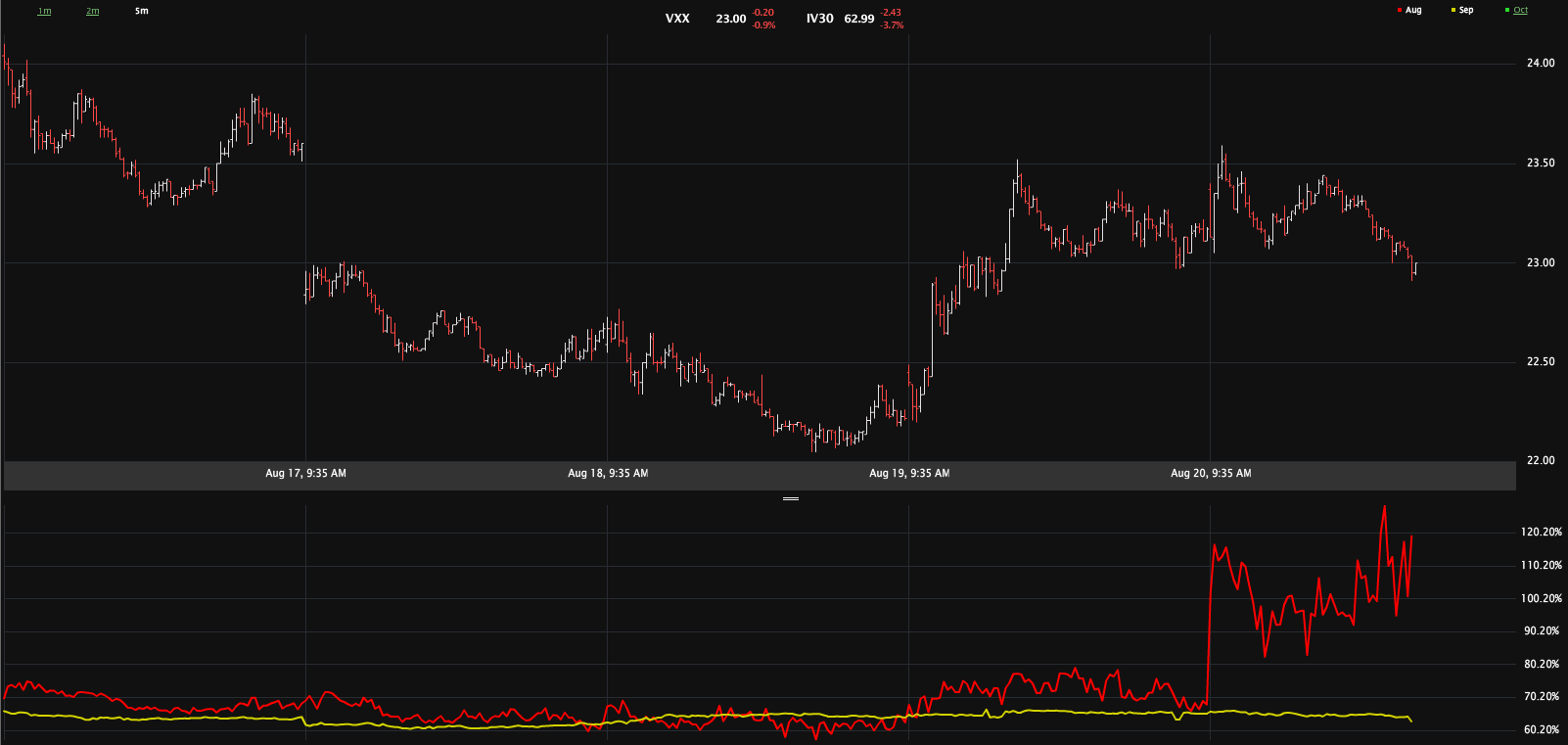
Looking at the implied volatility of VXX this week, one can see that August IV (red line) was tracking in a fairly tight range of 60-70 from Monday through Wednesday. Yesterday saw a little more noise and some IV spikes into the upper 70s. Today there has been a quantum change in implied volatility, with VXX IV shooting up over 120 and gyrating wildly throughout the session, as the chart below shows. Interestingly, the underlying VXX ETF has not been particularly volatile today. I attribute much of the erratic change in implied volatility to the approach of options expiration.

While VXX options are certainly not for the faint of heart, particularly during expiration, in my opinion these newfangled products are just the place where retail traders are more likely to be able to find an edge than some of the better-known institutional warhorses.

Related posts:


[source: Livevol Pro]

Disclosure(s): short VXX at time of writing; Livevol is an advertiser on VIX and More

Tuesday, August 10, 2010

What a Difference a Weekly Makes

Last week I made my first trade using weekly options. Part of the reason I am so excited about weeklys is that I would not have made the trade had only standard monthly options been available.

Last Monday, after the markets had jumped more than 2%, I was of the opinion that we would have choppy trading on Tuesday through Thursday, as investors chose to sit on the sidelines in advance of Friday’s nonfarm payrolls report.

My trade of choice was a short straddle and my preferred underlying was IWM, the iShares Russell 2000 Index ETF. When I looked at the available options, the weeklys almost jumped off of the page, with superb liquidity and much higher implied volatility. As the intent of my trade was to take maximum advantage of time decay (theta), choosing the weeklys were a no-brainer.

A look at the chart below shows the difference in IV between the IWM weekly options that expire this Friday (red line) and the standard monthly options that expire the following week (yellow line.) All things being equal (and they never are) the higher implied volatility of the shorter-dated weeklys translates into substantially higher time decay.

So…if you are comfortable trading options that are toward the end of the expiration cycle, take a close look at the weeklys. If you are not comfortable doing this (controlling gamma risk is critical), then perhaps future posts on weekly options will assist in this regard.

For more on related subjects, readers are encouraged to check out:


[source: Livevol Pro]

Disclosure(s): long IWM at time of writing; Livevol is an advertiser on VIX and More

Monday, August 9, 2010

Weekly Options Gain Momentum

Up until a couple of weeks ago, it was almost impossible to find anyone who thought it was worthwhile to mention weekly options: options that have the same terms as standard monthly options, except that they expire on every Friday other than the third Friday of the month (which is when standard monthly options expire.)

For those who find the definition above a little too sparse, the CBOE has an excellent FAQ for weeklys; the Options Industry Council (OIC) also has a weekly options FAQ for those who wish to learn a little more about these products.

Some of my fellow bloggers have already taken up the cause of weekly options and have shared some of their initial thinking on the subject:

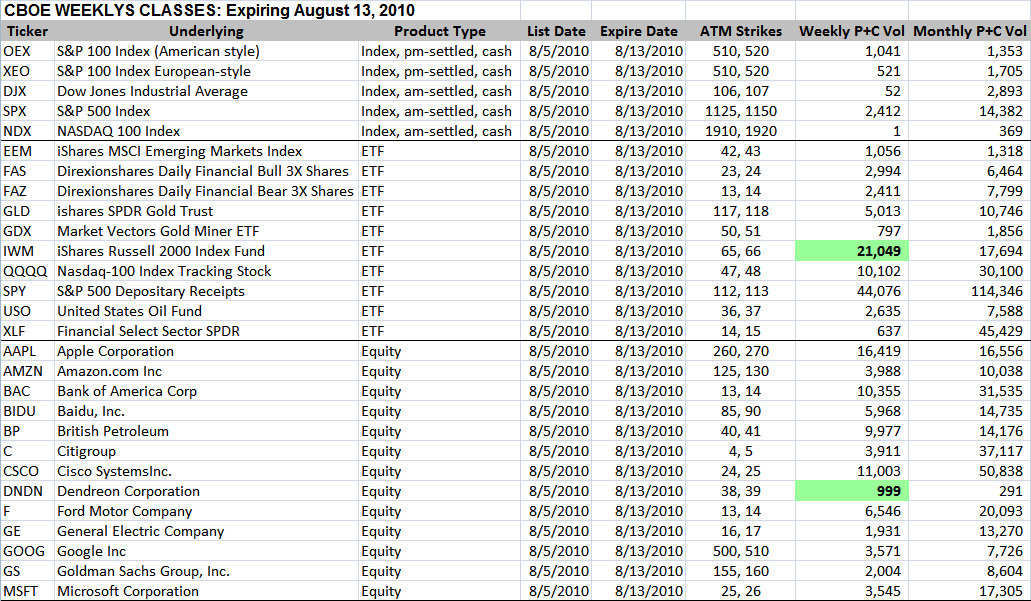
Before anyone gets too excited about new products, one of the first questions is invariably about liquidity and market depth. Rest assured, there is already substantial liquidity and market depth in the weekly options being offered. In the table below, I have calculated today’s volume in weekly options and standard options for the two at-the-money strikes for all the weeklys listed by the CBOE. Note that for the most part, the weekly options volumes are running at about one third to one half of the rate of the standard monthly options. In the case of IWM and DNDN, today’s weekly volume exceeded the volume in the monthly options.

For the record, I made my first weekly option trade last week and I was excited because it was a trade I never would have made unless it was near the end of an expiration cycle – a time frame many options traders avoid, but I like to embrace. Given the increasing popularity of weekly options and new end-of-cycle trading opportunities, I would recommend that anyone who has not already done so to spend some time with Jeff Augen’s excellent Trading Options at Expiration, where many of Jeff’s ideas can now be applied on a weekly basis.

I will have a lot to say about weeklys (blame the CBOE for the spelling choice) going forward. In the meantime, readers looking to learn more about these products should start with the CBOE Weekly Options splash page.


[source: CBOE, Livevol Pro]

Disclosure(s): long IWM at time of writing; both the CBOE and Livevol are advertisers on VIX and More

Friday, August 21, 2009

Options Expiration Weeks and the March to August Bull Market

For a number of reasons, the options expiration cycle can be extremely difficult to trade. One of the problems with options expiration week is that the forces acting on stock prices are often much different this week than during other weeks, often ignoring underlying existing trends, but sometimes magnifying them.

A good rule of thumb is that the week before options expiration is most likely to be bullish and the week after options expiration is most likely to be bearish. On average, options expiration week is less volatile and more directionally neutral than these other two weeks.

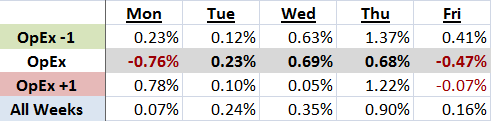
In the table below, I looked at data since the March 6th low and found it interesting that the week before options expiration has been the most bullish of the three expiration weeks, with the week after options expiration the second most bullish, by a small margin. Options expiration week itself has been relatively flat, particularly when compared to the other two weeks.

My knee-jerk explanation for this is that stock movements during options expiration week are more likely to be random and out of synch with underlying trends. As a result, during options expiration week, stocks frequently underperform in bull markets and outperform in bear markets.

For some related posts, try:

Wednesday, September 12, 2007

The VIX and the Fed

Since nobody was reading this blog when I first posted about the VIX and FOMC meetings, I thought I might use next week’s highly anticipated FOMC meeting as an excuse to flag some research I published earlier in the year.

Perhaps the most important piece of information on the VIX and the Fed is a study I have placed in the Archive Highlights section of the blog with the title “VIX Price Movement Around FOMC Meetings.” If you follow the link, you can see why the odds favor a substantial volatility contraction on Tuesday, when the results of the meeting are announced, as well as another smaller volatility contraction on Wednesday, after the information has been digested overnight.

While I am on the subject of the Fed and Archive Highlights, I would be remiss in not pointing out what I consider to be the best set of links on the Fed available on the internet, which I have archived in “Fed Links.”

One other blog link is worth flagging here, the rather innocuous sounding “Options Expiration Calendar,” which resides in the VIX and Sentiment Links section in the upper right hand corner. The reason I mention this link is to remind all interested parties that one of the idiosyncrasies of VIX options is that they do not expire on the third Friday of every month, like equity, index and many other options. Instead, 9 months of the year VIX options expire on the Wednesday after the third Friday of the month; 3 months of the year they expire on the Wednesday before the third Friday of the month – right in the middle of options expiration week. As you can see in the calendar linked above, this early VIX options expiration pattern happens at the end of each quarter in March, June, September and December. This means that VIX options expire the day after next week’s big FOMC meeting, with a special opening quotation (more on this another time.) Even more important, the last day for trading these VIX options is the day before they expire. So anyone holding VIX September options will have exactly 1:45 following the Fed’s announcement to close out their positions. Given the high expectations going into the Fed meeting, it will be very interesting to watch the VIX action – as well as the action on the VIX September options.

So while Tuesday will be a particularly busy day for me, remember that you don’t have to play unless the odds are in your favor. When in doubt, get neutral and watch the action for free from the sidelines.

Tuesday, January 16, 2007

VIX Performance During the Options Expiration Cycle

How does the VIX generally perform during options expiration week? What about the week before options expiration week? The week after?

After crunching the weekly closing data, here are some summary comments about each of these three weeks:

Options expiration week
This week is the only week where the VIX has traditionally made a significant move down, probably a case of reality falling short of the expectations that some associate with -- and plan for -- on triple and quadruple witching expiration weeks. On average, options expiration week has the VIX falling 2.7%, compared with an average rise of 1.4% on non-expiration weeks. The VIX is significantly more likely to fall 15% or more on this week than on any other week. Correspondingly, this is the week in which the VIX is least likely -- at least in terms of historical data -- to spike to the upside.

The week before options expiration

As many times as I have seen things heat up the week before options expiration, it came as a surprise to me to see that the week before options expiration consistently displays lower VIX volatility than the week of expiration or the week following expiration. Consistent with the idea that high volatility may be just around the corner during options expiration week, the VIX is least likely to spike to the downside during the week before options expiration – by a large margin. The VIX will spike to the upside more often than other weeks, but the combined upside and downside volatility of the VIX on the week before expiration is the lowest of the three weeks I examined. The average gain on the VIX of 1.4% during this week is the highest of the three weeks, but is not meaningfully higher than the 0.2% of the other weeks, particularly if one backs out the historically poor performance during options expiration week.

The week following options expiration
One surprising finding was that the VIX is more likely to spike up or down in the week following expiration than any other week. The probability of an upside spike of 15% or more in the VIX was significantly higher in this week than any other week. The pattern held true for downside spikes as well, with the VIX significantly more volatile to the downside than the week before options expiration and slightly more likely to spike down than during options expiration week. In terms of relative performance, the upside and downside spikes seem to cancel each other out as the VIX is up an average of 0.8% during this week and 0.4% in the other weeks.

Additional comments

For those who are not familiar with the quirky personality of the VIX, this might be a good time to keep in mind that just looking from weekly close to weekly close, you can expect a price change of at least 10% -- either up or down – in 30% of all weeks and a move of 20% or more on 7% of all weeks. On average, VIX moves down have been much more frequent during the past two decades than moves to the upside, with moves of 20% or more from week to week occurring at a rate of four times more frequently to the downside than to the upside.

Current VIX position
With the fifth consecutive week of dropping prices and a 10.15 close last Friday, I am mildly bullish on the VIX right now and would look to aggressively buy VIX calls should the VIX slip to the 9.75 mark.

DISCLAIMER: "VIX®" is a trademark of Chicago Board Options Exchange, Incorporated. Chicago Board Options Exchange, Incorporated is not affiliated with this website or this website's owner's or operators. CBOE assumes no responsibility for the accuracy or completeness or any other aspect of any content posted on this website by its operator or any third party. All content on this site is provided for informational and entertainment purposes only and is not intended as advice to buy or sell any securities. Stocks are difficult to trade; options are even harder. When it comes to VIX derivatives, don't fall into the trap of thinking that just because you can ride a horse, you can ride an alligator. Please do your own homework and accept full responsibility for any investment decisions you make. No content on this site can be used for commercial purposes without the prior written permission of the author. Copyright © 2007-2023 Bill Luby. All rights reserved.
 
Web Analytics