Showing posts with label VXX options. Show all posts

Thursday, June 27, 2013

VIX Futures Margin Requirements to Increase After Today’s Close

A number of readers have expressed concern to me privately about today’s increase in the VIX futures margin requirements. The current margin requirements are detailed at the CFE Margins splash page, while the new margin requirements were outlined in CFE Regulatory Circular RG13-019 on Tuesday and were just updated on the CFE (CBOE Futures Exchange) web site here.

Perhaps the most critical of the changes is the substantial increase in margin requirements for spread positions. The current initial margin requirement for a spread is $625 - $1250, with the variation due to the number of months involved in the spread. The maintenance margin for these positions is currently $500 - $1000. After today’s close, the initial margin requirement jumps to $2860 - $4015, with the maintenance margin rising to $2700 - $3650.

For those VIX futures spread traders out there – and I’d imagine that includes just about all VIX futures traders – this is an increase of 5-6 times the current margin requirement and has the potential to trigger some forced liquidations. If you have any concerns about your margin position going into tomorrow’s trading day, I urge you to take the balance of today’s trading session to make the appropriate adjustments.

As best as I can tell, quite a few VIX spread traders are not aware of these margin requirements changes, which could only add to any potential market dislocation.

Of course the VIX futures are also an essential ingredient in the VIX ETPs, notably VXX, which also has weekly options expiring tomorrow…so depending upon how much impact the new margin requirements have on the VIX futures market, VXX, XIV, UVXY, TVIX and their associated options (as well as the full stable of VIX ETPs) could be influenced by tomorrow’s market action.

In addition to the potential issues related to the VIX futures market tomorrow, there are a number of broader issues that are related to the margin requirements. For starters, the CFE used to set margin requirements for the VIX futures. This responsibility recently moved to the OCC, which uses a large-scale Monte Carlo-based risk management methodology, known as System for Theoretical Analysis and Numerical Simulations (“STANS”) that is said to evaluate approximately 7,000 risk factors. Today’s margin requirements change is the first instance in which the OCC made the determination (presumably after STANS crunched the numbers for rising volatility across a wide variety of asset classes) to change margin requirements and essentially directed the CFE to implement this change. Recognizing that this was the first OCC-driven margin requirements change, the CFE issued the regulatory circular referenced above to explain what was happening. Going forward, no such regulatory circular is likely to be issued when there are changes to margin requirements. Instead, traders are expected to learn about changes in margin requirements by visiting the CFE Margins page each morning. This raises another question: if traders think two days’ notice via a regulatory circular is not sufficient notice for margin requirement changes, I can only imagine how they will react when that notice is of the same-day variety.

Of course STANS and the OCC can change margin requirements at any time, but if the VIX futures markets do not operate with their usual efficiency tomorrow and some traders are subject to forced liquidations of relatively illiquid back month legs because they were not aware that margin requirements were about to increase by a factor of five or six, then perhaps it is time to think about some other ways that changes in margin requirements can be implemented and communicated.

Related posts:

Disclosure(s): long VXX, long XIV and short UVXY at time of writing; the CBOE is an advertiser on VIX and More

Friday, June 8, 2012

A Favorite Trade: VXX Weeklys

I might as well admit this up front: weekly options are one of my favorite innovations in many years and VXX weeklys have become one of my preferred trades during the past few months.

Why? Several factors are at play. Huge implied volatility is a plus, as is growing liquidity, the ability to employ VXX for speculative and/or hedging purposes, and the applicability of VIX-based ETPs as trading vehicles for the news cycle.

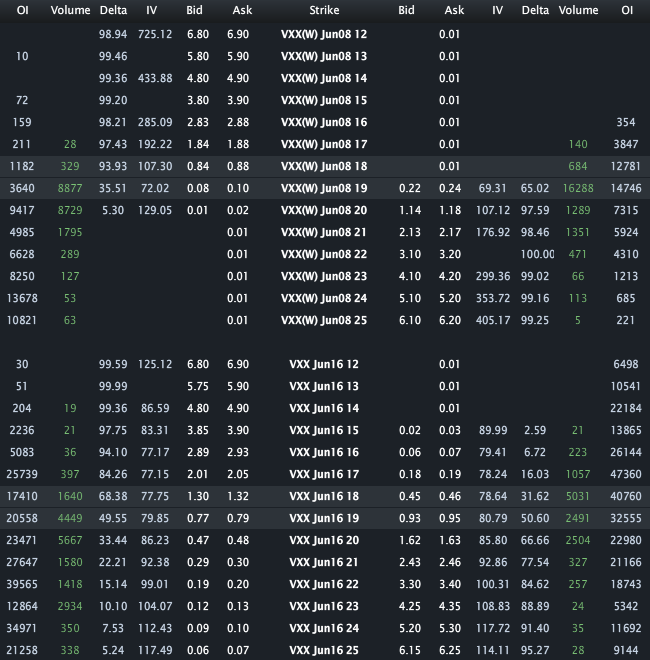
The chart below shows the VXX weekly options that expire today and compares them to options on the standard monthly options expiration cycle, which still have one week left until expiration. Note that with three hours left in today’s trading session, the implied volatility (and skew) of the VXX options is distorted as we approach expiration. Whereas the options that expire next week have an implied volatility reading in the 77 – 125 range, today’s weekly options prices have IVs of over 700 on the call side and over 400 on the put side. While this may seem outrageous, given the fact that the VIX can spike without warning and the VIX futures and VXX will move sharply in conjunction with the cash/spot VIX, options prices (and thus IV) have to account for the possibility of a spike – particularly in light of the recent news cycle.

If you think VXX IV and options prices are crazy, then perhaps it’s time you considered trading the VXX weeklys.

To reiterate what I hope is obvious to everyone who follows the VIX and the options market, VXX options are extremely aggressive trades and are probably best traded as spreads or in other defined risk positions rather than those which expose the trader to unlimited risk.

More on this (these) subject(s) in the coming weeks.

Related posts:

[source(s): LivevolPro.com]

Disclosure(s): Livevol is an advertiser on VIX and More

Friday, January 14, 2011

Managing Risk with a Short VXX Position

Since I am not sure how many readers review the comments section, I thought I should pass along a recent reader Q&A in post format in order to capture the attention of a broader audience. By the way, if you would like to see more Q&A in this space or have a specific question you are longing for an answer to, just hit up the comments section below.

Reader Mike submits:

With less $$ going into the VXX EFT due to other options to shoppers, in theory VXX should continue dropping in price value as well, correct?
I lost a good amount of money longing VXX over the summer, but recouped all losses and made money towards the end of the year shorting VXX. Now, I've loaded up on shorting it with even more capital and have a very comfortable % gain so far this year. I want to protect that gain, but my belief is that VXX will continue much lower allowing for even more reward.
I'm thinking you have the same thoughts, is that right?

Hi Mike,

Good questions. VXX is more of a function of the price of the underlying VIX futures than the demand for the ETP, so unlike some neglected stocks, it will not drop just because demand slacks off.

I'm glad to hear you have done well shorting VXX. In terms of protecting your gains, you might want to consider buying some VXX calls to hedge your risk in the event of a VIX spike. Another thought is to convert your short VXX position into a long XIV position. While these positions look almost equivalent on the surface, when VIX spikes, the size of your VXX short will increase, while the size of your XIV long will decrease. This has implications for position concentration and potential margin issues, etc. It also means that instead of having losses compound if the VIX continues to rise, there will be a diminution of incremental losses.

For example, assume a net position of $100,000. If VXX jumps 10% three days in a row a short VXX position will lose $10,000, then $11,000, then $12,100. On the other hand a long XIV position would lose $10,000, then $9,000, then $8,100. In only a few days, the daily losses become 50% higher in short VXX than in long XIV. The longer the increase in volatility persists and the bigger the daily moves are, the larger the difference becomes. Recall that in April-May 2010, the VIX tripled in a month and VXX doubled. You might want to walk through how you can protect yourself should something like that happen again.

It's something to think about, anyway.

Good trading,

-Bill

Related posts:
Disclosure(s): short VXX and long XIV at time of writing

Monday, November 8, 2010

VXX 1-4 Reverse Split Reminder, After Today's Close

Just a quick reminder that everyone's favorite VIX ETN, VXX, will undergo a 1-4 reverse split at the close of business today.  Of course the net value of any VXX positions will not be affected, as the split will merely change the units of the holdings in the ETN or in VXX options.

Thursday, September 9, 2010

VIX Weekly Options Coming on September 28

The CBOE Futures Exchange (CFE) announced today that it will begin trading weekly options on VIX futures as of Tuesday, September 28. Please note that unlike standard monthly VIX options which expire on Wednesdays, the weekly VIX options will expire on Fridays, as is the case with other weekly options. Also, settlement for weekly options will feature physical settlement - one futures contract for each expiring options contract. [Thanks to Chris McKhann for highlighting this important clarification.]

With the addition of weeklys to the VIX options stable, the proliferation of tradable VIX products has the potential to overwhelm and confuse investors. For example, in just three weeks we will have VIX futures options and VXX options expiring on the same date. The former will trade off of the VIX futures; the latter is based on iPath S&P 500 VIX Short-Term Futures ETN (VXX), which is a weighted portfolio of front month and second month VIX futures.

Among other things, the new VIX weeklys set up some interesting volatility pairs trades, including a VXX-VIX options pair that has the potential to be able to isolate the contango and backwardation components of VXX using VIX options with an identical expiration date.

For volatility traders, 2010 is shaping up to be a banner year in terms of new products.

Related posts:

Disclosure(s): none

Wednesday, August 25, 2010

VXX Weeklys Begin Trading Tomorrow

Thanks to a tweet from Adam Warner of the Daily Options Report for alerting me to the fact that VXX options have just been added to the list of 28 indices, ETFs and stocks on which the CBOE is now trading weekly options, or as the exchange calls them, weeklys.

The VXX ETF and VXX options are two subjects I have covered in considerable detail over the course of the past two years, so rather than repeat myself, I will encourage readers to start with the links to older posts on the subject toward the bottom of this post or refer to the keyword links herein and labels at the very bottom of this post.

Weekly options are the new kid on the block and something I jumped on early and have enjoyed, particularly as someone who has been an aggressive seller of options over the course of the last 1 ½ years. Again, there are links above and below for readers to find some of what I have said on the subject to date.

I should also note, however, that the August issue of Expiring Monthly: The Option Traders Journal (published on Monday) has three articles on weekly options, including a guest article from Vance Harwood of the Six Figure Investing blog. Farther afield, Steven Sears of Barron’s tackles the subject of weeklys in today’s The Striking Price column: The Weeklys Get Stronger.

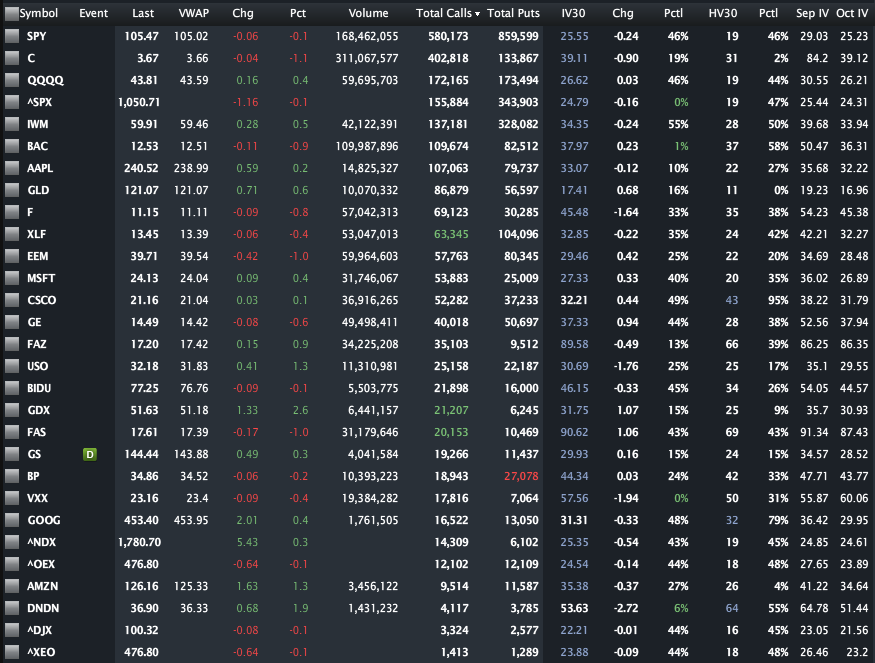
Below I have included a watch list I set up on Livevol Pro that has this week’s 28 weekly options plus next week’s addition, VXX, sorted by call volume. Note that VXX replaces Dendreon (DNDN) and brings the current breakdown of weeklys to 12 equities, 11 ETFs and 5 indices.

Related posts:


[source: Livevol Pro]

Disclosure(s): short VXX at time of writing; Livevol is an advertiser on VIX and More
Friday, August 20, 2010

VXX Implied Volatility Spikes into Expiration

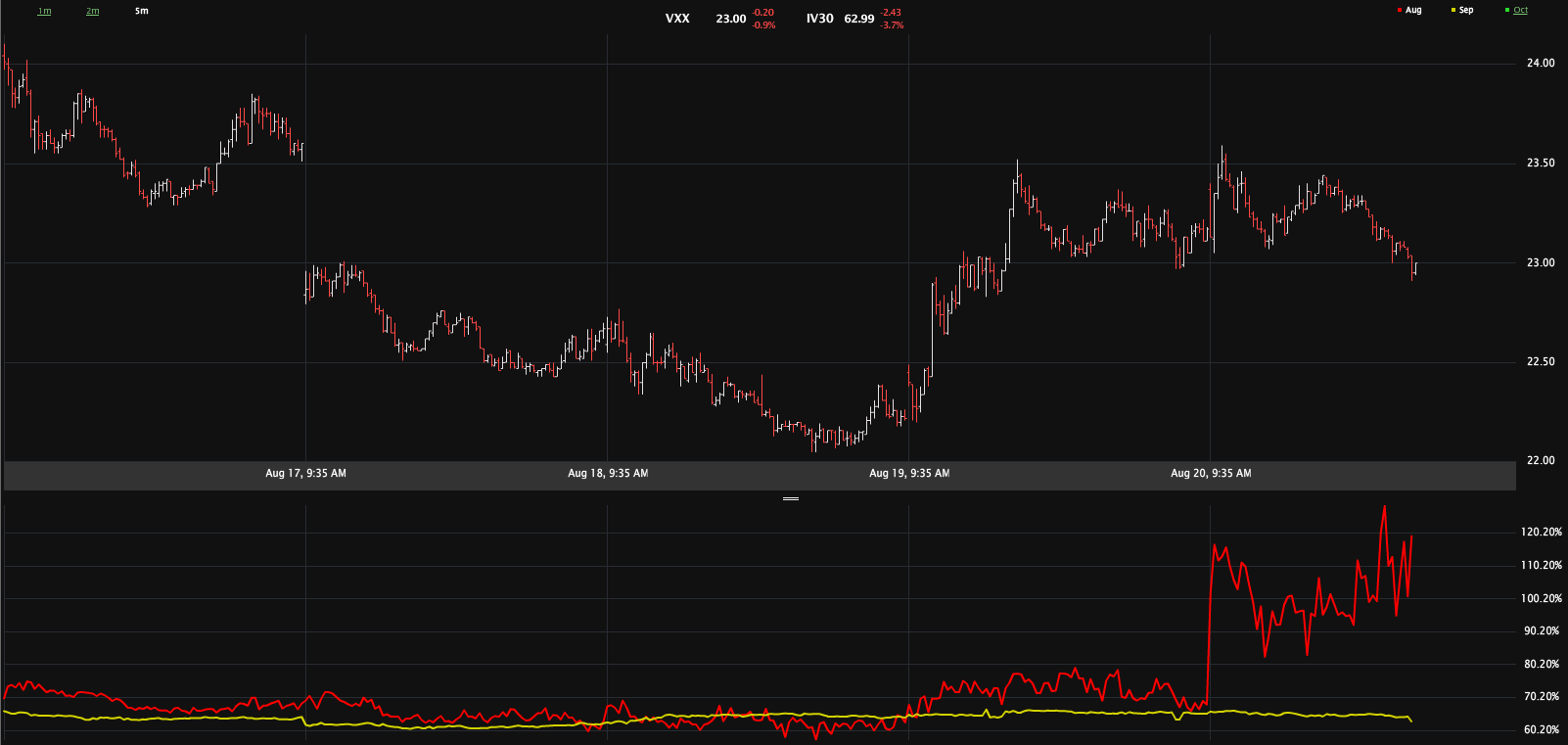
With VIX options expiring on Wednesday and VXX options expiring today (technically tomorrow) in the normal monthly expiration cycle, this is a big week for volatility traders who are comfortable holding options positions into expiration.

One of the things I like about expiration week is the manner in which time and volatility can sometimes become distorted, presenting some interesting trading opportunities.

Looking at the implied volatility of VXX this week, one can see that August IV (red line) was tracking in a fairly tight range of 60-70 from Monday through Wednesday. Yesterday saw a little more noise and some IV spikes into the upper 70s. Today there has been a quantum change in implied volatility, with VXX IV shooting up over 120 and gyrating wildly throughout the session, as the chart below shows. Interestingly, the underlying VXX ETF has not been particularly volatile today. I attribute much of the erratic change in implied volatility to the approach of options expiration.

While VXX options are certainly not for the faint of heart, particularly during expiration, in my opinion these newfangled products are just the place where retail traders are more likely to be able to find an edge than some of the better-known institutional warhorses.

Related posts:


[source: Livevol Pro]

Disclosure(s): short VXX at time of writing; Livevol is an advertiser on VIX and More
Wednesday, August 4, 2010

Record Call Activity in VXX

The iPath S&P 500 VIX Short-Term Futures ETN (VXX) saw record call volume yesterday, with over 49,000 call contracts traded (compared to 93,000 VIX calls.)

VXX calls are active once again today with 25,000 contracts traded in the first two hours, compared to only 1,500 puts.

VXX call buyers have yet to demonstrate that they are the ‘smart money’ when it comes to predicting the future of volatility, but this fact is obviously is not dissuading at the moment.

Looking at the VIX futures, the second month futures are trading at 3.30 point higher than the front month, continuing the trend of 21 consecutive trading days with at least an 8% premium for the second month over the front month VIX futures. Call it the “contango rip tide” if you will.

I mentioned the surge of interest in VXX calls a little over a week ago in VXX Calls Attracting Interest and wondered aloud whether “there is a little desperation in the air that may be triggering some revenge trades in VXX.”

It is certainly not difficult to make the case for a rise in volatility from current levels, but with negative roll yield, time decay and other factors, that doesn’t necessarily mean VXX calls will be profitable trades if this turns out to be the case.
For more on related subjects, readers are encouraged to check out:


[source: Livevol Pro]

Disclosure(s): neutral position on VXX via options at time of writing; Livevol is an advertiser on VIX and More

Monday, July 26, 2010

VXX Calls Attracting Interest

Since their launch just two months ago, options on the iPath S&P 500 VIX Short-Term Futures ETN (VXX) have attracted a robust following and have averaged about 20,000 contracts per day. During that period, approximately 2/3 of the VXX options transactions have involved calls.

Action in VXX options has heated up substantially in the past week, with record call volume last Tuesday and again today, as the Livevol chart below shows. Perhaps more importantly, call transactions as a percentage of all options transactions has spiked to a new all-time high of 78%, indicating that investors have become increasingly insistent that volatility is due for a rise.

So far at least, the VIX has refused to cooperate, closing today at 22.73, a 12-week low.

With VIX front month and second month futures settling at 25.55 and 28.75 today, respectively, the gap in the VIX futures used to calculate VXX has jumped to 3.20, reflecting a strong contango rip tide (the “headwind” metaphor has a vacation day today…) and substantial daily negative roll yield.

Looking at the chart, previous instances of VXX call spikes (green columns at bottom) have tended to coincide with tops in VXX. If the smart money is piling into long VXX calls this time around, it looks as if they are already underwater. With implied volatility just under 65, time decay is at least as much of a threat to long VXX calls as contango. The chart patterns have me wondering if there is a little desperation in the air that may be triggering some revenge trades in VXX.

As always, caveat emptor.

For more on related subjects, readers are encouraged to check out:


[source: Livevol Pro]

Disclosure(s): neutral position on VXX via options at time of writing; Livevol is an advertiser on VIX and More

Sunday, June 13, 2010

Chart of the Week: VXX Options

Launched just two weeks ago, VXX options have already attracted a great deal of interest, averaging approximately 17,000 contracts traded per day. While this number is impressive for such a short period of time, it still pales when compared to the 260,000 or so contracts in VIX options that are traded on a typical day.

As the chart of the week below (which uses VXX data from May 23 to the present) shows, VXX call volume has been running at about twice the rate of VXX put volume. It is far too early to determine whether VXX options data may flag smart money or dumb money, but it is worth noting at this juncture that the biggest spike in VXX call volume (green bars at bottom) preceded a nice jump in VXX. On the other hand, the second biggest single day volume in VXX calls came last Wednesday, the day before the SPX jumped 3.0% and caused volatility to plummet.

Going forward, I am likely to make VXX options a favorite topic in this space, particularly as VXX options can be used in combination with the underlying, the VXX ETN.

For more on related subjects, readers are encouraged to check out:


[source: Livevol Pro]

Disclosures: short VXX at time of writing

Friday, May 28, 2010

CBOE Launches Options on VXX and VXZ

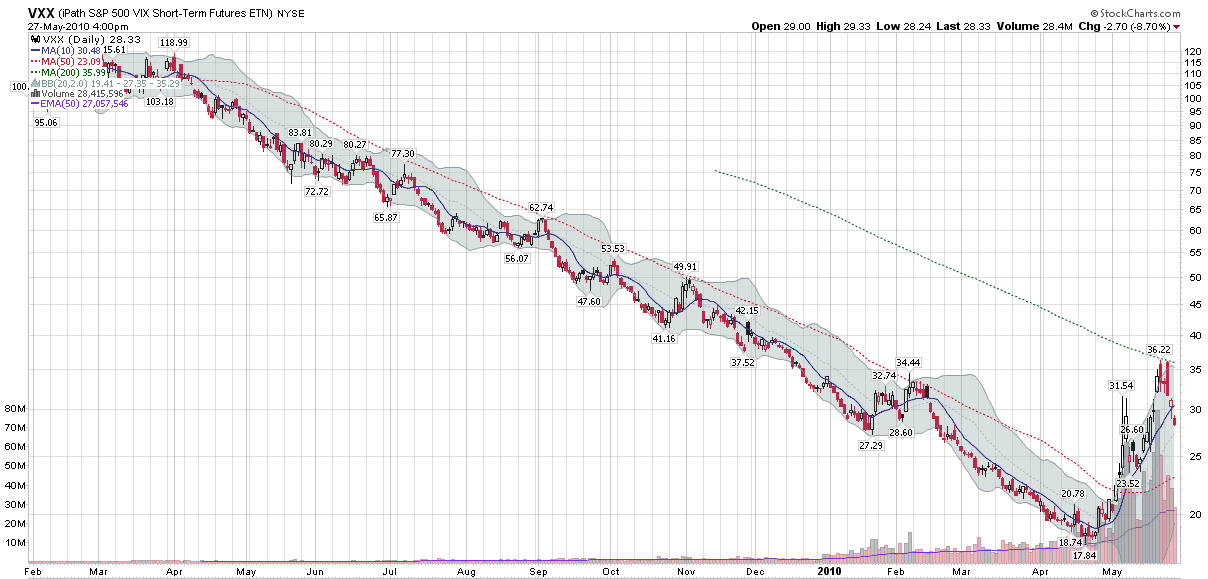
The iPath S&P 500 VIX Short-Term Futures ETN (VXX) has been one of the most closely followed topics on VIX and More, ever since the day the two VIX ETNs were launched, in January 2009. In the intervening 16 months, VXX has gone from an obscure niche product to a favorite of day traders, with volumes in excess of 20 million in each of the last 18 sessions. As a result, it is with great excitement that I note the CBOE has begun to offer options on VXX and VXZ today. (hat tip, Adam Warner)

I have discussed the calculation and performance quirks relative to VXX and its sibling, the iPath S&P 500 VIX Mid-Term Futures (5 month) ETN (VXZ) at considerable length in this space in the past and will not dive into that subjects again today. For those who are interested in exploring these issues in greater detail, the links below are a good place to start, as are the tags and hyperlinks for items such as VXX, term structure, VIX futures, contango and negative roll yield.

An even more through discussion of VXX calculations and performance can be found in The VIX ETNs: VXX and VXZ, in the March 2010 issue of Expiring Monthly.

I think it is safe to say that VXX options will open up a whole new world of volatility trading opportunities, whether considered separately or in conjunction with VIX options and other volatility products. I will definitely devote a good deal of time to this subject going forward.

For more on related subjects, readers are encouraged to check out:


[source: StockCharts.com]

Disclosure(s): short VXX at time of writing; I am one of the founders and owners of Expiring Monthly

DISCLAIMER: "VIX®" is a trademark of Chicago Board Options Exchange, Incorporated. Chicago Board Options Exchange, Incorporated is not affiliated with this website or this website's owner's or operators. CBOE assumes no responsibility for the accuracy or completeness or any other aspect of any content posted on this website by its operator or any third party. All content on this site is provided for informational and entertainment purposes only and is not intended as advice to buy or sell any securities. Stocks are difficult to trade; options are even harder. When it comes to VIX derivatives, don't fall into the trap of thinking that just because you can ride a horse, you can ride an alligator. Please do your own homework and accept full responsibility for any investment decisions you make. No content on this site can be used for commercial purposes without the prior written permission of the author. Copyright © 2007-2023 Bill Luby. All rights reserved.
 
Web Analytics