Showing posts with label VXST. Show all posts

Sunday, March 30, 2014

CBOE RMC 2014: A Retrospective

Earlier this month, I had the pleasure of attending the CBOE Risk Management Conference (RMC) in Bonita Springs, Florida. Now that the conference is over and the CBOE has posted most of the presentations, I thought I would take a little time and offer a retrospective look at some of the content that caught my attention.

Before I do that, I am compelled to tip my cap to Russell Rhoads, whose indefatigable and prolific efforts were responsible for capturing many of the details of the conference. Russell’s posts and those of Matt Moran made it possible for anyone to have a virtual front-row seat throughout the proceedings. Their efforts in conjunction with the RMC are archived at the CBOE Options Hub with the CBOERMC tag.

From my vantage point, I thought it particularly interesting that the two keynote speakers, Martin Zonis and Carl Tannenbaum, had such divergent views about the potential risks and rewards in the U.S. financial markets in the coming years. Zonis placed most of his attention on political risk and foreign policy matters and declared that the markets were “underestimating volatility in future years.” While Tannenbaum expressed concern about banks in Europe as well as credit and real estate in China, he had a much more sanguine view of the future of the U.S. economy and financial markets.

Among the other presentations, I was particularly interested to hear Maneesh Deshpande provide an overview of the players and strategies used in volatility products during the course of the evolution of the VIX product platform. Deshpande described the VIX futures as a mature market, with liquidity and supply having shifted from commercial to con-commercial traders. He also indicated that demand for VIX puts has stagnated, while new entrants are increasing the demand for VIX calls. All of this has influenced how the VIX spikes and mean reverts, as well as how the VIX futures term structure has evolved.

Another particularly interesting session involved Ed Tom and John-Mark Piampiano, who tackled the subject of the volatility of volatility, invoking the likes of VVIX as well as the third and fourth derivatives of SPX implied volatility. At every conference at least one session gives you things to mull over long after the speakers are done and for me, this was the session that hit the high notes. Ed Tom’s presentation has not yet been posted, but he started his talk by decomposing VIX risk premium into realized volatility plus skew plus kurtosis and went on from there.

Sheldon Natenberg and Trevor Mottl were tasked with the subject of evaluating the volatility surface: skew and term structure. Not surprisingly, they were up to the task, with Mottl focusing on the role of money and credit in shaping the volatility surface. He indicated that the increasing size of the Fed’s balance sheet has depressed volatility across the board over the course of the past few years and expects that as the Fed’s balance sheet normalizes, the change in non-financial debt will become the most important influence on equity market volatility going forward. Mottl attributed the steepness of the VIX futures term structure to the uncertainty related to the Fed’s ability to be successful with its quantitative easing program. He also traced fluctuations in the skew of volatility to expectations related to the Fed’s tapering plans.

Among the other presentations I sat in on were:

  • a panel on volatility as an asset class (the consensus that volatility is more of a tool and in order to be thought of as an asset class needs to harvestable, allocatable and easier to benchmark; a separate thread was critical of the costs associated with traditional approaches to tail hedges)
  • a discussion of trading volatility across asset classes (included an interesting set of metrics and trade ideas)
  • a wide-ranging session on the design and trading of VIX and other volatility derivatives, which had a detailed explanation of the VIX settlement process as well as a discussion of VXST, which is expected to gain much more momentum when options on the index become available on April 10

Finally, I had an opportunity to sit down with Angela Miles of CBOE TV to offer my thoughts on the second day of RMC:


For those who may be interested, the 3rd Annual CBOE RMC will be held September 3-5, just south of Dublin, Ireland.  Since all of my ancestors trace their roots back to Ireland, I can’t imagine a better place to hear about the latest thinking in volatility and ponder the miracle of Guinness draught at the same time.

Related posts:

Disclosure(s): CBOE is an advertiser on VIX and More

Tuesday, March 11, 2014

CBOE Risk Management Conference, the VIX and Volatility Summit, Begins in One Week

The CBOE calls it the CBOE Risk Management Conference and I like to think of it as “The VIX Summit,” but by any name I am convinced that the 30th annual CBOE RMC (yes, it is even nine years older than the VIX) is the top conference of the year for anyone with an interest in the VIX, volatility and more broadly in the subject of risk management.

Kicking off one week from today, on March 17th in Bonita Springs, Florida, the CBOE RMC is the best place I can think of to interact with the top thinkers and practitioners in the volatility space. The speakers and the agenda are both top notch and as always, an abundance of fascinating ideas and information will flow freely outside of the formal presentations. Some of the sessions that sound particularly interesting to my ear include:

  • The Shifting Landscape of Volatility Products: Who is Doing What and Why, and What Should You Do About It?
  • Panel on Volatility as an Asset Class: What Options- and Volatility-Related Strategies are Institutional Investors Employing and Why?
  • Trading Volatility Across Asset Classes
  • Volatility of Volatility
  • The Volatility Surface:  Skew and Term-Structure
  • Listed Derivative Product Design and Trading

I encourage anyone with an interest in volatility to attend as this is an excellent place to find ideas to ruminate on and to master the art of volatility cross-pollination. After all, it is still a relatively small (but growing) group of aficionados that live and breathe volatility. Where else, for instance, can you find a bunch of like-minded souls who are already plotting how to implement VXST options strategies when these products have not even been launched?

Speaking of like-minded souls, if you have a moment, I encourage you to flag me down and say hello.

For those who are unable to attend, I will do my best to pass along some of the highlights from the conference.

Finally, for those who might be interested in a similar event on European soil, planning for the 3rd Annual CBOE RME-Europe is ongoing and at this juncture the odds favor a location that will appeal to those who are fans of links golf courses.

Related posts:

Disclosure(s): CBOE is an advertiser on VIX and More; VIX and More is a sponsor of the CBOE Risk Management Conference

Thursday, October 24, 2013

The New VXST and the VXST:VIX Ratio

At the beginning of the month several interesting announcements came out of the CBOE Risk Management Conference in Portugal. One which particularly caught my interest was the announcement of the launch of the new CBOE Short-Term Volatility Index (VXST), which is essentially identical to the VIX, except that whereas the VIX is looking ahead at a window of 30 calendar days, the VXST measures implied volatility of options on the S&P 500 index (SPX) for the next 9 calendar days.

This means that the CBOE now has three different indices to measure implied volatility expectations in SPX options:

  • 9 days (VXST)
  • 30 days (VIX)
  • 93 days (VXV)

The VXV has been a favorite subject of mine going back to my initial comments on the index and the VIX:VXV ratio I pioneered as an indicator back in December 2007. With the new VXST, investors now have a better gauge of volatility expectations to apply to time frames that are appropriate for weekly options, which are on track to account for about 25% of all options trades by the end of the year.

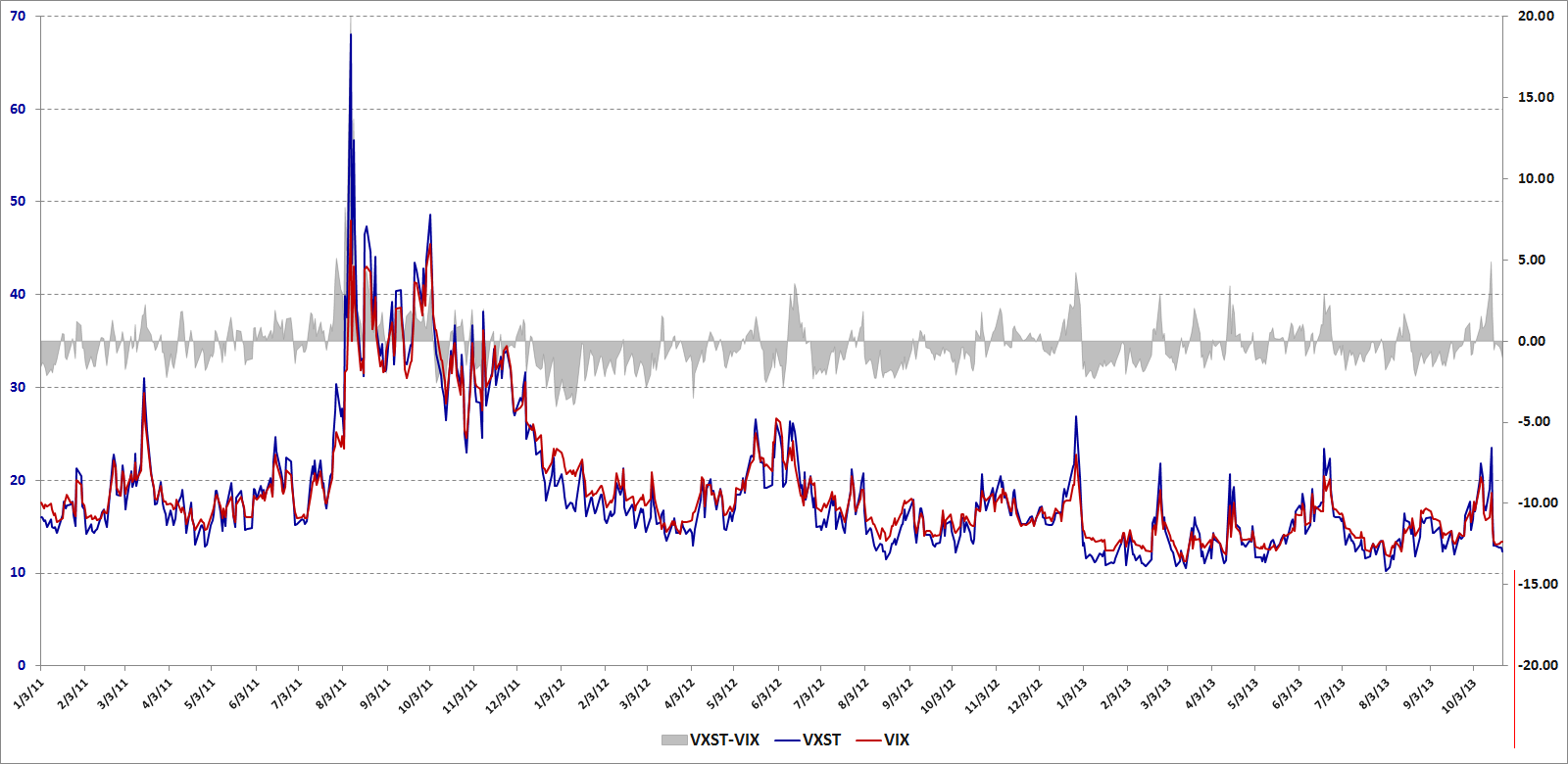
The launch of VXST options opens up a whole new set of possibilities, not the least of which is a VXST:VIX ratio that offers some possibilities as an indicator that are similar to those of the VIX:VXV ratio. In the chart below, I have mapped not the ratio of VXST:VIX, but the differential between the two indices. With VXST historical data going back to the beginning of 2011, it is worth noting that the VIX has been higher than VXST about 61% of the time. Typically, when volatility spikes, VXST spikes much higher than the VIX, with the bulk of the 39% of the instances in which VXST is higher than VIX occurring mostly during periods of elevated volatility.

[source(s): CBOE, VIX and More]

I will go into much greater detail regarding VXST:VIX vs. VIX:VXV at a later point. For now it is worth noting that these ratios have some advantage to comparing the VIX futures term structure in that the indices focus on a fixed time period, while the days to expiration of the VIX futures is constantly in flux.

Also of interest, the CBOE press release notes:

“Plans call for CBOE and CBOE Futures Exchange, LLC (CFE®) to introduce VXST Weeklys options and futures. The launch dates for these tradable VXST products are yet to be determined, pending regulatory approval.”

As compelling as VIX products are for trading, I can imagine that VXST options and futures might be even more attractive to certain types of traders. Also, if VXST futures gain some traction, I can envision ETPs based on these that might rival the interest in VXX at some point.

In other words, this could easily turn out to be a huge development in the volatility space.

Related posts:

Disclosure(s): short VXX at time of writing; the CBOE is an advertiser on VIX and More
DISCLAIMER: "VIX®" is a trademark of Chicago Board Options Exchange, Incorporated. Chicago Board Options Exchange, Incorporated is not affiliated with this website or this website's owner's or operators. CBOE assumes no responsibility for the accuracy or completeness or any other aspect of any content posted on this website by its operator or any third party. All content on this site is provided for informational and entertainment purposes only and is not intended as advice to buy or sell any securities. Stocks are difficult to trade; options are even harder. When it comes to VIX derivatives, don't fall into the trap of thinking that just because you can ride a horse, you can ride an alligator. Please do your own homework and accept full responsibility for any investment decisions you make. No content on this site can be used for commercial purposes without the prior written permission of the author. Copyright © 2007-2023 Bill Luby. All rights reserved.
 
Web Analytics