Showing posts with label solar stocks. Show all posts

Wednesday, June 2, 2010

Turmoil in the Oil Patch

Several factors have combined to create turmoil in the oil patch. Most notably, the Deepwater Horizon oil spill has hammered the stocks of BP and Transocean (RIG), while tainting the entire oil and oil services (OIH, XES) sector. On top of the spill, the European sovereign debt crisis has generated concerns about an economic slowdown of the European region and beyond, while manufacturing data and other news out of China hints at the possibility of weakness in the most significant area for future growth in energy demand.
In short, valuations across the sector are way down and yet the long-term supply and demand imbalance will likely suffer no more than a small dent as a result of the events of the last couple of months.
The energy sector has a very promising future and I am looking to add to existing positions on weakness. As the chart below shows, there are some indications that crude oil (USO) may have put in a bottom and the exploration and production ETF (XOP) may also be beginning a bottoming process as well. Outside of fossil fuels, alternative energy plays in solar (TAN, KWT) and wind (FAN, PWND) are somewhat suspect in that critical governmental subsidies from the likes of Spain and Germany appear to be a victim of the sovereign debt crisis. Still, these alternative energy plays, including some broad-based alternative energy ETFs (GEX, PBD), have also been marked down dramatically and should also benefit as crude oil prices start to rebound and governments come under increasing pressure to make use of ecologically sustainable energy sources.
For more on related subjects, readers are encouraged to check out:


[source: ETFreplay.com]

Disclosure(s): long OIH and XOP at time of writing

Wednesday, October 29, 2008

Is the Fear Bubble Bursting?

There have been quite a few bubbles and mini-bubbles that have burst over the past year or so. A short list would probably include China; housing; oil; fertilizer; solar; dry bulk carriers; etc.

What about a fear bubble?

We have overshot on just about everything else, so maybe it’s time we overshot the whole business of overshooting. Fear and volatility have become so much a part of the everyday existence for those who work in the investment world that it is all too easy to take them for granted.

When I see a contract on Intrade that allows people to bet on the end of western civilization, then I’ll know things have gone too far. I haven’t seen such a contract yet, but I feel obliged to note that there is a contract for The U.S. Economy to go into a Depression in 2009, with a depression defined as “a cumulative decline in GDP of more than 10.0% over four consecutive quarters.”

Looking at previous bubbles, I wonder if the fear bubble is analogous to an oil bubble. You see macroeconomic events moving inexorably in the same direction day after day and you begin to assume the future is a predestined march down what looks like an unavoidable path.

On Monday, in Fear Is on the Decline, I talked about signs I was seeing that fear was already “starting to leave the markets.” The VIX has already fallen more than 15% from Monday’s close and there is a good chance it will be at least another decade before it sees the 80s again.

Roger Ehrenberg is out with another thoughtful piece, Is Volatility Embedded in the System for a Generation? In it, Roger paints a picture of a financial crisis receding only to the point that it exposes gaping fundamental holes in the economy, the substantial risk of a Japan-style deflation, and a Fed so determined to prevent deflation that their easy money policy leads to runaway inflation and ultimately some sort of cruel game of low growth inflation-deflation ping pong.

In such an environment, which I would not consider to be too far-fetched, Roger describes a VIX of 40 as the new 20 and predicts a much higher floor for volatility in the future.

On the other hand, I am reminded of a post I titled The Big Question for the VIX back on May 22nd when the VIX closed at 18.05. The big question back then, with a financial crisis raging, oil approaching 150, and investor anxiety on the increase, was why the VIX was below 20.

Just five months ago, which was the more unlikely scenario: crude oil at 60 or the VIX at 90? It’s hard to say, but suffice it to say that it would have been hard to find the appropriate strikes to even make such a bet back then.

In the last five months, cause and effect has flipped. Not too long ago it was oil prices that were driving estimates of future economic activity and volatility, now the economy is the cause and oil, volatility and the like are the effects.

One day of 900 points gains in the Dow Jones Industrial Average will not fix all the economic woes on the horizon. It just might, however, signal an end to the runaway bull market in fear.

Friday, April 4, 2008

Chinese Solar Stocks on the Rise

Two areas that have been rife with speculative frenzy – both bullish and bearish – over the past year or so have been China and solar stocks. Not surprisingly, the space where the two intersect, Chinese solar stocks, has been one of the most volatile segments of the market.

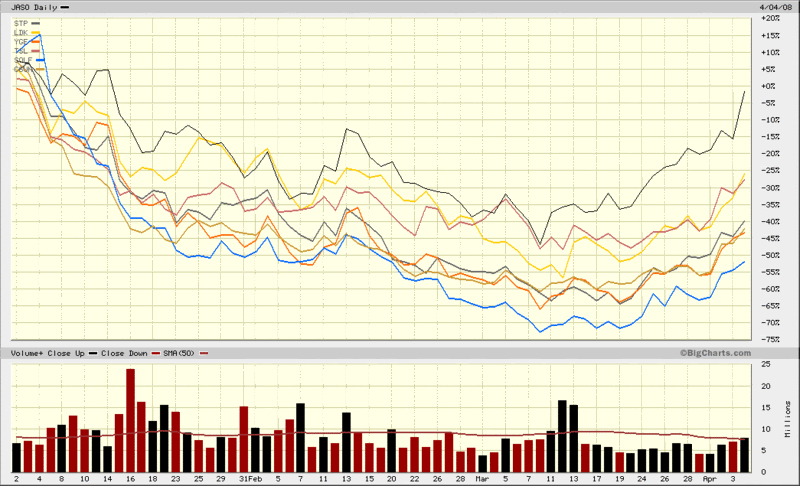
I have elected not to show the long-term chart of these stocks, which looks a lot like a higher beta version of the chart of the FXI. Instead, the chart below compares the year-to-date performance of the most significant players in the Chinese solar space that are traded on US exchanges: JASO; STP; LDK; YGE; TSL; SOLF; and CSUN. I left JASO as the anchor and show the volume in this stock at the bottom of the chart because JASO is the biggest gainer of the year so far and the chart shows that after the March 10th bottom, strong volume flowed into the stock over the next three days, marking the beginning of the current leg up.

Given their high profile and speculative history, Chinese solar stocks can be an excellent speculative barometer, not only for China and the solar sector, but for the markets as a whole. More importantly, where there is strong speculative activity, particularly coming off of a sharp bear move, there is increased confidence in the markets and a high degree of perceived opportunity.

Thursday, December 20, 2007

Gap City: LDK

I’m reasonably sure that whatever I write here will be obsolete in the ten minutes that it takes me to post it, but I feel compelled to comment about LDK Solar (LDK) anyway.
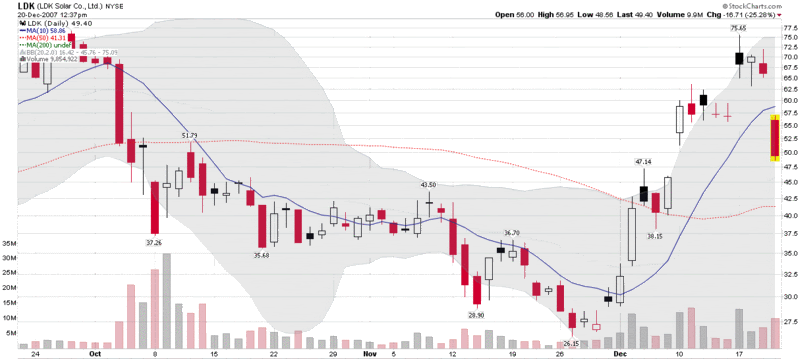
For those who do not follow LDK, this is the Chinese solar company that was the subject of accounting fraud allegations by a former controller that helped to knock the stock down from the mid-70s to the mid-20s over the course of a month or so. On Monday, LDK reported that the Audit Committee of the Board of Directors had finished their review of the matter and concluded that there had been no wrongdoing. Things were looking up until LDK reported quarterly results after the close yesterday. The numbers were generally in line, but concerns about margins and the absence of raised guidance has put pressure on this stock this morning, which traded down as much as 27% earlier in the session.

While the story is interesting, the chart may raise even more eyebrows, as it is littered with gaps and the tombstones of overzealous traders. If you are thinking about playing solar roulette, consider that directional plays are extremely dangerous. One way to make to potentially make some money off of the faddish momentum and wild gyrations is to sell volatility below support and above resistance, so you can get paid while you watch the fun. Even if you don’t play this stock, the entertainment value alone makes it worth keeping an eye on.

On a related note, is it only me, or does anyone else who trades Chinese solar counterpart JA Solar Holdings (JASO) think of a hockey mask every time they look at the ticker? Given the volatility in that stock, somehow it seems an appropriate image…

Finally, anyone interested in rolling the dice in the solar sector, Chinese and otherwise, should start their research with the excellent solar stock comparison table at China Analyst.

DISCLAIMER: "VIX®" is a trademark of Chicago Board Options Exchange, Incorporated. Chicago Board Options Exchange, Incorporated is not affiliated with this website or this website's owner's or operators. CBOE assumes no responsibility for the accuracy or completeness or any other aspect of any content posted on this website by its operator or any third party. All content on this site is provided for informational and entertainment purposes only and is not intended as advice to buy or sell any securities. Stocks are difficult to trade; options are even harder. When it comes to VIX derivatives, don't fall into the trap of thinking that just because you can ride a horse, you can ride an alligator. Please do your own homework and accept full responsibility for any investment decisions you make. No content on this site can be used for commercial purposes without the prior written permission of the author. Copyright © 2007-2023 Bill Luby. All rights reserved.
 
Web Analytics