Showing posts with label CFE. Show all posts

Friday, May 25, 2012

First Day of Trading in Nasdaq-100 Volatility Index (VXN) Futures

You really need a scorecard to keep up with the new product launches at the CBOE. Today was potentially a big one, with the launch of futures on the Nasdaq-100 Volatility Index, which most of us simply refer to as VXN or Vixen.

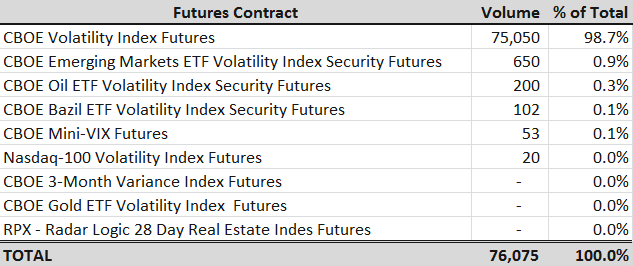
As the table below shows, the VIX continues to account for approximately 99% of the volatility index futures at the CBOE Futures Exchange (CFE). Today VXN futures (VN) traded 20 contracts on its opening day. While futures in the CBOE Emerging Markets ETF Volatility Index (VXEEM) are currently positioned at the #2 product at the CFE, VXN futures certainly have a lot of potential, with the likes of Apple (AAPL), Facebook (FB) and Google (GOOG) and other technology high fliers folded into this security.

On a related note, for anyone who may be interested, I authored the feature article, The Expanding Volatility Megaplex, in the current edition of Expiring Monthly. This article chronicles the history of volatility indices and looks at how the CBOE has recently begun to aggressively expand the scope of volatility indices and turn these into product platforms for futures, options and exchanged-traded products.

Related posts:

[source(s): CBOE Futures Exchange]

Disclosure(s): The CBOE is an advertiser on VIX and More

Thursday, December 9, 2010

VIX Futures Now Opening at 8:20 a.m. ET

Effective tomorrow, December 10th, VIX futures will be open for trading as of 8:20 a.m.

"Extended trading hours for VIX futures will give investors the ability to more efficiently mitigate risk and establish or offset positions that may be impacted by potential market-moving events such as overnight news, banking actions, or key economic reports released prior to the general market open," explained Andrew Lowenthal, Managing Director, CBOE Futures Exchange.

Of course VIX futures are the underlying security for all VIX options and exchange-traded products.

For more information, check out the CBOE Futures Exchange (CFE) press release.

Wednesday, October 10, 2007

VIX Futures and Volatility Expectations

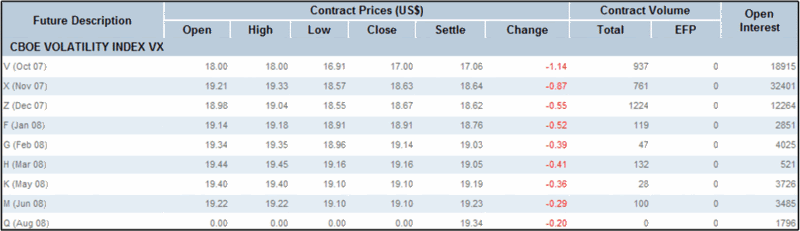
Periodically, I get a question about where to find VIX futures data. A few brokers (optionsXpress is one) have this information available via their web site and/or trading platform. The CBOE also provides VIX futures data at no charge through the CBOE Futures Exchange (CFE). Follow the link provided and click on the “Price and Volume Detail” tab to get information on all the VIX futures contracts for the previous trading day. The CFE also has a Historical Market Data page for those who are interested in detailed historical statistics.

I have clipped a snapshot of yesterday’s closing data to give a sense of what information is available. Note that most of the action is in the front three months, yesterdays futures were pricing in an 0.94 gain (a 17.06 futures settlement price vs. a 16.12 close in the VIX cash price) in the VIX over the next five days (October contracts expire a week from today), and volatility expectations from November 2007 to August 2008 are fairly uniform and muted.

If we do see volatility return to the markets soon, as I anticipate, I will compare a snapshot of VIX futures then with the current picture.

Monday, May 21, 2007

Larry McMillan on a Positively Correlated VIX and SPX

Thanks to the CFE’s Futures in Volatility newsletter, I have a fairly good idea what Larry McMillan is thinking about vis-à-vis a positively correlated VIX and SPX. The May 21, 2007 issue of Futures in Volatility just arrived in my mailbox a few minutes ago and in it McMillan makes the following observations:

“The last few weeks have seen a slow but steady rise in VIX (and in most VIX futures), even though the broad market, as measured by the S&P 500 Index, is rising in price. This is not a phenomenon that is seen too often, but it is not completely unprecedented. Occasionally, one sees a day or two in which VIX rises while the broad market rises, but it is much more unusual to see a trend of that sort. The current trend has lasted one month, but back in the 1990s, there were periods when VIX rose for months while the S&P 500 Index rose as well. If one recalls, VIX was near 10 in late 1994. But during the bull market of the 1990s, VIX rose to the point where it was routinely between 25 and 30 in 1998 and 1999. Yet, during that time, the S&P 500 Index also rose quite strongly, as those were the banner years of that bull market.


In the last month, futures prices have reacted accordingly, although their pricing curve is in a state that has not yet been seen in the 3-year history of VIX futures trading. Most of the VIX futures, Variance futures, and VIX options have followed VIX higher in the last month. VIX products have increased in price much across the board: November 2007 and February 2008 VIX futures are now slightly above 15. Even the August 2007 VIX futures are nearly 15. Does this mean that volatility traders are looking for higher volatility later this year? It certainly seems that way. What is a bit unusual is that there is not really much of a spread between the longer-term contracts…Looking back over the history of VIX futures trading, there are only two other occurrences of similar tightly-packed groupings of VIX futures prices. Those occurred in April and May 2005, and June and July 2006, both of which were times when the market had just fallen and was beginning to rally, so the futures were transitioning between “bearish” and “bullish” shapes. That is not the case now. This is the first time we have seen this construct while the market is rallying. In all likelihood, the futures are indicating that the market is going to become more volatile, regardless of the direction of the S&P 500 Index. It appears that traders expect volatility to be more in line with historical norms (the long-term historical volatility of the S&P 500 Index is approximately 15%).”

McMillan’s remarks dovetail nicely with my thinking in “VIX Futures: The One Picture to Remember” (see the comments, in particular.) Still, I am not yet prepared to make a call on the likelihood of increasing volatility or the direction of the SPX. As far as I’m concerned, the record highs and continued upside momentum in the SPX outweigh any signs of technical weakness or a breakdown in investor sentiment. I will have more to add to my May 4th “Predictive Value of SPX and VIX Correlation: First Pass” post in the near future. This time around I will offer only two words of advice: trailing stops.

Friday, May 18, 2007

VIX Futures: The One Picture to Remember

There are really only a handful of important things to remember about the VIX. I can summarize the most important ones as follows:

  • The VIX is generally negatively correlated with the SPX
  • The VIX is a mean-reverting animal
  • VIX options prices are calculated off of VIX futures

Now raise your hand if you follow the futures market. I thought so. Well, neither do I for the most part, but I’m quickly coming around to futures as a useful tool for getting a better handle on how investors are thinking about and betting on the future.

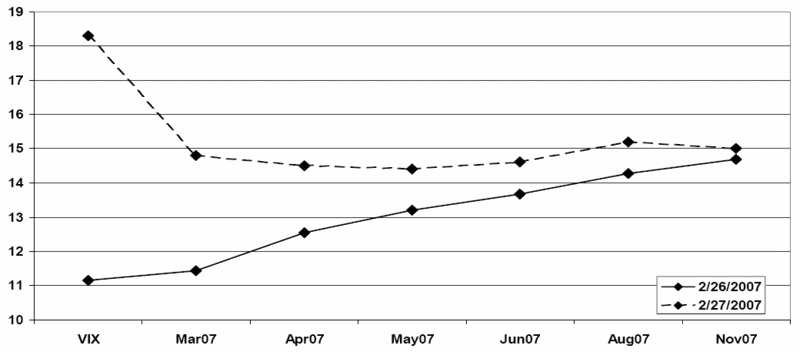
Rather than try to sound like some sort of evangelist, however, let me just offer one chart, which comes courtesy of the CFE. I will skip the commentary, other than to translate the obvious into some numbers: when the VIX jumped 64% from February 26th to February 27th, the nearest futures, the March ’07 VIX, moved less than half as much in percentage terms. Looking further out, the August ’07 VIX futures moved about one tenth of the VIX index, while the November ’07 VIX futures moved about one thirtieth as much as the VIX did.

Tuesday, May 15, 2007

VIX Futures Starter Kit

If anyone is wondering why I’m not talking more about VIX futures on this blog, the reason is simple: ignorance. Sure, I know what VIX futures are and I know the central role they play in the calculation of VIX options values, but I can’t say that I’ve ever studied them. The time has come to eradicate that particular blind spot in my investment universe and I’ll do the best I can to pull along anyone else who is interested.
First, it may be useful to back up for a minute and take a look at the VIX as a derivative instrument. Consider that stocks are an underlying asset, options are derived from stocks, options premiums are 'derived' from options prices, volatility indices (like the VIX) are derived from the options premiums, and, to top it off, when you want to trade the VIX, you cannot trade it directly, but have to trade a VIX option, which is a derivative based not on the VIX, but VIX futures! That's a fifth or sixth generation derivative, depending upon how you count...

The way I see it, however, the most important component in the derivative chain is the VIX futures. Unless you understand VIX futures, thinking about and trading the VIX is lot like trying to drive a car with a view of the road from 30 miles back rather than what currently lies beyond the front windshield. Even you are somewhere in the Midwestern United States, drive very slowly, and have auto insurance, I wouldn’t recommend it. The VIX, unfortunately, looks more like the road pictured above.

Fortunately, the CBOE Futures Exchange (CFE) has some excellent information on VIX futures. In fact they have a monthly newsletter, Futures in Volatility, you can sign up for that includes a VIX market summary and analysis by options guru Larry McMillan, as well some trading strategy ideas, also provided by McMillan. In short, it’s the perfect place for the budding VIX futures student to brush up on his or her knowledge. After considerable searching, I have discovered where the CFE archives (hides?) these newsletters, but you may prefer to follow the CFE’s instructions to get the newsletter delivered via e-mail.

Homework is optional at VIX and More, but don’t be surprised if I refer to these newsletters (only three of them so far, about 8 pages each) down the road.

DISCLAIMER: "VIX®" is a trademark of Chicago Board Options Exchange, Incorporated. Chicago Board Options Exchange, Incorporated is not affiliated with this website or this website's owner's or operators. CBOE assumes no responsibility for the accuracy or completeness or any other aspect of any content posted on this website by its operator or any third party. All content on this site is provided for informational and entertainment purposes only and is not intended as advice to buy or sell any securities. Stocks are difficult to trade; options are even harder. When it comes to VIX derivatives, don't fall into the trap of thinking that just because you can ride a horse, you can ride an alligator. Please do your own homework and accept full responsibility for any investment decisions you make. No content on this site can be used for commercial purposes without the prior written permission of the author. Copyright © 2007-2023 Bill Luby. All rights reserved.
 
Web Analytics