Showing posts with label VXEEM futures. Show all posts

Thursday, June 20, 2013

VXEEM as a Measure of Emerging Markets Volatility and Risk

If you think U.S. stocks have been through a rough patch as of late, then you haven’t been paying attention to emerging markets stocks, where the popular EEM emerging markets ETF as fallen from a high of 42.96 on May 22nd to 37.02 earlier today – a 13.8% drop in less than one month. A large part of the problem has been the performance of the BRIC countries, where Brazil (EWZ), China (FXI) and India (EPI) are all acting as if they have been thrown overboard with anchors tied to their ankles, making Russia (RSX) look like the most stable investment of the group – which is quite a task.

Investors looking to monitor risk and uncertainty in Brazil and China are fortunate enough to have dedicated volatility indices based on the VIX methodology for EWZ and FXI. These volatility indices were created by the CBOE and use the tickers VXEWZ and VXFXI, respectively. For a more holistic view of risk and uncertainty in the emerging markets space, the best choice is probably VXEEM, the CBOE Emerging Markets ETF Volatility Index that is calculated based on options in EEM.

The chart below shows the relative performance of VXEEM and the VIX going back to the end of October 2012. Note that during toward the end of 2012, the debate over sequestration caused the markets to assign much more additional risk and uncertainty to U.S. stocks than to emerging markets stocks. During the course of the last month or two, this relationship has reversed and the risk and uncertainty associated with VXEEM has grown at a much faster rate than that of the VIX. On average, the absolute level of VXEEM is about 40% higher than that of the VIX. This week, however, VXEEM has been about 60% higher than the VIX.

On a related note, I find it interesting that S&P announced the launch of the S&P Emerging Markets Volatility Short-Term Futures Index just ten days ago. With that index in place, it would be relatively easy to create a futures-based emerging markets volatility ETP that would function in the same manner as VXX, but be based on VXEEM rather than the VIX. The biggest obstacle to this type of product is probably the current lack of liquidity in the VXEEM futures market.
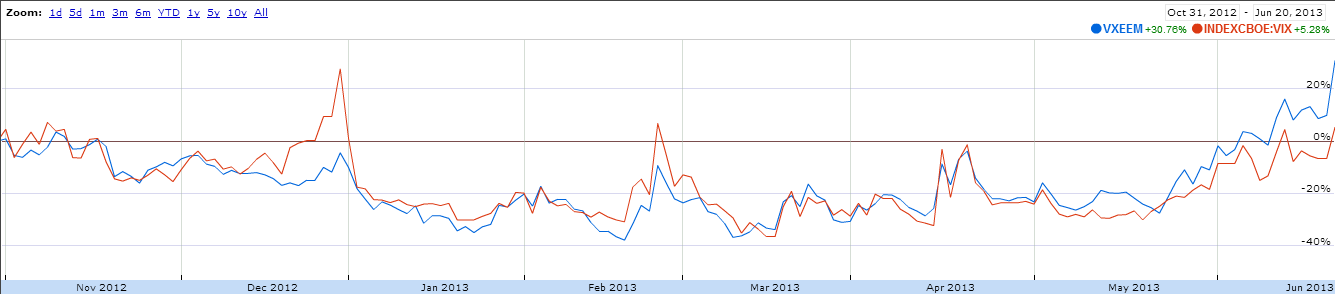
[source(s): Google Finance]

Related posts:

Disclosure(s): short VXX at time of writing

Friday, May 25, 2012

First Day of Trading in Nasdaq-100 Volatility Index (VXN) Futures

You really need a scorecard to keep up with the new product launches at the CBOE. Today was potentially a big one, with the launch of futures on the Nasdaq-100 Volatility Index, which most of us simply refer to as VXN or Vixen.

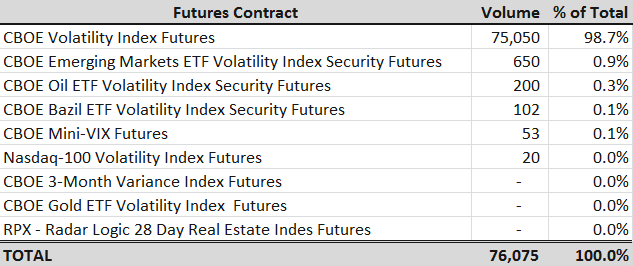
As the table below shows, the VIX continues to account for approximately 99% of the volatility index futures at the CBOE Futures Exchange (CFE). Today VXN futures (VN) traded 20 contracts on its opening day. While futures in the CBOE Emerging Markets ETF Volatility Index (VXEEM) are currently positioned at the #2 product at the CFE, VXN futures certainly have a lot of potential, with the likes of Apple (AAPL), Facebook (FB) and Google (GOOG) and other technology high fliers folded into this security.

On a related note, for anyone who may be interested, I authored the feature article, The Expanding Volatility Megaplex, in the current edition of Expiring Monthly. This article chronicles the history of volatility indices and looks at how the CBOE has recently begun to aggressively expand the scope of volatility indices and turn these into product platforms for futures, options and exchanged-traded products.

Related posts:

[source(s): CBOE Futures Exchange]

Disclosure(s): The CBOE is an advertiser on VIX and More

Tuesday, March 6, 2012

VXEEM vs. VIX Indices and Futures in Today’s Selloff

Stocks have been eerily quiet for the first ten weeks of 2012, with only four 1% moves in the SPX so far – and all of those coming to the upside.

It just so happens that the CBOE’s launch of futures and options on the CBOE Emerging Markets ETF Volatility Index (VXEEM) coincided with this period of languid volatility, which has made it easier for this index to fly under the radar.

Today is the first time I am able to get data on the VXEEM futures in a market that is down at least 1% and I must admit to being somewhat surprised by the results.

The table below captures SPY and VIX data in the left column along with and EEM and VXEEM data in the right column. Note that approximately one hour into today’s regular trading session, SPY was down about 1.3% and EEM, the popular emerging markets ETF, was down 3.1%. So far, so good. Far more interesting, while EEM was down about 2.4 times as much as SPY, the VIX was up substantially more than the VXEEM index, 16.57% to 12.62%...so while the selloff was disproportionately in emerging markets, the panic was disproportionately in the S&P 500 index.

I also captured simultaneous futures data for March, April and May for both the VIX futures and VXEEM futures. Interestingly enough, the changes in the front three month futures for both the VIX and VXEEM were almost identical.

So what kind of volatility environment do we live in where the emerging markets index falls faster than the SPX (even beta-adjusted, but that discussion is for another day), while the VIX spikes much more than VXEEM, yet the futures for both products seem to move in almost identical fashion?

If you think you have the answer, pairs trading opportunities with VIX products and the VXEEM futures and options (there are no ETPs yet that are based on VXEEM) are certainly there for the taking. While VXEEM futures and options are not particularly liquid or deep yet, they are sufficiently liquid and deep from which to extract some profits.

Related posts:

[source(s): Interactive Brokers]

Disclosure(s): long EEM at time of writing; the CBOE is an advertiser on VIX and More

DISCLAIMER: "VIX®" is a trademark of Chicago Board Options Exchange, Incorporated. Chicago Board Options Exchange, Incorporated is not affiliated with this website or this website's owner's or operators. CBOE assumes no responsibility for the accuracy or completeness or any other aspect of any content posted on this website by its operator or any third party. All content on this site is provided for informational and entertainment purposes only and is not intended as advice to buy or sell any securities. Stocks are difficult to trade; options are even harder. When it comes to VIX derivatives, don't fall into the trap of thinking that just because you can ride a horse, you can ride an alligator. Please do your own homework and accept full responsibility for any investment decisions you make. No content on this site can be used for commercial purposes without the prior written permission of the author. Copyright © 2007-2023 Bill Luby. All rights reserved.
 
Web Analytics