Showing posts with label and More. Show all posts

Sunday, February 26, 2017

Clustering of Volatility Spikes

Last week, my Putting Low Stock Volatility to Good Use (Guest Columnist at Barron’s) triggered a bunch of emails related to the clustering of low volatility.  Most readers expressed an interest in the phenomenon of volatility clusters occurring in both high and low volatility environments and were curious about the differences between high and low volatility clusters.

When it comes to measuring volatility clusters I am of the opinion that realized or historical volatility is a more important measurement than implied volatility measurements, such as is provided by the VIX.  When I think in terms of VIX spikes, I generally focus on two single-day realized volatility thresholds:  a 2% decline in the S&P 500 Index and a 4% decline.

The graphic below is in many respects the inverse of the graphic in Putting Low Stock Volatility to Good Use (Guest Columnist at Barron’s) – and this should come as no surprise.  Simply stated:  while both high volatility and low volatility cluster in the short-term, volatility regimes tend to persist for several years, so it is very rare to see a clustering of high and low volatility in the same years.  This is exactly the principle I laid out more than ten years ago regarding echo volatility in What My Dog Can Tell Us About Volatility.

[source(s):  CBOE, Yahoo, VIX and More]

Note also that in spite of all the talk in the past few years of the potential implosion of the euro zone, a hard landing in China, central banks across the globe creating the seeds of our destruction, increasingly bipartisan politics creating deep divides across the nation, etc., etc. – volatility has been relatively mild during the past 5-6 years.

The interesting thing about volatility regimes is that they eventually transition from low volatility environments to high volatility environments and vice versa and create what I call VIX macro cycles in the process.  The volatility transition phases are some of the most interesting times in the market and can certainly be some of the most profitable.  These inflection points are sure to be a target of some of my future writing on volatility.

So, as VIX and More sails off into its second decade of publication, I vow to flesh out some of my evolving thinking on subjects I have touched upon above (some of which have lain dormant in this space for several years) at the same time I charge off into new areas.  While I will continue to have a laser focus on volatility (particularly its global, multi-asset class aspects), it is time to pay more attention to the “and More” portion of this title of this blog and make a push into new frontiers.  Said another way:  my thinking likes to cluster, but it likes to spike as well.

Finally, most posts tend to touch on one or two key ideas, so I typically put a half dozen or so links below that I refer to as “Related posts.”  Today, it seems as if I have touched briefly on so many subjects that more links (I’m sure today’s is a new record) seem appropriate and instead of referring to these as related posts, they are now officially Further Reading going forward.  Enjoy!

Further Reading:
For those who may be interested, you can always follow me on Twitter at @VIXandMore

Disclosure(s): none

Thursday, May 13, 2010

Brett Steenbarger’s TraderFeed Archives

In the four years or so I have been using blogs as one of my core investment resources, only a handful of these blogs have consistently offered up high quality information and analysis. At the top of that list is probably Dr. Brett Steenbarger’s TraderFeed, which has specialized in trader psychology, where it has been the destination blog for this subject since its launch. Unfortunately, TraderFeed will no longer see any new posts, as Dr. Brett has made a career change which has resulted in the a cessation of new material on the blog. Fortunately, however, TraderFeed will live on as an archive of some 3700+ posts.

As far as I am concerned, what set TraderFeed apart was the interweaving of psychology, market sentiment, technical analysis and related subjects, deftly researched and written, all tied together with a fountain of original ideas. Back in the days when I used to periodically assemble my linkfest posts, it seemed almost impossible to cherry pick from the best of the blogosphere without including at least one post from Dr. Brett, as the links below can attest to.

The archives notwithstanding, the end of TraderFeed leaves a large hole in the blogging world. I have enjoyed others who have written extensively on trader psychology, including Denise Shull at Trader Psyches, but the departure of TraderFeed also provides me with an excuse to work more of my thinking about trader psychology into this blog. So whereas I still have many thousands of posts on the VIX and volatility kicking around in my head, I will also consider this development as an opportunity to explore some of the “…and More” side of this blog.

Finally, as luck would have it, Expiring Monthly had a feature interview with Brett Steenbarger just before the decision was made to put TraderFeed on hold. Look for Mark Wolfinger's conversation with Brett in the May edition of Expiring Monthly, which will be published on the Monday following the current options expiration cycle, May 24.

For more on related subjects, readers are encouraged to check out:

Disclosure(s): I am one of the founders and owners of Expiring Monthly

Wednesday, December 2, 2009

Where Is VIX and More Headed?

I failed to mention it when it first came out a month ago, but anyone who missed The Periodic Table of Finance Bloggers by Josh Brown at The Reformed Broker not only missed out on a great resource for identifying and classifying some of the top bloggers in the investment world, but also missed out on two elements that are often in short supply in the investment blogger space: subtlety and humor.

I got to thinking about the periodic table when I happened on Horizontal vs. Vertical Blogging from Michael Stokes at MarketSci.

When VIX and More started out, three years ago next month, financial blogging was still in its early stages and the options space in particular was wide open. In fact, Adam Warner at Daily Options Report pretty much had the entire options blogosphere to himself at the time. When I arrived on the scene, I envisioned taking ten minutes or so once a week to recap what had happened with the VIX and volatility during the week so I would be able to have some sort of archival historical overlay of my (almost) real-time thoughts on volatility. At least that was the idea…

Within a couple of days, the idea of a weekly post morphed into a daily post and not wanting to beat the VIX drum day after day, I started branching out into some tangential subject areas. I took up put to call ratios in short order, then expanded into the broader subject of market sentiment, decided to dive into the options space, adopted ETFs and particularly leveraged ETFs, and recently have ventured into behavioral finance, drafted a trader development stage model and have set out on a number of more distant tangents.

Part of the reason for the increase in breadth is to keep the content fresh and to be able to draw connections that are farther afield (e.g., VIX Data to Support Availability Bias and Disaster Imprinting Hypothesis.) Another reason is that I like the variety and never wish to be a slave to routine. Frankly, a third reason for my increasingly horizontal approach is that another wave of options bloggers has taken up the cause in the last year or so. As a result, I no longer feel that if I fail to comment on a particular zig or zag in the VIX or on another subject in my wheelhouse, that it won’t get said.

Before the month is over, I will be delighted to welcome my 1,000,000th unique visitor. So while the content on this blog has unfolded in a somewhat haphazard fashion, I am glad to see that it is resonating with a broad audience.

Going forward, I envision a broader net than might have been implied by the original tongue-in-cheek tagline: “Your One Stop VIX-Centric View of the Universe…” It’s still (mostly) the same universe, but I think it’s time to explore more of the “and More” portion of this blog. Maybe it's time to visit the lighter side more often too...


For related posts, readers are encouraged to check out:

Disclosure: none

Thursday, July 17, 2008

First Impressions of MSI Wind

I have had a new MSI Wind ultra mobile laptop in the house for 24 hours now. This laptop has a 10” screen, 80 GB hard drive, Atom processor running at 1.6GHz, and is pre-loaded with Windows XP. All this comes with a footprint of only 10.2” x 7.1” and tips the scales at only 2.3 lbs. [full specs are available from the MSI site]

In the interest of full disclosure, I am such a laptop aficionado that in my two decades plus of computing, I have never owned a desktop. Back in the day, I toted around a Toshiba T1000 for two years on an airplane before I saw anyone else attempting to carry on another laptop; since then I have gone through literally dozens of laptops, including a 3.4 lb. Fujitsu LifeBook P7010 when those 10.6” screen models were first released several years ago.

So…when I saw the MSI Wind coming, I jumped.

My experience so far has been mixed. MSI has managed to stretch the keyboard out so that it takes up the entire 10.2” width of the machine (see photo). This is still almost two inches smaller than a standard laptop keyboard space, but the results are workable, given a little time to adapt. As is usually the case with non-standard keyboards, the problem is not so much getting used to a new configuration as it is alternating between that configuration and another keyboard.

So far the screen is the biggest limitation I have had to contend with. The 1024 x 600 resolution is certainly acceptable, but the issue for me is that there is not much in the way of real estate beyond what is required for email. It is possible to use a browser, but that experience is a little too much like walking around the house with a pair of binoculars strapped to your eyes. I can manage quite nicely with a 14” inch screen and find that a screen in the 13” range is workable, but at 12” and below I feel as if I have a mobile communications device rather than a laptop. Ultimately it all comes back to form factor.

So I am left to wonder if the proliferation of Asus Eee-inspired mini-laptops will find their niche. In all fairness, my wife loves the machine, but she uses it mostly for email and light browsing. You can always hook it up to a big LCD display, but then the other compromises seem more annoying: the undersized keyboard; the middling processor; etc.

I may have to wait for a foldable display and keyboard…

Thursday, September 13, 2007

Two Humorous Interludes

Instead of the usual technical analysis mumbo jumbo, I thought I might offer up two humorous tangents for today.

The first comes courtesy of The Onion, as initially brought to my attention by Barry Ritholtz at The Big Picture. Check out a video in which a panel debates the pressing issue of “Are America’s Rich Falling Behind the Super-Rich?

Of course, if you are short the markets and/or one of those perma-bears, you might not find the humor in discussing net worth at the moment. Fortunately for you and your den, Cassandra Does Tokyo has the perfect support group at “Bears Anonymous.”

Wednesday, May 16, 2007

From Futures to Pastures (an “and More” selection)

All this talk about futures must have conjured up Newton’s Third Law of Brainstorming: whenever I focus my thoughts on a particular future time period, the future simultaneously exerts a force on me with the same magnitude in the opposite direction.
The result is today’s chronological oddity in which I use this space to pull from my personal archives some of the computer hardware and software that still generate nostalgic smiles more than 15 years after I first used them. All examples date (I believe) from before the 1992 launch of Windows 3.1 that essentially ended the DOS/keyboard era of personal computing.

In no particular order…

Stacker (Stac Electronics) – disk compression technology that turned a 10 MB hard drive into a 20 MB one. Stac was one of many innovative small software companies that Microsoft out-marketed and eventually made irrelevant via operating system bloat. Bonus points if you have ever heard of Squish Disk or used it to stretch the capacity of 720k floppies.

(the original) Norton Utilities – the best tool available for recovering from a nasty crash, with tech support that would help you regardless of whether you owned their product, just for the pure joy of solving your problems and getting you up and running. Hard to imagine in the current environment… Key components were Unerase and Disk Doctor

QEMM (Quarterdeck Extended Memory Manager) – after you discovered, like Bill Gates did (or did he?) that not only was 640k not enough, but you were lucky if you could use 512k of that RAM, every k mattered

Toshiba T1000 laptop – this was my first computer and my first laptop. Actually, it was the first laptop. Twenty years later I have owned approximately 25 laptops and zero (count ‘em) desktops. Despite the 768k RAM disk, this was so technologically backward, even for its time, that it forced you to learn all sorts of innovative workarounds. Fortunately, very limited technology is a great way to develop and sharpen a techie brain…

DOS 3.1 – the first DOS that led me to believe that there would someday be a workable and powerful operating system. Little did I know how long the wait would be…and perhaps it is still ongoing. (DR-DOS was better, but it was DOA)

LapLink – the first speedy way to transfer information between computers, as long as you didn’t mind trying to keep track of those damn cables…

WinFax – a great late night savior that allowed me to fax documents from my room to the hotel’s fax machine when late night (or sometimes mid-day) printing was not yet an option…

Quattro Pro – much better than then-dominant Lotus 1-2-3, with unmatched graphics, tabbed worksheets, and many other features that were way ahead of their time

SimCity – a glimpse at the future of gaming, with the odd idea that there was nothing to win, but everything to create

Telix 3.15 – once you crossed over to the world of BBSes, you pretty much had a virtual internet all to yourself, with the exception of a bunch of other pioneering souls. Telix facilitated those modem to modem communications – which were definitely not as easy as trying to find a modern day hot spot.

Z-modem – a radical idea at the time, a file transfer protocol that actually allowed you to restart your dial-up file transfer from the point where it left off. Important in the era of frequent dropped connections.

Silly Little Mail Reader (a.k.a. SLMR or Slimer) – no piece of software has ever induced the quantum leap in internet enjoyment as did this offline mail reader
This tagline stolen by Silly Little Mail Reader!

Practical Peripherals Pocket Modem – the first cigarette box-sized modem had no lights or audible indicators, but you could travel with it and surf up to 2400 bps back in the day, about 1/22 the speed of current dial-up technology… I love the comment from the 1991 New York Times review: “…plenty of speed for all but huge amounts of data…”

Relay Net International Mail Exchange – imagine something not too far from an open source telephone-based internet, where phones called each other in the middle of the night and swapped BBS messages – long before the DARPA version of the internet was made available to the public

Tuesday, February 13, 2007

Why an Entire Blog Dedicated to the VIX?

Someone has to be wondering about this, even if I haven’t been asked yet.

Here is the reasonably concise answer:

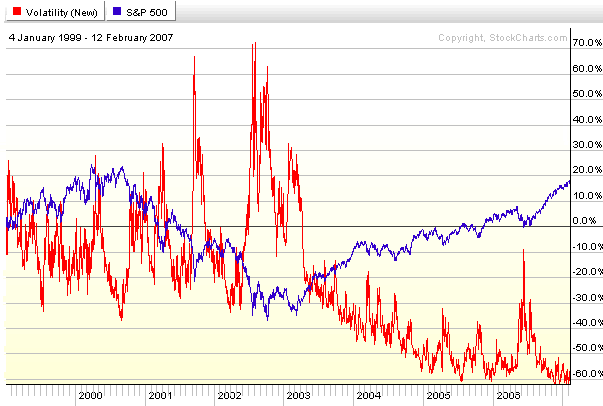
In December 2006, I began wondering when we were going to have a correction from the July rally (I’m still wondering) and set about to look at a bunch of sentiment and other contrary indicators that might support my case. One that particularly caught my attention was the VIX, not just because of the obvious negative correlation to the SPX (see graph below), but also because options are actively traded in the VIX and could provide a more leveraged play than say the QID in a nasty downturn. I did some Googling and concluded that if there are any VIX ‘experts’ out there, they are certainly not a publicity-seeking bunch.

So I download the VIX price history data to Excel and started playing around with it. I posted some observations on an InvestorVillage forum and decided that a blog would be a much more convenient way to archive my thoughts.

That’s about it.

I find it ironic that I now have a VIX blog and am now thinking regularly about implied volatility issues, as I am not an “options guy” per se, having traded almost exclusively equities for the past 20 years, with the exception of an occasional outright purchase of a call or a put, and a rare covered call play. Only in the past month have I made my first foray into (bear call) spreads.

So that is why I call this a “learning laboratory of sorts.”

Initially, I thought I might tackle a wide variety of sentiment-related issues, but since Zen’s Market Insights, HeadlineCharts, and others do such a good job of covering the waterfront there, is not a high priority for me at this stage.

I will, however, experiment with the “and More” portion of this blog soon enough. Hell, espn has never figured out what to do with the “e” at the beginning of their name, so I am not worried about how long it takes me to sort it out.

Thanks to all who have contributed here in one way or another.

As always, comments and suggestions are welcome.

DISCLAIMER: "VIX®" is a trademark of Chicago Board Options Exchange, Incorporated. Chicago Board Options Exchange, Incorporated is not affiliated with this website or this website's owner's or operators. CBOE assumes no responsibility for the accuracy or completeness or any other aspect of any content posted on this website by its operator or any third party. All content on this site is provided for informational and entertainment purposes only and is not intended as advice to buy or sell any securities. Stocks are difficult to trade; options are even harder. When it comes to VIX derivatives, don't fall into the trap of thinking that just because you can ride a horse, you can ride an alligator. Please do your own homework and accept full responsibility for any investment decisions you make. No content on this site can be used for commercial purposes without the prior written permission of the author. Copyright © 2007-2023 Bill Luby. All rights reserved.
 
Web Analytics