Showing posts with label Bollinger bands. Show all posts

Wednesday, February 8, 2012

What the VIX Kitchen Sink Chart Says

One of the more interesting developments of 2012 has been to watch the diminution of the strident bearish narrative that has been focused largely on the collision course between a preponderance of debt and low or negative growth. The bullish beginning to 2012, however, has not prompted many in the way of converts to the bullish camp. Instead, there have been whispers of “…overbought…” that have turned into a soft murmur and are now verging on becoming a loud chorus. Suddenly the general consensus seems to be that stocks just do not deserve their current lofty valuation.

In this type of environment, many investors become particularly susceptible to confirmation bias and scramble to find one or more indicators which will tell them what they have already begun to believe: that a major correction is likely just around the corner.

For better or for worse, a look at the VIX is often one of the first stops for those who are looking for evidence of a market reversal.

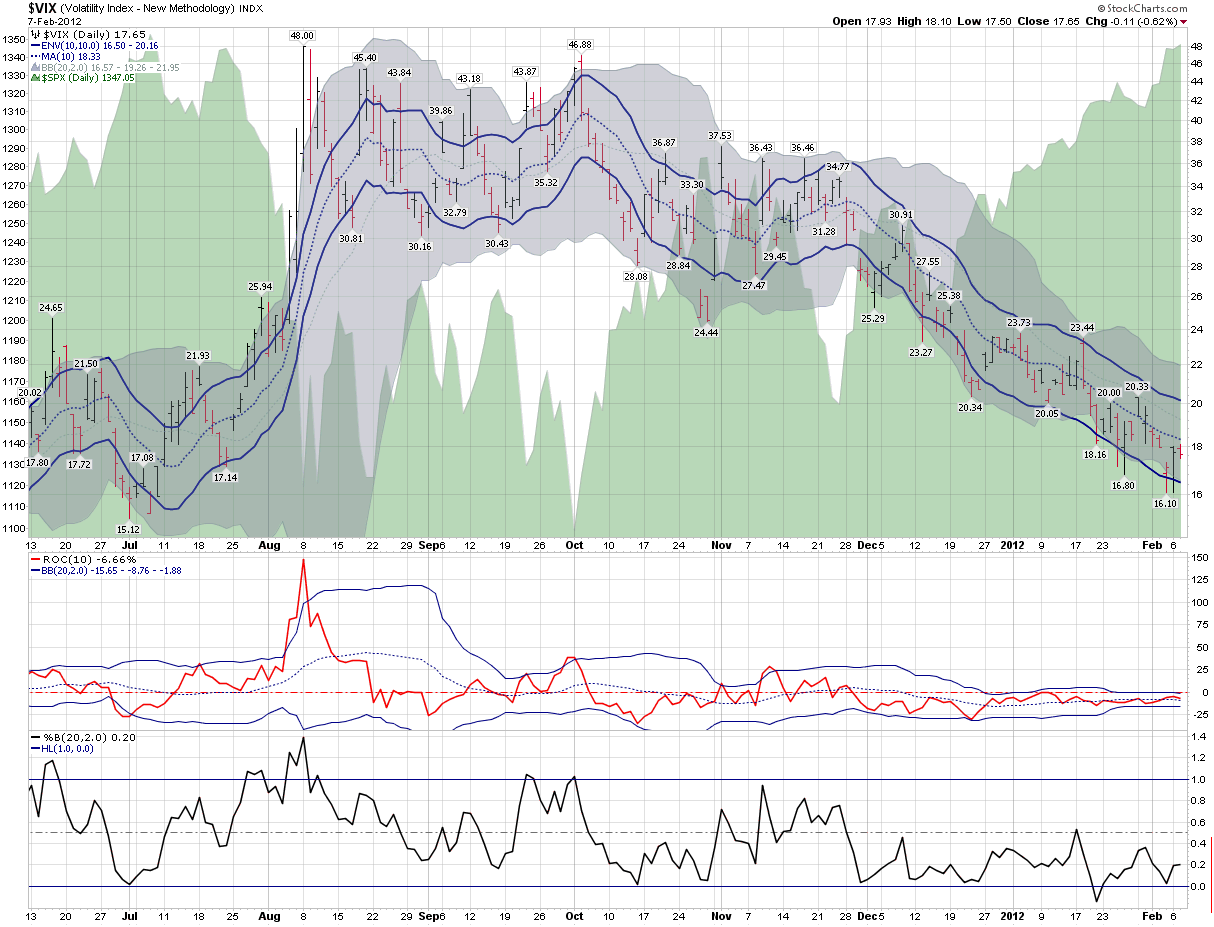
In the chart below, I have updated and extended a chart from three years ago that I call my “VIX kitchen sink chart” – as it pokes and prods the VIX in a number of different ways. Standard VIX analysis attempts to determine whether the VIX has strayed too far from historical norms, whether this be in the form of moving averages, Bollinger bands or other mechanisms. I have even included a separate rate of change study (with its own Bollinger bands) and a Bollinger band width study below the main chart in order to provide a couple of additional analytical twists.

The bottom line, however, is this:  if stocks are overbought and a correction is indeed just around the corner, the VIX does not appear to be aware of any such inevitability. Instead, it looks a lot more like business as usual in the land of the CBOE Volatility Index.

Related posts:

[source(s): StockCharts.com]

Disclosure(s): none

Thursday, January 12, 2012

Tight VIX Range Keeps Overbought Signals at Bay
Yesterday’s little dose of VIX trivia (VIX Has Smallest Intraday Range Ever!) was just the kind of post that I suspected would raise quite a few eyebrows, until everyone concluded that the headline was out of proportion to the actual data point. Ironically, that was a large part of the intent of the post: to poke fun at statistical outliers and extreme readings that have dubious predictive value.

The more I thought about the tight intraday VIX range, the more I believe it is a good segue to a more important related point: that a narrow trading range for the VIX – and also for stocks in general (10-day historical volatility in the SPX is down into the 12s) is allowing for stocks to rise without triggering any overbought signals.

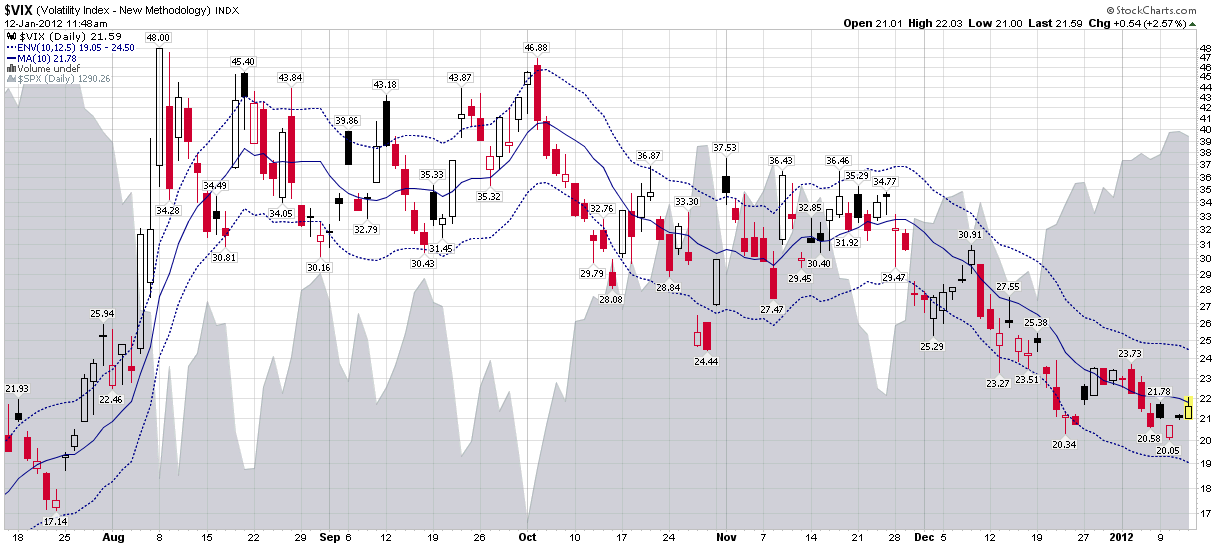
One way I track whether the VIX is signaling an overbought or oversold condition is to use a ratio of the VIX to its 10-day moving average. To make this easy on the eyes, I am partial to using moving average envelopes (MAEs) which quickly flag when the VIX (or any other underlying) has strayed a large distance from its moving average, similar to the manner in which Bollinger bands measure outliers.

My personal preference is to use the VIX 10-day moving average as the baseline and set the MAEs to 10%, 12.5% or 15%, depending upon the underlying volatility in the market. In the chart below, I have set the MAEs to 10 days and 12.5%. The result is a VIX that has hugged the center line (the 10-day moving average) for the past 2 ½ weeks, never threatening the dotted blue MAE lines.

In many respects, the recent activity in the VIX is a microcosm of the action in general in the markets: stocks continue to rise, but not rapidly enough to trigger many of the favored overbought alarms.

Related posts:

[source(s): StockCharts.com]

Disclosure(s): none

Monday, April 25, 2011

Spotlight on the VIX and Bollinger Bands

As we sit in the pre-FOMC doldrums contemplating how Ben Bernanke will handle his historic post-meeting press conference and wondering whether we can properly label the next VIX move to 17 or 18 a ‘spike,’ this seems like a good time to review some of the elements of VIX spikes and other measures of VIX extremes.

Better yet, point your browser to the My Simple Quant blog and more specifically to a post from last Thursday, More on VIX and Bollinger Bands, in which the resident author Chris has presented the results of his analysis of what happens to the VIX and SPY in the week following those instance in which the VIX closes below its lower Bollinger band two days in a row.

A couple of comments are in order on the analysis at My Simple Quant. First, the results should not surprise long-time readers here, but for those who are prone to not click through, there is always something to be learned in the details. I have discussed at some length how one can use simple and exponential averages, moving average envelopes, Bollinger bands and other similar mechanisms to measure how far the VIX has strayed from various assessments of a historical range.

An important point to consider – and one not stressed by My Simple Quant – is that the VIX is generally a better market timing mechanism when it spikes up than when it prints extreme lows. Perhaps a better way of thinking of this phenomenon is that while an extremely high VIX can rarely cause investors to rethink where an appropriate range should be for volatility, an extremely low VIX can sometimes be a self-reinforcing mechanism and signal a move to a new lower volatility regime.

Related posts:

Disclosure(s): neutral position in VIX via options at time of writing

Wednesday, April 6, 2011

CNBC Real-Time for the iPad

Since there seems to be such a large supply-demand imbalance (little supply, lots of demand) regarding information on trading apps for the iPad, I have decided to devote a little time to drilling down on some of these apps.

First up is CNBC Real-Time for iPad, which offers a large amount of content ranging from market data and graphics to news and videos. For the investor whose primary goal is to monitor the markets when he or she is not at a desk, this app is an excellent choice. The market data goes beyond just stocks and the major market equity indices and includes commodities, currencies and bonds. As the app name indicates, quotes are in real-time and even include a separate Pre-Markets tab with equity futures data. The graphic below shows the menu structure and various tabs available. In the screen capture, I have elected to highlight the Markets > Movers > S&P data. A similar tab, Dow Impact, ranks the five stocks with the largest positive impact and negative daily impact on the Dow Jones Industrial Average, along with the point impact for each stock.

Looking at other features, the news and video content are what you would expect from CNBC: high quality, voluminous and current.

For portfolio monitoring, the My Stocks content pulls charts, news and videos together for each watch list entry. The charts use real-time NASDAQ and NYSE data and make it easy to compare a security to a variety of indices, as well as utilize technical indicators such as moving averages (SMA, EMA, WMA), Bollinger bands, MACD, RSI, DMI and a handful of others. In short, the market technician is well-served here, though it would be nice to have some ability to customize the default settings on the technical indicators.  One thing that is lacking is an ability to enter share and cost basis information so that investors can easily track changes to their portfolio in dollar terms across the full range of their holdings.

Even with these small caveats, all in all the CNBC Real-Time for iPad is an excellent ‘do everything’ app for those who wish to monitor the markets remotely and do not need to trade directly from their market monitor platform. Of course, there is nothing stopping this person from keeping their favorite broker-based application open at the same time and becoming an opportunistic trader as well.

Related posts:


[graphic: CNBC Real-Time for iPad]

Disclosure(s): none
Tuesday, November 16, 2010

VIX Punches Through Upper Bollinger Band

The VIX has no idea what is going on in Ireland and has no way of knowing whether the markets are underestimating or overestimating the full extent of the European sovereign debt crisis, not only in the Emerald Isle, but also in Greece and Portugal.

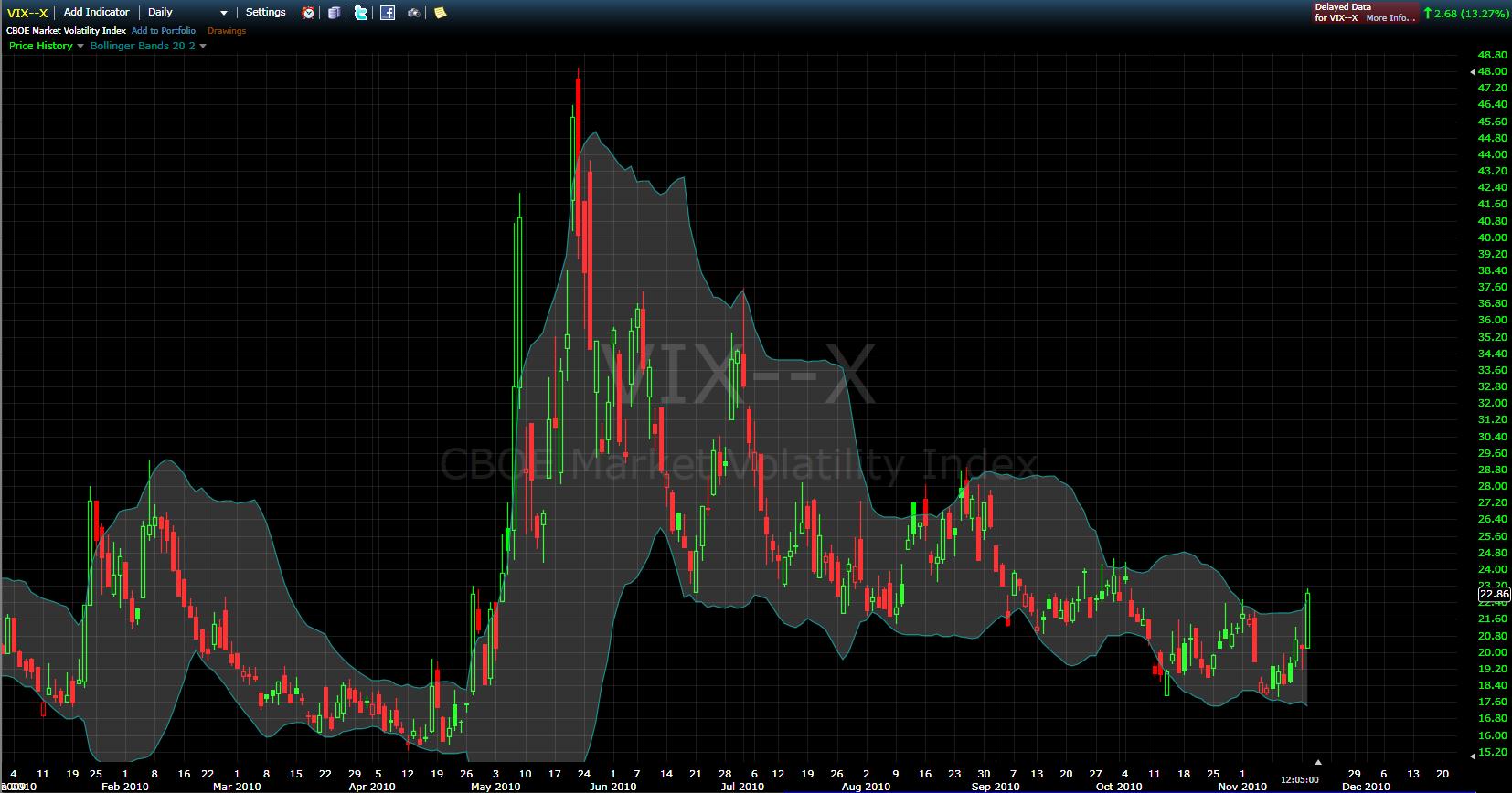
While it is always important to be well-informed when it comes global political and economic flash points, most VIX traders prefer to take a technically-based approach to trading volatility. In this vein, the simplest and most effective approach is to fade any VIX extremes. I have covered many ways to measure VIX extremes in this blog. One of the simplest is to use Bollinger bands to identify VIX values which are extreme enough to invite high probability mean reversion trades.

The chart below is a daily bar snapshot of the VIX, with standard Bollinger band settings (20 days, 2.0 standard deviations), showing that the recent VIX high of 23.06 is well above the 22.45 upper band level of the current Bollinger band settings. For most VIX traders, this means a short VIX play is in order, irrespective of events on the ground in Europe.

For those who are new to volatility trading, keep in mind that VIX spikes have a habit of clustering and creating a vicious cycle. One only has to scroll back six months to see what happened the last time concern about European sovereign debt soared, sending the VIX from 15 to 48 in the space of a month.

Related posts:


[source: FreeStockCharts.com]

Disclosure(s): short VIX at time of writing

Friday, November 6, 2009

Combining Bollinger Bands and Rates of Change in the VIX

As far as I can tell, I have not yet posted about the use of Bollinger bands in conjunction a rate of change (ROC) indicator to identify volatility breakouts.

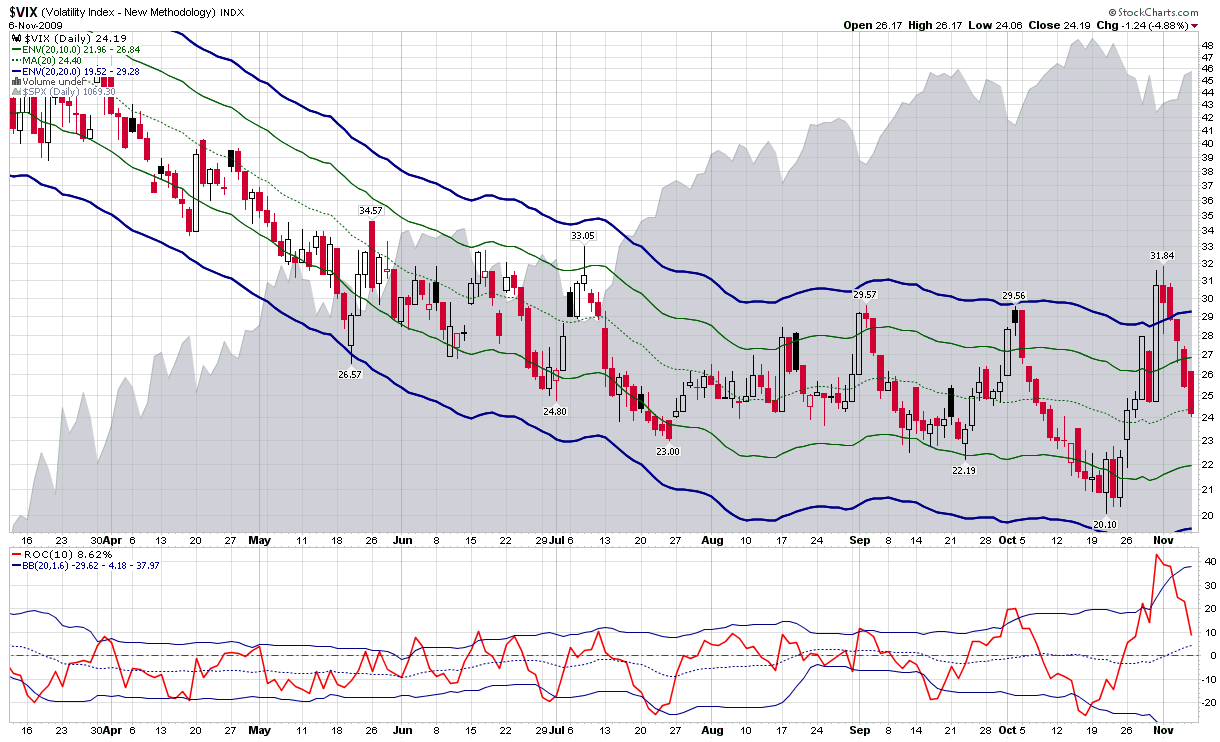
In summarizing the action in the VIX over the course of the past two weeks, the chart below captures some of the drama in terms of 10% (solid green) and 20% (solid blue) moving average envelopes. In the six month time frame included in the chart, the moving average envelopes flag last week’s VIX spike as the most powerful since stocks turned up in March. The moving averages also indicate that the VIX low of 20.10 from three weeks ago is the second strongest in terms of penetration of the lower moving average envelopes.

The study below the main chart utilizes a 10-day rate of change function as well as Bollinger bands that are tuned to 20 days and 1.6 standard deviations. Note that in this study both the VIX spike and the prior VIX low represent the largest upward and downward moves in terms of magnitude relative to the Bollinger bands.

The rate of change indicator is a valuable way to measure sharp price moves. When combined with the Bollinger band indicator, it is possible to better identify sharp upward and downward moves, particularly when the underlying has a habit of making sudden large moves, as is the case with the VIX.

For additional posts on related subjects, readers are encouraged to check out:

[source: StockCharts]

Wednesday, September 2, 2009

VIX Spikes Above Bollinger Bands

Yesterday’s 12% jump in the VIX lifted the volatility index to 13.8% above its 10 day simple moving average. As noted on a number of occasions here, when the VIX is at least 10% above its 10 day SMA, this is usually a good time to initiate a short-term mean reversion play and go long the SPX and/or short the VIX.

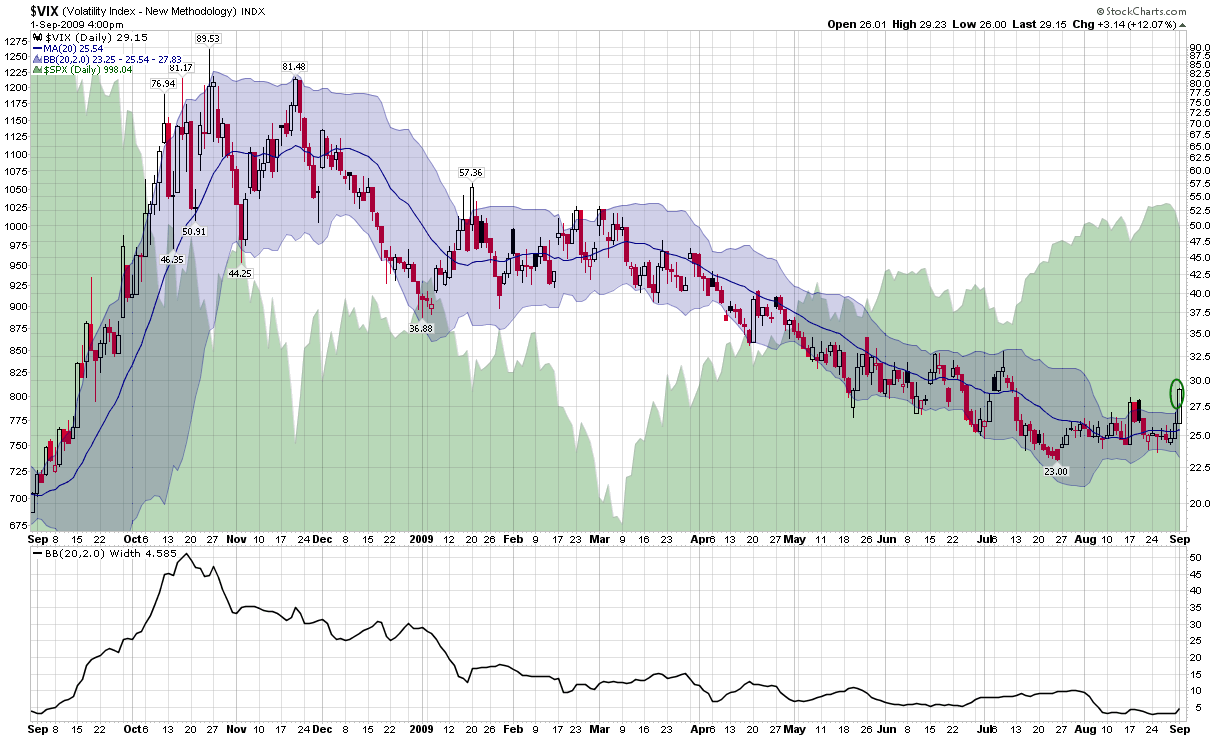
While I have not discussed it as often in this space, another useful VIX mean reversion signal can be derived from using Bollinger bands to determine when the VIX is overextended and likely to snap back. The simplest approach is to monitor when the VIX closes above the upper band of a 20 day, 2 standard deviation lookback period.

The chart below uses the standard 20 day, 2 standard deviation Bollinger bands to evaluate the moves in the VIX during the past year. Note that following the largest sustained VIX spike ever – during September and October of last year – it has been relatively rare for the VIX to close above the upper band. There was one instance of a close well above the upper band in January that marked a short-term bullish move, then there were two closes above the upper band at the end of February and the beginning of March that preceded the market bottom and strong bounce.

By historical standards, yesterday’s close 4.7% above the upper band is a fairly substantial breach and suggests a short-term bullish bias. Given the narrowing Bollinger band width (bottom study), however, it obviously took a much smaller move to penetrate the upper band than it did in January, when the VIX was hovering around 50.

It seems as if lately everyone has been looking for a pullback. The big question is how much of a pullback it will take to satisfy the bears and how soon it will be until the buy-on-the-dip mentality begins to dominate again.

For some related posts, try:

[graphic: StockCharts.com]

Wednesday, July 22, 2009

More Questions About Bollinger Bands

Yesterday’s post, StockCharts.com Charts on the Blog, triggered several questions from readers about the nature of the Bollinger Bands data and the usefulness of these bands to traders.

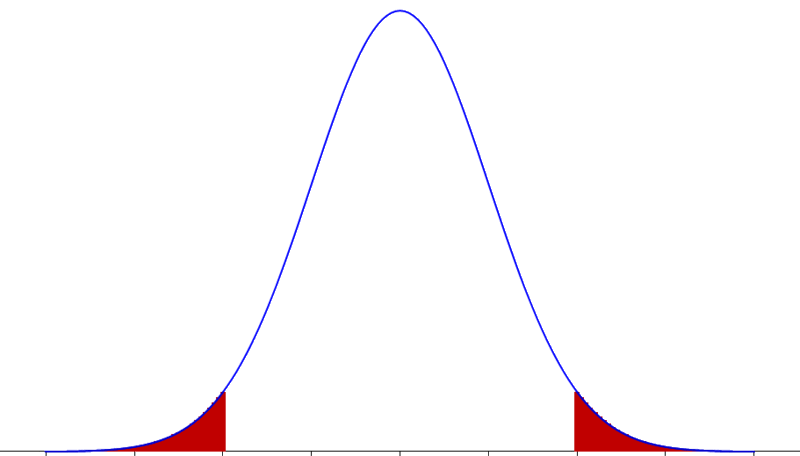
One reader asked whether I intended to say that the two standard deviations should contain 95.45%. While this is what would expect from a Gaussian or normal distribution, the distribution of stock prices does not follow a normal distribution. In fact, they tend to have fat tails or what statisticians call positive kurtosis.

In Bollinger on Bollinger Bands, John Bollinger talks about the extensive research he did which demonstrated that Bollinger Bands do not capture as much of the data as would be expected from statistics associated with a normal distribution.

Bollinger describes his findings as follows:

Only approximately 89 percent of the data is contained within 2 standard deviation bands when we would expect 95 percent.

There are two possible reasons why we don't get as high as a level of containment as we would expect -- near 95 percent with 2 standard deviation bands. First, we are using the population calculation, which results in slightly tighter bands than the sample calculation. Second, the distribution of stock prices is not normal -- there are more observations at the extremes than one would expect -- so there are more data points outside the bands too. There are undoubtedly more factors, but these appear to be the main ones.”

Another reader offered the following critique of Bollinger Bands:

“I've never understood the value of Bollinger bands. They don't provide a measure of volatility since as the chart gets more volatile the bands expand. One might look at the width of the band to estimate volatility. But that seems like a very imprecise measure. It doesn't really stand out. A graph of historical volatility would be much more useful.

Nor do they help with estimating when regression to the mean might occur. For again, as the item moves farther from the mean, the bands expand. There are many instances in which the chart touched the extreme of the band only to continue on farther -- with the band following along.”

While not trying to sound like an apologist for Bollinger Bands, it is important to note that these are one way of measuring historical volatility (albeit not the standard approach) and they have the benefit of providing a visual shorthand for those who wish to eyeball the ebb and flow of relative volatility.

In fact, Bollinger Band width is a way to measure one type of historical volatility statistically rather than to rely on a chart and I have used this measure on the blog (see link above for examples) on several occasions to measure volatility.

Regarding predictive value of Bollinger Bands, I find that they can be a useful indicator – notably with the VIX – and increase in their predictive the more standard deviations the VIX is from the mean. While October and November 2008 were not good times to employ this strategy, for the most part, I believe Bollinger Bands usually provide some helpful information about the likelihood of mean reversion.

Finally, there are some traders who prefer to play the volatility trend instead of using a mean reversion approach. Volatility trend traders might do something opening and maintaining long positions when a stock is trading between +1.0 and +2.0 standard deviations above the mean and closing those positions when the Bollinger Band lines are violated.

For those who are interested in learning more about Bollinger Bands, Bollinger’s own book on the subject (see above) is a probably the last word on the matter. Readers are also encouraged to check out a three-part series on three important parameters of Bollinger Bands that I posted a little over a year ago:

  1. Bollinger Bands: Why 20 Days?
  2. Bollinger Bands and the Standard Deviation Setting
  3. Bollinger Bands and the Percent B Setting

Tuesday, July 21, 2009

StockCharts.com Charts on the Blog

By far, my favorite stock charting site on the web is StockCharts.com, from which quite a few screen shots have been imported into the blog.

Recently I have fielded a few questions about my StockCharts charts and I wanted to spend a little time talking about the information contained in these charts. For starters, StockCharts offers what they call a “gallery view” for each ticker. This is a group of three free charts consisting of a daily chart with five months of data, a weekly chart with two years of data and a point and figure chart. StockCharts members also have a fourth intraday utilizes ten minute bars for the past four days.

While these gallery charts are an excellent starting point, the true power of StockCharts is in creating custom charts. At the bottom of this post is what I would call my “standard chart” from StockCharts, which uses daily bars over the course of the past eleven months. My standard chart utilizes candlesticks because I prefer the informational content that can be displayed in one candle. I also utilized three simple moving averages: 10 days (solid blue line) for the short-term; 50 days (dotted red line) for the intermediate-term; and 200 days (dotted green line) for the longer-term. These are widely-used moving averages and the selection is somewhat arbitrary. I prefer the 10 day to the more common 20 day because I often have a very short-term time horizon and because the 10 day is utilized heavily by traders who follow the VIX.

The gray cloud around the candlesticks is Bollinger Bands, set to 20 days and two standard deviations. I like to use Bollinger Bands to give a sense of the ebb and flow of historical volatility superimposed on the price data, rather than as a separate study above or below the main price chart. I choose to display these by area instead of the more typical lines because I want to limit the lines cluttering up the chart and give some semblance of visual clarity. According to extensive studies done by John Bollinger, one would expect 88-89% of all future daily price moves to fall within the range defined by the current Bollinger Bands – assuming, of course, the future resembles the past.

The only other graphical data on this chart is the volume data, which includes a 50 day exponential moving average line in purple, making it relatively easy to identify large volume spikes.

Finally, a reader recently asked why the y-axis is not proportional. The short answer is that charts can be plotted with a standard (proportional) y-axis or using a logarithmic axis. The benefit of a standard axis is the ease of measuring absolute changes: ten points up and ten points down are the same height. For longer periods, however, compounding distorts percentage changes, so a logarithmic axis ensures that percentage moves up and down are the same height. Consider a $100 stock. If it goes up 50% three years in a row, it ends up at 337.50 (100*1.5*1.5*1.5) a change of 227.50 points. But if the same stock goes down 50% three years in a row, it will be at 12.50, a change of only 87.50 points. On a standard y-axis, the move up 50% for three years will look 2.6 times (237.50 / 87.50) greater than the move down 50% for three years. A logarithmic axis makes sure that these percentage changes look identical to the eye. In a future post, I will talk more about logarithmic axes and use some examples to illustrate their advantages and disadvantages.

In the meantime, those with an interest in learning more about charts, high quality charts and archiving their ideas in chart form are advised to kick the tires of StockCharts.com. If you want to see some of what others have done with the available tools, check out the public charts section.

[source: StockCharts]

Sunday, July 19, 2009

Chart of the Week: SPX and NDX

In reviewing previous chart of the week graphics, I was surprised to see that I have featured a chart of the SPX only once in the past five months (Chart of the Week: Lack of Volume and Breadth Threatens Bull Move) and decided that this most important of indices needs to take center stage more often.

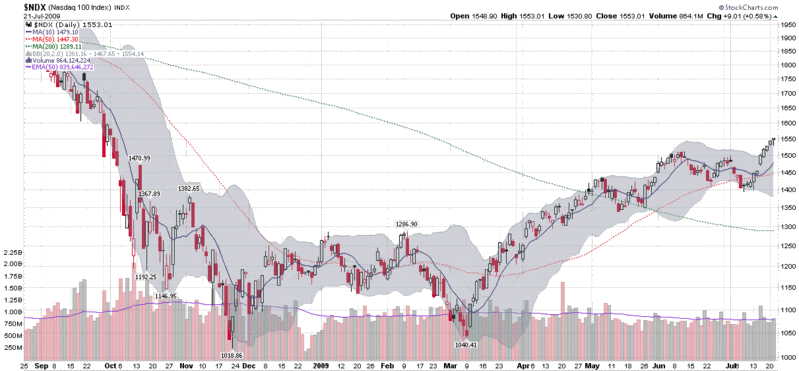
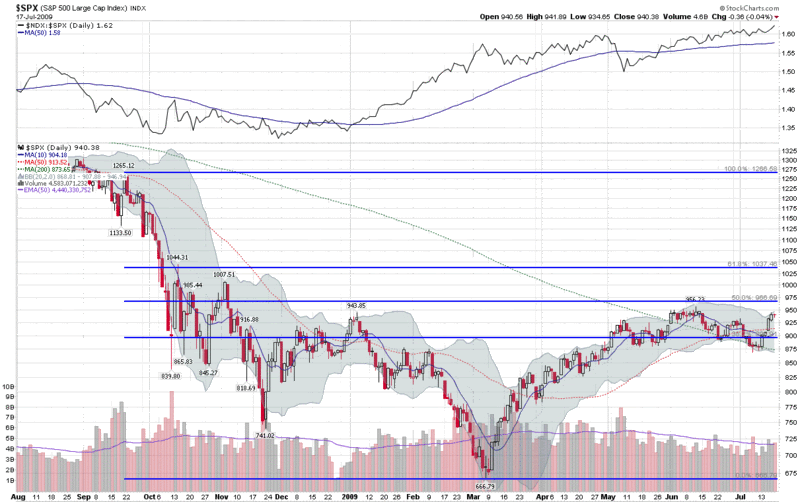
Alas, this week’s chart of the week shows a year of SPX daily bars, with some standard moving averages and Bollinger Bands, as well as a set of Fibonacci retracement lines that have generated considerable discussion in the past (SPX and Fibonacci Resistance at 966.) The new twist on this chart is a simple ratio of the NASDAQ-100 (NDX) to the SPX, which is included as a study above the main graph. The NDX:SPX ratio shows that while the SPX was retreating from its June 12th high, the NDX was outperforming the SPX on a relative basis, as has been the case for the past two months. Spurred on by a very strong earnings report from Intel (INTC) the NDX:SPX ratio is currently at its highest level since early 2001 and the NDX is now comfortably above its June high.

It is worth noting that outside of technology, the only other major sector to have topped its June high is health care (XLV) with consumer staples (XLP) just 0.03 below that high water mark. With the leadership role of technology should be considered a positive sign for bulls, the high relative strength of defensive sectors such as health care and consumer staples might be considered a warning sign.

For a related prior chart of the week post, see: Chart of the Week: The Resurgent NASDAQ-100 (4/5/2009)

[graphic: StockCharts]

Wednesday, March 18, 2009

XLF Bias Depends on Time Frame

Lately it seems as if the financial sector is the market. For this reason, I now watch the financial sector SPDR (XLF) and the KBW Bank Index (BKX) tick by tick, in addition to a handful of financial stocks that seem to be in the most peril on a particular day.

In my opinion, however, XLF is the best way to capture the full extent of goings on in the financial sector, from banks and brokerage houses to insurers and consumer finance companies, XLF pretty much covers the waterfront.

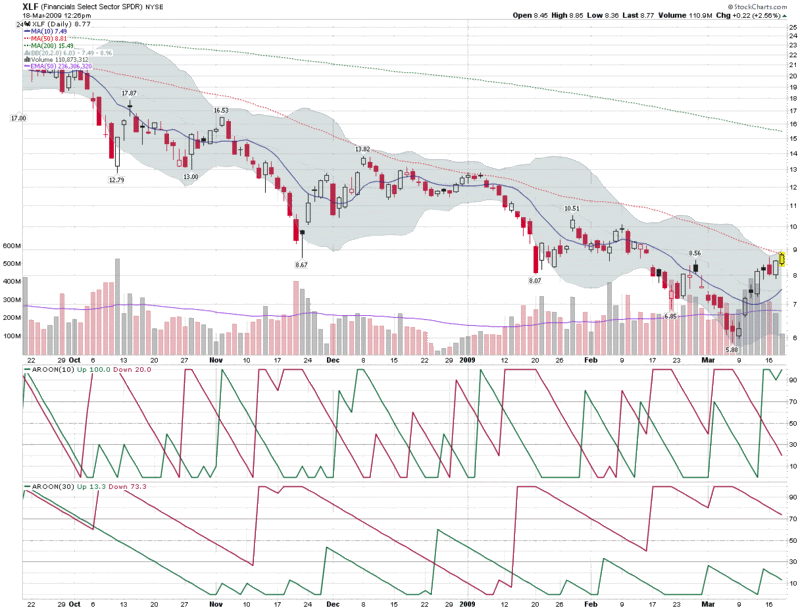
The chart below captures the last six months of action in XLF and highlights the problem facing XLF and the broader markets at the moment. Stocks are overbought in the short-term and oversold in the long-term.

Rather than use oscillators to show how overbought and oversold stocks are, I generally prefer to rely on a combination of moving averages and trend strength indicators, with volatility as an important secondary indicator. Looking at the moving averages, XLF is now well above the 10 day MA and running up against resistance in the form of the 50 day MA. In terms of trend, utilizing the Aroon indicator to measure trend and breakout strength, XLF is bullish in the 10 day calculations, but bearish from a 30 day perspective. In this chart there is not much to see in terms of volatility, but by tracking in the upper half of the Bollinger Bands, XLF generally has positive short-term momentum, while proximity to the upper band suggests a reversal is likely soon.

So there you have it: bullish momentum triggering buying on the part of the trend following crowd, while overbought indicators have the swing trading crowd ready to get short. Such is the current state of the market. The direction in which you lean is more likely to be a function of the time horizon of your analysis than any other technical factor.

[source: StockCharts]

Disclosure: Short XLF at time of writing.

Monday, February 23, 2009

VIX Kitchen Sink Chart

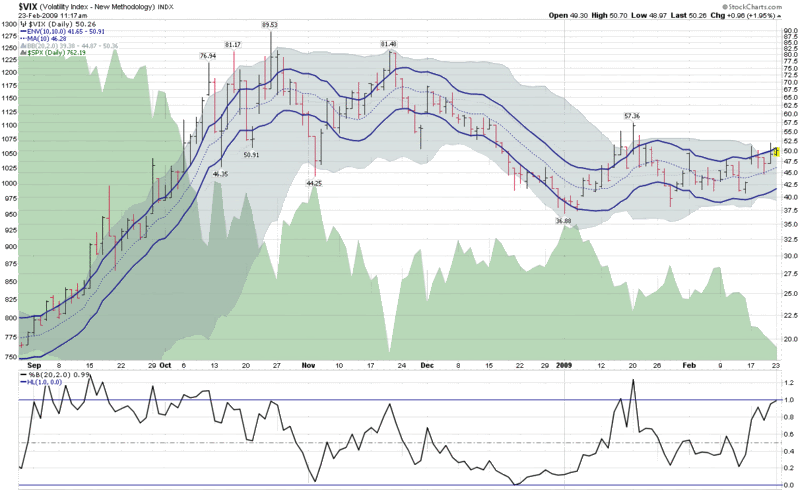
The VIX is once again above 50 as I type this and technical analysis aficionados are wondering where the next resistance levels are for the VIX and whether these might increase the odds of predicting a market bottom.

The chart below is a kitchen sink chart of sorts, as it includes the 10 day moving average of the VIX (dotted blue line), surrounded by 10% moving average envelopes (solid blue lines) to indicate when the VIX is 10% above or below that 10 day moving average.

The chart also includes Bollinger Bands (the gray cloud around the price history), which have been left at the default 20 day, 2.0 standard deviations settings. I have also added the %b setting for the Bollinger Bands in order to determine where the VIX is relative to the middle (0.5) of the Bollinger Band range.

During highly volatile periods, the Bollinger Bands are typically much wider than the moving average envelopes and large moves in the VIX usually pierce the moving average envelopes before they reach the limits of the Bollinger Bands. At present, however, the upper boundary of the Bollinger Bands is at 50.36, with the top of the moving average envelope at 50.91. With the VIX having posted an intraday high of 50.70 so far, the Bollinger Bands have been violated, yet the moving average envelope is intact. This unusual situation reflects the relatively low historical volatility we have been experiencing (the 20 day historical volatility in the SPX is below 35 and 50 day historical volatility in the SPX is the lowest it has been since September.)

If one considers that implied volatility is largely a function of historical volatility plus a premium based on fear and uncertainty, then obviously the fear and uncertainty component is currently responsible for implied volatility (in the form of the VIX) being almost 50% higher than historical volatility.


[source: StockCharts.com]

Saturday, February 14, 2009

Chart of the Week: SPX Volatility on the Wane

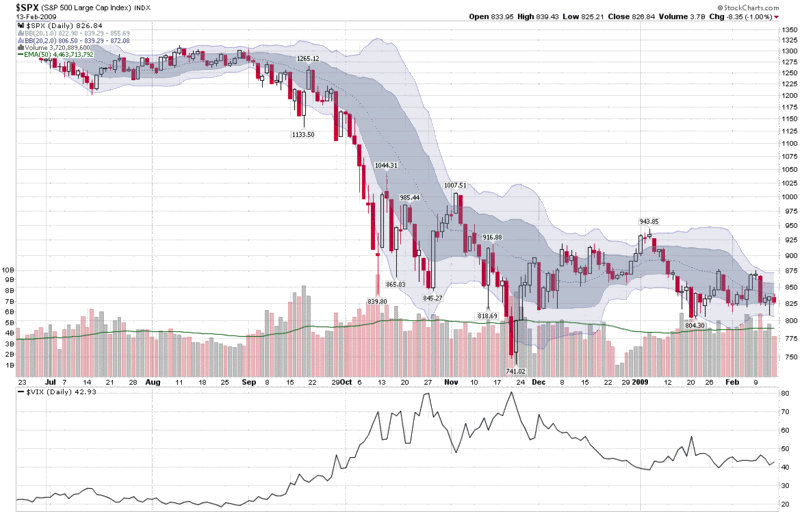
In my chart of the week posts I have been striving for more of a generalist theme, with only occasional excursions into the land of volatility. I am making an exception this week, because for the first time in five months the historical volatility of the S&P 500 index (SPX) as measured by 10 day, 20 day, 30 day and 50 day look back periods is less than 40 in all four instances.

In the chart below, I have elected to show the fluctuations in the volatility of the SPX over the course of the past eight months as reflected in two Bollinger bands ranges. The outer range (gray) is the standard 20 day, 2 standard deviations measure. The inner range (blue) covers 20 days but only one standard deviation. The contraction of the Bollinger bands since the beginning of December and particularly in the first two weeks of February shows how volatility has been declining dramatically, notwithstanding the mid-January spike in the VIX. In fact, at current levels, the Bollinger bands are now as narrow as they have been since the week of the Lehman Brothers bankruptcy.

Given current trends, I would expect to see the VIX to be back in the 30s before the end of the month, with a VIX below 35 more likely than a VIX above 50.

Note: Those with an interest in learning more about Bollinger bands and/or customizing the settings on these indicators may wish to check out a series of posts from last June:

[source: StockCharts]

Friday, August 22, 2008

VIX Slips Below 19

One of the interesting side benefits of having a blog is that you can get a sense of what some investors are thinking just by looking at the Google searches that result in people clicking through to the blog. Today, for instance, I note some have found their way to VIX and More with the following Google searches:

  • “VIX oversold”
  • “VIX call options”
  • “trade using the VIX”
  • “bull call spread VIX”
  • “calendar spread VIX”
  • “predict VIX settlement value”
  • “September VIX futures”

It certainly appears as if quite a few investors are looking at a VIX that is below 19 and trying to understand that number in the context of headlines filled with gloom and doom. One possible conclusion, which I’m sure accounts for a fair number of the Google searches above, is that it is just a matter of time before the VIX spikes to a level consistent with the fear and anxiety which dominates much of the media coverage of the markets at the moment.

While a VIX of 18.92 (as I type this) sounds low, it is only 7.3% below the 10 day simple moving average and 11.8% below the 100 day SMA. Further, because today is a Friday and we have some low volume days approaching in advance of the Labor Day holiday, there are some calendar reversion effects at work, as Adam at Daily Options Report has detailed nicely in VIX Bicentennial Parade and several previous posts.

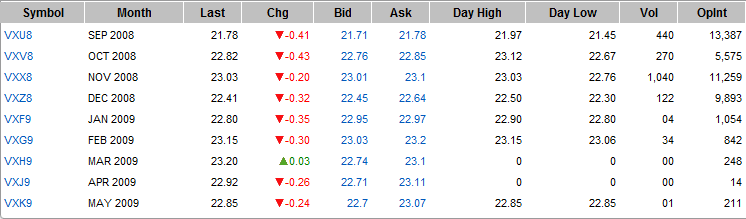
A look at VIX futures (see futures quotes from optionsXpress below) shows that futures expectations for the VIX for October to May are generally in the range of 22.50 – 23.20. Anyone considering a VIX options trade needs to get a better sense of how VIX options are priced off of and generally move with VIX futures, not the cash or spot VIX index that is four points lower.


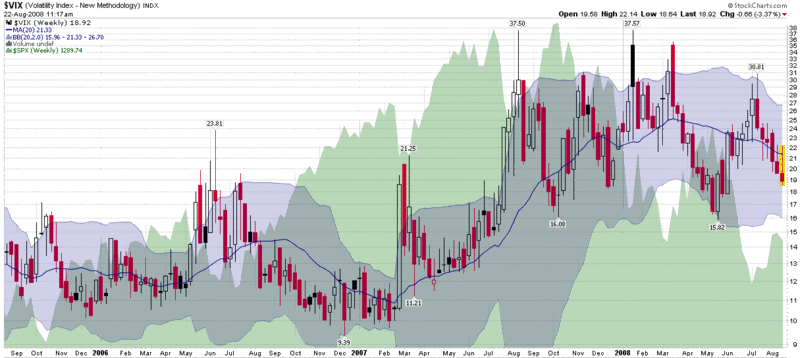
That being said, there is also the case to be made that the VIX is not that low at the moment. Looking at a weekly chart, for instance, the VIX is toward the middle of the typical Bollinger band settings. This is the essence of VIX options: when they look like sitting ducks, it is usually an optical illusion.

Still, with a relatively low VIX and relatively low VIX implied volatility (58.2%), VIX options may be inexpensive portfolio insurance and/or a good leveraged bet against further turmoil in the markets. The key concept to remember is that a 3-4 point move in the cash/spot VIX will have little impact on the VIX futures prices on which the VIX options are based.

Wednesday, July 16, 2008

XLF Volume Spikes 3.3 Standard Deviations Above Mean Yesterday

If I could pick only one ticker to watch in order to gauge the market’s health in the current environment, it would probably be XLF, the most popular of the financial sector ETFs. You could make an argument for RKH, the regional bank ETF, XBD, the broker dealer ETF, or any number of others, but XLF covers the entire financial sector, from Allstate (ALL) to Zions Bancorp (ZION).

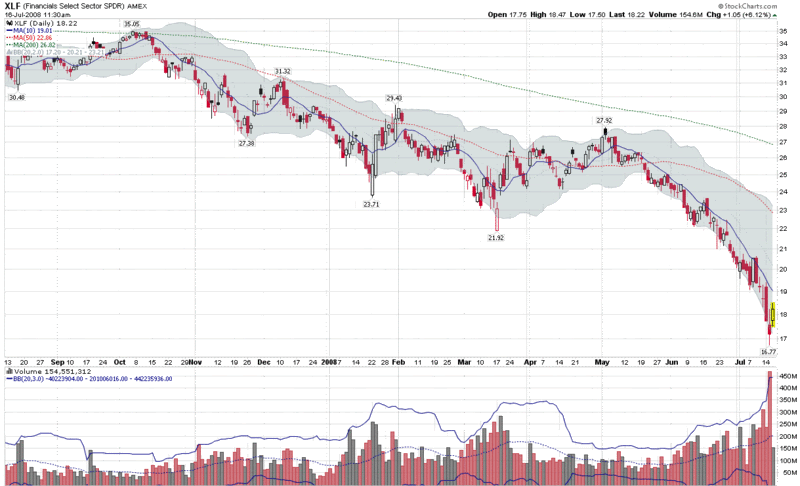
With all the talk about the degree of a VIX spike needed to signal a bottom and other measures of capitulation, I am surprised I have not heard anyone else mention the volume in XLF yesterday. As shown in the graphic below, XLF traded over 469 million shares yesterday, eclipsing the previous volume record (set just last Friday), by over 150 million shares. The 469 million share turnover also represents 3.3 standard deviations above the mean, which translates into an extremely unlikely event. [Note that in the chart below, the Bollinger band settings for volume are for 3 standard deviations instead of the default 2 setting] This is capitulation-level volume in the sector that is most important to the stock market at the moment. If XLF can weather all the financial sector earnings due out tomorrow, I suspect that a bottom will be in for the financial sector.

Thursday, July 3, 2008

On Measuring Volatility

Mike at HEDGEfolios.com has a good post up today with the title of Measuring Volatility. He touches a lot of bases, but it all starts with the following statement:

“When it comes to measuring or sensing stock market volatility, I do not follow the VIX.”

Now I may have invented that silly tagline, “Your one stop VIX-centric view of the universe,” but I am the first to argue that a defaultist mind set is the wrong way to approach the investment landscape. If you follow the same indicators with the same default settings as everyone else, you are setting yourself up not just to follow the crowd, but to be a half step behind it. In order beat the crowd, what is needed is a variant perception.

Back to HEDGEfolios for a moment:

“The key element of volatility using traditional methods like the VIX rests on the reversal at extremes in a contrarian indication such as buying when the VIX exceeds 30. This is a very dangerous concept and I do not advocate for its use… I never liked that approach so I do my own thing and look at each stock, the turnover in each and how the composite of all signal changes indicates the market volatility.”

Volatility is a wide-ranging concept. It can be defined, measured and applied to over 10,000 stocks and ETFs in many different ways. To think that best way to harness information about volatility is to buy when the VIX hits X is ludicrous.

Consider that the concept of volatility can be applied not just to price, but to volume, options prices, market breadth data, etc. Volatility is a characteristic of every slice of the almost infinite flow of data that is associated with the markets.


It’s not just what you measure, it’s how you measure it. Volatility can look forward when it is in the form of a forecast or a derivation, such as implied volatility. When volatility looks backward, the opportunities to get creative are even richer. There is historical volatility, average true range, Bollinger bands, Chaikin volatility, relative volatility, and a variety of ways in which to index volatility.

Go ahead and watch the VIX, but don’t think for a moment that you are going to have an advantage over the thousands of other people who are watching the same indicator. Sure, you might come up with the next great VIX permutation, but you are far more likely to get a leg up on the competition by revisiting some basic questions:
  • Is volatility worth following?
  • How can more knowledge about volatility make me a better investor?
  • Which aspects of volatility should I pay attention to?
  • How should I measure that type of volatility?
  • How do I interpret those measurements for maximum ROI?
One of my favorite measures of volatility is the number of buy and sell signals my various systems generate each evening. It’s simple, but effective. And I can be sure that nobody is not going to show up on CNBC tomorrow touting the same approach.

Tuesday, June 17, 2008

Bollinger Bands and the Percent B Setting

It occurred to me, as I reviewed my last two posts on Bollinger Bands, that it would take quite a few posts to do anything more than scratch the surface of the Bollinger Bands indicator. For that reason, I am going to set aside my thinking on Bollinger Bands after today’s third post in the series, with a promise to pick up the subject again at a later date.

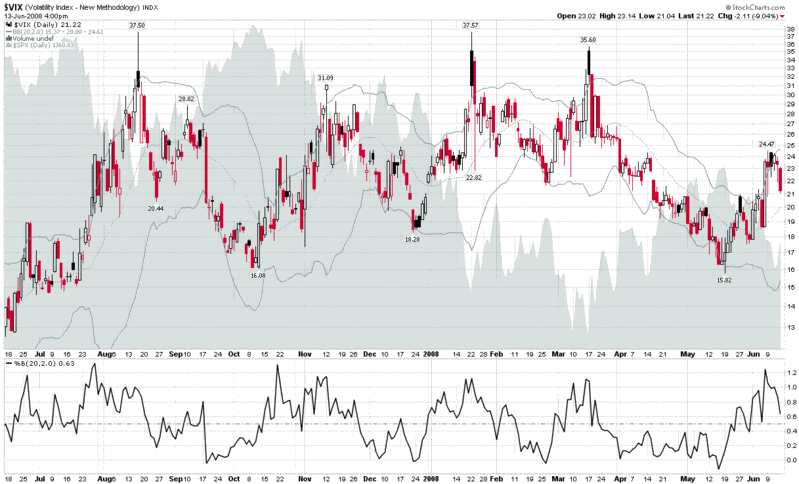
Before I wrap up this introductory look at Bollinger Bands, I want to be sure to mention the %b indicator. Quite simply, %b calculates the current price relative to the top and bottom Bollinger Bands. A %b reading of 0.5 means that the current price is exactly at the middle band (the dotted line in the gray line in the graph below that is a 20 day simple moving average in the default setting). A 1.0 reading puts the current price exactly at the level of the top band and a 0.0 reading establishes that the current price is at the level of the lower band. Unlike some oscillating indicators, %b is unbounded, so in the chart below it will exceed 1.0 when the VIX spikes above the upper band (note the most recent instances of this in January, March and the first week of June.) Each 0.1 increment above 1.0 translates to 10% of the band width above the upper band, so that a %b of 1.25 would mean 25% of the band width above the upper band. In addition to spikes above the upper band, when the VIX drops rapidly, it will periodically slide into negative territory, as it did most recently in February and May.

The %b indicator can also help to identify a change in the volatility climate. If one studies the %b peaks in late July and mid-October of last year, these %b readings of over 1.2 were nowhere the VIX tops. In each instance, however, the extreme %b readings did signal a dramatic change in volatility that ultimately ended with a volatility climax about three weeks after the 1.2+ readings in the %b indicator.

Finally, from a systems development perspective, consider that while converting Bollinger Band chart data into mechanical signals may seem like a daunting task, the %b numbers are often ideally suited for this purpose.

Monday, June 16, 2008

Bollinger Bands and the Standard Deviation Setting

On Friday, I used Bollinger Bands: Why 20 Days? as an excuse to begin my “evangelical crusade against rampant defaultism.” I did this mostly so I could make up a word (or so I thought, apparently others beat me to it), but also to warn against the tendency to favor the default settings in charting software in lieu of rigorously exploring the alternatives.

Using Bollinger Bands as my guinea pig indicator, on Friday I explored what happens when you tweak the default setting of 20 days. The other important setting in Bollinger Bands, of course, is the standard deviation setting. In Bollinger on Bollinger Bands, John Bollinger cites tests he conducted on various stocks, indices, currency pairs, and commodities, the results of which led him to conclude that a 2.0 standard deviation setting was quite robust across a variety of asset classes and time frames. Bollinger went on to recommend that the standard deviation setting should be decreased to 1.9 for a time window of 10 days and increased to 2.1 standard deviations when the time frame is extended to 50 days. In other words, modifying the number of days is more likely to provide additional insight than adjusting the standard deviation setting.

Undeterred, I have had a lot of fun experimenting with the standard deviation setting for VIX charts and a number of other charts. My takeaway: even if you do not discover any particularly revealing new information, it is important to experiment with the default settings to get a better understanding of how the indicator works in default mode and why the bands act the way they do.

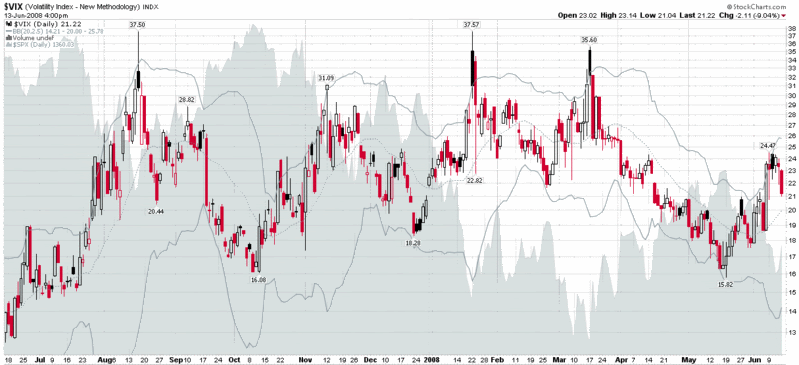
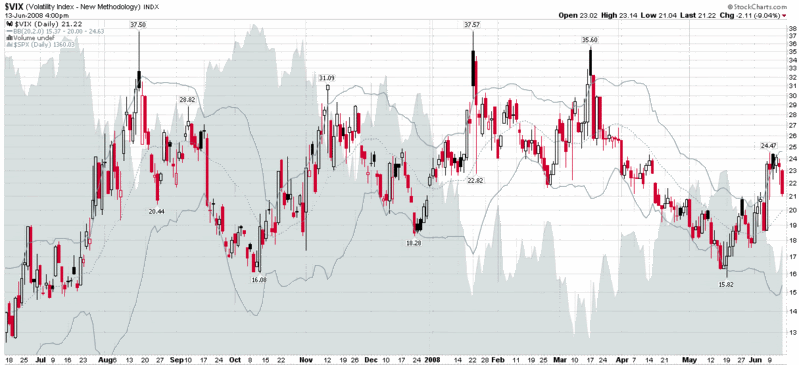
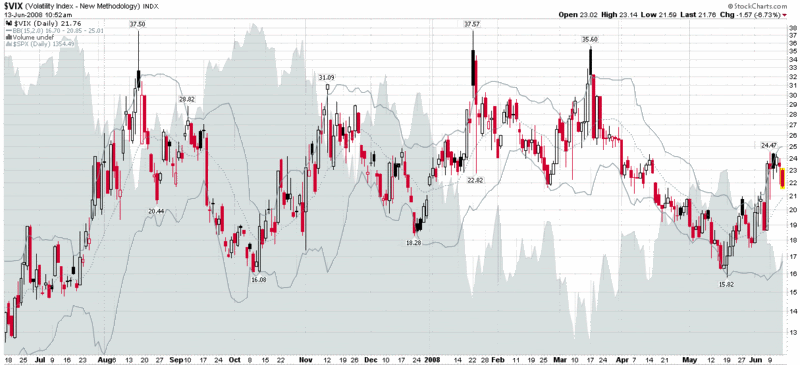
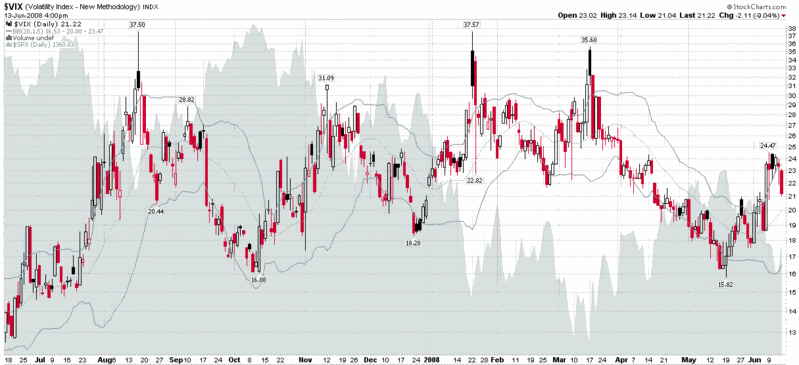
In the VIX charts below, I have included the 2.5 standard deviation setting on the top, with the default 2.0 standard deviation setting in the middle, and the 1.5 standard deviation setting on the bottom. As the graphics show, the standard deviation settings can be fine tuned to adjust the frequency of signals generated by the indicator in a given time period. The exact settings should be largely a function of one’s preferred trading time horizon.

Friday, June 13, 2008

Bollinger Bands: Why 20 Days?

I am surprised by how many traders, bloggers, and hybrids (a category I seem to have morphed into) are content to stick with the default settings offered by their favorite charting package. On a related note, one reader had asked me why I stick to the 10/50/200 simple moving averages on most of my charts; another reader regularly decries the laziness of the default charting crowd, adding that they deserve the mediocre performance that their lack of curiosity and imagination undoubtedly lead to.

So consider this the first post in my evangelical crusade against rampant defaultism.

Let’s start with simple moving averages. Personally, I prefer my standard chart of daily bars to have SMA settings of 16, 38 and 155 days. That is not much different from the 20/50/200 setting that is favored by many charting packages, but it works for me and it gives me a slightly different perspective on the world, which often makes it easier to take a position against the crowd. Of course, I have different settings for looking at narrower or broader time frames.

Moving on to an example, Bollinger Bands is one of the indicators for which I rarely see anything other than the default settings of 20 days and 2 standard deviations. Why is this? Is it laziness? Is the indicator so perfectly constructed as to defy tweaking? Is it possible that 20 days and 2 standard deviations work that well over all time horizons? Hardly. Read Bollinger on Bollinger Bands to see what John Bollinger has to say on the subject or do some experimenting on your own without the safety net of Bollinger’s commentary (for more information on Bollinger Bands, check out John Bollinger’s Bollinger Bands web site.)

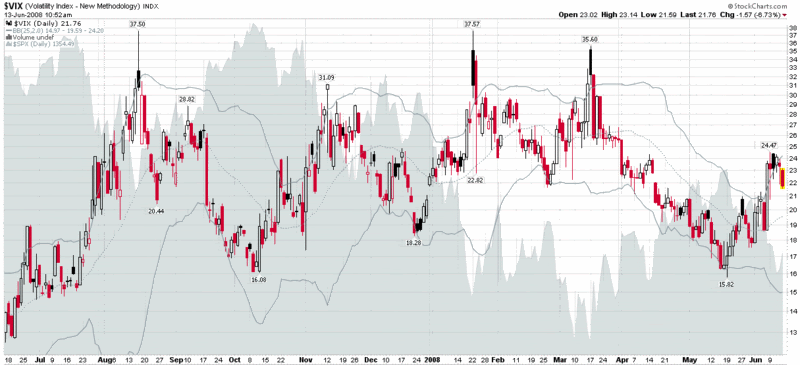
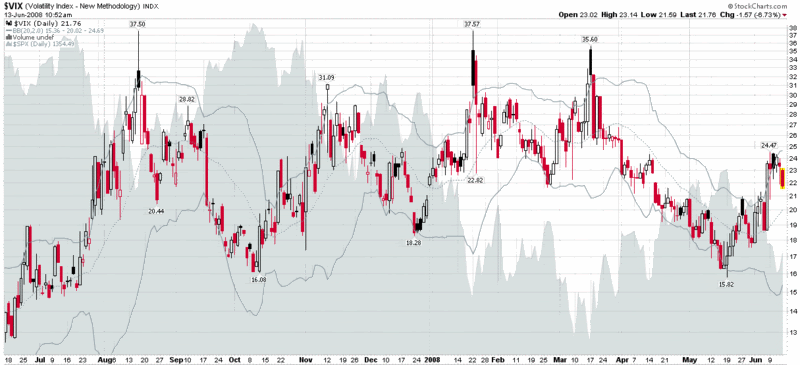
In the three charts below, I have modified the Bollinger Bands setting to reflect a 25, 20, and 15 day setting – while keeping (at least for today) the 2 standard deviation parameter intact. Without providing too much commentary, note that in the top chart, the 25 day setting casts what I call a longer ‘time shadow’ to the right of any major moves. This time shadow is muted somewhat in the second chart (20 days) and is even less noticeable in the bottom chart (15 days). Note also how the 25 day setting almost resembles Donchian Channels (aka price channels), while the 15 day setting hugs the price action closely enough so that even a gentle trend can exceed the standard deviation bands. Consider, for a minute, the possible implications of customizing Bollinger Bands for securities that have a greater tendency to trend (i.e. commodities) vs. those that have more pronounced mean-reverting characteristics, like the VIX.

Monday, November 12, 2007

NASDAQ Chart with Hourly Bars

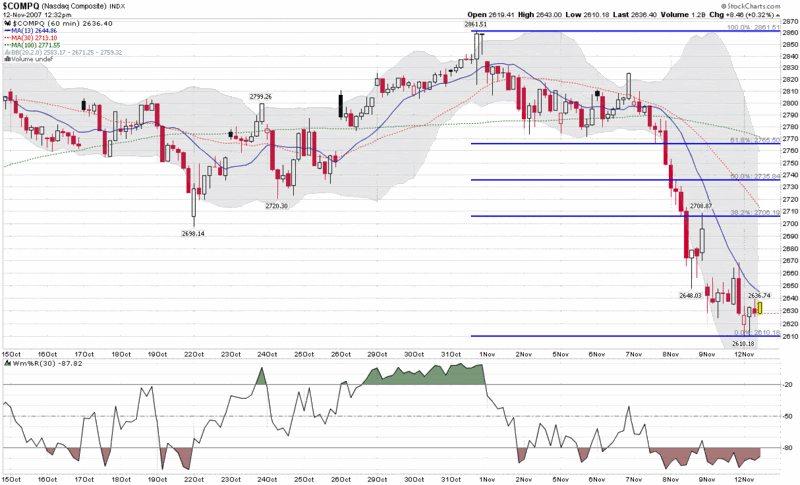
On Friday I posted a weekly chart of the NASDAQ going back six years. Today I am swapping the wide angle lens for a telephoto one and focusing on hourly bars for the past month. I am emphasizing the NASDAQ Composite (and the NDX) because that is where a good deal of the speculative activity has been as of late and where the correction was most severe last week.

The graph below shows four semi-arbitrary simple moving averages for the NASDAQ Composite Index: 13 bars; 20 bars (the faint dotted gray line in the middle of the Bollinger Bands); 30 bars (the same as the Williams %R time frame); and 100 bars. All this spans roughly a period of 1 ½ days to about 3 weeks. With the aforementioned Bollinger Bands and Williams %R data, as well as the Fibonacci retracement lines, there are many ways to keep score. As much as anything, however, I will be looking at the intensity and duration of the bull rallies off of the bottom. Given that many indicators point to the current situation as significantly oversold, the absence of a compelling bull rally may provide as much information as what is actually happening. In other words, a draw should favor the bears.

Finally, I still haven’t seen much in the way of fear yet…

DISCLAIMER: "VIX®" is a trademark of Chicago Board Options Exchange, Incorporated. Chicago Board Options Exchange, Incorporated is not affiliated with this website or this website's owner's or operators. CBOE assumes no responsibility for the accuracy or completeness or any other aspect of any content posted on this website by its operator or any third party. All content on this site is provided for informational and entertainment purposes only and is not intended as advice to buy or sell any securities. Stocks are difficult to trade; options are even harder. When it comes to VIX derivatives, don't fall into the trap of thinking that just because you can ride a horse, you can ride an alligator. Please do your own homework and accept full responsibility for any investment decisions you make. No content on this site can be used for commercial purposes without the prior written permission of the author. Copyright © 2007-2023 Bill Luby. All rights reserved.
 
Web Analytics