Showing posts with label Aroon. Show all posts

Tuesday, May 1, 2012

An Aroon Stalemate for S&P 500 Index

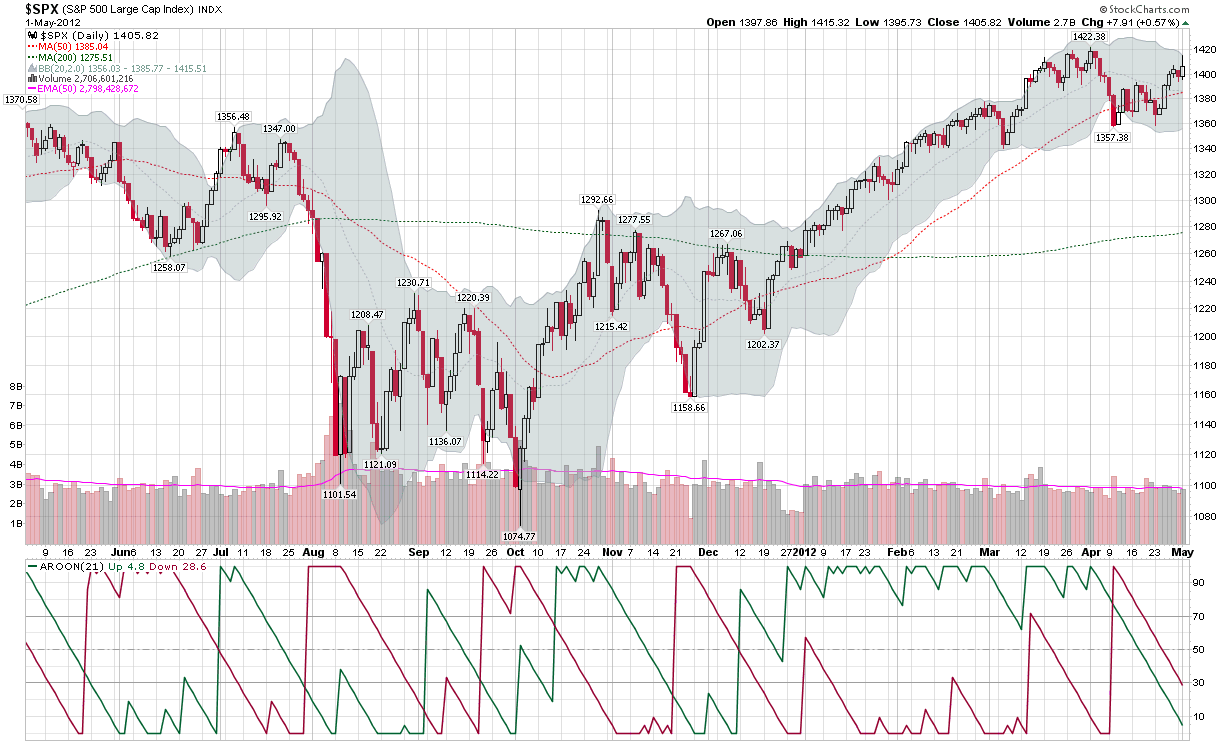
While the bias in stocks for the past three years and two months has definitely been upward, the S&P 500 index (SPX) has struggled to remain above 1400 ever since making a post-2008 high of 1422 on April 2nd.

There are many ways to determine the strength of a trend and one that has a very strong following is the Average Directional Indicator (ADX), which was developed by Welles Wilder and first published in 1978 classic, New Concepts in Technical Trading Systems.

While the ADX has a great deal to recommend it, I am somewhat partial to another trend evaluation tool, the Aroon indicator, which was developed by Tushar Chande. The Aroon is actually two measures in one, an Aroon Up (green line in study below main chart) and an Aroon Down (red line). Essentially, the Aroon Up and Down lines measure the proximity of N-period highs and lows to the most recent trading period, on a 0-100 scale, with 100 indicating that the high or low for the period was made during the most recent trading day and 0 indicating that the high or low was made on the first day of the N-period window.

The default time frame for the Aroon indicator is usually represented as 25 periods, but in some charting software, the default is 14 periods. Since I tend to look at the investing world in months that average 21 trading days, the chart below uses my favored default Aroon setting of 21 days.

The chart shows the SPX over the course of the past year, with a strong uptrend (green line above 50 or 70) since the second week in December that has recently begun to show signs of fatigue on the part of the bulls as it has now been 20 days since that high of 1422. On the other hand, the red line shows that it has now been 15 days since the SPX made its 21-period low of 1357. In other words, the last three weeks have seen neither the high or the low of the 21-day lookback period, as the SPX has meandered in a 65-point range. The result is that both the green line and red line have dipped below 30, signaling the absence of any meaningful bullish or bearish momentum.

The Aroon indicator is effective as a trend-following tool partly because it usually waits for 1/3 to 1/2 of the lookback window to elapse before signaling a change in trend – which is generally represented by either the green or red line crossing the horizontal lines at 50 or 70.

As it looks now, if stocks were to continue to tread water for the next four days, Monday would likely signal an ascendant green line, but Friday’s employment report, the European Central Bank and other factors make it unlikely that stocks continue to trade in a narrow range for another week or so.

Related posts:

[source(s): StockCharts.com]

Disclosure(s): none

Wednesday, March 18, 2009

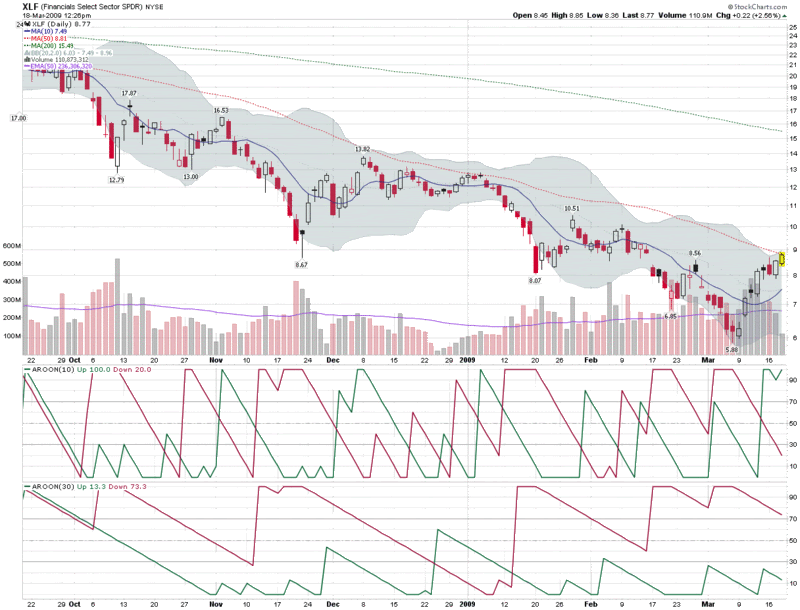
XLF Bias Depends on Time Frame

Lately it seems as if the financial sector is the market. For this reason, I now watch the financial sector SPDR (XLF) and the KBW Bank Index (BKX) tick by tick, in addition to a handful of financial stocks that seem to be in the most peril on a particular day.

In my opinion, however, XLF is the best way to capture the full extent of goings on in the financial sector, from banks and brokerage houses to insurers and consumer finance companies, XLF pretty much covers the waterfront.

The chart below captures the last six months of action in XLF and highlights the problem facing XLF and the broader markets at the moment. Stocks are overbought in the short-term and oversold in the long-term.

Rather than use oscillators to show how overbought and oversold stocks are, I generally prefer to rely on a combination of moving averages and trend strength indicators, with volatility as an important secondary indicator. Looking at the moving averages, XLF is now well above the 10 day MA and running up against resistance in the form of the 50 day MA. In terms of trend, utilizing the Aroon indicator to measure trend and breakout strength, XLF is bullish in the 10 day calculations, but bearish from a 30 day perspective. In this chart there is not much to see in terms of volatility, but by tracking in the upper half of the Bollinger Bands, XLF generally has positive short-term momentum, while proximity to the upper band suggests a reversal is likely soon.

So there you have it: bullish momentum triggering buying on the part of the trend following crowd, while overbought indicators have the swing trading crowd ready to get short. Such is the current state of the market. The direction in which you lean is more likely to be a function of the time horizon of your analysis than any other technical factor.

[source: StockCharts]

Disclosure: Short XLF at time of writing.

Saturday, December 13, 2008

Chart of the Week: U.S. Dollar Reverses Down
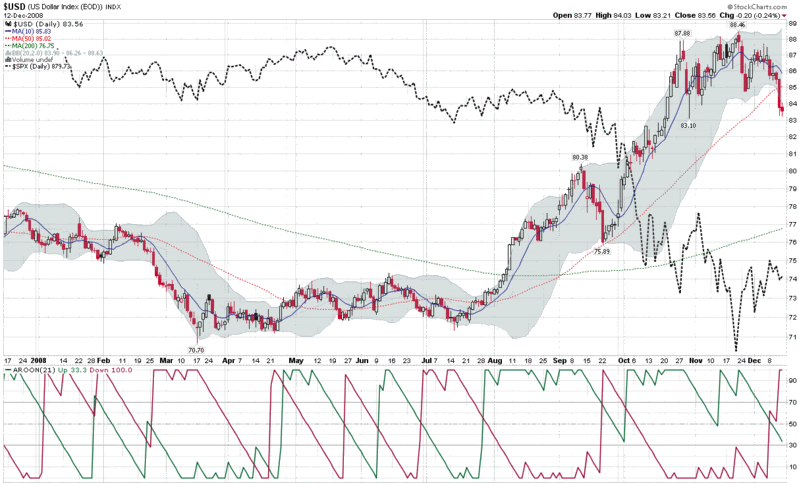
There were many strong candidates for the chart of the week, but this week’s honor goes to the U.S. Dollar, which saw its largest one week drop in percentage terms in at least 25 years.

As the chart below shows, the dollar has been negatively correlated to stocks for the past five months or so. Historically, a falling dollar has generally not been positive for stocks. It will, however, provide some support for exporters and enhance demand for commodities that are quoted in dollars across the globe.

For the most part, the strength of the dollar usually reflects traders’ opinions about the strength of the U.S. economy relative to economies associated with the other major currencies. When the dollar was rising, therefore, it was not necessarily a vote of confidence in the U.S. economy as much as it reflected a concern that other nations may be in an even more difficult situation. Now with the mushrooming U.S. debt on top of an already severe economic crisis, the prospects for the U.S. economy relative to that of some of other global economies is being reevaluated from one of the strongest to perhaps only slightly better than average.

The dollar appreciated approximately 23% from July to November. This week the dollar moved below its 50 day moving average for the first time since the July bullish move again. Trend indicators such as the Aroon are starting to reflect a reversal in trend; expect trend-following systems to be short the dollar as the new trend becomes more pronounced.

Do not be surprised to see half of the 23% gain disappear in the next few months.

[source: StockCharts, VIX and More]

DISCLAIMER: "VIX®" is a trademark of Chicago Board Options Exchange, Incorporated. Chicago Board Options Exchange, Incorporated is not affiliated with this website or this website's owner's or operators. CBOE assumes no responsibility for the accuracy or completeness or any other aspect of any content posted on this website by its operator or any third party. All content on this site is provided for informational and entertainment purposes only and is not intended as advice to buy or sell any securities. Stocks are difficult to trade; options are even harder. When it comes to VIX derivatives, don't fall into the trap of thinking that just because you can ride a horse, you can ride an alligator. Please do your own homework and accept full responsibility for any investment decisions you make. No content on this site can be used for commercial purposes without the prior written permission of the author. Copyright © 2007-2023 Bill Luby. All rights reserved.
 
Web Analytics