Showing posts with label moving average envelopes. Show all posts

Thursday, January 12, 2012

Tight VIX Range Keeps Overbought Signals at Bay

Yesterday’s little dose of VIX trivia (VIX Has Smallest Intraday Range Ever!) was just the kind of post that I suspected would raise quite a few eyebrows, until everyone concluded that the headline was out of proportion to the actual data point. Ironically, that was a large part of the intent of the post: to poke fun at statistical outliers and extreme readings that have dubious predictive value.

The more I thought about the tight intraday VIX range, the more I believe it is a good segue to a more important related point: that a narrow trading range for the VIX – and also for stocks in general (10-day historical volatility in the SPX is down into the 12s) is allowing for stocks to rise without triggering any overbought signals.

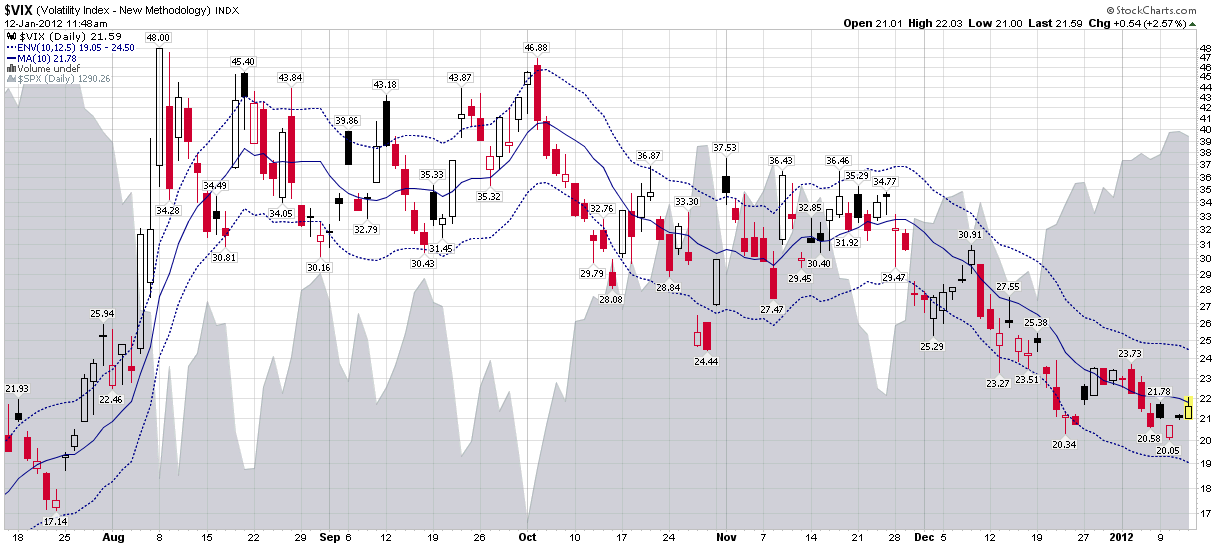
One way I track whether the VIX is signaling an overbought or oversold condition is to use a ratio of the VIX to its 10-day moving average. To make this easy on the eyes, I am partial to using moving average envelopes (MAEs) which quickly flag when the VIX (or any other underlying) has strayed a large distance from its moving average, similar to the manner in which Bollinger bands measure outliers.

My personal preference is to use the VIX 10-day moving average as the baseline and set the MAEs to 10%, 12.5% or 15%, depending upon the underlying volatility in the market. In the chart below, I have set the MAEs to 10 days and 12.5%. The result is a VIX that has hugged the center line (the 10-day moving average) for the past 2 ½ weeks, never threatening the dotted blue MAE lines.

In many respects, the recent activity in the VIX is a microcosm of the action in general in the markets: stocks continue to rise, but not rapidly enough to trigger many of the favored overbought alarms.

Related posts:

[source(s): StockCharts.com]

Disclosure(s): none

Tuesday, January 18, 2011

Chart of the Week: the VIX Since 2007

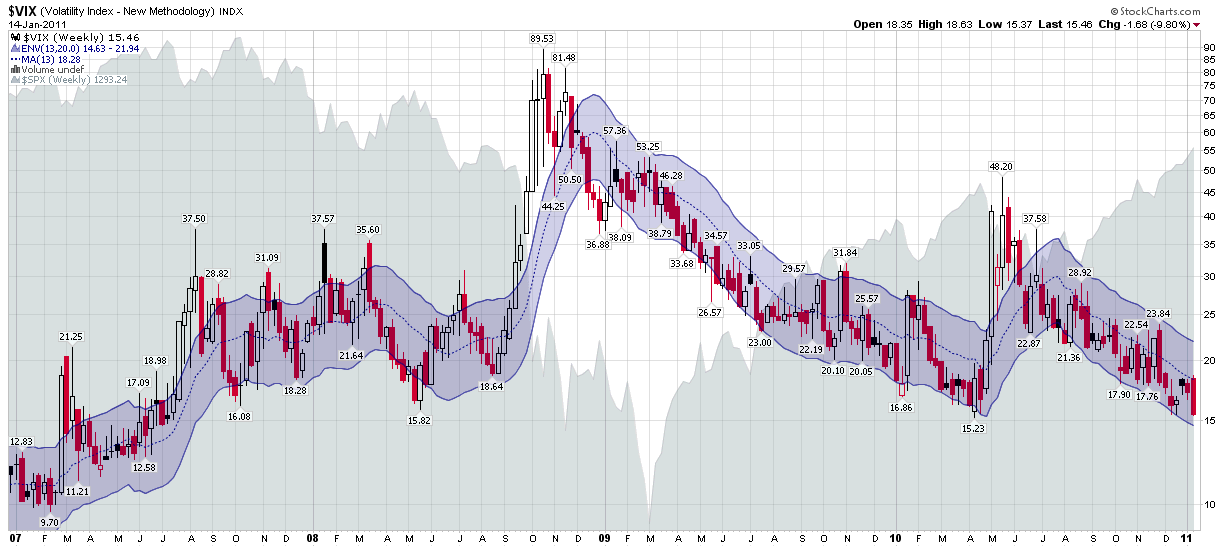
The Year in VIX and Volatility was such a huge hit two weeks ago that I thought it would be appropriate to address all the angst about low readings in the VIX with a chart of the CBOE Volatility Index (yes, the VIX does have a formal name) that stretches back to the beginning of 2007 and incorporates the 2007 peak in stocks, the 2008 panic, the 2009 bottom and the rally that has dominated the past two years.

Whereas the majority of the charts in this space use daily VIX bars and an occasional chart of VIX macro cycles and the like utilize monthly bars, this time around I am pulling back to a perspective which utilized weekly bars for the VIX. Personally, I like weekly bars because it removes the weekend effect or ‘calendar reversion’ as I like to call it. More importantly, I plan my trading and execute my strategies in weekly time chunks, hence the weekly subscriber newsletter.

The chart below, courtesy of StockCharts.com, is the first I recall ever having seen that uses weekly moving average envelopes (MAEs) for the VIX. In this particular variation, I have used MAEs that cover 13 weeks (one quarter) of VIX data and plotted an envelope which extends 20% above and below that 13-week moving average. The result is a chart which does a good job of capturing outliers that are generally high probability fade trades.

The chart also shows that a break below the 15.00 level will but the VIX back at a level not seen since July 2007, which is, ironically, just about the time that Adam Warner and I had the bright idea to estimate where volatility was going to be. [See Volatility Aces Bloggers for the gory details.]

Getting back to the moving average envelopes, current VIX levels are relatively low in absolute terms, but with the bottom of the weekly 13-20 moving average envelope currently at 14.63, the risk of the VIX punching through the lower envelope appears to be extremely low, at least to this observer.

My best guess is that the next piercing of the envelope is more likely to be associated with a rising VIX than a falling one, but even that scenario may take a while to play out.

Related posts:


[source: StockCharts.com]

Disclosure(s): none
Thursday, December 3, 2009

VIX of 20 Spurring Market Correction?

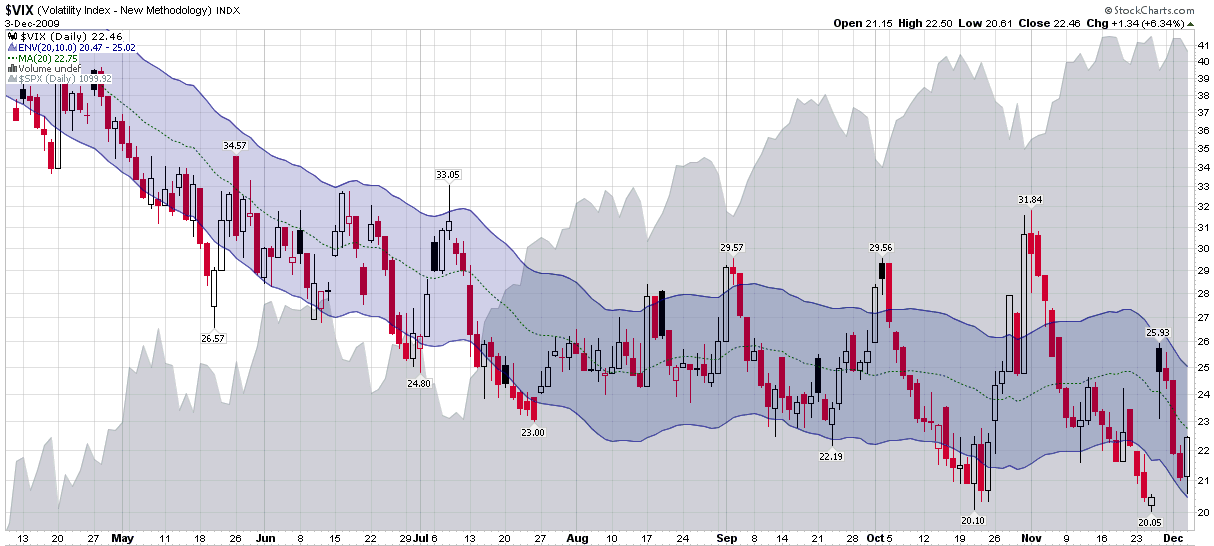
As the chart below shows, the last two times the VIX has taken a run at 20 (late October and late November), stocks have responded by selling off and spiking volatility. It is possible that a VIX of 20 may still be something that investors are not yet ready to accept (availability bias), but with historical volatility hovering around 16 and the long-term trend in the VIX still moving downward, it is likely just a matter of time before we see a VIX in the 19s.

In addition to the absolute levels of the VIX, one must always watch relative VIX levels, which is where the moving average envelopes come in. Displayed as a blue zone in the middle of the trading range on the chart, the 10 day simple moving average envelopes make it easy to identify when the VIX is extended to the high side or the low side. While the 20 level has been well out of the moving average envelopes for the last two drops in the VIX, that is not likely to be the case going forward. This sets the possibility of a battle between the absolute VIX (support at 20) vs. the relative VIX (support at the bottom of the envelope) in the near future, with an increased likelihood that the 20 level does not hold the next time around.

Finally, it is that time of year where I feel compelled to remind everyone that seasonal factors also indicate that volatility should be moving lower. I have discussed the holiday effect several times in the past in this space and essentially the historical pattern calls for the VIX to hold relatively steady for the first two weeks of December, then drop sharply (probably about 1.5 points at current levels) as Christmas approaches.

For more on these subjects, readers are encouraged to check out:

[source: StockCharts]

Disclosure: none

Friday, November 6, 2009

Combining Bollinger Bands and Rates of Change in the VIX

As far as I can tell, I have not yet posted about the use of Bollinger bands in conjunction a rate of change (ROC) indicator to identify volatility breakouts.

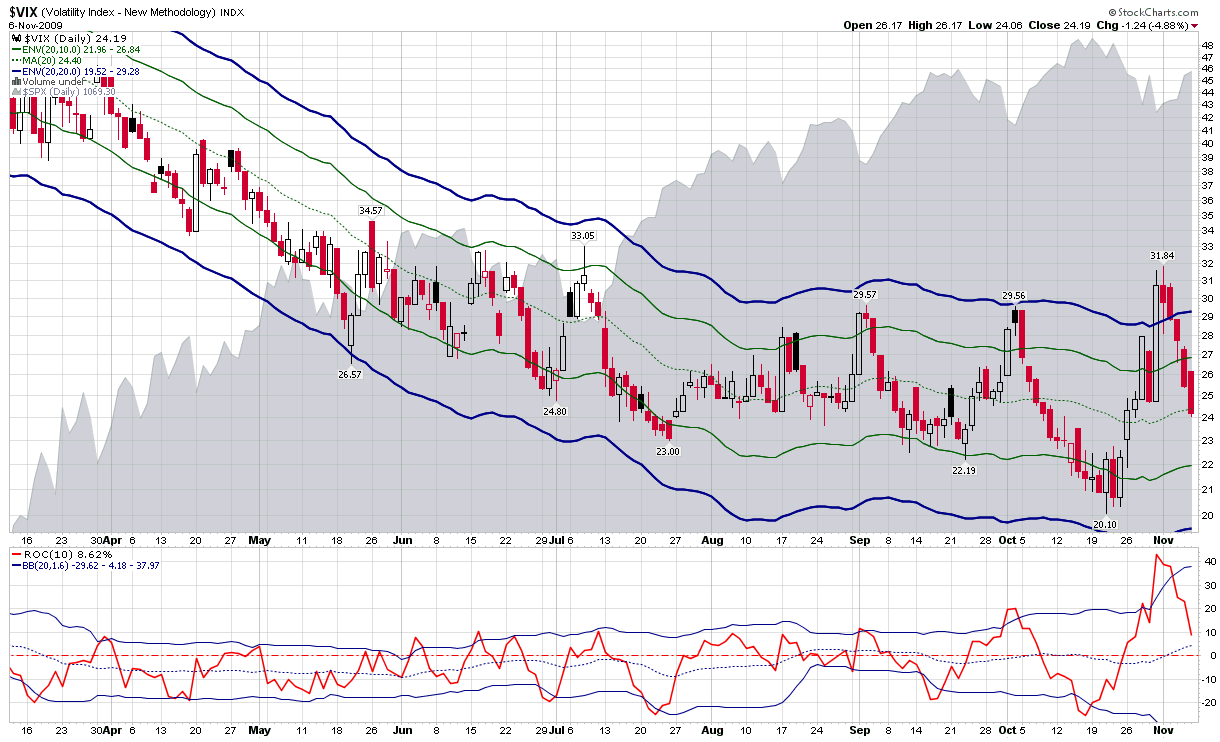
In summarizing the action in the VIX over the course of the past two weeks, the chart below captures some of the drama in terms of 10% (solid green) and 20% (solid blue) moving average envelopes. In the six month time frame included in the chart, the moving average envelopes flag last week’s VIX spike as the most powerful since stocks turned up in March. The moving averages also indicate that the VIX low of 20.10 from three weeks ago is the second strongest in terms of penetration of the lower moving average envelopes.

The study below the main chart utilizes a 10-day rate of change function as well as Bollinger bands that are tuned to 20 days and 1.6 standard deviations. Note that in this study both the VIX spike and the prior VIX low represent the largest upward and downward moves in terms of magnitude relative to the Bollinger bands.

The rate of change indicator is a valuable way to measure sharp price moves. When combined with the Bollinger band indicator, it is possible to better identify sharp upward and downward moves, particularly when the underlying has a habit of making sudden large moves, as is the case with the VIX.

For additional posts on related subjects, readers are encouraged to check out:

[source: StockCharts]

Monday, February 23, 2009

VIX Kitchen Sink Chart

The VIX is once again above 50 as I type this and technical analysis aficionados are wondering where the next resistance levels are for the VIX and whether these might increase the odds of predicting a market bottom.

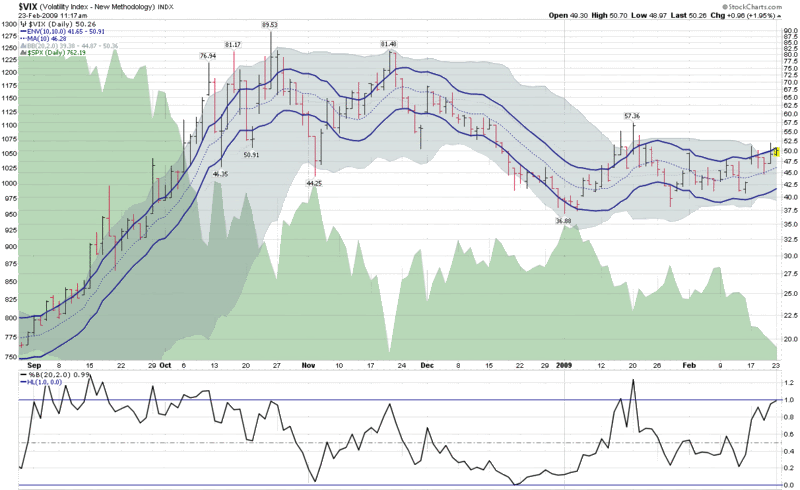
The chart below is a kitchen sink chart of sorts, as it includes the 10 day moving average of the VIX (dotted blue line), surrounded by 10% moving average envelopes (solid blue lines) to indicate when the VIX is 10% above or below that 10 day moving average.

The chart also includes Bollinger Bands (the gray cloud around the price history), which have been left at the default 20 day, 2.0 standard deviations settings. I have also added the %b setting for the Bollinger Bands in order to determine where the VIX is relative to the middle (0.5) of the Bollinger Band range.

During highly volatile periods, the Bollinger Bands are typically much wider than the moving average envelopes and large moves in the VIX usually pierce the moving average envelopes before they reach the limits of the Bollinger Bands. At present, however, the upper boundary of the Bollinger Bands is at 50.36, with the top of the moving average envelope at 50.91. With the VIX having posted an intraday high of 50.70 so far, the Bollinger Bands have been violated, yet the moving average envelope is intact. This unusual situation reflects the relatively low historical volatility we have been experiencing (the 20 day historical volatility in the SPX is below 35 and 50 day historical volatility in the SPX is the lowest it has been since September.)

If one considers that implied volatility is largely a function of historical volatility plus a premium based on fear and uncertainty, then obviously the fear and uncertainty component is currently responsible for implied volatility (in the form of the VIX) being almost 50% higher than historical volatility.


[source: StockCharts.com]

Wednesday, January 21, 2009

What the VIX Thinks About Tuesday’s Breakdown

I know I shouldn’t be referring to the VIX as a sentient being, but I get so many questions along the lines of “what does the VIX think about…?” that I hope I can be excused for an occasional anthropomorphic slip of the keyboard.

In any event, I think the equity markets are at an important inflection point at the moment, with large commercial banks across the globe breaking down and starting to pull the major indices with them. Momentum is decidedly in the bearish camp and while today’s volume was of the fair to middling variety, we appear to be as close as one or two trading days away from the type of meltdown that could make November a fond memory.

Of course there are several possible scenarios and not all of them are bearish.

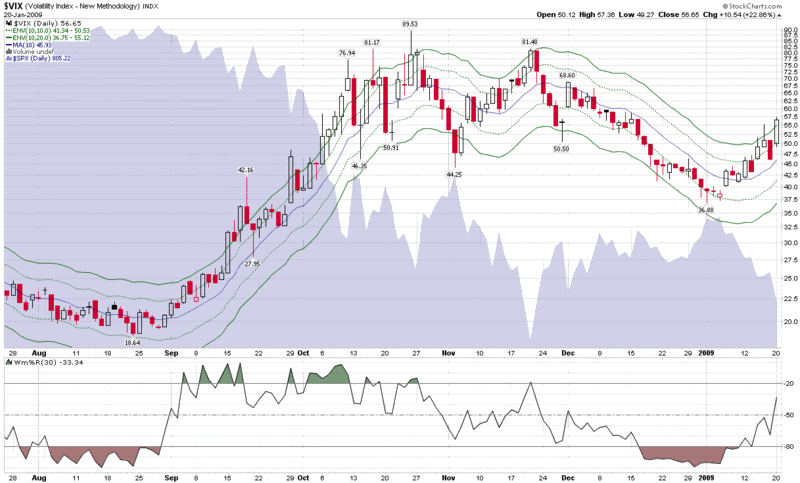
The chart below is one of my basic VIX charts and uses 10% and 20% moving average envelopes to bracket a 10 day simple moving average. The VIX closed 23.3% above the 10 day SMA, clearly at overbought levels, but as September and October showed, this is no guarantee we have hit a reversal point.

I also like to study the VIX relative to various historical volatility measures for the SPX. This too suggests an extremely extended VIX, with 10, 20 and 30 day historical volatility currently all residing in the 33-37 range.

The ever popular VIX:VXV ratio, which considers some elements that are analogous to the VIX term structure, is more neutral, with a slightly bullish reading of 1.032.

When I looked for historical data points that closely resemble the current situation I struggled to find analogous data. Only two periods come close to matching the present: October 2007, just when the markets were putting in a top; and July 1993, when the markets were slowly running out of steam, prior the bearish 1994 that preceded the great bullish leg from 1995-1999.

All things considered, my best guess is that the VIX is soon to begin suffering from oxygen deprivation and is not likely to climb much higher than the current altitude, providing some relief to the markets and keeping the SPX above the 770 level – perhaps even establishing 800 as the new SPX floor. The large pool of cash on the sidelines is sure to be tempted at current levels, but will not likely chase equities until there are some more convincing signs of a bottom forming. The next week or two could well determine whether the balance of the first half of 2009 is bullish or bearish.

[source: StockCharts]

Wednesday, November 12, 2008

Recent VIX Activity in the Context of Moving Average Envelopes

I have been receiving quite a few questions about the VIX lately. These are usually of the “where is it going?” or “what does it mean?” variety, but also quite a few from the do-it-yourself crowd who want to know how to best chart the VIX.

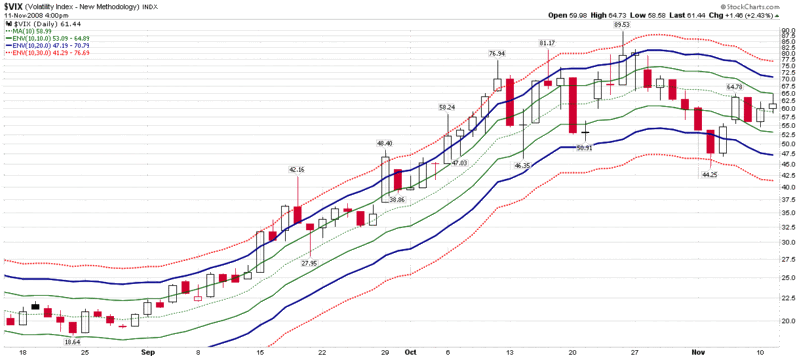
Though it may not always appear to be the case in this space, I am a big proponent of keeping things simple. The chart below is one simple approach to thinking about the VIX. The chart utilizes three different moving average envelopes to track where the VIX is relative to its 10 day simple moving average. Unlike Bollinger bands, which expand and contract according to recent volatility trends, the moving average envelopes define fixed percentage deviations from the moving average. In the case of the chart below, the dotted green line in the center is the 10 day SMA, the solid green lines represent a 10% moving average envelope, the bold dark blue lines mark the 20% envelope, and the dotted red lines are 30% above and below the 10 day SMA.

In terms of interpretation, consider that the VIX spends of most of its life between the 10% envelopes (e.g., late August, last few days) and generally strays only briefly out of the 20% envelopes before being pulled back by mean reversion. Of course the recent historic highs in volatility had the VIX above the top of the 20% envelope for almost all of September and October and then dramatically reversing to below the bottom of the 20% envelope last week. For any time other than the recent market activity, the 30% envelopes are superfluous. Historically, these are breached about once per year and almost always when the VIX spikes up.

[source: StockCharts]

Wednesday, May 7, 2008

VIX Surfing Down the Moving Average Channel

I have seen a number of typing heads out there proclaiming that the VIX is “too low” and therefore the recent rally is about to run out of steam. I have my own reasons (yesterday’s VIX:VXV ratio warning sign, for instance) for thinking that the current move is overextended, but labeling the VIX as “too low” is not one of those reasons.

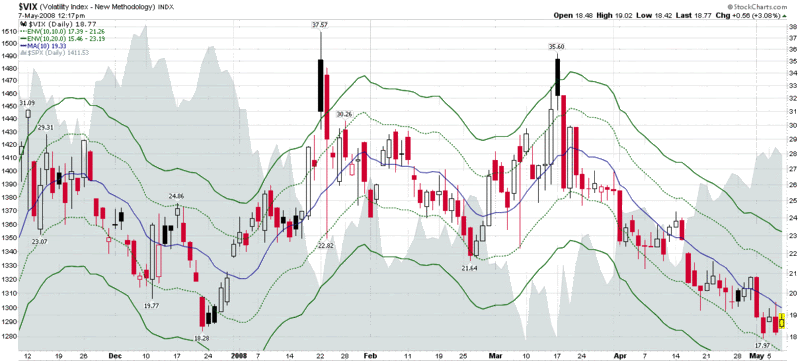
As best as I can determine, most people who use the VIX to time the market focus on the distance between the current VIX value and 10 day simple moving average, with the expectation that the greater the distance between the two, the more likely that the VIX will snap back in the direction of the SMA. With that in mind, consider the chart below, which shows the VIX in the context of the 10 day SMA and two moving average envelopes that show the 10% (dotted green) and 20% (solid green) distance from the SMA. For the last 6 ½ weeks or so, the VIX has been dropping steadily, but in such a fashion that its movements have largely been constrained to a channel between the 10 day SMA and the -10% moving average envelope. At current levels, the VIX is barely 3% below the very same 10 day SMA, hardly what most would consider to be in the “too low” category.

Wednesday, April 9, 2008

Volatility Spikes Above 10 Day Moving Average

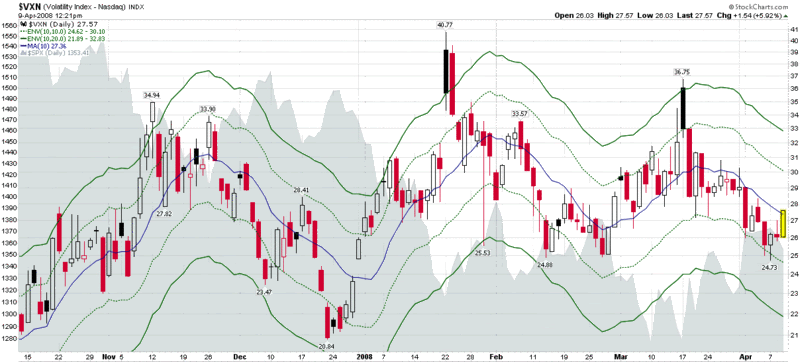
After three weeks of down trending volatility, the bearish action of the past three days has caused the VXN (volatility index for the NASDAQ-100) to reverse course and spike back above the 10 day simple moving average. As the NASDAQ-100 (NDX) has fallen more dramatically than the S&P 500 has this morning, the corresponding spike in the VIX, while similar, has not quite moved that volatility index up to the 10 day SMA.

As best as I can determine anecdotally, the use of volatility indices – particularly the VIX – to measure the ebb and flow of market sentiment has been on the rise in recent months. One of the most common ways to use the VIX is to measure the deviation from the 10 day SMA and bet that the larger the deviation, the more likely the index will rapidly move in mean reversion fashion in the direction of the 10 day SMA.

In trending markets, the mean reversion plays are excellent opportunities to add to a trend trade. When the markets are moving sideways, as they appear to be doing now, the VIX is better used as an oscillator for timing swing trades from one sentiment extreme to another.

In the chart below, I have added 10% and 20% moving average envelopes to the VXN to help define the most likely parameters of a volatility swing. While some resistance is usually evident as volatility swings back over the 10 day SMA, the opposite side of the 10% moving average envelope – a VXN of 30.09 in this case (26.09 for the VIX) – is where the volatility swing is most likely to run out of steam as it encounters stronger resistance. On the chart, the 10% moving average envelopes are represented by the dotted green lines. The solid green lines are 20% moving average envelopes; these usually signal the end of an extreme volatility swing and are more reliable mean reversion trading signals.

Tuesday, April 1, 2008

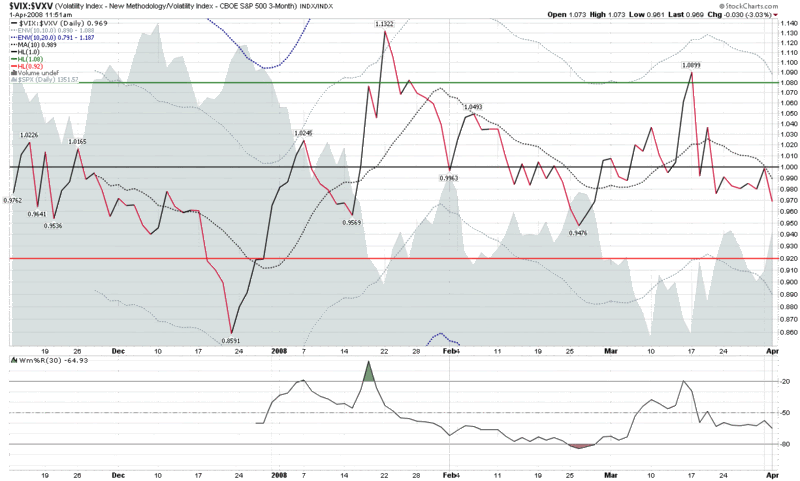
VIX:VXV Not Signaling Overbought Market

With the VIX trading at its lowest level (23ish) since late February, there are a number of investors who are trying to determine whether a falling VIX signals an overbought situation in the market.

There are many ways to use the VIX as a market sentiment indicator to assist in calling tops and bottoms. The most widely used is probably to determine the distance the VIX is from the 10 day simple moving average and get long if the VIX is 10% above the 10 day SMA and short if the VIX is 10% below the 10 day SMA. A simple plot of the VIX and the appropriate moving average envelopes will do the trick here – and also indicate that the markets are currently in an overbought condition.

Another way to use the VIX – and one which I continue to have high hopes for as the historical record evolves – is to use the ratio of the VIX (30 day implied volatility for SPX options) to the VXV (93 day IV for the SPX options) to determine the extent to which current volatility readings deviate from future volatility expectations. I have discussed this VIX:VXV ratio on a number of occasions and have continued to observe the predictive value of extreme readings. Now that I have the benefit of 4 ½ months of VXV data, I can say that the ratio continues to generate useful readings – and suggests that the current market is not particularly overbought (see chart below.)

I will continue to monitor instances in which the SMA +/- 10% rule and the VIX:VIX ratio rule(s) diverge and provide periodic updates in this space.

Wednesday, September 26, 2007

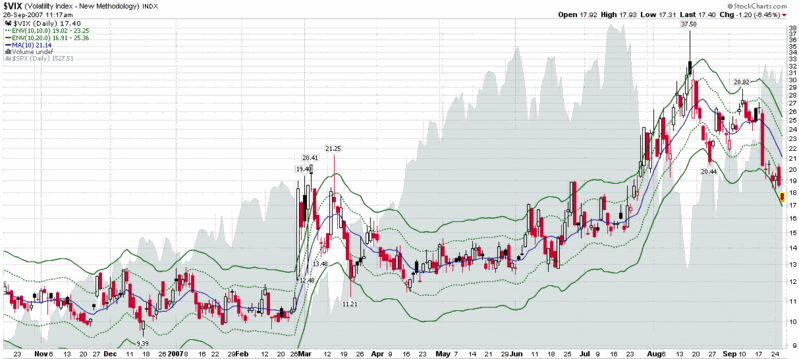
VIX Oversold

At 17.48, the VIX is now 17% below its 10 day SMA and 24% below its 20 day SMA, levels not seen since the end of June 2006. While I am not going to predict that the VIX will jump 43% over the next ten days like it did the last time it was this far below the two SMAs, history suggests that the VIX will start moving up from here and that the broader indices, some of which are approaching previous highs, are due for a selloff.

For the record, the chart below show the VIX with respect to its 10 day simple moving average, with the dotted green lines tracking +10% and -10% from that SMA and the solid green lines indicating the +20% and -20% levels from the 10 day SMA. As a general rule, mean reversion is increasingly likely the farther the VIX strays from the 10 day SMA.

I am inclined to think that the new floor in the VIX for the next month or so will be in the 16-17 range, but that is no more than a guesstimate. How the various sentiment indicators act as we test old highs will tell us a lot about the strength of this decidedly long in the tooth bull. Better not to anticipate, but to prepare for several different contingencies – and keep an eye on the VIX for some clues.

Also, apropos of yesterday's commentary, while the DJIA may be +80 at the moment, I note that many of the recent momentum stocks are in the red: BIDU, GRMN, LVS, BCSI, FWLT, MA, FSLR, AAPL, FCX, PCU, CMI, etc. Keep an eye on this development too.

Tuesday, July 24, 2007

VIX Has More Room to Run

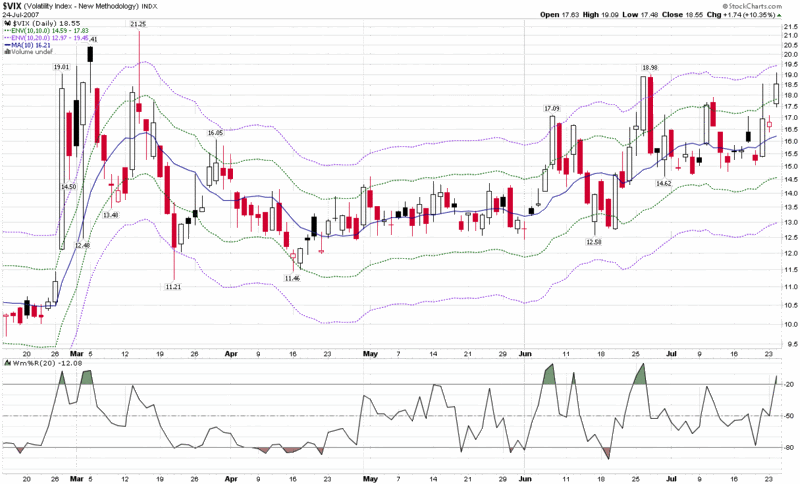
Thanks in part to a strong earnings report from Amazon (AMZN), the VIX dropped back to 18.55 by the time of its 4:15 ET close, down from an intra-day high of 19.09.

How high will the VIX go from here?

Turning to the VWSI, I note that it closed at -3 today, indicating that there is still a fair amount of room for the VIX to run without getting overextended. For the VWSI to reach -6 tomorrow – the point at which I generally look to fade the move with options – the VIX will have to touch 19.26. Also consider that a VWSI of -8 requires that the VIX hit 19.46 tomorrow; the maximum reading of a VWSI of -10 would result from a VIX of 21.21. So, if it turns out that today’s 19.09 is not a near-term high in the VIX, I would expect to see the VIX topping out in the 19.50 – 21.50 range. (Note that all VWSI numbers are reset at the end of each day, so these thresholds are moving targets and will be lifted higher by a gradually trending VIX.)

One way to illustrate the moving target aspect of the VMSI is to look at the VIX’s somewhat analogous moving average envelopes. Shown below are the 10% (dotted green line) and 20% (dotted purple line) moving average envelopes that surround the VIX’s 10 SMA (solid blue line.) As the VIX has trended upward over the past three months, the moving average envelopes have risen with it, so while the 17.08 and 18.98 VIX spikes in early and late June look like breakouts that are highly susceptible to the gravitational pull of mean reversion, today’s runup to 19.09 looks much more like normal oscillation around an uptrending mean.

Of course the VIX should not be the only tool in your toolbox. When I look at put to call ratios, new highs and new lows, as well as other market sentiment data, the case for the VIX topping out soon looks fairly strong to me.

Friday, June 15, 2007

Charting the VIX with 10 Day SMA Envelopes

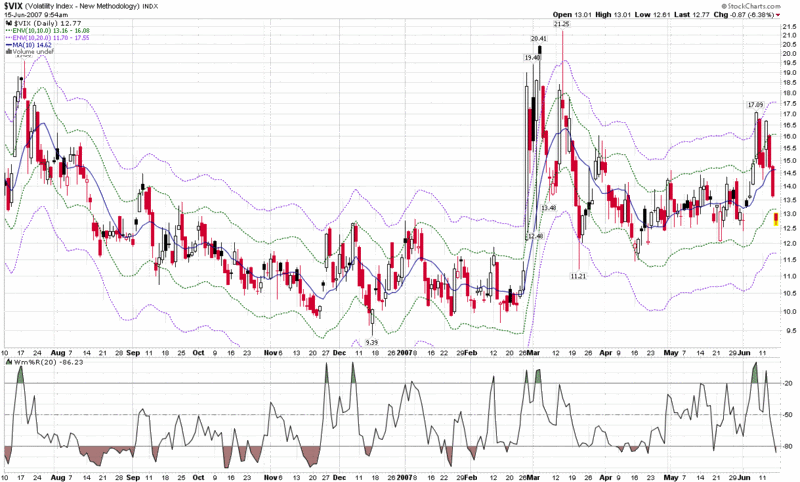
While the VIX is currently in the process of what looks like a mini-implosion, I thought this might be a good time to offer up what may be the best single chart for keeping track of the VIX.

To understand where I am coming from, I should say up front that I consider the 10 and 20 day simple moving average to be two of the most important pieces of VIX data to watch – and the keystone for short-term mean reversion analysis. Of these two SMAs, I favor the 10 day SMA slightly over its older sibling.

Of course you can easily put the 10 day SMA and the 20 day SMA on the same chart, but what is often more useful is to know just how far the VIX has strayed from these moving averages. For a quick visual check of this, I recommend using moving average envelopes, such as the ones shown in the chart below. You can follow the link in the previous sentence to see how StockCharts describes these envelopes or just consider that they work in a similar fashion to Bollinger Bands, except that instead of using standard deviations as a measuring device for the width of the bands above and below a mean, the moving average envelopes used a fixed percentage of the simple moving average.

An example helps tell the story. In the chart below, the 10 day SMA (mean) is represented by a solid blue line, with a current value of 14.62. The 10% upper band (currently 16.08) is represented by green dotted line while the upper 20% band (currently 17.55) is shown with a purple dotted line. A similar pattern is evident in the lower bands.

There are a couple of important things to remember about moving average envelopes. First, unlike Bollinger Bands or any other standard deviation-based calculation, they do not reflect any sort of volatility. Instead, their width is entirely a function of the value of the underlying SMA, regardless of volatility. Second, the 20% bands are rarely violated and usually represent excellent mean reversion setups; the 10% bands are violated more frequently, yet also offer many good mean reversion setups.

While there are many ways to watch and analyze the VIX, in my opinion moving average envelopes are among the best tools out there for the chartist trader.

DISCLAIMER: "VIX®" is a trademark of Chicago Board Options Exchange, Incorporated. Chicago Board Options Exchange, Incorporated is not affiliated with this website or this website's owner's or operators. CBOE assumes no responsibility for the accuracy or completeness or any other aspect of any content posted on this website by its operator or any third party. All content on this site is provided for informational and entertainment purposes only and is not intended as advice to buy or sell any securities. Stocks are difficult to trade; options are even harder. When it comes to VIX derivatives, don't fall into the trap of thinking that just because you can ride a horse, you can ride an alligator. Please do your own homework and accept full responsibility for any investment decisions you make. No content on this site can be used for commercial purposes without the prior written permission of the author. Copyright © 2007-2023 Bill Luby. All rights reserved.
 
Web Analytics