Showing posts with label VWSI of -10. Show all posts

Sunday, November 18, 2007

VWSI Swings From -10 to Zero in Wild Week

When you are playing the VIX mean reversion game, it doesn’t get any better than last week.

We entered the week with the VIX Weekly Sentiment Indicator (VWSI) at an unusually low -9 reading, but by the time the bull carnage had been tallied on Monday evening, the VWSI was maxed out at -10 and the VXN was looking even more ‘overbought’ than the VIX. These extreme readings triggered a rare market call on my part, which I titled a VXN Reversal Signal, but which also applied to the VIX. On Tuesday, the markets responded on cue, with the NASDAQ composite rallying 89.52 points in an impressive show of strength…and pushing the VWSI all the way back to zero.

Given the fireworks on Monday, the rest of the week was relatively uneventful, with the major market indicies largely meandering and the VIX ending the week at 25.49, down 3.01 (10.6%) from the previous week. In a nutshell, Waldo was nowhere to be found.

As is my new custom, I look to Barry Ritholtz at The Big Picture to sum up the week that was and the week that will be:
The VWSI has no bias going into the shortened week (3 ½ trading days, with the half day on Friday) and I find myself in the unusual position of sitting mostly in cash while I look for the currents to tell this jellyfish where to go next.


(Note that in the above temperature gauge, the "bullish" and "bearish" labels apply to the VIX, not to the broader markets, which are usually negatively correlated with the VIX.)

Wine pairing: For a VWSI of zero, I have heretofore been recommending a variety of inexpensive Rhone blends. The time has come to loosen the reins a bit and broaden the category to include everyday white and red blends from all varietals and regions, as long as they are reasonably priced. With this expanded criteria, I am please to recommend an usual blend of sauvignon blanc, pinot grigio, gewurztraminer, and semillon that goes into the Brassfield Serenity. This is an $11 white blend that is not just a fascinating change of pace, but an excellent food accompaniment and ultimately a wine that is quite impressive as a solo act as well. Finally, if you want to stump your favorite wine snob in a blind tasting, this is almost guaranteed to do the trick…


Sunday, September 16, 2007

Waiting on the Fed; VWSI at -1 Again

By the numbers, last week saw the VIX decline 1.31 or 5% to 24.92, following four days in a row where the VIX opened near the high of the day, then slowly pulled back.

Needless to say, all eyes are on Tuesday at this stage, where the Fed and the VIX will dance on the last day for trading September VIX options and disappointed investors could provide additional confirmation for the current VIX macro cycle.

With the VWSI at -1, held in check largely by the VIX’s relatively low long-term moving averages, I don’t see implied volatility or the VWSI telling us much about what the Fed is going to say, so I’ll be waiting just like everyone else, content to know that it is usually better to try to react than anticipate.

(Note that in the above temperature gauge, the "bullish" and "bearish" labels apply to the VIX, not to the broader markets, which are usually negatively correlated with the VIX.)


Wine pairing:
For a VWSI of -1 I continue to recommend a pinot noir. When I think of California pinot noirs, I immediately think of the Russian River Valley and the nearby small and foggy appelation known as Green Valley. Excellent pinot noir is more the rule than the exception here and four of my favorite producers are Martinelli Winery, Lynmar Winery, Hartford Family Winery, and Dutton-Goldfield Winery.

Further afield, last week, I spoke about three superb pinot noir producers from Anderson Valley: Londer Vineyards, Goldeneye (along with their second label Migration), and Esterlina Vineyards.

For some other suggestions on the pinot noir front, I have another blog with links to a dozen of my favorite producers: Zin and Pinot.

Sunday, August 5, 2007

VWSI Still Holding at -9

In the 17 ½ years of VIX data, the VWSI has never managed register extreme negative reading two weeks in a row…until now. With the VIX spiking to 24.15 on Friday, down 0.02 for the week, the VWSI managed to end the week at -9, just one tick higher than the maximum -10 reading of a week ago. The old record for two consecutive weeks was a rather paltry sounding -6 and -8, which spanned the weeks ending August 28 and September 4, 1998, at the height of the Russian financial crisis.

So while a week ago I spelled out the historical context that argued forcefully for a mean reverting VIX drop this past week, clearly this week’s sideways movement represented another unprecedented turn of events for the VIX. In spite of this, I still anticipate that the VIX will shed some 15-20% in the coming week. If the VIX goes up again this week, then it is time to tweak the VWSI model and/or accept the fact that we are in uncharted volatility waters.

To put things in perspective from a VWSI standpoint, if the VIX holds steady this week, we will probably end the week with a VWSI of about -2. On the other hand, if the VWSI is to remain in the -9 to -10 range for a third consecutive week, it will take a VIX of at least the high 20s to pull that rabbit out of the hat.

(Note that in the above temperature gauge, the "bullish" and "bearish" labels apply to the VIX, not to the broader markets, which are usually negatively correlated with the VIX.)

Wine pairing: After two weeks of heightened volatility, I would be hard pressed to find fault with someone who is still drinking some of the ports from last week. A VWSI of -9, however, calls for a change of pace. What better change of pace then to turn to a varietal that was almost completely wiped out, only to stage a recent comeback over a century later on another continent. I am talking about carmenere, a grape whose rediscovery and revival in Chile is one of the great stories of the wine world. I was lucky enough to have an exceptional Concha y Toro 2003 Terrunyo Carmenere last year and it was one of the tasting highlights of the year. If you are looking for additional suggestions, see which other carmeneres have been getting rave reviews on Cellar Tracker.

Saturday, July 28, 2007

VIX Spikes to 24.17, VWSI at -10

Thanks to an unusual 1.20 surge from 4:00 – 4:15, the VIX managed to spike all the way up to a 24.17 close on Friday, ending the week up 7.22 or 42.6%. In dollars and percentage terms, this is the type of VIX weekly move that you would expect to see only a couple of time per decade, yet this week’s action does not quite match that of five months ago, when the VIX jumped 7.99 points on a much smaller base and logged a 75.2% gain for the week.

Several readers have asked what these extreme VWSI readings mean. In a nutshell, they mean that a short-term (i.e., 5-10 trading days) VIX mean reversion move is highly likely and tradeable. While this also means that the broader markets will likely move in the opposite direction of a mean-reverting VIX, I tend to focus on the VIX play rather than the broader markets play – at least so far – in this blog.

In terms of historical context, I provided some interesting data for the week of February 27th that neatly predicted the subsequent unprecedented VIX contraction. I will expand upon this data set by offering up the only instances of an end of week VWSI of less than -6 since the shortened week of September 11, 2001:

  • week ending 3/22/07: VWSI of -10…VIX -24.3% the next week
  • week ending 5/19/06: VWSI of -9..…VIX -17.0% the next week
  • week ending 1/20/06: VWSI of -7..…VIX -17.8% the next week
  • week ending 4/15/05: VWSI of -9..…VIX -13.3% the next week
  • week ending 9/21/01: VWSI of -8..…VIX -25.2% the next week
Next week may turn out to be the exception to the historical rule, but the odds are stacked heavily against it.

(Note that in the above temperature gauge, the "bullish" and "bearish" labels apply to the VIX, not to the broader markets, which are usually negatively correlated with the VIX.)

Wine pairing: What kind of wine should you drink when volatility spikes and skewers your portfolio? A fortified one, of course! I am specifically talking about port, a wine that Americans often fail to properly appreciate. Port is a complex wine with a complex story that requires more than this small space to tell properly. A good introduction can be found in “A Port Primer Ruby,” by Steve Pitcher. To save you some lengthy research, I suggest you just go ahead and sample something in the $15 range, preferably Fonseca Bin #27 and/or Graham’s Porto Six Grapes. If either of these is a hit, then you should probably sample the slightly more expensive 10 and 20 year tawny ports, keeping in mind the names of Taylor, Dow and Fonseca. As soon as we see another VWSI of -10, I will elaborate on port in considerably more detail. This who catch the port bug are encouraged to take a peek at For the Love of Port to help further your interest.

Thursday, July 26, 2007

VIX 21.50 = Blood in the Streets

In panic there is always the greatest opportunity.

I am long equities and short the VIX, as we are at VWSI -10.

Today's VWSI of -10 Threshold is at 21.25

It the VIX jumps up to that level, it might signal a capitulation of sorts.

For what it's worth, I am starting to get short the VIX as it sits just below 21.

Tuesday, July 24, 2007

VIX Has More Room to Run

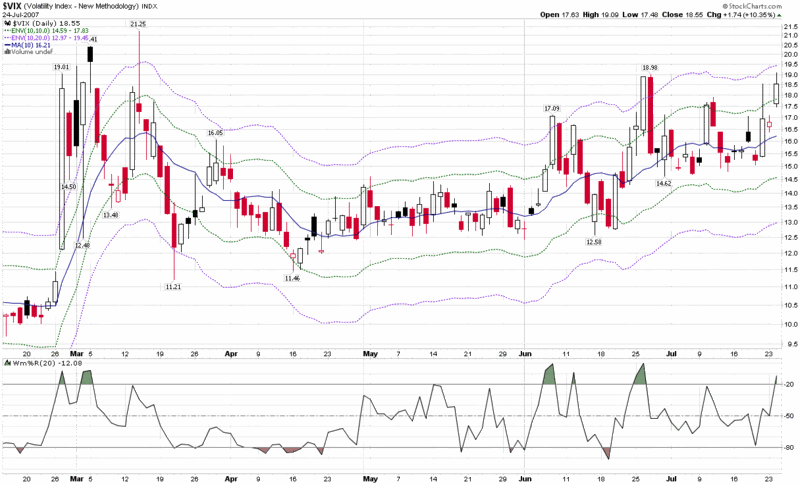
Thanks in part to a strong earnings report from Amazon (AMZN), the VIX dropped back to 18.55 by the time of its 4:15 ET close, down from an intra-day high of 19.09.

How high will the VIX go from here?

Turning to the VWSI, I note that it closed at -3 today, indicating that there is still a fair amount of room for the VIX to run without getting overextended. For the VWSI to reach -6 tomorrow – the point at which I generally look to fade the move with options – the VIX will have to touch 19.26. Also consider that a VWSI of -8 requires that the VIX hit 19.46 tomorrow; the maximum reading of a VWSI of -10 would result from a VIX of 21.21. So, if it turns out that today’s 19.09 is not a near-term high in the VIX, I would expect to see the VIX topping out in the 19.50 – 21.50 range. (Note that all VWSI numbers are reset at the end of each day, so these thresholds are moving targets and will be lifted higher by a gradually trending VIX.)

One way to illustrate the moving target aspect of the VMSI is to look at the VIX’s somewhat analogous moving average envelopes. Shown below are the 10% (dotted green line) and 20% (dotted purple line) moving average envelopes that surround the VIX’s 10 SMA (solid blue line.) As the VIX has trended upward over the past three months, the moving average envelopes have risen with it, so while the 17.08 and 18.98 VIX spikes in early and late June look like breakouts that are highly susceptible to the gravitational pull of mean reversion, today’s runup to 19.09 looks much more like normal oscillation around an uptrending mean.

Of course the VIX should not be the only tool in your toolbox. When I look at put to call ratios, new highs and new lows, as well as other market sentiment data, the case for the VIX topping out soon looks fairly strong to me.

Monday, June 25, 2007

Today's Key Number for the VIX is 17.26

At 17.26, the VWSI model jumps from -5 to -7 and I will likely open a fairly significant short position in the VIX. Keep in mind that because fear and greed can go vertical in a hurry, it is always a good idea to scale into a VIX position, starting with a small opening position, and adding to it when the odds in your favor get better. If the VIX continues to spike to 20 or 25, for example, you want to make sure you have some dry gunpowder to take advantage of it.

FWIW, I have already opened up a small short position with call spreads, but I may quickly switch from call spreads to puts if volatility continues to rise. It is unusual that the VWSI threshold targets for today are so compressed, with a VWSI of -10 hit at 17.43. If we get that far, I'll probably be buying some ATM puts, then if things get uglier, perhaps some OTM puts.

Thursday, June 7, 2007

How Overextended is the VIX?

In a word: excessively.

With the VIX currently up almost 14% to 16.96 in what is now a four day bounce, today's VWSI threshold numbers, which are good for generating setups for mean reversion plays are:
VWSI -8 at VIX 17.03
VWSI -9 at VIX 17.09
VWSI -10 at VIX 17.76

Keep in mind that most four day VIX moves will reverse dramatically over the course of the next few days. In fact, this may be a good time to review some post-spike VIX tendencies I spelled out following the February 27 VIX spike.

Sunday, March 4, 2007

VWSI at -10

With the VIX Weekly Sentiment Indicator (VWSI) ending the week at -10 for the first time since 9/11, the prognosis for the VIX over the next month or so is as bearish as it has ever been.

The current extreme readings in the VWSI have only been approached on three previous weeks since 1990:

  • Following 9/11
  • In the wake of the Asian Financial Crisis and a 554 point decline in the Dow on 10/27/97
  • On the heels of a second Fed rate hike in consecutive months in March 1994, after a period of five years without any Fed rate hikes

In each of the three instances above, the broader markets were characterized by considerable turbulence and uncertainty for at least a year following the crisis.

As far as the VIX is concerned, if the history above is any guide, expect a sharp reversion to the mean. The three previous -10 VWSI readings resulted in the following changes in the VIX:

  • 3 days: mean of -23% (-17%, -24%, -27%)
  • 5 days: mean of -32% (-27%, -33%, -36%)
  • 10 days: mean of -33% (-18%, -38%, -42%)
  • 20 days: mean of -43% (-37%, -46%, -47%)

As is the case with most VIX mean-reversion plays, most of the gains in these instances were limited to the first 20 trading days.

Keeping in mind the history above, there are many possible investment approaches if one expects history to repeat itself. Being short volatility or short the VIX should be a central portion of that strategy. Neutral calendar spreads are a relatively conservative approach; put back spreads would be more appropriate for an aggressive investor. Those wishing to strictly limit risk should probably also be looking at iron butterfly and iron condor strategies.

Finally, I would be remiss if I didn’t add that in periods of elevated volatility even more so than in more ‘normal’ markets, one should always plan exits before placing any trade and use stops wisely. Better yet, if you are not used to trading options, this is not the time to start experimenting.

(Note that in the above temperature gauge, the "bullish" and "bearish" labels apply to the VIX, not to the broader markets, which are usually negatively correlated with the VIX.)

DISCLAIMER: "VIX®" is a trademark of Chicago Board Options Exchange, Incorporated. Chicago Board Options Exchange, Incorporated is not affiliated with this website or this website's owner's or operators. CBOE assumes no responsibility for the accuracy or completeness or any other aspect of any content posted on this website by its operator or any third party. All content on this site is provided for informational and entertainment purposes only and is not intended as advice to buy or sell any securities. Stocks are difficult to trade; options are even harder. When it comes to VIX derivatives, don't fall into the trap of thinking that just because you can ride a horse, you can ride an alligator. Please do your own homework and accept full responsibility for any investment decisions you make. No content on this site can be used for commercial purposes without the prior written permission of the author. Copyright © 2007-2023 Bill Luby. All rights reserved.
 
Web Analytics