Showing posts with label VIX Weekly Sentiment Indicator. Show all posts

Sunday, April 8, 2007

VWSI at Zero Again

The VIX Weekly Sentiment Indicator (VWSI) is back at zero for the second week in a row, which is not unusual. In fact, over the long term, the VWSI should generate a zero reading approximately 40% of the time and fall in to the +3 to -3 ‘neutral zone’ approximately 80-90% of the time. When it comes to trading the VIX, patience and discipline are absolute requirements for high percentage and high expectancy trades.

On the price patterns front, the VIX fell 9.6% this past week, barely bringing an end to the five week double digit pendulum of price swings we noted last week in this space, but continuing to print an intriguing pattern: +75%; -24%; +19%; -23%; +13%; and -10%.

Speaking of intriguing patterns, the 90,000+ open interest for the April 11 and 12 VIX puts suggests that someone is staking large money on a continued contraction in volatility.

(Note that in the above temperature gauge, the "bullish" and "bearish" labels apply to the VIX, not to the broader markets, which are usually negatively correlated with the VIX.)

Wine pairing: The official wine pairing for a VWSI of zero is a Rhone blend. More broadly, it is any affordable and enjoyable red or white that works as an everyday wine. This week I will offer up an inexpensive version of a popular Rhone varietal, the broadly advertised and surprisingly drinkable 2005 Wrongo Dongo. While the label is short on information, this wine is from the Jumilla region of Spain and consists primarily of mourvedre, blended with some cabernet sauvignon and merlot. This is an easy drinking wine, but it has enough spice and backbone to stand up to those hard to pair ethnic foods. I found it locally for $7.99 and it can be had for less on sale. If you make money on one side of the market while everyone else is losing money on the other side, what could be more appropriate than to open a glass of Wrongo Dongo and drink to your contrarian success…

Sunday, April 1, 2007

VWSI at 0…and to Drink?

The VIX Weekly Sentiment Indicator (VWSI) is back at an even zero this week, which the fourth week in a row (i.e., each week since the week of 2/27) that it has been safely in the neutral zone in terms of future bias.

I normally pay very little attention to the VIX weekly chart, but I noticed that this past week was the fifth week in a row that the VIX end of week price changed by more than ten percent from the previous week. In my quick scan of the archives, I could only find two other times that this has happened before: in September-October 1999; and August-September 2001. One was an instance when the voices calling for a top were quite loud and increasingly persuasive; the other, of course, was associated with the events of 9/11.

Note that the current volatility in the VIX weekly price movements looks a lot like a pendulum that has been running out of momentum over the past five weeks: +75%; -24%; +19%; -23%; and +13%. If historical patterns repeat themselves, the VIX will move less than 10% in one direction or the other in the coming week.

(Note that in the above temperature gauge, the "bullish" and "bearish" labels apply to the VIX, not to the broader markets, which are usually negatively correlated with the VIX.)

Wine pairing: With considerable attention and care, I have now crafted a wine pairing for each VWSI reading and will unveil one every week to match a new VWSI reading. The trouble is that after finishing my list of varietals, I realized that I did not have a pairing for a 0 reading. Fortunately, I have a solution. Since 0 is the most common reading, this is where you should enjoy your everyday red and/or everyday white wine: one that doesn’t break the bank. Because I probably spend too much time with single varietals, I recommend that your everyday wine be a blend, preferably of varietals you do not have the opportunity to enjoy on a regular basis. For a fresh and exciting everyday red blend, I recommend a Rhone blend, specifically the Robert Hall Rhone de Robles. The 2004 was highly acclaimed, but I think the 2005 (44% grenache, 40% syrah, 11% cinsault, and 5% counoise) is even better – and at $10.99 a bottle at Trader Joe’s, it’s a steal. If you prefer a white wine, go with a white Rhone blend. A top selection is Tablas Creek’s Cote de Tablas Blanc, a blend of 42% viognier, 33% roussane, 19% marsanne, and 6% grenache blanc. This is a consistently excellent wine and if you search around, you should be able to find if for $9.99 a bottle. As an aside, both Robert Hall and Tablas Creek are wineries in the up and coming Paso Robles region. If you are looking for excellent California versions of Rhone wines, look to Paso Robles first. Enjoy!

Sunday, March 25, 2007

Complacency Creeping Back In; VWSI at +1

Quite a few commentators, including Tim Knight, have pointed out that the VIX has reversed all of the post 2/27 spike. While volatility measures are subsiding much more rapidly than put to call ratios, it is safe to say that some investors are thinking that the brief correction has passed and the bull market can now safely resume its course. In short, some complacency is creeping back into the market, albeit slowly.

The VIX Weekly Sentiment Indicator (VWSI) reflects some of this complacency, as it has hugged the 0 mark the past few weeks, currently sitting at +1.

While the VWSI generally seeks to predict VIX movements looking out only 1-2 weeks, this is as good a time as any to remind the reader that longer term seasonal cycles are at work as well. You may never have heard, “Sell in March and go away,” but the March-June period marks the downside cycle of the mid-year “V” pattern in the VIX that I have commented on earlier.

I would not be looking to anticipate volatility spikes at this stage, but I would expect that we will see a few more smaller ones in the coming weeks. Better yet, be prepared to play a little Whac-a-Mole and fade these spikes as they occur.

(Note that in the above temperature gauge, the "bullish" and "bearish" labels apply to the VIX, not to the broader markets, which are usually negatively correlated with the VIX.)


Wine pairing: A while back, a reader had the temerity to suggest that I might want to consider offering a wine pairing with the VWSI. Why not? I've been neglecting my wine blog, so why not jump start the latent oenophile in all of us. For the current +1 reading, coming off of some violent volatility spikes and ushering in the new season, I am recommend a dry gewurztraminer. Gewurztraminer is a wine that can stand up to all seasons and all levels of volaltility. It has more personality than any other white wine, is found in more styles and...it's not chardonnay. While the classic version comes from Alsace, I am a big fan of several American versions of this wine: dry; off-dry; and the dessert variety. One winery that gets all three versions right is Navarro. Last weekend, however, I found a stunning example of dry gewurz off the beaten track in the Russian River Valley at Harvest Moon. I hesitate to mention Harvest Moon because it is such a small winery, but the wines are so good that they deserve a wider audience. Enjoy!

Sunday, March 18, 2007

VWSI at -2

After a classic mean-reverting snap back last week, the VIX Weekly Sentiment Indicator (VWSI) took more of a meandering approach in the most recent week, registering only a -3 reading following Tuesday’s 30% spike and a -4 on Wednesday, when the VIX topped out at 21.25, a reading not seen since June 2006. While technically any reading below zero has to be considered to be somewhat bearish for the VIX, the current -2 reading is still within the -3 to +3 neutral zone, where I do not consider the statistical edge and risk/reward profile of the VIX to warrant taking either a long or short position.

At a little less than 4% over the VIX’s 10 day SMA of 16.18, it is difficult to make a case that the VIX is over or undervalued at current levels. It is worth recalling that the VIX tends to fizzle on Fed Days and almost never spikes 10%, so it is particularly difficult to make the case for being long the VIX going into the upcoming Fed announcement. For those looking to trade the VIX, this is a good time to be patient and wait for better setups.

(Note that in the above temperature gauge, the "bullish" and "bearish" labels apply to the VIX, not to the broader markets, which are usually negatively correlated with the VIX.)

Sunday, March 11, 2007

VWSI Snaps Back to Neutral

If you wanted to find an example in your investment textbook to illustrate “VIX Mean Reversion,” last week would be a classic case study. After soaring 75% in the week ended March 2nd, the VIX snapped back 24% this week, so that it now sits comfortably between its 10 and 20 day SMAs.

Perhaps surprising to some, this 24% drop is still less of a move than the VIX drops in each of the three previous instances in which the VIX Weekly Sentiment Indicator (VWSI) was at -10, as I discussed last week. It is enough of a move, however, for the current week’s VWSI to return to a neutral reading of zero. This roughly translates as the odds times the magnitude of another VIX spike are about the same as the odds times the magnitude of continued subsidence over the coming week. Said another way, there is a higher probability that the VIX will be lower on March 16, but if the VIX makes a significant move in the coming week, that move is more likely to be up than down.

In the event that you still have open positions resulting from a post-2/27 fade the spike strategy, this looks like a good time to start taking those profits. Keep in mind, however, that the VIX has a tendency to drop during options expiration. With the 10 day SMA of total put to call ratio currently sitting at 1.28, you can safely assume that it will need a Sherpa to stay at that altitude, suggesting that the market is poised to move upward and the VIX may have another leg down this week.

(Note that in the above temperature gauge, the "bullish" and "bearish" labels apply to the VIX, not to the broader markets, which are usually negatively correlated with the VIX.)

Sunday, March 4, 2007

VWSI at -10

With the VIX Weekly Sentiment Indicator (VWSI) ending the week at -10 for the first time since 9/11, the prognosis for the VIX over the next month or so is as bearish as it has ever been.

The current extreme readings in the VWSI have only been approached on three previous weeks since 1990:

  • Following 9/11
  • In the wake of the Asian Financial Crisis and a 554 point decline in the Dow on 10/27/97
  • On the heels of a second Fed rate hike in consecutive months in March 1994, after a period of five years without any Fed rate hikes

In each of the three instances above, the broader markets were characterized by considerable turbulence and uncertainty for at least a year following the crisis.

As far as the VIX is concerned, if the history above is any guide, expect a sharp reversion to the mean. The three previous -10 VWSI readings resulted in the following changes in the VIX:

  • 3 days: mean of -23% (-17%, -24%, -27%)
  • 5 days: mean of -32% (-27%, -33%, -36%)
  • 10 days: mean of -33% (-18%, -38%, -42%)
  • 20 days: mean of -43% (-37%, -46%, -47%)

As is the case with most VIX mean-reversion plays, most of the gains in these instances were limited to the first 20 trading days.

Keeping in mind the history above, there are many possible investment approaches if one expects history to repeat itself. Being short volatility or short the VIX should be a central portion of that strategy. Neutral calendar spreads are a relatively conservative approach; put back spreads would be more appropriate for an aggressive investor. Those wishing to strictly limit risk should probably also be looking at iron butterfly and iron condor strategies.

Finally, I would be remiss if I didn’t add that in periods of elevated volatility even more so than in more ‘normal’ markets, one should always plan exits before placing any trade and use stops wisely. Better yet, if you are not used to trading options, this is not the time to start experimenting.

(Note that in the above temperature gauge, the "bullish" and "bearish" labels apply to the VIX, not to the broader markets, which are usually negatively correlated with the VIX.)

Saturday, February 24, 2007

VIX Weekly Sentiment Indicator Update

Last week I introduced the VIX Weekly Sentiment Indicator (VWSI) as a gauge of likely VIX activity over the coming 1-4 weeks. Following my initial post on this subject, several readers asked for additional details about the inputs into the VWSI and how the VWSI readings are calculated. This seems like a good time to set some expectations.

First, my intent is to update the VWSI each weekend with some pithy remarks about some reasons for the current reading as well as thoughts around how one might employ various VIX option strategies when the readings reach extreme levels. I would consider ‘extreme’ readings to be >+5 or <-5, but believe that readings in the +3 to +5 and -3 to -5 ranges to be such that they can be also be traded profitably. When we see readings of this magnitude, I will go into more detail.

As far as the calculations are concerned, I have no intention of publishing the exact formula, but suffice it to say that the most heavily weighted inputs are several simple moving averages. Typically, if you see readings of >+3 or <-3, it is usually a function of extreme divergences between the current price and the SMAs – and with it an expectation that the VIX will move back in the direction of the SMA reading over the course of the next 5-10 days. I actually provided considerable detail about this last week.

I should also note that I have wrestled with the idea of how much the content in this blog should be presented as an informational resource and how much, if any, it should be geared toward specific trading strategies and setups. My strong preference is for an informational approach; while I may discuss trading approaches or even specific positions I may be taking in the VIX or in other securities, this will definitely be the exception rather than the rule. I am primarily a discretionary trader and do not have any desire to disclose the rationale for my entries and exits, except on an occasional basis, generally to illustrate a point.

Those interested in an example of one of the mechanical systems I use for trading are encouraged to look at my Portfolio123 live portfolio, which I will update every Sunday.

Finally, to address the title in this post: the VWSI temperature gauge reading for the week ending 2/23/07 is 0, down from the +1 level of the previous week. While some averages (e.g., the 20, 50 and 100 day SMAs) are at all-time lows on an absolute basis, the relative numbers keep the VWSI in the middle of the neutral zone at the present time.


(Note that in the above temperature gauge, the "bullish" and "bearish" labels apply to the VIX, not to the broader markets, which are usually negatively correlated with the VIX.)

Sunday, February 18, 2007

New Feature #1: VIX Weekly Sentiment Indicator

The time has come to start adding some regular features to this blog, in addition, of course, to the regular barrage of pastel Excel charts…

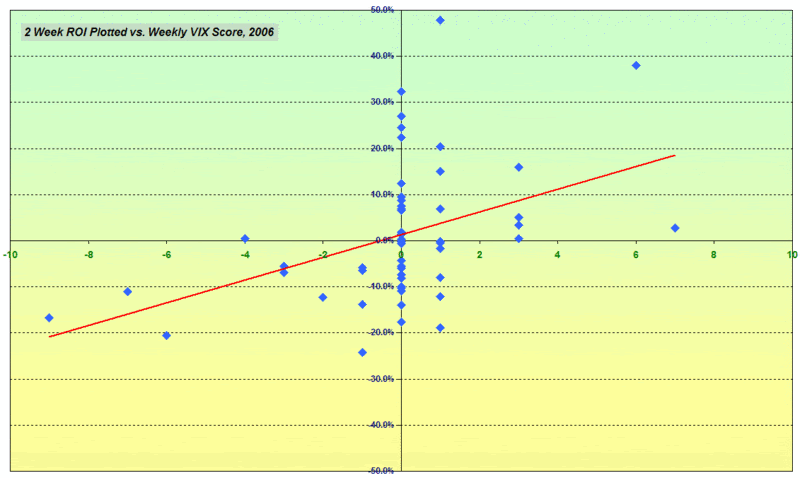
Today I am introducing the VIX Weekly Sentiment Indicator – or VWSI if you like unwieldy acronyms. The intent of this indicator is to gauge the future movements of the VIX in the coming week or so. In fact, the indicator has proven to be a useful tool for predicting VIX moves in the 1-4 week period. For better or for worse, I will not be trotting out a bunch of statistics to demonstrate how well the VWSI would have performed over various backtesting periods. Instead, consider the following scatter plot showing the two week ROI on various VWSI scores from 2006 as reasonably representative of the predictive power the VWSI:

The factors that have the largest impact on VWSI scores are largely oscillator calculations involving various simple moving averages, the Commodity Channel Index, the Williams %R indicator, and others. It is worth noting that the weekly VWSI scores have no memory of the previous week’s scores. Therefore, even while the value of a score may have tradeable implications for a 1-4 week period, a new score is constructed from scratch each week. As a result, extreme VWSI scores rarely persist for more than one or two weeks.

Finally, the VWSI temperature gauge below should be relatively self-explanatory, particularly if you keep in mind that the "bullish" and "bearish" labels apply to the VIX, not to the broader markets, which are usually negatively correlated with the VIX. The reading for the week ending 2/16/07 is +1, which is considered to be in the neutral zone. Last week’s VWSI reading was an even zero.

DISCLAIMER: "VIX®" is a trademark of Chicago Board Options Exchange, Incorporated. Chicago Board Options Exchange, Incorporated is not affiliated with this website or this website's owner's or operators. CBOE assumes no responsibility for the accuracy or completeness or any other aspect of any content posted on this website by its operator or any third party. All content on this site is provided for informational and entertainment purposes only and is not intended as advice to buy or sell any securities. Stocks are difficult to trade; options are even harder. When it comes to VIX derivatives, don't fall into the trap of thinking that just because you can ride a horse, you can ride an alligator. Please do your own homework and accept full responsibility for any investment decisions you make. No content on this site can be used for commercial purposes without the prior written permission of the author. Copyright © 2007-2023 Bill Luby. All rights reserved.
 
Web Analytics