Showing posts with label fade the spike. Show all posts

Thursday, April 5, 2007

Lessons From the Post-2/27 VIX Price Action

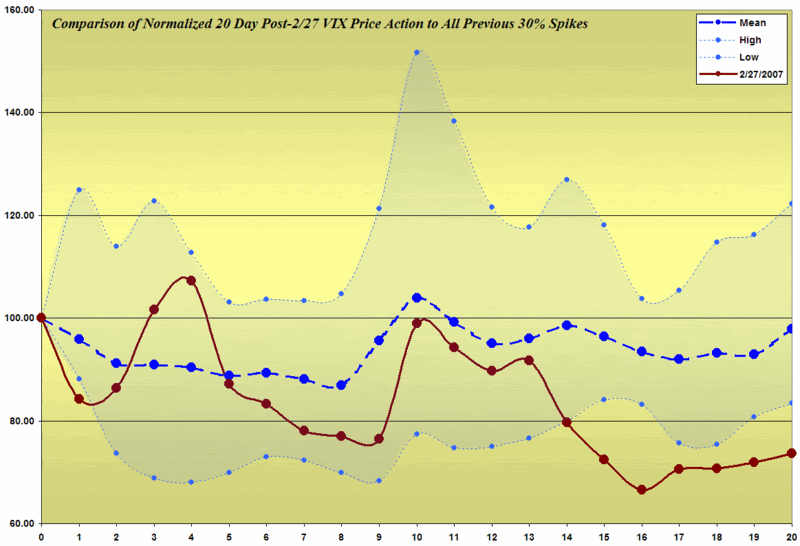
Following the 64% spike in the VIX on 2/27, there were many voices insisting that volatility was returning to the markets. For a week or two, they were occasionally correct, but I do not believe you can put a VIX spike in historical context until at least 20 trading days have passed since the spike. The 20th trading day, it turns out, was last Tuesday, so let’s do a post-mortem.

First, as I type this the VIX stands at 13.10, down almost 30% from the February 27th close of 18.31. While we did see some ‘echo volatility’ that briefly pushed the VIX into the 20s on the 4th and 11th day following the spike, for the last 14 trading days the VIX has only closed above 15 once, on March 29th, and even then it just barely managed to do so.

With an eye to historical context, I have been solidly in the mean-reversion camp since the 2/27 spike. On March 1, I posted some graphs showing what had happened to the VIX over the course of the subsequent 20 trading days in the eight previous instances following a 30% spike. In short, the conclusion was to expect considerable mean reversion in the first 10 days or so, with a couple of echo volatility spikes. The high probability trade was to expect mean reversion to win out over any subsequent volatility spikes and if you followed any of my suggested mean reversion VIX options trades, you undoubtedly did very well.

All of which brings us back to the present. How has the VIX price action following 2/27 compared to the VIX price action in previous 30% VIX spikes? The answer to this question, which can be discerned from the graph below of normalized closing prices, is that the two echo volatility spikes on day 4 and day 11 look eerily similar to the historical record. For the most part, the 2/27 VIX spike has been followed by very little volatility. In fact on only two days out of the 20 days subsequent to the spike did the VIX close at a level above the historical mean. I find it even more interesting that from days 14 through 20 (March 19–27), the VIX closed below the historical low on each day, down an aggregate 20-33%.

The next time you see a VIX spike, look for the high probability “fade the spike” play on the mean reversion side and be prepared to bet against the likely one or two instances of echo volatility. History is on your side.
Sunday, March 25, 2007

Complacency Creeping Back In; VWSI at +1

Quite a few commentators, including Tim Knight, have pointed out that the VIX has reversed all of the post 2/27 spike. While volatility measures are subsiding much more rapidly than put to call ratios, it is safe to say that some investors are thinking that the brief correction has passed and the bull market can now safely resume its course. In short, some complacency is creeping back into the market, albeit slowly.

The VIX Weekly Sentiment Indicator (VWSI) reflects some of this complacency, as it has hugged the 0 mark the past few weeks, currently sitting at +1.

While the VWSI generally seeks to predict VIX movements looking out only 1-2 weeks, this is as good a time as any to remind the reader that longer term seasonal cycles are at work as well. You may never have heard, “Sell in March and go away,” but the March-June period marks the downside cycle of the mid-year “V” pattern in the VIX that I have commented on earlier.

I would not be looking to anticipate volatility spikes at this stage, but I would expect that we will see a few more smaller ones in the coming weeks. Better yet, be prepared to play a little Whac-a-Mole and fade these spikes as they occur.

(Note that in the above temperature gauge, the "bullish" and "bearish" labels apply to the VIX, not to the broader markets, which are usually negatively correlated with the VIX.)


Wine pairing: A while back, a reader had the temerity to suggest that I might want to consider offering a wine pairing with the VWSI. Why not? I've been neglecting my wine blog, so why not jump start the latent oenophile in all of us. For the current +1 reading, coming off of some violent volatility spikes and ushering in the new season, I am recommend a dry gewurztraminer. Gewurztraminer is a wine that can stand up to all seasons and all levels of volaltility. It has more personality than any other white wine, is found in more styles and...it's not chardonnay. While the classic version comes from Alsace, I am a big fan of several American versions of this wine: dry; off-dry; and the dessert variety. One winery that gets all three versions right is Navarro. Last weekend, however, I found a stunning example of dry gewurz off the beaten track in the Russian River Valley at Harvest Moon. I hesitate to mention Harvest Moon because it is such a small winery, but the wines are so good that they deserve a wider audience. Enjoy!

Tuesday, March 20, 2007

Good Time to Take Some Profits

With the VIX at 13.52 and expiration coming tomorrow, this is a good time to take some profits on any remaining fade the spike trades.

Note that the lowest VIX close since 2/27 is 13.99, so the risk/reward profile on any mean reversion trades continues to deteriorate with each click the VIX makes down.

Wednesday, March 14, 2007

Reminder: VIX Options Expire on 3/21 This Month

This means that any positions put on today still have 5 days left until expiration -- long enough to give most fade the spike strategies a chance to benefit from a short-term mean-reverting subsidence in volatility.

Tuesday, March 13, 2007

Fade the Echo Volatility Spike

VIX currently at 18.06, +29% for the day.

Looks like some echo volatility and another opportunity to fade the spike.

Sunday, March 11, 2007

VWSI Snaps Back to Neutral

If you wanted to find an example in your investment textbook to illustrate “VIX Mean Reversion,” last week would be a classic case study. After soaring 75% in the week ended March 2nd, the VIX snapped back 24% this week, so that it now sits comfortably between its 10 and 20 day SMAs.

Perhaps surprising to some, this 24% drop is still less of a move than the VIX drops in each of the three previous instances in which the VIX Weekly Sentiment Indicator (VWSI) was at -10, as I discussed last week. It is enough of a move, however, for the current week’s VWSI to return to a neutral reading of zero. This roughly translates as the odds times the magnitude of another VIX spike are about the same as the odds times the magnitude of continued subsidence over the coming week. Said another way, there is a higher probability that the VIX will be lower on March 16, but if the VIX makes a significant move in the coming week, that move is more likely to be up than down.

In the event that you still have open positions resulting from a post-2/27 fade the spike strategy, this looks like a good time to start taking those profits. Keep in mind, however, that the VIX has a tendency to drop during options expiration. With the 10 day SMA of total put to call ratio currently sitting at 1.28, you can safely assume that it will need a Sherpa to stay at that altitude, suggesting that the market is poised to move upward and the VIX may have another leg down this week.

(Note that in the above temperature gauge, the "bullish" and "bearish" labels apply to the VIX, not to the broader markets, which are usually negatively correlated with the VIX.)

DISCLAIMER: "VIX®" is a trademark of Chicago Board Options Exchange, Incorporated. Chicago Board Options Exchange, Incorporated is not affiliated with this website or this website's owner's or operators. CBOE assumes no responsibility for the accuracy or completeness or any other aspect of any content posted on this website by its operator or any third party. All content on this site is provided for informational and entertainment purposes only and is not intended as advice to buy or sell any securities. Stocks are difficult to trade; options are even harder. When it comes to VIX derivatives, don't fall into the trap of thinking that just because you can ride a horse, you can ride an alligator. Please do your own homework and accept full responsibility for any investment decisions you make. No content on this site can be used for commercial purposes without the prior written permission of the author. Copyright © 2007-2023 Bill Luby. All rights reserved.
 
Web Analytics