Showing posts with label 30%. Show all posts

Thursday, July 26, 2007

Some Data on Post-Spike Performance

Back on February 27th, I posted about what typically happens following a 20% and 30% VIX spike. At a high of 23.37, the VIX was recently up 29.1% from the previous day.

You can follow the links below to get some historical context:


For what it's worth, I think today has been way overdone, but that doesn't necessarily mean the worst is over. I suspect it may take several weeks to get this one out of our system.

Thursday, April 5, 2007

Lessons From the Post-2/27 VIX Price Action

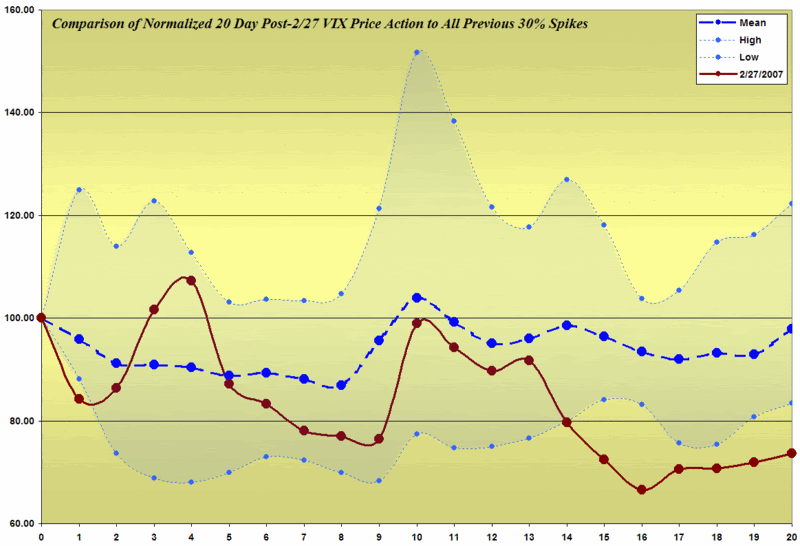
Following the 64% spike in the VIX on 2/27, there were many voices insisting that volatility was returning to the markets. For a week or two, they were occasionally correct, but I do not believe you can put a VIX spike in historical context until at least 20 trading days have passed since the spike. The 20th trading day, it turns out, was last Tuesday, so let’s do a post-mortem.

First, as I type this the VIX stands at 13.10, down almost 30% from the February 27th close of 18.31. While we did see some ‘echo volatility’ that briefly pushed the VIX into the 20s on the 4th and 11th day following the spike, for the last 14 trading days the VIX has only closed above 15 once, on March 29th, and even then it just barely managed to do so.

With an eye to historical context, I have been solidly in the mean-reversion camp since the 2/27 spike. On March 1, I posted some graphs showing what had happened to the VIX over the course of the subsequent 20 trading days in the eight previous instances following a 30% spike. In short, the conclusion was to expect considerable mean reversion in the first 10 days or so, with a couple of echo volatility spikes. The high probability trade was to expect mean reversion to win out over any subsequent volatility spikes and if you followed any of my suggested mean reversion VIX options trades, you undoubtedly did very well.

All of which brings us back to the present. How has the VIX price action following 2/27 compared to the VIX price action in previous 30% VIX spikes? The answer to this question, which can be discerned from the graph below of normalized closing prices, is that the two echo volatility spikes on day 4 and day 11 look eerily similar to the historical record. For the most part, the 2/27 VIX spike has been followed by very little volatility. In fact on only two days out of the 20 days subsequent to the spike did the VIX close at a level above the historical mean. I find it even more interesting that from days 14 through 20 (March 19–27), the VIX closed below the historical low on each day, down an aggregate 20-33%.

The next time you see a VIX spike, look for the high probability “fade the spike” play on the mean reversion side and be prepared to bet against the likely one or two instances of echo volatility. History is on your side.

Tuesday, February 27, 2007

One Day 30% (!) Spikes in the VIX

Nobody has asked yet, but I might as well save those who are contemplating the question a few keystrokes.

Since the VIX was officially rolled out in 1993, there have been only 4 days in which it spiked up 30% or more. Turn the clock back to 1990 and you find a total of 8 days.

For those who might be interested, the mean reversion expectations following a +30% move are very similar to that of +20% days, which I weighed in on this morning. The data sample size is small enough to not be statistically significant, but still, in the 3, 5 and 10 days following the VIX spikes, 6/8, 7/8 and 5/8 of the VIX moves had reversed. The mean retracements were 9% and 11% over the 3 and 5 day period, but 10 days out, the mean move had continued upward 4%, owing largely to the strength of one subsequent 52% spike in the VIX.

The VIX has not made a 40% move to the up side since February 2, 1994, when the Fed’s decision to raise interest rates sent shock waves through the markets.

DISCLAIMER: "VIX®" is a trademark of Chicago Board Options Exchange, Incorporated. Chicago Board Options Exchange, Incorporated is not affiliated with this website or this website's owner's or operators. CBOE assumes no responsibility for the accuracy or completeness or any other aspect of any content posted on this website by its operator or any third party. All content on this site is provided for informational and entertainment purposes only and is not intended as advice to buy or sell any securities. Stocks are difficult to trade; options are even harder. When it comes to VIX derivatives, don't fall into the trap of thinking that just because you can ride a horse, you can ride an alligator. Please do your own homework and accept full responsibility for any investment decisions you make. No content on this site can be used for commercial purposes without the prior written permission of the author. Copyright © 2007-2023 Bill Luby. All rights reserved.
 
Web Analytics