Showing posts with label VDAX. Show all posts

Thursday, November 6, 2008

AMEX Ready to Pull the Plug on Fixed Return Options?

Stan Freifeld at TheOptionsInsider.com has crafted the first draft of an obituary for fixed return options, also known as FROs. In The Death of Fixed Return Options? Freifeld concludes that the absence of new expirations months and strikes suggests the AMEX is likely to phase out FROs soon.

While clearly a fan of FROs, Freifeld highlights six issues which have hampered the development of these new types of options:

  1. New nomenclature required (Finish High and Finish Low)
  2. Large bid/ask spreads
  3. Product not aggressively marketed by the AMEX
  4. Limited availability via brokers
  5. Available on only one exchange (AMEX), with low volume
  6. Utilizes volume-weighted average price (VWAP) for settlement, instead of closing price

I think the salient points are captured above, but ultimately FROs are doomed by the lack of availability via brokers and particularly the large bid/ask spreads. These two issues may be a function of marketing, nomenclature, a single exchange approach or other factors, but ultimately if the spreads are too large, then it becomes extremely difficult to implement a strategy which can overcome such large transaction costs over the long term.

“Fixed return options” is the name the AMEX gives to their all-or-nothing options products. The CBOE uses the term “binary options” for similar options they offer on the SPY and VIX. While SPY binary options are generating some interest, at the money spreads are still in the 0.06 – 0.08 range, which is discouraging a more active market.

Further to my VIX Binary Options post of two months ago, VIX binaries continue to suffer from a lack of interest. This is unfortunate, because in many respects VIX binary options are in much easier to understand and potentially to trade successfully than standard VIX options.

Students of volatility derivatives may recall that the Deutsche Börse launched futures on the VDAX known as the VOLAX back in 1998. While that product launch was not successful, it did pave the way for a successful launch of VIX futures six years later.

Thursday, September 11, 2008

The U.S. VIX vs. a BRIC VIX

India has an India VIX, Germany has the VDAX, and some other countries (largely in Europe) have their own country volatility indices. Outside of North America and Europe, the volatility index pickings are slim, however, so when you want to get a sense of international volatility on a broader scale, you have to roll your own.

Which is exactly what I have done today.

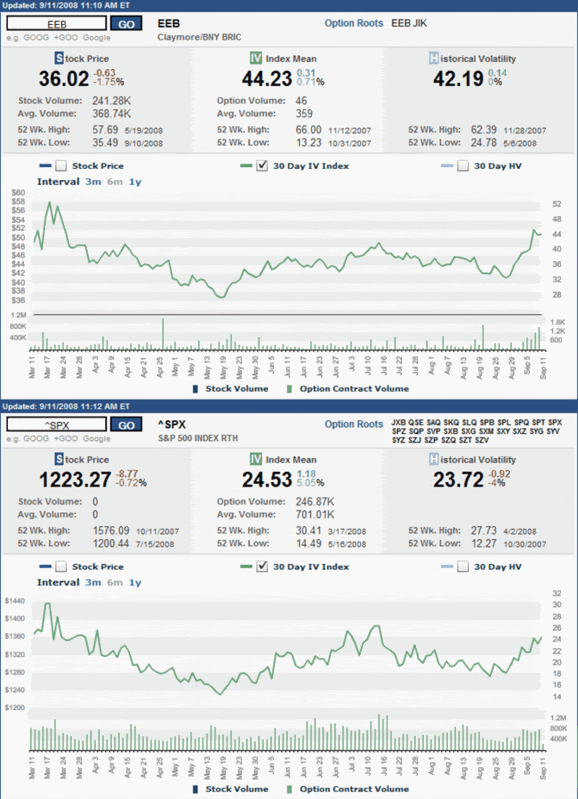
In the chart below, the bottom half is a six month chart of implied volatility in the S&P 500 index. It is similar, but not identical to the VIX. Note the March high, a second peak in mid-July, and the recent uptrend in volatility.

On the top half of the chart is the implied volatility in the Claymore BHY BRIC (Brazil, Russia, India, and China) ETF (EEB), which attempts to replicate the performance of the Bank of New York BRIC Select ADR index. In contrast to the SPX, implied volatility in the BRIC ETF was relatively moderate in July, but has spiked dramatically over the course of the past two weeks. In short, fear and anxiety may be rising slowly in U.S. markets, but in the critical economies of Brazil, Russia, India, and China, signs of panic are much more widespread.

If emerging markets are the buffer whose continued growth is supposed to buttress developed markets in this economic slowdown, then emerging markets need to find their own firm ground and soothe anxious investors before they can be expected to lubricate the wheels of the global economy.

[source: International Securites Exchange]

Monday, August 4, 2008

The Evolution of the Volatility Index Family Tree

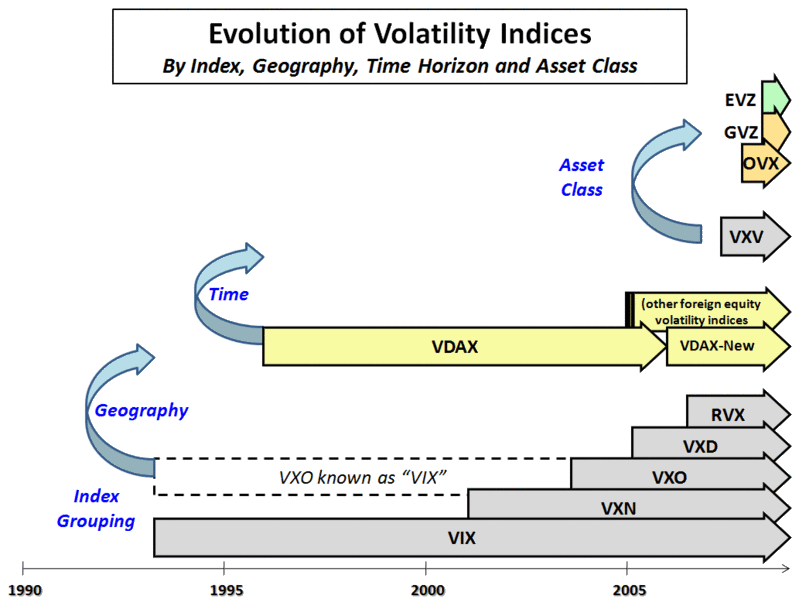
In the beginning, there was the VIX. Eventually, the reach of the VIX was deemed too narrow and the volatility index universe was expanded to include the VXN, VXO, and a host of other volatility indices based on various U.S. equity indices. First an American phenomenon, volatility indices soon began sprouting up overseas, notably in the form of the German VDAX, but more recently reaching Asian shores with the April launch of the India VIX.

Having expanded geographically, volatility indices also recently began to expand the time horizon in which they evaluated volatility with the launch of the VXV, the 93 day version of the VIX.

In the last three weeks, the CBOE has started moving past equity-based volatility indices into commodity and currency volatility indices. The OVX (“Oil VIX”) was the first such effort. Last Friday the CBOE launched two new volatility indices:

  • GVZ – CBOE Gold Volatility Index (“Gold VIX”), based on the GLD ETF

  • EVZ – CBOE EuroCurrency Volatility Index (“Euro VIX”), based on the FXE ETF

The graphic below summarizes some of the highlights across the volatility index evolutionary timeline.

It remains to be seen whether the VIX branding and labeling will stick to oil, gold and the euro. Five years ago, the VIX label was transported from the S&P 100 (OEX) to the S&P 500 (SPX), but until the past few months there has been only one VIX. With the recent arrival of the India VIX, Oil VIX, Gold VIX, and Euro VIX, there is ample room for confusion about what exactly “VIX” means. On the other hand, “VIX” is really just shorthand for a generic “volatility index.” If this potential confusion can be overcome, the CBOE may have found a way to enhance and extend the most successful product and brand they have ever launched – and in the process dramatically change the volatility landscape.


Tuesday, April 29, 2008

Ten Things Everyone Should Know About the VIX

I have had quite a few requests to present some introductory material on the VIX, so with that in mind I offer up the following in question and answer format:

Q: What is the VIX?
A: In brief, the VIX is the ticker symbol for the volatility index that the Chicago Board Options Exchange (CBOE) created to calculate the implied volatility of options on the S&P 500 index (SPX) for the next 30 calendar days. The formal name of the VIX is the CBOE Volatility Index.

Q: How is the VIX calculated?
A: The CBOE utilizes a wide variety of strike prices for SPX puts and calls to calculate the VIX. In order to arrive at a 30 day implied volatility value, the calculation blends options expiring on two different dates, with the result being an interpolated implied volatility number. For the record, the CBOE does not use the Black-Scholes option pricing model. Details of the VIX calculations are available from the CBOE in their VIX white paper.

Q: Why should I care about the VIX?
A: There are several reasons to pay attention to the VIX. Most investors who monitor the VIX do so because it provides important information about investor sentiment that can be helpful in evaluating potential market turning points. A smaller group of investors use VIX options and VIX futures to hedge their portfolios; other investors use those same options and futures as well as VIX exchange traded notes (primarily VXX) to speculate on the future direction of the market.

Q: What is the history of the VIX?
A: The VIX was originally launched in 1993, with a slightly different calculation than the one that is currently employed. The ‘original VIX’ (which is still tracked under the ticker VXO) differs from the current VIX in two main respects: it is based on the S&P 100 (OEX) instead of the S&P 500; and it targets at the money options instead of the broad range of strikes utilized by the VIX. The current VIX was reformulated on September 22, 2003, at which time the original VIX was assigned the VXO ticker. VIX futures began trading on March 26, 2004; VIX options followed on February 24, 2006; and two VIX exchange traded notes (VXX and VXZ) were added to the mix on January 30, 2009.

Q: Why is the VIX sometimes called the “fear index”?
A: The CBOE has actively encouraged the use of the VIX as a tool for measuring investor fear in their marketing of the VIX and VIX-related products. As the CBOE puts it, “since volatility often signifies financial turmoil, [the] VIX is often referred to as the ‘investor fear gauge’”. The media has been quick to latch onto the headline value of the VIX as a fear indicator and has helped to reinforce the relationship between the VIX and investor fear.

Q: How does the VIX differ from other measures of volatility?
A: The VIX is the most widely known of a number of volatility indices. The CBOE alone recognizes nine volatility indices, the most popular of which are the VIX, the VXO, the VXN (for the NASDAQ-100 index), and the RVX (for the Russell 2000 small cap index). In addition to volatility indices for US equities, there are volatility indices for foreign equities (VDAX, VSTOXX, VSMI, VX1, MVX, VAEX, VBEL, VCAC, etc.) as well as lesser known volatility indices for other asset classes such as oil, gold and currencies.

Q: What are normal, high and low readings for the VIX?
A: This question is more complicated than it sounds, because some people focus on absolute VIX numbers and some people focus on relative VIX numbers. On an absolute basis, looking at a VIX as reformulated in 2003, but using data reverse engineered going back to 1990, the mean is a little bit over 20, the high is just below 90 and the low is just below 10. Just for fun, using the VXO (original VIX formulation), it is possible to calculate that the VXO peaked at about 172 on Black Monday, October 19, 1987.

Q: Can I trade the VIX?
A: At this time it is not possible to trade the cash or spot VIX directly. The only way to take a position on the VIX is through the use of VIX options and futures or on two VIX ETNs that are based on VIX futures: VXX, which targets VIX futures with 1 month to maturity; and VXZ, which targets 5 months to maturity. An inverse VIX futures ETN, XXV, was launched on 7/19/10. This product targets VIX futures with 1 month to maturity. As of May 2010, options have been available on the VXX and VXZ ETNs.

Q: How can the VIX be used as a hedge?
A: The VIX is appropriate as a hedging tool because it has a strong negative correlation to the SPX – and is generally about four times more volatile. For this reason, portfolio managers often find that buying of out of the money calls on the VIX to be a relatively inexpensive way to hedge long portfolio positions. Similar hedges can be constructed using VIX futures or the VIX ETNs.

Q: How do investors use the VIX to time the market?
A: This is a subject for a much larger space, but in general, the VIX tends to trend in the very short-term, mean-revert over the short to intermediate term, and move in cycles over a long-term time frame. The devil, of course, is in the details.

[Last updated on 7/22/2010]

Wednesday, August 1, 2007

Euronext Adding Three New Volatility Indices

Euronext, the European arm of NYSE Euronext, recently announced the creation of three new volatility indices: the AEX Volatility Index; the BEL 20 Volatility Index; and the CAC 40 Volatility Index. These indices will be calculated in the same manner as the current VIX methodology and will be launched on September 3, 2007.

Euronext has also historical data available for download for all three indices and has some summary information available for each index:

The three new volatility indices will compete with the VDAX, which is the incumbent volatility index of choice for the European markets and also a product of the Deutsche Börse.

It should come as no surprise that volatility products are proliferating in the US and across the globe, with volatility in the headlines as of late, demand for these products growing rapidly, and the battle for supremacy among the major exchanges heating up at the same time. I wonder, though, given that we already have a volatility index for the Frankfurt Stock Exchange, do we gain anything significant by adding new ones for Amsterdam, Brussels and Paris as well?

Monday, March 12, 2007

The VDAX and the VIX in the Wake of 2/27

When I introduced the VDAX in this space back on 2/22, volatility was hibernating with the bears on each and every continent and my commentary focused on the high degree of correlation between the VIX and the VDAX. I noted that the two indices often trade in tandem, but pointed out that the VDAX sometimes lags the VIX by one trading day or even two.

With the surge in volatility on the heels of 2/27, this seems like a good time to revisit some of those ideas.

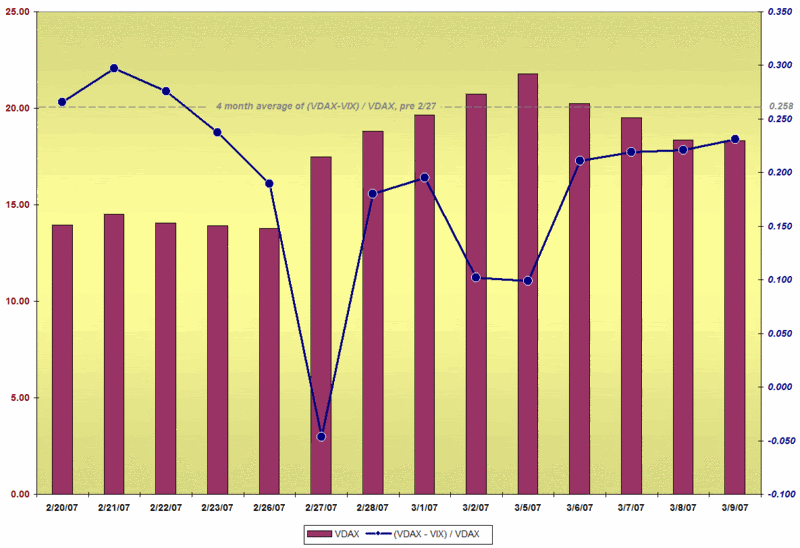
Looking at the data for the four months leading up to 2/27, the difference between the VDAX (VDAX-NEW) and the VIX as a percentage of the VDAX ranged between 17% and 36%, with a mean of about 26% (plotted below as a dashed gray line.)

On February 27, the German markets closed well before the US markets; by the time the VIX had closed for the day, it was trading 5% higher than the VDAX. Over the next week or so, you can see where the VIX and VDAX played lead-lag cat and mouse, as global players tried to place bets ahead of any signs of increasing or lessening international contagion. Only in the last several days, has the VDAX-VIX spread ratio settled into a relatively narrow trading range, which I would interpret as a sign that the major players in the volatility markets believe that the probability of increased volatility or contagion is starting to subside. Whether these traders can accurately help predict the future remains to be seen, but when they stop playing the intermarket volatility game, you should at least incorporate that information into your market outlook.

Thursday, February 22, 2007

Introducing the VDAX

So here I am patting myself on the back about how Dali’s “The Persistence of Memory” is the perfect accompaniment to my nearly finished post on ever shrinking VIX numbers and the warping of our collective sense of time decay…when I decide to visit one of my favorite options blogs. I pause for a second, then do a double take. Oops, that must be my draft post I pulled up by mistake. No, it turns out I am having a surrealist moment of my own. Dali’s melting clocks appeared on the other blog just minutes before they were scheduled to appear on mine.

It felt almost like the CFO of my largest long position had just resigned abruptly, so I have decided to go in another direction today. Make that another continent…

So, today I am introducing the VDAX! Actually, like the VIX and the old VXO, the Deutsche Börse has a new VDAX (aka VDAX-NEW) and an old VDAX. The biggest distinction between the two is that VDAX-NEW is calculated from the implied volatility in the DAX (German counterpart to the DJIA) options looking out 30 days while the original VDAX looks ahead 45 days.

We will discuss the VDAX and other international volatility indices in greater depth at a later date, but for today I want to pose and address two questions:

  • What is the correlation between the VIX and the VDAX?
  • To what extent does one volatility index lead or lag the other?

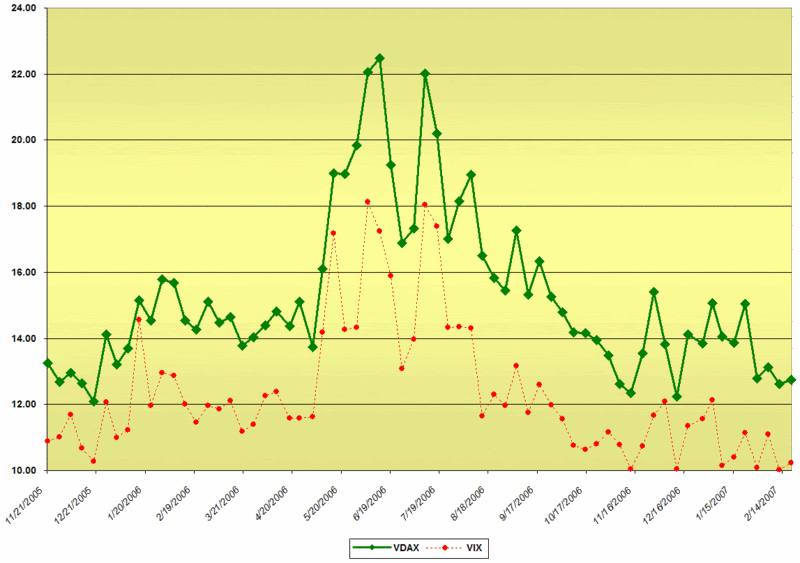
In order to answer these questions, I have relied on data for the original VDAX only because I have a better data set. The VDAX and the VDAX-NEW are very highly correlated; in the two graphs below I used data for the original VDAX:

Note the strong correlation between the weekly VDAX and the weekly VIX. In the second chart, the red dotted line and solid ‘best fit’ line for that data series represent the difference between the VDAX and the VIX as a percentage of the VDAX. This difference between the VDAX and the VIX shows that at least over the past year or so, volatility has been dissipating in US markets faster than in the German markets.

As is the case for most comparisons of the US and international markets, it should come as no surprise that the US markets tend to take the lead in volatility moves, with foreign markets usually reacting to changes in the US. Writing in 2003, Sofiane Aboura concludes in International Transmission of Volatility: A Study on the Volatility Indexes VX1, VDAX and VIX that “the information flow contained in the VIX is globally transferred the same day to the VX1 [derived from the CAC 40] while it is diffused the two first days to the German market through the VDAX. We note again the contemporaneous relationships between the US and the French implied volatility indexes.”

So, from the same continent that brought you Salvador Dali, we have the VDAX – and we also have a date with Dali to discuss volatility in the not too distant future. In the meantime, I will leave you with one of his quotes:

“Have no fear of perfection - you'll never reach it.” ~ Salvador Dali

DISCLAIMER: "VIX®" is a trademark of Chicago Board Options Exchange, Incorporated. Chicago Board Options Exchange, Incorporated is not affiliated with this website or this website's owner's or operators. CBOE assumes no responsibility for the accuracy or completeness or any other aspect of any content posted on this website by its operator or any third party. All content on this site is provided for informational and entertainment purposes only and is not intended as advice to buy or sell any securities. Stocks are difficult to trade; options are even harder. When it comes to VIX derivatives, don't fall into the trap of thinking that just because you can ride a horse, you can ride an alligator. Please do your own homework and accept full responsibility for any investment decisions you make. No content on this site can be used for commercial purposes without the prior written permission of the author. Copyright © 2007-2023 Bill Luby. All rights reserved.
 
Web Analytics