Showing posts with label binary options. Show all posts

Monday, August 17, 2009

How to Trade the VIX

Based upon the search terms that are landing visitors on the blog this morning, it seems as if many readers are interested in how to trade the VIX. This question really boils down to two separate issues: strategies and trading vehicles.

Since I have talked about strategies repeatedly in this space in the past, I thought I would offer a quick summary of trading vehicles today.

First off, it is not possible to trade the VIX directly. Formally known as the CBOE Volatility Index, the VIX calculates market expectations of 30 day implied volatility for S&P 500 index options. The VIX (sometimes referred to as the cash or spot VIX) is a statistic that the CBOE calculates and disseminates every 15 seconds during the trading day. While widely disseminated, this statistic is not available for purchase.

Fortunately, there are a number of VIX derivatives that allow traders to take positions on the VIX without owning the underlying. In no particular order, they are:

  1. VIX options – these include standard options as well as VIX binary options

  2. VIX futures – standard VIX futures contracts have a contract size of 1000 times the VIX; the recently added mini-VIX futures have a contract size of 100 times the VIX

  3. VIX ETNs – currently consists of two exchange traded notes: the iPath S&P 500 VIX Short-Term Futures ETN (VXX) and the iPath S&P 500 VIX Mid-Term Futures ETN (VXZ). The former targets one month VIX futures and the latter targets five month VIX futures.

In addition to VIX products, one can always trade options on the SPX (or SPY). A long VIX position is very similar to a long SPX straddle (or strangle); a short VIX position is very similar to a short SPX straddle (or strangle.)

For some additional reading on these subjects, readers are encouraged to check out:

Thursday, January 1, 2009

2008 Volatility Awards

I thought I’d spare everyone a silly sounding name like “the VIXies,” so without further ado, here are the highly subjective and not-otherwise-nicknamed VIX and More volatility awards for 2008:

I’m sure I overlooked some other obvious awards. Feel free to add to this list in the comments section.

Thursday, November 6, 2008

AMEX Ready to Pull the Plug on Fixed Return Options?

Stan Freifeld at TheOptionsInsider.com has crafted the first draft of an obituary for fixed return options, also known as FROs. In The Death of Fixed Return Options? Freifeld concludes that the absence of new expirations months and strikes suggests the AMEX is likely to phase out FROs soon.

While clearly a fan of FROs, Freifeld highlights six issues which have hampered the development of these new types of options:

  1. New nomenclature required (Finish High and Finish Low)
  2. Large bid/ask spreads
  3. Product not aggressively marketed by the AMEX
  4. Limited availability via brokers
  5. Available on only one exchange (AMEX), with low volume
  6. Utilizes volume-weighted average price (VWAP) for settlement, instead of closing price

I think the salient points are captured above, but ultimately FROs are doomed by the lack of availability via brokers and particularly the large bid/ask spreads. These two issues may be a function of marketing, nomenclature, a single exchange approach or other factors, but ultimately if the spreads are too large, then it becomes extremely difficult to implement a strategy which can overcome such large transaction costs over the long term.

“Fixed return options” is the name the AMEX gives to their all-or-nothing options products. The CBOE uses the term “binary options” for similar options they offer on the SPY and VIX. While SPY binary options are generating some interest, at the money spreads are still in the 0.06 – 0.08 range, which is discouraging a more active market.

Further to my VIX Binary Options post of two months ago, VIX binaries continue to suffer from a lack of interest. This is unfortunate, because in many respects VIX binary options are in much easier to understand and potentially to trade successfully than standard VIX options.

Students of volatility derivatives may recall that the Deutsche Börse launched futures on the VDAX known as the VOLAX back in 1998. While that product launch was not successful, it did pave the way for a successful launch of VIX futures six years later.

Tuesday, September 23, 2008

CBOE Adds Puts to VIX Binary Option Choices

As I discussed earlier this month in VIX Binary Options, the CBOE is now offering binary options on the VIX. The first out of the gate was VIX binary calls, which were launched in July. Starting today, there are now VIX binary puts.

The CBOE noted the following about their new binary options:

"CBOE's binary options have experienced impressive volume early on, reaching as much as 10,000 to 12,000 contracts on some days and averaging 2,500 contracts daily during September. CBOE has seen strong institutional use of these contracts. Based on customer feedback, we fully expect the addition of puts to spur more brokers-dealers to come on-line to handle binaries, thus enabling more individual investors to access these products.

The Designated Primary Market Maker (DPM) for binary options on the S&P 500 Index (ticker symbol BSZ) is Chicago Trading Company; the DPM for binary options on the CBOE Volatility Index (ticker symbol BVZ) is Group One Trading, L.P.
"

I feel obliged to add that so far the success of the binary options has been more the result of the SPX options than the VIX options, but if you are one of those who does not expect to see a VIX in 30s for very long, VIX binary puts might be something to investigate. I can only hope that the bid-ask spreads are low enough to make these viable trading instruments.

Wednesday, September 3, 2008

VIX Binary Options

Back on July 1st, the CBOE launched binary options on the VIX. Essentially the CBOE’s binary options are the same as the pioneering ‘fixed return options’ launched by the AMEX earlier in the year.

As the name implies, a binary option is an all or nothing security that pays off a fixed cash settlement amount if the underlying settles at or above a specified strike price at expiration. If the underlying settles below the specified strike price, the binary option will expire worthless. If you are familiar with Intrade.com, then you are already familiar with binary options.

In the case of VIX binary options, these are European style (no early exercise) options, currently consisting only of calls (no puts are available), and settled in cash. The CBOE specifies the settlement as follows:

"The exercise-settlement value for VIX Binary Options will be the same as the exercise-settlement value ("VRO") for CBOE Volatility Index Options. VRO is a Special Opening Quotation (SOQ) of VIX calculated from the sequence of opening prices of the options used to calculate the index on the settlement date. The opening price for any series in which there is no trade shall be the average of that option's bid price and ask price as determined at the opening of trading. Exercise will result in delivery of cash on the business day following expiration.

The exercise-settlement amount for VIX Binary Call Options will be 1) $100, if VRO is equal to or greater than the VIX Binary Call Option strike price; or 2) $0, if VRO is less than the VIX Binary Call Option strike price."

I checked with my two favorite options brokers, thinkorswim and optionsXpress, to determine the availability of VIX binary options. thinkorswim has not yet implemented VIX binary options, but is “working on adding them.” optionsXpress does have VIX binary options available to trade. To access the optionsXpress VIX binary options chain, just pull up the chain for options on VRO (the VIX special opening quotation ticker).

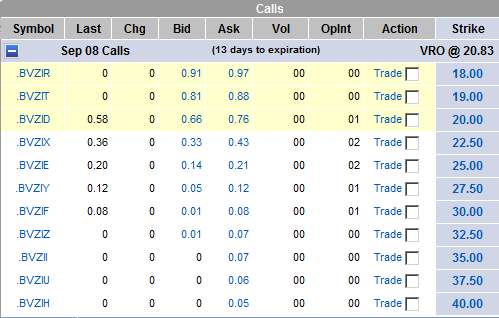
A graphic of the current optionsXpress VIX binary option chain is below. As you can see, volume and open interest are negligible at this stage, which has translated into bid-ask spreads generally in the 0.06 – 0.10 range. For the month of August, the 22,162 VIX binary options contracts traded accounted for 1.8% of all VIX call options and 1.1% of all VIX options transactions.

For additional information, check out the VIX binary contract specifications at the CBOE’s web site.


[source: optionsXpress]

DISCLAIMER: "VIX®" is a trademark of Chicago Board Options Exchange, Incorporated. Chicago Board Options Exchange, Incorporated is not affiliated with this website or this website's owner's or operators. CBOE assumes no responsibility for the accuracy or completeness or any other aspect of any content posted on this website by its operator or any third party. All content on this site is provided for informational and entertainment purposes only and is not intended as advice to buy or sell any securities. Stocks are difficult to trade; options are even harder. When it comes to VIX derivatives, don't fall into the trap of thinking that just because you can ride a horse, you can ride an alligator. Please do your own homework and accept full responsibility for any investment decisions you make. No content on this site can be used for commercial purposes without the prior written permission of the author. Copyright © 2007-2023 Bill Luby. All rights reserved.
 
Web Analytics