Showing posts with label synthetic. Show all posts

Thursday, August 16, 2012

A VIX Risk Reversal

With the VIX at about 14.50 as I type this and a large group of investors convinced that stocks are overbought and/or not properly discounting global macro risk, many are wondering just how to translate their beliefs into an effective trading strategy.

For those who think a long volatility trade is the answer, there is the issue of the significant contango headwinds, where a negative roll yield will pummel net asset values on VIX options and VIX exchange-traded products as a part of the daily rebalancing process, while VIX futures are subjected to a similar decay that reminds me a little bit of a dying helium balloon. Long story short: there is a huge daily penalty being assessed just for holding these long positions.

There are ways to minimize the effect of negative roll yield and typically one of the best of these is to work with positions that focus on the more distant months of the VIX futures term structure. This is generally why VXZ outperforms VXX over an extended period. Unfortunately for aficionados of VXZ, the negative roll yield between the fourth and seventh month VIX futures (VXZ buys the seventh month and sells the front month each day) hit a new record on Monday and continues at near record levels.

So what is a long volatility trader to do?

One trade that I somehow have never managed to highlight in my 5 ½ of writing about the VIX is a VIX risk reversal. A risk reversal is essentially a synthetic long position in which a trader uses options to create a position that is similar to owning the underlying, but typically ties up less capital in the process. In the case of a risk reversal, this means selling out-of-the-money puts and buying out-of-the-money calls. In many instances, the sale of the put options will finance 100% of the cost of the calls.

While the VIX is currently trading at 14.50, keep in mind that the best proxy for the price of the underlying for VIX options is the VIX futures for the corresponding month. So, with the September VIX futures at 18.95 at the moment, one could sell the September 18.00 puts for 1.50 and buy the September 24 calls for 1.05, pocketing the 0.45 differential. A more conservative trader might look to sell the VIX September 16 puts for 0.55 and use the proceeds to pick up a September 30 call for 0.55 or to defray some of the costs of the purchase of a more expensive call, such as the September 24 (priced at 1.05) mentioned above.

There are ways to turn this idea into a more aggressive trade as well. One approach is to morph a risk reversal into a leveraged trade in which more calls units are purchased than put units are sold. An example of this approach might involve selling the September 19 puts (which are currently at-the-money) for 2.15 and using the proceeds to purchase two contracts of the September 24 calls for 1.05 each.

A risk reversal also goes by other names, notably a long combination (or long combo) and, despite the name, is a high-risk trade that is vulnerable to the ravages of time decay. This trade is not for everyone, but can be a good way to generate significant long exposure with a minimal outlay of funds and sometimes no outlay of funds at all.

Related posts:

Disclosure(s): long VIX at time of writing

Tuesday, March 27, 2012

Options on UVXY and SVXY Open Up New VIX ETP Trading Approaches

Whether or not I find it useful to flog the wounded horse otherwise known as the VelocityShares Daily 2x VIX Short-Term ETN (TVIX), it seems as if investors and the media insist that the wild and crazy story of this +2x VIX futures ETN remain on the front page for now.

While the TVIX story is indeed a fascinating one (see links below for more details), I fear it has crowded out a potentially more useful development from last week that has been criminally overlooked, the launch of options on two important VIX ETFs:

  • ProShares Ultra VIX Short-Term Futures ETF (UVXY)
  • ProShares Short VIX Short-Term Futures ETF (SVXY)

First off, note that the fact that these two products are exchange-traded funds instead of exchanged-traded notes means that it was much easier for options to be approved. While their more famous ETN counterparts, TVIX and XIV, grab most of the headlines, the addition of options means that traders now have much more flexibility in terms of strategy and tactics with UVXY and SVXY. 

In the past when I have mentioned how options on VIX ETPs were critical to their long-term success, I was met with a few (electronic) blank stares. Part of this reflects that fact that many have been drawn to the VIX ETPs for the potential to reap huge profits in a short period of time (more on this in The Trader Development Stage Model and the Jump from Stocks to Options) with leveraged trades. Talk to most professional options traders, however, and leverage is rarely a factor they mention as a reason for their focus on options trading. In fact, pros are more likely to cite the two key advantages of options as their flexibility and ability to structure defined risk (or limited risk) trades.

This brings me back to options on UVXY and SVXY. With UVXY down 83% for the quarter as of yesterday’s close, one would think that defined risk positions – on the long or short side – would be a critical factor in structuring future trades. With the huge contango and negative roll yield currently in the VIX futures, a directional bet in either direction entails huge risk. For shorts, this means that a short position can have its risk capped by buying UVXY calls. For longs this means that a long position can also limit risk by buying puts.

There are other ways to implement defined risk trades, notably with vertical credit spreads and vertical debit spreads, where gains and losses are limited to the distance between strikes. Traders can also just simply buy puts and calls to put a directional idea to work, knowing that their maximum loss will be limited to the purchase price.

In hard to borrow situations – which are common with some VIX ETPs – traders can also use options to create a synthetic position. For instance, a long put plus a short call is the equivalent of a synthetic short, so if no shares are available to borrow, a synthetic position might be an excellent proxy, with the same profit and loss potential as a standard short position, yet typically tying up a lot less trading capital.

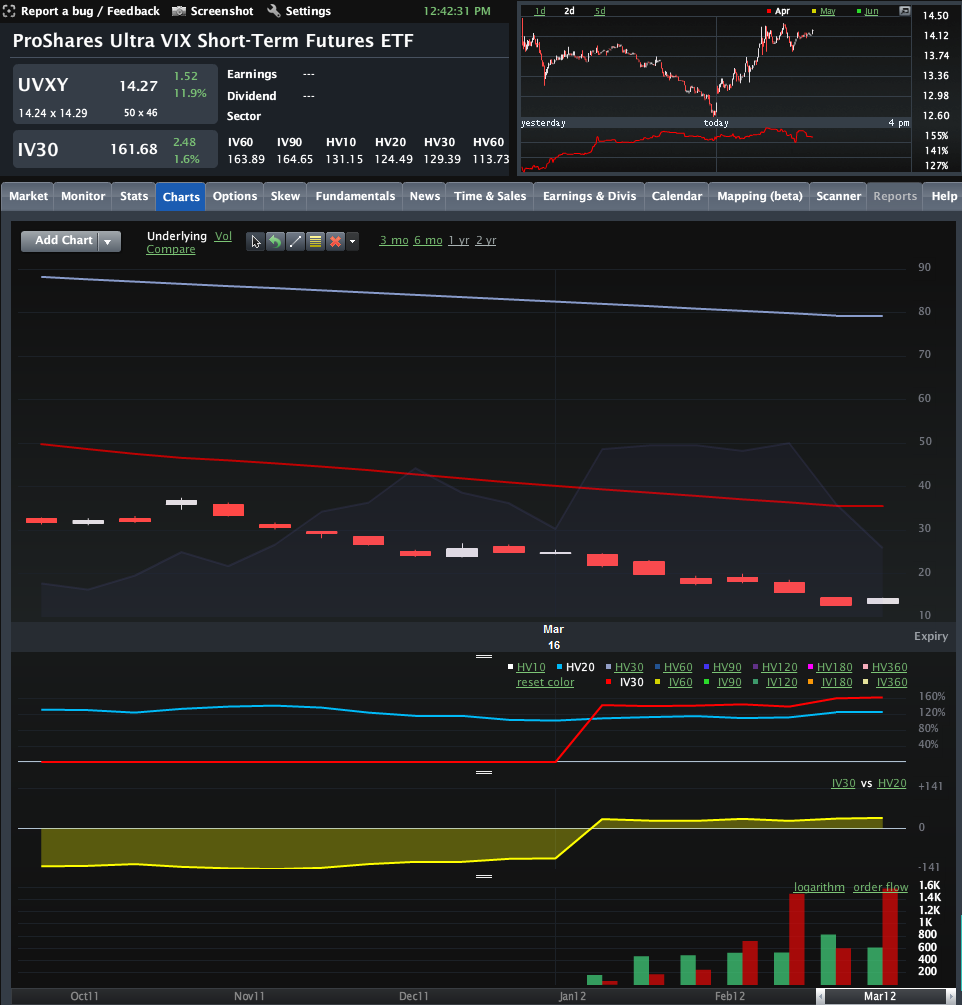
Note that the markets for options in UVXY and SVXY are only one week old and not particularly liquid at this stage. On the other hand, volumes are ramping up quickly (see graphic of UVXY options volume, etc. below) and the flexibility and risk control inherent in options products makes these attractive, particularly so when applied to highly volatile products like UVXY and SVXY.

Related posts:

[source(s): LivevolPro.com]

Disclosure(s): long XIV and SVXY, short TVIX and UVXY at time of writing; Livevol is an advertiser on VIX and More

DISCLAIMER: "VIX®" is a trademark of Chicago Board Options Exchange, Incorporated. Chicago Board Options Exchange, Incorporated is not affiliated with this website or this website's owner's or operators. CBOE assumes no responsibility for the accuracy or completeness or any other aspect of any content posted on this website by its operator or any third party. All content on this site is provided for informational and entertainment purposes only and is not intended as advice to buy or sell any securities. Stocks are difficult to trade; options are even harder. When it comes to VIX derivatives, don't fall into the trap of thinking that just because you can ride a horse, you can ride an alligator. Please do your own homework and accept full responsibility for any investment decisions you make. No content on this site can be used for commercial purposes without the prior written permission of the author. Copyright © 2007-2023 Bill Luby. All rights reserved.
 
Web Analytics