Showing posts with label hurricanes. Show all posts

Sunday, September 6, 2009

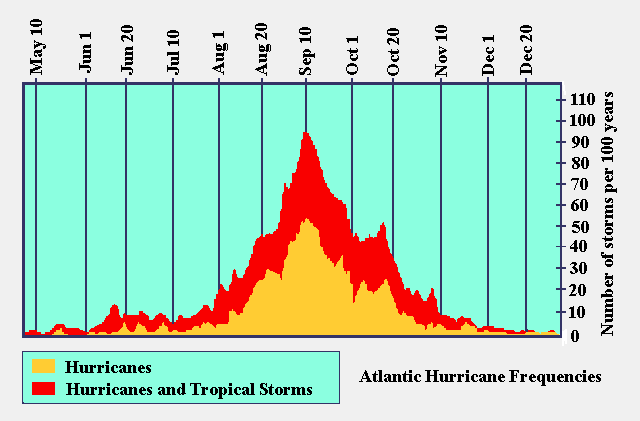
Chart of the Week: Peak Hurricane Season Is Here

This year the Atlantic hurricane season has been a quiet one, but that is not to say things cannot heat up over the course of the next month or so.

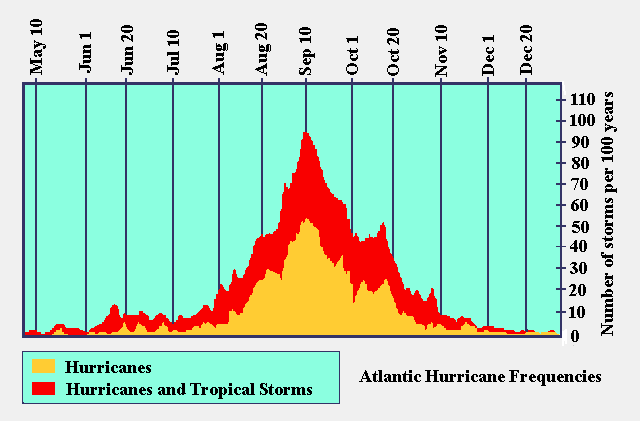
In fact, as this week’s chart of the week shows, the hurricane season officially peaks in the next few days with the risk of hurricanes and tropical storms remaining elevated through the end of October.

While hurricane season is peaking soon, it is worth noting that there are meteorological phenomena which suggest it is no accident that hurricanes have had very little impact on the U.S. mainland in 2009. Specifically, experts attribute the below normal hurricane activity to El Niño, which developed in the tropical Pacific Ocean during June and has been responsible for increased wind shear in the tropical North Atlantic Ocean and Caribbean Sea, where most Atlantic hurricanes develop.

It is possible that the U.S. – including the Gulf of Mexico oil and gas infrastructure – will manage to elude significant damage from hurricanes this season, but for anyone looking to hedge positions or make speculative plays on hurricane activity, this would be a good week to do so relatively inexpensively.

For some excellent hurricane resources, try:

[source: National Oceanic and Atmospheric Administration]

Friday, August 29, 2008

Best Hurricane Blog Out There?

I am by no means a weather junkie, although many years of sailing have helped transform my curiosity about weather systems and related phenomena into just enough knowledge to get me into trouble.

As I am also interested in market volatility and the commodities markets, each hurricane season gives me an opportunity to scour the web to update my favorite hurricane links, which seem to increase in quantity and quality each year.

There is one hurricane blog out there that strikes me as the undoubtedly best in the business: Dr. Jeff Masters Wunder Blog. Masters is one of the founders of The Weather Underground (that would be the meteorologists, not the radical bombers) and his blog is well written and filled with top notch content. The Wunder Blog has also attracted the attention of quite a few aficionados who do a surprisingly good job of augmenting Masters’ content in the comments section.

Side note: if you ever wanted to know what it is like to fly into the eye of a major hurricane, check out Masters’ harrowing account of Hunting Hugo

Thursday, August 28, 2008

Gustav and the Oil Volatility Index (OVX)

Since first becoming a tropical depression on the morning of August 25th, Gustav became a tropical storm, then a hurricane, and is now back to being a tropical storm – at least for the time being. Most models have Gustav reaching hurricane strength again later today, perhaps as soon as the next National Hurricane Center (NHC) update, which is only a half hour away.

If anyone is interested in watching a movie of the evolution of Gustav and the evolution of the five day forecast cone, I can highly recommend the Gustav graphics archive at the NHC web site.
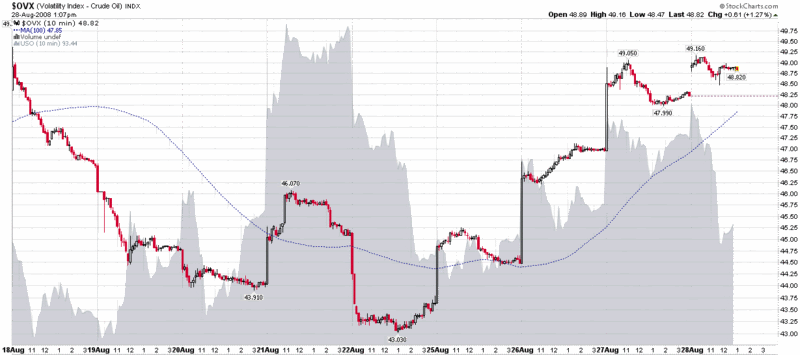
At least as interesting as the changing fortunes of Gustav and predictions for Gustav’s future has been the market’s reaction to crude oil and natural gas prices. In the graph below, courtesy of StockCharts.com, I have captured the change in crude oil prices (via the USO crude oil ETF) as well as the change in the new ‘Oil VIX’ (OVX) that was recently launched by the CBOE. Note how volatility (the candlesticks) has generally followed the underlying up and down, though it has remained elevated as oil prices (the gray area chart) trended down this morning.

Those who are looking at options plays on oil and gas are likely to see long positions facing an uphill battle against time decay in the current highly speculative environment. As a result, spreads and short volatility plays should look more attractive as alternatives.

Wednesday, August 27, 2008

Where Will Gustav Land?

There are several excellent sources which will provide the latest updates on hurricanes and the various potential paths that a number of computer models are projecting. These sites include the National Hurricane Center, Weather Underground, AccuWeather, and others. The most common graphical depiction of these projections come in the form of a probability cone that projects the most likely path of the eye, with an increasingly large cone farther into the future to reflect the increased uncertainty about the forecast.

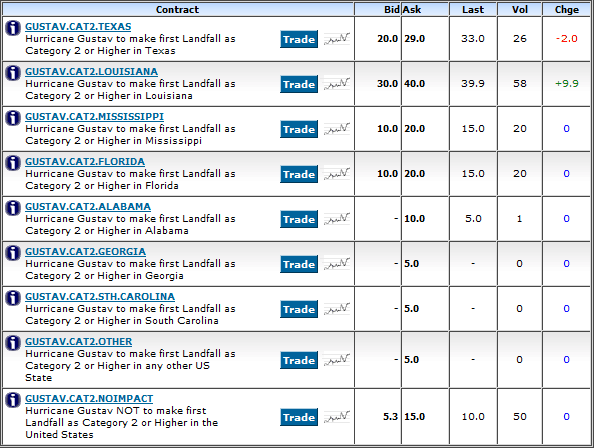
You can study these probability cones, computer projections and other data and adjust your portfolio accordingly. There is another tool that I don’t believe many know is out there. Intrade, the prediction market site, has recently added a number of contracts covering possible landfall locations for Gustav. The graphic below highlights the current landfall contracts associated with Gustav. These range across the Gulf of Mexico and also include Georgia, South Carolina, and “any other state”. Note that all these contracts stipulate that landfall has to be as a category 2 hurricane (winds 96-110 mph) or higher. Finally, there is also a contract that Gustav does not make first landfall in the U.S. as a category 2 or higher hurricane.

These may not be the ideal trading vehicles for hurricanes, but they can be interesting data sources as volume picks up in these contracts, enhancing the value of their informational content.

Tuesday, August 26, 2008

Energy ETFs and Katrina

With Hurricane Gustav now packing 90 mph winds and apparently headed in the direction of the Gulf of Mexico, this seems like a good time to pull up some data from the Hurricane Katrina period to get a sense of what happened to energy stocks during this time.

Recall that of Katrina was the fourth strongest Atlantic hurricane ever recorded and the most intense hurricane ever to enter the Gulf of Mexico at the time it made landfall on August 29, 2005. Amazingly, just three weeks later, Hurricane Rita turned out to be even stronger than Katrina, reaching maximum sustained winds of 180 mph on September 21, before losing strength and making landfall on September 24 with 115 mph winds. While Katrina ended up doing most of the damage, the appearance of an even stronger Rita headed toward an already damaged energy infrastructure almost certainly had a much stronger psychological impact on the markets. Katrina, which strengthened considerably just before making landfall, arrived with much less fanfare than Rita.

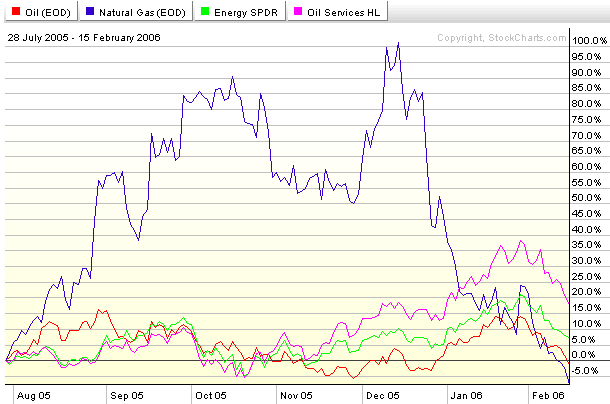
In the chart below, I have captured the relative performance of crude oil, natural gas, the broad energy select sector SPDR ETF (XLE), and the oil services HOLDRs ETF (OIH) for a period of a little over six months leading up to and following Katrina and Rita. Note that there was very little net change in crude oil, XLE and OIH from the end of July to October/November; almost all of the action was in natural gas.

Thursday, May 29, 2008

It’s the Oil, Stupid

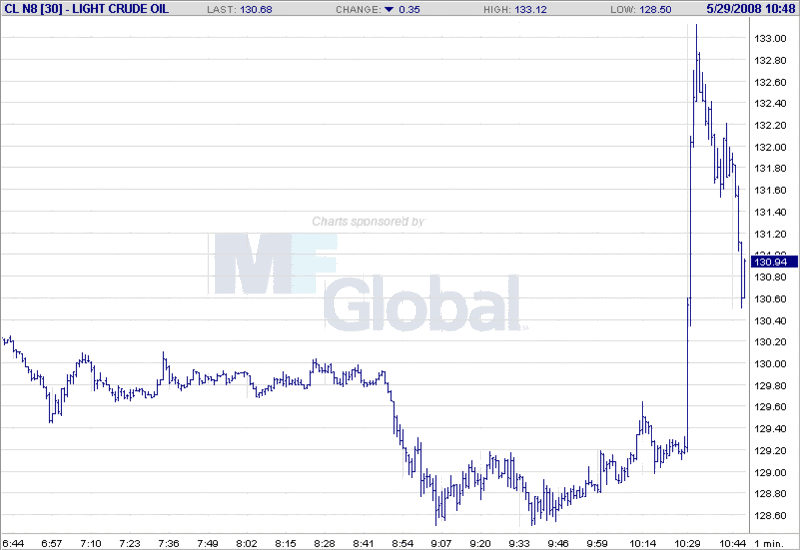
When it comes to volatility, there are few catalysts that can spook the market like the prospect of an oil shortage. With today’s announcement that crude oil inventories fell 8.8 million barrels when analysts were expecting a slight increase in inventory levels, the markets reacted sharply, with crude futures immediately spiking almost $4 per barrel to over $133. In spite of today’s jump, crude is still trading below the all-time high of $135.09 and has pulled back toward 130. Still, 135 will be an important resistance level to watch going forward. If 135 holds, volatility should be contained; if it is breached, expect equities to face and volatility to surge with crude prices.

One more thing: tomorrow is the last trading day before the official beginning of the Atlantic hurricane season…

Thursday, May 15, 2008

One Reason Why Volatility May Have Bottomed

The graphic below says it all – and the official beginning of hurricane season is two weeks from Sunday.

Given the supply issues with oil and natural gas, even the threat of a hurricane in the Gulf of Mexico is sure to cause considerable consternation. Of course, with all the global warming, this year’s prediction from the folks at Colorado State University is not particularly soothing:

"Based on our latest forecast, the probability of a major hurricane making landfall along the U.S. coastline is 69 percent compared with the last-century average of 52 percent," said Phil Klotzbach of the Colorado State hurricane forecast team. "We are calling for a very active hurricane season this year, but not as active as the 2004 and 2005 seasons."

I’ll have more to say on weather and volatility as we get deeper into the hurricane season.

Friday, August 17, 2007

How Healthy Is the Rally?

I don't have much to add to what has already been said about today's rally.

For what it's worth I am watching three indicators in particular to gauge the health and longer term potential of this rally:
XBD -- broker/dealer index (to a lesser extent XBD:SPX, GS, BSC, BKX, CFC, etc.)
RUT -- Reuters 2000 Small Cap Index (also RUT:SPX)
EEM -- iShares MSCI Emerging Markets (also EEM:EFA)

Right now, all three indicators are outperforming the broad market indices, so I feel as if the rally is on good footing. My biggest concern coming into the day was that would be traders worried about Monday's headline risk, but the longer the indicators noted above continue to do well, the less pressure there will be on the system.

For a little while earlier in the day the markets and the VIX were both up, as fear lingered in the face of a weekend of uncertainty, but for now, the fear component of the VIX seems to be slowly dissipating.

Before I finalize my positions going into the weekend, I will take one last look at Hurricane Dean.

Wednesday, August 15, 2007

Hurricanes and the VIX

Lest anyone wonder, I was absolutely kidding when I decided to append the “Your one stop VIX-centric view of the universe…” tagline to this blog when I created it. That doesn’t mean, however, there might be more than a little truth embedded in the tagline.

I had planned to talk at considerable length about hurricanes and the VIX during the past month, recognizing that August is when tropical activity typically kicks in to high gear. Given all the non-weather volatility we’ve had, it looks like I’m going to need a lot more back burners to hold all those boiling pots.

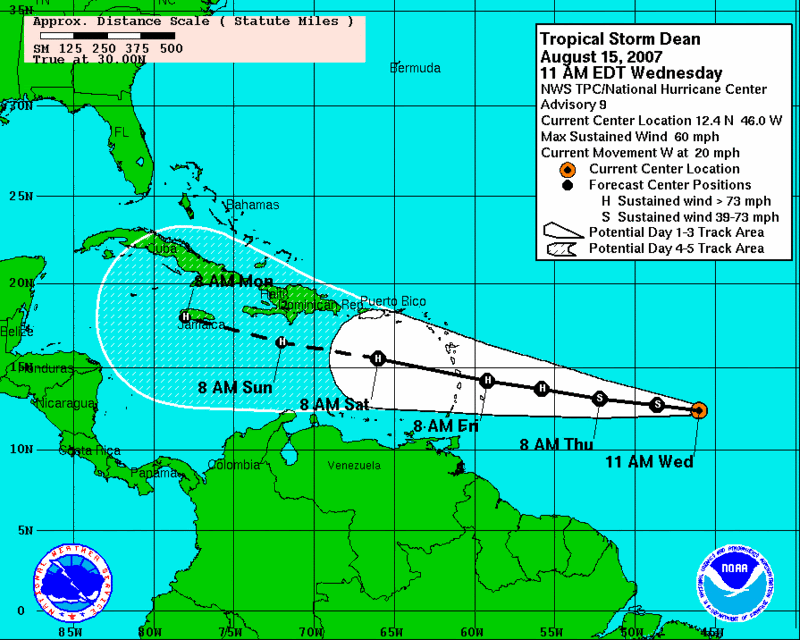
Speaking of which, we now we have tropical storm Dean bearing down on the Gulf of Mexico, apparently destined to become a hurricane force storm in the next 24 hours. I have included the current computer consensus path in the graphic below, but consider that the breadth of the ‘projected path’ is about 650 miles wide 5 days out before you start to draw any conclusions, then remember how fraught with uncertainty these projections can be.

As Dean approaches, I will opine more about the potential VIX and oil-related trades (I’m going to keep it simple and skip the insurance and other aspects of this gambit) that are possible with oncoming hurricanes. Keep in mind that while New Orleans is the landfall site that is most likely to garner the most press, there is a high concentration of refineries that span the Texas and Louisiana coast. If you want more detailed refinery information in map form, check out where the major vulnerabilities are in Texas and Louisiana. You want odds? Check out the probabilities table provided via Dr. Bob Sheets and Jack Williams in Hurricane Watch: Forecasting the Deadliest Storms on Earth.

Interested in a tool for viewing and evaluating hurricane tracks? Try the NHC archive of hurricane seasons.

Finally, consider that unlike most financial storms, the duration of the disruption caused by a hurricane strike is fairly easy to predict, which makes mean reversion plays all the more attractive. This is something to think about, anyway, as Dean whips up fears that will likely be out of proportion to the probabilities times the magnitudes of the various possible scenarios.

DISCLAIMER: "VIX®" is a trademark of Chicago Board Options Exchange, Incorporated. Chicago Board Options Exchange, Incorporated is not affiliated with this website or this website's owner's or operators. CBOE assumes no responsibility for the accuracy or completeness or any other aspect of any content posted on this website by its operator or any third party. All content on this site is provided for informational and entertainment purposes only and is not intended as advice to buy or sell any securities. Stocks are difficult to trade; options are even harder. When it comes to VIX derivatives, don't fall into the trap of thinking that just because you can ride a horse, you can ride an alligator. Please do your own homework and accept full responsibility for any investment decisions you make. No content on this site can be used for commercial purposes without the prior written permission of the author. Copyright © 2007-2023 Bill Luby. All rights reserved.
 
Web Analytics