Showing posts with label Gustav. Show all posts

Thursday, August 28, 2008

Gustav and the Oil Volatility Index (OVX)

Since first becoming a tropical depression on the morning of August 25th, Gustav became a tropical storm, then a hurricane, and is now back to being a tropical storm – at least for the time being. Most models have Gustav reaching hurricane strength again later today, perhaps as soon as the next National Hurricane Center (NHC) update, which is only a half hour away.

If anyone is interested in watching a movie of the evolution of Gustav and the evolution of the five day forecast cone, I can highly recommend the Gustav graphics archive at the NHC web site.
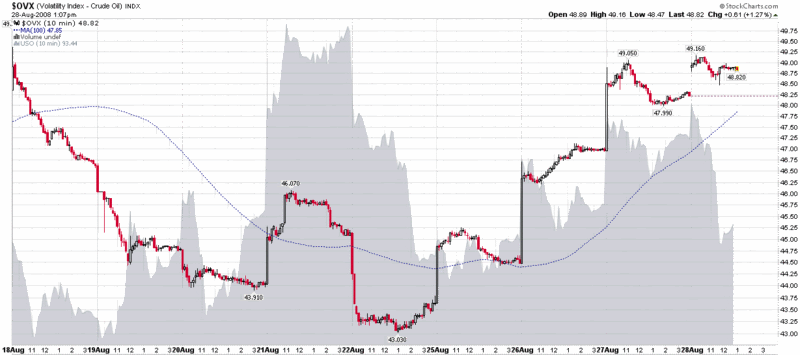
At least as interesting as the changing fortunes of Gustav and predictions for Gustav’s future has been the market’s reaction to crude oil and natural gas prices. In the graph below, courtesy of StockCharts.com, I have captured the change in crude oil prices (via the USO crude oil ETF) as well as the change in the new ‘Oil VIX’ (OVX) that was recently launched by the CBOE. Note how volatility (the candlesticks) has generally followed the underlying up and down, though it has remained elevated as oil prices (the gray area chart) trended down this morning.

Those who are looking at options plays on oil and gas are likely to see long positions facing an uphill battle against time decay in the current highly speculative environment. As a result, spreads and short volatility plays should look more attractive as alternatives.
Wednesday, August 27, 2008

Where Will Gustav Land?

There are several excellent sources which will provide the latest updates on hurricanes and the various potential paths that a number of computer models are projecting. These sites include the National Hurricane Center, Weather Underground, AccuWeather, and others. The most common graphical depiction of these projections come in the form of a probability cone that projects the most likely path of the eye, with an increasingly large cone farther into the future to reflect the increased uncertainty about the forecast.

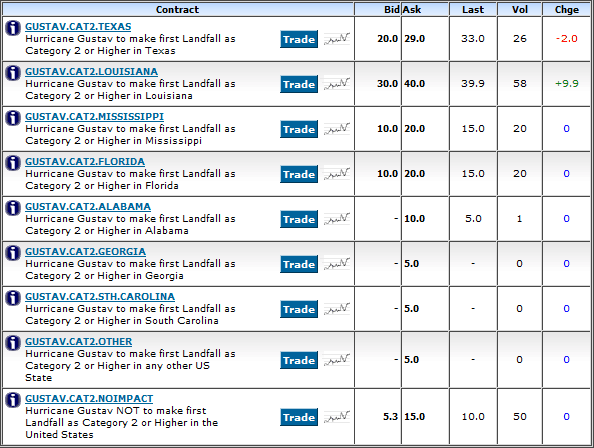
You can study these probability cones, computer projections and other data and adjust your portfolio accordingly. There is another tool that I don’t believe many know is out there. Intrade, the prediction market site, has recently added a number of contracts covering possible landfall locations for Gustav. The graphic below highlights the current landfall contracts associated with Gustav. These range across the Gulf of Mexico and also include Georgia, South Carolina, and “any other state”. Note that all these contracts stipulate that landfall has to be as a category 2 hurricane (winds 96-110 mph) or higher. Finally, there is also a contract that Gustav does not make first landfall in the U.S. as a category 2 or higher hurricane.

These may not be the ideal trading vehicles for hurricanes, but they can be interesting data sources as volume picks up in these contracts, enhancing the value of their informational content.

Tuesday, August 26, 2008

Energy ETFs and Katrina

With Hurricane Gustav now packing 90 mph winds and apparently headed in the direction of the Gulf of Mexico, this seems like a good time to pull up some data from the Hurricane Katrina period to get a sense of what happened to energy stocks during this time.

Recall that of Katrina was the fourth strongest Atlantic hurricane ever recorded and the most intense hurricane ever to enter the Gulf of Mexico at the time it made landfall on August 29, 2005. Amazingly, just three weeks later, Hurricane Rita turned out to be even stronger than Katrina, reaching maximum sustained winds of 180 mph on September 21, before losing strength and making landfall on September 24 with 115 mph winds. While Katrina ended up doing most of the damage, the appearance of an even stronger Rita headed toward an already damaged energy infrastructure almost certainly had a much stronger psychological impact on the markets. Katrina, which strengthened considerably just before making landfall, arrived with much less fanfare than Rita.

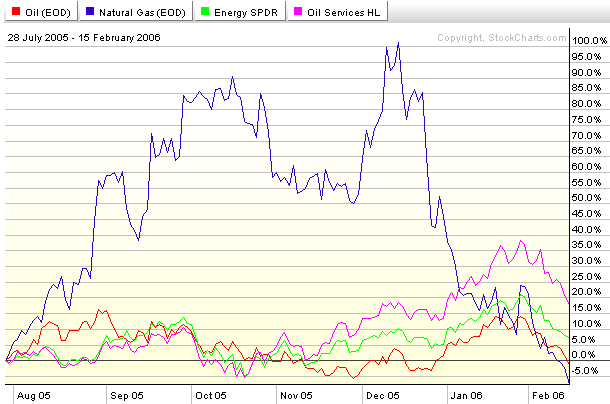
In the chart below, I have captured the relative performance of crude oil, natural gas, the broad energy select sector SPDR ETF (XLE), and the oil services HOLDRs ETF (OIH) for a period of a little over six months leading up to and following Katrina and Rita. Note that there was very little net change in crude oil, XLE and OIH from the end of July to October/November; almost all of the action was in natural gas.

DISCLAIMER: "VIX®" is a trademark of Chicago Board Options Exchange, Incorporated. Chicago Board Options Exchange, Incorporated is not affiliated with this website or this website's owner's or operators. CBOE assumes no responsibility for the accuracy or completeness or any other aspect of any content posted on this website by its operator or any third party. All content on this site is provided for informational and entertainment purposes only and is not intended as advice to buy or sell any securities. Stocks are difficult to trade; options are even harder. When it comes to VIX derivatives, don't fall into the trap of thinking that just because you can ride a horse, you can ride an alligator. Please do your own homework and accept full responsibility for any investment decisions you make. No content on this site can be used for commercial purposes without the prior written permission of the author. Copyright © 2007-2023 Bill Luby. All rights reserved.
 
Web Analytics