Showing posts with label prediction markets. Show all posts

Sunday, October 24, 2010

Chart of the Week: Intrade and the Midterm Elections

Three months ago in Chart of the Week: Intrade and Control of the House of Representatives, I used an Intrade.com contract as the chart of the week to illustrate how the markets were assigning probabilities to whether the Republicans would control the House of Representatives following the upcoming November 2nd election. At the time, that contract had last traded for 55.1, which roughly translates to a 55.1% probability of Republican control.

Just two weeks and two days before voters go to the polls, that same contract is trading at 90, meaning that the markets are about 90% sure that Republicans will control the House following the election. Among the more critical questions at this juncture are how many seats the Democrats will retain in the Senate and just how many seats the Republicans will gain in the House. The contracts covering the House gains are issued in increments of five seat strikes, so that there are separate contracts for a gain of 50 or more seats, 55 or more, 60 or more, etc. Right now the most active trading can be found in the at-the-money contracts, with the +55 seat contract last quoted at 57.9 bid and 61.8 ask, while the +60 seat contract last quoted at 38.1 bid and 43.8 ask.

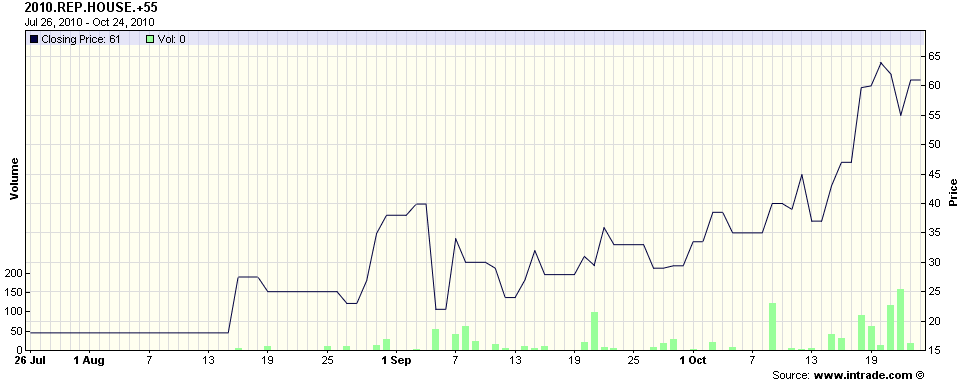
The chart below, courtesy of Intrade, tracks the trading in the +55 seat contract for the past 90 days. Note that this contract crossed the 50 threshold one week ago today and last traded at 61. Looking at the various contracts, prior to the contracts, the highest seat count that was trading over 50 was +45 seats. During the second week in October, both the +50 and the +55 seat contracts rose above the 50 level. With the recent heavy betting on the +60 seat contract and its doubling in price over the course of the last month, it looks as if this is the contract to watch to see how the far the balance of power appears to be tipping in the direction of the Republicans.

As I noted the last time around, for those who are interested in a seat-by-seat, poll-by-poll perspective on the election, RealClearPolitics.com is a great place to start. Those like me who are more interested in assigning probabilities to the overall outcome may prefer to keep an eye on Intrade.com, the popular prediction market site.

Finally, it is probably stating the obvious, but don’t be surprised to discover that there is a relationship between the projected Republican seat gains and the stock market.
Related posts:


[source: Intrade.com]

Disclosure(s): none

Monday, July 26, 2010

Chart of the Week: Intrade and Control of the House of Representatives

With everyone else thinking about double dip recessions, European bank stress tests and the like, my thoughts have wandered to the next U.S. elections, which are barely three months away.

While there are a number of key questions that will be strongly influenced by the composition of Congress following the November elections, the fundamental question is which party will hold the majority of seats in the House of Representatives when voters have a chance to voice their opinions.

For those who are interested in a seat-by-seat, poll-by-poll perspective on the election, RealClearPolitics.com is a great place to start. Those like me who are more interested in assigning probabilities to the overall outcome may prefer to keep an eye on Intrade.com, the prediction market site.

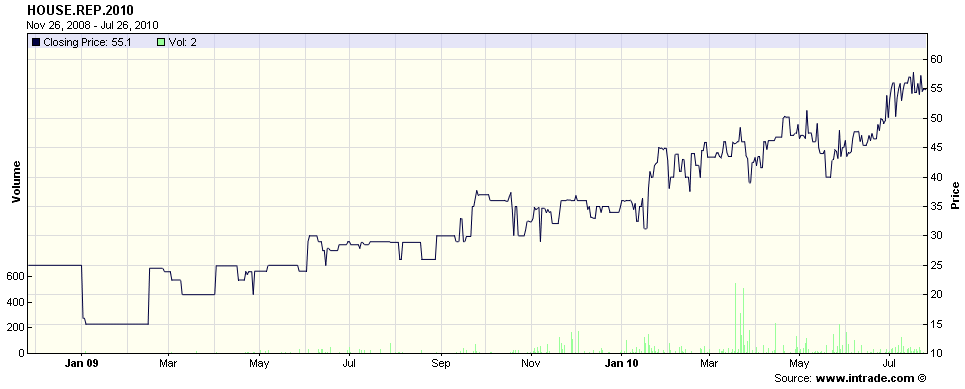
One of the more active contracts at Intrade is based on whether the Republicans will wrest control of the House from the Democrats in November. The chart of the week below is structured to pay off on the basis of that outcome. The chart shows that the collective wisdom of the crowds put the odds (contract price roughly matches the odds of an event happening, just as the delta of an option roughly matches the probability of finishing in the money at expiration) of a Republican victory in the area of 15% at the time President Obama was sworn in back in January 2009. The odds moved over 50% for good about a month ago and currently stand at 55.1%.

With many political and economic issues of great importance facing the U.S. in the next year or two, the composition of the U.S. House of Representatives will have a great deal to say not just about fiscal policy, but about a broad range of influences across the financial landscape.

Of course, if you prefer to speculate on whether California will legalize marijuana, Rutgers will join Big 10 Conference or Rod Blagojevich will plead guilty or be found guilty of corruption, then Intrade is a good spot to do that too…

For more on related subjects, readers are encouraged to check out:


[source: Intrade.com]

Disclosure(s): none

Wednesday, August 27, 2008

Where Will Gustav Land?

There are several excellent sources which will provide the latest updates on hurricanes and the various potential paths that a number of computer models are projecting. These sites include the National Hurricane Center, Weather Underground, AccuWeather, and others. The most common graphical depiction of these projections come in the form of a probability cone that projects the most likely path of the eye, with an increasingly large cone farther into the future to reflect the increased uncertainty about the forecast.

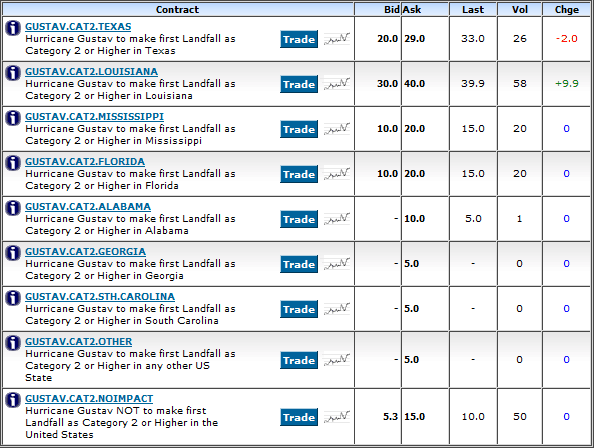
You can study these probability cones, computer projections and other data and adjust your portfolio accordingly. There is another tool that I don’t believe many know is out there. Intrade, the prediction market site, has recently added a number of contracts covering possible landfall locations for Gustav. The graphic below highlights the current landfall contracts associated with Gustav. These range across the Gulf of Mexico and also include Georgia, South Carolina, and “any other state”. Note that all these contracts stipulate that landfall has to be as a category 2 hurricane (winds 96-110 mph) or higher. Finally, there is also a contract that Gustav does not make first landfall in the U.S. as a category 2 or higher hurricane.

These may not be the ideal trading vehicles for hurricanes, but they can be interesting data sources as volume picks up in these contracts, enhancing the value of their informational content.

Friday, August 1, 2008

Intrade 2009 Recession Prediction Contract

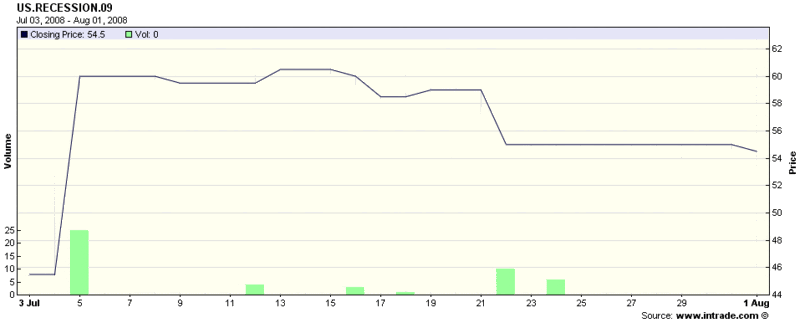
Since I have not seen it mentioned anywhere else, I thought I should point out that Intade.com, the prediction market site, now has a contract covering whether or not the United States will go into a recession at any time during 2009. While the contract currently suggests a greater than 50% probability that the U.S. will slip into a recession in 2009, I find it interesting that the contract price has been slipping over the past 2-3 weeks, suggesting that the likelihood of a recession next year is declining.

For more on Intrade and prediction markets, see my February post, Intrade Prediction Markets as a Sentiment Indicator.

Tuesday, April 8, 2008

Sticky Sentiment

Back in February I received a lot of positive feedback for a post titled Intrade Prediction Markets as a Sentiment Indicator which discussed the usefulness of prediction markets as a gauge of investor sentiment. This is a theme I will come back to in due course, but for now I wanted to highlight some excellent complementary work in this area.
Expanding on prediction markets as sentiment indicator theme and drawing an interesting parallel in the sports world, Jeff Miller at A Dash of Insight has a superb post up today in which he looks at the ebb and flow of the North Carolina vs. Kansas game as a case study in investor sentiment. In Sentiment Is Slow to Change: A Basketball Lesson, Part One, Jeff uses a real-time chart of the price of the futures contract for the game from Intrade’s sister site, TradeSports.com and provides a thought-provoking analysis of the changing fortunes during the game and the betting response in the futures contract. I highly recommend that readers click over for the full story, but I have taken the liberty of posting Jeff's conclusion below:

“The lesson here is that market sentiment is very ‘sticky.’ Those investing in UNC futures were not just fans. Most were regular players of many sporting events, seeking a profit on this one. They began with an opinion, and the opinion was slow to shift.

The value of looking at an example like this is that the entire picture of sentiment and reality can be captured in the space of a few hours.

In the stock market, a similar process may take many months or even years. We shall explore this further.”

I am certainly looking forward to the next installment in this series.

Thursday, February 21, 2008

Intrade Prediction Markets as a Sentiment Indicator

Intrade.com is a fascinating place to park your brain from time to time. At this prediction market site, users can buy and sell binary options contracts that allow them to place bets on whether a future event will happen. Intrade has a broad range of contracts that cover everything from whether Osama Bin Laden will be captured by a particular month, which country will host the 2016 Olympics, what the year’s snowfall will be in New York City, and a wide variety of bets about the US election.

Prediction markets have received considerable press and academic attention for their purported ability to provide a better predictive view of the future than that of individual experts. Evaluating the arguments on both sides of this issue is beyond today’s scope, but those who are interested in reading about these claims may wish to start with Prediction Markets: Does Money Matter? by Servan-Schreiber, Wolfers, Pennock and Galebach and move on to prediction markets as a proxy for probabilities in Interpreting Prediction Market Prices as Probabilities by Wolfers and Zitzewitz. For an excellent broad introduction to prediction markets, I recommend Prediction Markets, also by Wolfers and Zitzewitz.

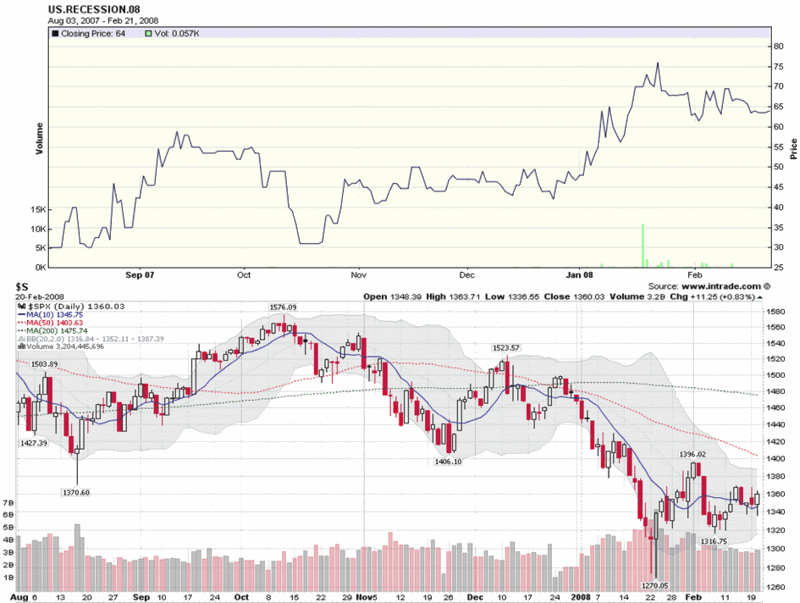
Unfortunately, the volume of trading activity for the financial and economic prediction markets contracts are not as popular as those for politics and entertainment. I do think, however, that there is considerable potential value not only in establishing probabilities for future events, but also gauging investor sentiment. At the moment, the most heavily traded financial contract at Intrade is whether the US will go into a recession in 2008. I have included a chart of that contract, which goes back to August 2007, in the graphic below, which compares estimates of the probability of a recession with the SPX during the same period. While there is a very high negative correlation here (i.e., we have yet another contrarian sentiment indicator working), I find it particularly interesting that the expectations for a 2008 recession peaked just as the SPX was making its January bottom.

If only there were a little more volume in the financial contracts, I suspect there would be quite a few more gems to pluck from the prediction markets. Until then, they are still a great place to get a sense of what the odds are that Barack Obama wins the Democratic nomination or Barry Bonds will be found guilty of one or more of the perjury and obstruction charges he is facing.

DISCLAIMER: "VIX®" is a trademark of Chicago Board Options Exchange, Incorporated. Chicago Board Options Exchange, Incorporated is not affiliated with this website or this website's owner's or operators. CBOE assumes no responsibility for the accuracy or completeness or any other aspect of any content posted on this website by its operator or any third party. All content on this site is provided for informational and entertainment purposes only and is not intended as advice to buy or sell any securities. Stocks are difficult to trade; options are even harder. When it comes to VIX derivatives, don't fall into the trap of thinking that just because you can ride a horse, you can ride an alligator. Please do your own homework and accept full responsibility for any investment decisions you make. No content on this site can be used for commercial purposes without the prior written permission of the author. Copyright © 2007-2023 Bill Luby. All rights reserved.
 
Web Analytics